

THE PINK FAMILY: CHINA AND THE WEST 14
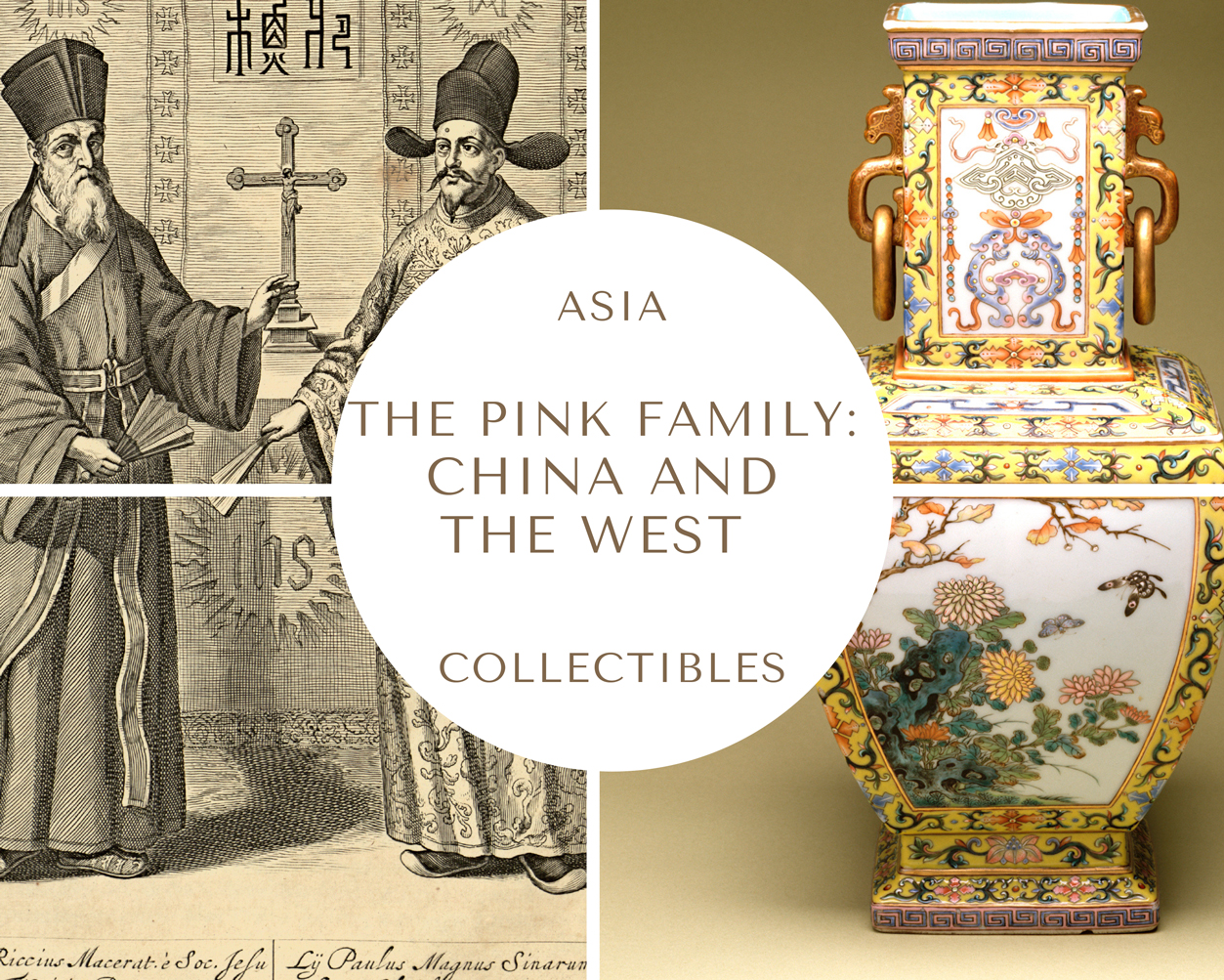
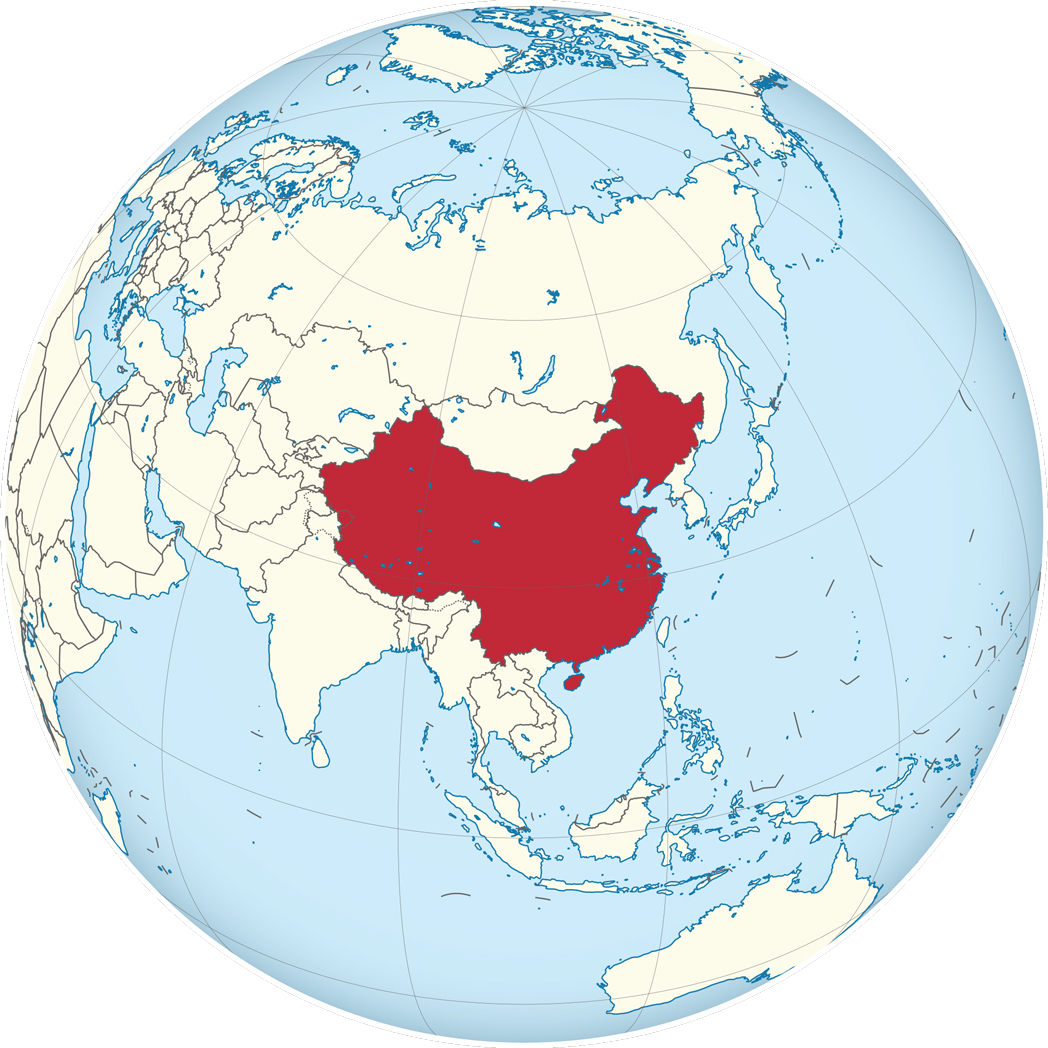
Current China on the globe.
Under the Creative Commons Attribution-Share Alike 3.0 Unported license.
This map is for illustrative purposes only. The Ethnic Home does not take a position on territorial disputes.
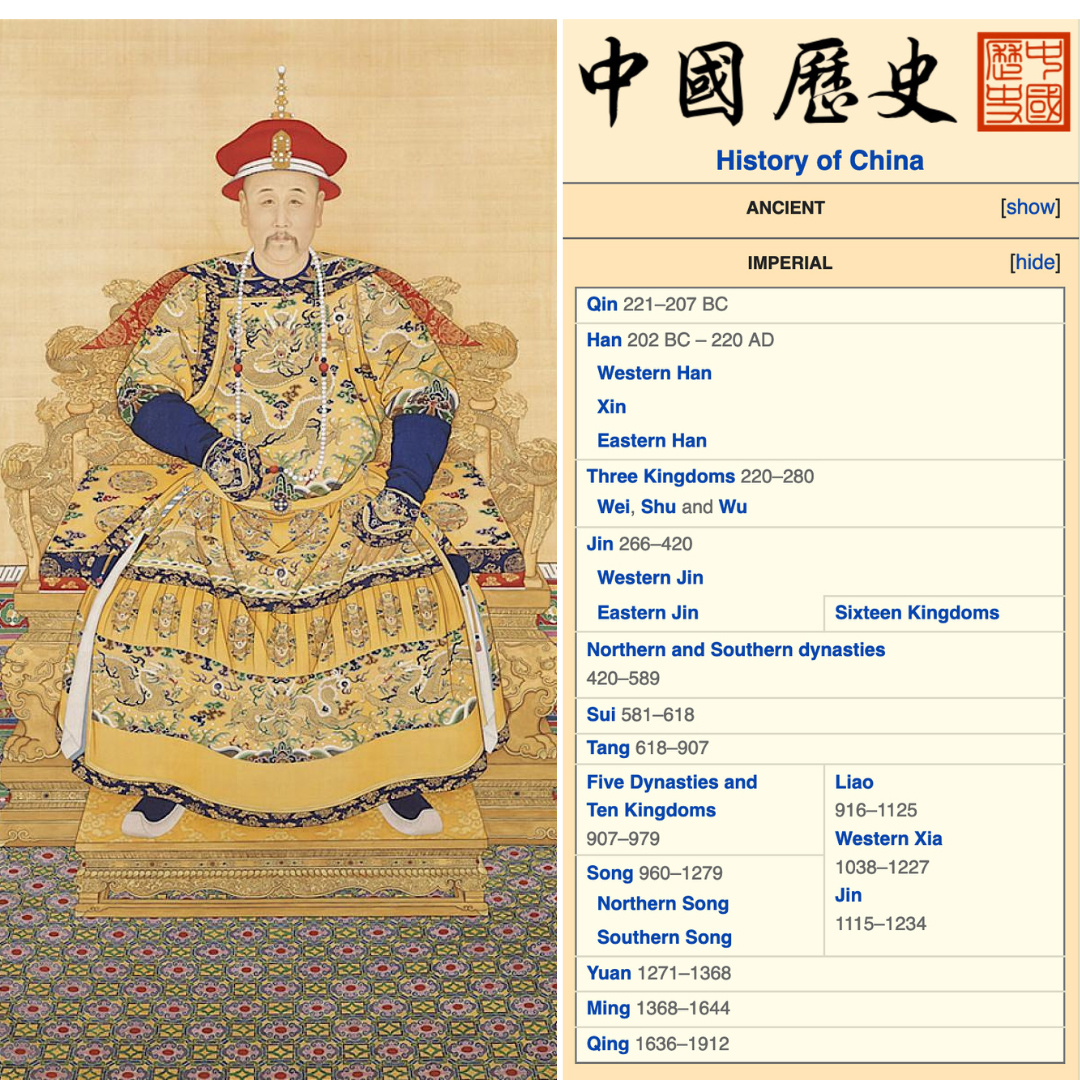
LEFT: Portrait of the Yongzheng Emperor in Court Dress, by anonymous court artists, Yongzheng period (1723—35), Qing Dynasty. Hanging scroll, color on silk. The Palace Museum, Beijing. Public Domain.
RIGHT: History of China, Imperial Dynasties, source: Dynasties in Chinese history, Wikipedia.
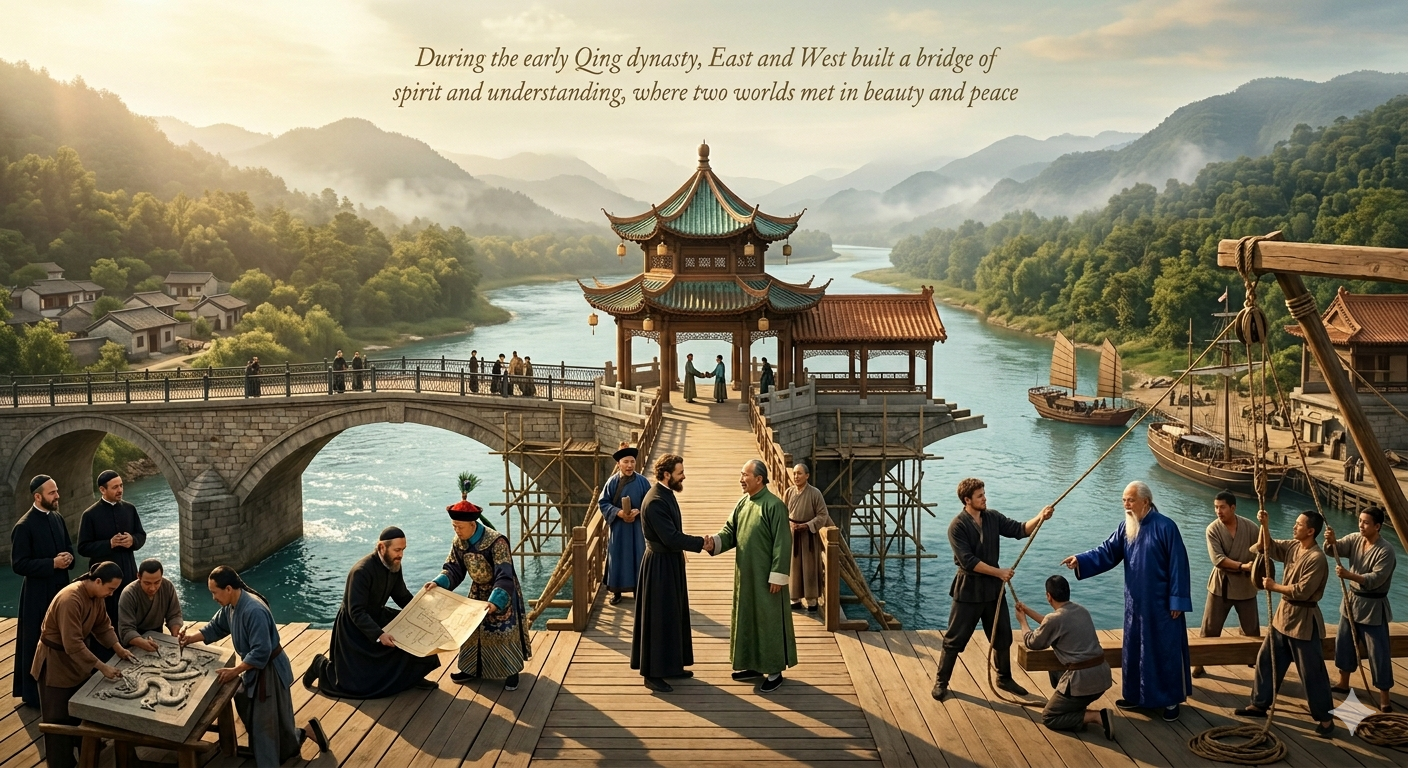
THE COLLAPSE OF THE INTERCULTURAL “BRIDGE” BETWEEN EAST AND WEST
A Frail, Imperfect, yet Precious Bridge
The cultural bridge between Europe and China during the late Ming and early Qing periods was not solely the work of the Jesuits. Rather, it emerged from a triangular encounter. Each group—the Jesuit missionaries, the Chinese literati, and the imperial court—brought distinct interests, vocabularies, and expectations to the exchange. Matteo Ricci's mission was fundamental, not because it produced an easy "fusion," but because it established a lasting method of contact. Ricci did not simply try to transplant Latin Christianity into China unchanged. He learned Chinese, adopted elite cultural forms, and sought entry into literati society through scholarship in areas such as cartography, astronomy, and ethical discourse.
This strategy had two significant consequences for art history. First, the Jesuits became mediators of knowledge rather than mere preachers. Second, the information they transmitted to Europe was shaped by the social world in which they had won credibility: the world of educated officials, court service, and classical learning. The Europe that first "discovered" China through Jesuit texts therefore encountered not China in its totality but rather a highly selective version of China: learned, urban, ceremonially ordered, technically accomplished, and often presented in ways that were intelligible or attractive to European readers. This selectivity was evident in the documentary record itself. The archival description of the Roman Jesuit collections notes that Jesuit annual letters were "apologetic and hagiographic accounts," even though they were also rich in ethnographic information.
However, one must not reduce these writings to mere propaganda. They were among the most consequential vehicles of cultural transmission in early modern Europe. Boston College's Beyond Ricci project illustrates how quickly and widely such works circulated. Ricci's journals were quickly reproduced, Athanasius Kircher compiled missionary writings on Chinese geography, flora, and fauna in China Illustrata (1667), and Du Halde's Description de l'empire de la Chine (1735) became a popular and influential encyclopedia of Chinese customs, politics, language, geography, and material culture.
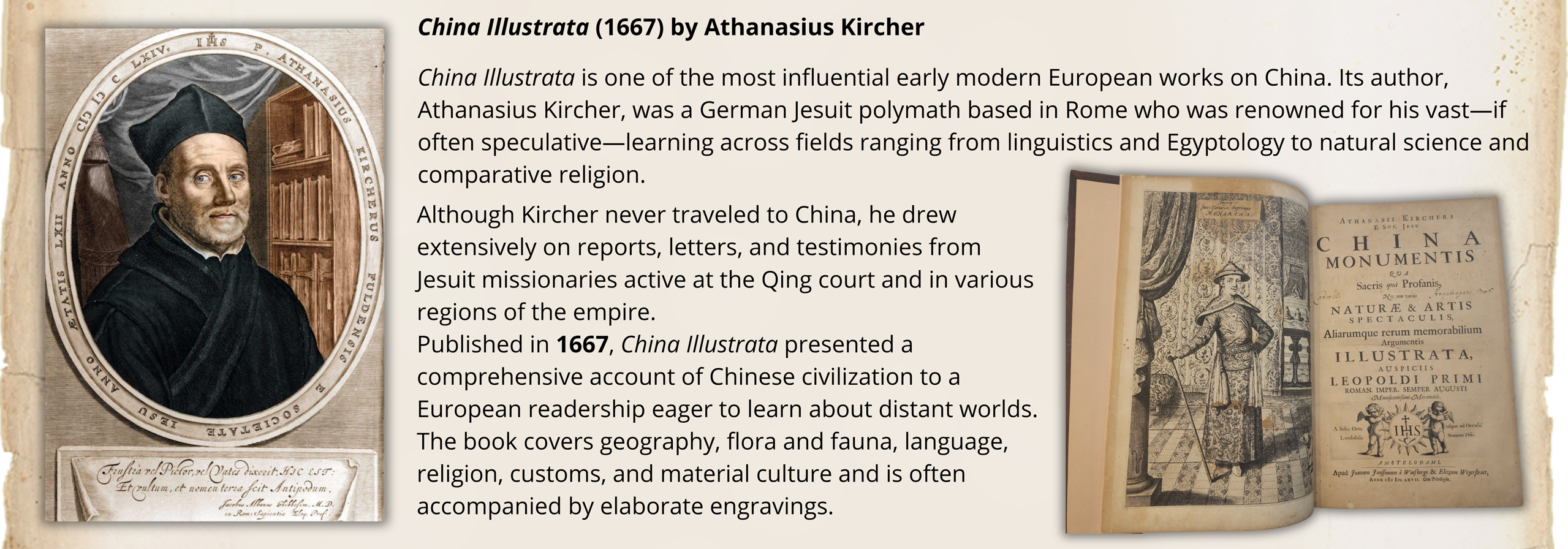
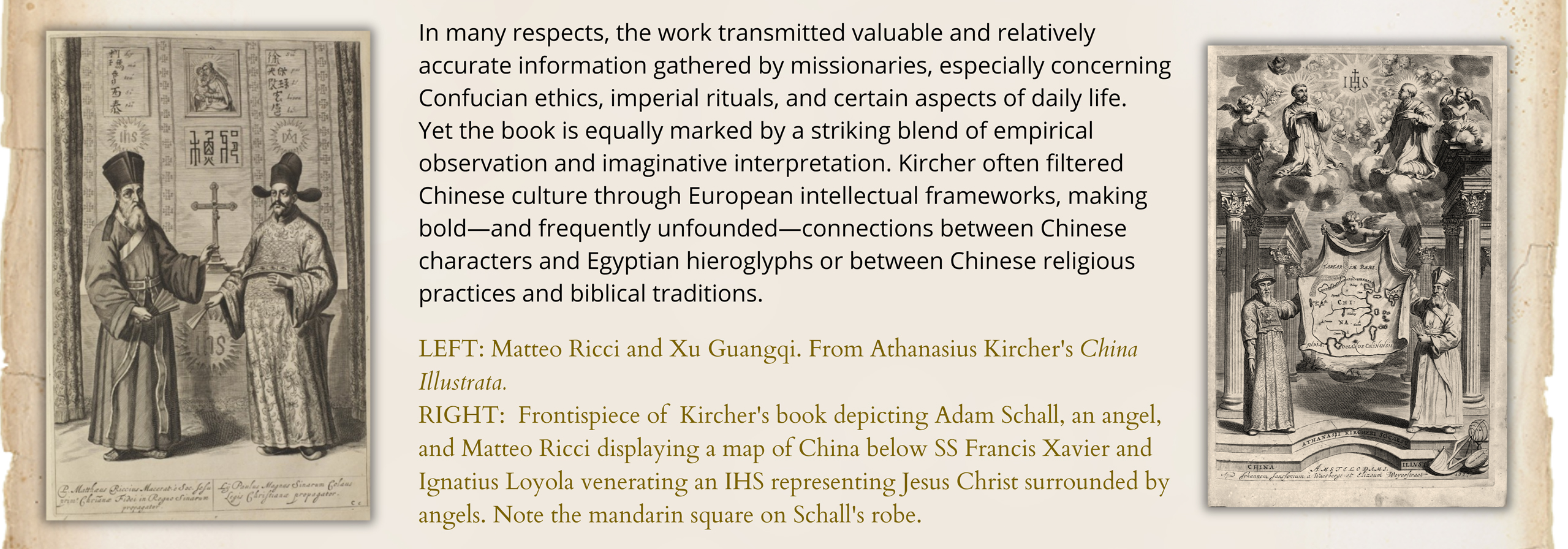
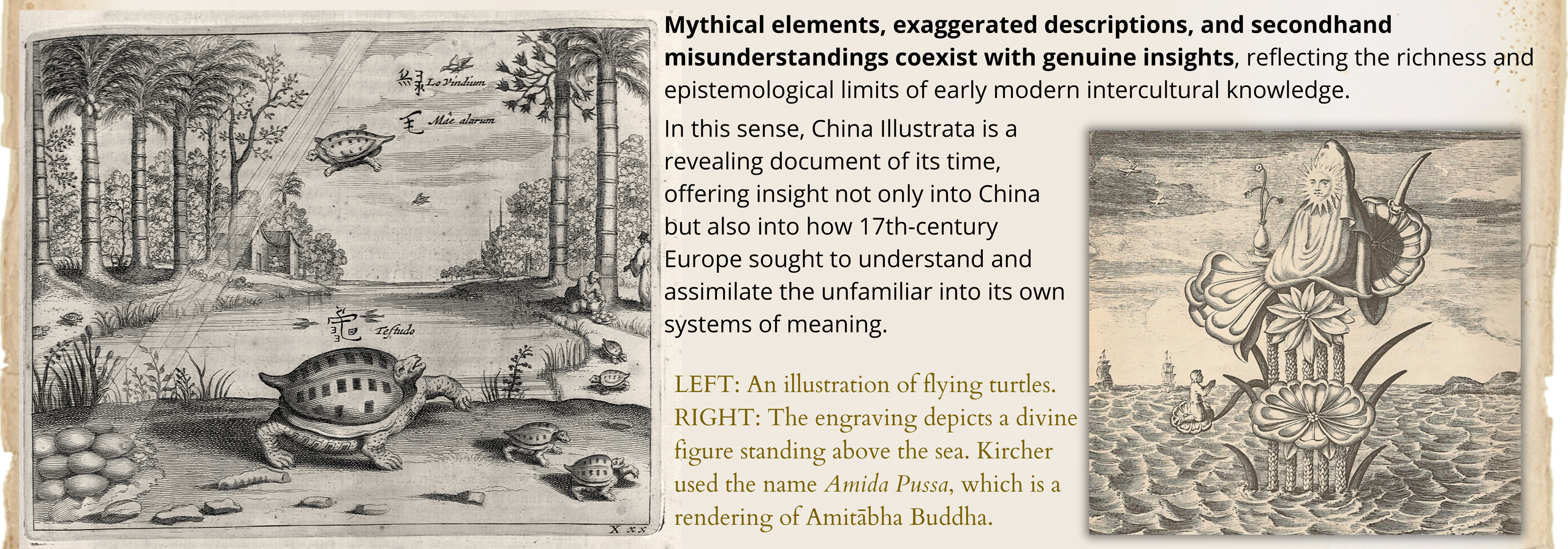
These publications provided European readers with unparalleled access to Chinese statecraft, Confucian learning, religious rites, technical expertise, maps, objects, and images.
The artistic implications were profound. Europe's fascination with porcelain, lacquer, silk, gardens, pavilions, and ornamental motifs was not born of pure fantasy, but rather was fueled by imported objects, commercial exchange, and textual mediation. However, the result was not simply an understanding of Chinese art. As the Victoria and Albert Museum notes, eighteenth-century designers often failed to distinguish carefully between Chinese, Japanese, and Indian forms. Instead, they adapted "oriental motifs" into an exotic decorative idiom. Chinoiserie was therefore both a response to real Asian objects and a European imaginative construction nourished by distance, rarity, and limited information. This was one of the central limitations of intercultural dialogue in Europe—admiration did not necessarily produce accuracy. China became an aesthetic category.
At the same time, however, the dialogue was not merely consumptive. Jesuit publications could convey concrete technical and intellectual knowledge. François Xavier d'Entrecolles's letters on Jingdezhen porcelain, for example, were among the first substantial accounts available in the West. They helped intensify the European search for the secrets of porcelain manufacture. In such cases, Europe did more than fantasize about China; it studied, imitated, and attempted to appropriate Chinese expertise. Nevertheless, the transfer remained asymmetrical. European audiences often absorbed Chinese achievements as marvels to be classified, copied, or translated into local luxury industries rather than as expressions of an autonomous aesthetic and philosophical order.
This is precisely where Giuseppe Castiglione's significance lies. He was more than just a European painter in China or a Jesuit decorator at court. Rather, he was the product of a century of negotiated contact, demonstrating that the exchange could evolve from mere curiosity to disciplined collaboration. The Metropolitan Museum of Art describes him as a key figure in establishing a new Qing court aesthetic. They note that he was an Italian Jesuit who lived in China from 1716 until his death in 1766 and worked with Chinese assistants to create "a synthesis of European methods and traditional Chinese media and formats." Similarly, Columbia's Asia for Educators stresses that Castiglione combined Western realism with traditional Chinese brush conventions in a manner suited to imperial taste.
The phrase "suited to imperial taste" is crucial. Castiglione's art did not represent a European victory within the Qing Palace. Rather, it was a negotiated adaptation under Chinese conditions. He served the court during the reigns of Kangxi, Yongzheng, and Qianlong. However, his success depended on modifying European illusionism so that it could function within Chinese formats, materials, and courtly expectations. Therefore, the National Palace Museum is right to present Castiglione as an artist who served three Qing emperors and built bridges between cultures. However, one should immediately add a qualification: the bridge did not erase hierarchy. Castiglione was a court servant, and the Qing court retained control over the terms of artistic incorporation. The synthesis was real but not neutral.
Europe, for its part, drew both genuine enlargement and persistent distortion from this intercultural encounter. The enlargement was unmistakable. Jesuit texts and objects expanded the European Republic of Letters. They fueled debates on ethics, religion, political order, natural history, cartography, and the decorative arts. They also helped transform China's perception from a mere marvel on the edge of the map to a major civilization. The distortion was equally clear. Much of what Europe admired was filtered through missionary priorities, courtly spectacle, luxury consumption, and the needs of controversy. Chinoiserie often transformed China into an appealing fantasy, and while missionary writings were informative, they were also shaped by apologetic purposes and the need to defend Jesuit methods.
The Chinese Rites Controversy exposed the limits of this entire enterprise. While the Jesuit policy of accommodation made deep dialogue possible, it also provoked fierce opposition within the Catholic world. Rome's eventual condemnation of the rites gravely damaged the Jesuits' position. The controversy demonstrated that Europe could not always sustain the cultural flexibility required by the China mission. Thus, the European reception of China was constrained not only by ignorance but also by confessional politics.
The Chinese Rites Controversy and the Suppression of the Society of Jesus
The Chinese Rites Controversy was not a minor disciplinary dispute, but rather one of the most significant disputes in the history of early modern religion. It was a struggle over whether Christianity could be translated into the moral, ritual, and political world of late imperial China without compromising either tradition beyond recognition. At its core was a question that the Jesuits, especially Matteo Ricci, answered in the affirmative: Could Chinese converts continue to honor their ancestors and participate in rites to Confucius and Heaven if these acts were not considered "idolatry," but rather civil rites expressing filial piety, social order, and loyalty to the state? Ricci and his successors argued that they could. Their missionary method rested on a broad strategy of accommodation. They learned classical Chinese, adopted the dress and manners of the literati, engaged with Confucian texts, and presented Christianity as a doctrine compatible with the highest ethical traditions of China, not as a barbarian cult from the West.
The opposing camp—principally Dominicans and Franciscans, later joined by anti-Jesuit currents in Europe, including Jansenist critics, and ultimately, the papacy itself—rejected that reading entirely. For them, the rites to ancestors and Confucius were not merely civil observances. They were religious acts embedded in a pre-existing system of belief and therefore incompatible with Christian worship. They also distrusted the Jesuits' methods: using Chinese terms such as Shangdi or Tian for God, adopting Chinese dress and elite customs, and tolerating practices that seemed like superstition or idolatry to them.
The controversy persisted for nearly a century because Rome itself was indecisive. In 1645, the Congregation for the Propagation of the Faith condemned the rites. However, in 1656, the congregation lifted the ban after hearing the Jesuits' case. The dispute then widened beyond China, involving theologians, universities, religious orders, papal congregations, and eventually, the Qing court itself. What began as a missionary quarrel evolved into a global struggle over authority: Who had the right to interpret Chinese civilization—missionaries on the ground with linguistic and cultural competence or Roman institutions judging from afar?
The turning point came under Clement XI. In 1704, a decree was issued that was reinforced by the apostolic constitution Ex illa die in 1715. This decree banned the rites. Then, in July 1742, Benedict XIV reaffirmed the prohibition in Ex quo singulari and forbade any further debate. Missionaries were required to accept the ruling and not reopen the question. Essentially, Rome decided that the Jesuits' interpretation of the rites as civil practices was unacceptable.
This decision had consequences that extended far beyond theology. It shattered the credibility of the Jesuits' cultural mediation efforts in China. The "bridge" that Ricci and subsequent Jesuits had patiently built with the Chinese literati depended on a fragile yet genuine mutual trust. The literati could respect the missionaries because they seemed to grasp Chinese moral life from the inside. Meanwhile, the Jesuits could present Christianity as a religion that did not require educated Chinese people to abandon filial piety, ancestral memory, or participation in the ritual language of the empire. Once Rome condemned the rites, however, that bridge cracked at its foundations. In effect, the papacy was declaring that key practices of Confucian civilization were religiously illicit for Christians. To Chinese officials and scholars, this signaled that Christianity was not complementary to the moral order but rather a force that demanded withdrawal from the ritual fabric of family and state. This made the earlier assurances of the Jesuits appear unreliable and exposed a deep inconsistency within Christianity itself in the eyes of the Chinese.
The damage was especially severe at the Qing court. The Kangxi Emperor, who had been relatively favorable toward the Jesuits because of their knowledge, technical expertise, and apparent respect for Chinese institutions, responded with open hostility when Rome insisted on prohibiting the rites. In his view, the 1715 apostolic constitution amounted to a foreign religious authority claiming the power to judge rites that lay at the heart of Chinese civilization and imperial order. This transformed a potential dialogue between Christianity and Confucianism into a matter of political and cultural sovereignty. Eventually, the Emperor banned Christian missions in China in 1721, declaring that Westerners "do not understand larger issues as we understand them in China."
From that moment on, the mission's social position steadily deteriorated. The older Jesuit hope had been to spread Christianity through elite dialogue, intellectual exchange, and cultural translation. However, the rites controversy convinced many Chinese that Christianity was unwilling to recognize the legitimacy of China's ethical and ceremonial foundations. The result was not merely the loss of a few tolerated customs, but rather, the collapse of the trust that had made serious intercultural encounters possible. Ecclesiastical sources concede that the 1742 bull severely damaged the China mission, resulting in fewer Christians among the upper classes and the disappearance of the court elite who had once been receptive to the faith.
Thus, the controversy destroyed the Jesuit experiment in reciprocal translation. Ricci's approach aimed to demonstrate that one could be fully Christian while remaining culturally Chinese. However, Rome's final condemnation implied the opposite, suggesting that entering Christianity required abandoning the rites that shaped Chinese family memory, literati ethics, and political loyalty. At that point, the Jesuit "bridge" ceased functioning as such. Instead, it became a monument to the limits of intercultural encounters when doctrinal authority overrides cultural intelligence.
The suppression of the Society of Jesus in 1773 by Clement XIV was not solely caused by the Chinese Rites Controversy, and it would be misleading to present its suppression as merely the end result of that dispute. Rather, the suppression arose from a much broader European political assault on the Jesuits, driven primarily by the Bourbon courts of France, Spain, and Portugal. These courts had expelled the order from their territories since 1759. Nevertheless, the rites controversy contributed to the climate of hostility surrounding the order by intensifying anti-Jesuit sentiment and lending credence to the accusation that the Society was too accommodating in matters of doctrine. The order survived in Russia, where Catherine the Great refused to promulgate the suppression brief — a decision rooted in both political calculation and admiration for Jesuit education — and in Prussia, where Frederick the Great also blocked enforcement.
The Chinese Rites Controversy ended when Rome chose doctrinal uniformity over cultural accommodation. In doing so, Rome crippled the Jesuit mission in China and dismantled one of the most ambitious attempts in the early modern world at genuine intercultural dialogue between Christianity and the Confucian literati.
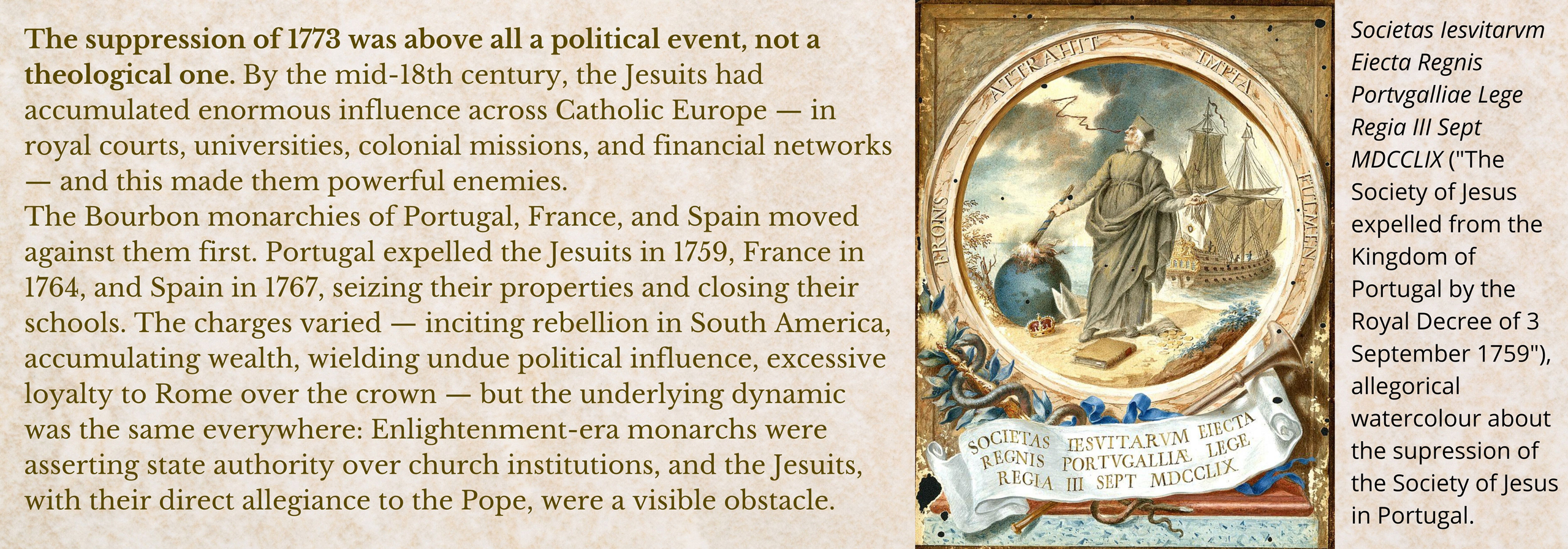
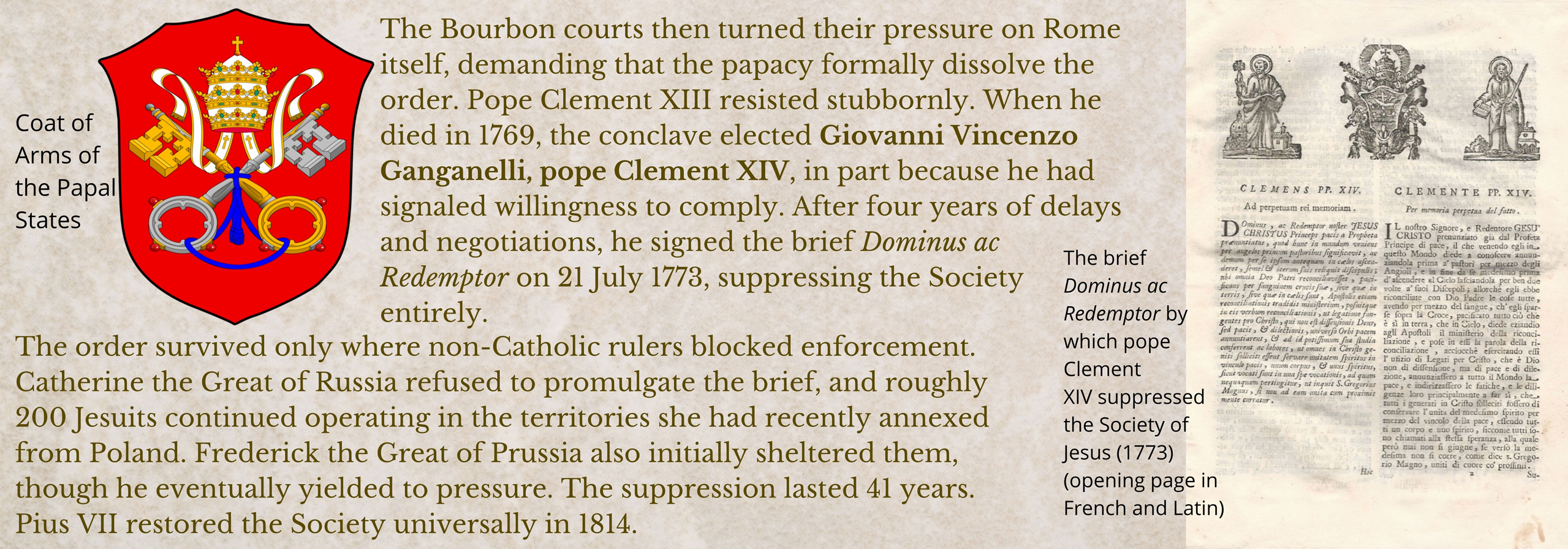
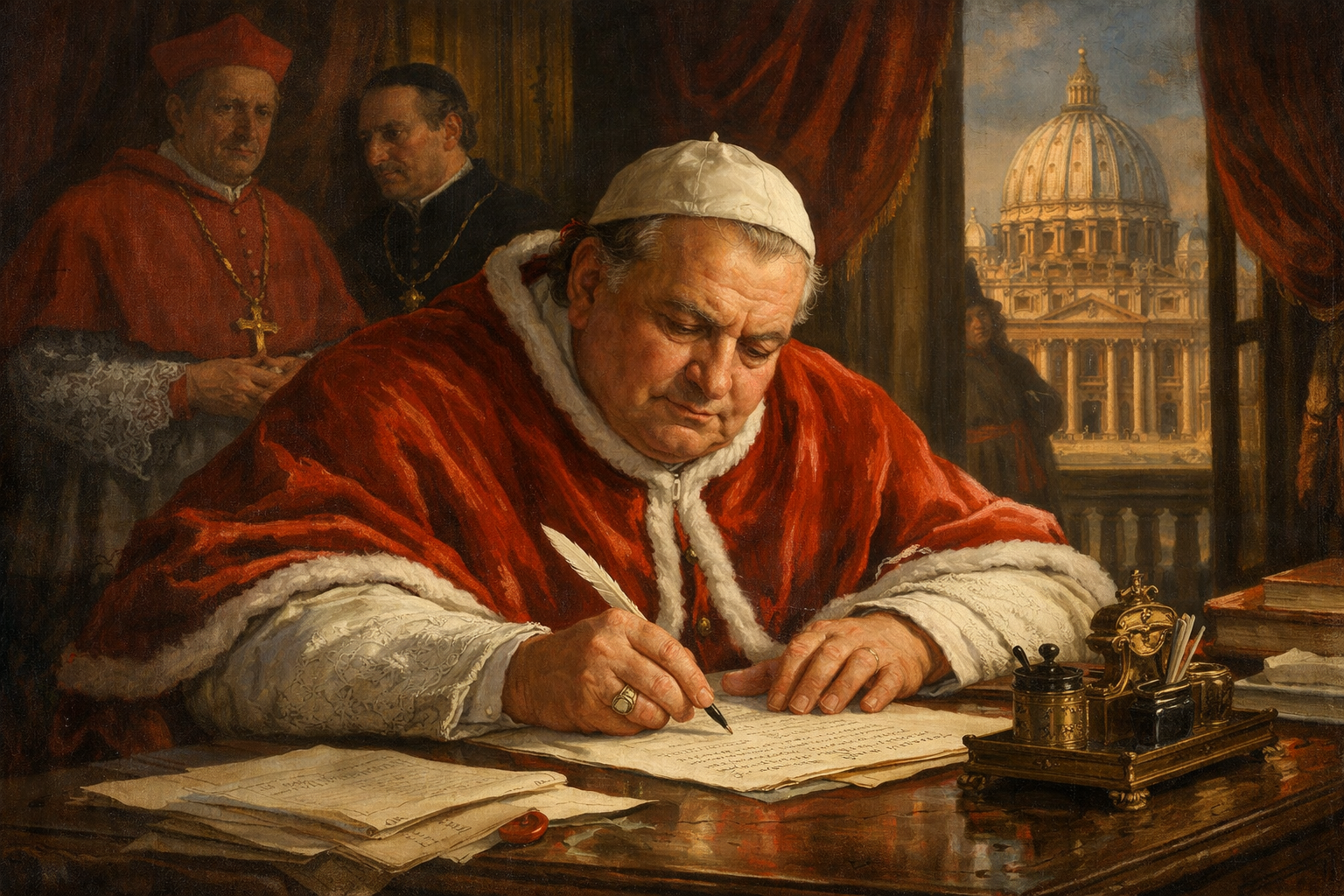
Papal States, July 21, 1773: Pope Clement XIV signed the document Dominus ac Redemptor, decreeing the dissolution of the Jesuits.
The Qing Court and the Failure of Intercultural Reciprocity
The collapse of the intercultural "bridge" between Christianity and Confucian , which was painstakingly constructed by Jesuit missionaries and Chinese literati in the 17th century, cannot be attributed solely to the Roman condemnation of accommodation. From the reign of the Qianlong Emperor onward, the Qing court itself contributed to this breakdown by narrowing the space for genuine intellectual reciprocity and misreading the nature of an increasingly expansionist West. This was not the result of simple ignorance. As Benjamin Elman has demonstrated, late imperial China had already adopted significant aspects of European scientific knowledge through Jesuit mediation. The issue was the court's inability to convert this selective knowledge into a broader, more strategic understanding of Europe as a dynamic, structurally distinct power.
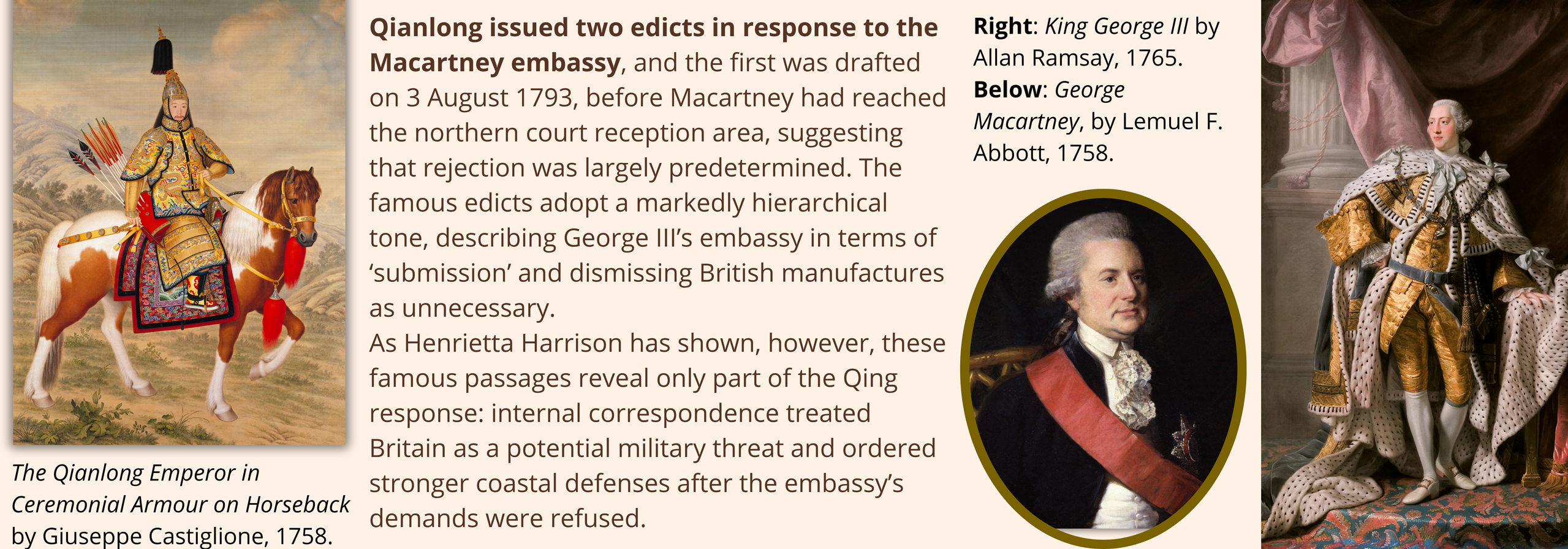
This limitation is reflected in Qianlong's 1793 reply to George III, written in response to the Macartney embassy. The emperor rejected the British requests for a permanent diplomatic presence, expanded commercial access, and the cession of a coastal island to be used as a trading post. He asserted that the Qing Empire had everything it needed and was not interested in foreign manufactures. As Henrietta Harrison has demonstrated, however, this response should not be read as mere arrogance or blindness. Archival evidence shows that the court primarily viewed the embassy as a security threat, interpreting Britain's demands through the lens of diplomatic protocol and border management rather than commercial rivalry.
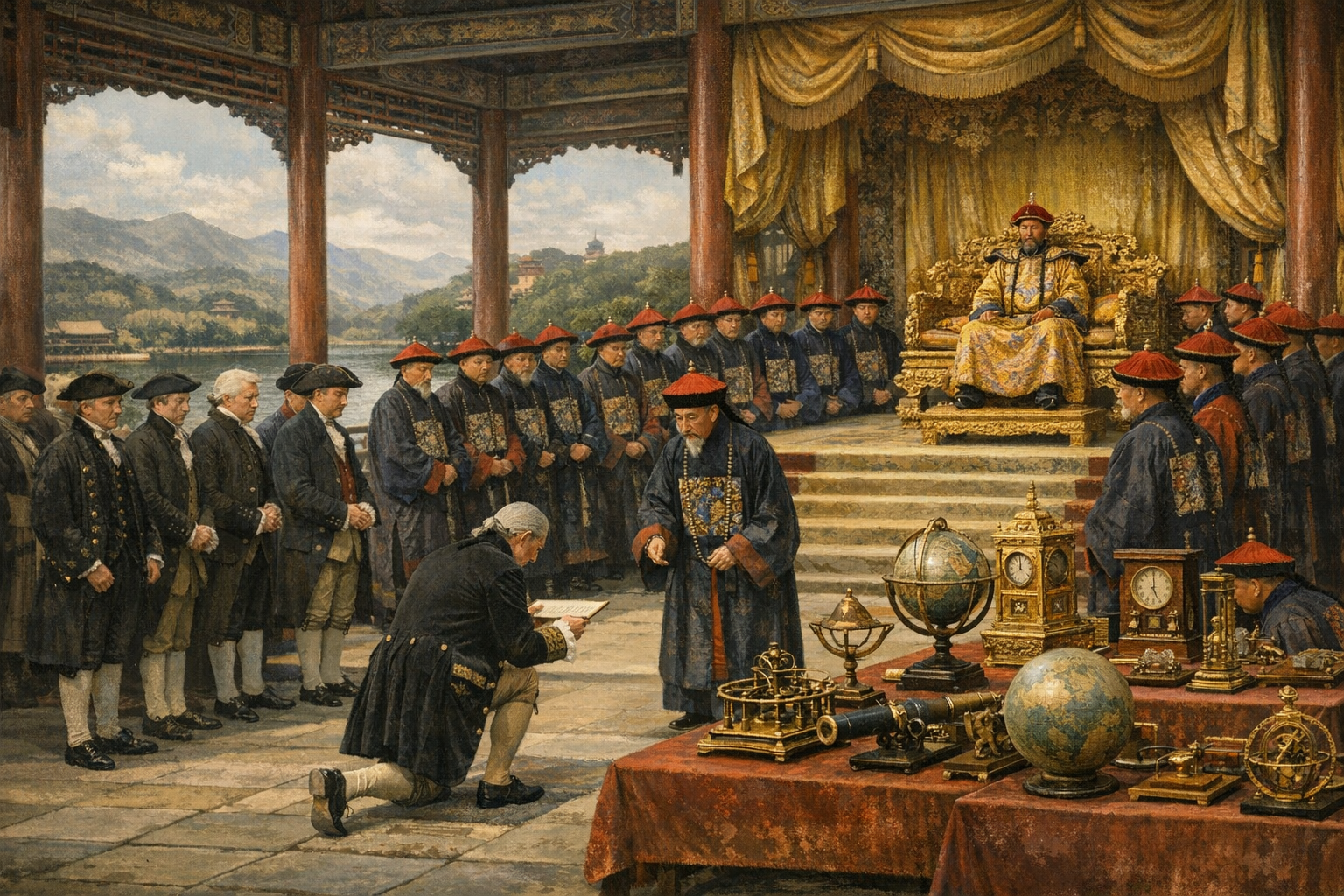
The Macartney embassy, sent in 1792–93 under Lord George Macartney, was Britain’s first formal diplomatic mission to Qing China. The mission aimed to improve commercial access and establish more regular state-to-state relations with the Qianlong court. Britain wanted new ports, a permanent envoy in Beijing, and less restrictive trade beyond the Canton system. However, the Qing court viewed foreign relations through a hierarchical imperial lens rather than as diplomacy between equal sovereign states. The mission also displayed British science, craftsmanship, and imperial prestige. It traveled with hundreds of personnel and carried clocks, instruments, luxury goods, and other gifts intended to impress the emperor. Macartney finally met Qianlong in 1793, but their meeting was shaped by deep differences regarding court ritual, political status, and the meaning of trade itself. Modern historians emphasize that the failure of the mission cannot be attributed solely to the famous “kowtow question”; it reflected a broader clash between two diplomatic and imperial systems. In practical terms, the embassy failed. Qianlong rejected the British requests and maintained the existing trading order. Nevertheless, the mission became historically significant because it revealed the vast differences in assumptions about commerce, sovereignty, and international order between Britain and Qing China. The mission is often seen as an early sign of the tensions that would later culminate in the Opium War. At the time, however, both sides also used the embassy to observe, measure, and interpret one another.
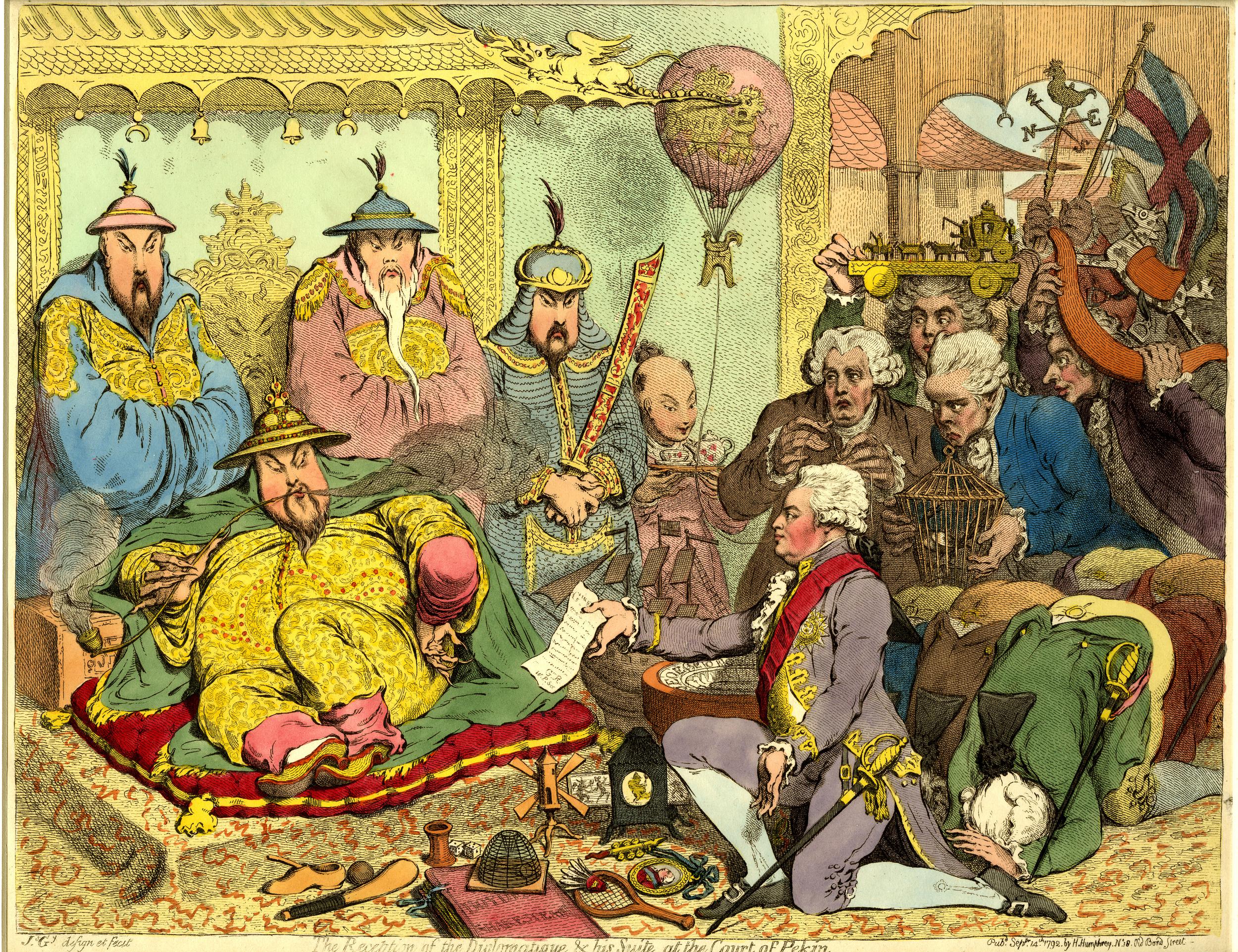
English satyrical print. Hand-coloured etching printed in 1792. © The Trustees of the British Museum, London, UK.
Produced in Britain during the Macartney Embassy, this satirical print operates on two distinct yet intertwined levels. On the surface, it uses the visual language of 18th-century European caricature to depict the Chinese court as exotic and stylized. The Qianlong Emperor reclines with theatrical disdain, surrounded by impassive mandarins with exaggerated facial features, claw-like nails, and grotesque mannerisms. These elements undeniably reflect the racialized and Orientalist conventions of the period, revealing the cultural distance and limited understanding through which China was often viewed in Europe. Yet the true target of the satire lies elsewhere. The British embassy itself is subjected to far sharper ridicule. Lord Macartney is depicted in a submissive posture, while his entourage prostrates itself in an exaggerated manner. The gifts presented to the emperor are belittled as trivial toys and amusements, including a rocking horse, shuttlecock, toy coach, and a magic lantern with devils. Thus, the image inverts imperial self-perception: Britain, which imagined itself as a bearer of refinement and progress, is rendered absurd, naïve, and diplomatically inept. Though caricatured, China is not depicted as inferior, but rather as distant, self-sufficient, and unmoved. In this sense, the print captures a moment of unease within British political culture. Faced with a powerful, resistant empire, Britain turns to satire to process what would otherwise appear as a quiet, profound humiliation. In short, this print is a self-critical British satire that uses racist imagery to depict Britain's humiliation in the face of Qing power.
However, this reframing itself was a form of strategic misreading. As Harrison's research reveals, accurate assessments of British military capabilities were largely absent from imperial records. Thus, the court engaged with an incomplete picture of British power, processing its demands within a traditional imperial framework that reduced Britain to a peripheral actor seeking accommodation within an established, Sinocentric order. What remained unrecognized was that, through the East India Company, Britain represented a historically novel configuration of power in which commerce, diplomacy, and military coercion were inseparably intertwined.
This misrecognition was reinforced by broader intellectual attitudes. As Zhang Longxi has argued in his work on cross-cultural understanding, meaningful intercultural dialogue depends on recognizing the translatability of cultures. When one side assumes its own normative centrality and reduces the other to an incommensurable or subordinate position, dialogue collapses into classification. From the Qianlong period onward, the Qing court increasingly treated Europe not as a partner in intellectual exchange, as the Jesuits had once enabled, but as a manageable "outer" entity to be regulated through fixed rituals and administrative categories. This shift did not eliminate knowledge of the West, but it did constrain its interpretation within a rigid ideological framework.
Gao Hao's research further clarifies the consequences of this narrowing perspective. Qing officials had limited yet significant information about Britain, especially in coastal regions. However, the central government failed to systematically investigate British power. Instead, the central government cultivated a reassuring image of Britain as a distant, commercially dependent, and ultimately subordinate polity whose reliance on Chinese tea was assumed to guarantee its compliance. However, such assumptions obscured the reality that the East India Company functioned not merely as a trading body, but also as a commercial-military institution capable of projecting force and restructuring regional economies to its strategic advantage.
Matthew Mosca's work adds a further dimension to this analysis by identifying the structural constraints on Qing strategic thought. Contrary to the older narrative of Chinese ignorance, Mosca shows that Qing rulers, officials, and scholars were attentive to foreign affairs and maintained sophisticated information networks. The difficulty did not lie in indifference, but rather in the Qing state's institutional architecture. The Qing state managed foreign relations through a segmented, frontier-based system in which discrete points of contact were largely governed in isolation from one another. This model proved inadequate when confronted with European empires operating across multiple, interconnected fronts simultaneously. The British Empire combined maritime mobility, commercial networks, and territorial expansion in ways that exceeded the conceptual boundaries of Qing frontier governance. The Qing administrative system was slow to develop an integrative foreign policy that could have met this challenge.
In this context, the Qing court's failure does not appear as passive isolation, but rather as an active constriction of interpretive horizons within real structural limits. By insisting on the sufficiency of its own categories and underestimating the transformative nature of Western expansion, the court undermined the conditions necessary for sustained intercultural engagement. The Jesuit-literati dialogue once rested on mutual efforts at linguistic, philosophical, and ritual translation. By the late 18th century, however, that dialogical space had largely vanished, replaced by asymmetrical perceptions and strategic miscalculations on both sides. Just as the Roman Church withdrew its support for cultural accommodation, the Qing state retreated into a form of epistemic self-containment. This rendered meaningful engagement with the West increasingly impossible, not because the Qing state was ignorant, but because its knowledge was filtered through frameworks that could no longer account for what Europe was becoming.
THE BRITISH EMPIRE IN CHINA AND THE ROAD TO THE OPIUM WARS
The Architecture of British Expansion in China
At first, the British Empire did not enter China as a conventional territorial conqueror, but rather as a maritime-commercial power whose reach depended on shipping, finance, monopoly privileges, and imperial control of India. In this respect, Britain operated through forms of mobility and projection that did not align with Qing assumptions about foreign relations. Qing rule was territorial, hierarchical, and land-based, whereas British power was oceanic, corporate, and increasingly global. The East India Company was at the center of this system. The Company linked Calcutta, Canton, London, and the Indian interior into a single imperial circuit, transforming commercial exchange into political leverage and eventually into war. Under the Canton trade regime, foreign commerce was restricted and supervised. However, Britain gradually learned to exploit and ultimately break that system. By the early 19th century, the most profitable instrument in this strategy was opium.
British expansion into China was driven by three interrelated strategies. First, the East India Company was used as an imperial-commercial arm, linking Indian revenues to Chinese trade. Second, a silver deficit was transformed into an opium-financed trade regime. Third, naval force and treaty diplomacy were used to convert illegal commerce into protected imperial privilege. The Opium Wars were not accidental clashes caused by cultural misunderstandings alone. Rather, they were the violent culmination of a British strategy that used commerce as leverage, law as justification, and military force as enforcement.
The Canton System and the Problem of Qing Limits
From the Qing perspective, foreign trade was to be strictly controlled. Under the Canton System, commerce with Western merchants was largely confined to Guangzhou. It was mediated through licensed Chinese merchants, known to Europeans as the Cohong. The system was designed to prevent foreigners from establishing a deeper political presence. This system reflected the Qing court’s broader concept of order: foreign trade was permitted, but not as a means for foreign powers to gain autonomy within the empire.
Britain, however, approached China from a different perspective. Its empire was increasingly structured by sea power, long-distance credit, protected merchant shipping, and corporate rule. The East India Company had become more than a trading body. By the late 18th century, the Company was also a territorial power in India, with access to land revenue, military force, and coercive agricultural systems. This gave Britain something the Qing state did not expect from foreign merchants—an overseas commercial actor backed by an expanding empire. The Company connected Calcutta and Canton as twin nodes in a single imperial network, efficiently moving goods, bullion, and information across the Indian Ocean and South China Sea.
The British problem was straightforward. Britain wanted massive quantities of Chinese tea, silk, and porcelain, especially tea. China, by contrast, had limited interest in British manufactured goods, so payment largely flowed in silver. Both contemporary sources and later historical overviews agree that this silver drain troubled British policymakers and East India Company officials alike. Tea was not merely a luxury at the fringes of British life. By the early 19th century, it had become integral to consumption, taxation, and social habits. Thus, the trade imbalance mattered not just economically, but also politically.
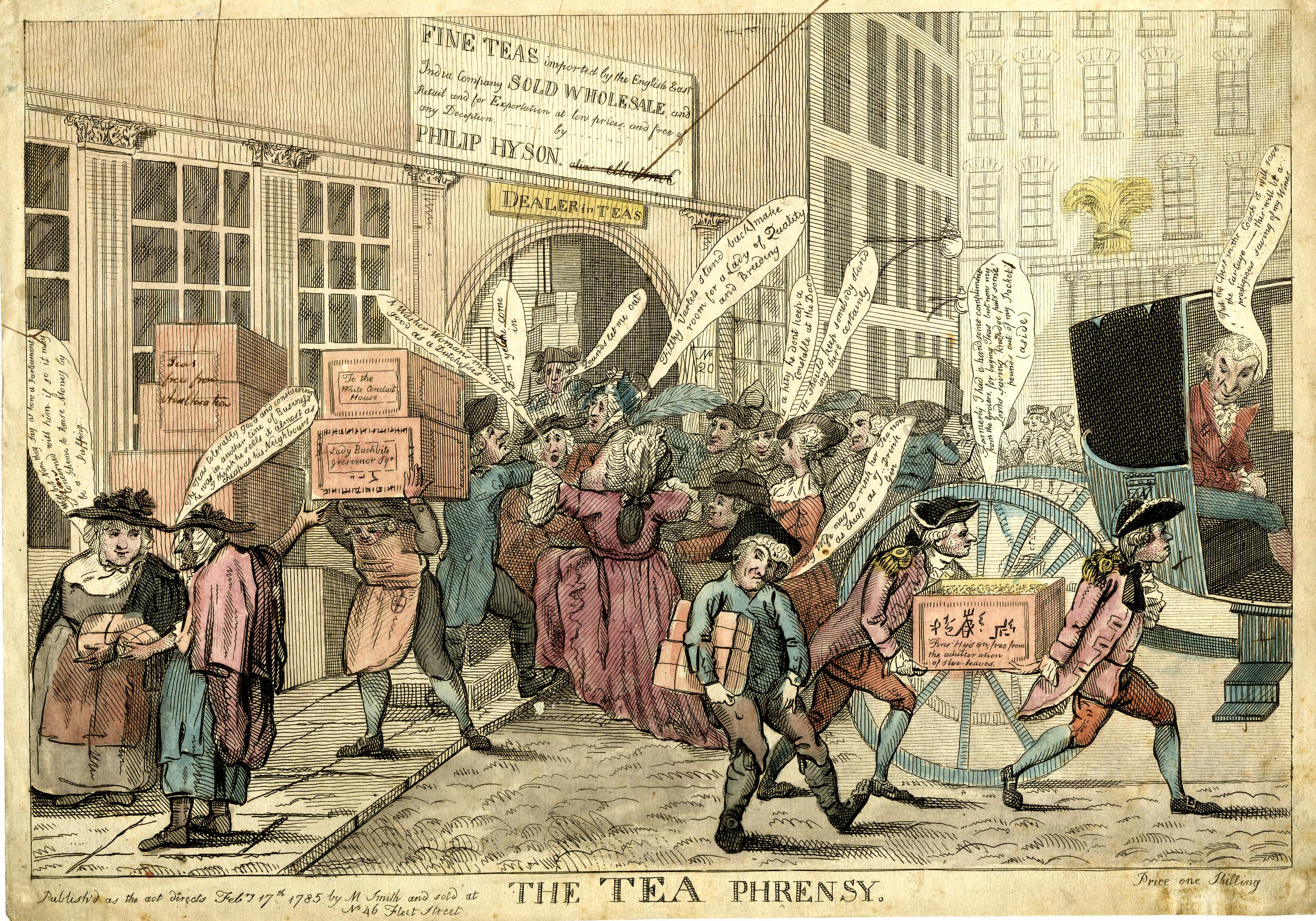
The Tea Phrensy, satirical print published in London by M. Smith. Medium: Hand-colored etching. Date: 1785. "A large, disparate crowd queue outside the arched entrance to 'Philip Hyson, Dealer in Teas', others carry tea away, including a drunkard and two lackeys carrying a chest to a gentleman's carriage; the people fight for precedence and comment on the fact that anyone can buy tea cheaply here". © The Trustees of the British Museum, London, UK.
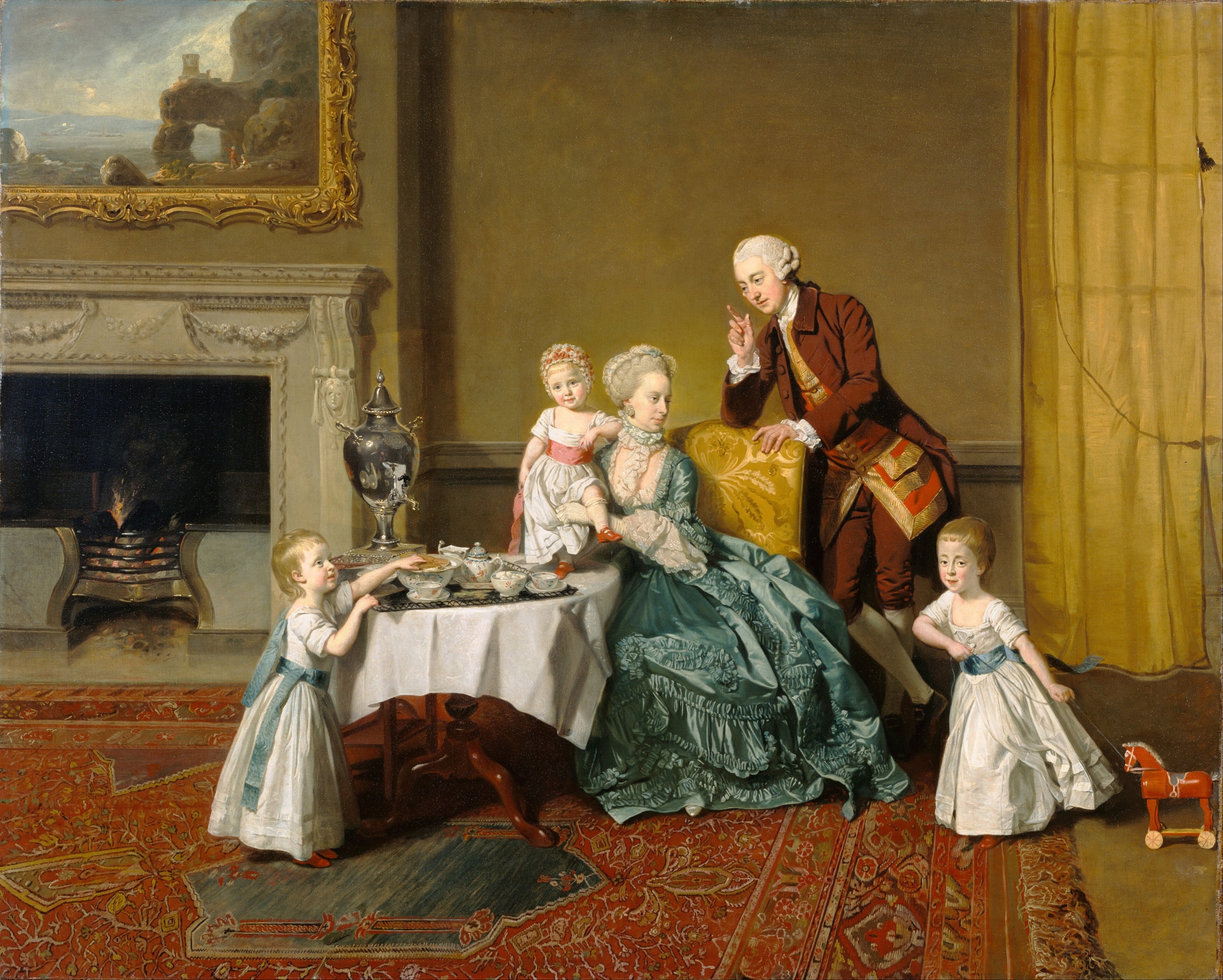
John, 14th Lord Willoughby de Broke, and His Family drinking tea, by Johann Zoffany. Medium: Oil on canvas. Date: about 1766. Dimensions: 40 1/8 × 50 1/8 in., 100 x 125 cm. Getty Center, Los Angeles, CA, USA.
The East India Company and the Opium Trade
The importance of the East India Company in China cannot be reduced to its formal trade monopoly. More importantly, the Company fused commerce and sovereignty. Its conquest and administration of Bengal allowed the Company to reshape production in India to meet the demands of imperial trade. Once the Company acquired control over opium-producing regions, it gained a decisive advantage because it could use Indian territory to solve Britain’s China problem. The Company supervised opium cultivation and procurement and auctioned the drug in Calcutta. Meanwhile, private "country traders" or smugglers carried opium into China. This arrangement was ideal from a British imperial standpoint. It generated revenue, reversed silver flows, and preserved plausible deniability since the Company could distance itself from the final illegal transaction in Chinese waters.
This point requires precision. The East India Company did not simply load opium onto its own ships and openly sell it at Canton as a lawful article of trade. Since opium was prohibited by Qing law, the company usually sold the drug at auction in India, and private traders smuggled it into China. However, this does not lessen the Company’s responsibility. In fact, it demonstrates the sophistication of the system. The company organized the supply, profited from the auctions, relied on the return of silver, and helped create the institutional conditions in which illegal narcotics became a pillar of imperial commerce. In that sense, the Company functioned as the long arm of the empire, not always the visible hand at the point of sale but the indispensable structure behind the trade.
The real mechanism was not a simple line from "Company" to "Smuggler," but rather a deliberately layered imperial system.
The division of labor was what made it effective. After expanding in Bengal, the East India Company held a monopoly over opium production there. It supervised cultivation in places such as Bihar, gathered the drug into its warehouses, and sold it at auction in Calcutta. Then, the Company stepped back before the final leg. Private British merchants, agency houses, and other "country traders" purchased the opium and transported it toward the Chinese coast. There, it was transferred through offshore and coastal smuggling networks rather than being sold openly as lawful cargo in Canton. This setup enabled the Company to profit from the trade while maintaining a formal distance from illegal sales within Qing territory.
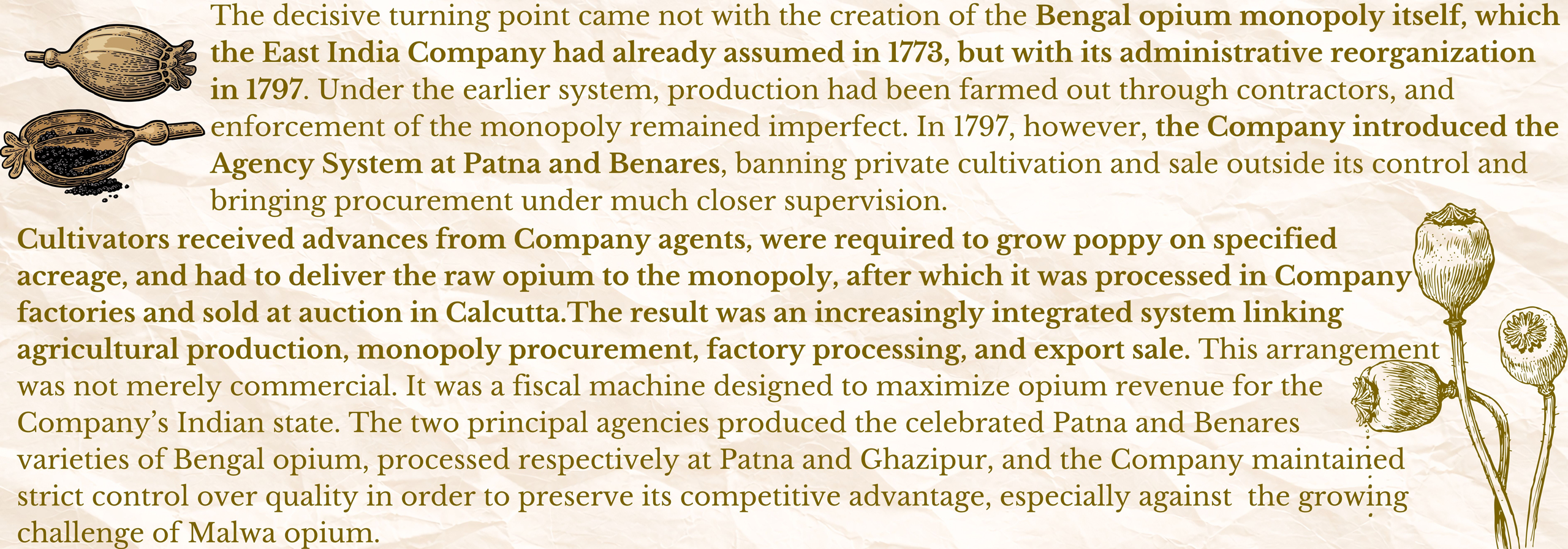
Thus, the complicity was structural rather than incidental. The company did not need to be the visible smuggler at the final point of exchange to be indispensable to the entire system. The company monopolized production, organized procurement, created the auction machinery, and collected revenue before the drugs ever reached Chinese waters. British archival and teaching materials based on Company records explicitly state this. Company ships were generally not supposed to carry opium themselves, but traders and agency houses smuggled it further, and the silver obtained through this commerce fed directly back into the Company’s China operations. According to the factory-record guide derived from British Library materials, by 1825, most of the money needed to buy tea in China was being raised through the opium trade.
The East India Company (EIC) did not usually command smugglers the way a navy commands officers. Rather, it controlled them by controlling the conditions of the trade: the supply, terms of access, quality, and financial structure. The smugglers were private merchants in name only; they operated within a commercial system that the Company had built and dominated.
More precisely, the EIC exercised control in four main ways.
First, it controlled the commodity itself. In Bengal and Benares, for example, the Company monopolized production. It supervised the cultivation of opium, procured it, standardized and packed it, and treated it as Company property until it was sold. Since private traders could not produce equivalent Bengal opium outside of this system, smugglers depended on the Company as their main supplier.
Second, the EIC controlled market access through the Calcutta auctions. Private merchants had to obtain Bengal opium through these auctions, meaning the EIC could control who entered the trade, the quantities involved, and the prices. While this did not provide day-to-day control over each smuggling voyage, it was a powerful form of upstream discipline. If a trader wanted Bengal opium for the Chinese market, he had to go through the Company’s sales mechanism.
Third, the Company controlled quality and commercial reliability. The Company supervised the processing, packing, and grading of opium, making it highly valued in the Chinese market. This gave private traders a strong incentive to remain tied to the EIC system rather than break away from it. In other words, the Company did not merely sell opium; it sold a dependable, branded product that anchored the entire network.
Fourth, the Company controlled profit incentives. Smugglers bore the legal and maritime risks of bringing opium into Chinese waters. However, the Company structured the trade so that this risk-taking remained profitable for the smugglers and fiscally useful for Britain. The EIC captured revenue at auction, while private traders gained from the illegal resale. This division of labor aligned interests without requiring overt micromanagement.
In short, the EIC didn't strictly control the smugglers once they set sail for China. However, it did have a significant impact on them before they left. It controlled what they bought, how they bought it, and the commercial framework that made smuggling possible. The smugglers were technically "private," but economically, they were operating within a system designed by the Company. The EIC made rules for a standard way to supply narcotics. This included quality control, packaging, logistics, and finance. It was basically an early form of drug trafficking in the industrial sector that was hidden by official rules and procedures.
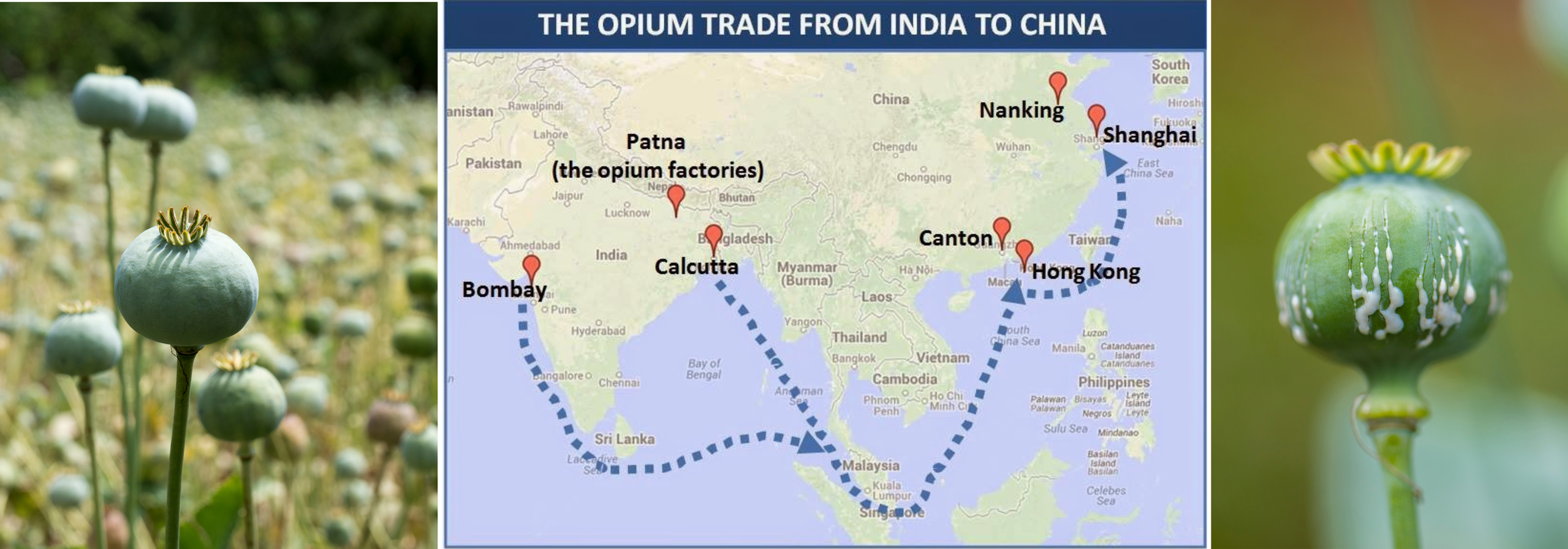
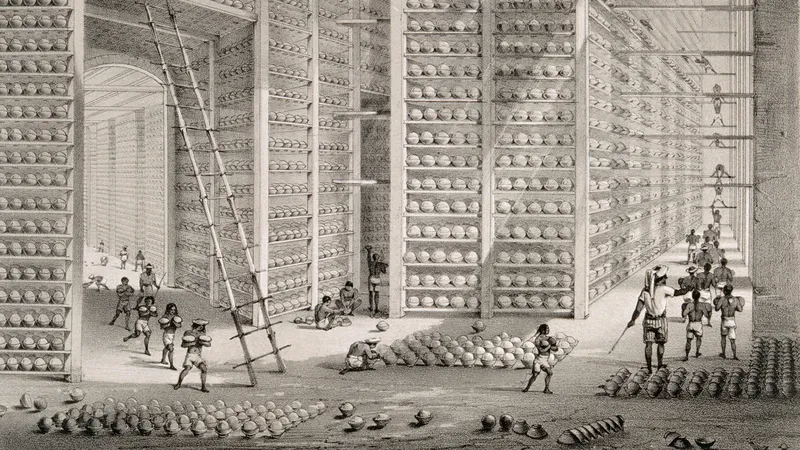
The 'Stacking Rooms' in a Patna opium factory with hundreds of opium balls prepared for use in the China trade. Lithograph by W. S. Sherwell, ca. 1850.
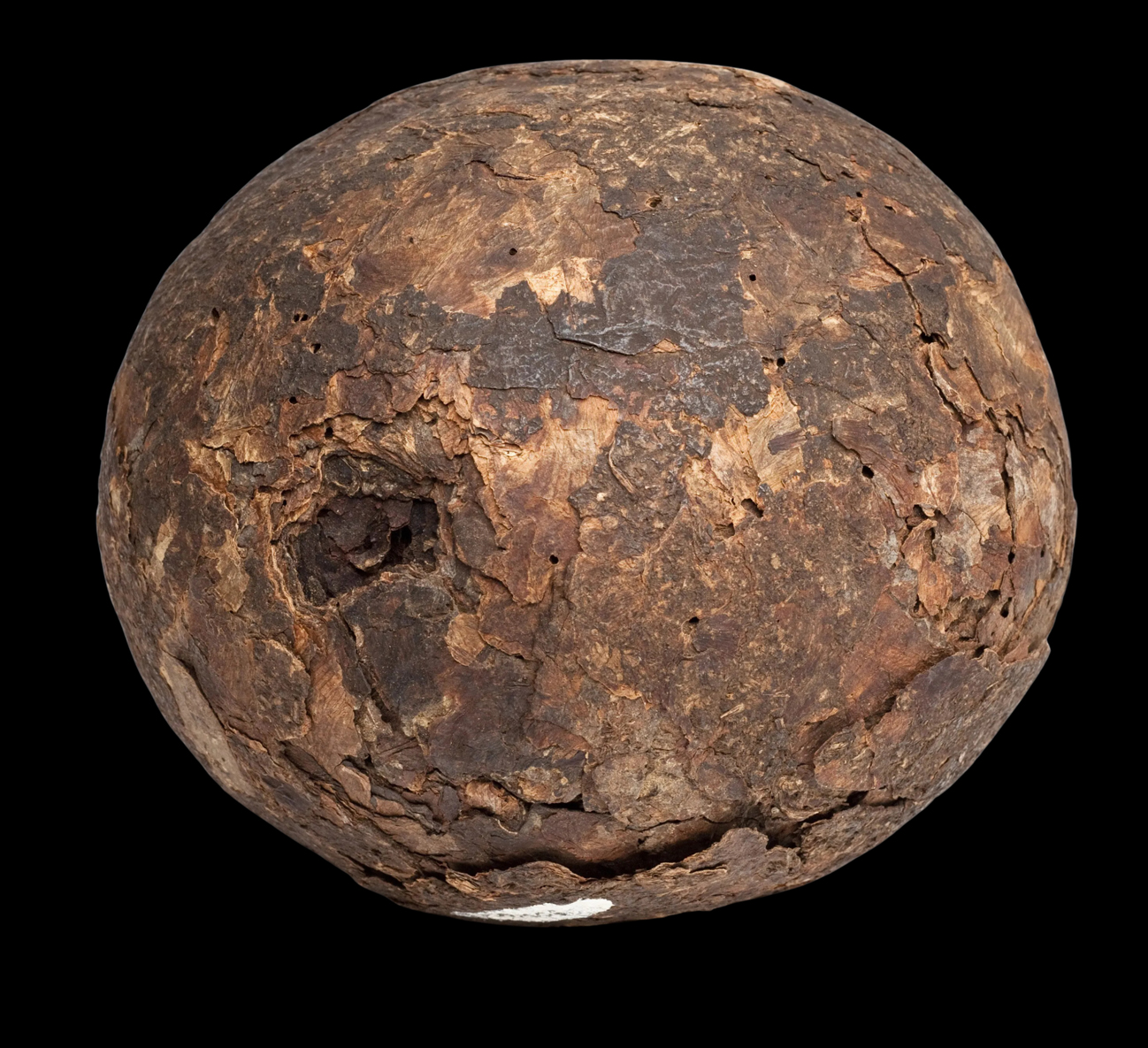
A compacted opium ball, prepared for long-distance trade in the 18th–19th centuries. Produced primarily in British-controlled India and transported across maritime routes to China, opium was molded into dense, durable forms like this to facilitate storage, concealment, and smuggling. These dark, resinous spheres became the material backbone of a vast imperial trade system, linking agriculture, finance, and addiction—transforming a narcotic substance into a geopolitical instrument that would help precipitate the Opium Wars.
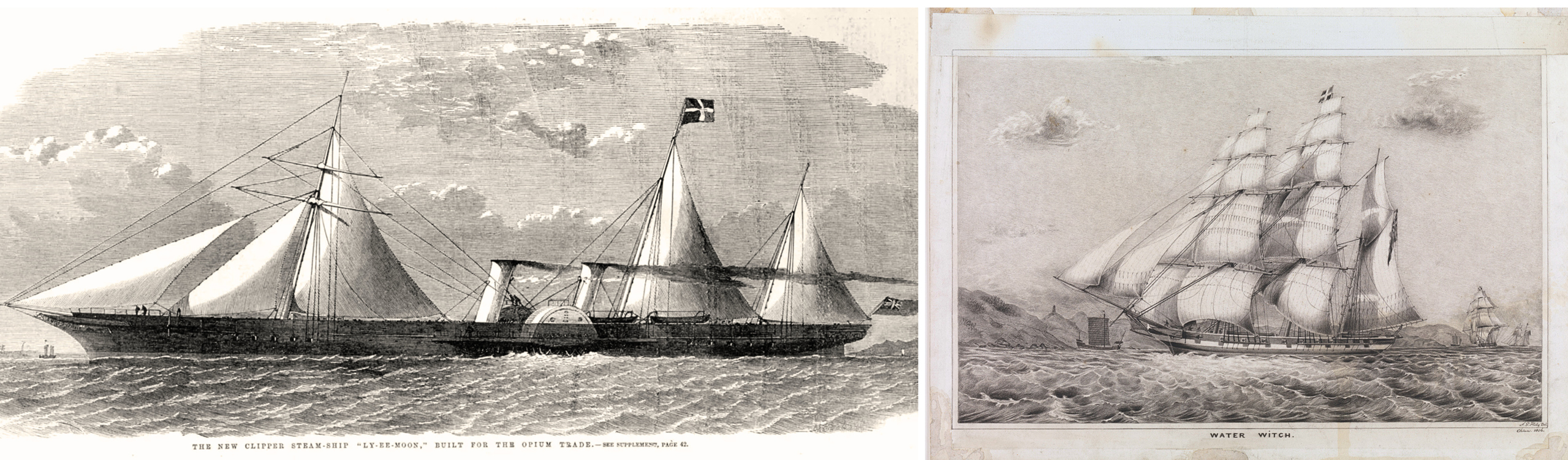
LEFT: The clipper ship Le-Rye-Moon, built for the opium trade, 19th-century wood engraving from the Illustrated London News. Encyclopædia Britannica.
RIGHT: Water Witch opium clipper barque built in Kidderpore in 1831, here shown in 1856 off China coast. Drawing by F.G. Hely. National Maritime Museum, Greenwich, UK.
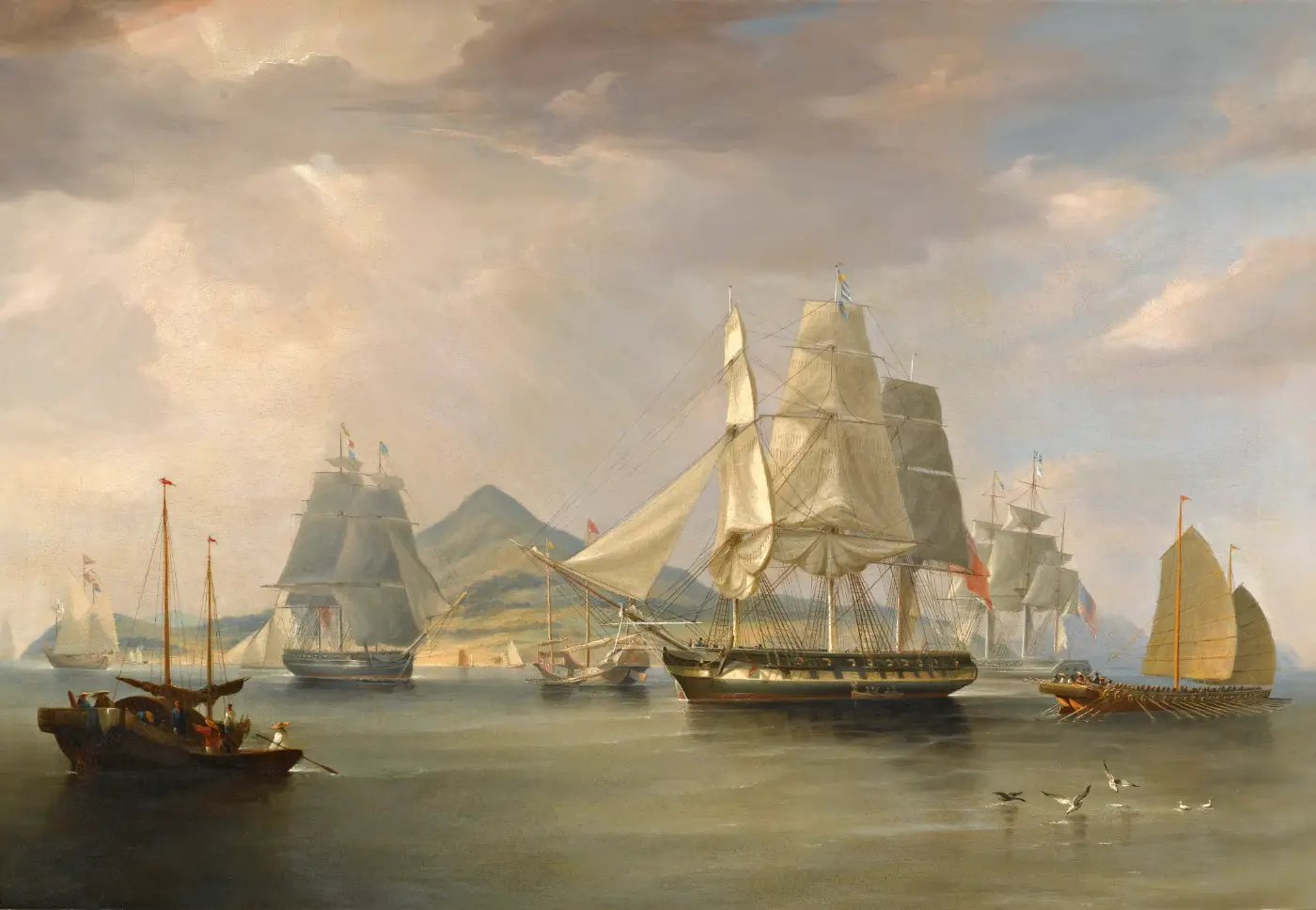
The Opium Ships at Lintin, China is a painting from 1824 by British maritime artist William John Huggins. It shows the busy illegal opium trade near Lintin Island in the Pearl River Delta, near Tuen Mun. It shows armed ships carrying opium for local traders. These ships are often owned by British people. This shows how much opium is being smuggled in the region.
The East India Company as the Long Arm of Empire
That is where Britain as a state enters the picture. The East India Company was more than just a business: it was an organization that had the power to govern a territory in India. It controlled Bengal and its people, land, taxes, and farming. In other words, opium was more than just something the British exported. It was also something produced under the protection of British imperial rule. The Company's territorial rule in India allowed for the cultivation regime, the monopoly, the auctions, and the financial exploitation that the China opium system relied on.
The smugglers, on the other hand, were not just random people. They were the mobile version of the system. Private merchants and agency houses handled the dangerous and illegal part of the trade because they could deny responsibility and be flexible. Offshore receiving points and coastal runners protected the Company and, to some extent, the British government from the most obvious illegal activity. But this was not about who was responsible for what. It was a way to spread risk across different people while keeping profit in the same imperial and commercial world. The structure worked because each layer depended on the others. The company controls the market, auctions, private shipping, finance, and Chinese distribution networks.
The British government was not just watching this happen. People in the government and the parliament understood that opium was helping to pay for the tea trade and, more broadly, contributing to Indian revenue. An Oxford history project citing a parliamentary committee notes that in 1832 a select committee judged it unwise to abandon so important a source of revenue as the Company’s opium monopoly. When Lin Zexu seized and destroyed opium in 1839, the British government did not see it as just a problem for a few smugglers; it sent the military. That response tells you everything you need to know. When Qing enforcement threatened the commercial architecture, Britain converted private illegal profits into a matter of imperial honor and state action.
The British government did not personally manage every part of the opium trade. But by the early 19th century, it had a lot of control over the East India Company's political framework. This helped protect the larger imperial system. In this system, the Company's monopoly, private smuggling, and British state power worked together. The smugglers moved the chests, the Company organized the supplies, and the British state was in charge of everything.
The East India Company produced the drug, sold it, and made money from it. Private traders moved and smuggled it. The British state protected the system when the Qing government tried to stop it. The Company provided the structure, the smugglers provided the mechanism, and Britain provided the ultimate guarantee of force. The brilliance—and the immorality—of the plan was in how it evenly divided up the jobs. It allowed each actor to say that they were not responsible, but all three benefited from the same trade.
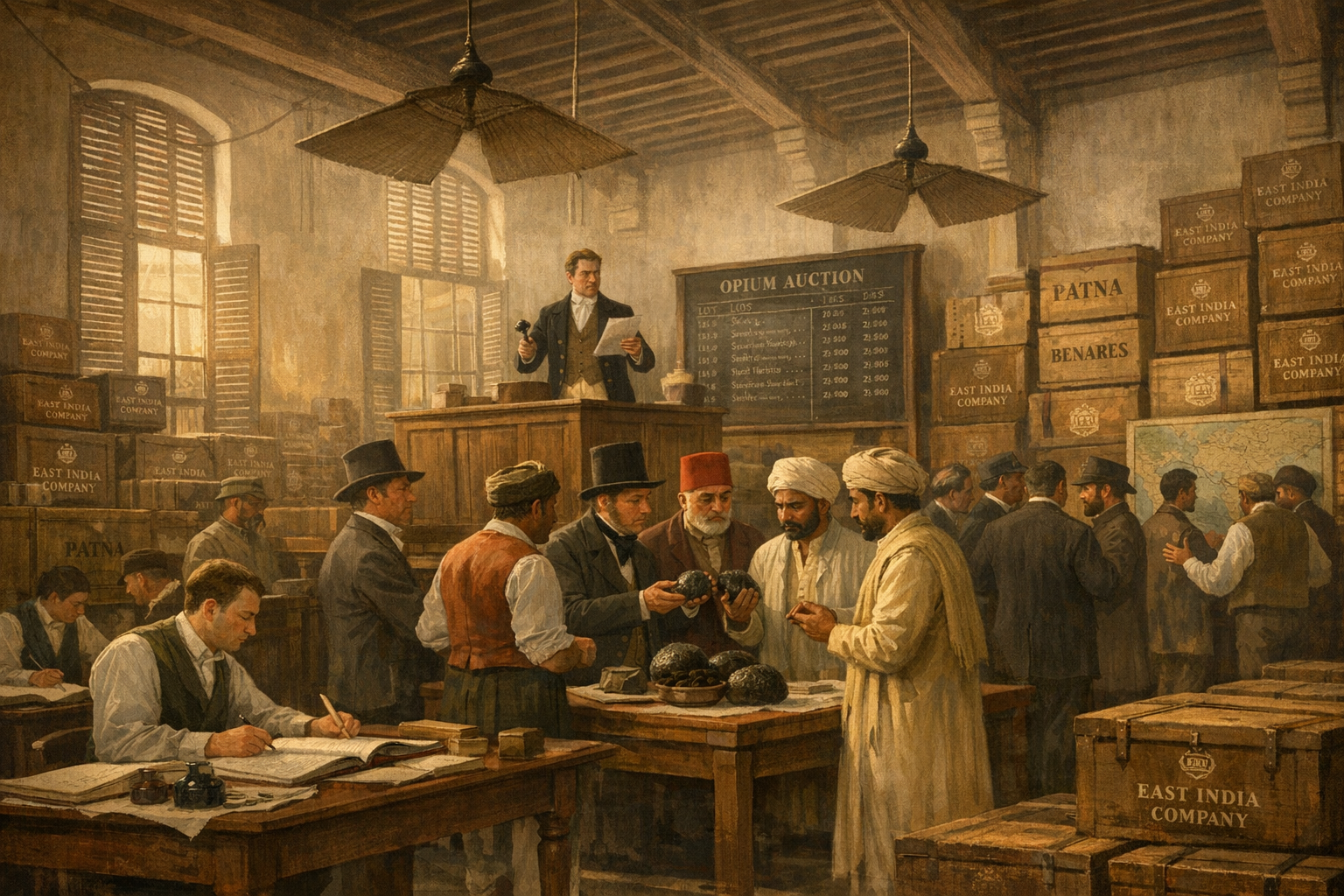
Opium aucton in Kolkata. Most visualizations get the opium trade in Calcutta (Kolkata) by turning it into a crude “drug deal.” It was nothing of the sort. It was formal, bureaucratic, almost respectable on the surface — and that contrast is the whole point.
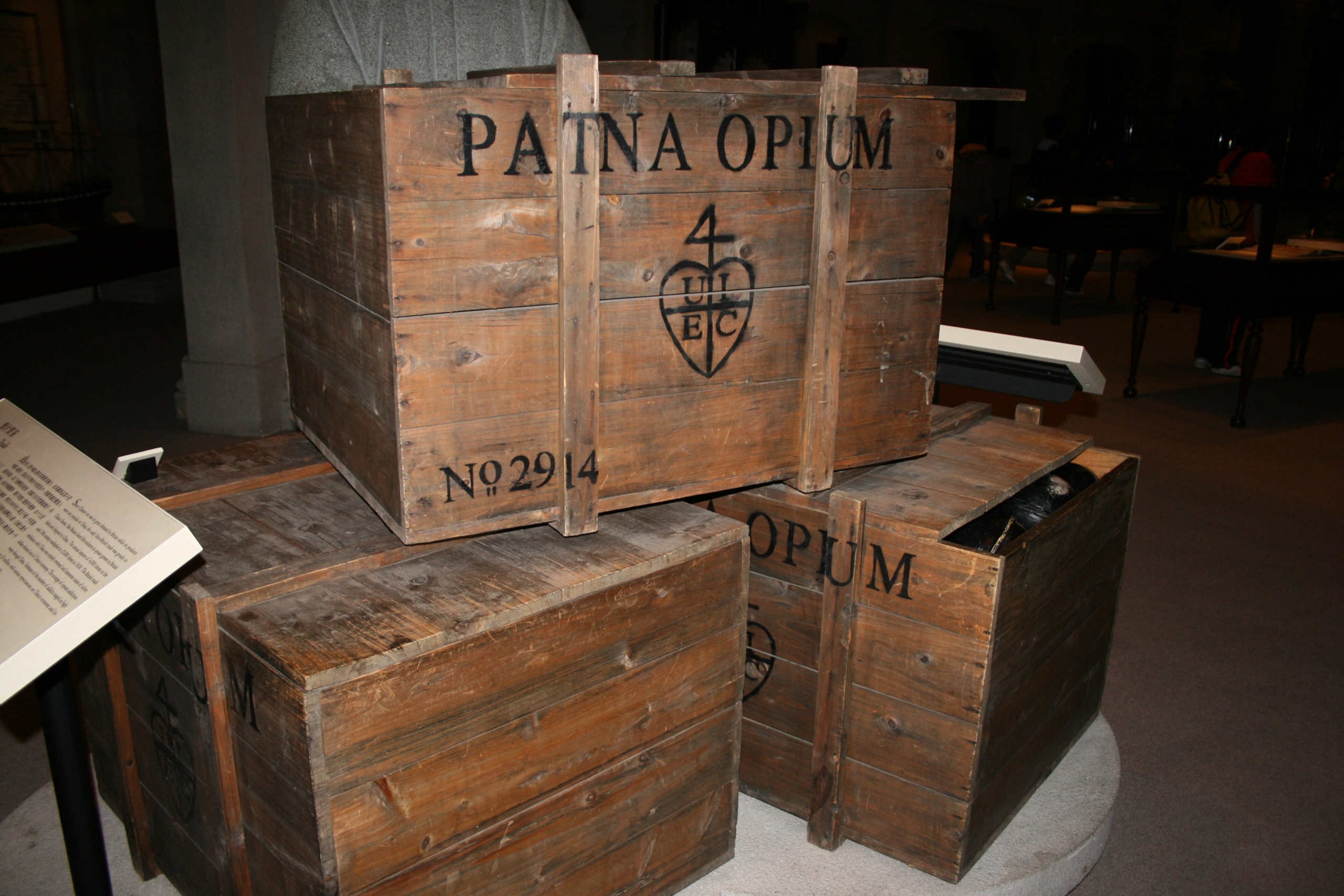
Patna EIC opium crates in museum in the Hong Kong History Museum. Wikimedia Commons.
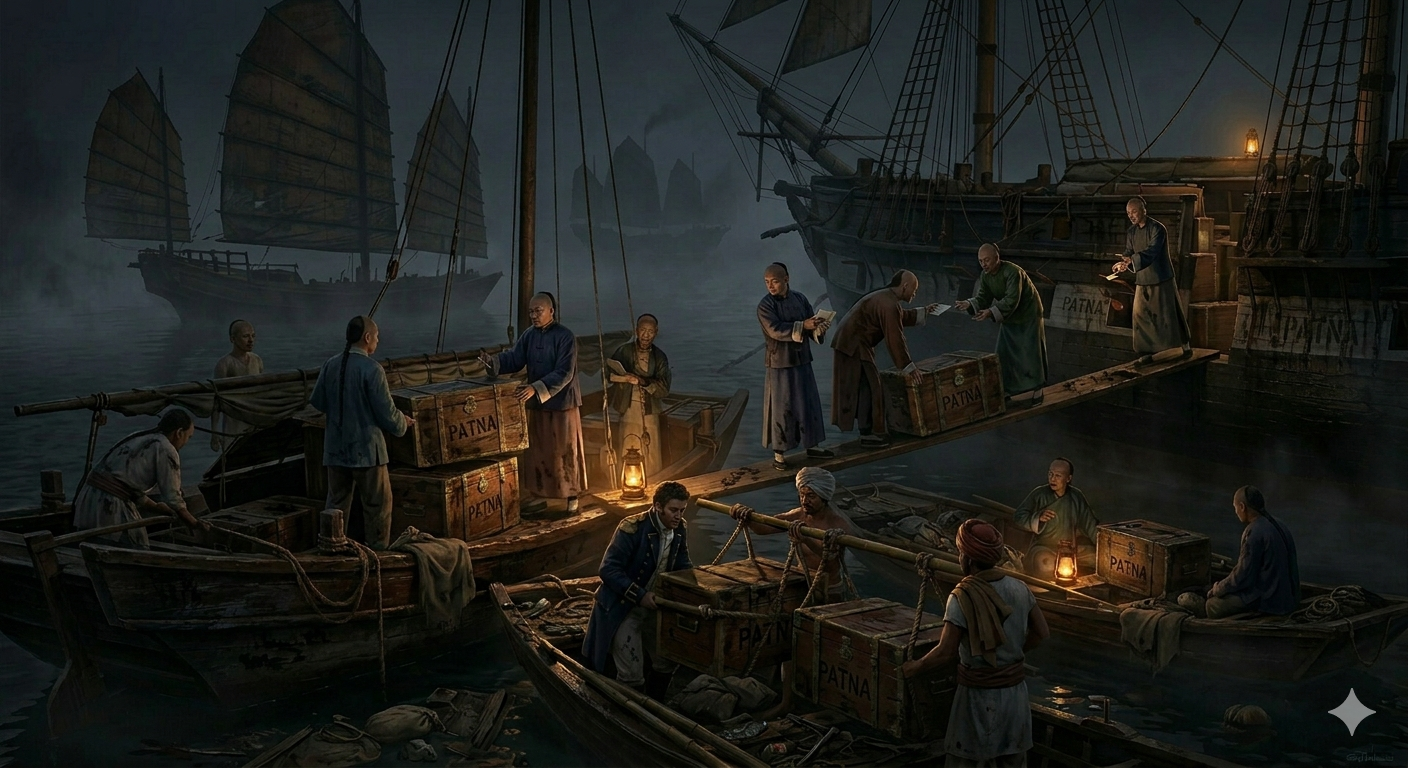
The smuggling took place along the south China coast, especially around the Pearl River Delta, near Canton, and offshore hubs like Lintin Island.
Why Opium Became the Tool of Expansion
Opium made China vulnerable because it took advantage of China's regulatory strength. The Qing government wanted to control foreign trade. They wanted to supervise and control it based on morals. Opium trade hurt all three goals. It spread outside the approved channels of trade, encouraged corruption among coastal officials and intermediaries, and drained silver from the empire. The problem was bigger than public morality, even though morality was important to Qing officials. It also threatened the financial stability and the reputation of the government.
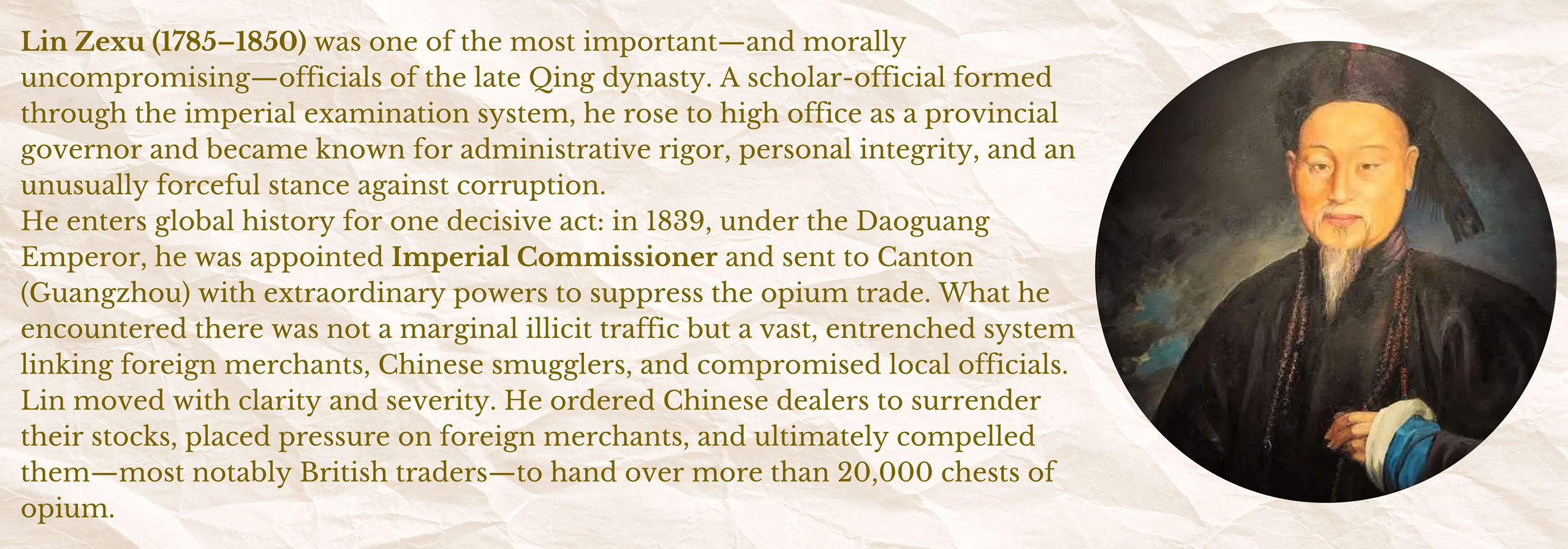
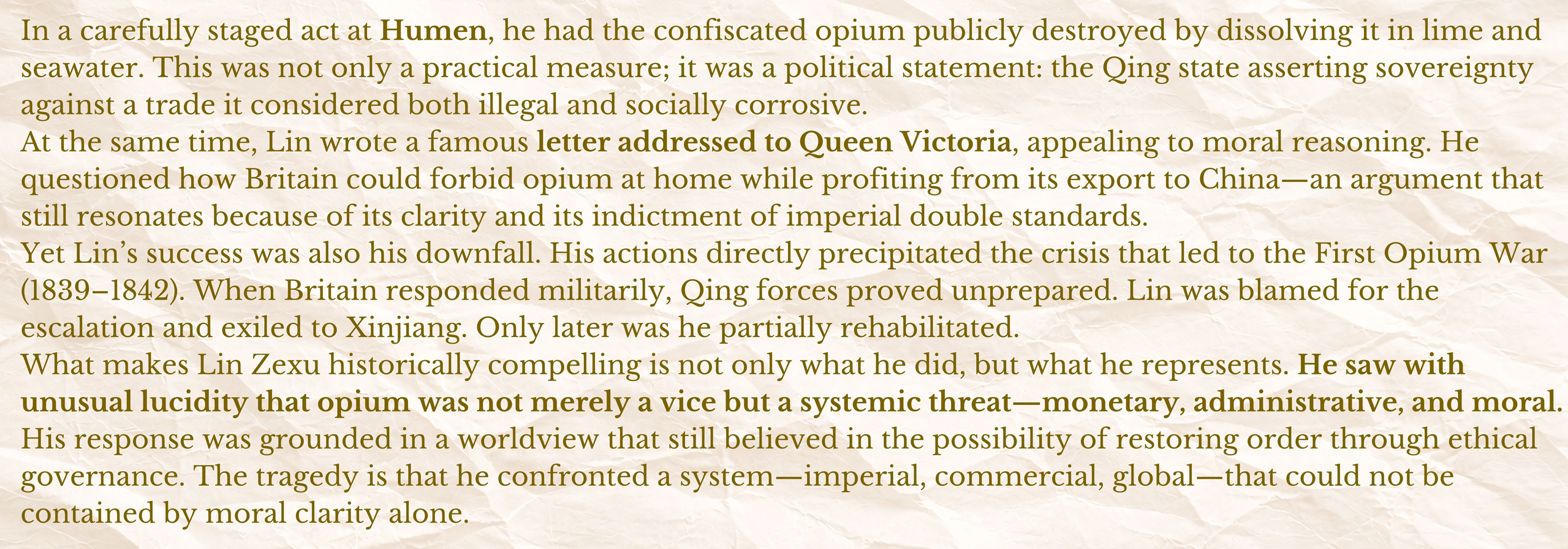
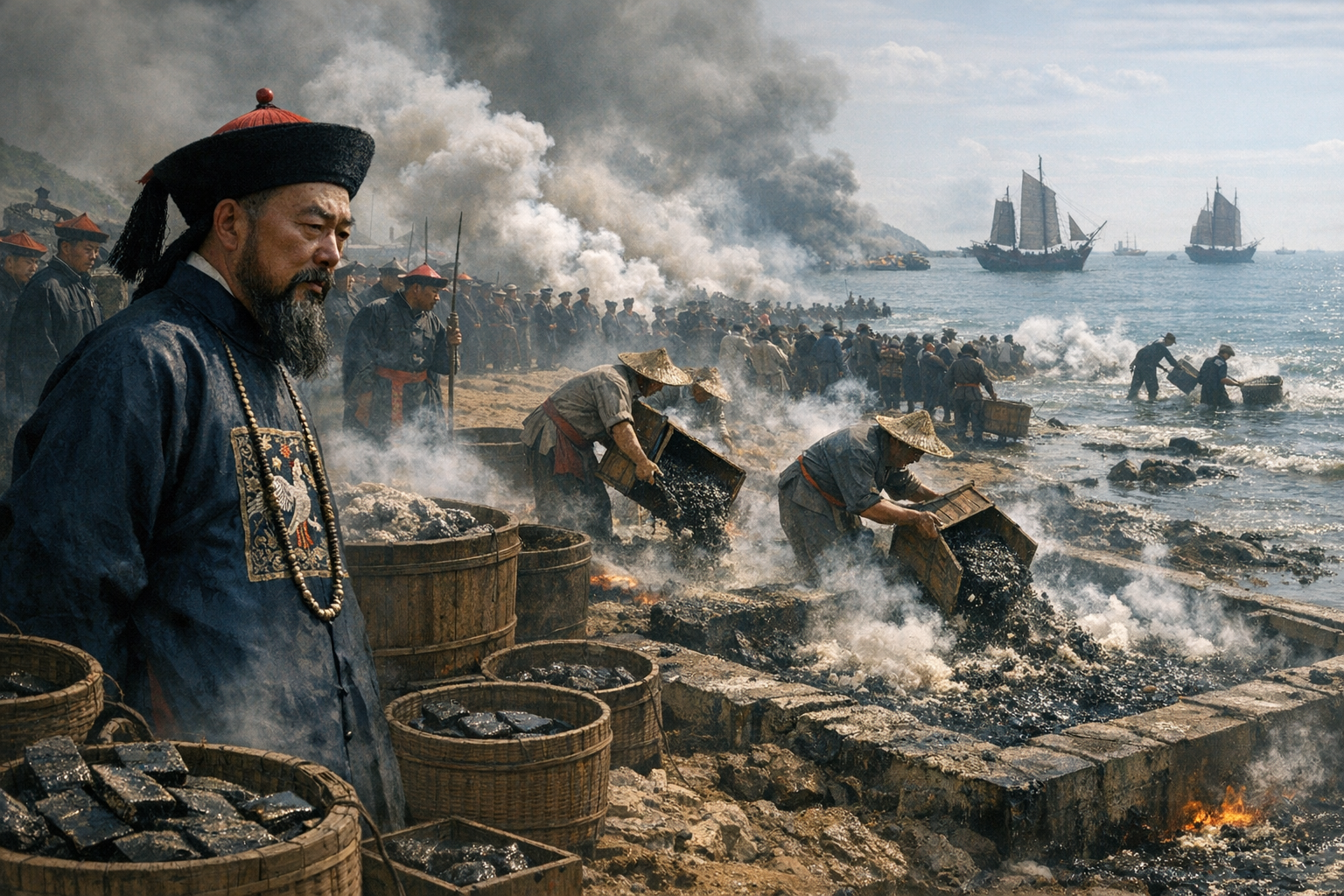
Commissioner Lin Zexu understood the crisis in exactly these terms. He was sent to Canton in 1839 to put an end to the trade. He pressured foreign merchants to hand over their opium and watched as it was destroyed in Humen. This was not an unprovoked outburst against business. It was a way for a country to show that it was in charge and that no one could bring in illegal drugs. British records show that the destruction of the opium at Canton/Humen led directly to war.
The British response is particularly noteworthy in historical context. Instead of admitting that the trade was illegal and trying to find a middle ground within Qing law, Britain used the destruction of the contraband as an excuse to attack militarily. This shows the real reason why the empire expanded. Britain was no longer just defending trade; it was defending a system in which its merchants claimed the right to continue a highly profitable trade that the Chinese state had explicitly forbidden. Opium became the point where business ambition, imperial pride, and military strength came together.
The Spread of Opium in China
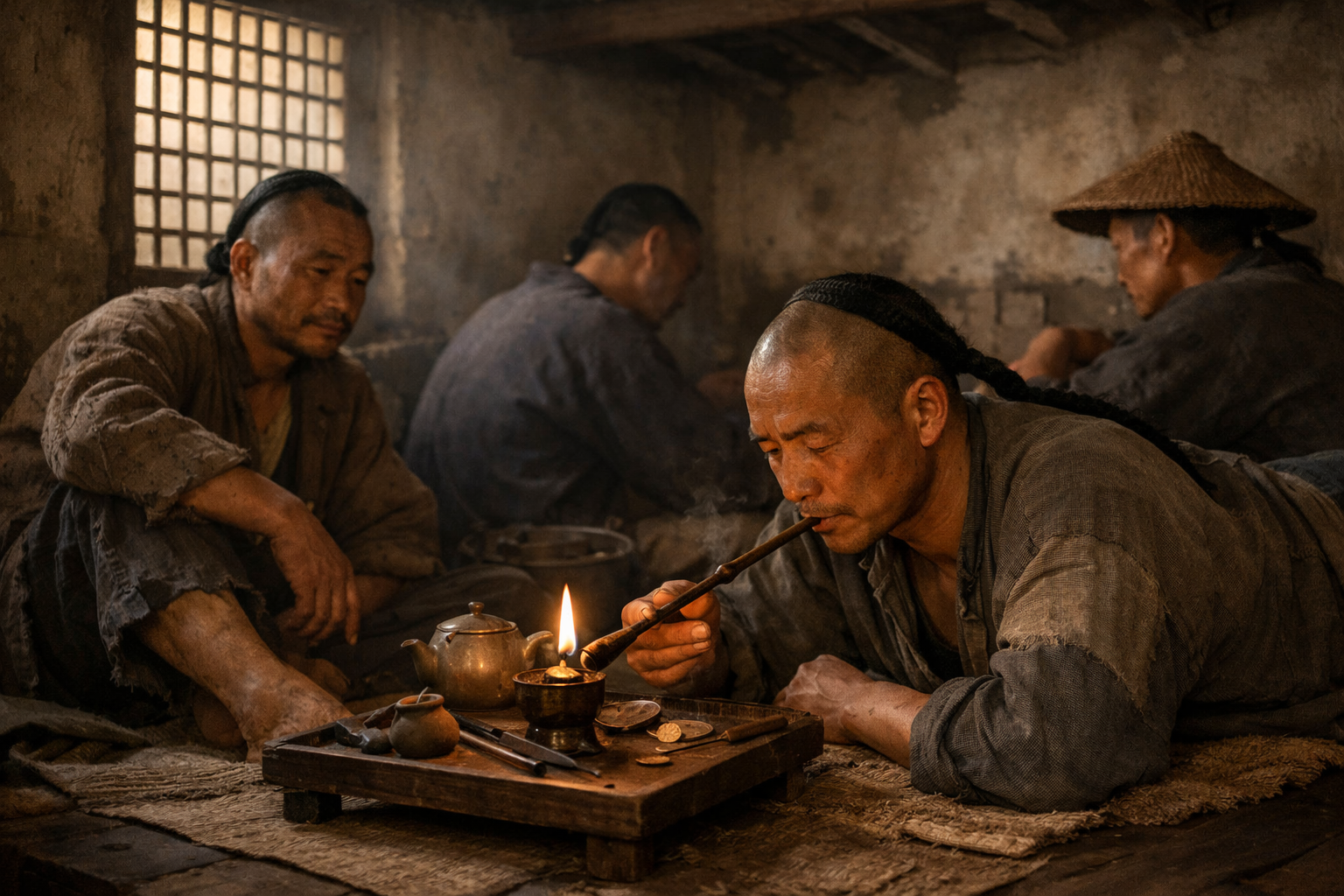
Opium had been used in China for a long time as a medicine. But in the 18th century, it became a popular recreational drug, especially when people smoked it. The Chinese government saw this as a political threat and tried to stop it. The Yongzheng emperor's 1729 edict did not ban opium. It tried to change the social situation by banning the sale of opium for smoking and the operation of smoking houses. At the same time, it allowed some limited use of opium as a medicine. During the reign of Emperor Jiaqing, this concern became a ban: in 1796 and again in 1799, the government officially prohibited the importation and domestic cultivation of opium. But these measures were at odds with a commercial system that was already growing and becoming more organized in a way that was much harder to deal with using traditional enforcement methods. Over time, the amount of opium entering China grew from a small trade of a few hundred chests to a huge, well-established trade of about 40,000 chests a year by the late 1830s.
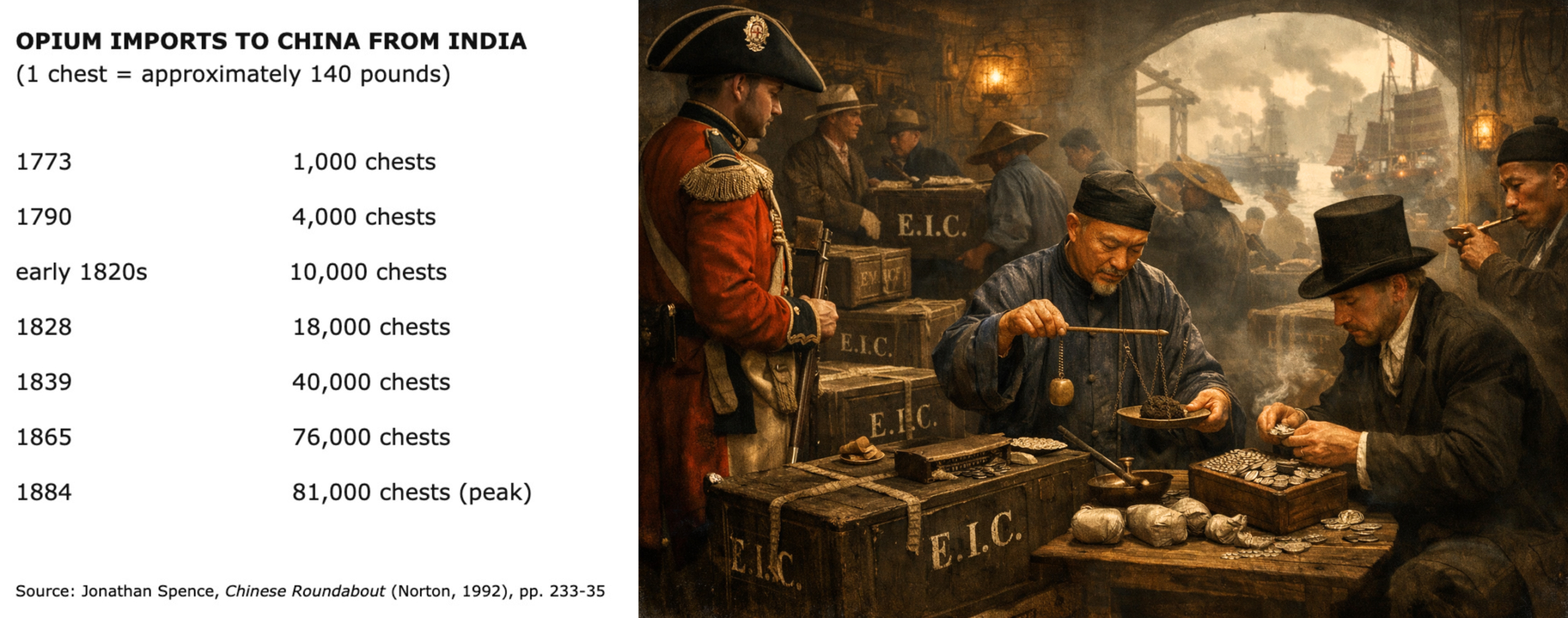
By 1838, just before the First Opium War, the yearly amount of opium brought into the country was more than 40,000 chests. This was 200 times more than the amount brought in in 1729 and 40 times more than the amount brought in in 1767. This growth wasn't just because of business, but also because more and more people were using opium. It spread from coastal areas to inland provinces and from rich people to regular people.
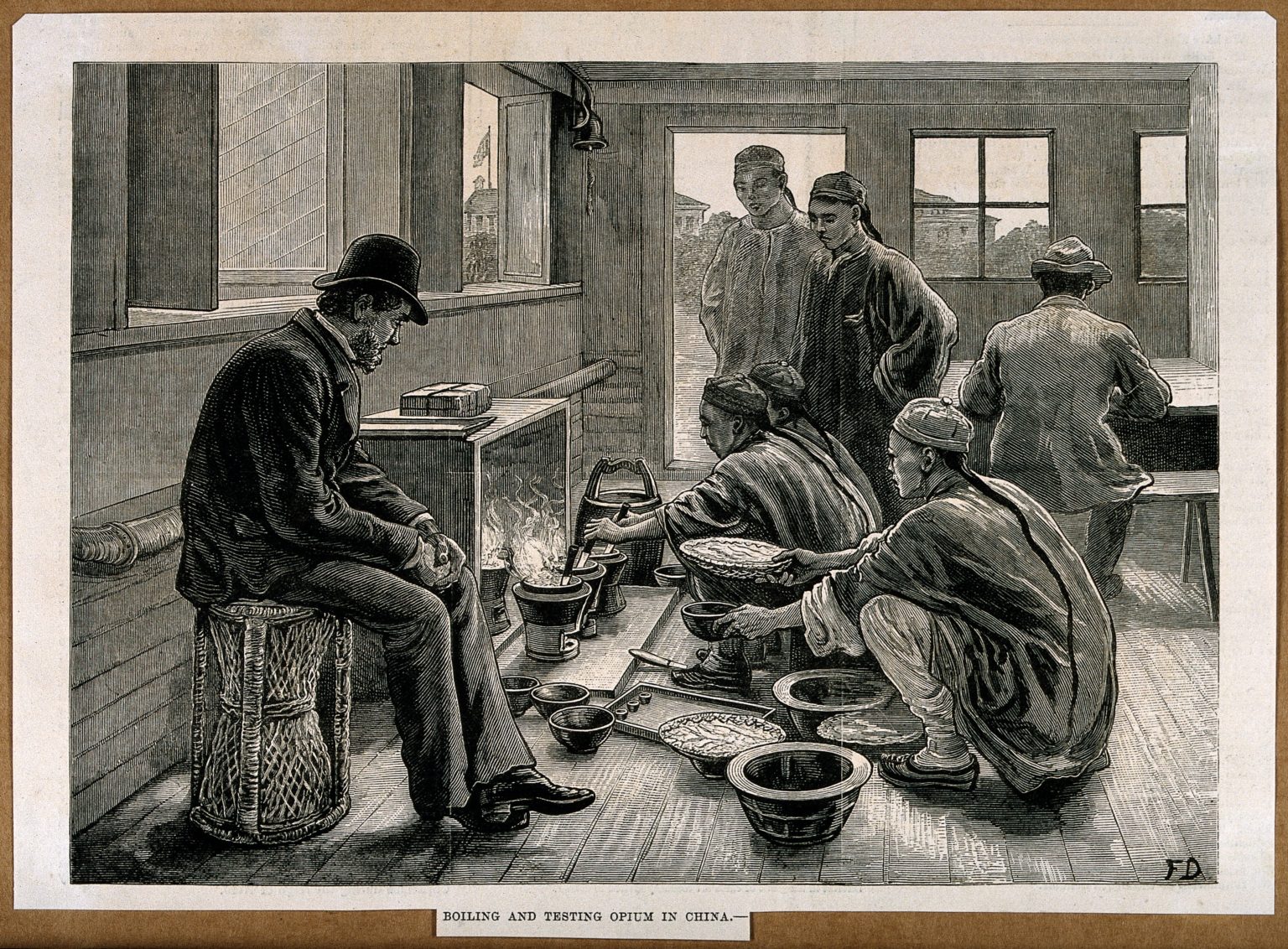
This 1881 Illustrated London News picture by Frank Dadd shows Chinese men preparing opium, showing how it is boiled and tested for local use. The scene shows how raw opium was prepared to make it easy to smoke. This was a common practice in 19th-century China, where many people used opium.
The consequences in China were cumulative, meaning they added up over time and were destructive, rather than being catastrophic for everyone. Opium use spread unevenly but widely, taking root not only in poor or secret places but also in business, city, and even government settings. Later stories often made addiction seem worse than it was, but today's Qing memorials show that officials across the empire were worried about how common addiction was becoming and how it was being accepted.
The biggest worry is about supply, not consumption. Imports from India increased from about 4,500 chests around 1800 to around 18,956 in 1830–1831 and around 40,200 by 1838–1839. This doesn't tell us exactly how many users there were, but it does show a huge increase in the amount of opium available on the Chinese market. When supply increases by that much over a few decades, it makes sense to think that more people will want to buy it, even if we cannot measure it exactly with modern statistics.
The phrase "unevenly but widely" is justified because the diffusion was not the same everywhere or for all people. The UN's review of history says that opium use spread quickly along China's coastal areas from an earlier period. Research on early modern China also says that the first significant growth of smoking happened in a few southern coastal regions before it spread more. Opium didn't spread evenly throughout China. It traveled through trade routes, ports, markets, and coastal areas before spreading inland. That's why "unevenly" matters.
The word "widely" is justified by the kind of people who appear in the sources. A recent overview of the Opium Wars by Cambridge says that by the 1830s, there were reports of soldiers and officials becoming addicted to opium. These reports reached the throne. Other scholarship emphasizes that in the 1830s, the Qing court was divided by an "inner opium war." This war was over whether to ban or legalize the opium trade. It would have made little sense if the problem had remained marginal. The concern was not only that a few urban people who enjoyed themselves were smoking opium. It was that the habit had spread to groups of people who were important to the state.
We also have proof from official records of the Qing dynasty that they were worried about this. One source that summarizes Lin Zexu's warnings says that opium smoking had spread to all parts of society and that addicts numbered "in the millions" in the early 1800s. Lin warned that, if opium smoking was tolerated, China would soon lack both soldiers and silver. This is not a modern epidemiological count, but it is important evidence of how senior Qing officials perceived the scale and consequences of the problem. In other words, the archives show that the court was worried about opium's impact on society, military readiness, and the budget.
The most common estimate for the number of opium smokers in China before the First Opium War is that there were about 10 million people who used opium, and about 2 million of them were addicted. That figure is in teaching materials that are used a lot and are based on common historical research. But it should be handled carefully. It is an estimate, not a census, and historians such as H. G. Gelber have warned that Qing authorities almost certainly lacked precise statistics on either opium consumption or its economic effects. So the safest way to say this is not "we know there were exactly 10 million smokers," but rather "historians who came after us arrived at very large numbers, though the exact totals remain uncertain."
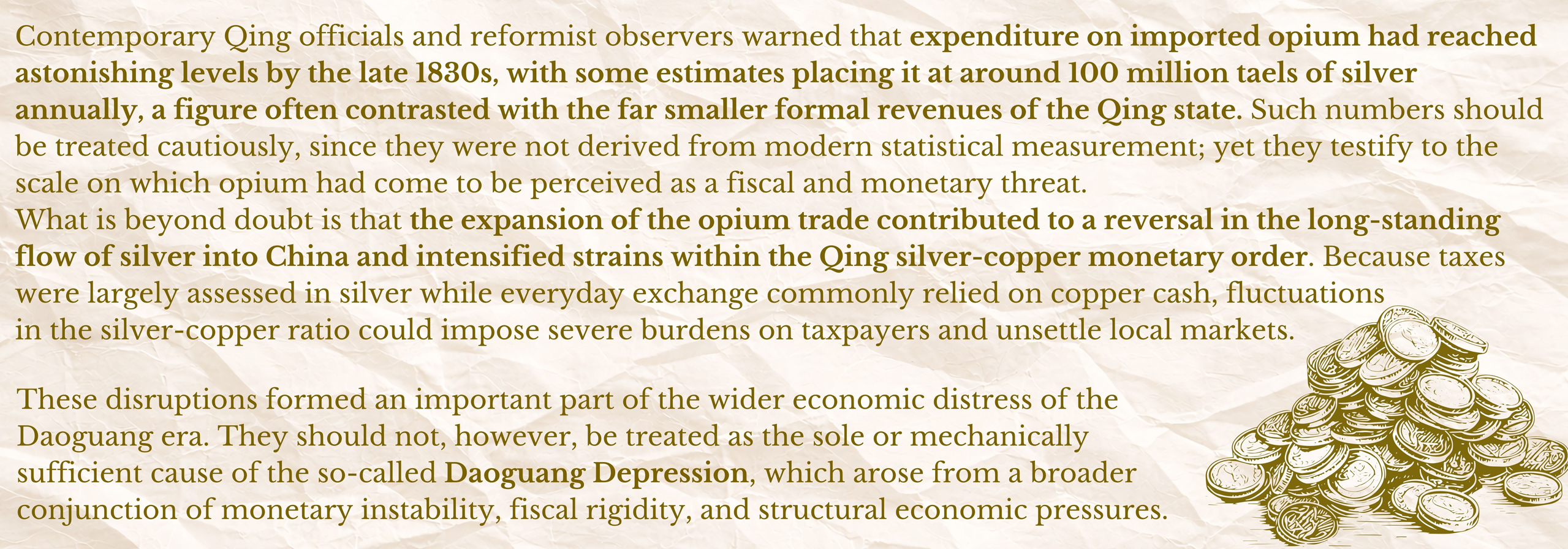
The evidence is especially strong when it comes to the state effects. One source based on Lin Zexu's documents reports that silver coming into China fell quickly after the growth of opium imports. From 1821 to 1830, China paid out 2.3 million taels. Then, from 1831 to 1833, it paid out 9.9 million taels. The source also explains the financial mechanism clearly: because taxes were based on the value of silver, and people used copper cash for everyday transactions, the increase in the value of silver meant that taxpayers had to pay a higher tax. While not all official estimates were exact, the court's concern about opium was not an overreaction based on material reality. It was connected to a clear lack of money.
There is also substantial evidence of corruption and administrative penetration, though it is difficult to measure. Gelber says that Chinese citizens, merchants, gangs, and even "hordes of officials" ignored the ban and took part in smuggling. Some senior coastal officials even made money from this trade or got kickbacks. Another overview of the early industry describes how merchants and local officials worked together to set prices and bribes for opium sales. This doesn't mean that all of the bureaucracy was corrupt, but it does show that opium was present not only in secret groups but also in business and administrative settings.
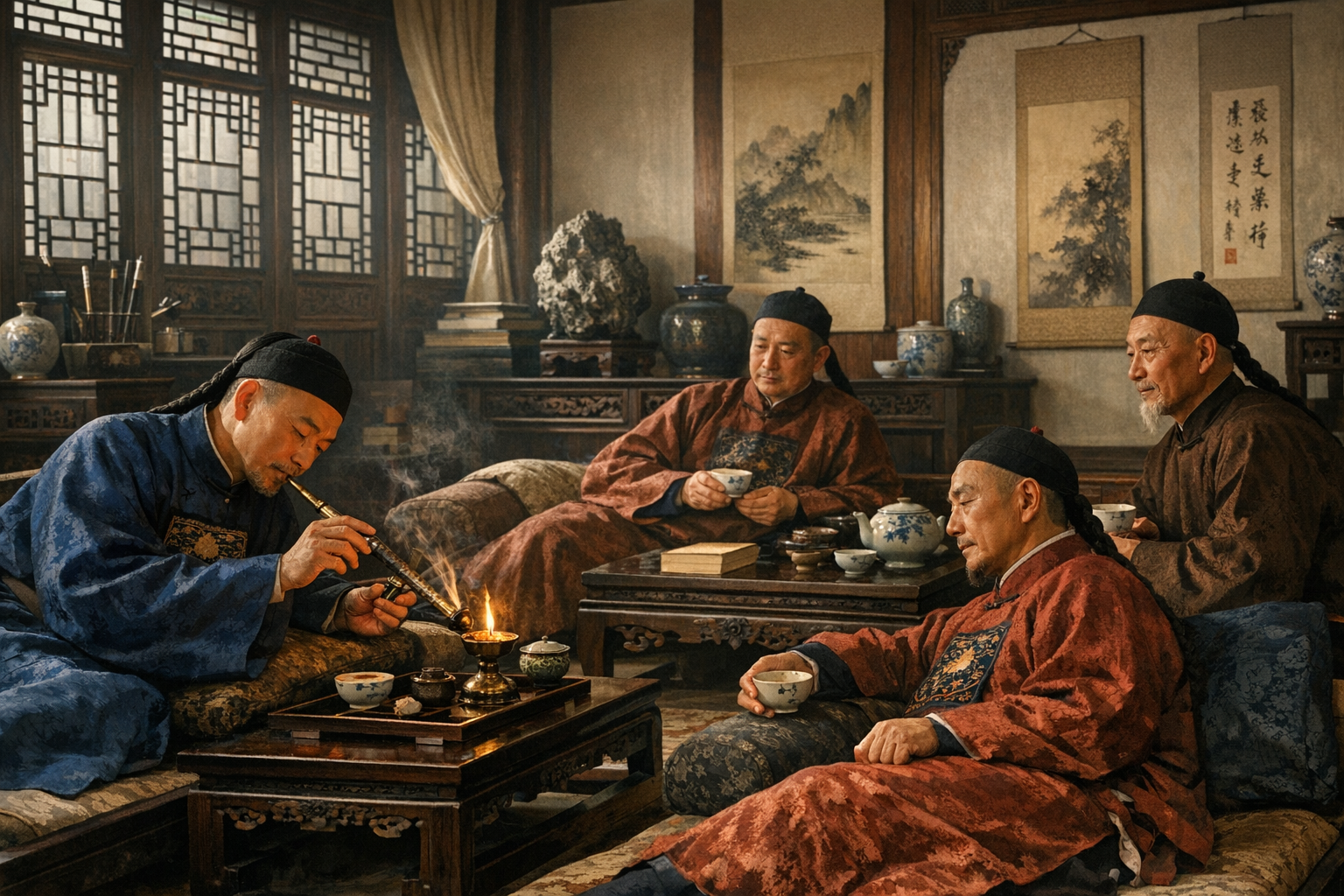
During the time when opium was illegal, it wasn't just used by a few people in secret. It was also used by people who were important to the Qing government. The court was particularly worried about how it spread among officials, degree-holders, and wealthy merchants. These groups were seen as authorities because of their moral example, not just because of their administrative work. When the people whose job it was to enforce the ban were caught breaking it themselves, the law stopped being seen as a reliable standard. Instead, it showed that it was weak. In this sense, elite consumption was not just a matter of private indulgence. It showed that the dynasty's ability to make rules was being undermined from within by the actions of the dynasty's own rulers. This wasn't just about being two-faced. The presence of opium among scholars and officials showed that the practice had become a part of society that could not be stopped by moral criticism or punishment. What happened was not just the failure of one policy. It was the gradual weakening of the rules and standards that were important for that policy to work.
The structural effects were even more significant. The trade changed the usual flow of silver, which led to significant outflows. These outflows disrupted the delicate balance between silver and copper currencies. This was important for the Qing fiscal practice. It made taxation complicated and put pressure on local economies. At the same time, the money made from these trade deals led to widespread corruption. Officials, clerks, and military personnel were caught up in networks of protection, bribery, and participation. These networks made it so that the coast was less able to enforce the rules.
By the 1830s, people started to see opium not as a separate moral or medical problem, but as something that had a negative effect on money, government, and the military. In 1839, the Daoguang emperor gave Lin Zexu special powers to stop the trade. This was not because the emperor had suddenly become moral. It was because he saw that trade with foreigners was hurting the Qing state. The crisis that followed was caused by more than just misunderstandings. It was also caused by the clash between an empire that controlled the production and illegal distribution of a narcotic drug and a society that, too late, understood how serious the threat was.
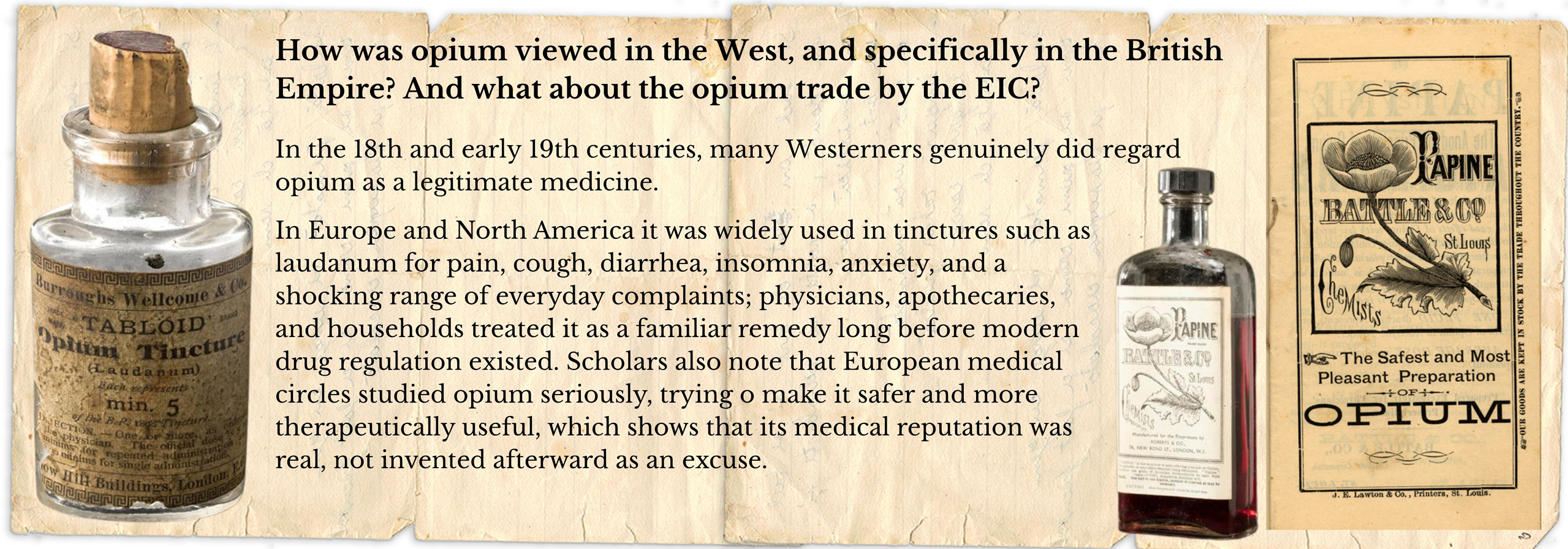
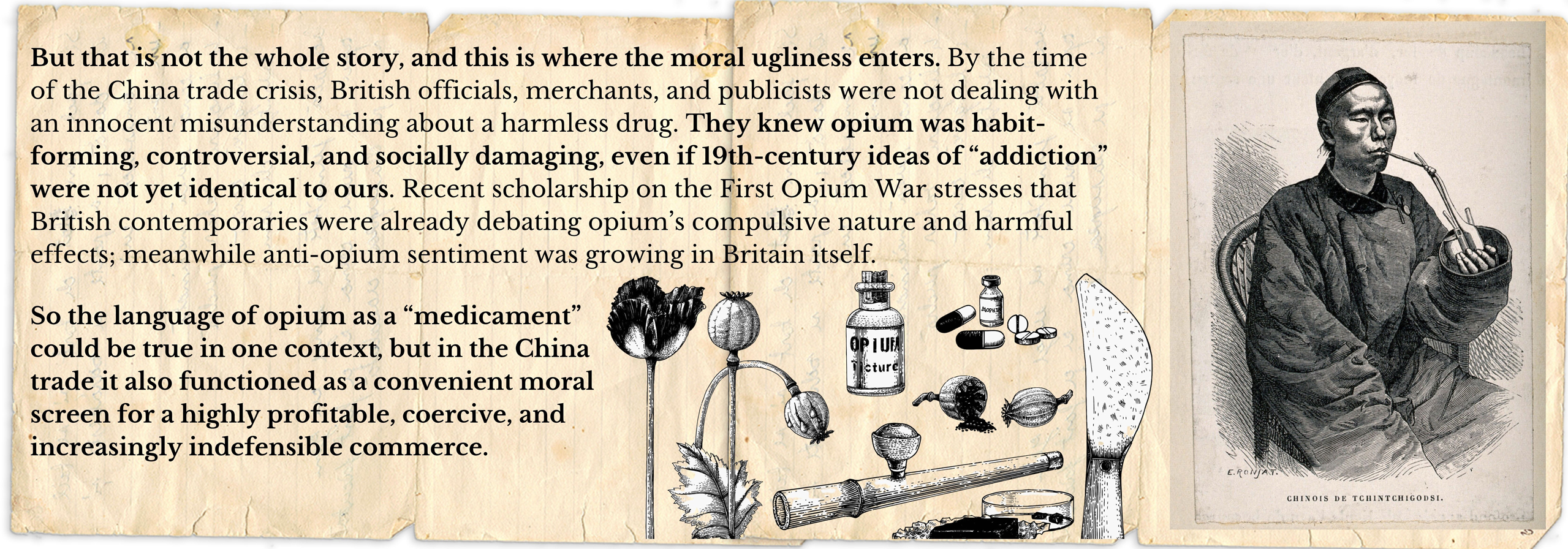
How was opium viewed in the West? And what about the opium trade by the EIC?
THE OPIUM WARS
The First Opium War, 1839–1842
The war was triggered by the Qing state's determined attempt to suppress the opium trade, which culminated in Lin Zexu confiscating and destroying large quantities of opium at Humen in 1839.
However, the deeper causes of the conflict were structural. Britain regarded the Qing system for regulating foreign trade, centred on the Canton system with its strict limitations on access and the Cohong merchant monopoly, as incompatible with its expanding commercial ambitions. The issue at stake was not simply opium, but rather the broader question of how China would be integrated into an increasingly European-dominated global trading order. The conflict also reflected a clash between two diplomatic systems: the Qing tributary framework, which was hierarchical and Sinocentric, and the British demand for diplomatic recognition and unrestricted commercial access. The latter was expressed in terms of 'sovereign equality', but was actually based on assumptions of civilisational and racial superiority. In other words, Britain invoked the principle of 'sovereign equality', drawn from European international law, but in China it operated through a hierarchy of power justified by racial and civilisational superiority. What Britain demanded was not equality in any reciprocal sense — it demanded recognition without submission and access without constraint.
The war quickly exposed a stark military imbalance. British forces deployed modern naval technology, including steam-powered gunboats, as well as superior artillery and disciplined expeditionary tactics. This enabled them to attack along the Chinese coast and penetrate major routes such as the Yangtze, bypassing traditional defensive structures. Qing forces, organised around older logistical and strategic assumptions, struggled to respond effectively to this form of mobile, industrial warfare.
The conflict ended with the signing of the Treaty of Nanjing in 1842. This was the first of the so-called 'unequal treaties'. The terms of the treaty marked a decisive shift in Sino-foreign relations.
The treaty:
- Opened five ports (Canton, Xiamen, Fuzhou, Ningbo and Shanghai) to British residents and traders;
- Abolished the Cohong monopoly system;
- Ceded Hong Kong Island to Britain 'in perpetuity';
- Imposed a substantial indemnity of 21 million silver dollars, including compensation for destroyed opium, merchant debts and war costs.
Further provisions were clarified in the Treaty of Nanjing, which granted Britain extraterritorial rights and most-favoured-nation status, significantly limiting Qing judicial and tariff autonomy.
The significance of the First Opium War lies not only in its military outcome, but also in the political and economic structure that it imposed. Britain did not seek to conquer China territorially. Instead, it secured strategic access points: treaty ports, fixed tariffs, legal privileges and a territorial foothold in Hong Kong. These enabled sustained commercial penetration without the burden of full occupation.
Hong Kong, in particular, became a crucial imperial base, facilitating shipping, finance, warehousing and the coordination of trade across the Chinese coast. The result was a form of maritime empire in which selective territorial control served a wider system of economic dominance. Thus, the war marked the beginning of a new phase in China’s integration into the global economy, one shaped not by negotiated reciprocity but by coercion and asymmetry.
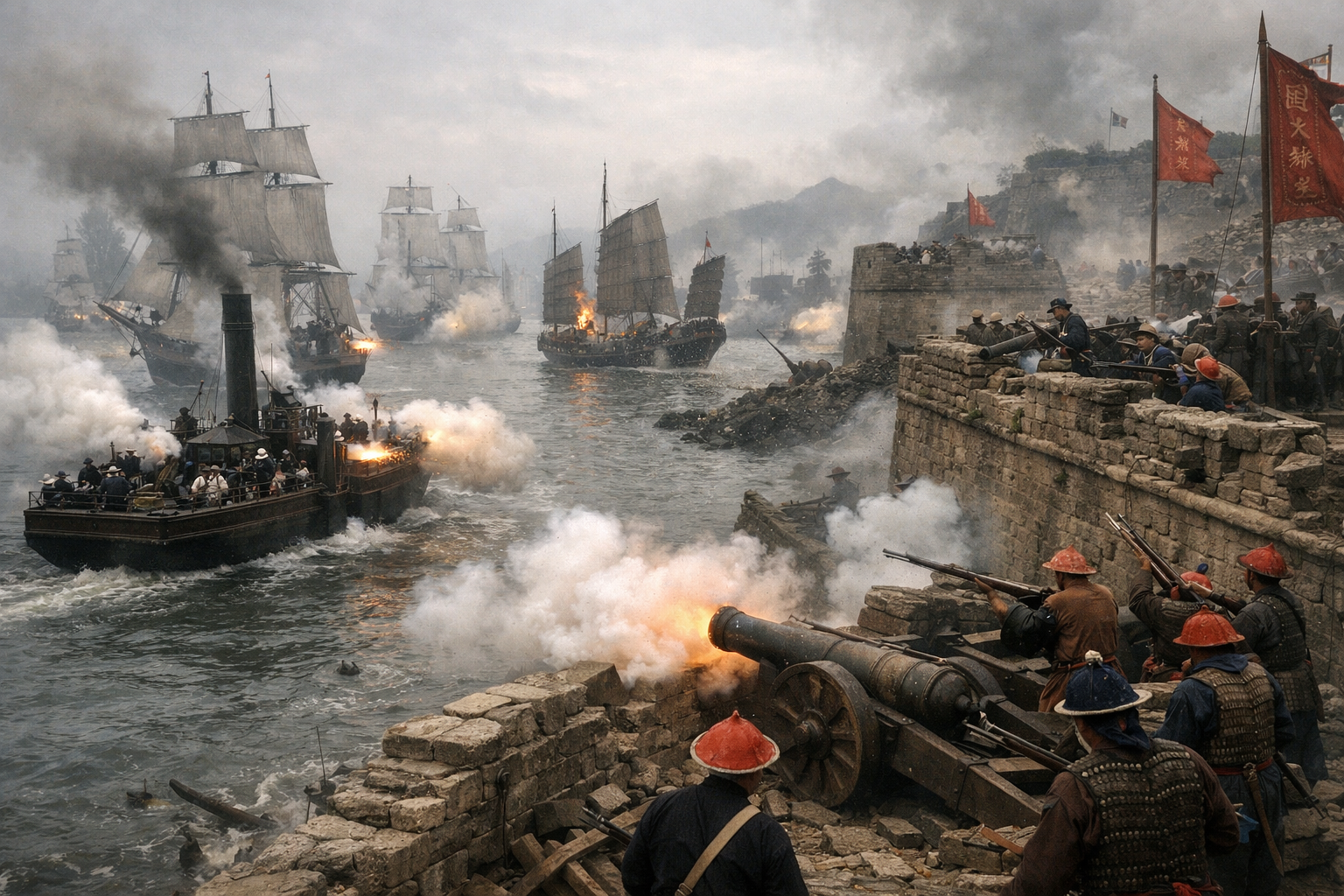
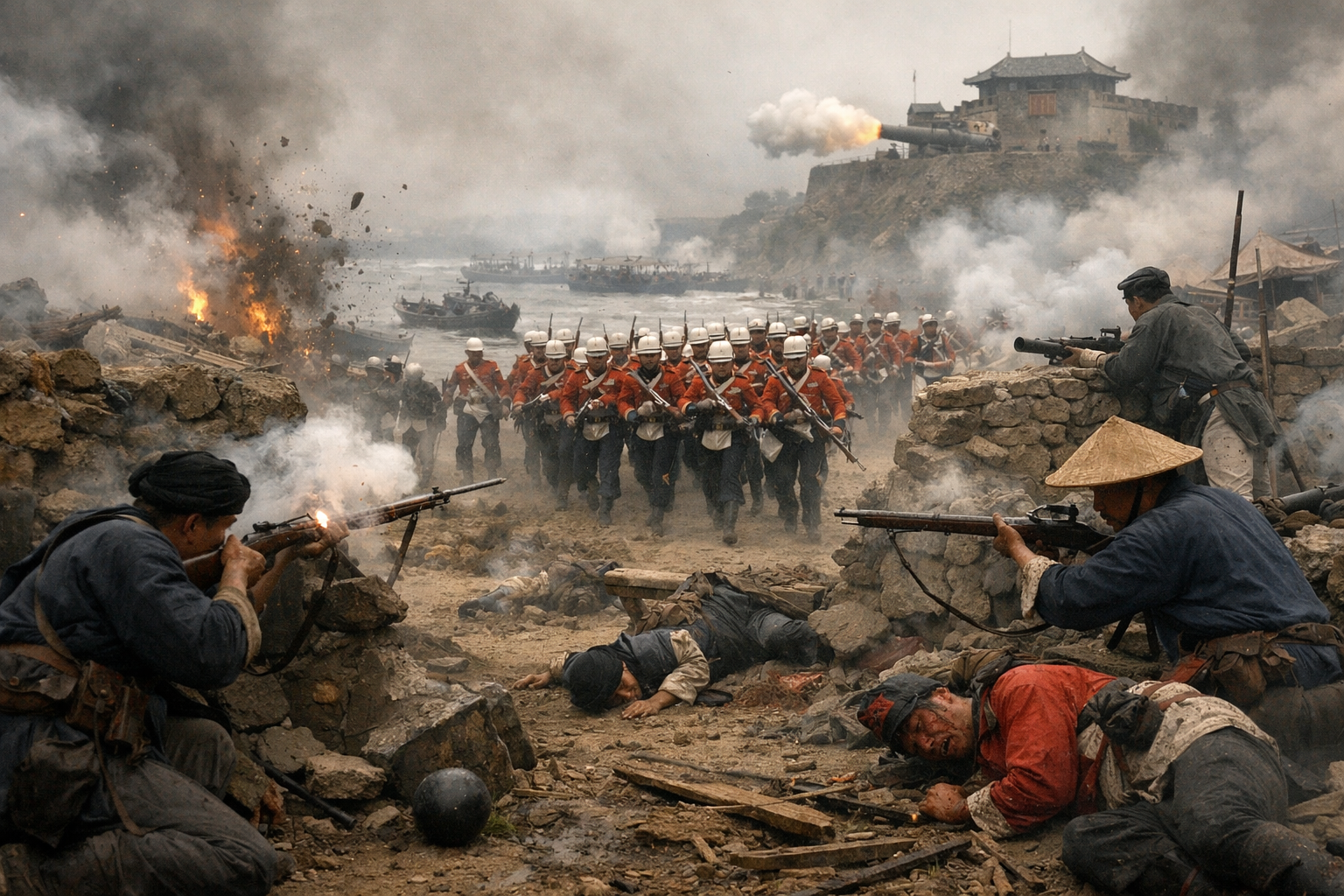
Scenes from the First Opium War recreated using AI.
When Capitalism Breaches a Civilization
The First Opium War is not merely a military conflict; it is a moment of structural rupture. Commercial capitalism forced its way into a civilizational order that had no conceptual place for it.
The Qing Empire was not "closed" in the simplistic sense often suggested by 19th-century British rhetoric. It was highly sophisticated and deeply interconnected internally. It also engaged in controlled forms of foreign trade. However, this trade was embedded within a moral and political framework that subordinated commerce to order, hierarchy, and cultural legitimacy. Trade was permitted and valued but contained geographically (Canton), institutionally (the Cohong), and symbolically (the tributary system).
What Britain represented was fundamentally different. Britain was not merely another trading partner seeking access; it was the carrier of a new logic: trade as an expansive, self-justifying system driven by profit and backed by state power that was increasingly indifferent to the moral frameworks of the societies it entered. The opium trade itself exemplified this logic in its most destabilizing form: an illegal, socially destructive commodity that was nevertheless indispensable to British commercial strategy in Asia.
At this point, the encounter ceased to be a negotiation and became a collision.
The Qing state attempted to respond within its own conceptual framework: prohibition, moral regulation, and administrative enforcement. The appointment of Lin Zexu embodied this approach. His actions at Humen were not only an act of law enforcement but also a reaffirmation of a worldview in which the state had the right and duty to regulate harmful commerce. However, this response misread the nature of the system it confronted. Britain did not treat the opium trade as a moral or legal issue within the Qing framework. Britain treated the opium trade as a commercial interest backed by sovereign power. When that interest was threatened, Britain escalated to war.
Defeat was not the only consequence; displacement followed as well. The Treaty of Nanjing and its successors did more than open ports; they introduced a new set of principles to China—fixed tariffs, extraterritorial jurisdiction, and treaty-based residence—that operated outside and above the existing Qing order. These were not negotiated adaptations, but rather imposed structures that redefined the terms of interaction.
In this sense, the war marked the beginning of a profound asymmetry. Although China was not colonized in the conventional territorial sense, it was drawn into a global system whose rules it neither shaped nor accepted. The result was not immediate collapse but rather a long process of erosion: fiscal, legal, and conceptual.
The deeper tragedy lies here. The Qing Empire was not only outmatched militarily, but also confronted with a form of power it could not fully comprehend. Its categories—such as tribute, hierarchy, and moral governance—were not equipped to grasp a system in which commerce and profit had become primary instruments of geopolitical domination.
Thus, the breach widened.
Where cultural encounters had once produced fragile dialogues, economic compulsion now produced submission. The earlier bridge, built through figures such as the Jesuits and sustained by mutual, albeit imperfect, curiosity, gave way to a new order in which understanding was unnecessary. Power spoke directly through trade and force.
The Second Opium War, 1856–1860
The First Opium War failed to resolve the underlying tensions between the Qing Empire and the expanding Western powers. British policymakers, merchants, and diplomats were dissatisfied with the limited concessions secured in 1842. They sought a broader restructuring of China’s external relations. By the 1850s, Britain aimed to expand commercial access, secure permanent diplomatic representation, extend mobility within the Chinese interior, and stabilize the conditions under which foreign trade, including the opium trade, could operate.
The immediate pretext for renewed conflict came with the so-called Arrow Incident of 1856. This incident involved the boarding of a Chinese-owned, British-registered vessel by Qing authorities in Canton. Britain treated the episode as a violation of its flag and treaty rights, although the legal basis for this claim was ambiguous.
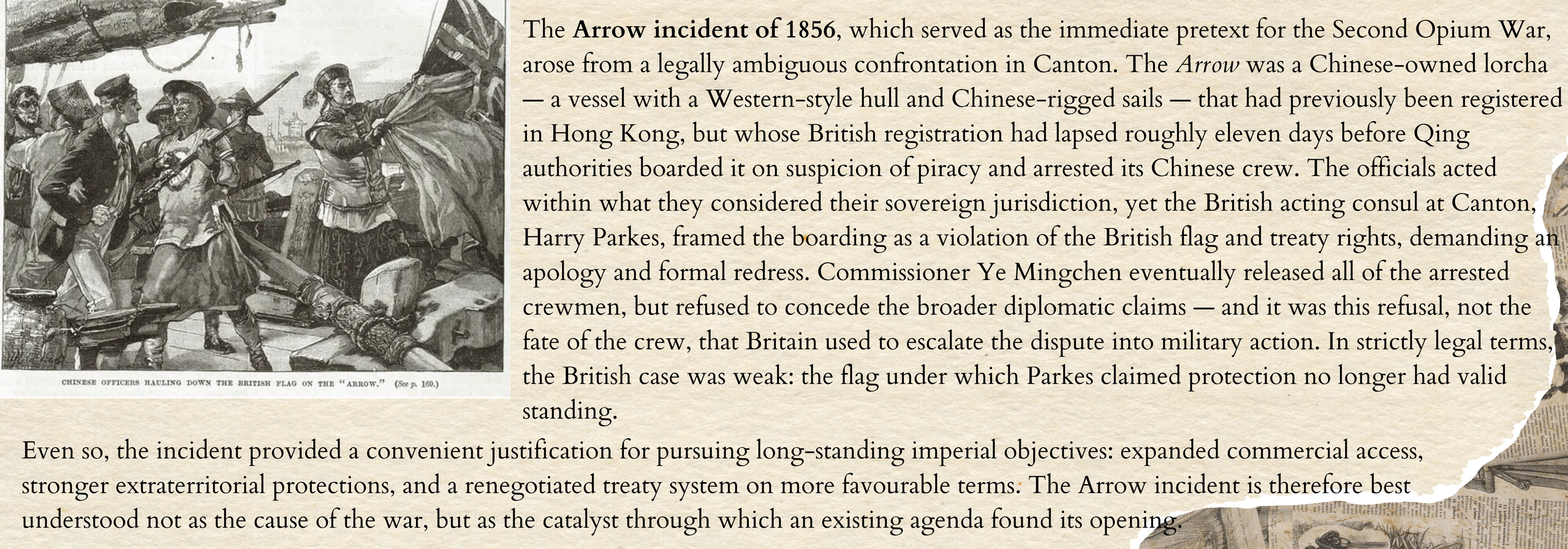
France soon joined the conflict, citing the execution of the missionary Auguste Chapdelaine as justification.
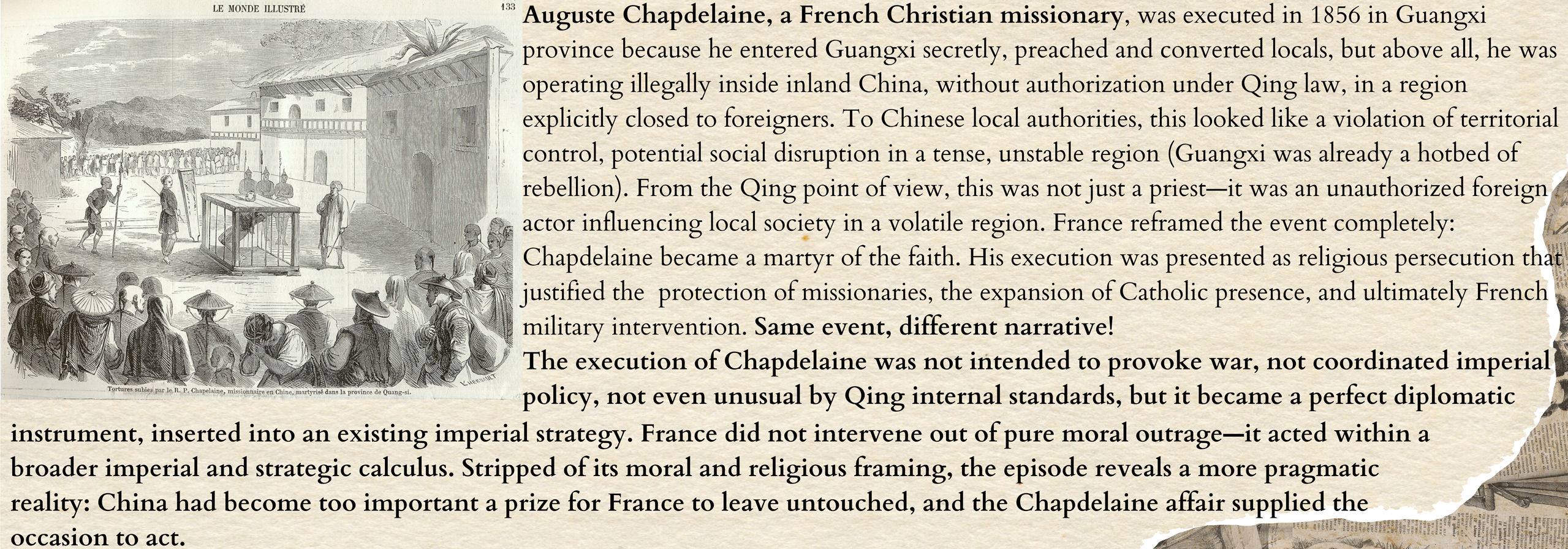
As in the previous war, such incidents served less as genuine causes and more as catalysts. They provided a pretext that could be used diplomatically and morally to pursue pre-existing imperial objectives. These incidents served as points of activation for a broader imperial agenda, much like in the earlier war.
That agenda was explicit. Britain and its allies sought to do more than defend existing treaty rights; they sought to expand and consolidate a new system of foreign privilege within China. This included opening additional ports, establishing diplomatic representation in Beijing, extending extraterritorial protections, and granting greater freedom for trade, movement, and missionary activity. Thus, the conflict marked a transition from the initial breach of the Qing system to its systematic reconfiguration.
The first phase of the war resulted in the Tianjin Treaties of 1858. These agreements significantly expanded foreign access by opening new treaty ports, permitting foreign legations in Beijing, granting the right to travel within the country (subject to passport controls), and extending protections to Christian missionaries. The treaties also imposed substantial indemnities and reinforced the framework of extraterritorial jurisdiction.
However, the Qing's resistance to fully implementing these terms led to renewed hostilities.
In August 1860, during the closing phase of the Second Opium War, Anglo-French troops launched a decisive assault on the Taku (Dagu) Forts. These strategic Qing defensive positions guarded the approach to Tianjin and ultimately, Beijing. The August 21 battle resulted in the Qing forces' rapid defeat and paved the way for the advance that would culminate in the occupation of the imperial capital. The painting below depicts the Anglo-French assault on one of the Taku Forts on August 21, 1860, during the Second Opium War. The painting’s title uses the older Western spelling "Peiho," connected to the Peiho/Bei River system, at whose mouth the Taku Forts stood.
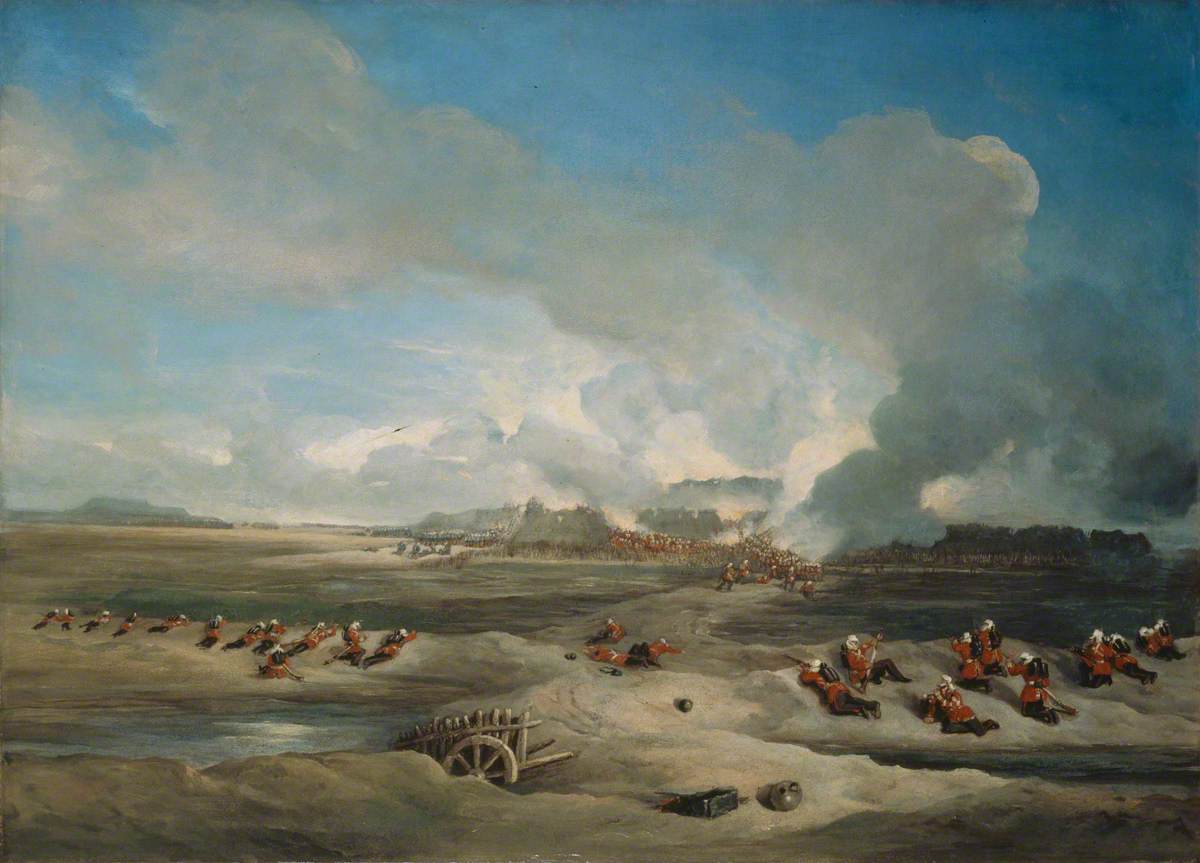
Charles Stewart Hardinge, The Storming and Capture of the North Fort, Peiho. Date: ca. 1865. Medium: oil on canvas. National Army Museum, London, UK.
In this painting, the Third Battle of the Taku Forts looks like what history remembers: an ordered, legible, and almost contained battle. It is one more episode among thousands, safely arranged within the reassuring grammar of war. In that sense, it was just another battle.
But nothing in war is as it seems. Nothing is as it is later recounted. Something has to be erased, or no one would endure it, let alone fight in it.
The truth is simpler and far more brutal. Every war and every battle, including the storming of the North Fort at Taku, is a descent into filth, terror, and pain. Not strategy, not glory, but mud, screams, and shattered bodies. The air is thick with gunpowder and decay. Blood, excrement, and fear. Men reduced to dusty matter.
Yet, for once, that truth was not entirely buried. It survives in the photographs of Felice Beato (1832/34–1909), who recorded the aftermath with neither mercy nor illusion. These images do not interpret. They do not ennoble. They simply show.
Some of them are shown below. They are difficult to look at. That is precisely the point.

Warning: The images discussed below contain graphic depictions of death and may be deeply disturbing.
These photographs were taken by Felice Beato, one of the earliest photographers to systematically document the realities of war, in the immediate aftermath. Unlike later, more mediated representations of conflict, Beato’s images confront viewers with the unfiltered consequences of violence. The bodies of Chinese soldiers lie scattered across breached fortifications where they fell. Their anonymity underscores the scale and impersonality of imperial warfare.
These photographs are historically significant because they record the outcome of the Battle of the Taku Forts (1860) and mark a turning point in visual culture. For one of the first times, war was not illustrated or narrated—it was shown. What is shown here is neither heroic nor cinematic. There is no triumph in these images, no dignity conferred by distance or allegory. Only the stark, unbearable presence of death is shown.
Confronting Beato’s work means facing a difficult truth: the violence of war resists aesthetic redemption. These images do not invite admiration; they demand reckoning.
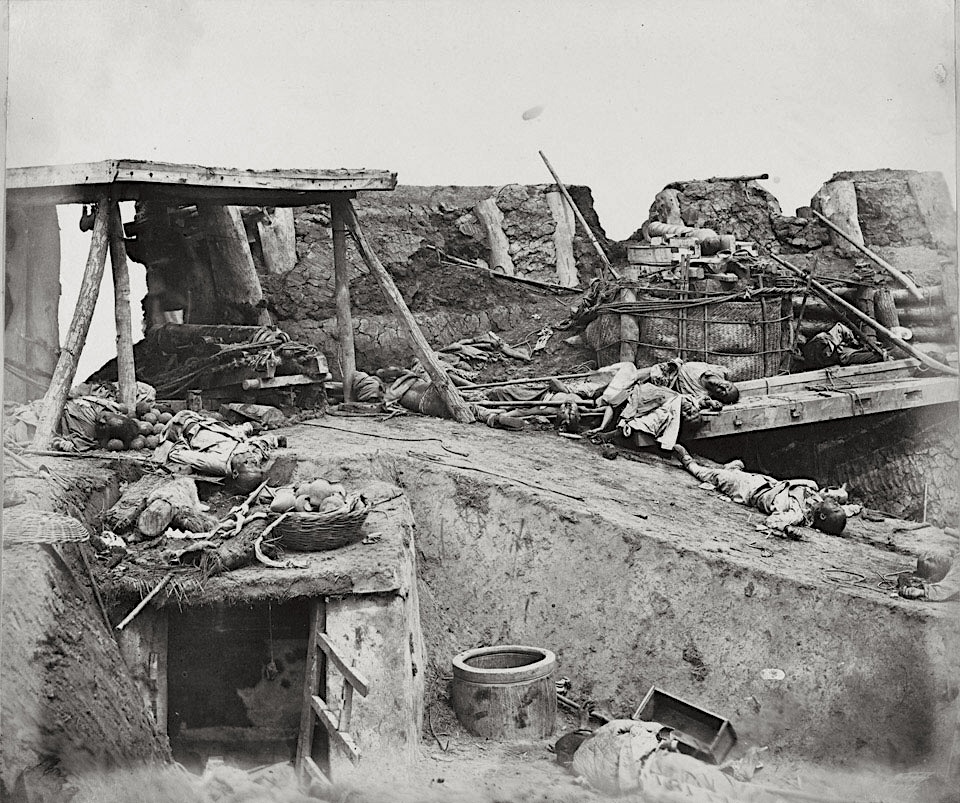
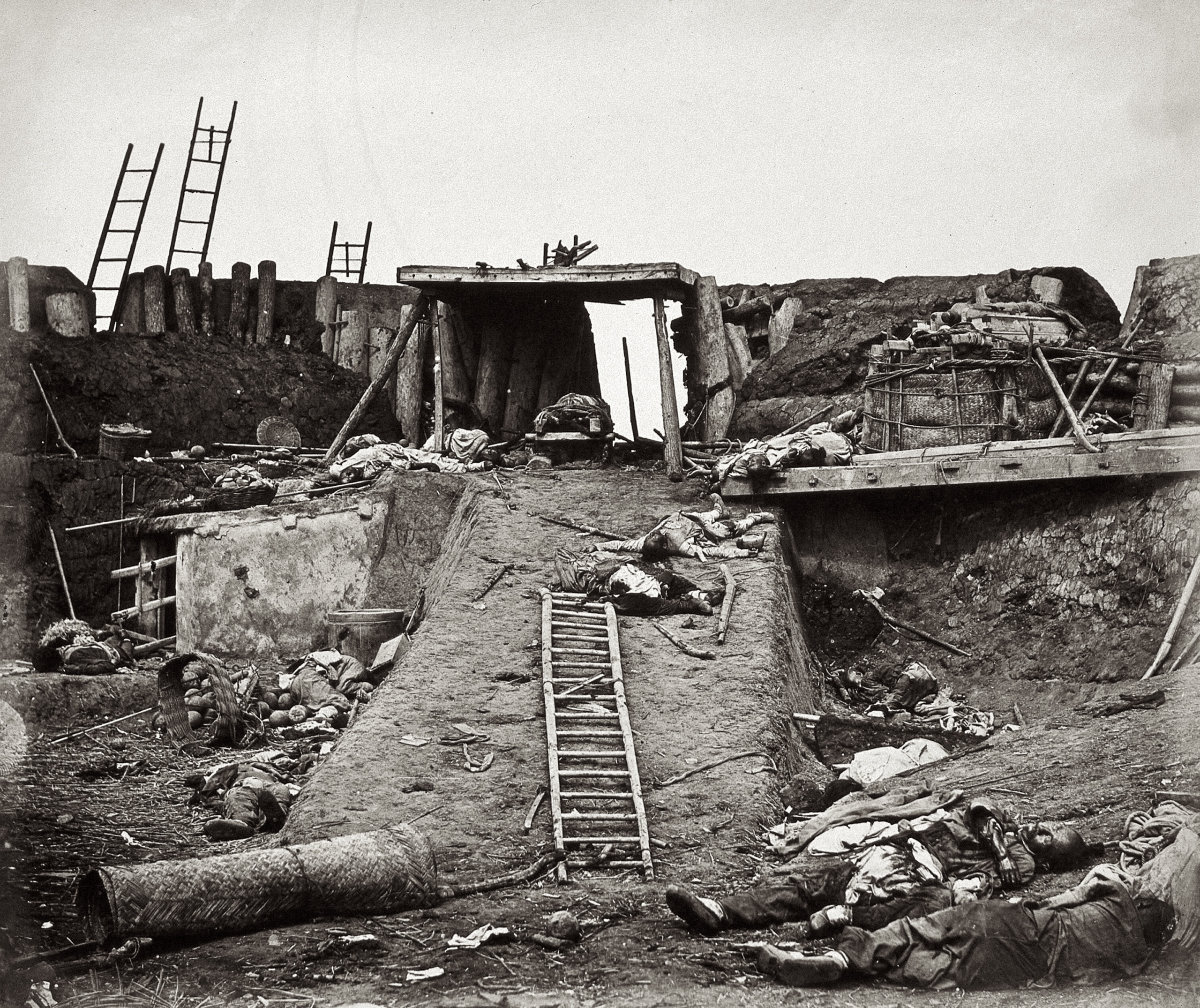
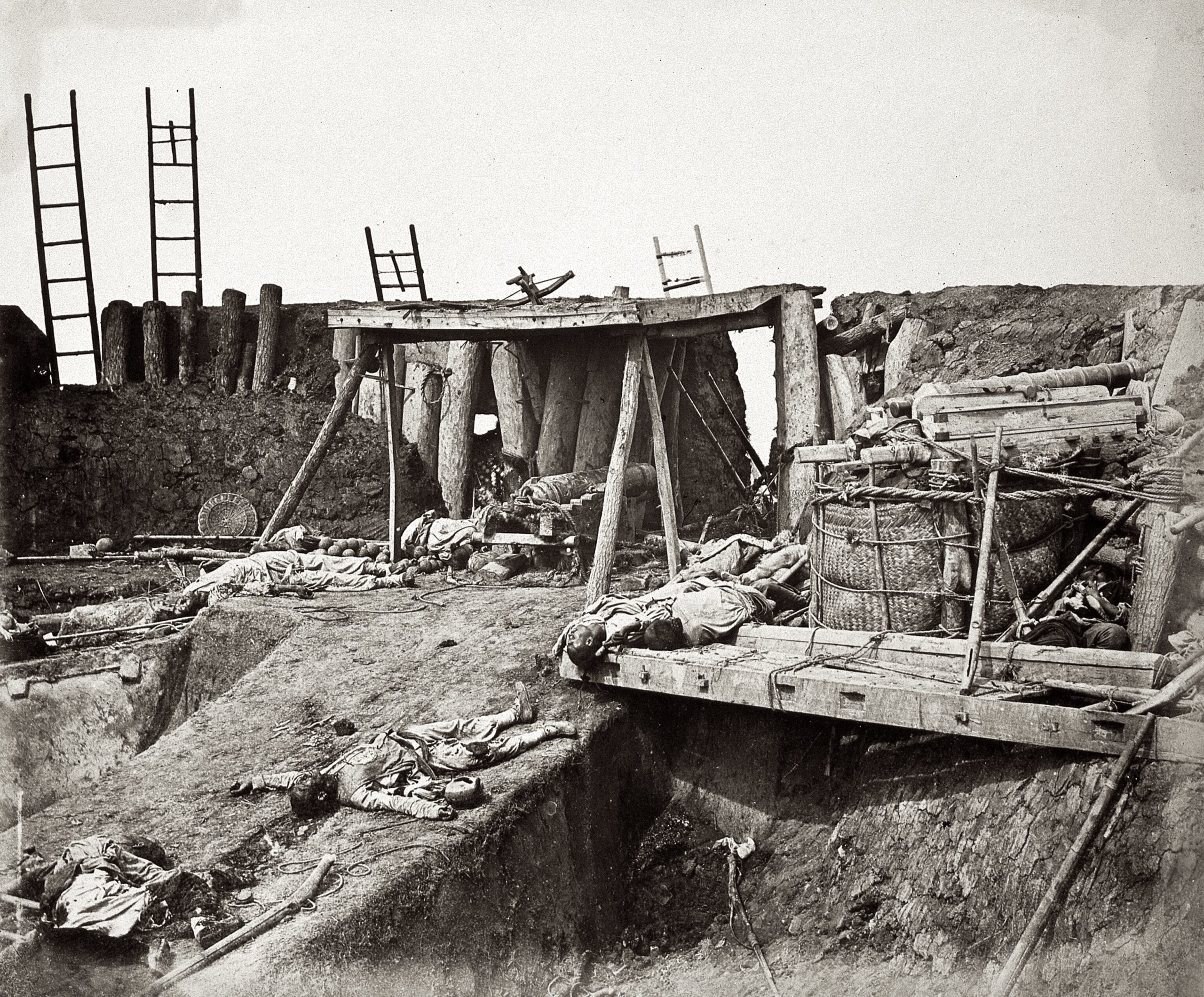
Following the fall of the Taku Forts in August 1860, the Anglo-French armies advanced from Tianjin toward Beijing, transforming a coastal victory into a direct assault on the Qing imperial center. During this final campaign, British and French prisoners, who had been captured during negotiations, were tortured, and several died in captivity. In retaliation, Lord Elgin ordered the looting and destruction of the Old Summer Palace (Yuanmingyuan), the vast imperial garden complex outside Beijing. The burning of the palace became one of the clearest symbols of nineteenth-century imperial violence in China. It was not only the annihilation of an irreplaceable cultural and architectural treasure, but also the violent collapse of any possibility for political understanding between the Qing court and the Western powers.
The destruction was not only of precious heritage, but also of what remained of diplomatic trust.
On the Qing side, the seizure and abuse of prisoners showed that negotiations had devolved into brutality. On the Anglo-French side, the burning of the Old Summer Palace showed that imperial warfare had moved beyond military necessity into symbolic devastation. In that sense, dialogue had indeed given way to violence on both sides. However, the two sides were not morally or politically equivalent. The British and French were the invading powers advancing through China to impose their demands by force. While Qing violence was real and condemnable, it took place within the context of resistance to foreign military aggression. By contrast, the destruction of Yuanmingyuan was an act carried out by an imperial expeditionary force already deep inside Chinese territory. Thus, although both sides resorted to violence, they did not occupy the same historical position. Although violence had replaced dialogue on both sides, this violence was not symmetrical. Qing brutality emerged from a desperate defensive struggle, while Anglo-French violence stemmed from the logic of imperial conquest and punitive domination.
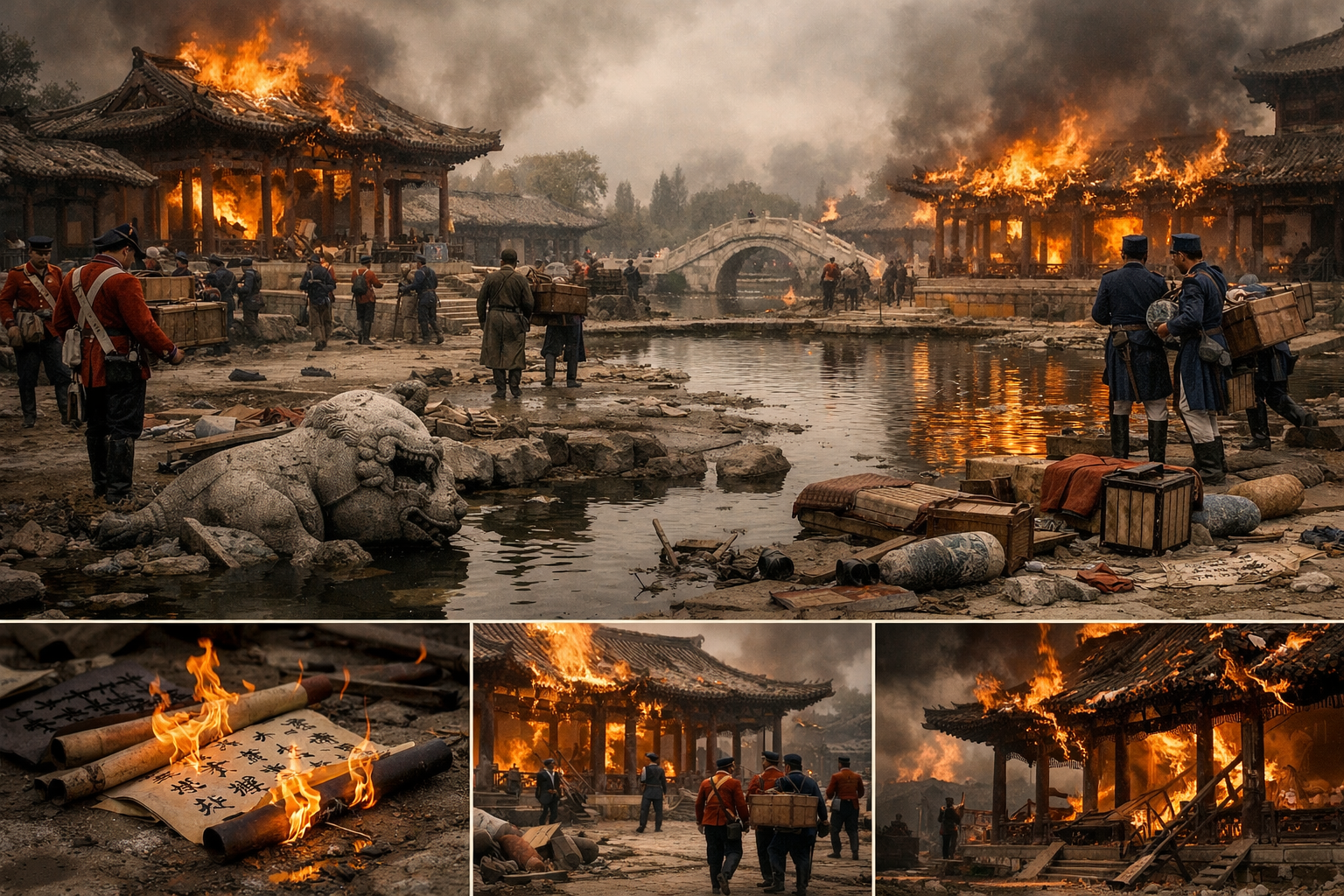
The war ended with the Convention of Beijing in 1860, which ratified and expanded the Tianjin agreements. This treaty opened Tianjin as a treaty port, legalized the permanent presence of foreign diplomats in Beijing, expanded commercial access along the Yangtze River, and ceded the Kowloon Peninsula (south of Boundary Street) to Britain. The treaty also imposed further indemnities and deepened the system of foreign legal and economic privileges.
The Second Opium War is significant because it clarifies the nature of the conflict. While the First Opium War may have appeared to be a contingent dispute over trade restrictions and enforcement actions, the Second Opium War revealed it to be part of a sustained imperial project. The renaming of the conflict as the "Arrow War" in some Western accounts reflects an effort—conscious or not—to divert attention from the central role of opium and the coercive mechanisms through which Western powers expanded their influence in China.
In practice, the postwar settlement did more than expand trade; it restructured the conditions under which China could exercise sovereignty. Tariff autonomy was constrained, legal jurisdiction was fragmented, and the foreign presence was normalized within key urban and commercial spaces. While not formally legalized by a single explicit clause, the opium trade was effectively incorporated into this new system. Its importation was regulated by the treaty tariff framework, and its suppression became increasingly untenable.
The result was not colonization in the formal sense but rather something more complex and enduring: China's insertion into a global order shaped by industrial capitalism and enforced through military power, legal asymmetry, and diplomatic coercion. If the First Opium War opened the breach, the Second made it permanent.
Opium and the Imperial Conquest of China
Britain did not colonize China as it did India, nor did it annex the Qing Empire outright. However, the Opium Wars undoubtedly produced another type of imperial conquest: the conquest of China’s commercial sovereignty, legal autonomy, and coastal gateways. First, Britain destabilized the existing trade order through opium; then, through war, it converted illegal advantage into legal privilege.
Opium was integral to this process. It linked India to China, company rule to imperial expansion, and contraband profit to geopolitical power. The East India Company’s opium system generated revenue in India, supplied traders in the South China Sea, reversed silver flows, and financed tea imports into Britain. When the Qing state attempted to defend itself against this system, Britain responded with war and coercive treaties. The sequence is clear: first, an imperial commodity chain; then, a sovereignty crisis; then, military intervention; and finally, the remaking of China’s treaty order in Britain’s favor.
For China, the consequences were profound.
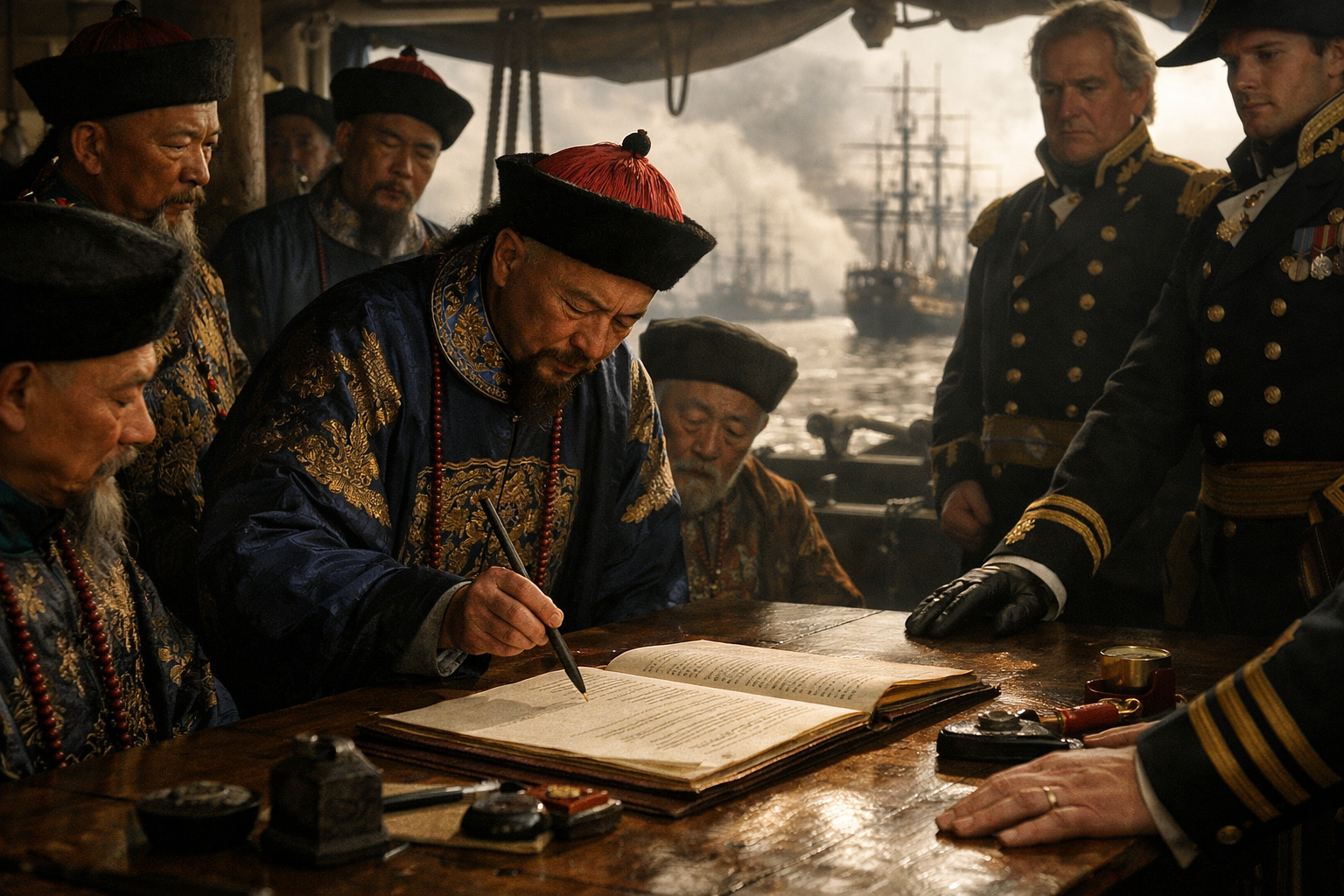
Signing of the Treaty of Nanking (1842). AI-generated image.
The system of "unequal treaties"
Following the Opium Wars, China was not formally conquered; rather, something more insidious occurred: the gradual establishment of a system designed to operate within the empire while steadily eroding its sovereignty. The so-called "unequal treaties," beginning with the Treaty of Nanjing and extending through the Treaty of Nanjing, the Treaty of Tianjin, and the Convention of Beijing, were not agreements between equals but rather settlements imposed under the pressure of defeat. These treaties compelled the Qing state to cede Hong Kong Island and part of the Kowloon Peninsula to Britain, open a growing network of treaty ports to foreign residence and trade, and pay heavy indemnities that threatened its financial stability. Even more consequential was the transformation of the legal and economic order. Tariffs were fixed beyond Chinese control. Foreign powers obtained extraterritorial jurisdiction over their nationals. Most-favored-nation clauses ensured that concessions granted to one state were rapidly extended to others. Within this framework, the opium trade—never legalized by a single act—was absorbed into the new regime and became increasingly difficult to suppress. The result was a profound reconfiguration of power. Although China was not annexed, it was forced to host a system of foreign privilege within its territory that limited its authority, fragmented its sovereignty, and integrated it into an expanding global order on unequal terms. Even where Britain did not rule directly, it imposed structures that diminished Chinese authority. This is why the Opium Wars occupy such a significant place in modern Chinese historical memory. They marked not only military defeat, but also the beginning of coerced incorporation into an imperial world economy on terms set by others.
The system of unequal treaties was not just a British imposition. Britain started it, but other powers quickly followed suit and demanded the same or comparable privileges.
The most-favored-nation clause was the key mechanism. Once China was forced to grant an advantage to one foreign power, other powers could often claim the same benefit. This meant that a concession extracted by Britain would not remain exclusively British for long. The result was a cumulative process: the treaty system gradually expanded, and more and more states acquired commercial, legal, missionary, and diplomatic privileges in China without having to fight separate wars.
The primary beneficiaries were Britain and France, who played central military roles in the Opium Wars. Britain obtained Hong Kong Island in 1842 and part of Kowloon in 1860. The country also gained treaty-port access, indemnities, and broad commercial privileges. France strengthened its position through missionary protections, diplomatic access, and commercial rights, especially after the Second Opium War. The United States also benefited early on, notably through the Treaty of Wangxia in 1844, which secured extraterritorial rights and commercial access without having to wage war on the scale of the British. Russia was another major beneficiary, albeit in a different way. It exploited the Qing dynasty's weakness to secure treaty privileges and obtain significant territorial gains in the northeast through the Treaties of Aigun (1858) and Peking (1860). This expansion occurred at China’s expense in the Amur and Ussuri regions.
After these leading powers, several other European states entered the treaty framework and claimed analogous rights. Among them were Prussia, the Netherlands, Denmark, Spain, Belgium, and Italy. Portugal later joined in a more formalized way regarding Macao. Their influence was not equal to that of Britain, France, Russia, or the United States. Nonetheless, they benefited from the same system of privileges: access to treaty ports, diplomatic recognition, consular jurisdiction, and commercial concessions. In other words, once the system had been forced open, China became exposed not to one foreign power alone but to a wider international scramble for access and advantage.
Thus, in brief, the unequal treaties did not benefit Britain alone. Once Britain forced open the Qing Empire, other powers quickly claimed similar privileges through parallel treaties and most-favored-nation clauses. France emerged as a major beneficiary after the Second Opium War, especially through protections for missionaries, diplomatic representation, and expanded commercial rights. The United States secured advantages early on through the Treaty of Wangxia (1844), including extraterritorial jurisdiction and access to treaty ports. Russia took advantage of the Qing's weakness to obtain treaty privileges and seize vast territories in the northeast through the Treaties of Aigun and Peking. Other European states—notably Prussia, the Netherlands, Denmark, Spain, Belgium, Italy, and Portugal—also entered the treaty system and obtained varying degrees of commercial and legal privilege. Thus, the unequal treaties created a broader international regime in which multiple foreign powers exploited China’s enforced opening for trade, influence, and territorial advantage, not just British dominance.
Western satyrical prints and cartoons in the mid-19th century
The Opium Wars did not pass uncontested in the West. Alongside official justifications about treaty rights, diplomatic honor, and commercial freedom, there emerged a strong countercurrent of criticism in Britain and beyond: politicians, journalists, missionaries, radicals, and satirists denounced the spectacle of a great imperial power waging war in defense of a trade that many already recognized as morally corrupt and politically indefensible.
The French caricature below belongs to that history of dissent. Published in Paris in La Caricature Provisoire on May 10, 1840, it shows a grotesque English figure forcing opium upon China while violence unfolds in the background. Even in satirical exaggeration, its message is unmistakable: British commerce in China had become inseparable from coercion, poison, and war.
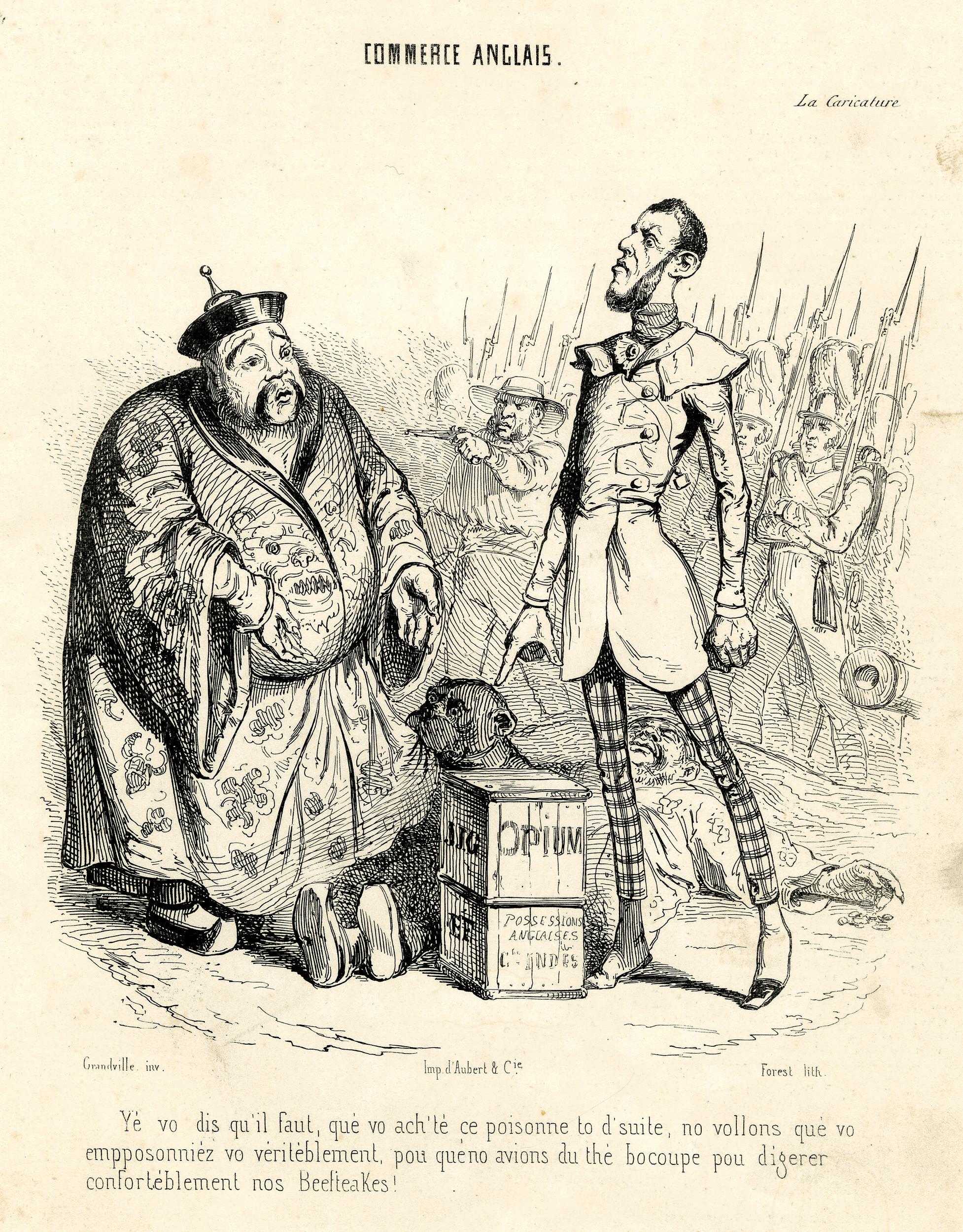
Commerce Anglais (English Commerce), satirical print after J. J. Grandville, published in La Caricature Provisoire, no. 19, May 10, 1840. Paris, France. © The British Museum, London, UK.
Let's analyze this satirical cartoon. The caption is not proper French. It is a phonetic parody of how a French caricaturist imagined an Englishman speaking French—heavy, clumsy, intrusive, and slightly absurd.
The original text reads: “Yé vo dis qu’il faut, qué vo ach'té ce poisonne to d’suite, no vollons qué vo empposonniéz vo véritéblement, pou quéno avions du thé bocoupe pou digerer confortéblement nos Beefteakes!”
Rendered clearly, the meaning is: “I tell you, you must buy this poison immediately. We want you to poison yourselves properly, so that we may have plenty of tea to comfortably digest our beefsteaks!”
This print is a French critique of British trade in China during the First Opium War (1839–1842). Let’s break its visual language.
The figures
- On the left: a Qing Chinese official, rendered with exaggerated features typical of European caricature (problematic, but standard for the time).
- On the right: a thin, arrogant Englishman, rigid, upright, almost mechanical—embodying cold commercial logic.
- Behind him: armed British soldiers → this is not trade, it is trade backed by force.
The object at the center
- The crate labeled “OPIUM”.
- Beneath it: references to British possessions (i.e., India)—the real source of the drug.
The dead/dying figure
- At the Englishman’s feet: a collapsed Chinese body → the consequence of the trade.
The joke is savage. The Englishman says, in broken French: “Buy this poison—poison yourselves properly—so that we can enjoy our tea and digest our beef.”
This condenses the entire opium system into one obscene exchange:
- Britain wants tea from China;
- China does not want British goods;
- So Britain sells opium (from India) to force a trade balance;
- When China resists → war.
The caricature strips away all diplomatic language and shows the logic naked: You poison them so you can eat comfortably.
The distorted language is not just comic—it is strategic.
- It marks the Englishman as foreign, intrusive, and uncultured.
- It exaggerates his speech to make him sound crude and morally tone-deaf.
- It reinforces the idea that British “civilization” is a mask over brutality.
In other words: he speaks badly because he thinks badly.
There's also a deeper layer. This image expose the hypocrisy of “free trade”, show the violence hidden behind commerce, reveal that economic exchange is pure coercion when backed by empire. The French caricaturist is even more brutal as he reduces the entire system to a single obscene sentence.
Now, let's analyze another powerful image by Honoré Daumier. Let’s go carefully, because this drawing is doing a lot with very little.
![Profitant de la circonstance, pour engager les Chinois à se payer pour deux cent millions d’opium… (“Taking advantage of the situation to induce the Chinese to pay for two hundred million [worth] of opium…”). By Honoré Daumier. Published on Le Charivari on December 29, 1858, in Paris (France). The date places it at the end of the Second Opium War (1856–1860), right around the time when European powers were intensifying pressure on Qing China and extracting further concessions.](http://www.theethnichome.com/wp-content/uploads/2026/04/profitant-de-la-circonstance-1e41dc.jpg "Daumier’s cartoon")
Profitant de la circonstance, pour engager les Chinois à se payer pour deux cent millions d’opium… (“Taking advantage of the situation to induce the Chinese to pay for two hundred million [worth] of opium…”). By Honoré Daumier. Published on Le Charivari on December 29, 1858, in Paris (France). The date places it at the end of the Second Opium War (1856–1860), right around the time when European powers were intensifying pressure on Qing China and extracting further concessions.
At the center of the scene, there's a grotesquely thin European figure—clearly coded as English—forcing opium down the throat of a Chinese man. This last figure is passive, tilted backward, mouth open, almost already lifeless. The European is rigid, angular, predatory, his gesture not commercial but violent and coercive. Around them: crates marked “OPIUM” → this is not incidental, it is industrial, systemic.
There is no negotiation here.
This is not exchange.
This is forced consumption.
There's no trade, just violence.
Daumier collapses the entire Opium War into one image: Britain does not sell opium to China—it forces China to ingest it.
The gesture is key. The hand is not offering—it is pushing, almost like a feeding tube. This transforms commerce into something closer to medical violation, poisoning, and physical domination. It is, quite literally, economic imperialism as bodily violence.
The caption matters because it adds a second layer:
- Not only are the Chinese being poisoned.
- They are being made to pay for their own poisoning.
That is the full obscenity.
Daumier simplifies—and in doing so, he radicalizes.
- Caricature as moral weapon
The Englishman is exaggerated into a mechanism of will, almost inhuman. The Chinese figure becomes pure victimhood. This is not balanced—it is deliberately accusatory.
- Compression of a system into a gesture
Instead of ships, treaties, tariffs, diplomacy, just one act: forcing poison into a mouth. That’s the whole empire, reduced to its truth.
- The body as a battlefield
This is crucial. The war is not shown as armies clashing but as a body being violated. That’s far more disturbing—and far more honest.
Thus, in Daumier’s 1858 caricature, the fiction of commerce collapses into a single brutal gesture: opium is not traded but forced, and China is made to swallow both the poison and the cost of its own destruction.
Moral Outrage and Political Criticism
Karl Marx was one of the sharpest European critics of the hypocrisy of “free trade”. In his New York Daily Tribune article of 20 September 1858, he argued that the wars did not truly open a healthy commercial relationship with China; rather, they deepened the destructive centrality of narcotics within imperial exchange. Marx wrote that the first war had stimulated opium “at the expense of legitimate commerce,” and he condemned what he called Britain’s “armed opium propaganda to China.” In the same article, he cited Montgomery Martin’s devastating summary of the problem: “Cease to send us so much opium,” and China would be able to take British manufactures. Marx’s point was clear: the supposed rhetoric of free trade concealed a far more brutal reality, in which military violence was being used to uphold a poisonous and distortionary commerce.
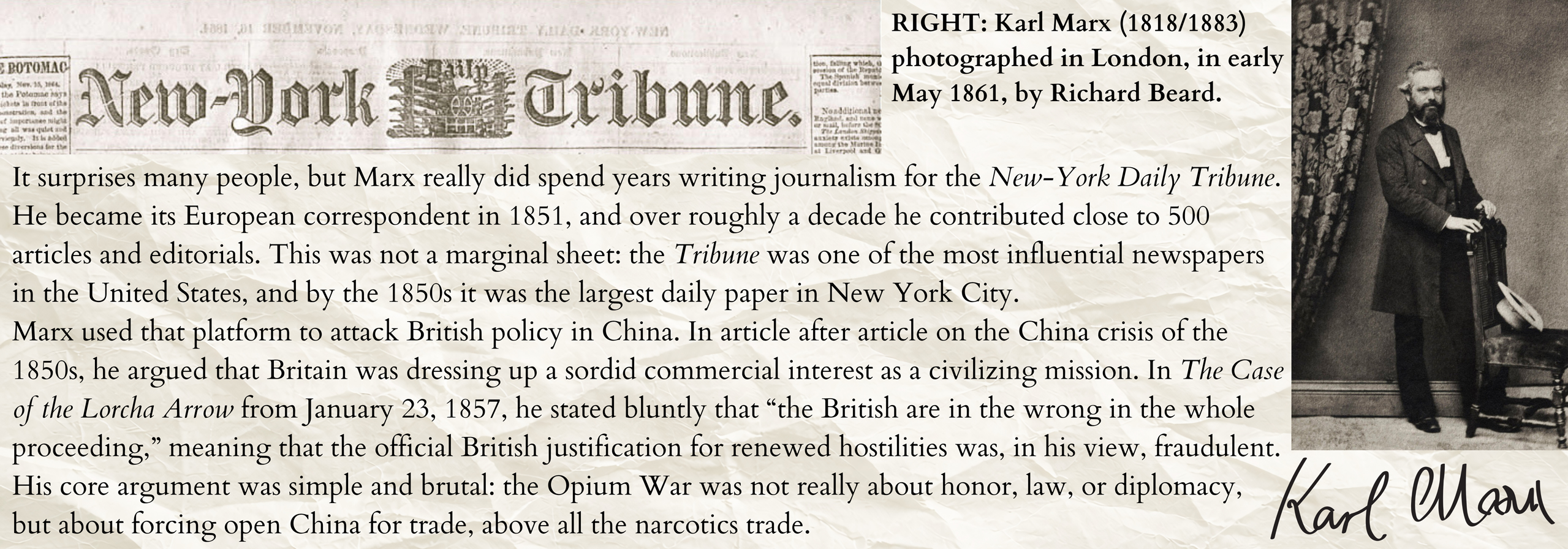
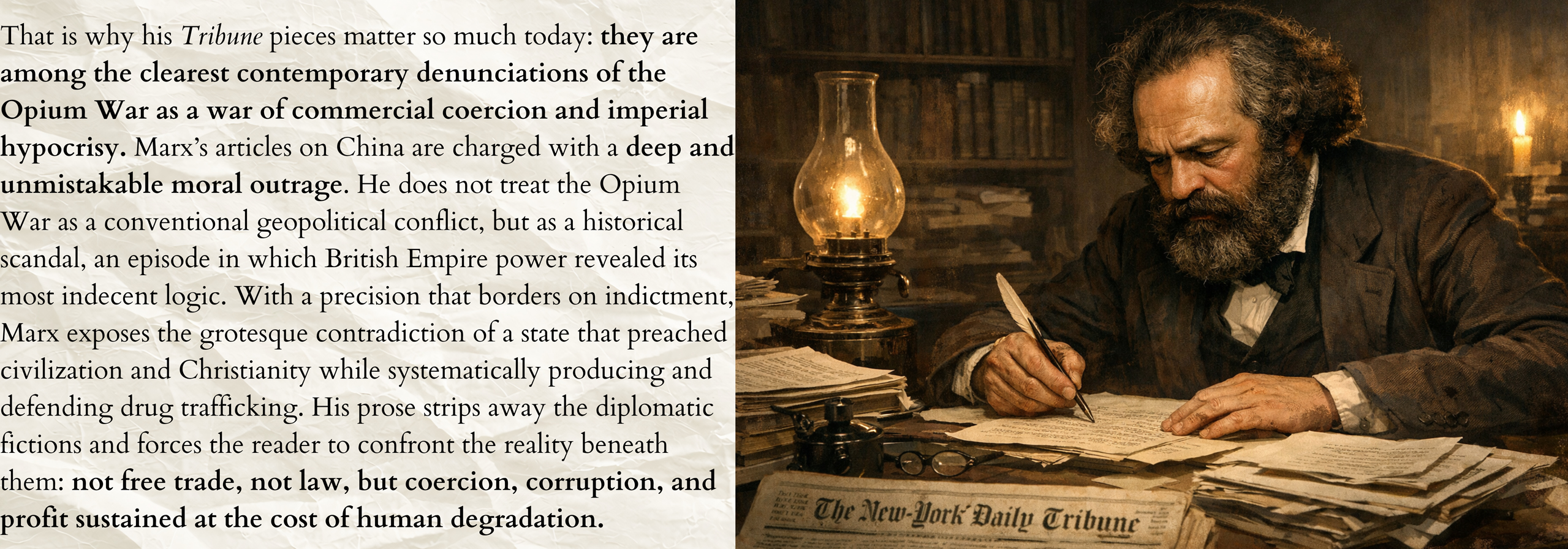
Robert Montgomery Martin, an Irish colonial statistician writing from within the intellectual framework of the British Empire, was nevertheless one of its internal critics. He argued that the opium trade had corrupted Anglo-Chinese commerce at its root, replacing legitimate exchange with a system sustained by narcotics and force—a judgment later cited by Karl Marx as evidence of the moral and economic contradictions of imperial ‘free trade.’ Montgomery Martin’s position, too, was severe. As quoted by Marx, Martin went so far as to say that the opium traffic was morally worse than the slave trade, because it degraded and destroyed its victims while corrupting the entire structure around it. That language was extreme, but it shows that criticism of British policy did not come only from socialists or anti-imperial radicals. It also came from within the broader British world itself. Marx and Martin were therefore not isolated voices. They belonged to a real, if divided, tradition of Western condemnation.
That said, their view was not the dominant consensus in Europe. It would be misleading to suggest that Europe as a whole opposed the Opium Wars. In Britain, there was substantial and vocal resistance, but there was also powerful support from commercial, governmental, and imperial circles that framed coercion as necessary to protect trade and national prestige. The parliamentary debates of 1840 make this split very visible. Some speakers openly defended British firmness and even treated the opium trade as too entrenched to suppress, while others insisted that China had every right to prohibit a contraband drug within its own territory.
Among the best-known British critics was William Ewart Gladstone, a British statesman and Liberal politician. In Parliament he denounced the conflict as “a war more unjust in its origin” and said it was calculated to cover Britain with “permanent disgrace.” He condemned the opium traffic itself as “infamous and atrocious” and argued that justice, however unfashionable it might sound to imperial ears, was on the Chinese side. Gladstone matters because he proves that moral opposition to the war was not a fringe eccentricity. It reached the center of British political life.
Recent scholarship also stresses that opposition in Britain was broader than older triumphalist narratives suggested. There was a genuine anti-war campaign between 1839 and 1843, and London newspapers helped popularize the very label “Opium War,” a name that itself carried a moral accusation. Some merchants favored peaceful engagement rather than military coercion, and missionary circles, though often complex and inconsistent in their attitudes, increasingly saw opium as a grave obstacle to Christian work and as a stain on Britain’s reputation in China. So the Western response was fractured: there were defenders of empire, but there were also people who saw very clearly what empire was doing.
On the Continent, reactions were more varied and usually less politically consequential than in Britain, but they were not absent. The attached French print is important precisely because it shows that criticism crossed borders. In France, caricature culture was already a sophisticated medium of political and moral commentary, and here it turned British commercial aggression into visual indictment. Yet continental Europe did not coalesce into a sustained anti-Opium War movement comparable to the British parliamentary debate. Criticism existed, especially in satirical, liberal, or radical circles, but it did not define official policy.
If one widens the lens beyond explicit anti-war protest, Western reactions also included something darker: fascination, stereotyping, and imperial self-justification. By the time of the Second Opium War, illustrated newspapers and popular imagery often reduced the Chinese to racialized caricatures and helped normalize aggression as spectacle. This is important because it reminds us that Western responses were not only moral or political; they were also visual and cultural. Satirical denunciation existed side by side with propaganda, mockery, and the manufacture of imperial consent.
So, was the position of Marx and Montgomery Martin “shared” in Europe? Partly yes, but not generally, and not officially. Their critique belonged to a significant Western tradition of dissent: one that included Gladstone, anti-war journalists, some missionaries, and satirists. But it did not represent the settled view of European governments, nor even the majority public mood. Europe was divided. Some saw the Opium Wars as a scandal of greed and hypocrisy; others accepted, excused, or celebrated them in the language of trade, civilization, and power. That division is precisely what makes these reactions so historically revealing. The West was not morally unanimous. It argued with itself, and some of its finest consciences knew perfectly well that what was being defended in China was not liberty, but domination. But we must highlight that the Western reaction to the Opium Wars was never one voice. It was a struggle between conscience and interest, between satire and propaganda, between those who recognized imperial violence for what it was and those who dressed it in the noble language of commerce and civilization.
The war propaganda
Please, look at the following cartoon.
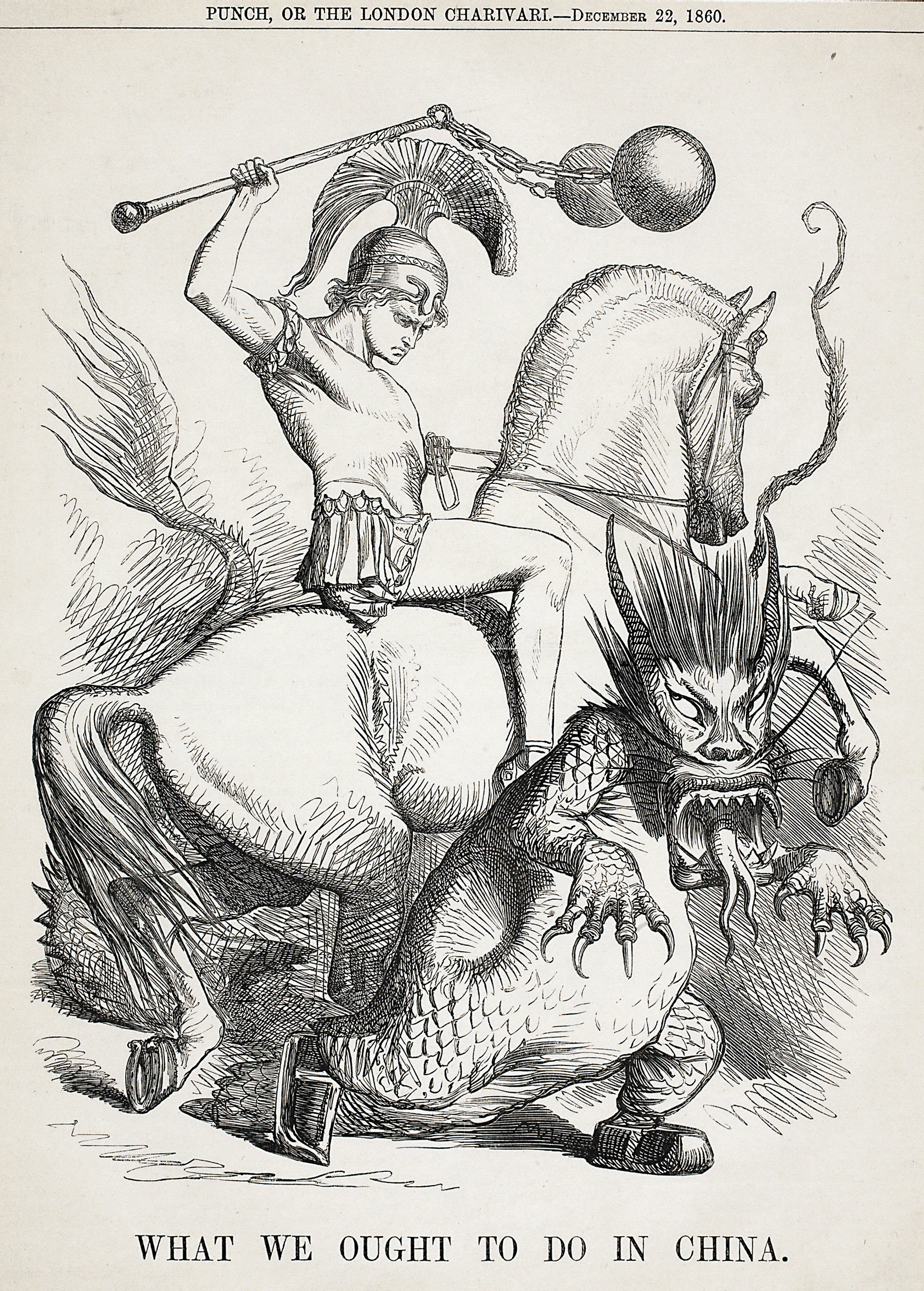
This is a Punch magazine cartoon from December 22, 1860, published at the very end of the Second Opium War—right after the Anglo-French capture of Beijing and the destruction of the Summer Palace.
Let’s unpack it clearly, because it’s deceptively simple and quite revealing.
What we see: a classical, almost Greco-Roman warrior (not a modern British soldier) riding and subduing a Chinese dragon, and raising a spiked mace to strike. The caption reads: “What we ought to do in China.”
Let's consider the symbolism.
1. The dragon = China
The dragon is the traditional imperial symbol of China—but here it is: in the cartoon it's distorted, aggressive, almost monstrous; crawling, not majestic; about to be beaten into submission. Thus, this is not neutral imagery. It dehumanizes China and turns it into something that must be subdued.
2. The rider = Britain as “a bearer of civilization”
The rider is crucial. He is not dressed as a British officer, but as a classical hero—a mix among Saint George and a Greek symbol of civilization and progress.
That choice matters. It reframes imperial violence as not conquest, but moral duty.
3. The mace = force, not diplomacy
The Greek hero/Saint George is not negotiating. He is about to strike. This is a visual argument: China does not need dialogue—it needs punishment.
Unlike the French caricature I showed you earlier, this Punch cartoon is largely supportive of British policy. It expresses a view that was widespread in Britain at the time:
- China is backward, stubborn, resistant.
- Britain represents order, progress, civilization.
- Therefore, force is justified—even necessary.
In other words, it says: “We tried diplomacy. Now we must impose.”
This image sits at a critical turning point. Earlier, there was still debate in Britain:
- Is the war just?
- Is opium defensible?
By 1860, after military victory, the tone hardens.
This cartoon shows:
- confidence after conquest;
- moral self-justification;
- the transformation of violence into “duty”.
In this 1860 cartoon from Punch, Britain no longer appears as a trader or negotiator, but as a classical avenger, poised to strike. China, reduced to a monstrous dragon, is not a counterpart but an obstacle. Violence is no longer hidden—it is justified, even prescribed.
The China Pie Cartoon and the "Partition" of China
Another famous cartoon.
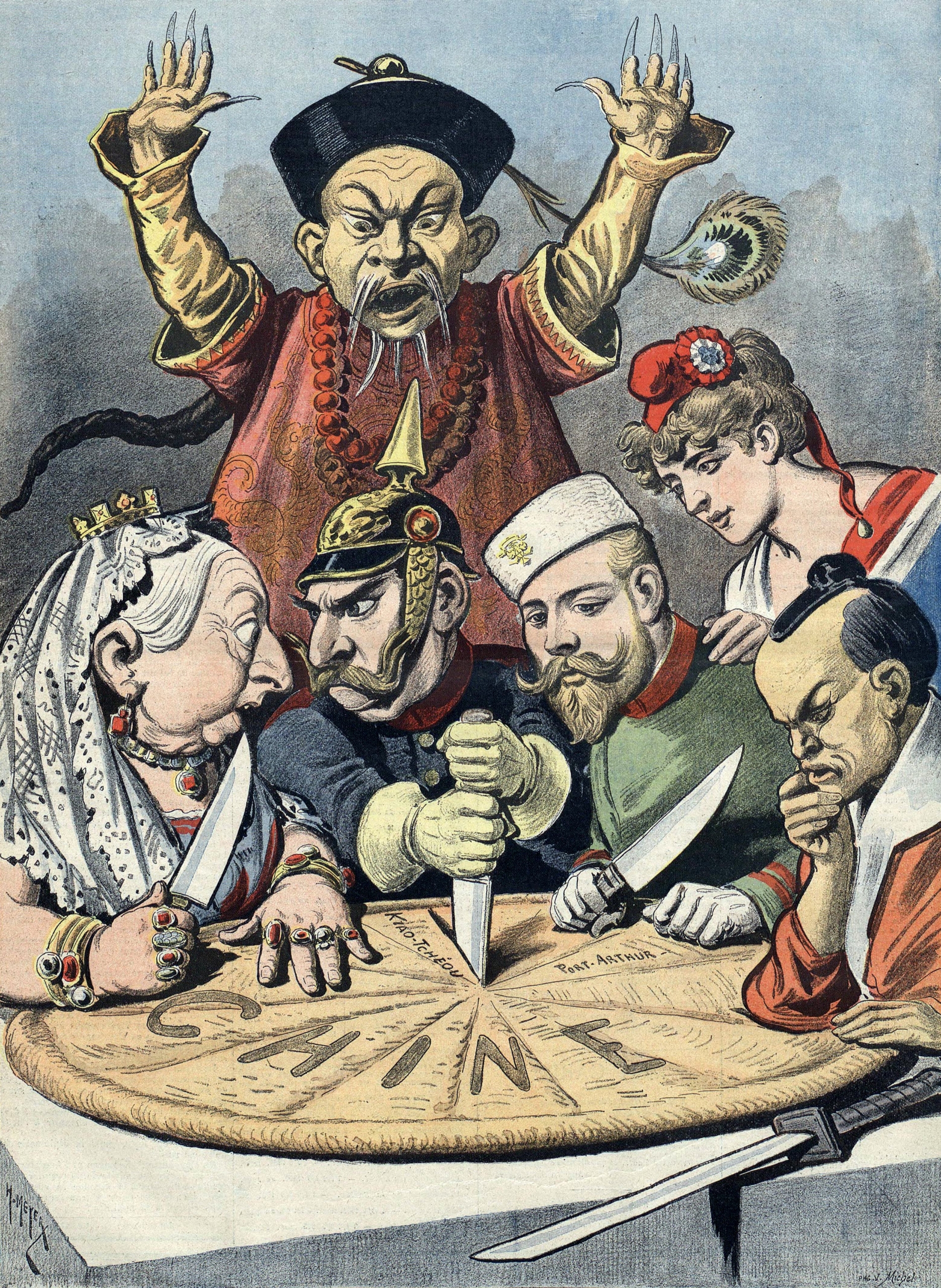
En Chine, Le gâteau des Rois et... des Empereurs ("China, the cake of kings and... emperors"). French political cartoon by Henri Meyer. Published on a supplement to Le Petit Journal, on January 16, 1898. Source: Bibliothèque nationale de France.
This famous caricature shows the great powers literally carving up China like a cake. Around the table you can recognize:
- Queen Victoria of the British Empire (depicted with the hands full of jewels and holding a razor-sharp knife);
- Kaiser Wilhelm II of Germany (who is squabbling with Queen Victoria over a borderland piece, whilst thrusting a knife into the pie to
- signify aggressive German intentions);
- Nicholas II of Russia (who is eyeing a particular piece);
- A Japanese figure representing the Meiji Emperor of Japan (who is carefully contemplating which pieces to take);
- A French Marianne-like figure (who is diplomatically shown by the French author as not participating in the carving, and is depicted as close to Nicholas II, as a reminder of the Franco- Russian Alliance).
Behind them looms a grotesque, powerless Chinese figure—angry, humiliated, but unable to intervene. It's a stereotypical Qing official(Li Hongzhang) who throws up his hands to try and stop them, but is powerless.
This image is not about the Opium Wars themselves, but about their long-term consequence: the “Scramble for China” in the late 19th century.
- The knives represent territorial concessions and spheres of influence;
- The “cake” represents China as an object to be divided;
- China is no longer treated as a sovereign empire, but as
This is the visual endpoint of what began with the Opium Wars: from forced trade → to military defeat → to semi-colonial fragmentation.
There’s something important here: this cartoon is critical, but also cynical. It does not protest innocence—it assumes imperial greed as a given.
Western reactions to the Opium Wars in the late 19th century
Western reactions to the Opium Wars and their aftermath were never unified: they oscillated between moral condemnation, uneasy self-awareness, and open justification of imperial power. Early critics such as Karl Marx and Robert Montgomery Martin exposed the contradiction at the heart of the conflict—what was presented as “free trade” was in reality a system sustained by narcotics and force. Yet, as the century progressed, a striking shift occurred in Western visual culture. The later satirical cartoons no longer simply denounce imperial violence; they reveal how deeply it had become normalized, even banal.
In the first image below (No Chance to Criticize in Puck, 1899), imperial powers carve up China while one of them—implicitly the United States—silences criticism by pointing to its own actions elsewhere (notably Cuba), suggesting that moral outrage has become impossible in a world where all participate in domination. This is a famous and very sharp American imperial cartoon—and it’s doing something slightly different from the previous French images. Let’s unpack it cleanly.
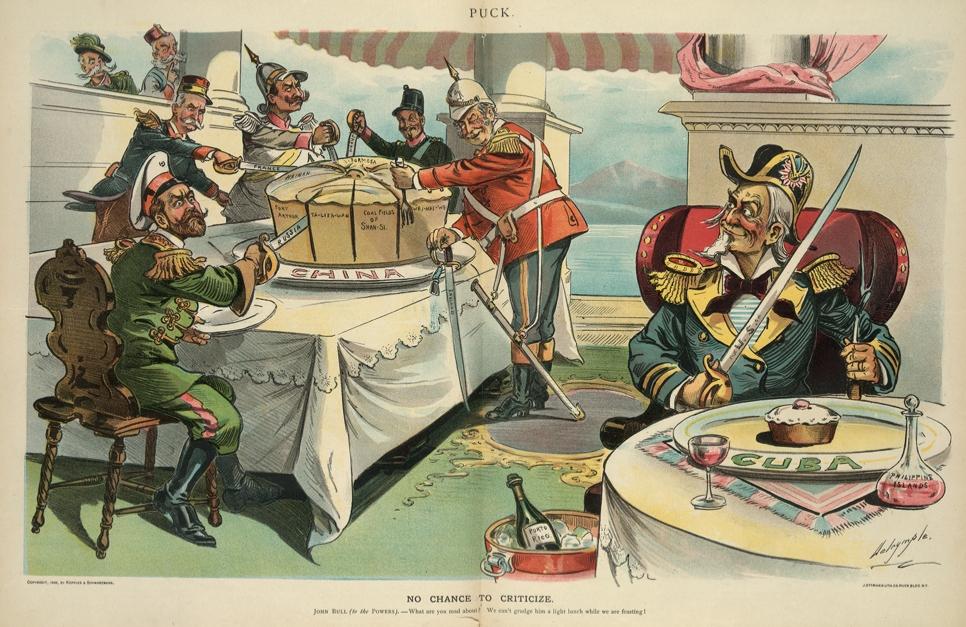
No Chance to Criticize Often attributed to J. S. Pughe, published in Puck in 1898. New York, USA.
There are two parallel scenes.
On the left, China being carved. European powers (UK, Germany, Russia, France) and Japan sit around a table literally cutting up a map of China like a cake. Each is cutting out a “sphere of influence”—not formal colonies, but zones of economic and political control. This reflects the “Scramble for China” in the 1890s:
- railway concessions
- ports
- mining rights
- territorial leases (e.g., Kiaochow, Port Arthur, etc.)
On the right, A figure representing the U.S. (often read as Uncle Sam / American officer) sits at a table with a dish labeled “CUBA”, knife and fork ready. He is about to carve Cuba—just like the Europeans are carving China.
The caption rerads: “No chance to criticize”. And below: John Bull (to the Powers): “What are you doing? We can’t allow this!” (reply): “What are you doing yourself? We can’t give him a light while we are feasting!” (wording varies slightly in versions, but the logic is consistent).
The core message is clear: the United States cannot criticize European imperialism in China because they are doing the same thing in Cuba. In 1898, during the Spanish-American War, the U.S. intervenes in Cuba (against Spain). The official narrative eards: liberation! The reality (as critics saw it) says "emergent imperial control".
At the same moment:
- Europe is dividing China into spheres of influence;
- The U.S. publicly supports the “Open Door Policy” (equal access to China, no partition).
Thus the cartoon highlights the contradiction: the U.S. say: “Don’t carve China” but also “We’ll take Cuba”.
Here no violence is shown, just polite division, which makes it more disturbing.
This is not retrospective critique: it's is contemporary American self-criticism. Unlike French caricature attacking Britain, this is America accusing itself of hypocrisy.
This cartoon marks a shift from the cartoons I've shown you eralier. In Grandville and Daumier, violence is explicit, opium is a poison and the British Empire market strategy is considered an assault. In the Puck's cartoon, violence is normalized and the real target is the hypocrisy. This is late 19th-century imperialism: less about forcing poison, more about organizing extraction.
In Puck’s 1898 cartoon, empire no longer needs to justify itself. China is carved as a matter of course, while the United States—engaged in its own imperial feast in Cuba—discovers that it has forfeited even the right to protest. What had once required violence now requires only etiquette.
In other terms, by the end of the 19th century, imperialism had shed even the need for disguise: it could be practiced openly, provided everyone at the table agreed to call it dinner.
The second cartoon I want to show you is from the Viennese Humoristische Blätter (1899), and presents China as a helpless body being dissected at a grotesque banquet, surrounded by European powers eagerly cutting their share: here, imperialism is rendered as a macabre ritual of consumption, with no pretense of legitimacy.
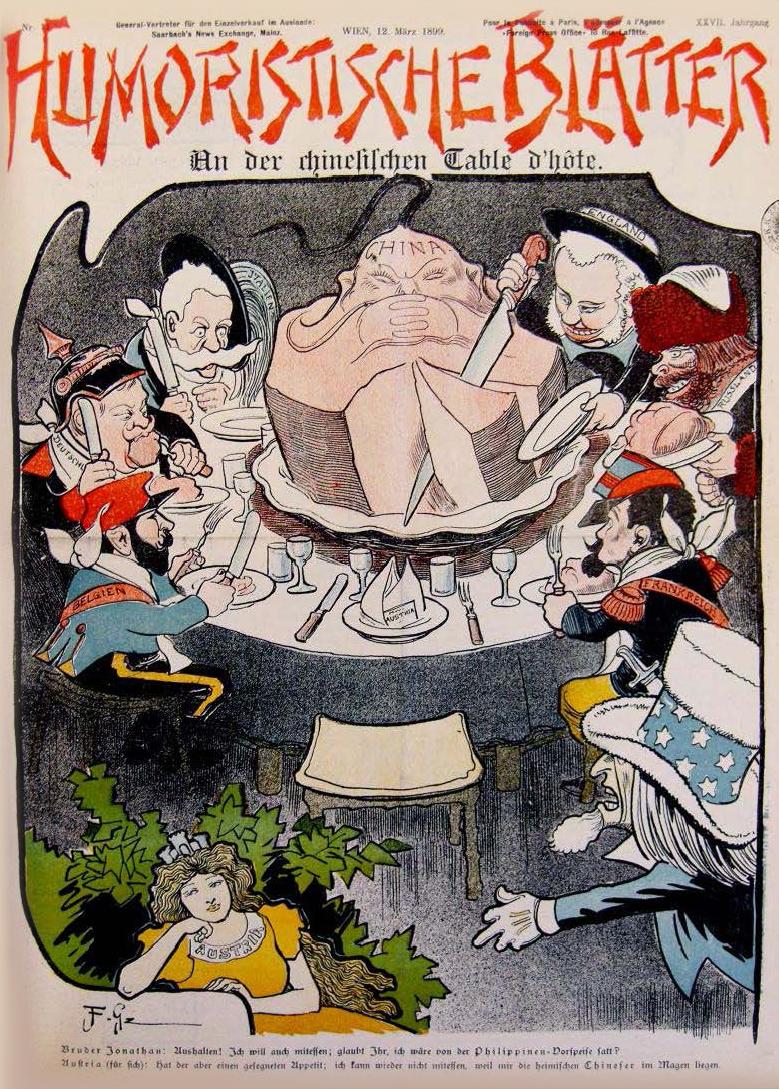
This cartoon appeared on the cover of the Viennese satirical weekly Humoristische Blätter on March 12, 1899 in Vienna (Austria). The captioned title is An der chinesischen Table d’hôte, literally, “At the Chinese dinner table.”
In An der Chinesischen Table d’hôte, China is no longer merely pressured, partitioned, or coerced: it is served. The imperial powers sit around a common table with knife and fork before a humanized body labeled “China,” transforming geopolitics into appetite and foreign policy into a banquet of dismemberment. The image belongs to the visual culture of the late 19th-century scramble for China, but it goes further than the usual rhetoric of “spheres of influence”: it presents empire as a meal in which the great powers consume not territory alone, but a civilization reduced to a dish. The cartoon’s brilliance lies in its indecency: China is not consulted, conquered, or even carved first—it is simply placed on the table.
At the center of the table sits not a dish but a humanized body labeled “CHINA,” arranged like a roasted course ready to be carved. Around the table sit the imperial powers as diners, knife and fork in hand, preparing to cut and consume it. Their uniforms identify them as the major foreign states competing for influence in China at the end of the 19th century; in this image you can clearly see England, France, Russia, Germany, Italy, Belgium, and Japan, while Austria appears separately below rather than at the table itself.
At the lower right, Brother Jonathan—the old personification of the United States—leans in from outside the scene, wanting to join the feast. The inscription, as summarized in the scholarly source, has him protesting that he wants to take part too and asking whether the Philippines are supposed to satisfy him. Austria, meanwhile, is shown below the table saying to herself that this fellow has quite an appetite and that she still cannot join because the local Chinese sit heavily in her stomach.
The metaphor is brutal and perfectly clear: China is not being negotiated with. China is being served.
That is the force of the French phrase table d’hôte. It evokes a set meal at a common table, a collective dining arrangement in which the guests partake of the same prepared dish. Here the “dish” is China itself. The cartoon transforms geopolitics into consumption and imperial competition into etiquette.
This is not yet the imagery of formal annexation piece by piece, as in some “carving the melon” cartoons. It is even more degrading. China is figured as a body prepared for foreign appetite. The powers are not simply drawing borders; they are feeding on a weakened civilization. That is why the image feels so savage. It turns empire into cannibalized hospitality.
The cartoon belongs to the wave of imagery produced during the “Scramble for China” in the late 1890s, when the great powers were pressing for railway rights, mining rights, leased territories, naval footholds, and spheres of influence in Qing China. Wagner places this cartoon directly within that visual discourse of partition.
The American line about the Philippines is especially revealing. After the Spanish-American War of 1898, the United States had taken control of the Philippines, and American power in East Asia was expanding. The cartoon mocks the idea that the United States stood outside the imperial banquet. It wanted in.
Austria’s awkward position is also meaningful. Austria-Hungary was a lesser player in East Asia than Britain, Russia, Germany, or France. In the cartoon it is present, but marginal—watching, tempted, half-excluded, and conscious of its own limitations. That asymmetry is part of the joke.
The violence here is not shown as battle. It is shown as table manners. That is the genius of the cartoon. No cannon, no corpses, no flames. Instead:
- a formally laid table;
- knives and forks;
- seated guests;
- a central course to be divided.
In other words, imperialism has become socially organized appetite. The powers do not need to justify themselves; they only need to secure a seat. That makes this image slightly colder than Daumier. Daumier showed the forced ingestion of opium as bodily assault. This Viennese cartoon shows the next stage: not poisoning, but consumption as routine international practice. The outrage is still there, but it is now conveyed through ritualized civility.
Here is one last cartoon from Puck.
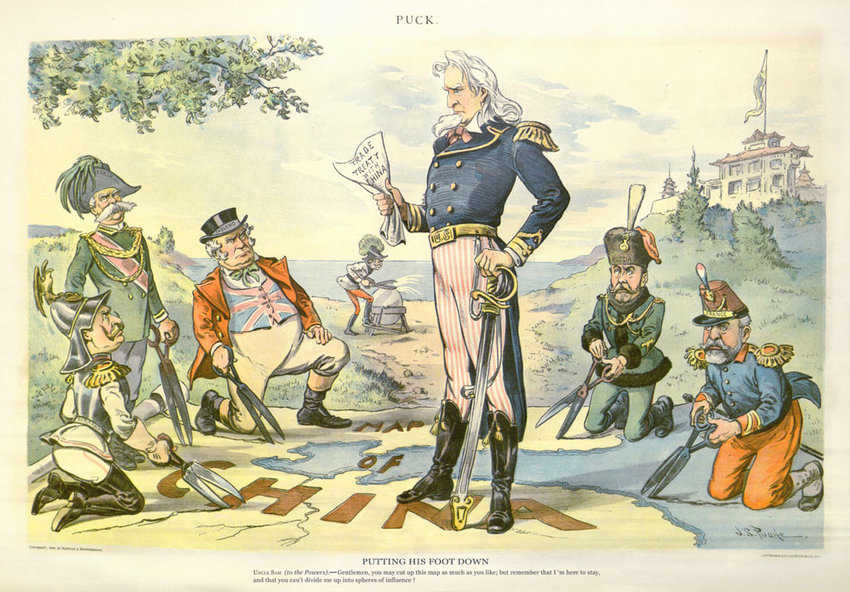
This cartoon is Putting His Foot Down by J. S. Pughe, published in Puck on August 23, 1899 in the United States.
At the center stands Uncle Sam, one boot planted firmly on a map of China, holding a paper labeled “Trade Treaty with China.” Around him kneel or crouch the other imperial powers with oversized shears, ready to cut the map into pieces. The figures are identified as Germany, Italy, England, Russia, and France, while Austria appears in the background sharpening scissors at a grindstone. The Library of Congress specifically identifies the rulers represented as William II, Umberto I, John Bull, Franz Joseph I, Nicholas II, and Émile Loubet.
The caption gives Uncle Sam’s line: “Gentlemen, you may cut up this map as much as you like, but remember that I’m here to stay, and that you can’t divide me up into spheres of influence!”. And this is where the cartoon gets interesting. At first glance, Uncle Sam looks like the defender of China against partition. But he is not saying, “Do not divide China because this is unjust.” He is saying, in effect: You may cut up China if you wish, but you may not shut the United States out of it. Uncle Sam is not defending China’s sovereignty in any deep moral sense. He is defending American access. He does not stand for anti-imperialism, but for competitive imperialism.
That is the logic of the Open Door Policy announced by U.S. Secretary of State John Hay in 1899: Washington did not seek a formal sphere of influence like the European powers, but it did insist on equal commercial access to Chinese markets and the preservation of China’s territorial and administrative framework so that no rival empire could monopolize it. Wagner explicitly reads the image in relation to that moment and that policy language. This cartoon, like the previous one, belongs to the late-1890s Scramble for China, when the major powers were demanding leased territories, railway rights, mining concessions, naval footholds, and privileged regional influence inside Qing China. American policymakers feared that if China were fully partitioned into exclusive spheres, the United States would lose access to the market. John Hay’s Open Door notes of 1899 were designed to prevent exactly that outcome. Wagner places this cartoon directly in that setting. Thus, the cartoon is not a humanitarian protest. It is an assertion that the United States has planted itself in China and cannot be carved out of the imperial arrangement. That is why the title matters so much: Uncle Sam is “putting his foot down,” not on behalf of China, but on behalf of American commercial rights.
This also explains why the image differs from the earlier Puck cartoon I showed, No Chance to Criticize. There, the stress was on hypocrisy: the United States could not condemn European carving while itself acting imperially in Cuba. Here, the emphasis shifts. The United States appears not as a rival diner at the feast, but as the power insisting that the feast remain open to all claimants—or at least open to itself.
The visual idea is elegant. China is reduced to a map on the ground, something to be cut with scissors. That already tells you that sovereignty has become geometry. But Uncle Sam stands upright in the middle, physically interrupting the act of partition. His body becomes a political barrier: the others may snip at the edges, but they cannot cut around the American presence.
There is also a tonal shift from the Daumier and Viennese cartoons. Those images are savage, bodily, almost cannibalistic. Pughe’s cartoon is colder and more bureaucratic. No one is bleeding. No one is dying. No one is swallowing poison. Instead, empire appears as a matter of maps, treaties, shears, and access. That is exactly what makes it so revealing. Violence has not disappeared; it has become abstract. This last point is an inference from the image and its historical setting rather than a direct statement in the catalog records.
A temporary conclusion
Taken together, these images do trace a historical and moral shift: the scandal does not disappear; it changes register. It moves from the exposure of a crime to the management of a system.
Seen in sequence, these images mark a movement from imperial violence as scandal to imperial violence as grammar. Grandville and Daumier still labor to reveal the indecency hidden beneath the rhetoric of commerce and civilization. The later cartoons, by contrast, begin from the assumption that predation is the normal language of international politics. China is no longer primarily represented as a wronged interlocutor, still less as a sovereign equal. It becomes first a victim to be poisoned, then a body to be forced, then a cake to be carved, then a meal to be consumed, and finally a market-space whose partition is negotiated among rivals. The moral scandal remains visible, but it no longer shocks. It has been naturalized.
These cartoons suggest that, by the 1890s, satire had come to assume that moral language no longer restrained imperial conduct in any meaningful way; it survived chiefly as alibi, posture, or rivalry’s reproach.
Morality ceased to function as a limit.
Taken together, these images register a profound transformation in the visual imagination of empire. In the 1840s and 1850s, satire still sought to expose the injustice of imperial aggression by unmasking commerce as poison and trade as coercion. By the end of the century, that work of exposure had largely given way to something colder: the assumption that predation was already the ordinary syntax of international life. China is no longer defended, nor even deeply pitied, but carved, served, and negotiated. The scandal remains visible, but it has ceased to scandalize. What these cartoons reveal is not simply the brutality of imperial power, but the normalization of a world in which profit and violence had become mutually intelligible, and in which moral language survived less as a restraint than as a decorative veil over the struggle for access, advantage, and control.
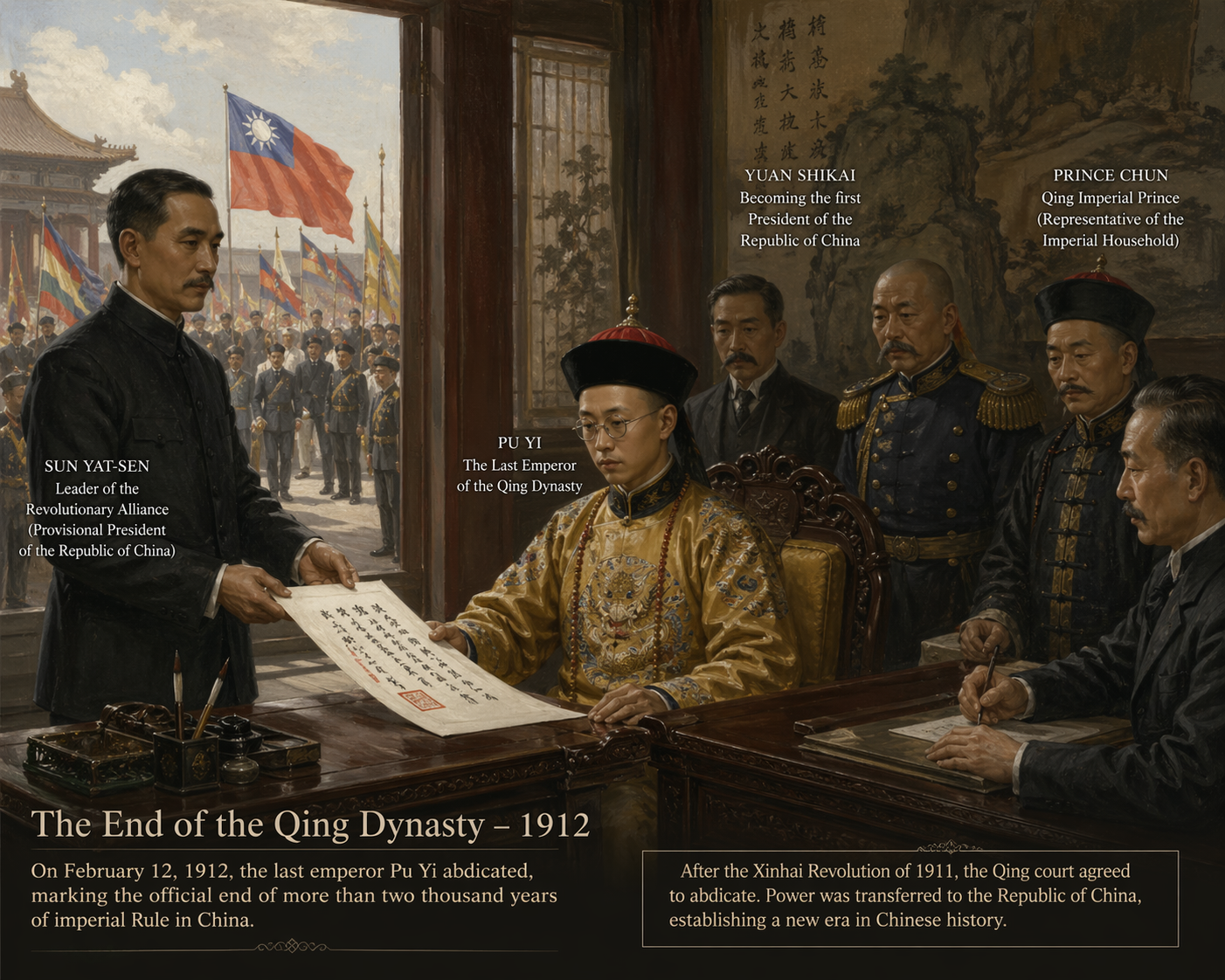
WHEN CULTURE FALLS SILENT
The dissolution of the intercultural bridge once sustained among Jesuit missionaries, Chinese literati, and the Qing imperial court marks one of the more subtle yet consequential fractures in the history of early modern global encounter. It did not, in any direct or mechanical sense, generate the expansionist logic of the British Empire, whose energies were driven by the converging forces of maritime supremacy, commercial capitalism, and colonial extraction in India. Yet its disappearance deprived Sino-European relations of a rare and delicate space in which difference could be engaged without immediately being subordinated to domination. Within that fragile sphere, translation had once exceeded mere words: it had been an intellectual and moral labor, an effort to render one world intelligible to another without dissolving its integrity.
When that labor ceased, something essential was lost. The relationship between China and Europe was gradually stripped of its interior dimension—its capacity for reciprocal recognition—and exposed instead to the exterior pressures of interest, profit, and power. Without a shared horizon of meaning, exchange could no longer sustain itself as encounter; it hardened into transaction, and transaction into coercion. What had once required patience, interpretation, and a willingness to dwell within difference was replaced by the impatience of empire, which seeks not to understand the other but to use it or overcome it.
In this light, the Opium Wars appear not only as the outcome of economic asymmetries and geopolitical ambition, but as the expression of a deeper impoverishment in the conditions of encounter. The absence of living cultural mediation did not cause the violence, but it removed one of the few remaining limits upon it. Where no common language—intellectual, ethical, or symbolic—can be sustained, the other is no longer encountered as a subject but reduced to an obstacle, a resource, or a field of intervention.
The tragedy of the 19th century lies not solely in the fact of imperial conquest, but in the prior erosion of the space in which genuine meeting might have resisted it. Culture, in its highest sense, does not eliminate conflict, but it creates the conditions under which conflict need not become annihilation. When that work falters—when culture no longer builds bridges across the distances it reveals—human beings find themselves with no place in which to meet except the field of force and profit. And there, inevitably, they do not meet. They collide.
What is true of China and Britain in the 1840s remains true wherever cultural encounter is surrendered to calculation. The historical circumstances change; the underlying structure does not. When the other is approached not as a partner in dialogue but as an object of interest, the restraints that culture once imposed — a shared vocabulary, a common obligation, an inherited scruple — dissolve one by one, without noise, without announcement. Their disappearance is rarely experienced as loss; it is more often mistaken for efficiency, for the clearing away of complication in favor of clarity. But what is cleared away is the very medium in which the other could remain a subject. What remains, once that medium is gone, is not clarity. It is exposure — the other exposed to whatever force or calculation one brings to bear upon it. A meeting without that interior ground is not a meeting at all. It is a confrontation awaiting its occasion.
This is why the work of culture is always, in some sense, a moral work — not in the sense of enforcing virtue, but in the sense of maintaining the conditions under which the humanity of the other cannot be simply set aside. When culture functions in its fullest capacity, it does not eliminate the tensions between peoples; it insists that those tensions be carried within a shared, if contested, horizon of meaning. To lose that is not merely to lose mutual understanding. It is to lose the very medium in which understanding remains possible, and with it, any basis for restraint that is not merely strategic.
When culture falls silent, war does not merely follow — it speaks in its place.

Alyx Becerra
OUR SERVICES
DO YOU NEED ANY HELP?
Did you inherit from your aunt a tribal mask, a stool, a vase, a rug, an ethnic item you don’t know what it is?
Did you find in a trunk an ethnic mysterious item you don’t even know how to describe?
Would you like to know if it’s worth something or is a worthless souvenir?
Would you like to know what it is exactly and if / how / where you might sell it?
