

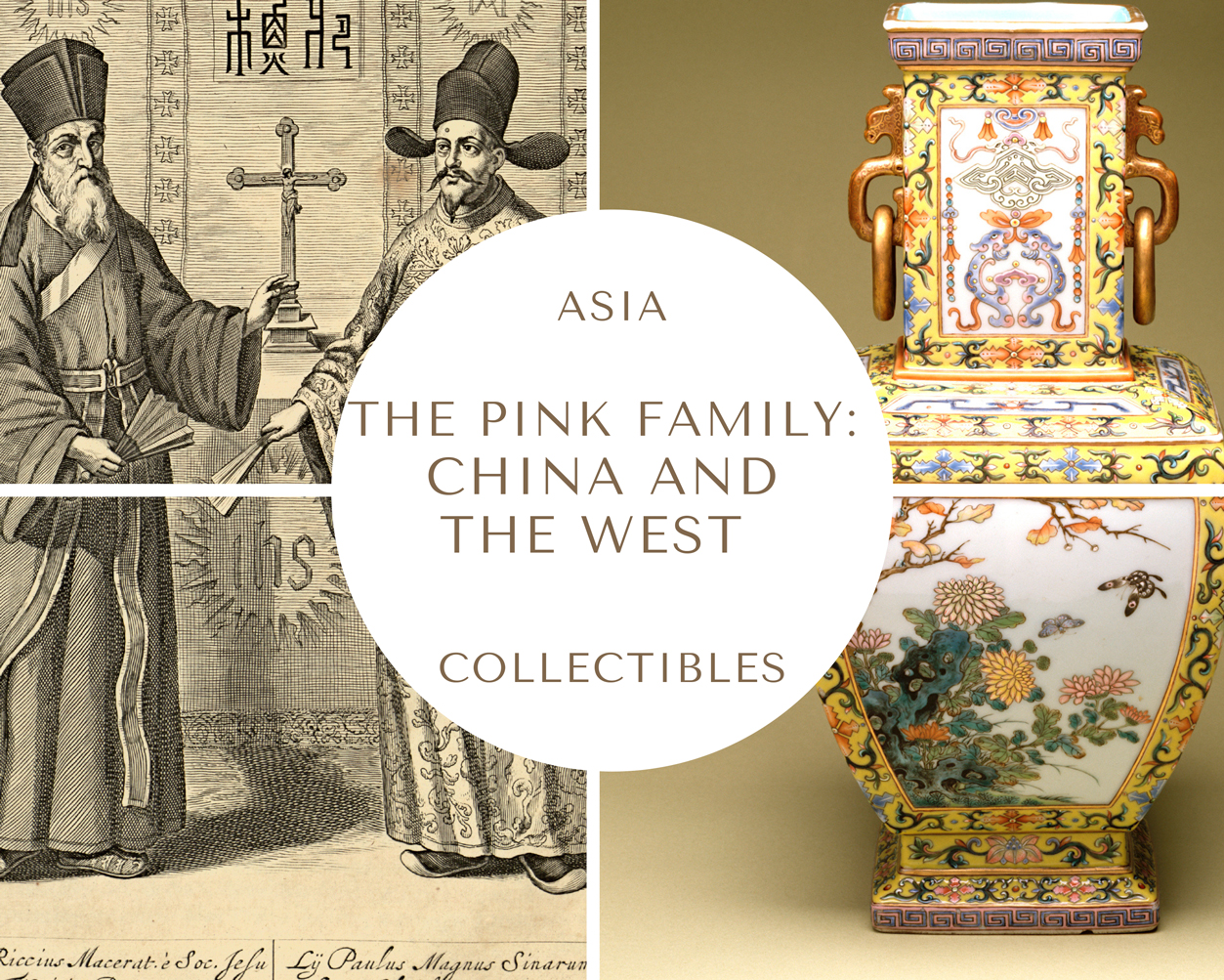
THE PINK FAMILY: CHINA AND THE WEST 12
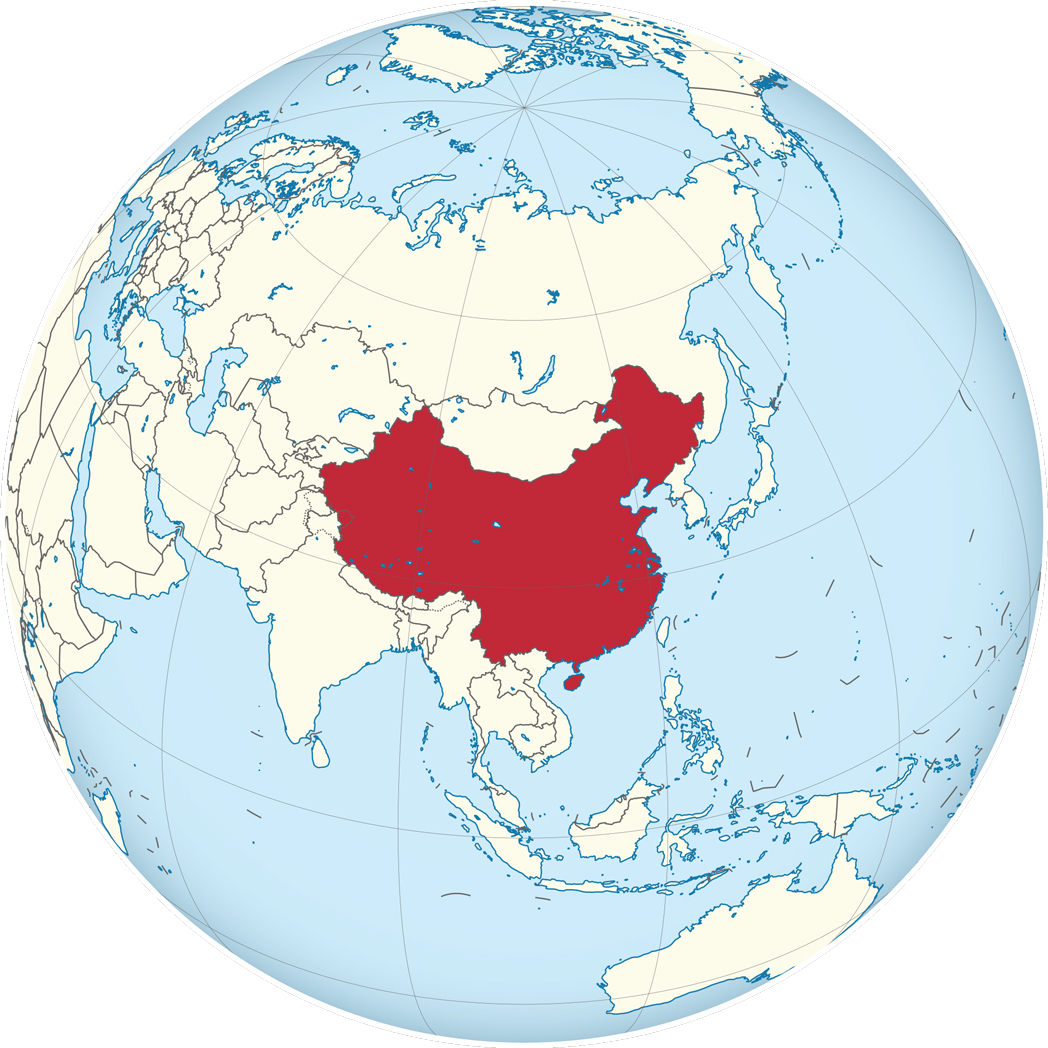
Current China on the globe.
Under the Creative Commons Attribution-Share Alike 3.0 Unported license.
This map is for illustrative purposes only. The Ethnic Home does not take a position on territorial disputes.
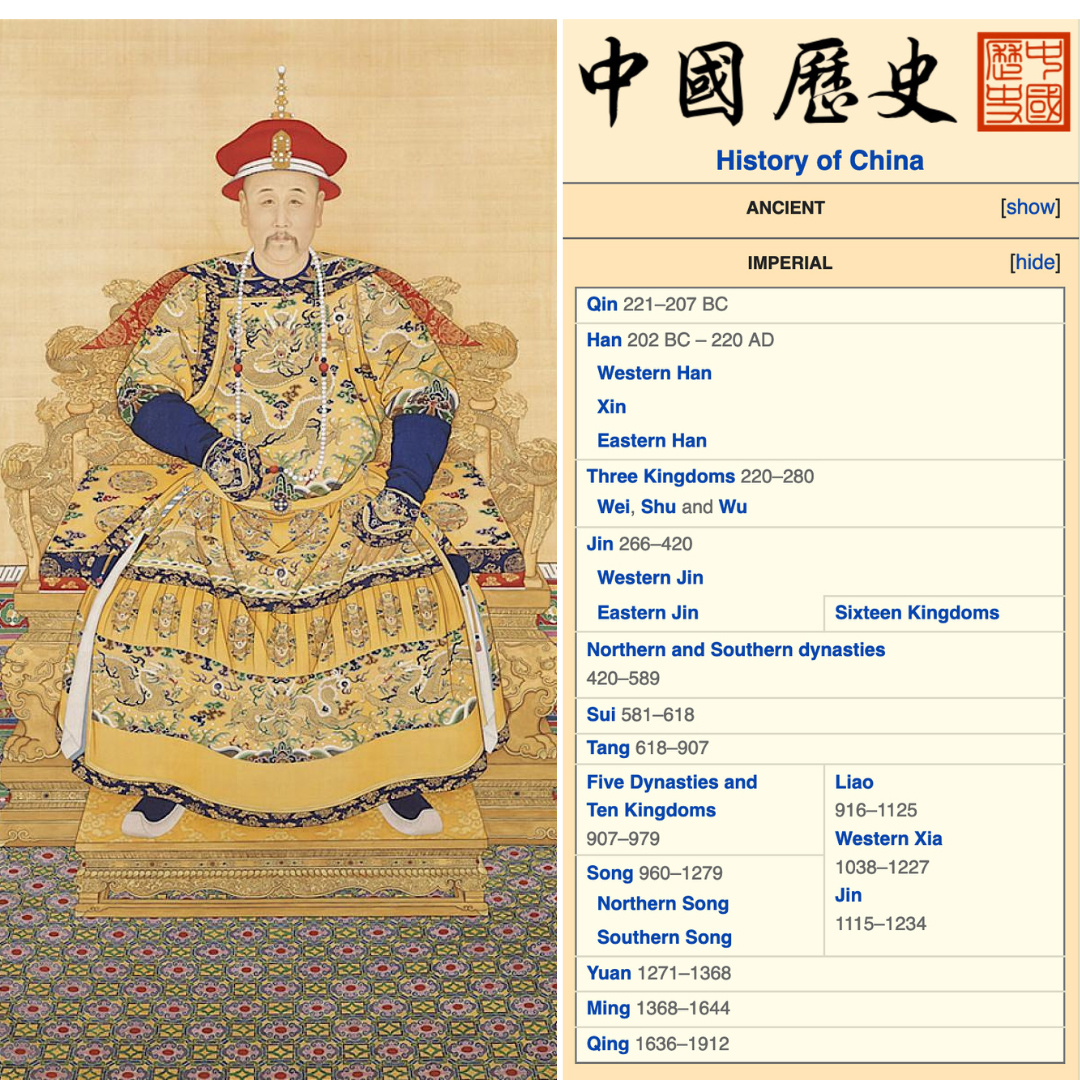
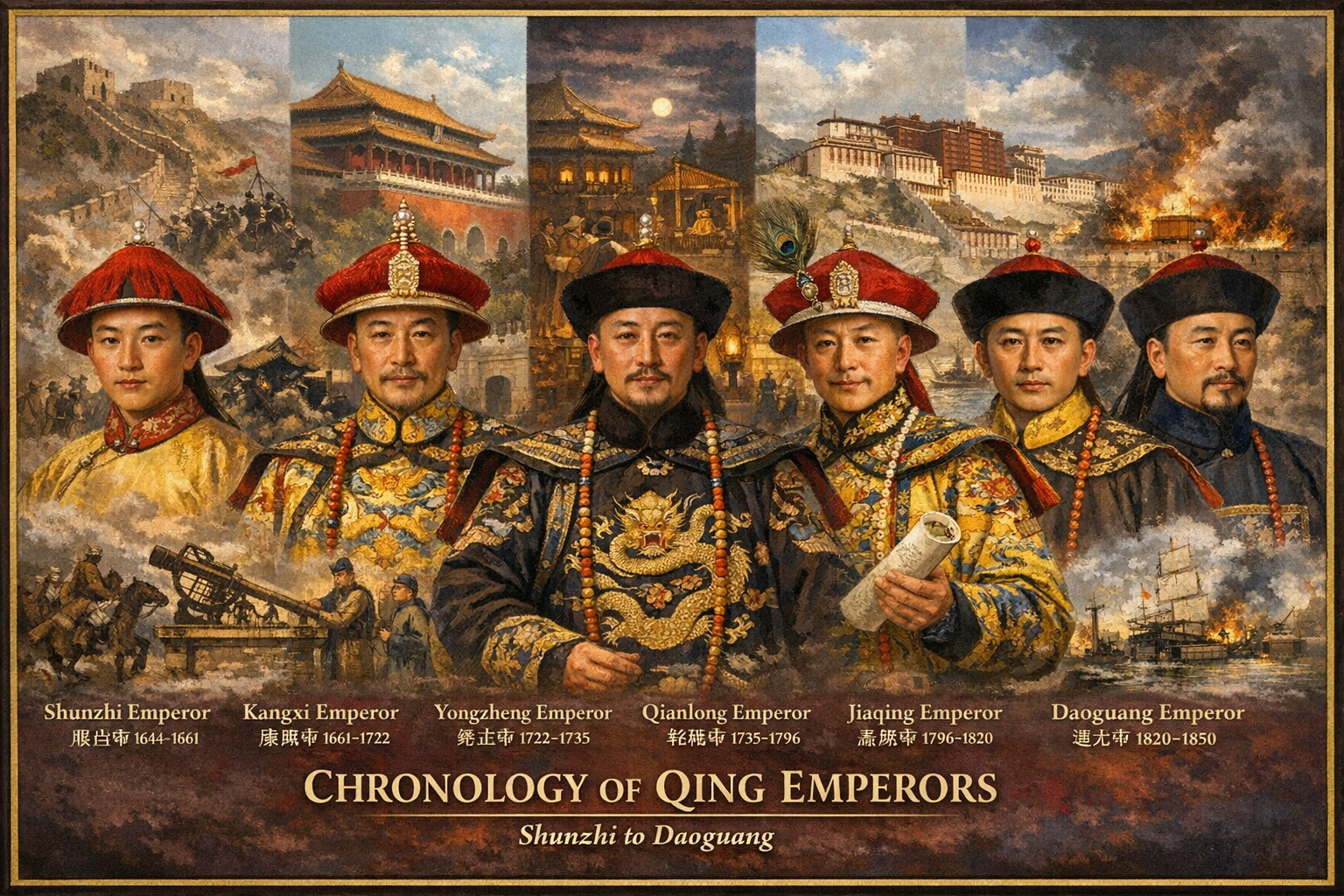
LEFT: Portrait of the Yongzheng Emperor in Court Dress, by anonymous court artists, Yongzheng period (1723—35), Qing Dynasty. Hanging scroll, color on silk. The Palace Museum, Beijing. Public Domain.
RIGHT: History of China, Imperial Dynasties, source: Dynasties in Chinese history, Wikipedia.
PROCESS OVER PALETTE:
THE CHINESE SYSTEM OF CERAMIC CLASSIFICATION
The Chinese approach: classifying by provenance, technology, and history
In Europe, porcelain is often grouped by surface effect—especially color palettes—using labels such as famille verte or famille rose. In Chinese scholarship and connoisseurship, the starting point is usually different. A ceramic object is described and classified above all by when and where it was made, how it was manufactured, and which technical tradition it belongs to.
That difference is not merely academic. Chinese ceramics were produced across many regions over a long chronology, and visual appearance can be misleading: similar glazes were made at different kilns, and later workshops often copied earlier styles. For that reason, Chinese specialists typically build identification from a set of interlocking criteria:
- Chronology: dynasty and—when justified—reign period
- Place and production tradition: kiln site, region, and related kiln groups
- Material glaze chemistry, firing atmosphere, kiln technology
- Decorative method: underglaze vs. overglaze, pigments/enamels, firing sequence
- Form and function: vessel type, intended use, and stylistic genealogy
This chapter introduces those principles and the key terms you will meet throughout the following chapters.
Dating first: dynasty and reign (with marks as evidence—not proof)
A common first move in Chinese classification is to propose a date range, expressed as a dynasty (e.g., Song, Yuan, Ming, Qing) and, when the evidence supports it, a more precise reign period (e.g., Ming Xuande, Qing Kangxi).
Reign marks can help, but they are not definitive on their own. Marks may be absent on authentic wares; they may also be copied later as homage, revival, or deception. As a result, specialists treat marks as one line of evidence to be weighed alongside material, glaze, and workmanship.
A practical way to express this in writing is:
- “Mark and period” when multiple factors align and the mark is consistent with the object.
- “Mark only” when a mark is present but the object's materials, handling, and workmanship do not support the period.
- “Attributed to…” / “in the style of…” when the object imitates an earlier model.
Describing decoration: monochrome and polychrome (useful, but not sufficient)
After establishing a chronological frame, it is often helpful to describe whether the object is essentially monochrome (a glaze effect dominates the surface) or polychrome (multiple colors are used in painting or enameling).
This distinction is a good orientation, but it should not be treated as a complete classification on its own. Many wares sit between categories (for example, monochrome glazes with molded relief, or underglaze decoration with subtle additional enamels). The more decisive questions are usually which technology produced the surface and which workshop tradition it reflects.
Yaoxi (窑系): “kiln systems” as technical lineages and research groupings
One of the most useful tools in Chinese ceramic scholarship is the concept of yaoxi (窑系), often translated as “kiln system” or “kiln lineage.” In practice, it refers to a group of kilns that are understood to share technical choices and historical relationships—clay recipes, glaze types, firing methods, forms, and decorative habits—often within a region and over time.
Two cautions make the concept stronger and more academically reliable:
- Yaoxi is frequently a modern scholarly grouping. As kiln-site archaeology expanded in the 20th century, researchers increasingly organized evidence by “systems” that connect related production centers and their evolution. Modern ceramic scholarship in China is closely tied to field investigation of kiln sites and comparative study of excavated sherds.
- A yaoxi is not a brand name. It is a hypothesis a provenance that should be argued from evidence (fabric, glaze, firing traces, and documented kiln-site finds), not assumed from appearance alone.
Used carefully, yaoxi is a powerful bridge between art history and materials history: it links objects to specific production ecologies and to the movement of skills, resources, and taste.
The “Five Great Kilns”: a later canon, still a useful reference point
Many introductions to Chinese ceramics present the Song dynasty’s “Five Great (or Famous) Kilns” as Ru, Guan, Ge, Jun, and Ding. This set is widely recognized today, but it is important to state what scholarship has clarified: the “five” are a retrospective canon, and the exact membership and meaning of the group shifted in later writings. In other words, this is not a fixed Song-period classification, but a later way of naming certain wares that came to be held in exceptional esteem.
With that caveat, the group remains useful as an orientation because it introduces several core technological and aesthetic ideals associated with elite wares:
- Ru ware (汝窑) is celebrated for refined forms and a soft, bluish-green glaze. A practical diagnostic detail often cited is the presence of typically a small number of tiny spur marks (sesame-seed marks) (“sesame-seed” marks) from firing supports.
- Guan ware (官窑) is associated with court supply in the Southern Song context and is often characterized by thick, lustrous glazes and prominent crackle patterns, though crackle alone does not confirm attribution.
- Ge ware (哥窑) is famous for dramatic crackle effects in later tradition; its historical definition and identification remain complex, and “Ge-type” is sometimes the more careful wording in museum practice.
- Jun ware (钧窑) is known for opalescent blue glazes with purple splashes; “transmutation” effects are central to its appeal, but terminology should avoid sounding mystical—these are kiln effects produced by glaze chemistry and firing.
- Ding ware (定窑) is admired for thin, elegant bodies and molded, incised, or carved decoration under a pale glaze; many Ding vessels show firing-related rim characteristics often finished with metal mounts.
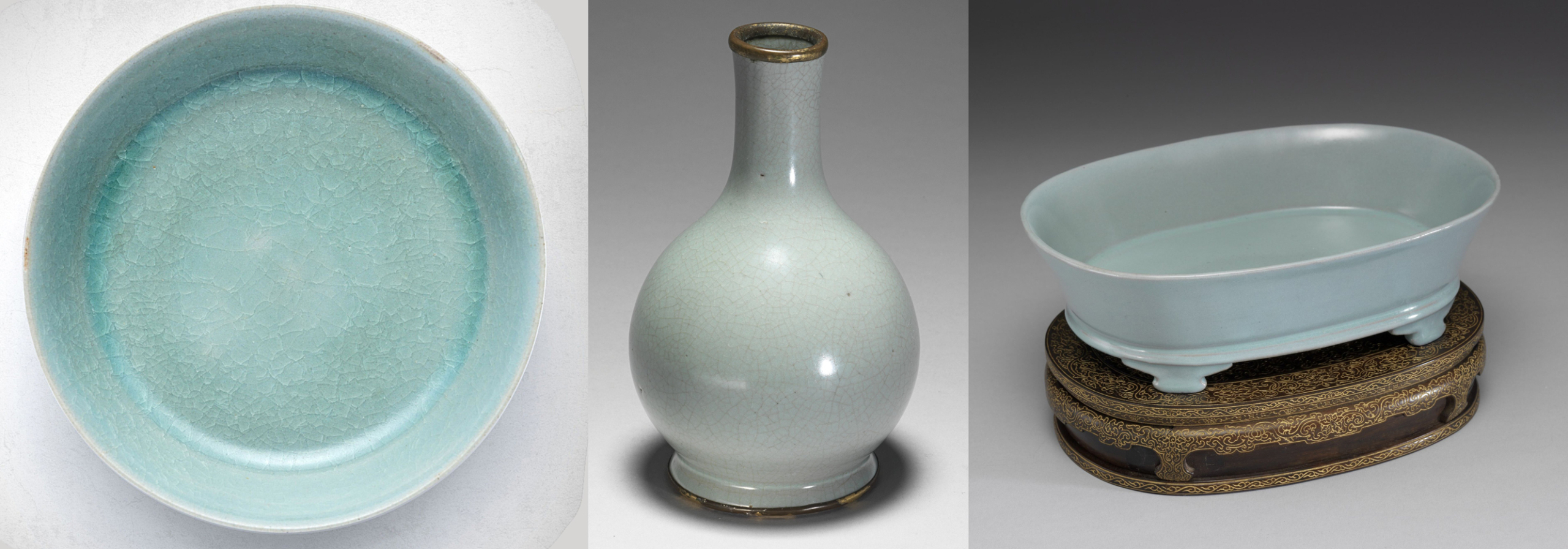
Ru ware
LEFT: Rare and finely potted Ru Guanyao brush washer with «a luminous and translucent bluish-green glaze suffused with a dense network of glistening ice crackles» (Sotheby's Catalog). It shows three fine ‘sesame seed’ spur marks on the base. Diameter: 13 cm. Northern Song Dynasty (960–1127). Auctioned by Sotheby's in 2017 for HKD 294,287,500 equivalent to approximately US$ 37,770,000 and € 33,500,000 today.
CENTER: Gallbladder-shaped vase with green glaze, Ru ware. Date: before 1225, Northern Song dynasty. Dimensions: height: 17.8 cm, 7 in; diameter: 3.6 cm, 1.4 in. National Palace Museum, Taipei, Taiwan.
RIGHT: Narcissus basin with bluish-green glaze, Ru ware. Date: Northern Song Dynasty 960-1127. Dimensions: height 6.9 cm, 23 cm across, 16.4 cm, 23 cm caliber, diameter 19.3 x 12.9 cm, weight 670 g. National Palace Museum, Taipei, Taiwan.
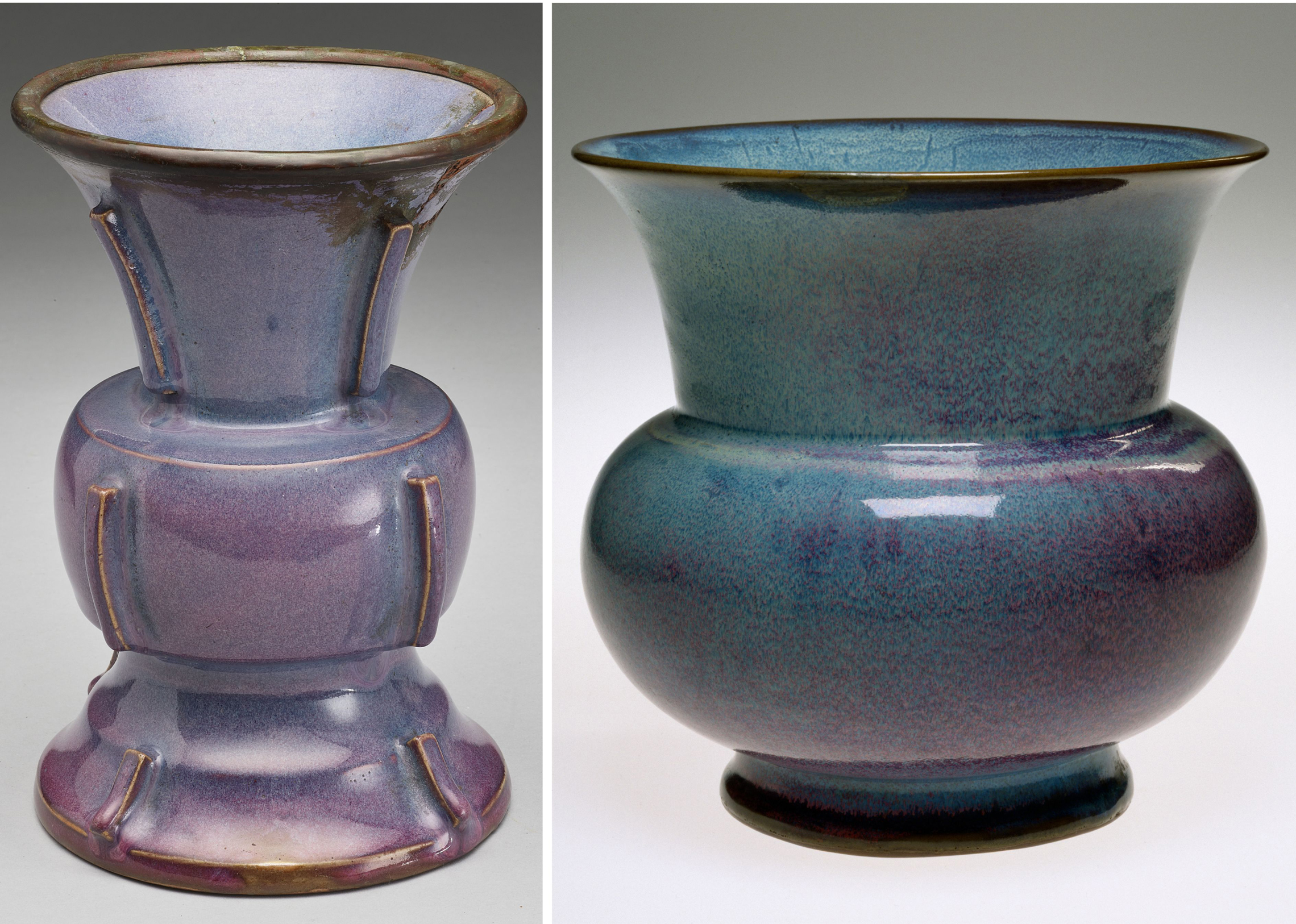
Jun Ware
LEFT: Jun ware zun vessel with grape-purple glaze and flanges, Northern Song dynasty. National Palace Museum, Taipei, Taiwan.
RIGHT: Spittoon stoneware with Jun ware glaze, Song dynasty. Walters Art Museum, Baltimore, Maryland, USA.
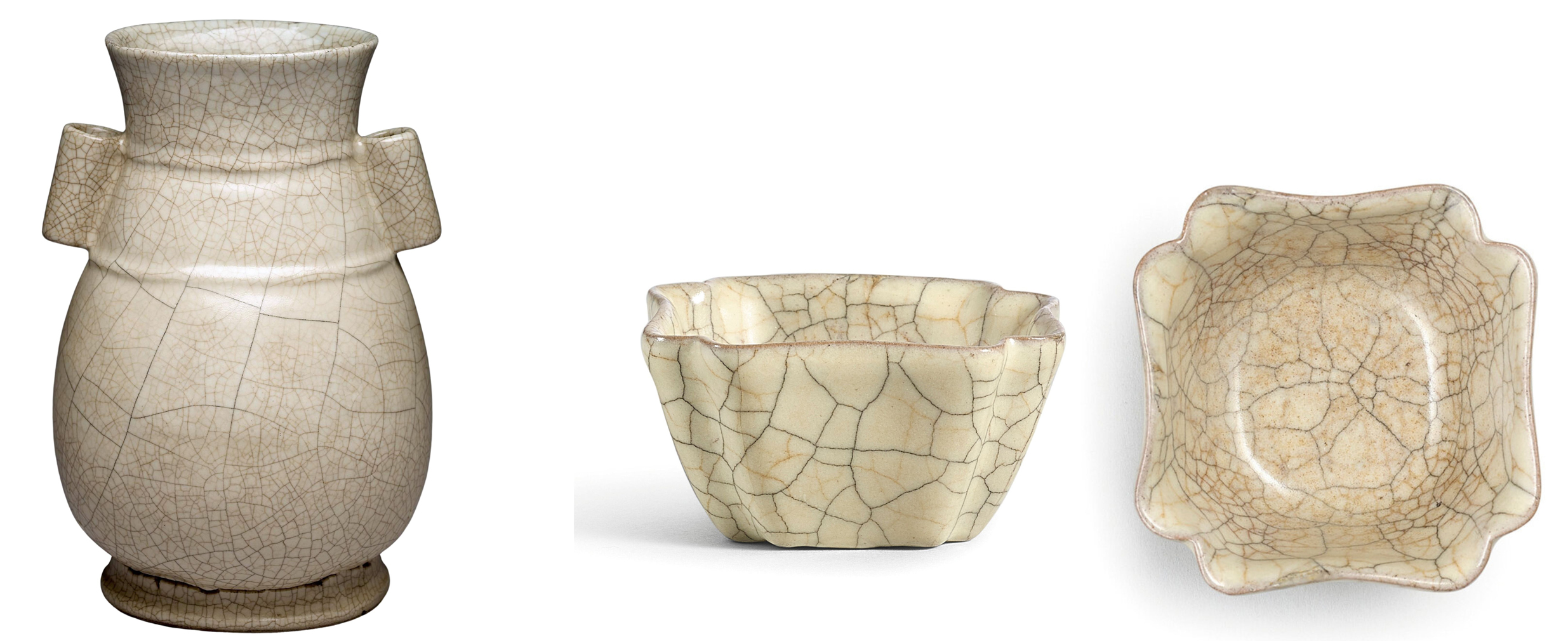
Ge Ware (Ge Yao)
LEFT: Ge ware vase showing the ancient hu bronze form, with flattened ovoid body, flaring mouth, and two tubular handles between two bands of low relief around the shoulder. The vase shows a thick, opaque beige-grey glaze with two layers of crackle, the wide crackle stained grey and the fine crackle brown. Height: 24.4 cm. Made in the Zhejiang province during the Yuan Dynasty, between the 13th and the 14th centuries. © The Trustees of the British Museum, London, UK.
RIGHT: An extremely rare Geyao square brush washer. Date: Southern Song dynasty (1127-1279). Dimensions: 6.7 cm, 2 5/8 in. Auctioned by Sotheby's Hong Kong in 2018 for HKD 6,720,000.
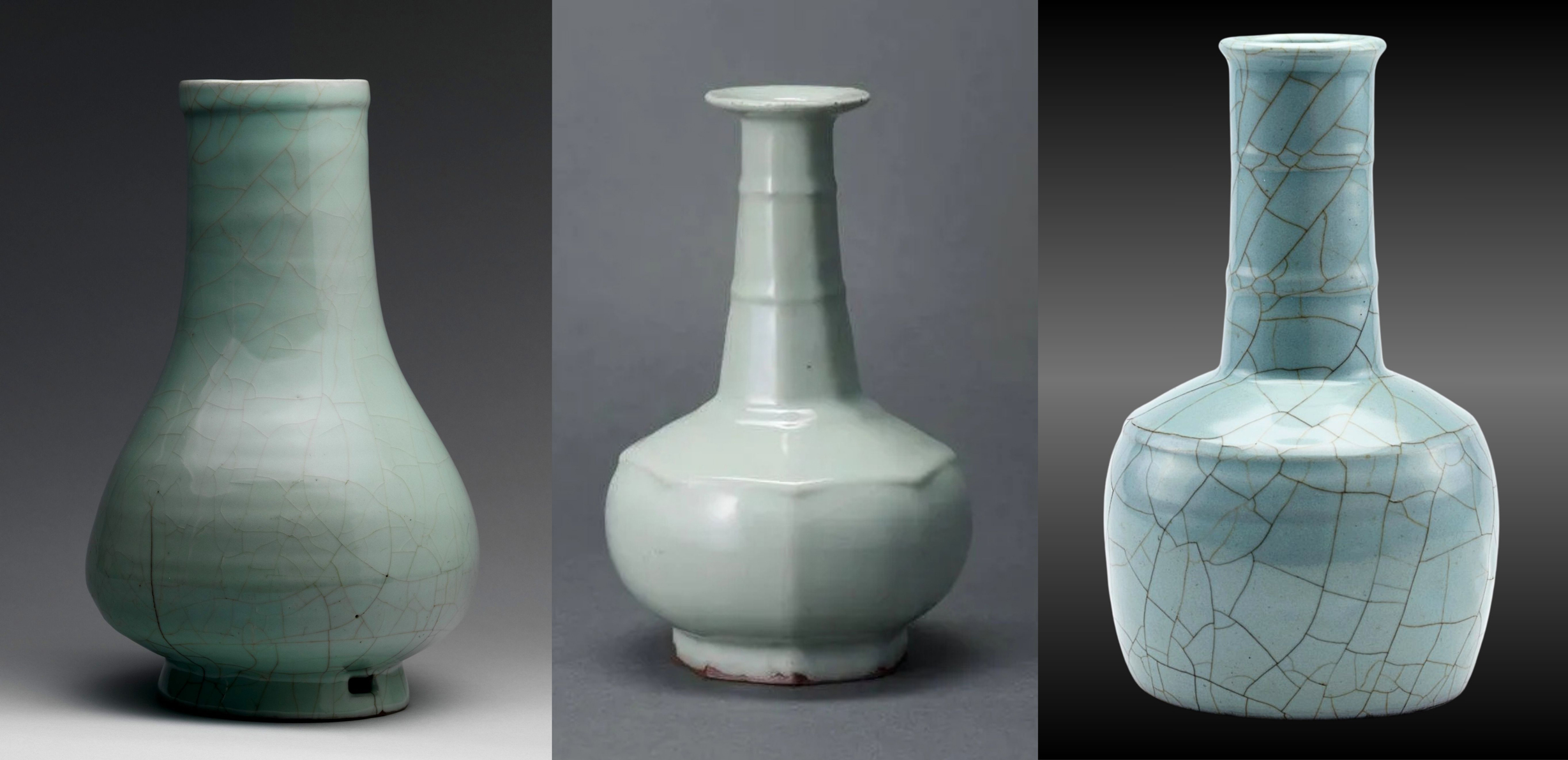
Guan ware
LEFT: Guan Ware, vase from the 12th–13th century. Period: Southern Song dynasty (1127–1279). Medium: Stoneware with crackled celadon glaze (Guan ware). Dimensions: height 13 3/8 in., 34 cm; diameter 8 1/2 in., 21.6 cm. The MET, New York, USA, "Guan ware was produced exclusively for the imperial court in Hangzhou, the capital of the Southern Song dynasty during the twelfth and thirteenth centuries. The unctuous glaze with subtle blue tone and icy crackles on these works is considered among the top achievements of Chinese ceramics." (from the museum's presentation)
CENTER: Celadon octogonal vase, Guan ware. Date: Southern Song dynasty, 12th-13th century. Dimensions: height 21 cm; diameter 13.5 cm. © The Museum of Oriental Ceramics, Osaka, Japan. Photograph by MUDA Tomohiro.
RIGHT: Long-necked vase with raised bow-string decoration, Guan ware. Southern Song dynasty, 12th century. Dimensions: 23.2 × 14.1 cm. Freer Gallery of Art, Smithsonian Institution, Washington, DC, USA.
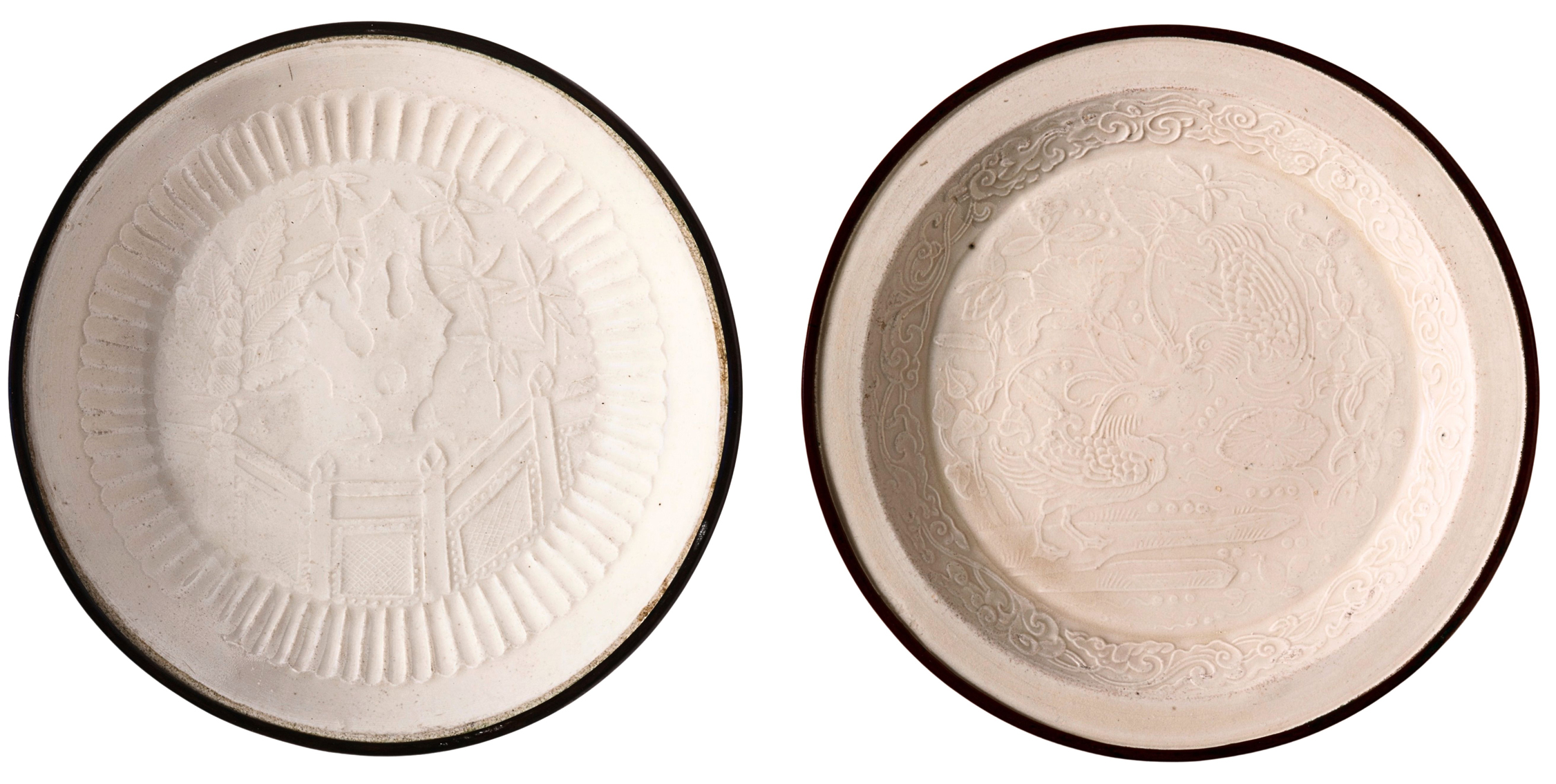
Ding ware
LEFT: Dish (pan) with garden landscape. Ding ware, molded stoneware with impressed decoration, transparent glaze, and banded metal rim. Date: late Jin dynasty or early Yuan dynasty, about 1200-1300. Diameter: 5 1/2 in., 14 cm. LACMA, Los Angeles County Museum of Art, CA, USA.
RIGHT: Dish (pan) with a pair of mandarin ducks. Ding ware, molded stoneware with impressed decoration, transparent glaze, and banded metal rim. Date: Jin dynasty, 1127-1234. Diameter: 5 1/2 in., 13.97 cm. LACMA, Los Angeles County Museum of Art, CA, USA.
Gongyi (工艺): classifying by decorative technology
For polychrome porcelains, Chinese classification becomes most precise when it names the decorative process (gongyi, 工艺), especially the relationship between pigment/enamel and glaze, and the sequence of firings. This is where terms such as qinghua, wucai, doucai, and fencai belong: they are best treated as technical categories, not merely “styles.”
Qinghua (青花): underglaze cobalt “blue-and-white”
Qinghua is decoration painted in cobalt pigment on the unfired (or once-fired) body, then covered with a clear glaze and fired at high temperature. The mature tradition is strongly associated with Jingdezhen from the Yuan onward, and it develops dramatically across the Ming and Qing. Cobalt sources vary by time and context; both imported and domestic supplies were used in different periods, and pigment chemistry can affect hue, saturation, and behavior in the glaze.
When writing about qinghua for experts, it helps to specify:
- whether blue is underglaze only (true qinghua), or combined with enamels,
- whether outlines are crisp or “heaped and piled” (a descriptive term often used for certain effects),
- and whether the object’s painting style and glaze quality align with the proposed period.
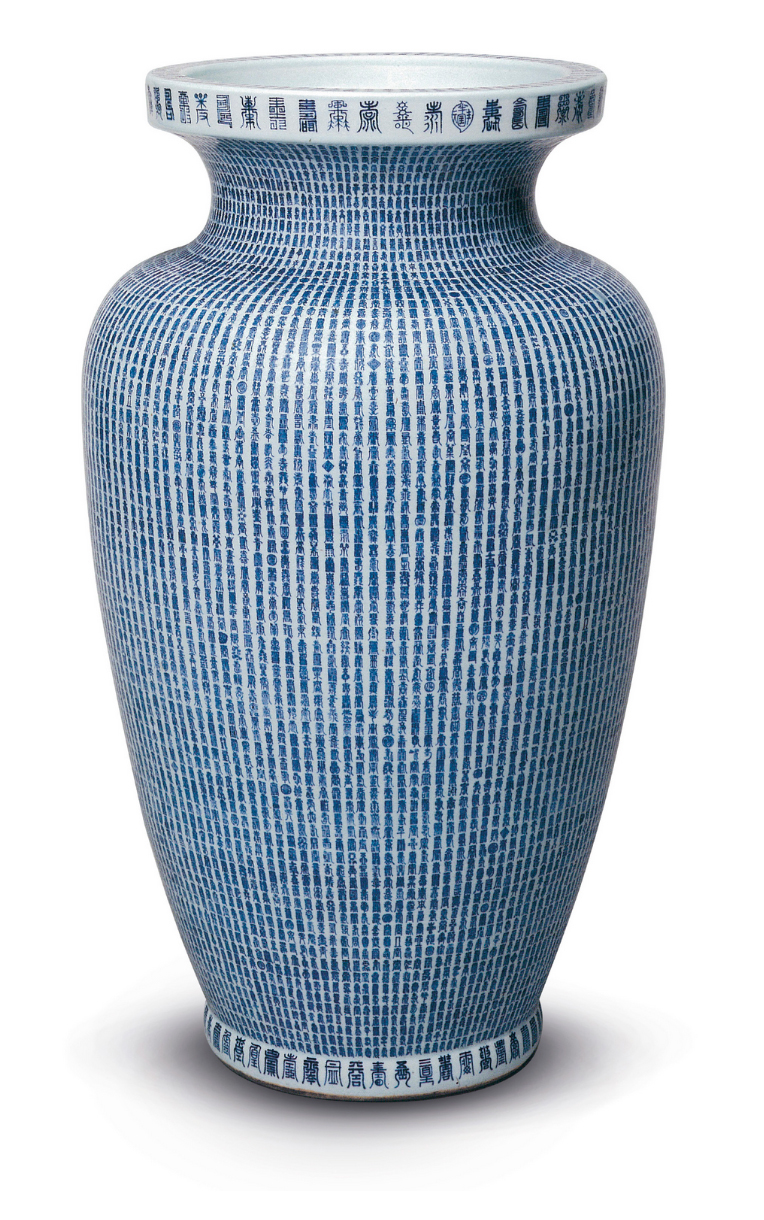
A monumental and extremely rare blue and white 'wanshou' vase from the Kangxi period (1662-1722), Qing dynasty. Height: 76.7 cm. Auctioned by Christie's Hong Kong in 2013 for HKD 64,520,000, equivalent to US$ 8,320,000 and € 6,270,000 today. "This extremely rare vase is of monumental size, being 76.7 cm high, and is decorated in brilliant underglaze cobalt blue with nine thousand, nine hundred and ninety-nine shou (longevity) characters and one wan (ten thousand) character. There are 77 characters in two concentric bands around the top of the mouth (154 characters), 48 characters on the vertical bands around the mouth and foot (96 characters), and 75 rows of 130 characters running vertically down the sides of the vase (9750 characters) - 10,000 characters in all. The shou characters are in a wide variety of styles - some recognisably archaic, some eccentric."
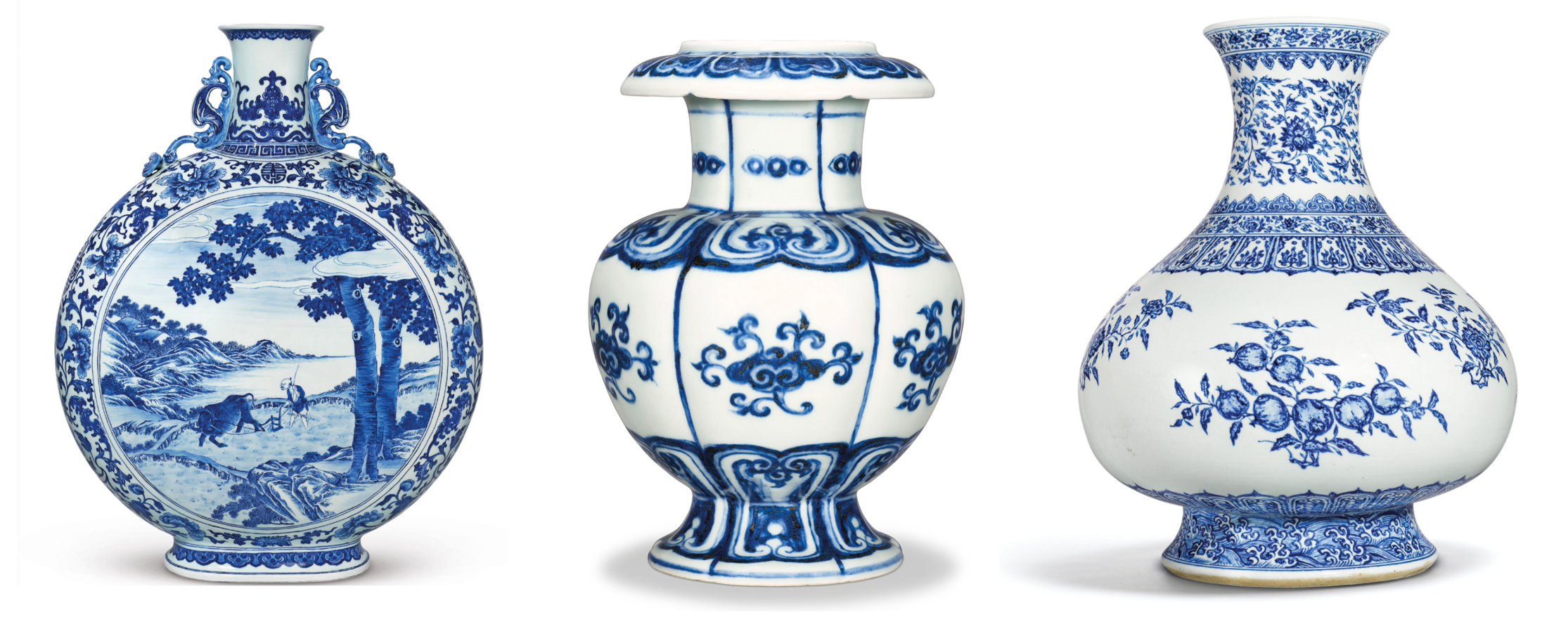
LEFT: A magnificent blue and white moonflask. Date: With Qianlong six-character seal mark in underglaze blue and of the period (1736-1795). Height: 23 ¼ in., 59 cm. Auctioned by Christies Hong Kong in 2018 for HKD 69,850,000, equivalent to US$ 8,910,000 and € 7,560,000 today.
CENTER: An extremely rare blue and white pomegranate-form vase. Date: With Xuande mark in underglaze blue within a double circle and of the period (1426–1435), Ming dynasty. Height: 7 3/4 in., 19.3 cm. Auctioned by Christies Hong Kong in 2023 for HKD 34,255,000.
RIGHT: A fine and exceedingly rare blue and white ‘fruit and flower spray’ vase. Date: With Yongzheng six-character seal mark in underglaze blue and of the period (1723–1735), Qing dynasty. Height: 22 1/2 in., 57 cm. Auctioned by Christies Hong Kong in 2019 for HKD HKD 37,260,000.
Wucai (五彩): underglaze blue plus overglaze enamels
Wucai (“five colors,” symbolically rather than literally) typically combines underglaze cobalt blue with overglaze enamels applied after the high-temperature firing, followed by a lower-temperature enamel firing. In many standard definitions, only parts of the design are in underglaze blue, while enamels provide the broader palette.
Wucai is not identical to Famille Verte. Famille Verte is a Western palette label (green-dominant enamels), while wucai is a process category (underglaze + overglaze). They overlap especially in the Kangxi period, but neither term fully contains the other.
A careful way to express the relationship is:
- Use wucai when the technique clearly involves the underglaze/overglaze sequence.
- Use Famille Verte when discussing the Western color-based taxonomy, especially export-market or European-collection contexts.
- When both are relevant, state explicitly which is a technical descriptor and which is a palette label.
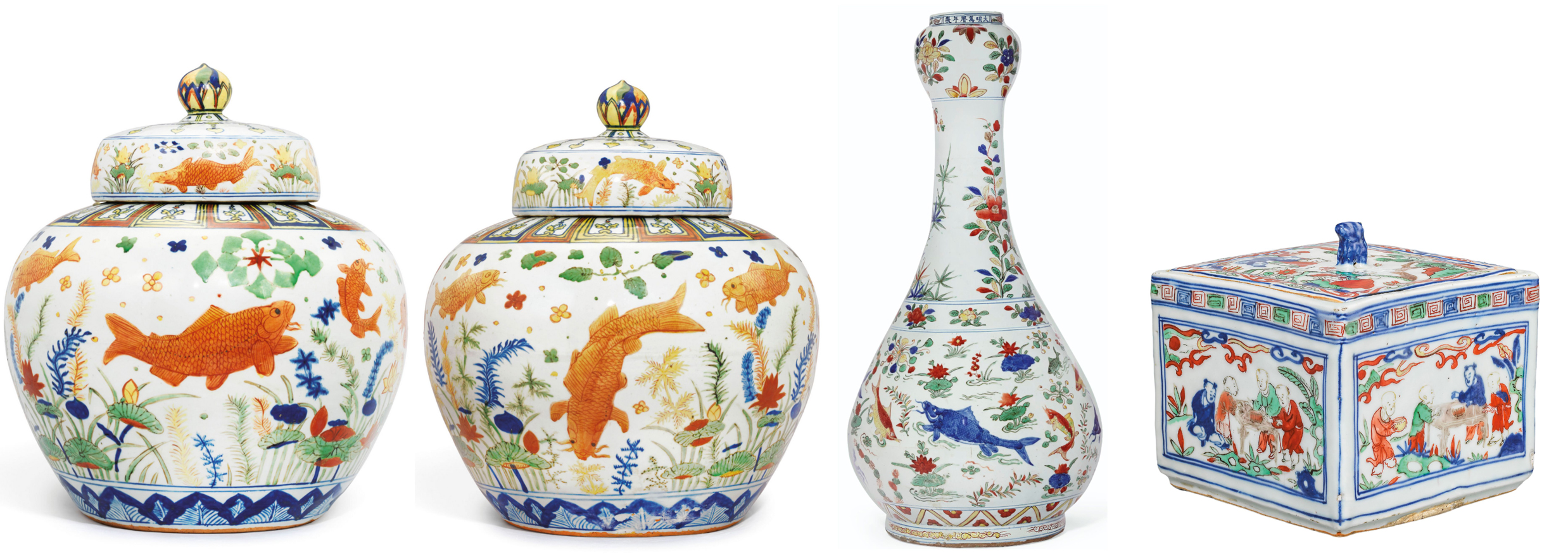
LEFT: Two sides of a highly important and extremely rare wucai ‘fish’ jar and cover. Date: Jiajing six-character mark in underglaze blue and of the period (1522-1566), Ming dynasty. Height: 18 1/8 in., 46 cm. Auctioned in 2017 by Christie's Hong Kong for HKD 213,850,000. This "globular jar is robustly potted and exuberantly painted around the sides with a continuous scene of eight golden carp depicted in different positions as they swim amidst floating aquatic plants above a band of lotus plants in shades of green and yellow and further water weeds in underglaze blue. The carp are set between a band of overlapping leaf tips in underglaze blue below and a band of petals lappets in yellow, iron-red and blue with blue outlines at the shoulder. The jar is completed with the original cover finely painted on the sides with lotuses dividing two pairs of golden carp, surmounted by a bud-finial decorated with swirling colors of green, red, yellow and blue, above radiating beaded tassels interlinked with various Daoist emblems." (from Christie's catalog). "This massive wucai jar in the current sale represents one of the pinnacles of Ming imperial porcelain achievement, and one of the treasures consistently sought by connoisseurs and collectors over the centuries. Large, colourful, and auspiciously decorated vessels such as this would have been prominently displayed in imperial halls." (Rosemary Scott, Senior International Academic Consultant Asian Art)
CENTER: A rare large wucai 'garlic-head' vase. Date: With Wanli six-character mark in underglaze blue in a line and of the period (1573-1619), Ming dynasty. Height: 22 ¼ in., 56.5 cm. Auctioned in 2019 by Christie's New York, USA. "The vase is heavily potted with a pear-shaped body rising to a cylindrical neck surmounted by a garlic-bulb-form mouth, and is decorated in underglaze blue and iron-red, yellow, green and brown enamels with a pond scene of various fish, crabs and shrimp amidst aquatic plants." (from Christie's catalog).
RIGHT: A very rare wucai 'boys' square box and cover. Date: With Wanli six-character mark in underglaze blue within a double circle and of the period (1573-1619), Ming dynasty. Height: 5 ¼ in., 13.5 cm. Auctioned in 2019 by Christie's Hong Kong. "The box is decorated on each side with children at play in a garden landscape within a double-outlined frame, under a key-fret band surrounding the exterior of the mouth rim. The flat square lid is similarly decorated, surmounted by a finial modelled as a small dog, and fitting neatly onto the recessed rim of the box, all raised on a short foot ring, the base bearing the reign mark in underglaze-blue." (from Christie's catalog).
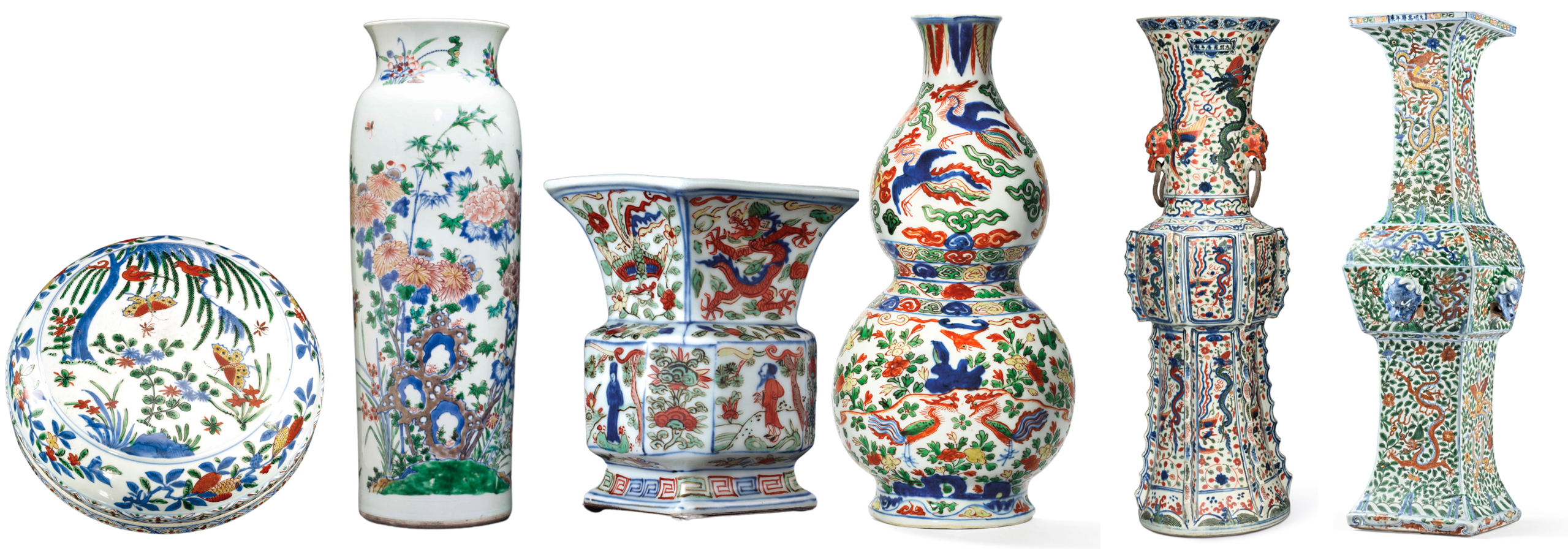
LEFT TO RIGHT
1. A rare lidded box in wucai porcelain. Date: With Wanli six-character mark in underglaze blue and of the period (1573-1619), Ming dynasty. Diameter: 24,5 cm, 9 5/8 in. Auctioned in 2012 by Christie's Paris (France). "The circular lid is adorned with birds perched on a willow tree. Butterflies fly above flowering shrubs. Branches of lychees, peaches, vines, and flowers adorn the sides. Friezes of geometric patterns embellish the edges." (from Christie's catalog).
2. A rare wucai sleeve vase. Date: from the Shunzhi period, circa 1645-1655, Qing dynasty. Height: 18 5/8 in., 47.2 cm. Auctioned in 2015 by Christie's New York. "The vase is of elongated, high-shouldered, tapering cylindrical form with a waisted neck and is finely decorated with a large Lake Tai garden rock amidst flowering branches of chrysanthemums, tree peonies, bamboo shoots, narcissi and millet stalks. The scene is set beneath sprays of lotus, peonies and camelia on the neck and an incised band on the shoulder. The base is unglazed." (from Christie's catalog).
3. A rare wucai square zun-form vase. Date: With Wanli six-character mark within double-squares and of the period (1573-1619), Ming dynasty. Height: 5 in., 12.7 cm. Auctioned in 2010 by Christie's Hong Kong. "Sturdily potted in archaic bronze form, the mid-section well enamelled with four panels each enclosing a scholar under a pine tree, divided by stylised lotus sprays at the canted corners, between a key-fret band around the spreading foot and a lingzhi scroll on the angled shoulder, the widely flaring trumpet mouth with a dragon on each face chasing a 'flaming pearl' amidst multi-coloured clouds, the interior of the mouth with double lingzhi sprays." (from Christie's catalog).
4. A rare wucai ‘phoenix’ double-gourd form wall vase. Date: With Wanli six-character mark in underglaze blue within a double rectangle and of the period (1573-1619), Ming dynasty. Height: 12 1/4 in., 31 cm. Auctioned in 2017 by Christie's Hong Kong for HKD 2,250,000. "The upper bulb is vibrantly enamelled with a pair of phoenix in flight amid ruyi-shaped clouds below a band of downward plantain leaves at the rim, the lower bulb with a pair of confronted phoenix standing amid peonies and rocks beneath seven smaller long-tailed birds above a classic scroll on the flared foot, divided by ruyi-head and lingzhi borders at the waist. The reverse is inscribed with the reign mark enclosed within a double-rectangle between a lotus flower and leaf above a square aperture." (from Christie's catalog).
5. A large wucai ‘dragon and phoenix’ gu-form vase. Date: With Wanli six-character mark in underglaze blue in a line and of the period (1573-1619), Ming dynasty. Height: 33 1⁄2 in., 85.3 cm. Auctioned in 2023 by Christie's Hong Kong. "The current vase is divided into three sections; the middle and bottom sections are further divided into six facets by vertical flanges. Each facet is decorated with a dragon and a phoenix pursuing a flaming pearl. The six-character mark is inscribed at the top of the trumpet section below the ruyi band around the flaring mouth. The neck is incised with a later inscription dedicating the vase to Mount Fo in the autumn months of cyclical year of guihai. The present vase took inspiration from the archaic ritual bronze form known as a gu. Wanli mark-and-period vases of this form, size and decoration are extremely rare." (from Christie's catalog).
6. A massive wucai ‘dragon’ gu-form vase. Date:With Wanli six-character mark in underglaze blue within a double rectangle and of the period (1573-1619), Ming dynasty. Height: 29 in., 73.5 cm. Auctioned in 2021 by Christie's Hong Kong. "Modelled after an archaic bronze gu, this well-proportioned vase is decorated on the exterior with four horizontal registers depicting a total of twenty dragons in flight above waves and rocks. The mid-section is applied with four lion-form masks, and the unglazed base is pierced with four circular apertures for ventilation." (from Christie's catalog).
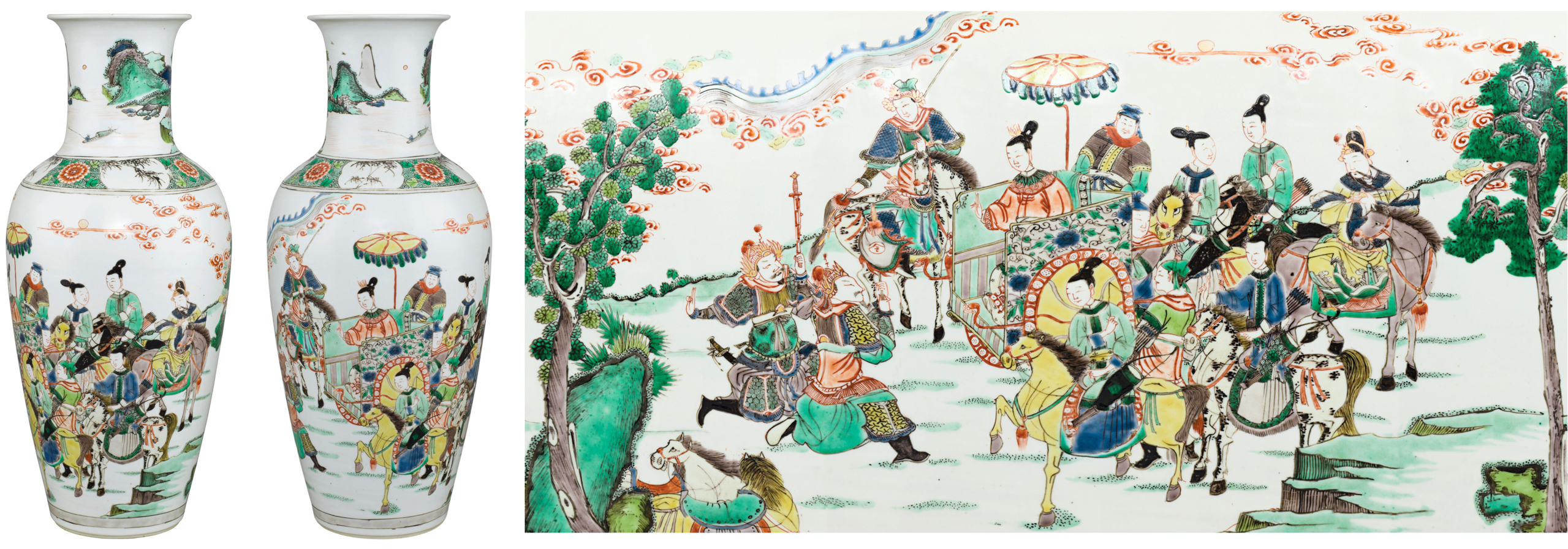
Chinese porcelain Famille Verte wucai baluster vase of tapered form. Date: Kangxi reign, 1662-1722. Height: 17 1/4 inches, 43.8 cm. On sale by Marchant, London, UK. The vase depicts a lady in a sedan chair amongst all her attendants, a warrior and a scholar, meeting two kneeling soldiers, one holding a sword by the scabbard, the other holding a banner with a character, ling, ‘order’. There's a castle wall in the distance, beneath the sun and clouds in a continuous landscape scene with pine, wutong and rockwork. The shoulder with bamboo reserves on a chrysanthemum flowerhead, leaf and green scroll ground, the gently flaring neck is painted with a continuous mountain river landscape scene, with a fisherman beneath the sun, the base glazed white.
Doucai (斗彩): Chromatic Dialogue Across Firings
Doucai—literally “contrasting colors”—is a highly controlled decorative technique that combines underglaze cobalt blue with overglaze enamel painting. Its defining feature is structural: the entire compositional framework is first established in underglaze blue.
Technical Process
- The design is outlined in cobalt blue on the unfired or biscuit-fired porcelain body.
- The piece is covered with a transparent glaze and fired at high temperature.
- Enamel colors are then applied within the established blue outlines.
- A second, lower-temperature firing fixes the enamels.
The underglaze blue therefore precedes and governs the enamel work. It is not supplementary; it is foundational.
In doucai:
- Blue defines the contours of motifs.
- Structural lines are rarely replaced by enamel outlines.
- Enamel colors remain contained within the blue framework.
- The composition appears deliberate, disciplined, and architecturally planned.
If the enamel were removed, the design would still read as complete in blue alone.
The technique reached its most refined early form in the Ming Chenghua period (r.1464–1487), where small-scale compositions—flowers, birds, fruit, and symbolic motifs—were rendered with exceptional delicacy. Later revivals in the Qing dynasty consciously referenced this model, sometimes very closely.
For classification purposes, it is essential to understand that doucai is defined by design hierarchy, not merely by the coexistence of blue and enamel.
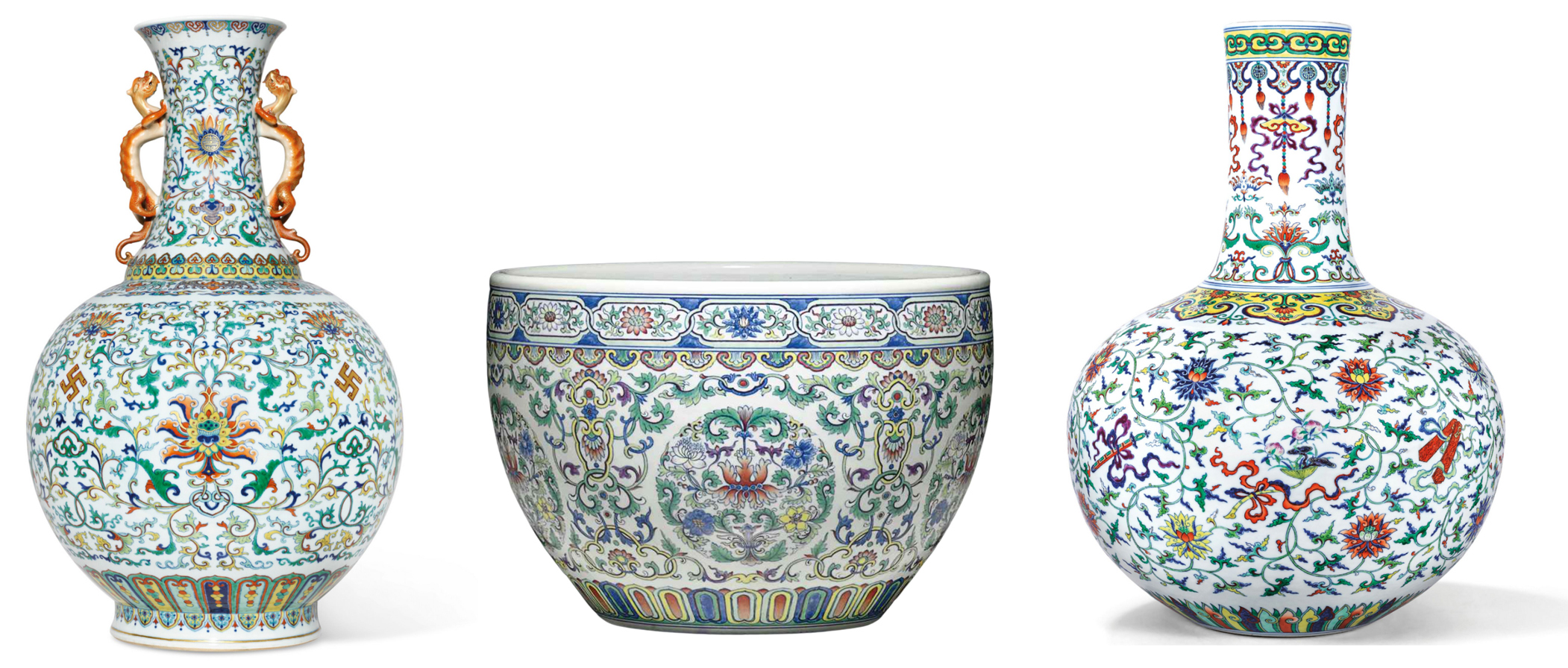
LEFT: A magnificent and extremely rare large doucai vase. Date: With Qianlong six-character seal mark in underglaze blue and of the period (1736–1795). Height: 20 3⁄4 in., 52.7 cm. Auctioned by Christies Hong Kong in 2022 for HKD 34,050,000. "The spherical body is superbly enamelled with four lotus blossoms interspersed with smaller lotus blossoms above gilt wan emblems, all reserved on a lush ground of leafy scrolls, bordered by a band of stylised bats above clouds on the shoulder and a band of petal lappets above the foot, the tall waisted neck is decorated on either side with a lotus blossom centered by a gilt shou medallion above a cluster of lingzhi, all set against leafy scroll and bordered above and below by ruyi-head bands and flanked by a pair of handles formed as chilong with scrolling bifurcated tails finely shaded in iron-red and with gilt details." (from Christie's catalog)
CENTER: A large doucai jardiniere. Date: from Qianlong period (1736-1795). Dimensions: 13 in.,33 cm across. Auctioned by Christies New York in 2011 for US$ 842,500. " The deep thickly potted sides tapering towards the base and decorated with five composite foliate roundels framed and separated by interlocking leafy foliate scrolls, between borders of petal lappets below and ruyi heads above, with a band of linked quatrefoil panels enclosing flower sprays reserved on a blue ground below the slightly lipped rim." (from Christie's catalog)
RIGHT: A fine magnificent and extremely rare doucai and famille rose anbaxian vase, tianqiuping. Date: With Qianlong six-character seal mark in underglaze blue and of the period (1736-1795). Height: 21 1/4 in., 53.9 cm. Auctioned by Christie's Hong Kong in 2018 for HKD 130,600,000. "The magnificent vase is superbly potted with a globular body surmounted by a columnar neck, delicately enamelled in the doucai and famille rose palettes, on the body with the anbaxian, ‘Eight Daoist Emblems’, each tied with flowing ribbons, amid leafy scroll issuing lotus blossoms in two rows, all between lappets at the foot and a band of cloud-shaped collar at the shoulder. The neck is enamelled with four lotus blossoms, beneath pendent double-fish and musical chimes." (from Christie's catalog)
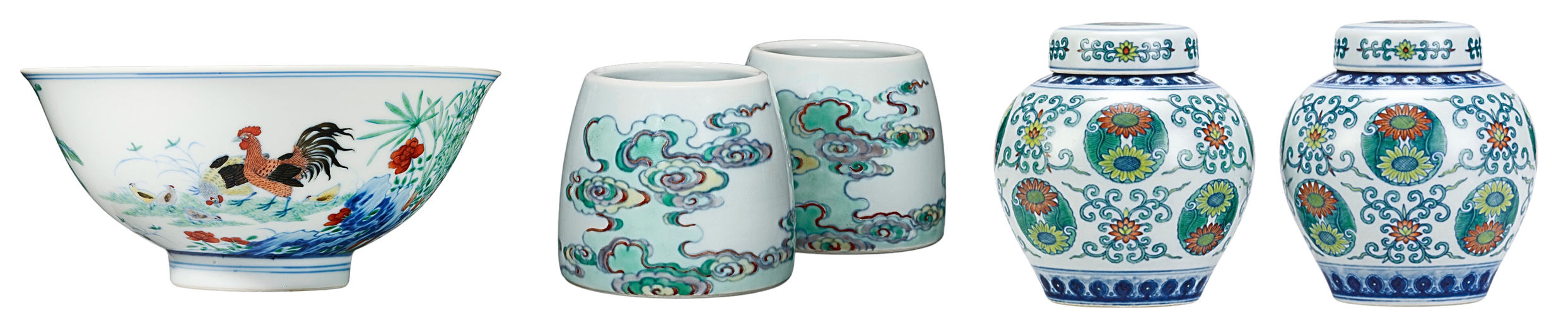
LEFT: A very rare doucai 'chicken' bowl. Date: With Yongzheng six-character mark in underglaze blue within a double circle and of the period (1723-1735). Diameter: 6 in., 15.2 cm. Auctioned by Christie's New York for US$ 756,000 in 2025. "The present ‘chicken’ bowl reflects the admiration of the 18th century court for the doucai ‘chicken’ cups of the Chenghua reign (1465-1487). The theme of the decoration on this cup, the rooster, hen, and chickens, has been ripe with strong connections to Chinese civilization for millennia. (...) ‘Chicken’ cups made in the Chenghua period are known for their fine porcelain and beautifully painted decoration and were consistently regarded by later generations as the most admired Chenghua porcelains. Yongzheng-period ceramicists tried to reproduce all aspects of these 15th-century pieces, particularly taking care to emulate the fine potting, soft glaze and delicate enamels of the Chenghua originals." (from Christie's catalog)
CENTER: A very rare pair of doucai water pots. Date: With Yongzheng six-character marks in underglaze blue within double circles and of the period (1723-1735). Diameter: 2 3/8 in., 6 cm. Auctioned by Christie's Hong Kong for 11,250,000 in 2022. " Each vessel is finely painted and enamelled around the incurving sides with swirling clouds circling the base and rising to two tall trailing formations, the clouds formed as overlapping whorls with ribbed edges picked-out in delicate tones of green, aubergine, blue, yellow and highlighted with iron-red, the interior and base with a transparent glaze." (from Christie's catalog)
RIGHT: A fine pair of doucai jars and covers. Date: With Qianlong six-character seal marks and of the period (1736-1795). Height: 4 7/8 in., 12.3 cm. Auctioned by Christie's Hong Kong for HKD 6,040,000 in 2013. "The globular body of each jar is delicately painted and enamelled with eight roundels, each containing two chrysanthemum blooms in yellow and iron-red, interspersed with lotus sprays on curled tendrils, all between ruyi lappet bands in underglaze-blue. The flat top of the cover is decorated with a further chrysanthemum medallion above detached florette sprays around the sides." (from Christie's catalog)
The Difference Between Wucai and Doucai
Confusion between wucai (五彩) and doucai arises because both techniques combine underglaze blue with overglaze enamels. The firing sequence is broadly similar in both cases. The distinction lies in the role blue plays within the design.
Wucai—“five colors,” symbolically rather than literally—also involves underglaze blue decoration followed by enamel painting. However, in wucai:
- Blue does not necessarily define the entire structure.
- Enamels may create their own outlines.
- Blue may function as shading, background, or one color among others.
- Enamels can dominate visually and compositionally.
If enamel areas were removed from a wucai piece, the remaining blue design would often appear incomplete.
In other words:
- Doucai = blue controls the design.
- Wucai = blue participates in the design.
This is a structural distinction, not a chromatic one. In other words, Doucai requires underglaze blue as structural outline.
Why the Confusion Persists
Several factors blur the boundary:
- Late Ming experimentation introduced freer combinations.
- Qing revivals imitated earlier models with varying fidelity.
- Western classification systems emphasized color palettes rather than compositional hierarchy.
- Auction catalogues often use the terms loosely.
For rigorous classification, the key question is always: Does underglaze blue establish the full compositional skeleton? If yes, the piece aligns with doucai. If not, it belongs to the broader wucai family.
Fencai (粉彩) in Brief
Fencai, often associated with what Western scholarship calls Famille Rose, represents a different development in enamel technology. Unlike wucai and doucai, its defining characteristic is not the role of underglaze blue, but the use of opaque enamel mixtures that allow soft tonal transitions.
The crucial material innovation is the use of an opaque white enamel (玻璃白, boli bai, sometimes called “glassy white”). Mixed with colored enamels, it produces:
- Pastel tonalities
- Gradual shading
- Greater illusion of volume
- A painterly surface quality
The enamel palette becomes softer and more atmospheric than earlier overglaze traditions.
Structural Differences from Wucai and Doucai
- Underglaze blue may be absent entirely.
- Design outlines are typically created in enamel rather than blue.
- Modeling through shading becomes central.
- Compositions often reflect a more naturalistic or pictorial ambition.
Fencai developed fully in the Qing dynasty, particularly from the Yongzheng period onward, when enamel technology at Jingdezhen achieved high refinement. Later productions range from imperial masterpieces to export wares and commercial reinterpretations.
For classification purposes, fencai is best understood as an enamel technology category, defined by material composition and painterly capability rather than by the structural logic that distinguishes doucai from wucai.
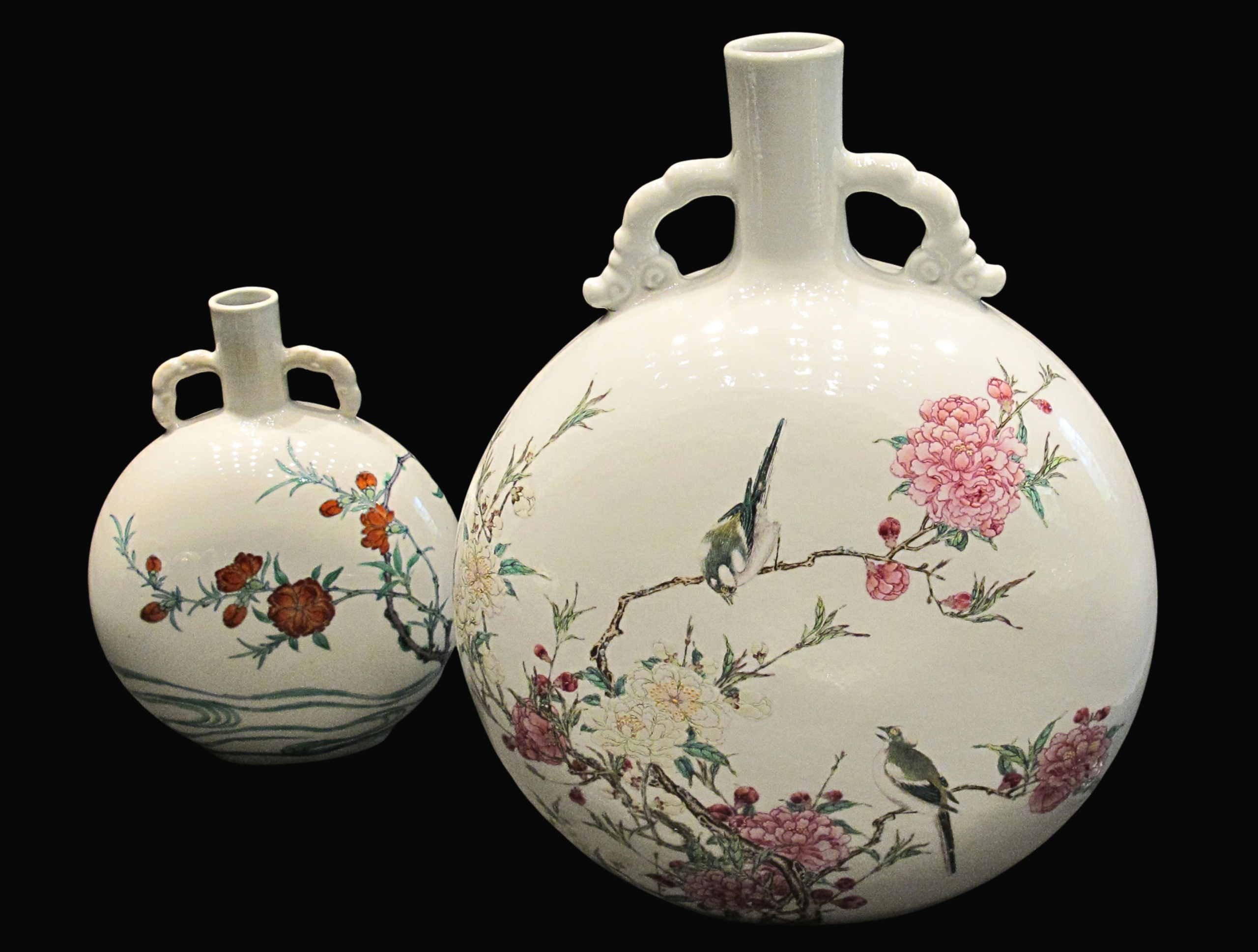
Two moon flasks with pairs of birds on floweing branches. The flask on the right is a fencai porcelain, while the left one is a doucai ware. Date: With Yongzheng mark, 1723-35, Qing dynasty. Max height: 29,3 cm. © The Trustees of the British Museum, London, UK.
Can Wucai, Doucai and Fencai be translated into the 'Famille' System?
No, wucai and doucai cannot be directly translated into the famille system.
Sometimes they overlap with famille categories, but they are not equivalent systems and should not be treated as translations of one another.
The Chinese system (wucai, doucai, fencai, etc.) classifies by:
- Technique
- Firing sequence
- Role of underglaze vs overglaze
- Technological structure
It is process-based.
The European Famille system classifies by:
- Dominant enamel palette
- Visual color impression
As we saw, it's color-based and was developed in 19th-century France for European collectors.
They are fundamentally different taxonomies and represent two different logics of classification.
Can Wucai be translated into Famille Verte?
The overlap is partial and context-dependent.
Most Kangxi-period wucai pieces that use
- Underglaze blue
- Iron red
- Green enamels
- Yellow
were classified by Western dealers as Famille Verte because green dominates visually.
However:
- Not all wucai is Famille Verte.
- Not all Famille Verte is wucai.
- Famille Verte includes pieces with no underglaze blue at all.
- Wucai can include palettes that are not green-dominant.
Thus, Wucai is not equivalent to Famille Verte but some Kangxi wucai pieces fall within what Western collectors call Famille Verte.
Can Doucai be translated into Famille Verte?
Generally, no.
Doucai is structurally defined by:
- Complete underglaze blue outline
- Enamels filling inside that framework
Famille verte says nothing about structure.
A doucai piece could visually appear green-dominant and be called famille verte by a dealer — but technically that would be imprecise and academically weak.
In most serious scholarship:
- Doucai remains doucai.
- It is not translated into famille terminology.
What About Fencai?
This is the only case where translation is commonly accepted: Fencai is considered equivalent to Famille Rose.
But even here, caution is needed:
- Famille rose is a Western collector’s label.
- Fencai is the Chinese technical term.
- Yangcai and ruancai complicate the picture further. And this will be the topic of the next chapter.
In conclusion, for experts, the safest hierarchy is:
- Primary term: Chinese technical classification;
- Secondary term (if useful): Western collector label.
Qing Dynasty Overglaze Enamels: Falangcai, Yangcai, and Fencai
Technical Mastery, Historical Evolution, and Cultural Significance
INTRODUCTION: THE TRIAD OF QING IMPERIAL PORCELAIN DECORATION
1.1 Defining the Overglaze Enamel Tradition
1.1.1 The emergence of polychrome decoration in Qing ceramic arts
The Qing dynasty (1644–1912) saw an unprecedented advancement in ceramic technology, especially in overglaze enamel decoration. During this period, Chinese porcelain production moved beyond the relatively limited chromatic palette of the Ming dynasty wucai (五彩, “five colors”) toward a sophisticated system of polychrome enamel painting. . This new system integrated indigenous Chinese traditions with techniques introduced from Europe.
This transformation was not merely an aesthetic development but represented a significant advance in materials science, workshop organization, and imperial artistic patronage, , not merely an aesthetic development. Three major decorative techniques emerged from this context: Falangcai (珐琅彩), Yangcai (洋彩), and Fencai (粉彩). Together, these techniques form an interconnected technological continuum that illustrates the Qing court’s ability to absorb, adapt, and ultimately domesticate foreign technical knowledge.
The technological foundations of these innovations were established during the reign of Kangxi (1662–1722). Jesuit missionaries at the Qing court and merchants operating through the port of Guangzhou introduced European enamel technologies and pigments. The Kangxi emperor’s well-documented interest in Western science and technology created institutional conditions that encouraged experimentation within the Imperial Household Department workshops (Zaobanchu 造办处) in Beijing.
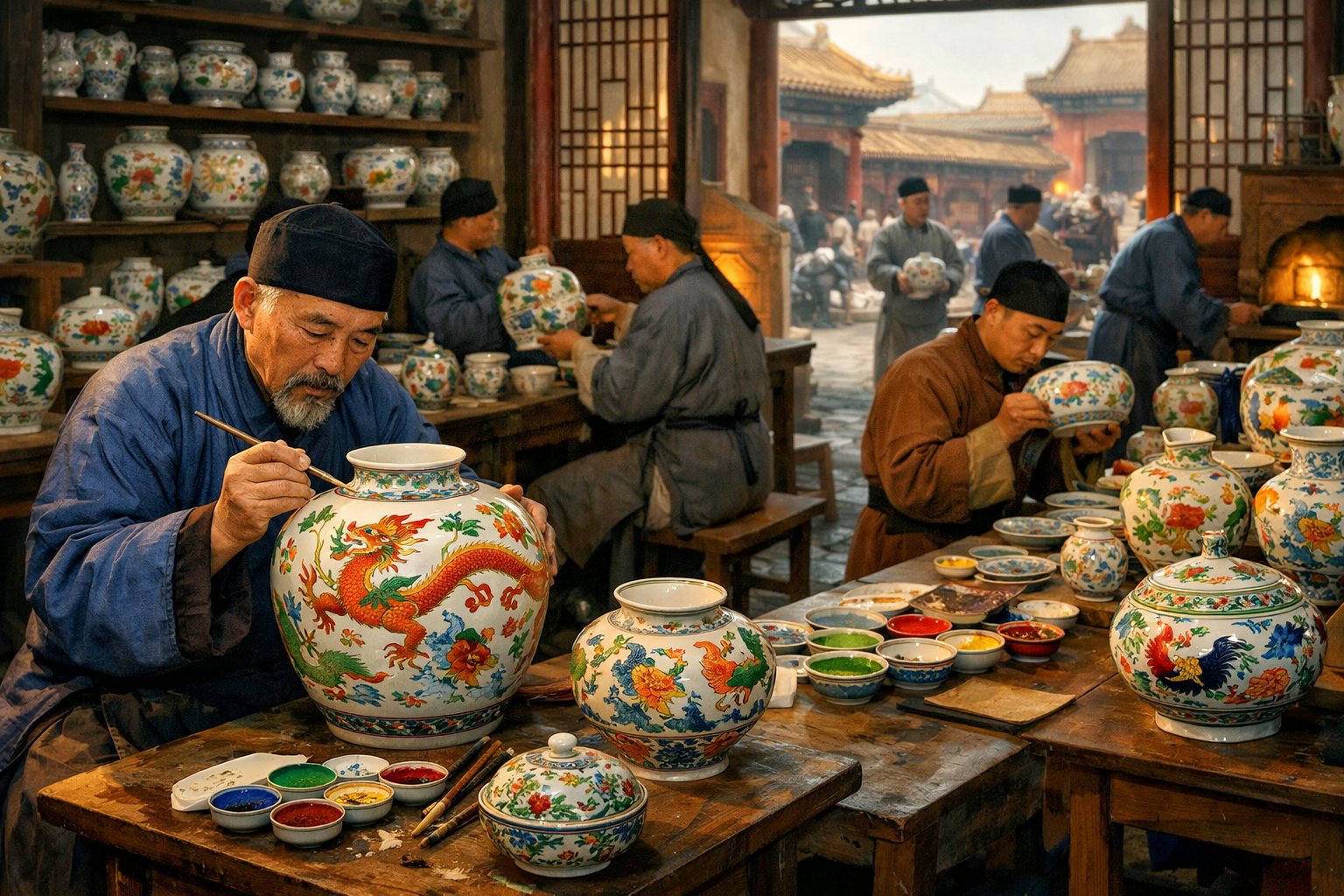
The workshops of the Imperial Household Department (Zaobanchu 造办处) were among the most important institutions for court art production in imperial China. Located within the palace precincts in Beijing during the Qing dynasty, the Zaobanchu served as the technical and artistic arm of the imperial household. The department oversaw specialized workshops that produced luxury items exclusively for the emperor and the court. These items included jade carvings, lacquerware, metalwork, enamels, glass, and, most importantly, porcelain.
Although most court porcelain was fired in the imperial kilns in Jingdezhen, the Zaobanchu played a decisive role in designing and supervising these wares. Court artisans and officials in Beijing developed patterns, shapes, and decorative schemes according to imperial taste. These designs were then sent to Jingdezhen for production. The workshops also inspected finished wares, modifying them or adding further decoration before they were used in the palace. Thus, the Zaobanchu acted as a central node, connecting the palace with the most important ceramic production center in the empire.
During the reigns of emperors such as Kangxi, Yongzheng, and especially Qianlong, this system became highly sophisticated. Archival records demonstrate the emperor's detailed involvement in porcelain design, including experimentation with archaistic forms, new glaze colors, and elaborate decorative programs inspired by antiquity or foreign styles. The palace workshops thus served as both administrative offices and laboratories of artistic innovation, mediating between the emperor's aesthetic ambitions and the technical expertise of the Jingdezhen kilns.
The Zaobanchu is significant in the history of porcelain because it formalized imperial control over design and quality. Through its supervision, court taste could swiftly translate into new ceramic forms, ensuring porcelain remained a key expression of Qing imperial culture.
Within the palace workshops, Chinese artisans collaborated with Jesuit missionaries and craftsmen who were familiar with the enamel techniques employed in European decorative arts. This collaboration produced decorative effects that were previously unknown in Chinese ceramics, such as vivid, glass-like colors that were applied with painterly precision. These colors were capable of subtle tonal gradation and chromatic depth that went beyond the possibilities of the traditional mineral pigments that were used in earlier overglaze decoration.
Therefore, the significance of Qing enamel techniques extends beyond their aesthetic achievements. They represent one of the few documented cases in premodern China of foreign technology being systematically studied, modified, and successfully integrated into established craft traditions. The chemical composition of enamel pigments, specialized firing methods, and organization of imperial production reflect the Qing court’s deliberate effort to master and transform imported technologies.
1.1.2 Terminology and scholarly debates on classification
The terminology used to describe Qing enamel techniques has been the subject of debate in Chinese and Western scholarship for a long time. This debate reflects the complexity of historical documentation as well as the retrospective application of modern classification systems to practices that were not always clearly distinguished by contemporary artisans.
The term Falangcai (珐琅彩) literally means “enamel colors.” The word falang itself is a phonetic borrowing connected to terms such as Folang (佛郎) or Folangqi (佛郎机), which were historically used in Chinese sources to refer to Europeans, particularly the “Franks.” Thus, the etymology explicitly acknowledges the foreign origin of enamel technology.
The term Yangcai (洋彩), meaning “foreign colors” or “Western colors,” emerged during the Yongzheng period. In historical documents the term often refers to porcelains decorated in a style influenced by Western painting techniques or produced using enamel materials derived from European methods.
However, modern scientific analysis has demonstrated that Falangcai and Yangcai share fundamental technical characteristics. In particular, both employ lead-boron-silicate enamel formulations, distinguishing them from Fencai. Consequently, the distinction between Falangcai and Yangcai often reflects differences in workshop location and institutional context rather than fundamental differences in materials.
In contrast, Fencai (粉彩) , often referred to in Western scholarship as Famille Rose, represents a distinct technical system characterized by the use of arsenic-based opacifiers and the absence of boron in the glass matrix. The French term famille rose, coined by 19th-century collectors, has become widespread in Western literature, but it sometimes obscures the technical distinctions recognized in modern scientific studies.
Recent research conducted at institutions such as the Palace Museum in Beijing, the National Palace Museum in Taipei, and Tsinghua University has clarified these issues through combined archival and scientific investigation. Scholars, including Shih Ching-Fei, Peng Ying-Chen, and Wang Zhuping, have emphasized that accurate classification must consider multiple factors simultaneously:
- chemical composition of enamel pigments;
- production location and workshop organization;
- historical documentation from imperial archives;
- stylistic and technical features of decoration.
Such research has demonstrated that visual appearance alone cannot reliably distinguish these categories.
FALANGCAI (珐琅彩): IMPERIAL ENAMEL PAINTING ON PORCELAIN
2.1 Technical Foundations and Material Innovation
2.1.1 Lead–boron glass as the principal enamel medium
The defining technical feature of falangcai decoration is the application of lead-boron-silicate enamel glass over a glazed porcelain body. Scientific analysis of Qing imperial wares has confirmed that Falangcai enamels typically contain boron oxide (B₂O₃) together with lead oxide, silica, and alkali fluxes. The presence of boron distinguishes Falangcai and Yangcai from the later Fencai system.
Scientific analysis has confirmed that falangcai enamels consistently contain boron oxide at levels ranging from approximately 5% to 15% by weight, with an average around 8.57% in analyzed samples.
Boron plays several important roles in the enamel formulation:
- lowering the melting temperature of the glass;
- improving adhesion between enamel and porcelain glaze;
- reducing thermal expansion mismatch;
- increasing surface brilliance and transparency.
The lead-boron system used in Falangcai was a direct transfer of technology from European glassmaking and enamel traditions. Contemporary European enamels, particularly those produced in France and Germany for decorative objects and scientific instruments, also used borax (sodium borate, Na₂B₄O₇·10H₂O) or boric acid as essential flux components. Court records from the Kangxi period document the introduction of this technology to China, noting the arrival of European missionaries with expertise in huafalang (画珐琅, painted enamel) techniques.
Falangcai's glass matrix was prepared by melting silica (quartz, or mayashi), lead oxide (usually red lead, or Pb₃O₄), borax or boric acid, and various coloring oxides. Then, the mixture was quenched in water and ground into a fine powder. This "fritted" enamel, pre-melted and reground, offered superior homogeneity and color consistency compared to raw ingredient mixtures.
The precise proportions of the base glass were adjusted to achieve the desired working properties: fluidity for painting, stability during firing, and compatibility with the porcelain body.
These properties enabled enamel decoration to be fired at relatively low temperatures (approximately 700–850 °C), even after the porcelain body and glaze had already been fired at high temperatures.
This process allowed for a level of artistic control that earlier Chinese ceramic pigments could not achieve.
Formulating and executing these enamels required substantial technical mastery, including knowledge of high-temperature chemistry, thermal expansion behavior, and color development, which far exceeded traditional Chinese ceramic practices. The successful adaptation of this foreign technology to Chinese porcelain production within decades of initial contact demonstrates the sophistication of Chinese material science and the effectiveness of imperial patronage in concentrating technical resources.
2.1.2 Imported Pigments and Their Chemical Signatures
Early falangcai production relied heavily on pigments of European origin, many of which can be identified through modern analytical techniques.
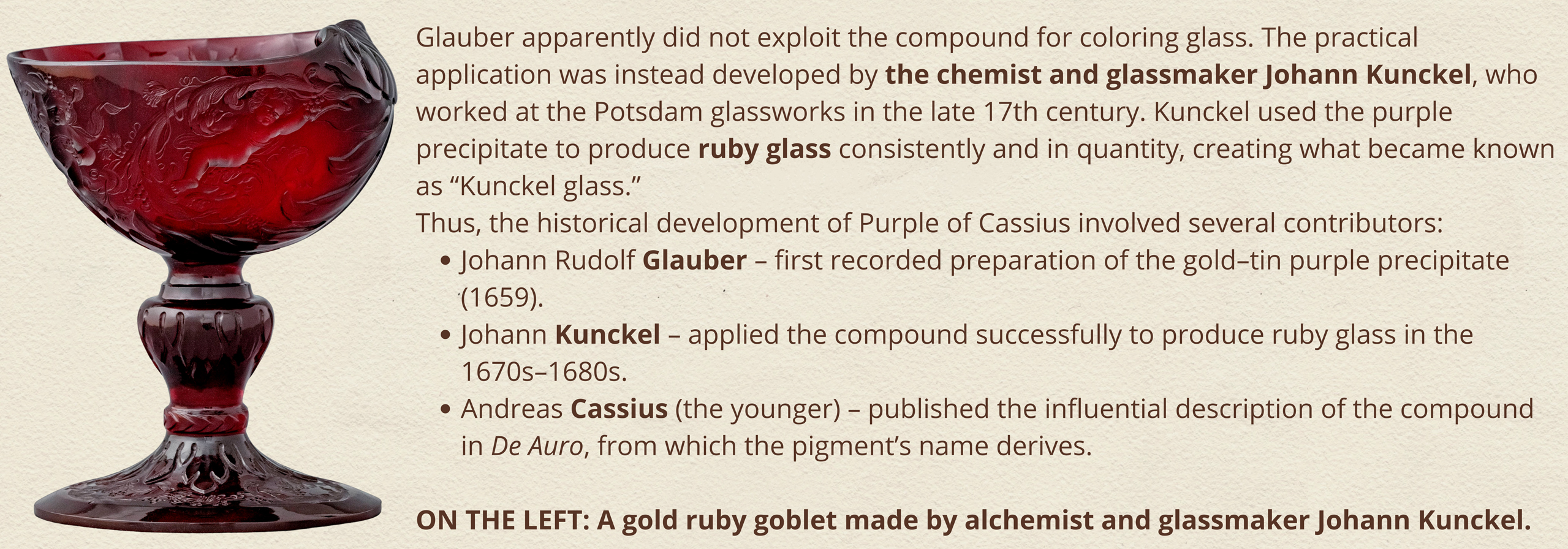
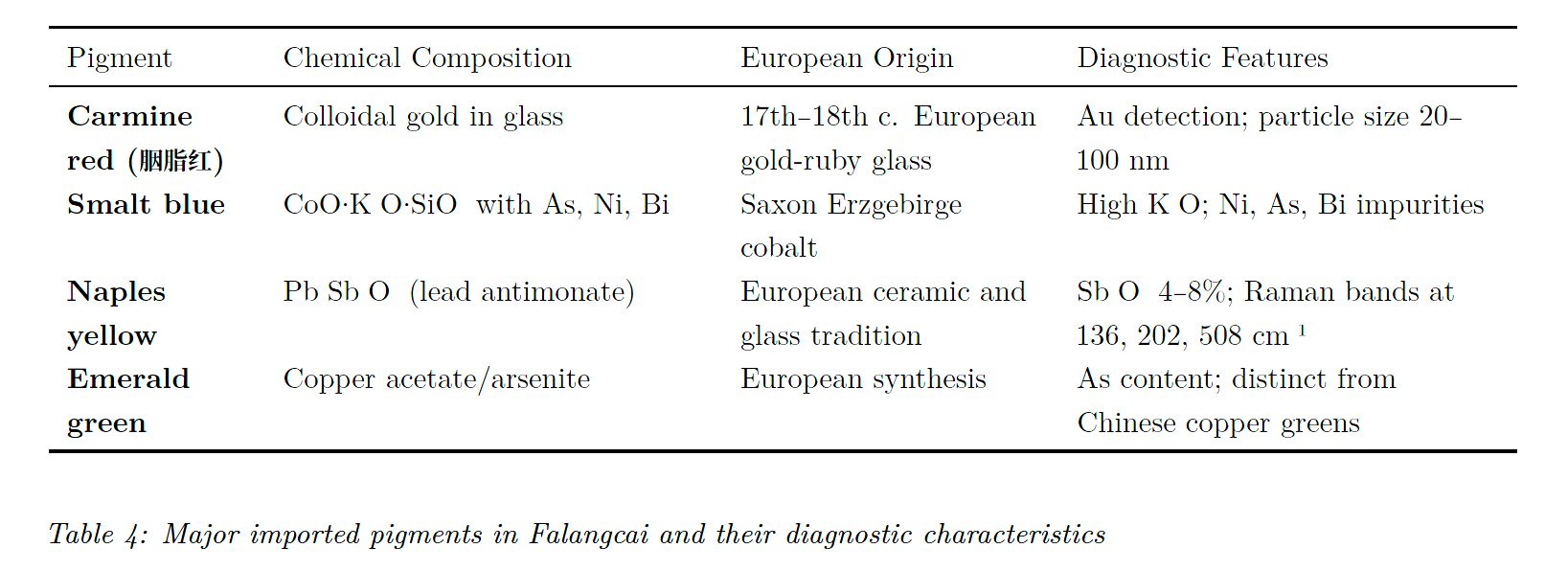
One of the most important pigments was gold-based pink, carmine, or rouge red, often referred to in Chinese sources as yanzhi hong (胭脂红). This color is produced by suspending extremely fine particles of colloidal gold within a glass matrix. In European chemistry it was known as “Purple of Cassius.”
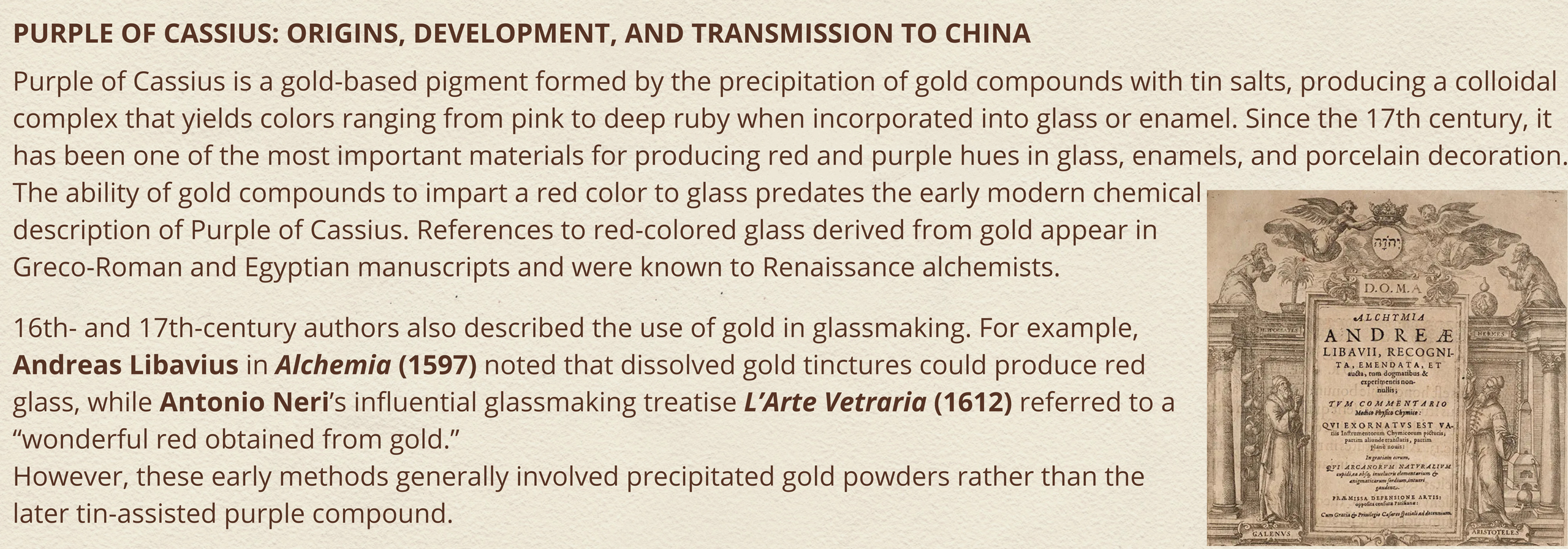
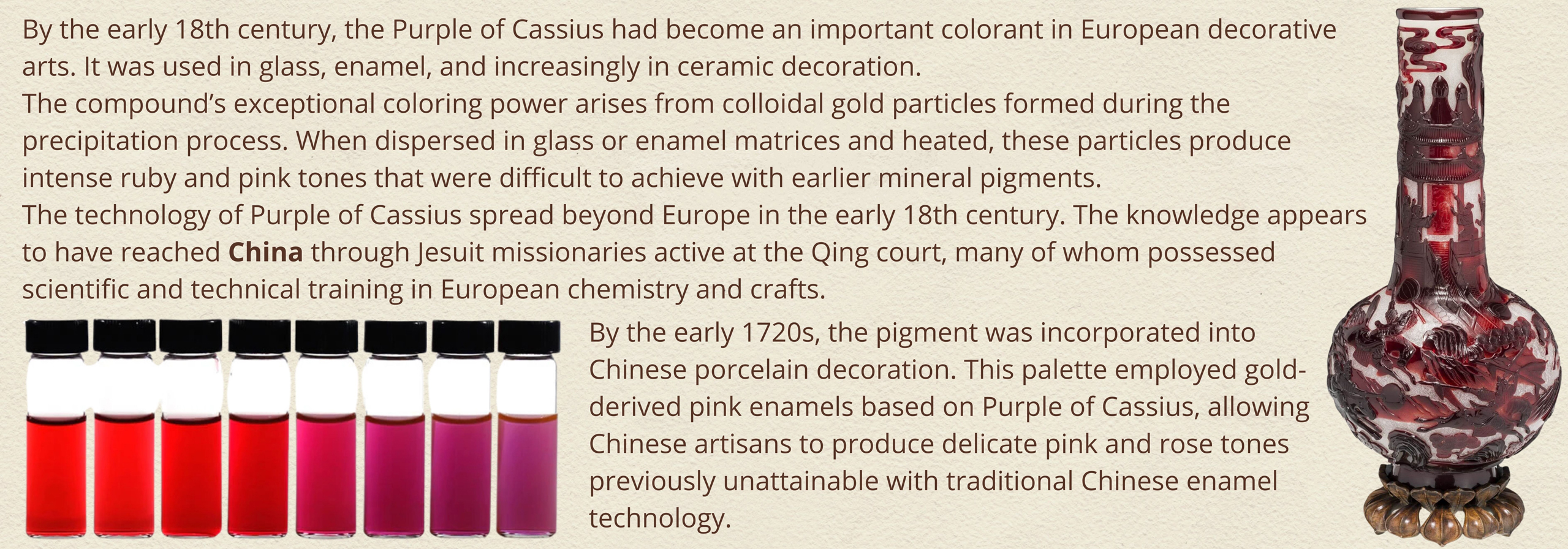
Scientific analysis has confirmed the presence of trace amounts of gold in some Yongzheng-period Falangcai enamels, which confirms the use of imported technology.
Another imported material is smalt, a potassium-rich cobalt glass produced in Europe from arsenic-containing cobalt ores, especially from the Erzgebirge region in Saxony. Introduced to China no later than the Kangxi period, this material contains distinctive impurities of nickel, arsenic, and bismuth that distinguish it from Asian cobalt sources. Smalt produced distinctive blue tones.
Yellow pigments often consisted of lead antimonate (Naples yellow, Pb₂Sb₂O₇), a compound widely used in European painting and ceramics but absent from earlier Chinese ceramic practice. A 2020 study by the Beijing Palace Museum documented the 4.08% antimony content in "ginger yellow" Falangcai pigments and the presence of antimony in compound greens, confirming the systematic employment of this European-derived material. (Non-destructive Assay of Two Enamel-painted Porcelains of the Kangxi and Yongzheng Eras in the Collection of the Palace Museum).
These pigments, together with copper greens, manganese purples, and iron-based browns, created a chromatic palette far broader than that of traditional Chinese overglaze decoration.
2.1.3 Arsenic and Antimony Compounds in Enamel Chemistry
Arsenic and antimony compounds played an important role in the chemistry of Falangcai enamels.
Arsenic oxide (As₂O₃) can be used as an opacifying agent in certain formulations to produce milky white tones or modify color intensity. Qing dynasty archival records that refer to the preparation of enamel pigments mention the controlled use of arsenic materials.
Antimony oxide is primarily found in yellow pigments, particularly those based on lead-antimonate compounds. These pigments produced brilliant, stable yellow tones that became characteristic of 18th-century enamel decoration.
The use of these materials demonstrates the advanced level of chemical experimentation achieved in the imperial workshops. However, handling these pigments posed significant health risks to artisans, a danger that was only partially understood at the time.
2.1.4 Low-Temperature Firing and Multi-Stage Decoration
Falangcai decoration required low-temperature firing at specific temperatures in specialized enamel kilns.
While porcelain bodies were fired above 1200 °C, enamel decoration was fired between 700 °C and 850 °C. At these temperatures, the enamel glass softens and fuses to the glaze surface without damaging the underlying porcelain.
Complex polychrome designs required multiple firings. Typically:
- The outline drawing was fired first.
- Major color fields were applied and fired.
- Third, delicate colors, such as pinks, were added later.
- Gold details or corrections were sometimes fired last.
Each firing stage increased the risk of damage or color alteration, making the production of Falangcai technically demanding and time-consuming.
2.2 Historical Development and Court Patronage
2.2.1 Introduction of Enamel Technology During the Kangxi Reign
Enamel painting was introduced to the Qing court during the Kangxi reign (1662–1722). Jesuit missionaries serving at the imperial court played a pivotal role in disseminating these techniques.
The missionaries were already familiar with European enameling techniques used on metal objects, such as watches, reliquaries, and scientific instruments. Their expertise attracted the interest of the Kangxi Emperor, who encouraged experimentation within palace workshops.
Imported enamel objects and pigments likely arrived through Guangzhou, the main gateway for European trade. From there, materials and knowledge were transmitted to the imperial workshops in Beijing.
The early Kangxi experiments adapting enamel decoration to porcelain were technically challenging. Surviving examples exhibit relatively simple designs and limited color palettes, suggesting that the technique was still being perfected. Furthermore, during the Kangxi period, the imperial workshop primarily used Western enamel pigments.
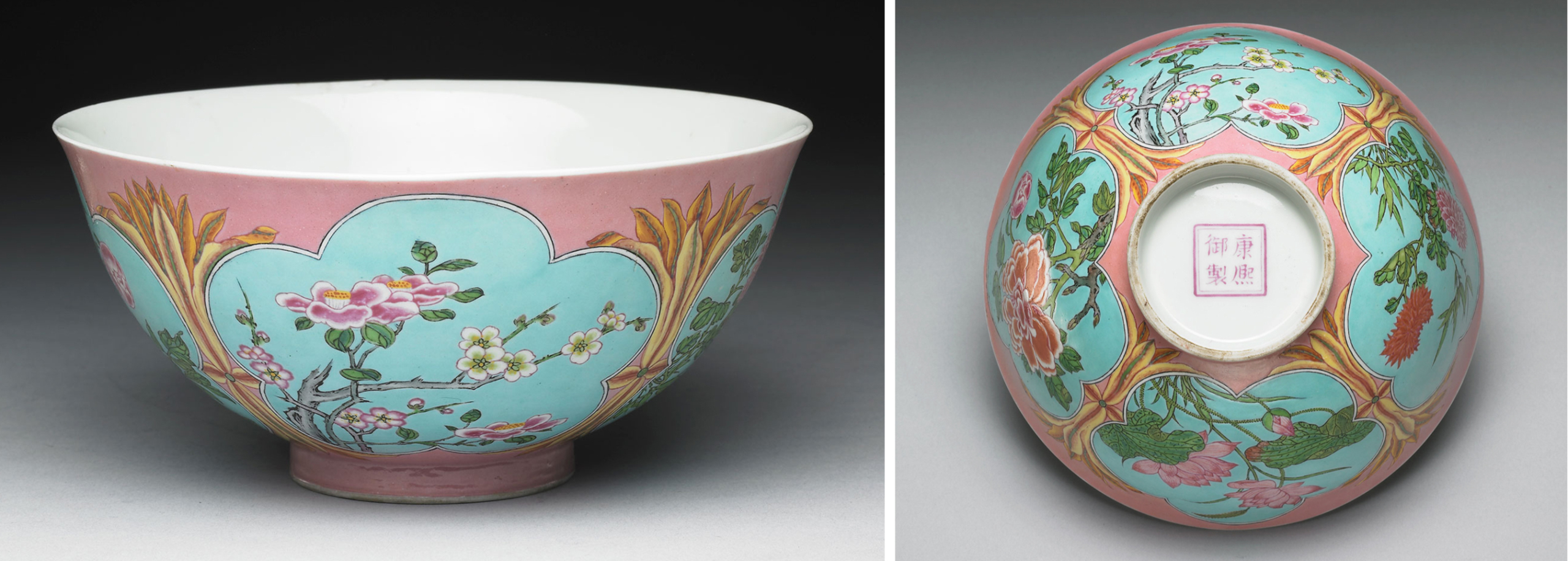
Bowl with flowers of the four seasons. Medium: painted porcelain with falangcai enamels. Qing dynasty, Kangxi reign (1662-1722). National Palace Museum, Taipei, Taiwan.

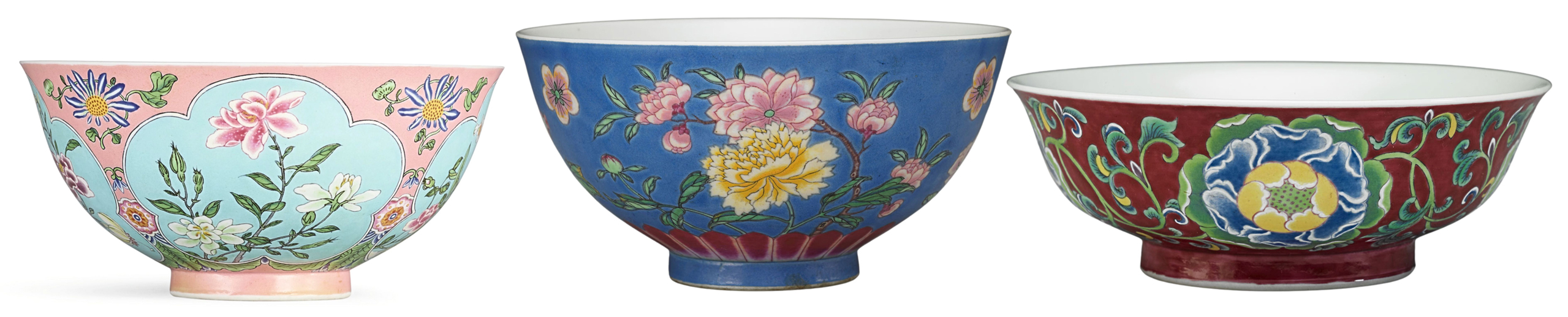
LEFT: Bowl with flowers on a yellow ground. Medium: painted porcelain with Falangcai enamels. Qing dynasty, Kangxi reign (1662-1722). National Palace Museum, Taipei, Taiwan.
CENTER: Fine white porcelain bowl, decorated in red, blue, green, orange and yellow Falangcai enamels. Made for Imperial use, it shows a design of intertwining peony scroll around the exterior, with interior bluish-white and undecorated. Qing dynasty, Kangxi reign (1662-1722). © The Trustees of the British Museum, London, UK.
RIGHT: Bowl with Indian lotuses on a pink ground. Medium: painted porcelain with Falangcai enamels. Qing dynasty, Kangxi reign (1662-1722). National Palace Museum, Taipei, Taiwan.
LEFT: A fine and rare pink-ground Falangcai bowl. Date: Kangxi reign (1662-1722), Qing dynasty. Auctioned by Sotheby's Hong Kong in 2018 for HKD 238,807,500, equivalent to todays' € 25,800,000 and US$ 30,500,000. "This small falangcai bowl, decorated with a turquoise quatrefoil and floral designs, could set a new auction record for Chinese ceramics when it is offered in a standalone sale. The piece measures just under six inches in diameter and is marked “Kangxi” and “Yuzhi” on the base, indicating that it was made for the emperor’s personal use, although its pristine condition suggests that it was a display-only piece. The falangcai porcelain type combines Western and Chinese techniques, comprising a ruby enamel derived from colloidal gold and a lead-based white enamel that allows for a range of pastel tones. Such ceramics had a short production period during the Qing Dynasty; specialists of the auction house believe this bowl is one of three related examples known to exist. One such bowl belongs to the collection of the National Palace Museum, Taipei, and is decorated with different flowers but made with the same material and markings. Both bowls are believed to have been thrown and fired twice in the imperials kilns of Jingdezhen, known as the porcelain capital of China with a tradition spanning nearly 2,000 years, and were likely painted by European Jesuits in the imperial palace workshops of the Forbidden City in Beijing." (Object lessons: a falangcai bowl that could set a new record for Chinese porcelain by Gabriella Angeletti, in "The Art Newspaper", 2018)
CENTER: Bowl with flowers of the four seasons on a blue ground. Medium: painted porcelain with Falangcai enamels. Qing dynasty, Kangxi reign (1662-1722). National Palace Museum, Taipei, Taiwan.
RIGHT: Bowl with peonies on a red ground. Medium: painted porcelain with Falangcai enamels. Qing dynasty, Kangxi reign (1662-1722). National Palace Museum, Taipei, Taiwan.
2.2.2 The Refinement of Enamel Production during the Yongzheng Period
The Yongzheng period (1723–1735) marked the true maturation of Falangcai.
During this period the imperial workshops gained greater control over pigment preparation, firing procedures, and artistic design. The emperor took a close interest in artistic production and is known to have personally reviewed objects produced in palace workshops.
Yongzheng falangcai is characterized by:
- refined porcelain bodies supplied from Jingdezhen;
- elegant compositions inspired by literati painting;
- restrained color palettes;
- integration of poetry and calligraphy into decoration.
Due to its balance of technical sophistication and aesthetic refinement, many scholars regard Yongzheng falangcai as the artistic peak of the tradition.
"In the 6th year of Yongzheng reign (1728), the Imperial workshop had eventually obtained the technique of processing enameling pigments. The additional colour selections and abundant supply widened the possibilities for the Yongzheng Emperor to improve the style of falangcai porcelains which had focused on delivering the "elegant" and "intricate" style, and endeavoured to make a difference from the commercial products. The craftsmen had taken the surface of bowls, plates and vessels as painting canvas; apart from continuing the floral compositions of the Kangxi reign, the decoration they created had further elaborated on the depiction of landscapes, flowers and birds, sceneries, and figure portraits. The combination of the poem, painting, and stamped mark presents an exclusive style of the Imperial court that was discrete from previous eras." (The Imperial Porcelain with Painted Enamels, National Palace Museum, Taipei, Taiwan).
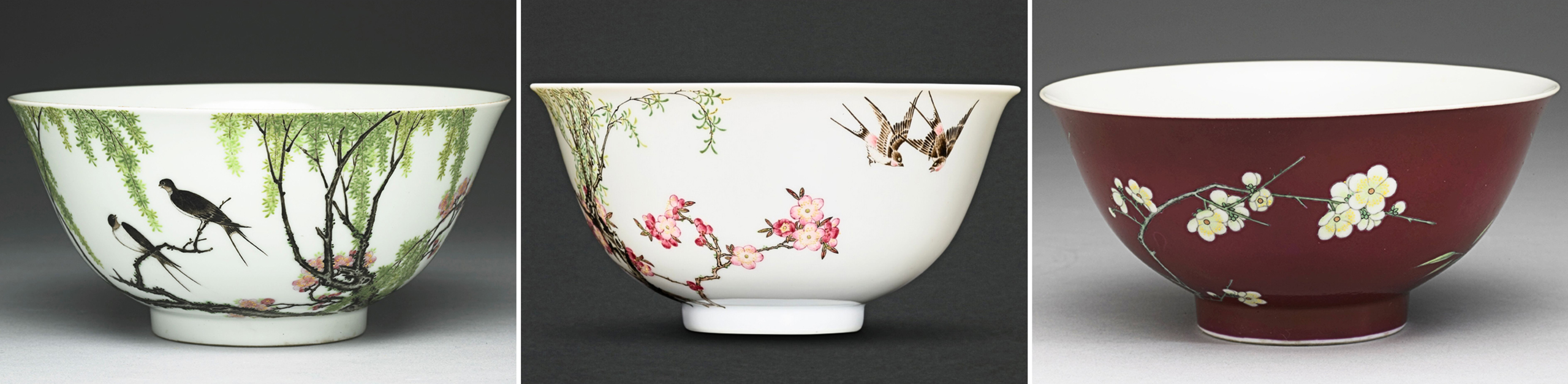
LEFT: Bowl with willows and swallows. Medium: painted porcelain with falangcai enamels. Date: Yongzheng reign (1723-1735). National Palace Museum, Taipei, Taiwan.
CENTER: A superbly enamelled imperial falangcai 'swallow' bowl. Date: With blue enamel mark and period of Qianlong, but the porcelain is possibly from the Yongzheng period and was painted in ca. 1736. Auctioned by Sotheby's Hong Kong in 2023 for HKD 198,220,000.
RIGHT: Bowl with plum blossoms and bamboo on a red ground. Medium: painted porcelain with falangcai enamels. Date: Yongzheng reign (1723-1735). National Palace Museum, Taipei, Taiwan.
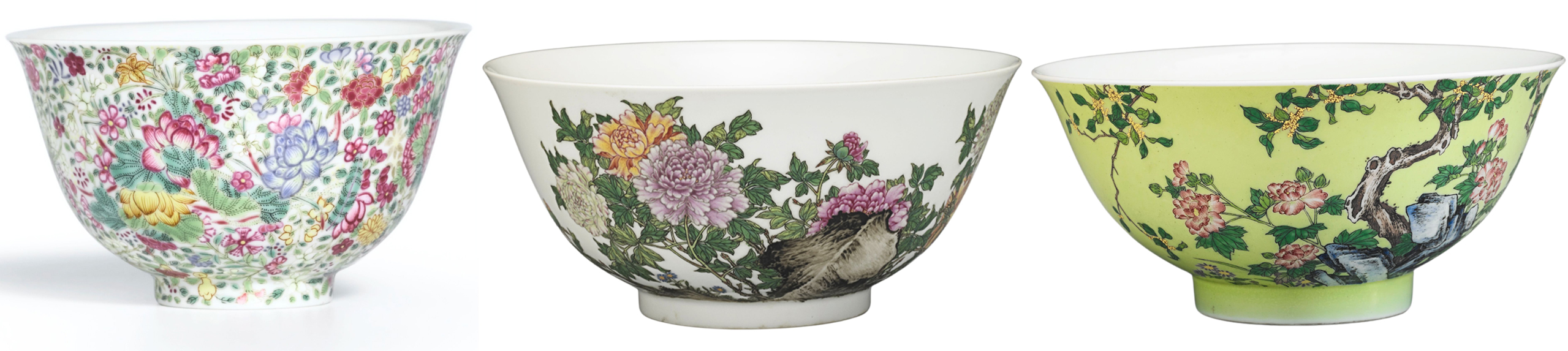
LEFT: A fine Falangcai 'mille-fleurs' bowl. Date: With mark and of the period of Yongzheng. Auctioned by Sotheby's Hong Kong in 2013. The bowl is "painted in brilliant enamels of magenta, yellow, green, lavender, and white with a dense bouquet of mixed flowers including large clusters of chrysanthemum and lotus, surrounded by sprigs of hydrangea, pink, magnolia, hibiscus and aster, all blooming against a ground of dense foliage in varied shades of green." (from Sotheby's catalog).
CENTER: Bowl with peonies. Medium: painted porcelain with Falangcai enamels. Date: Yongzheng reign (1723-1735). National Palace Museum, Taipei, Taiwan.
RIGHT: Bowl with cotton roses and osmanthuses on a green ground. Medium: painted porcelain with Falangcai enamels. Date: Yongzheng reign (1723-1735). National Palace Museum, Taipei, Taiwan.
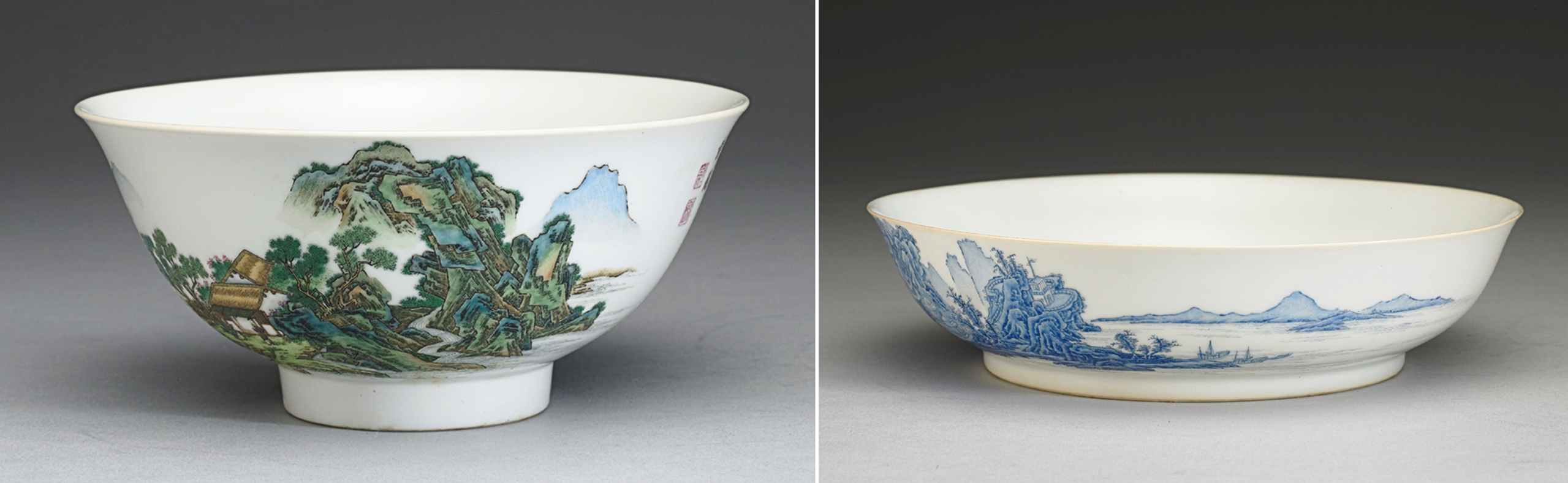
LEFT: Bowl with landscape and figure. Medium: painted porcelain with Falangcai enamels. Date: Yongzheng reign (1723-1735). National Palace Museum, Taipei, Taiwan.
RIGHT: Dish with blue landscape. Medium: painted porcelain with Falangcai enamels. Date: Yongzheng reign (1723-1735). National Palace Museum, Taipei, Taiwan.
2.2.3 Qianlong-Period Elaboration and Diversification
The Qianlong reign (1736–1795) was a pivotal time in the development of Falangcai (珐琅彩). It marked the culmination of technical achievements that began during the Kangxi (1662–1722) and Yongzheng (1723–1735) periods. It also represented a significant transformation in the nature and accessibility of this prestigious imperial ceramic art. During this sixty-year period, the production infrastructure that sustained Falangcai involved a dual-track system. The imperial workshops within the Forbidden City in Beijing, specifically the Zaobanchu (造办处, Imperial Household Department Workshops), produced the most refined pieces for exclusive imperial use. Meanwhile, the Jingdezhen imperial kilns in Jiangxi Province developed parallel capabilities under the supervision of the renowned kiln superintendent, Tang Ying (唐英, 1682–1756). This expansion increased the availability of enamel-decorated porcelains.
The organizational arrangement, inherited from earlier reigns, involved firing plain porcelain bodies at approximately 1280°C in Jingdezhen, then transporting them over 1,000 kilometers to Beijing for decoration with opaque enamel pigments at lower temperatures (780–850°C), which required multiple firings. This process ensured rigorous quality control, though it introduced significant logistical complexities. The white porcelain bodies supplied by Jingdezhen were characterized by exceptional fineness, whiteness, and thinness—qualities essential for successfully applying the opaque enamel pigments that defined the distinctive visual character of Falangcai. Since their introduction, the enamel materials had evolved considerably: initially imported from Europe through Jesuit missionaries and trade channels, by 1728, the imperial workshops had developed domestic production capabilities for over twenty varieties of enamel with color ranges that eventually exceeded those of imported materials.
A defining transformation of the Qianlong period was the gradual democratization and loss of earlier exclusivity that had characterized Falangcai during the Kangxi and Yongzheng reigns. While production was extraordinarily restricted earlier—with annual outputs measured in mere dozens of pieces reserved almost exclusively for the emperor’s personal use—the Qianlong era witnessed significant expansion. Archival records indicate that approximately 400 Falangcai pieces were eventually stored in the Duannian Hall (端凝殿) of the Qianqing Palace, a substantial increase over earlier periods. This expansion was not merely quantitative but also qualitative: the very success of Falangcai as an artistic medium led to its influence permeating related ceramic categories, most notably the development of Yangcai (洋彩, “foreign colors”) as a production stream that was technically distinct, yet aesthetically related.
The Qianlong Emperor’s engagement with Falangcai production was unprecedented in its directness and intensity. It reflected his broader pattern of active involvement in cultural and artistic matters. Unlike other monarchs who passively consumed luxury goods, Qianlong immersed himself in the details of design, technique, and quality control. He did so through the Imperial Household Department (Neiwufu, 内务府), the powerful bureaucratic apparatus that managed his personal affairs and the palace workshops. The Enamel Workshop's proximity to the emperor’s living quarters in the Forbidden City enabled him to closely supervise the workshop, with eunuch officials transmitting his comments and instructions daily.
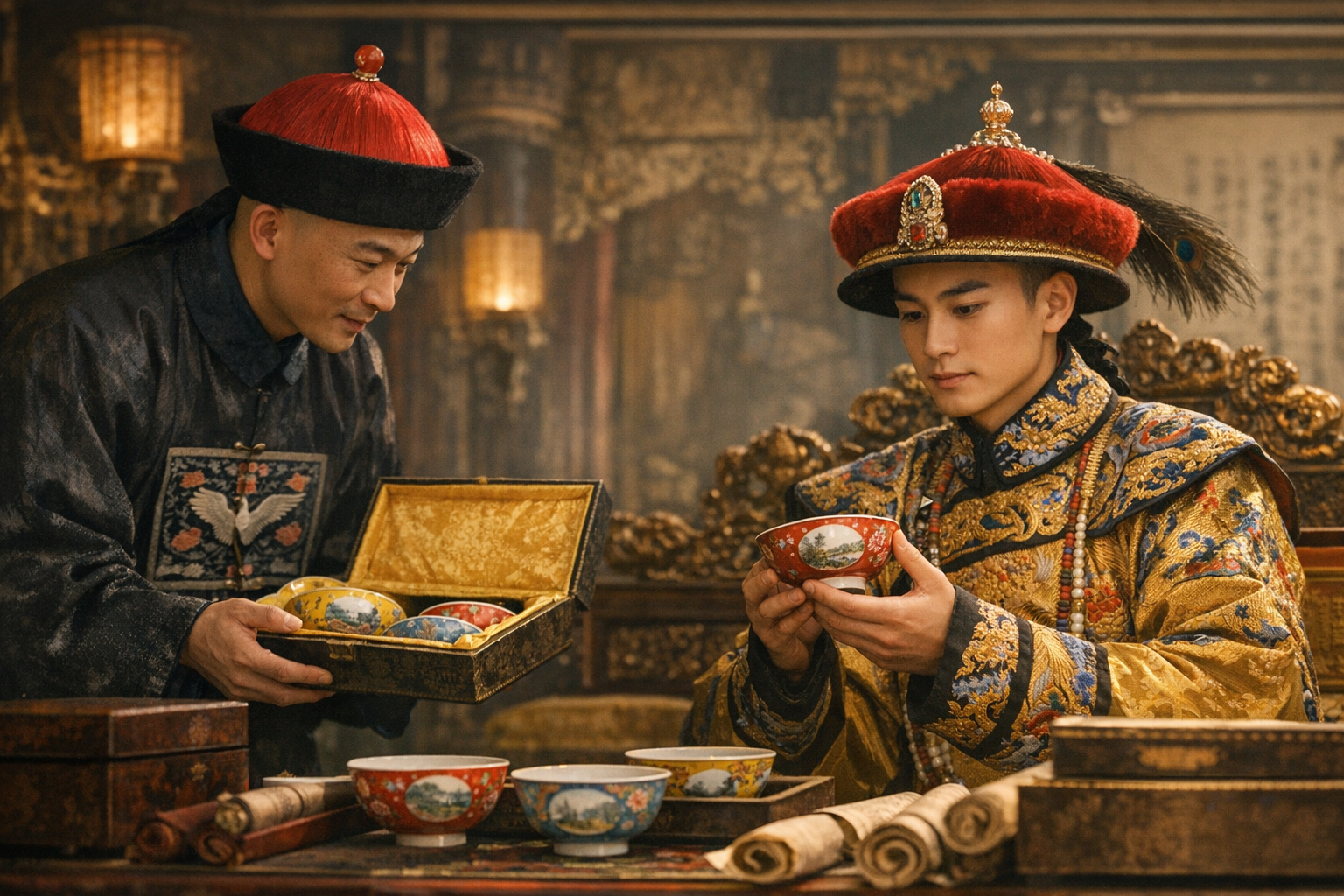
An entry from the eighth year of the Qianlong era (1743) documents eunuch Hu Shijie's submission of multiple Falangcai pieces. These pieces included "ten 'adding flowers to brocade' four-medallion landscape palace bowls with foreign-enamel red grounds" and similar pieces with yellow and blue grounds. They were subsequently ordered by imperial decree to be placed among the boxed porcelain ware in the Qianqing Palace. The image depicts the 32-year-old Qianlong Emperor with Hu.
2.2.3.1. Defining Characteristics of the Qianlong-Period Falangcai
The decorative programs of Qianlong-period Falangcai porcelain represent an unprecedented synthesis of multiple artistic disciplines. These vessels were transformed into comprehensive works of art that embodied the ideal of the “four perfections” (四绝)—poetry, calligraphy, painting, and seal impression—within a single object. Pioneered in the Yongzheng period, this integration reached its fullest expression under Qianlong, as demonstrated by numerous surviving examples that harmoniously combine these elements into unified compositions of extraordinary complexity.
The poetic element of these programs was executed with great care. Court calligraphers, trained in classical models, rendered verses in standard script (楷书) or running script (行书) of exceptional quality. They positioned the verses so that they complemented, rather than competed with, the painted imagery. On Falangcai proper, these inscriptions typically drew from classical Tang and Song dynasty poetry, selected for thematic resonance with the painted subject and its established place in literary tradition.
Another defining feature of these decorative programs is the synthesis of Chinese and Western artistic influences. The European origin of the enamel technique provided a foundation for this synthesis, and the Qianlong period saw its deliberate and sophisticated development. Western techniques such as linear perspective, chiaroscuro, and three-dimensional modeling were incorporated into traditional Chinese compositions, resulting in works that transcend simple categorization. A garlic-head vase in the Palace Museum collection uses the "Broken Treasures" (博古) composition method. Rocks and roses are rendered using Western perspective to create three-dimensional effects that would be impossible with purely Chinese painting techniques. The employment of European Jesuit artists at the Qing court facilitated this creative appropriation.
2.2.3.2. Monumental Scale and Vessel Forms
During the Qianlong period, there was a significant increase in the size of vessels and a diversification of forms. This represented a departure from the smaller sizes that had characterized much of the production during the Kangxi and Yongzheng periods. This shift reflected technical advances in porcelain manufacturing and changing patterns of imperial use. These objects increasingly served ceremonial and display functions, in addition to their traditional role as personal luxuries.
The technical challenges of applying enamel to larger surfaces were formidable. Unlike glaze decoration, enamel painting required meticulous brushwork, which became exponentially more challenging as the surface area increased. The risk of cracking, crawling, or color distortion across large surfaces necessitated innovations in kiln design, enamel formulation, and firing protocols. Improved kiln designs allowed for more uniform temperature distribution, and new enamel formulations with adjusted coefficients of thermal expansion improved compatibility with the porcelain body. The organization of workshop labor was also adapted to allow teams of painters to work in a coordinated fashion on larger pieces.
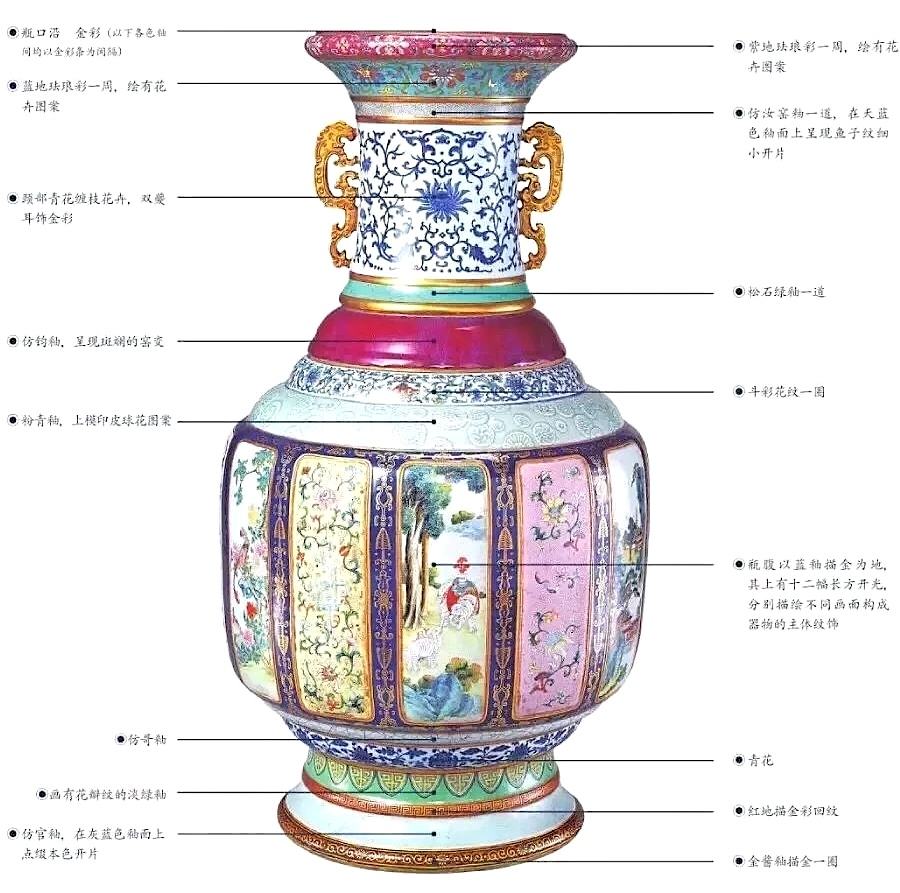
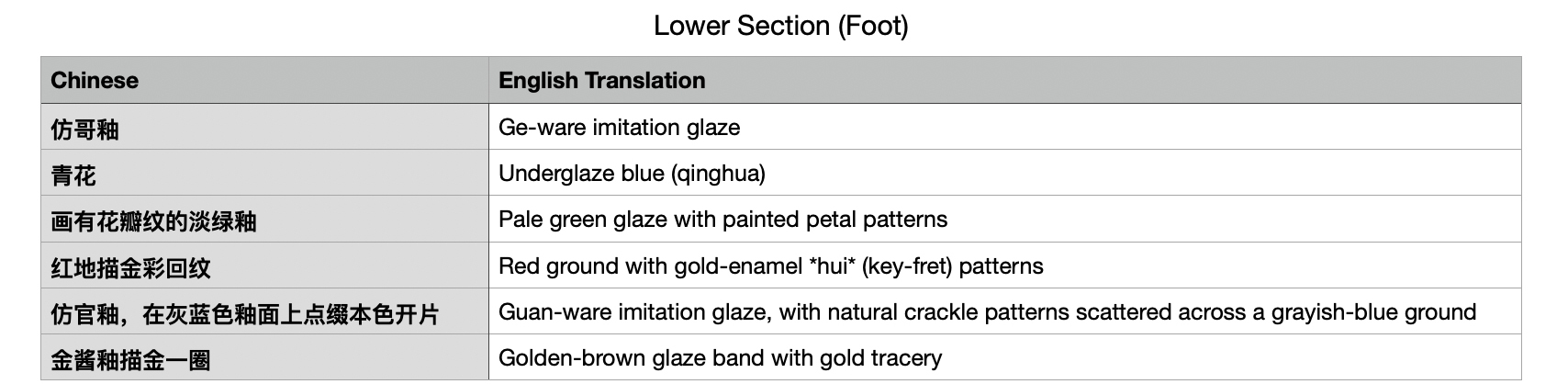
The Qianlong Emperor’s Vase with Various Glazes and Enamels in the Palace Museum, standing 86.4 cm tall with 17 layers of glazes and enamels from top to bottom, represents the absolute pinnacle of technical integration. It combines various high-temperature and low-temperature techniques in a single vessel and has been honored with the epithet “Mother of Porcelain” (瓷母).
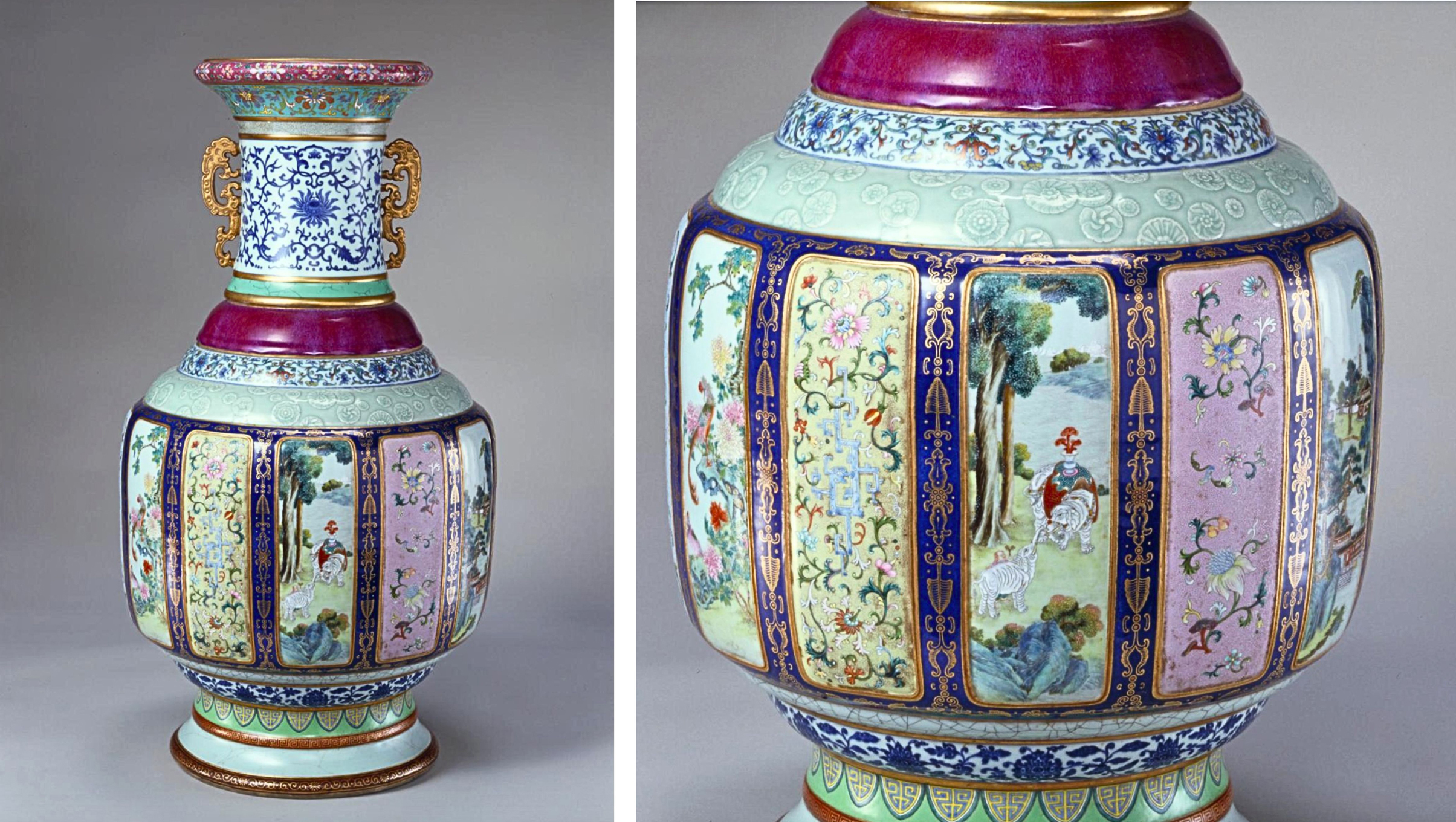
A large vase with various glazes. Date: Qianlong period. Dimensions: 86.4 cm high, 27.4 cm in mouth diameter, and 33 cm in foot diameter. The Palace Museum, Beijing, China.


2.2.3.3. Two Principal Categories of Decorative Patterns
Literary and Symbolic Ensembles
The first principal category of Qianlong falangcai decoration consists of artworks integrating written poems with profoundly symbolic patterns. These ensembles mutually reinforce textual and visual elements to produce layered meanings accessible at multiple levels of interpretation. This category is the most complete expression of the literati aesthetic in ceramic form because it most closely imitates the traditions of Chinese scholarly art, in which the combination of poetry, calligraphy, and painting is considered the greatest accomplishment.
The treatment of poetic inscriptions on Qianlong-period enamel wares reveals important distinctions between falangcai and yangcai, illuminating the different functions and cultural positioning of these categories. Research by museum specialists has revealed that yangcai pieces typically feature poems written by the Qianlong Emperor, while falangcai pieces more often display classical verses from the Tang and Song dynasties. Christie’s specialist Liang-Lin Chen notes that this pattern suggests the emperor respected the traditional association of falangcai with classical Chinese poetry, using Yangcai as a vehicle for his own literary self-expression.
In falangcai pieces, the pairing of poem and image was never arbitrary; each element was chosen to complement and extend the other, creating a whole greater than the sum of its parts. A Ming dynasty poem inscribed on a falangcai peony and golden pheasant yuhuchun vase exemplifies this practice—the poem's evocation of sensory experience resonates with the painted imagery, creating a unified aesthetic effect.
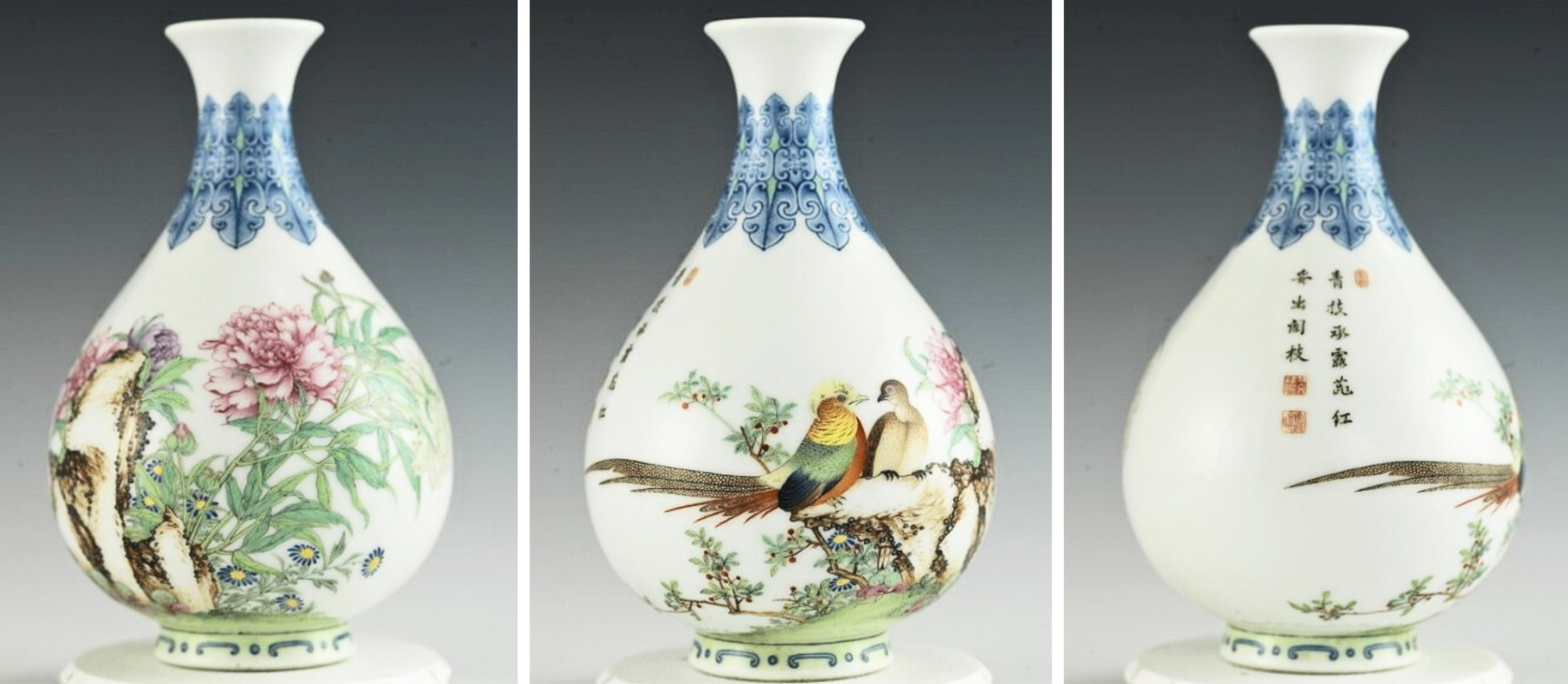
Imperial falangcai Chinese peony and pheasant Yuhuchun ping, Qianlong period. 清乾隆款珐琅彩芍药雉鸡图玉壶春瓶.Dimensions: height 16.3 cm, mouth diameter 4 cm, base diameter 5 cm. Tianjin Museum 天津博物馆所藏, China. The poetic inscription in refined calligraphy, which complements the visual imagery, reads: “青扶承露蕊,红妥出阑枝。” (Qīng fú chéng lù ruǐ, hóng tuǒ chū lán zhī). It's a Ming dynasty couplet by Li Minbiao (黎民表, c. 1515–1581) from his poem "Viewing the Peonies at Su Zichuan's Residence" (苏子川宅观芍药).
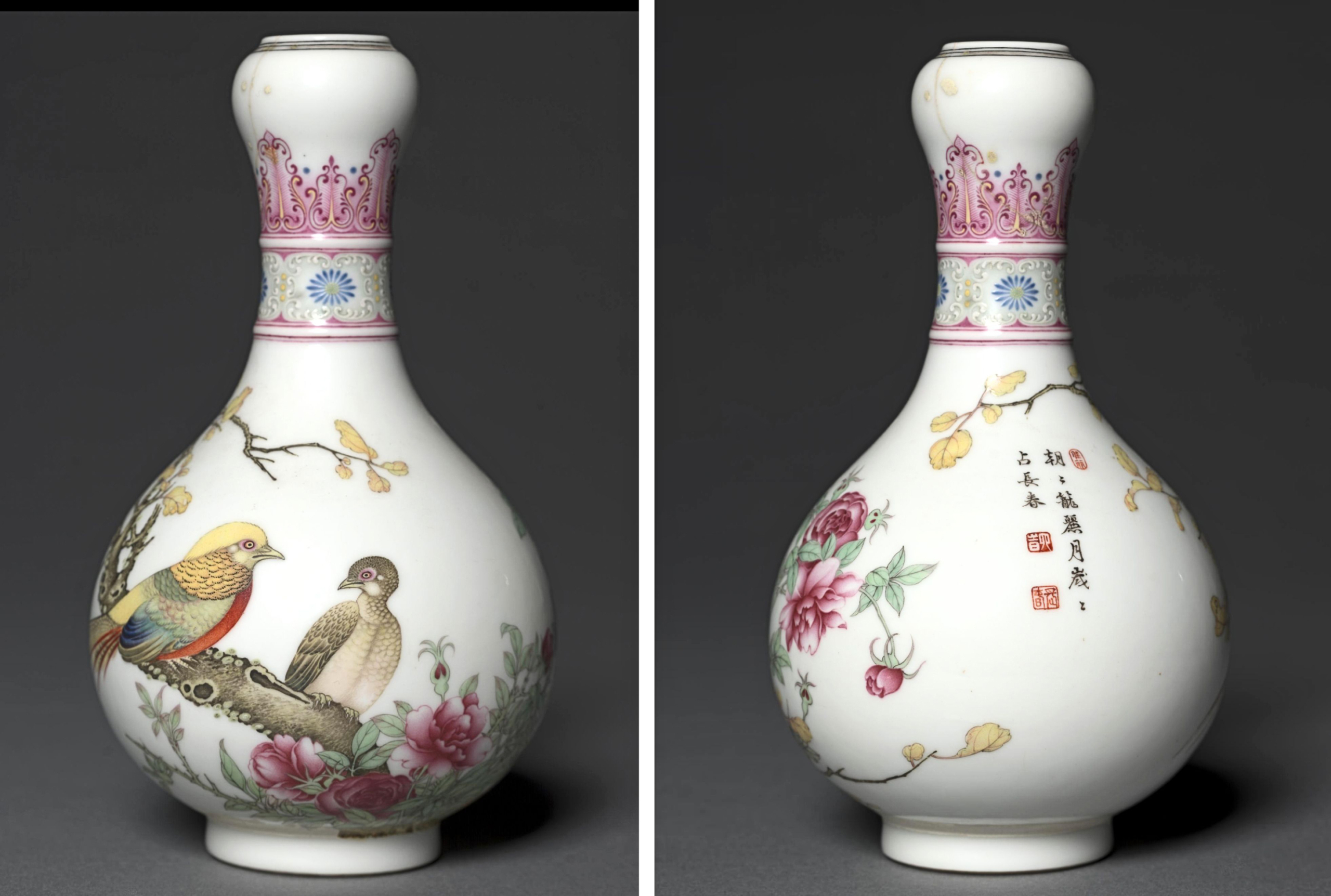
Superb vase with Golden Pheasants 珐琅彩錦雞花卉蒜頭瓶. Date: With Qianlong mark and of the period, 1736–95. Medium: Falangcai porcelain painted in polychrome enamels over transparent glaze. Dimensions: 18.6 x 10.5 cm; 7 5/16 x 4 1/8 in. The Cleveland Museum of Art, Ohio, USA.
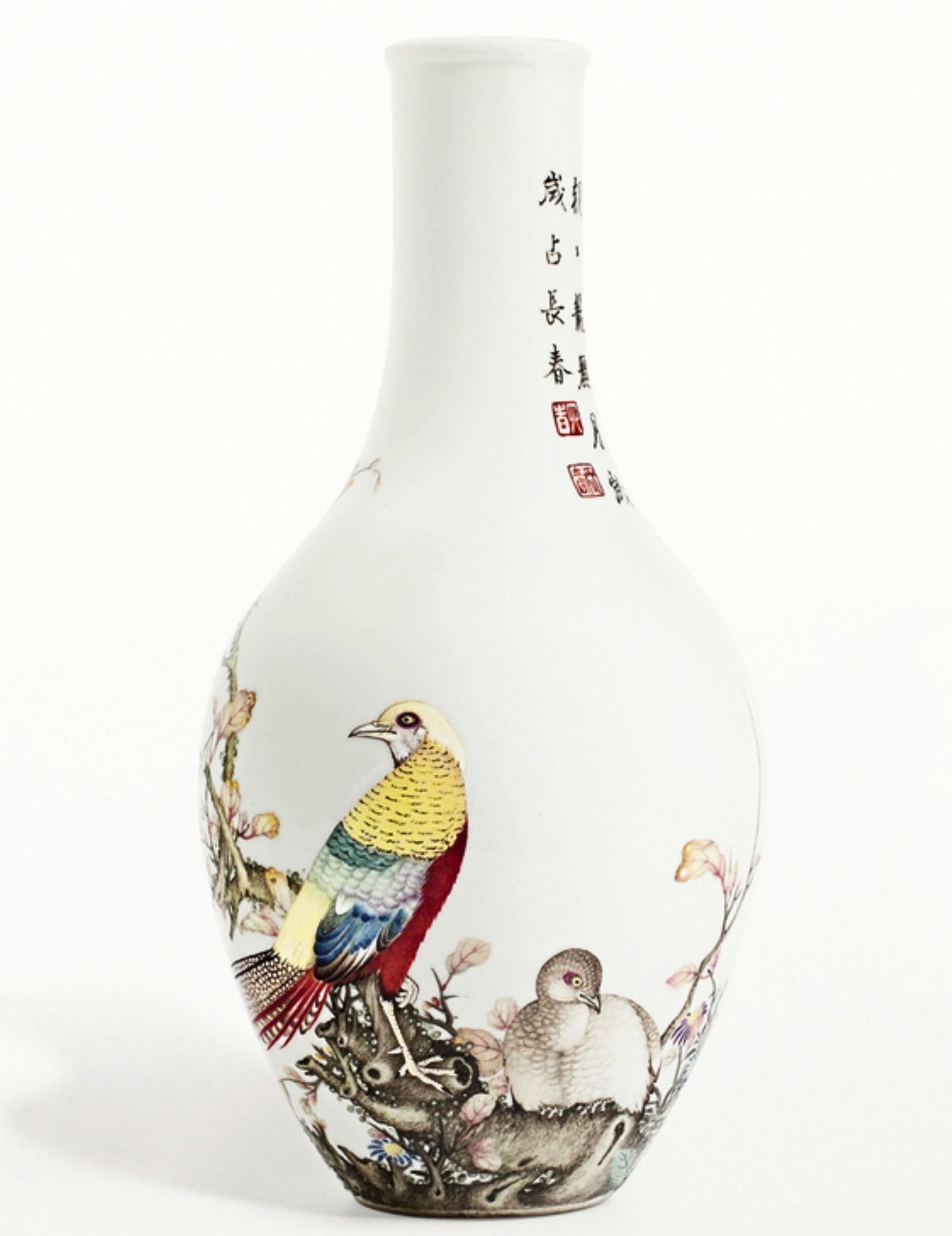
Magnificent Meiyintang 'Golden Pheasant' vase in falangcai painted enamels. The elegant shape of this Meiyintang vase is known as ganlanping ('olive-shaped vase'). Date: With blue enamel mark and period of Qianlong. Auctioned by Sotheby's Hong Kong in 2011. Sold privately after the sale for HKD 200,000,000 (US$ 25,064,000).
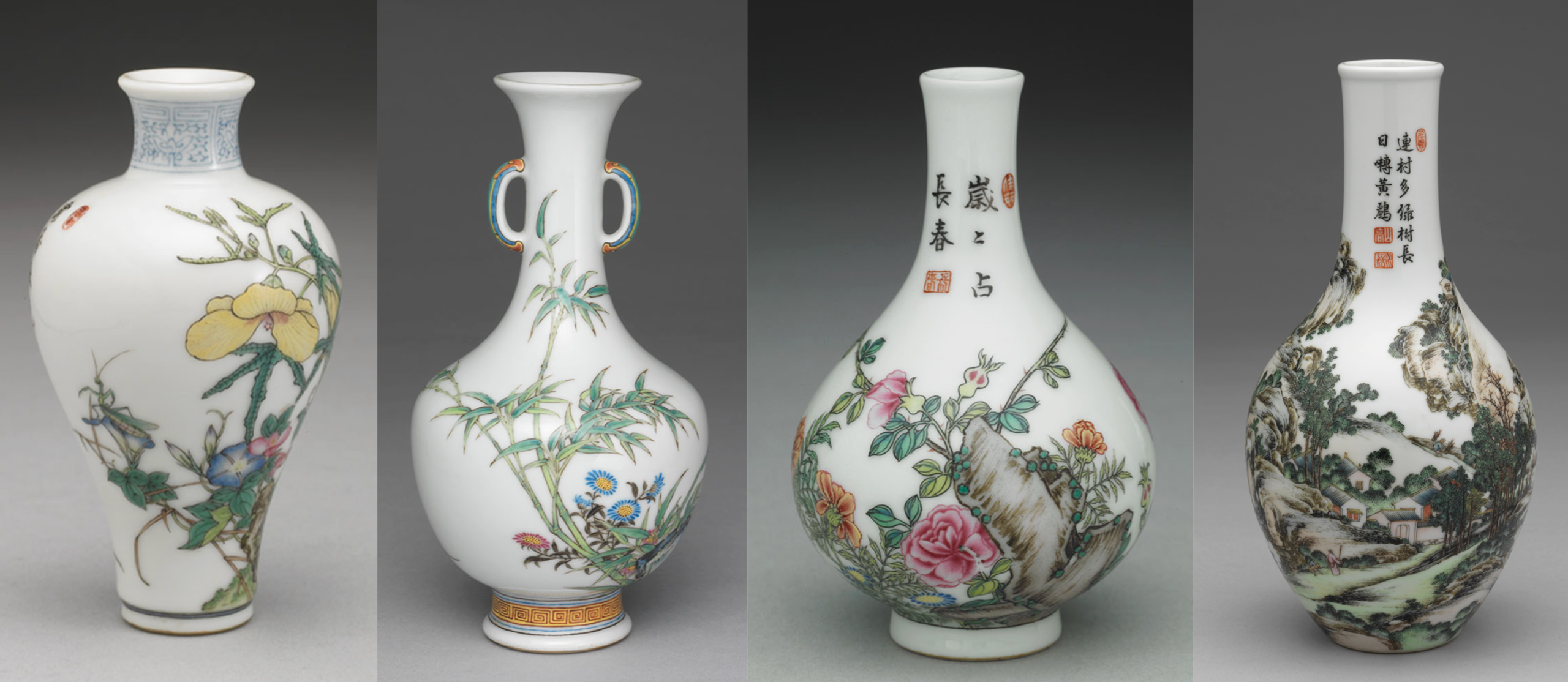
LEFT TO RIGHT
1. Vase with flower in falangcai painted enamels. Date: Qianlong reign (1736-1795). National Palace Museum, Taipei, Taiwan.
2. Vase with two handles and orchid and bamboo in falangcai painted enamels. Date: Qianlong reign (1736-1795). National Palace Museum, Taipei, Taiwan.
3. Vase with flower in falangcai painted enamels. Date: Qianlong reign (1736-1795). National Palace Museum, Taipei, Taiwan.
4. Gall-bladder-shaped vase with landscape in falangcai painted enamels. Date: Qianlong reign (1736-1795). National Palace Museum, Taipei, Taiwan.
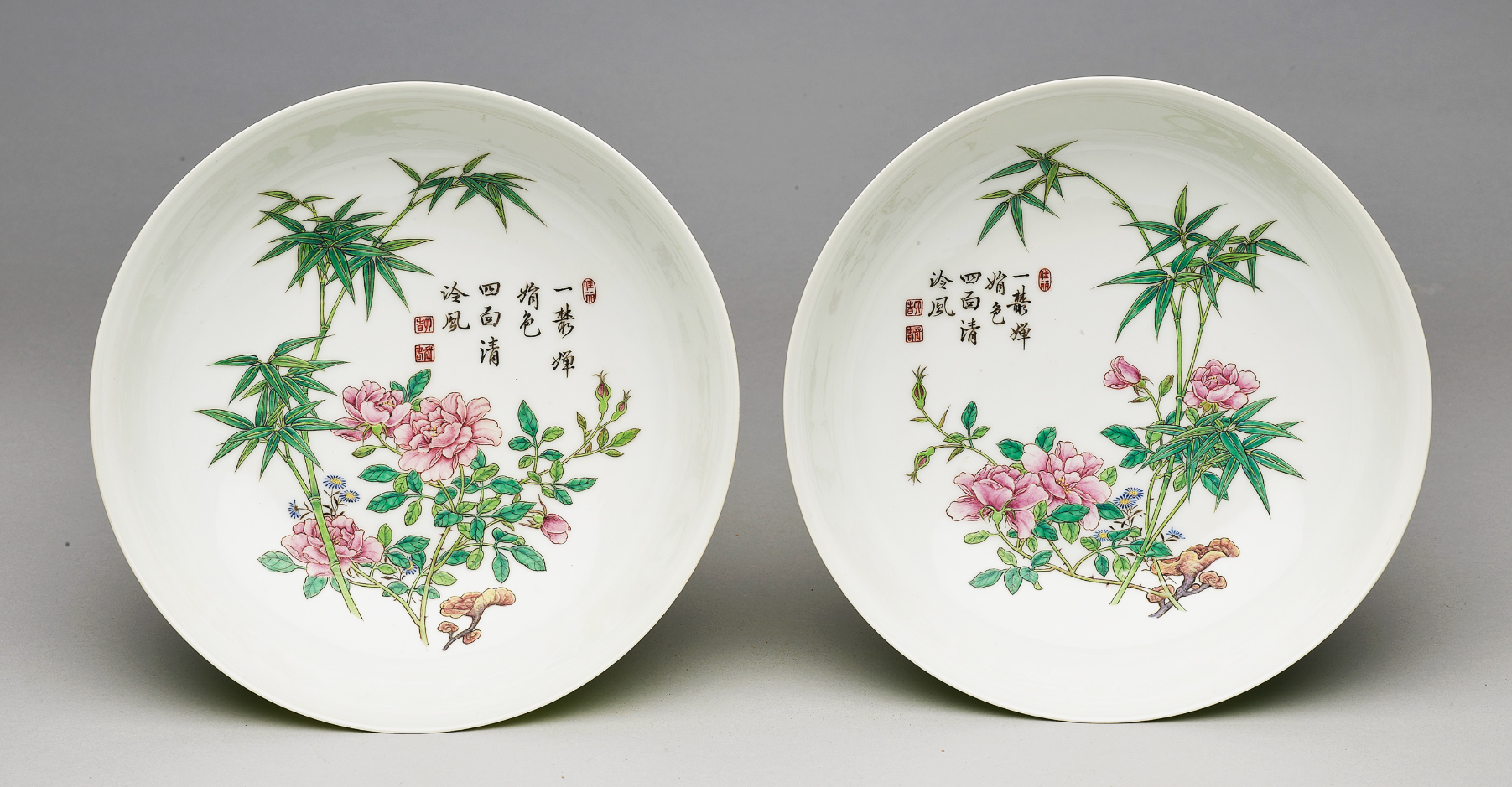
A pair of dishes with flower and bamboo inside a carved green exterior in falangcai painted enamels. Date: Qing dynasty, Qianlong reign (1736-1795). National Palace Museum, Taipei, Taiwan. "Catering for the Qianlong Emperor's ideas on producing and collecting artworks in pair, the decorative arrangement on the Qianlong porcelain in falangcai painted enamels often reveals the ingenuity of one echoing to another. Take porcelain dishes with poems for example. One dish has the design on its left side while the other one has the design on its right side. Ornaments on two dishes also show slightly different techniques. The arrangement presents the feature of designing pairs." (National Palace Museum text).
Painted Compositions and Divine Imagery
The second main category includes works dominated by painted compositions, especially landscapes of transcendent beauty and figural representations drawn from mythology and court life. These works achieve their effects through visual rather than textual means. These "divine compositions" (神品, shenpin)—a term borrowed from classical art criticism that denotes works of supreme technical and spiritual achievement—represent the adaptation of Chinese painting traditions to the ceramic medium. Enamel's unique properties enable these compositions to achieve effects that were previously impossible.
Landscape scenes held particular significance in this category and ranged from intimate garden vignettes to expansive mountain panoramas. The treatment of these subjects reflects the influence of Chinese and Western painting traditions. Compositional principles from Song and Yuan dynasty landscape paintings, such as carefully modulated voids and solids, rhythmic progression through spatial depth, and the symbolic use of particular motifs, were combined with Western techniques of linear perspective, atmospheric modeling, and naturalistic color, which were introduced by Jesuit artists.
Figural representations encompassed a wide range of subjects, including scholarly reclusion, courtly ceremony, and mythological narratives. A perennially popular theme, children at play (婴戏图) appears on numerous examples with symbolic attributes that multiply its auspicious meanings. The "Hundred Boys" (百子) theme, representing the wish for abundant offspring, was particularly favored for its festive animation. Despite the small scale and demanding medium, the technical execution of these figures achieved remarkable individual characterization, with facial expressions, postures, and gestures conveying specific emotional states and narrative moments.
"The Kezi ('Mother Tutoring Child') motif takes on the theme of mother and child, and it is one of the signature decorations of Qianlong's porcelain in falangcai painted enamels. From the child reading a book, the mother writing with a brush, to the moment that they appear in the garden and about to play, the exquisite composition and detailed depiction of window frames and ancient artefacts have all celebrated the daily life in the court to the finest state." (Text by the National Palace Museum, Taipei, Taiwan.
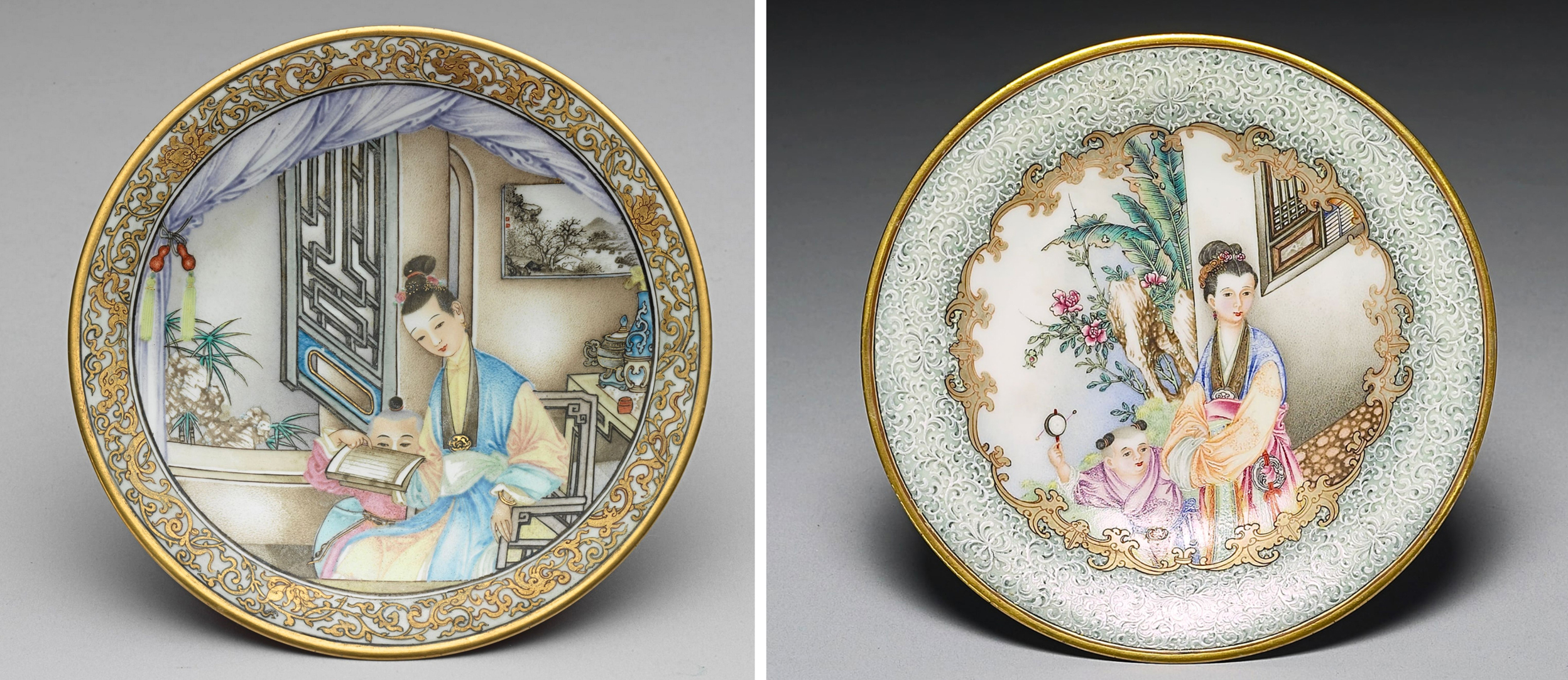
LEFT: Dish with "Mother Tutoring Her Child" motif in falangcai painted enamels. Date: Qianlong reign (1736-1795). National Palace Museum, Taipei, Taiwan.
RIGHT: Dish with 'Mother Tutoring Her Child' motif in falangcai painted enamels. Date: Qianlong reign (1736-1795). ). National Palace Museum, Taipei, Taiwan.
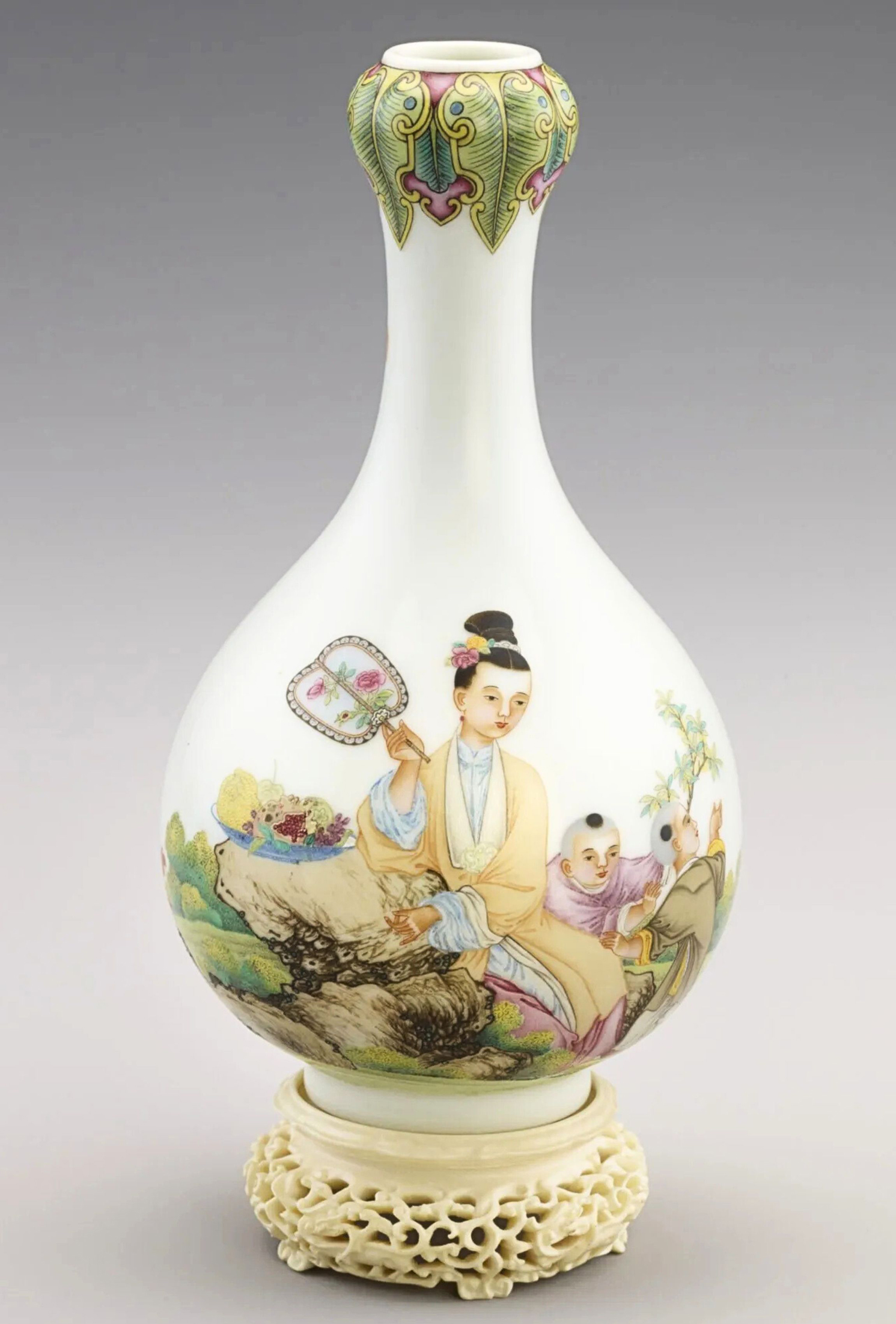
Bottle-shape vase on an ivory stand, made for and used by the imperial court. Date: Qianlong reign, 1736–95. Medium: Porcelain with falangcai enamels over clear, colorless glaze. Dimensions: 6 3/4 x 3 3/4 in. National Museum of Asian Art, Smithsonian, USA.
"The painting on the vase depicts a lady and two children in a blooming garden. The woman sits on a rock, holding a fan in her right hand. Next to her is a dish of pomegranates that symbolize fertility. One of the boys holds a branch of Osmanthus. The Chinese name for Osmanthus is a homophone for “noble.” As the plant blooms during the same month as the imperial examinations in the fall, it also signifies literary success. These two concepts reveal the painting as symbolic for the wish to bear high-ranking sons. The two-sentence poem on the neck of the vase sets an autumnal mood: The infinite moon is born in the branches/When blossoms are at their fullest, autumn naturally has come.” (National Museum of Asian Art text).
2.2.3.4. The “Red Landscapes” (Hongshanshui / 红山水)
These landscapes are one of the most distinctive and technically ambitious innovations of the Qianlong period of Falangcai. Scenery and figures are predominantly rendered in red enamel pigments, creating extraordinary visual effects and symbolic resonance. This technique originated from adapting Western copper-bodied enamelware (铜胎珐琅器), for which the use of gold-based red enamels for pictorial representation had been highly developed in France and Germany for the Chinese export market.
A critical moment of imperial endorsement occurred in 1738, the third year of the Qianlong reign. The emperor examined a copper-bodied enamel snuff bottle decorated with red landscape imagery and expressed his enthusiastic admiration. His recorded comment – 画红山水珐琅鼻烟壶烧得甚好,照样多烧造几件, “The enamel snuff bottle with red landscape is excellently fired; make several more pieces after this model” – transformed a technical experiment into an established decorative category. The imperial workshops responded with characteristic energy, and by 1740, they were producing accomplished examples of porcelain Red Landscapes, demonstrating the remarkable speed of technical adaptation driven by confirmed imperial preference.
The technical challenges of transferring this technique to porcelain were formidable. Copper and porcelain present fundamentally different surfaces for enamel application; their thermal conductivity, coefficients of expansion, and interaction with enamel media differ significantly. To achieve comparable effects on ceramic bodies, the Enamel Workshop required extensive experimentation with paste formulations, enamel compositions, and firing protocols. The rapid resolution of these challenges within approximately two years testifies to the resources and expertise concentrated in the imperial workshops and the effectiveness of imperial patronage in mobilizing technical innovation.
The technical foundation of Red Landscape painting was the “Yanzhi Hong” (胭脂红, “Rouge Red” or “Carmine Red”) enamel, a precious material with exceptional properties that defined the visual character of this distinctive category. Designated as “Jinhong” (金红, “Gold Red”), this pigment achieved its characteristic opaque quality and lustrous, oily sheen through the inclusion of gold in colloidal suspension—a technology among the most precious and closely guarded secrets of European enamel production.
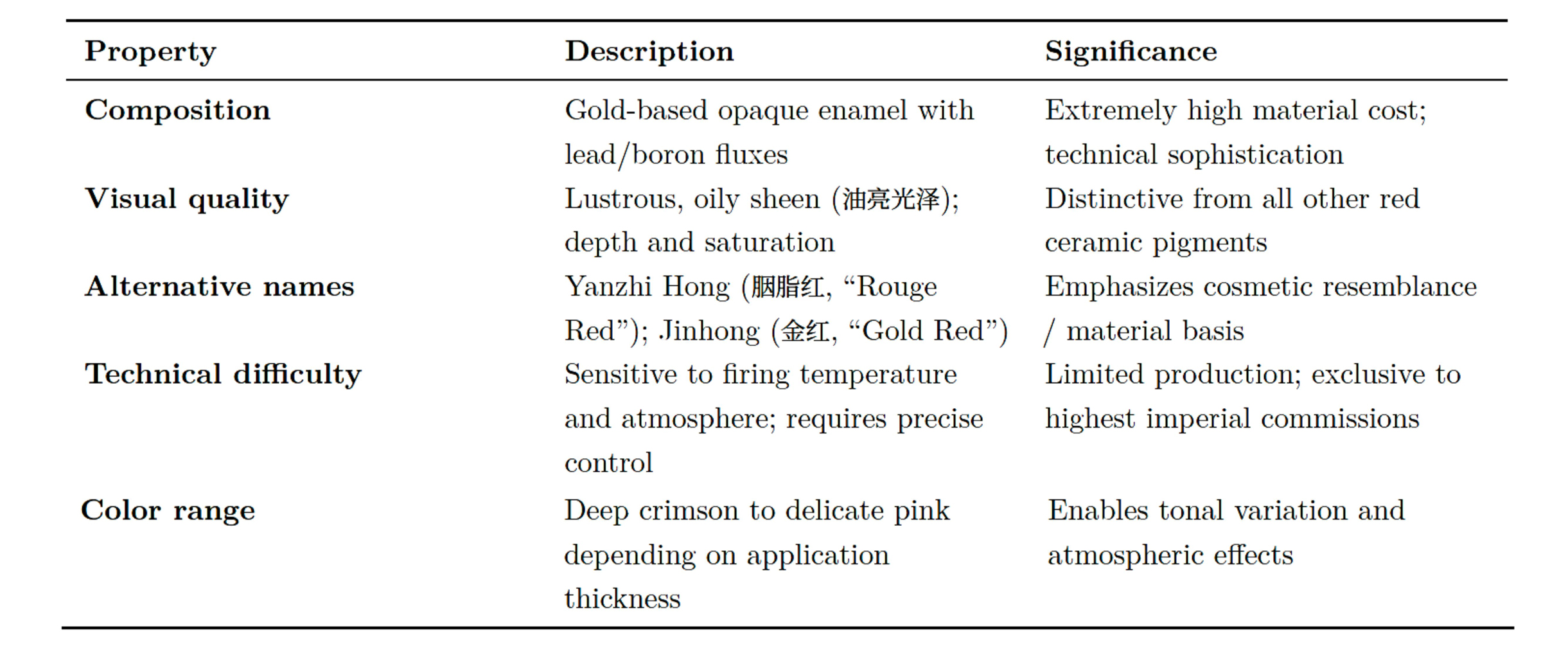
The value of Yanzhi Hong extended beyond its material cost to include the technical difficulty of its preparation and application. The Nanyao Biji (南窑笔记, “Notes on Southern Kilns”), a mid-Qing dynasty treatise on ceramic production, records that “the foreign colors now include Yanzhi Hong and Qiangshui Hong, both of which are compounded from red gold and crystal materials and are very expensive”. Tang Ying’s Taocheng Jishi (陶成纪事, “Record of Ceramic Achievements”) classified related materials as “new imitation Western purple vessels” and “Western red color vessels,” acknowledging their foreign origin while claiming successful domestic production. Due to its gold content, Yanzhi Hong was among the most expensive materials in the imperial enamel palette. Its use in extensive landscape compositions, where large surface areas could be covered, represented a particularly conspicuous display of imperial resources.
The artistic achievement of the Qianlong-period Red Landscapes lies in successfully adapting traditional Chinese landscape painting conventions to a radically new medium. Far from limiting expressive range, the monochromatic or near-monochromatic palette enabled effects of atmospheric depth and tonal variation that rivaled those of ink wash painting. Fine brushwork, employing the full range of Chinese painting techniques, such as texturing strokes (皴法, cunfa), dotting (点, dian), and lines of varying weight and character, achieved representations of mountain forms, water, vegetation, and architectural elements that remained legible and interesting across extensive surfaces.
A masterpiece from the Beijing Palace Museum collection (see below) exemplifies these qualities. The Qianlong-marked "Yanzhi Hong Landscape Bottle" (乾隆款胭脂红彩山水图瓶) stands only 9.6 cm high and depicts a pastoral landscape with mountains, dwellings, a small bridge, and scholarly figures—one carrying a qin (zither), the classic attribute of the cultivated recluse. The composition employs traditional Chinese landscape painting conventions; however, the red monochrome treatment transforms these familiar elements into something visually unprecedented. Remarkable variety is achieved within the single-color restriction through bold washes for mountain masses, delicate lines for architectural detail, and nuanced gradation for atmospheric effects. The integration of calligraphic and seal elements—the five-character verse “晚峰晴露巅” (“Evening peaks, clear dew on the summit”) with seals “Xuying” (旭映), “Shan” (山), and “Gao” (高)—completes the artistic ensemble.
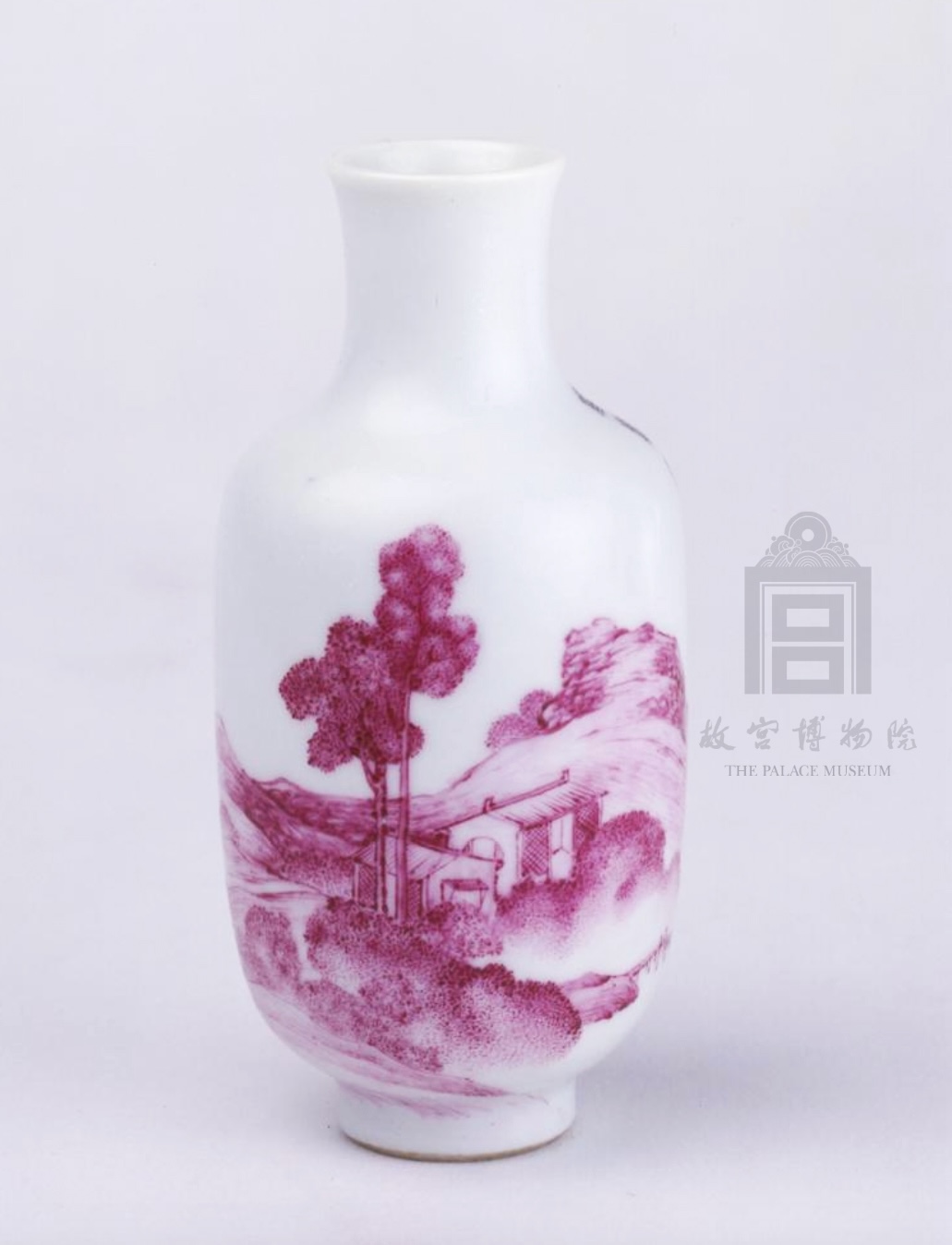
Attribution to court painters working under imperial direction is supported by technical and documentary evidence. The painting's exceptional quality, which is consistent with the standards of the Ruyi Guan (如意馆, Imperial Painting Academy), suggests the involvement of highly trained artists.
The consistent style across multiple pieces indicates a systematic production process, guided by standardized models or pattern books. The influence of court painting is evident in the finest pieces' sophisticated spatial organization and figure drawing, which approaches the quality of contemporary scroll painting.
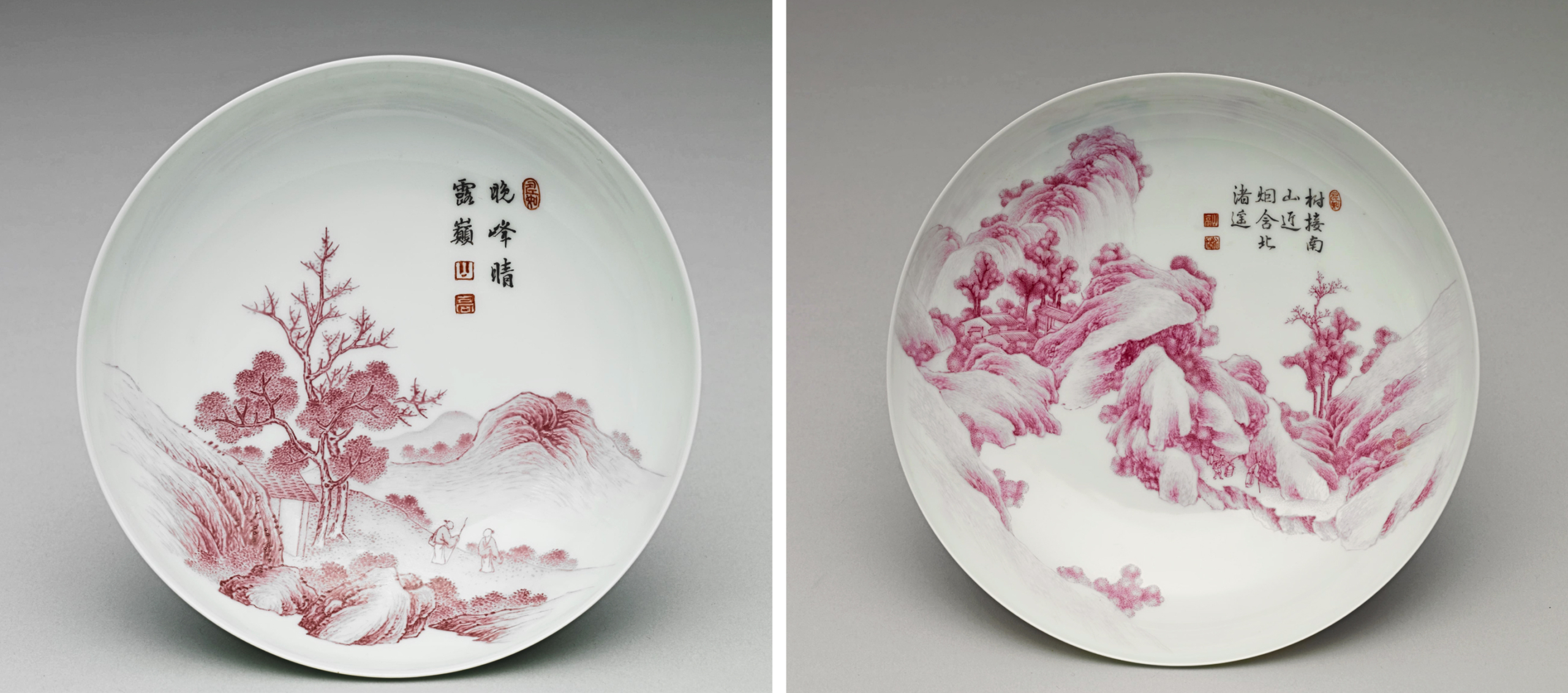
LEFT: Dish with red landscape inside a carved green exterior in falangcai painted enamels. Date: Qianlong reign (1736-1795). National Palace Museum, Taipei, Taiwan.
RIGHT: Dish with red "Longevity Mountain and Fortune Sea" motif inside a green exterior in falangcai painted enamels. Date: Qianlong reign (1736-1795). National Palace Museum, Taipei, Taiwan.
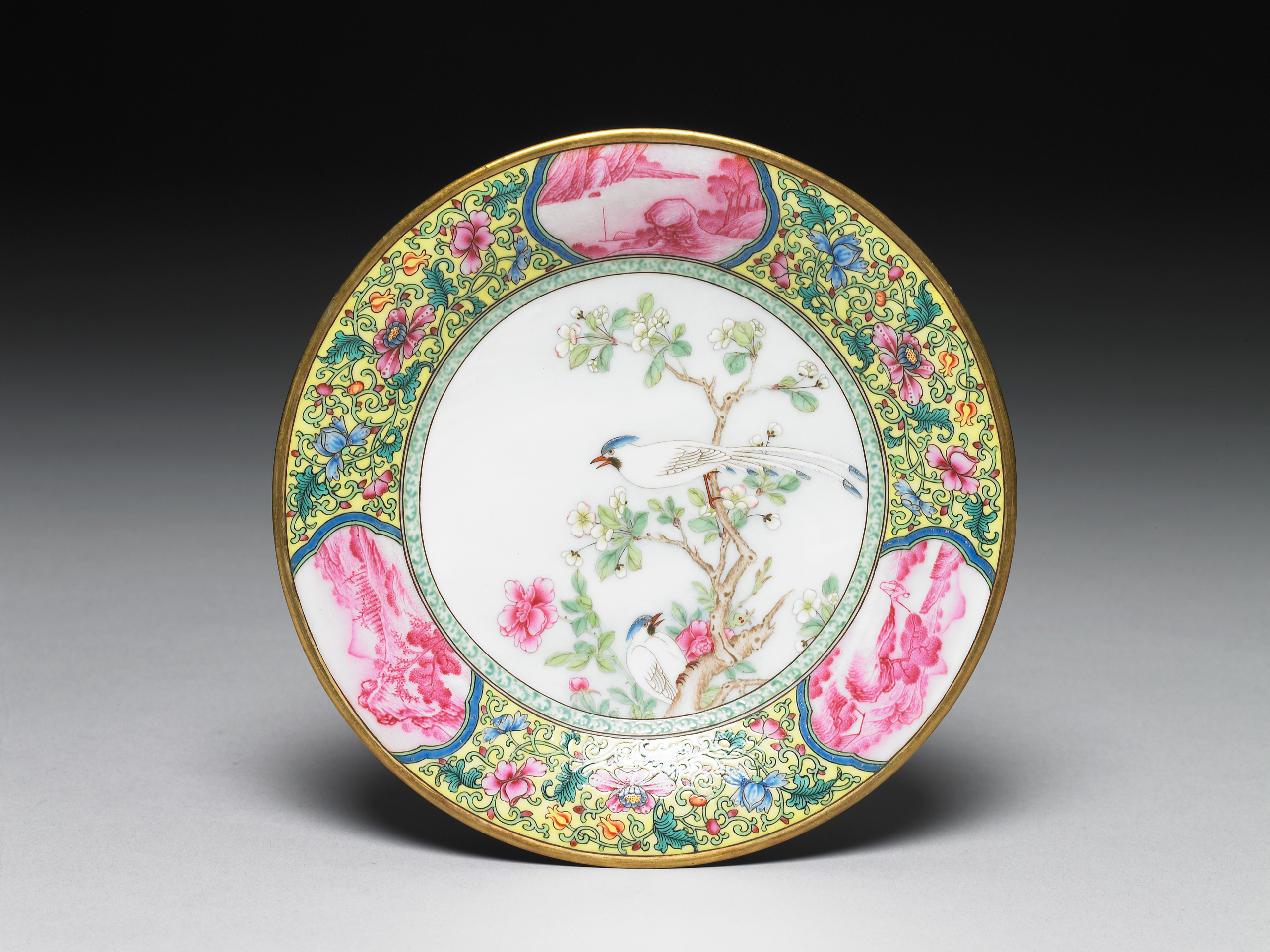
Polychrome-banded dish with flower and bird in falangcai painted enamels. Date: Qianlong reign (1736-1795). National Palace Museum, Taipei, Taiwan.
2.2.3.5. The “Jingshang Tianhua” (锦上添花) motif, also known as the "Adding Brilliance to Perfection" design
This motif represents one of the most technically sophisticated and visually striking decorative innovations of the Qianlong period. It embodies the era’s pursuit of opulence and technical refinement. This technique creates a distinctive effect in which lighter-colored main motifs appear to float on a densely patterned background, producing a tapestry-like richness that exemplifies the Qianlong aesthetic of calculated magnificence.
The motif's essential visual characteristic is placing principal decorative elements against elaborately prepared backgrounds. First, the ground is applied and fired. Then, it is covered with delicate scroll, lattice, or fern-like patterns, which are executed through painting or incision. The main motifs—flowers, birds, landscape medallions, or figural scenes—are then applied over this prepared field. This creates a sense of layered depth and material richness, distinguishing Jingshang Tianhua from simpler decorative schemes. The comparison to an embroidered silk tapestry is apt; the effect resembles the accumulation of decorative elements through successive layers of needlework. Each layer adds to the overall richness without sacrificing the clarity of the individual motifs.
The “glamorous effect” (华美效果, huamei xiaoguo) thus achieved was was precisely calculated to appeal to imperial tastes, which favored demonstrative displays of wealth and technical accomplishment. The Jingshang Tianhua motif embodies a logic of additive magnificence. The basic vessel form provides the foundation; the colored ground adds a first layer of luxury; the incised or painted pattern provides a second layer of enrichment; and the principal painted motifs complete the composition with their detailed elaboration. This cumulative approach risks visual chaos in less skilled hands but achieves harmonious integration in the finest Qianlong examples through careful attention to scale, color relationships, and compositional balance.
There are two main technical variations of the Jingshang Tianhua motif, which are distinguished by the method used to create the background pattern.
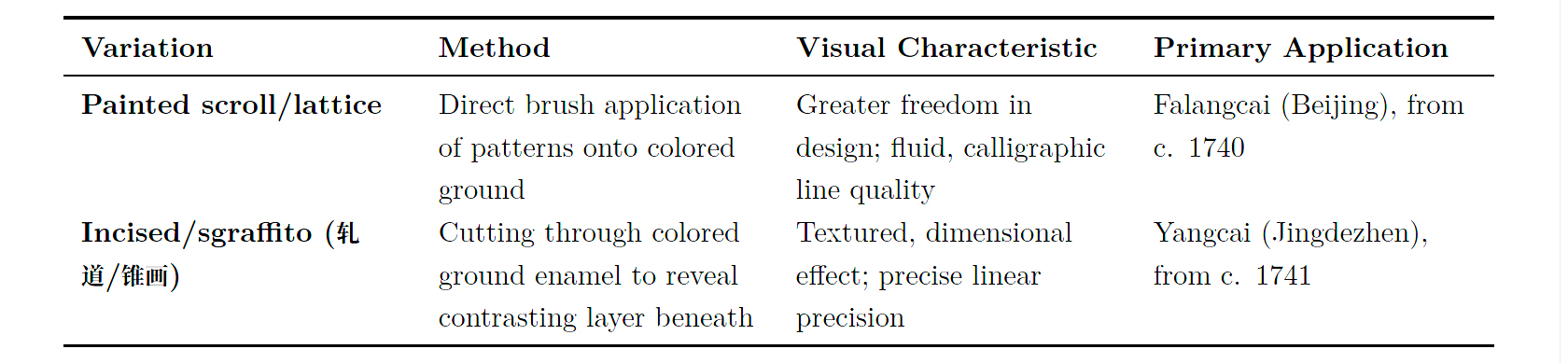
The painted variation, associated with falangcai production in Beijing, allowed for greater flexibility in pattern design and color variation. The painter could adjust the scrollwork to complement the main motifs in each composition. This approach emphasized the freedom of the painter and the individual touch of the court artist. The fluid quality of brush-applied enamel created effects similar to ink painting on silk.
The incised, or sgraffito, variation, which appeared slightly later on Yangcai porcelains, involved cutting patterns into the colored enamel ground before firing to create a tactile, three-dimensional effect. This technique, known as zha huā (轧花) or ya huā (压花), required precise control of the depth of the incisions to ensure clean edges without damaging the underlying layer. The resulting "Coned Phoenix Fern" (锥画凤尾草, zhuahua fengweicao) pattern, with its dense, feathery, fern-like quality, became particularly associated with Yangcai production. It provided a luxurious background for painted floral or figural motifs. Due to the additional labor and technical risk, this variation was reserved for the most prestigious commissions, where visual impact was more important than cost.
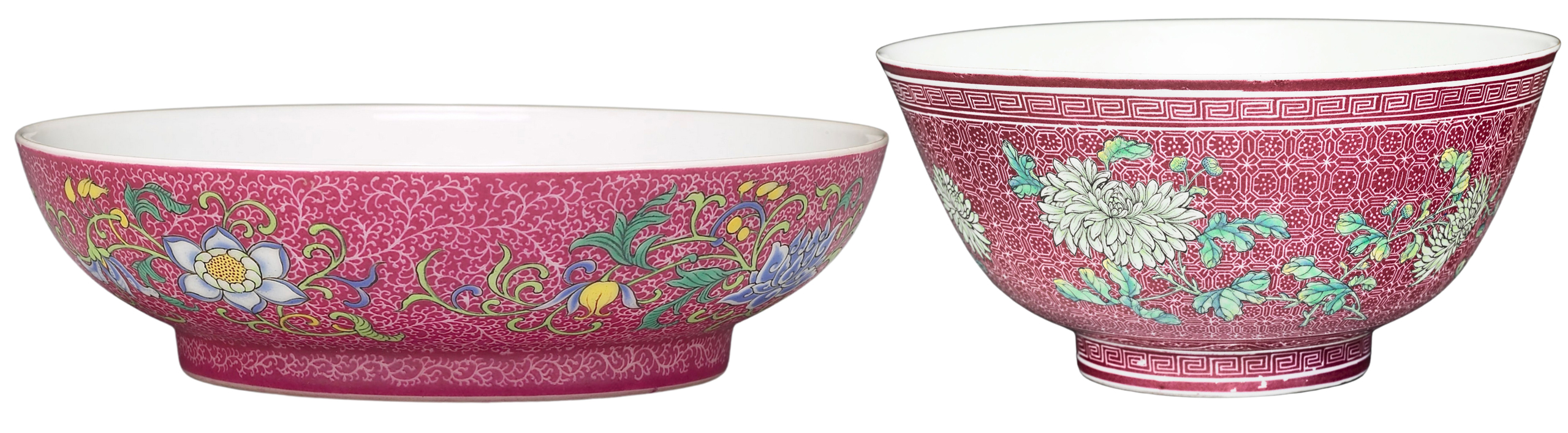
LEFT: Dish with "Three Plenty" motif on a polychrome red ground in yangcai painted enamels. Qianlong reign (1736-1795). National Palace Museum, Taipei, Taiwan.
RIGHT: Tea bowl with chrysanthemum on a carved red ground in falangcai painted enamels. Qianlong reign (1736-1795). National Palace Museum, Taipei, Taiwan.
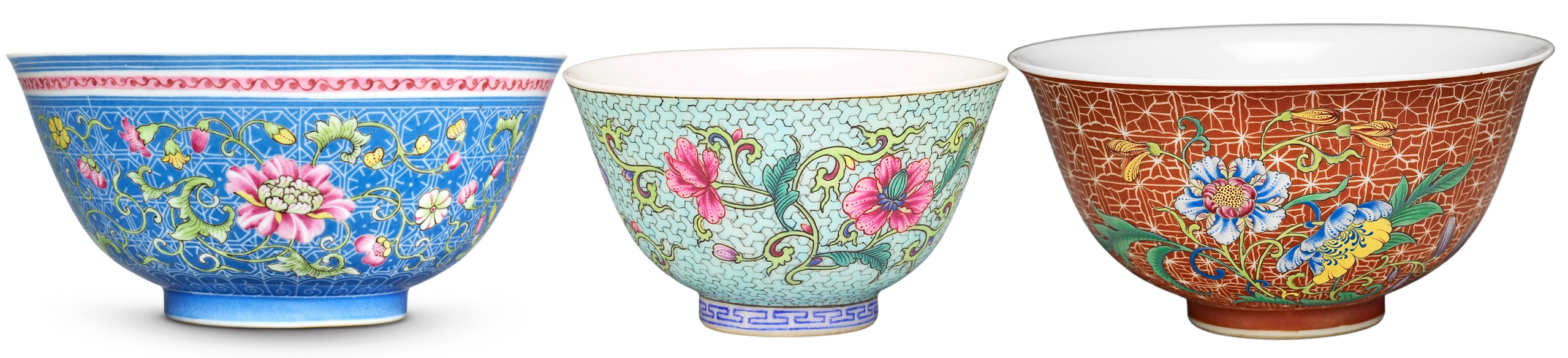
LEFT: A fine, rare falangcai blue-ground sgraffiato 'floral' bowl. Date: With blue-enamel mark and early period of Qianlong reign (1736-1795). Auctioned by Sotheby's Hong Kong in 2024.
CENTER: Zhong wine cup with flower on a polychrome light green ground in falangcai painted enamels. Qianlong reign (1736-1795). National Palace Museum, Taipei, Taiwan.
RIGHT: Tea bowl with flower and aquatic plants on a carved red ground in falangcai painted enamels. Qianlong reign (1736-1795). National Palace Museum, Taipei, Taiwan.
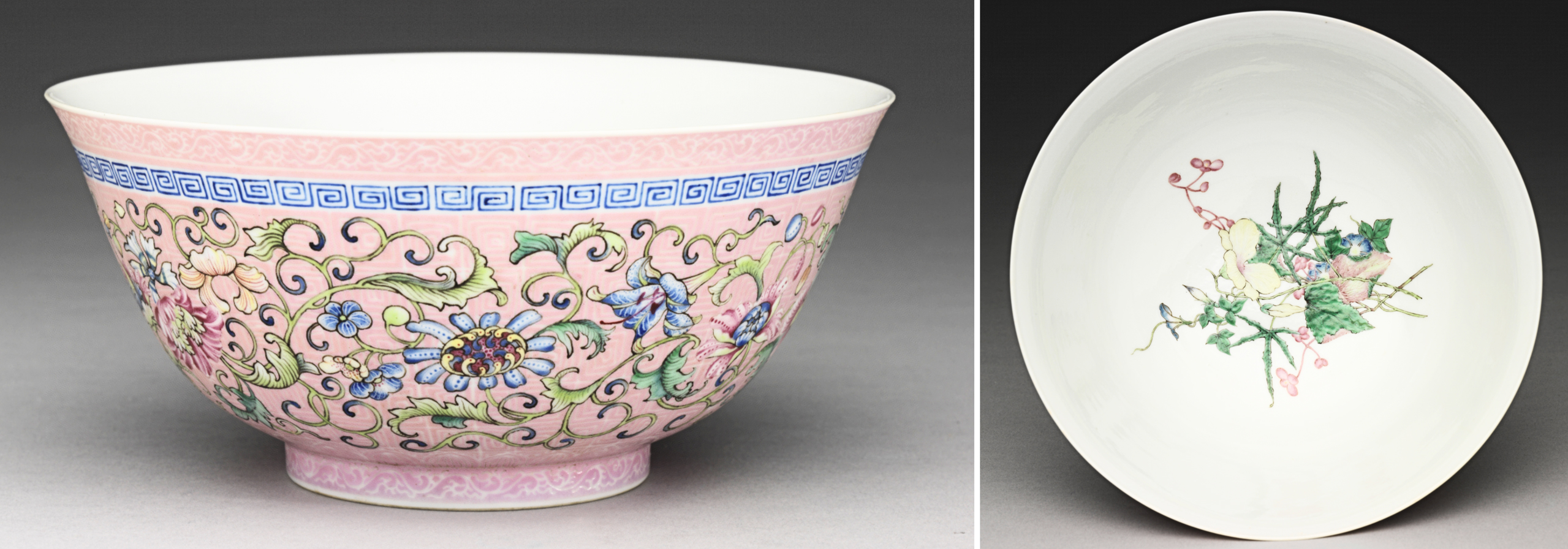
Bowl with Indian lotus decoration on a carved pink ground in falangcai painted enamels. Date: Qianlong reign (1736-1795). Height: 7.6 cm, rim diameter 15.9 cm. National Palace Museum, Taipei, Taiwan.
YANGCAI (洋彩): WESTERN-STYLE ENAMEL DECORATION AT JINGDEZHEN
3.1 Technical Definition and Material Characteristics
3.1.1 Shared enamel chemistry with Falangcai
Modern scientific research has demonstrated that Yangcai enamels share the same basic chemical system as Falangcai. Both employ lead–boron–silicate glass matrices, distinguishing them from the later Fencai technique.
Analytical studies of Qing imperial porcelain have consistently identified boron oxide (B₂O₃) in Yangcai enamels, typically in concentrations comparable to those found in Falangcai decoration. This shared chemical signature confirms that the two techniques derive from the same technological tradition introduced to China during the late 17th century.
The presence of boron provides several important technical advantages:
- lower melting temperatures for enamel pigments;
- improved bonding between enamel and porcelain glaze;
- increased brilliance and transparency;
- reduced risk of thermal cracking during firing.
These properties enabled artisans to apply highly saturated colors with exceptional clarity.
Consequently, from a technical standpoint, the difference between Falangcai and Yangcai lies more in their production context than in their materials. Falangcai decorations were made in the imperial workshops in Beijing, while Yangcai decorations were primarily produced in the imperial kilns of Jingdezhen.
3.1.2 Pigment composition and evolving material sources
Yangcai's color palette largely parallels Falangcai's and includes pigments derived from imported and domestic materials.
Important pigments include:
- gold-based pink and red enamels;
- cobalt blue pigments;
- copper greens;
- lead-antimonate yellows;
- manganese purples;
- iron-based browns.
During the early 18th century, many pigments relied on materials introduced through European contact. However, as Qing craftsmen gained experience with enamel chemistry, domestic production gradually replaced imported sources. This transition was gradual rather than immediate. Court records indicate that pigments and enamel materials were sometimes dispatched from Beijing to Jingdezhen to ensure consistency for imperial commissions.
3.1.3 Firing techniques and workshop adaptation
Because Yangcai uses enamel formulations similar to Falangcai, the firing process followed comparable procedures. Decoration was applied over already glazed porcelain and then fired at low temperatures (approximately 700–800 °C) in specialized enamel kilns. Multiple firings were often necessary to build complex designs. Each color required careful control of temperature and firing sequence to prevent chemical interaction between pigments.
Adapting Jingdezhen’s large-scale kiln infrastructure to these delicate enamel techniques required significant technical adjustments. Specialized furnaces were developed to permit lower firing temperatures and more precise control of heat. Despite these challenges, the Jingdezhen kilns succeeded in integrating enamel painting into their production system, allowing for a greater output than was possible in the palace workshops.
During the Qing period, Jingdezhen's specialized enamel kilns — a proto-industrial ecosystem, not a romantic workshop — often had multiple chambers and vertical or elongated firing logic with controlled heat gradients. Real kilns were chaotic, hot, and labor-intensive.
3.2 Historical Development
3.2.1 Emergence during the Yongzheng reign
The term yangcai first appeared in Qing historical documentation during the Yongzheng reign (1723–1735). It literally means “foreign colors”, reflecting the association between enamel decoration and Western technologies introduced through Jesuit intermediaries.
In the early 18th century, Jingdezhen craftsmen began producing porcelain with enamel pigments similar to those used in Beijing's imperial workshops. These wares were primarily intended for imperial use and were manufactured under close supervision.
Thus, the emergence of yangcai signifies the expansion of enamel technology from the imperial court to the imperial kilns in Jingdezhen.
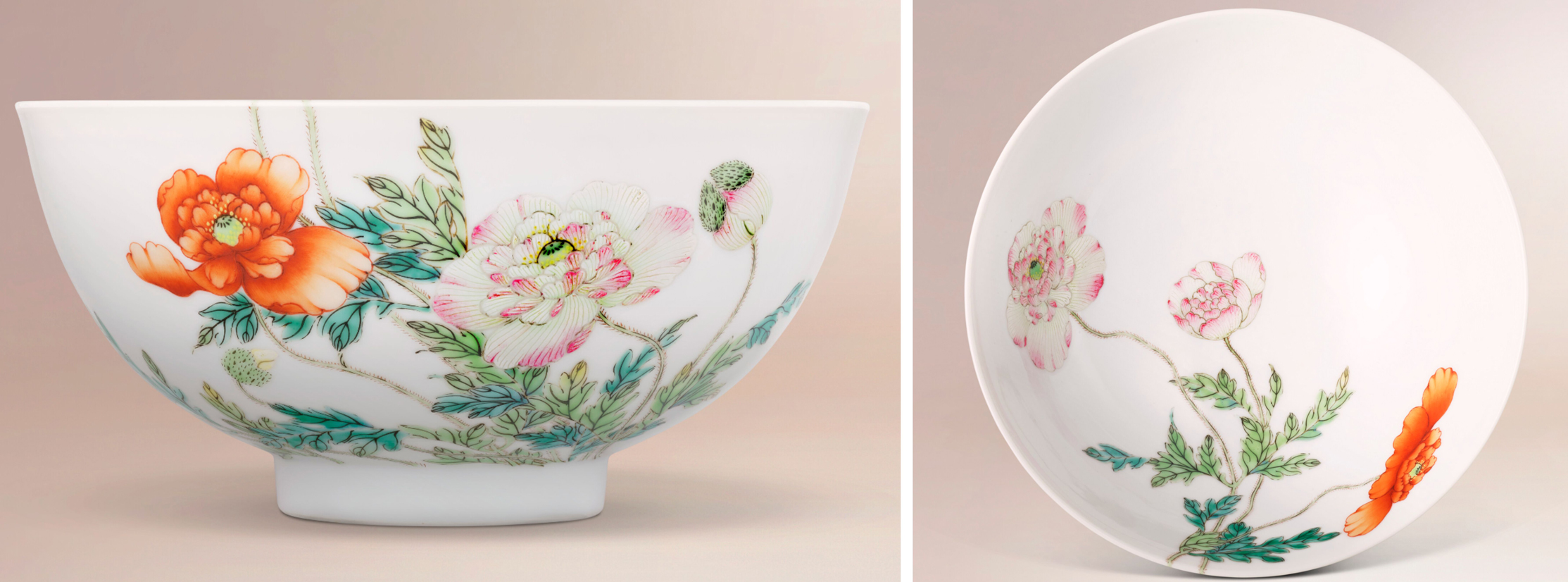
A fine and rare yangcai ‘poppy’ bowl. Date: With Yongzheng six-character mark in underglaze blue within a double square and of the period (1723-1735). Auctioned by Christie's Hong Kong in 2025 for HKD 17,458,000.
3.2.2 Tang Ying and the institutionalization of yangcai production
Tang Ying (1682–1756), superintendent of the Jingdezhen imperial kilns, was a central figure in the development of Yangcai. He oversaw the production of porcelain for the Qing court and played a pivotal role in standardizing enamel decoration techniques in Jingdezhen. His treatise Tao Ye Tu Bian (陶冶图编, "Illustrated Compendium of Ceramic Manufacture") provides valuable insight into mid-Qing ceramic technology. Tang described yangcai as porcelain decorated with colors that imitated Western painting techniques, using enamel pigments similar to those employed in falangcai.
Under his supervision Jingdezhen workshops achieved a high level of technical sophistication, producing enamel-decorated wares that rivaled those made in the imperial palace workshops.
3.2.3 Expansion during the Qianlong reign
Yangcai production expanded dramatically during the Qianlong reign (1736–1795). The Qianlong emperor displayed a strong interest in elaborate decorative programs and technical innovation in the arts. This encouraged the development of increasingly complex enamel decoration at Jingdezhen.
Characteristic features of Qianlong-period yangcai include:
- large vessel forms;
- elaborate decorative compositions;
- dense polychrome ornamentation;
- incorporation of Western-inspired imagery.
Enamel decoration became an important component of imperial porcelain production during this period.
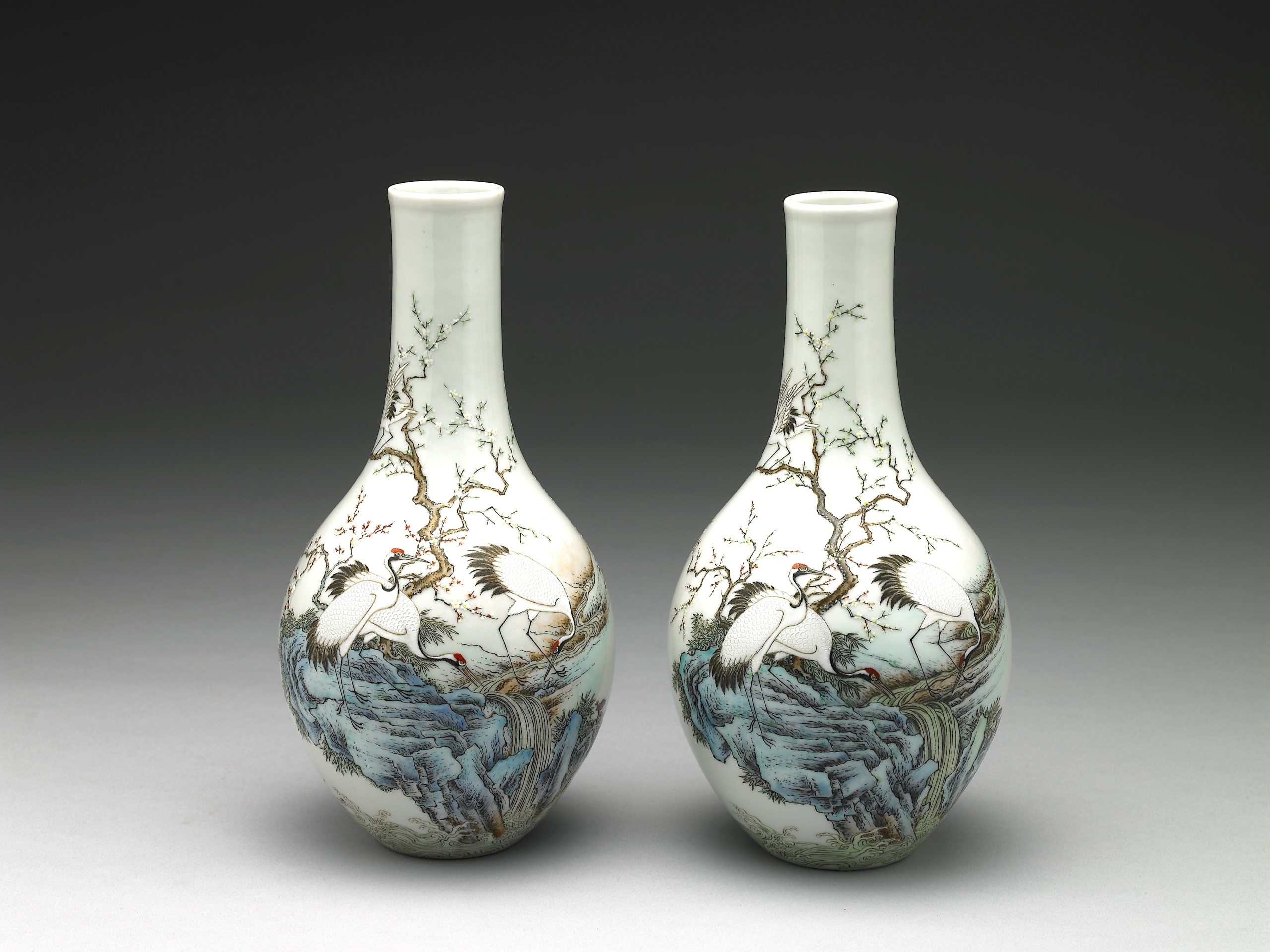
Two gall-bladder-shaped vases featuring the "Crane Bringing Fortune and Joy" motif. These yangcai porcelain pieces were graded "excellent" by Emperor Qianlong. Date: Qianlong reign (1736-1795). National Palace Museum, Taipei, Taiwan.
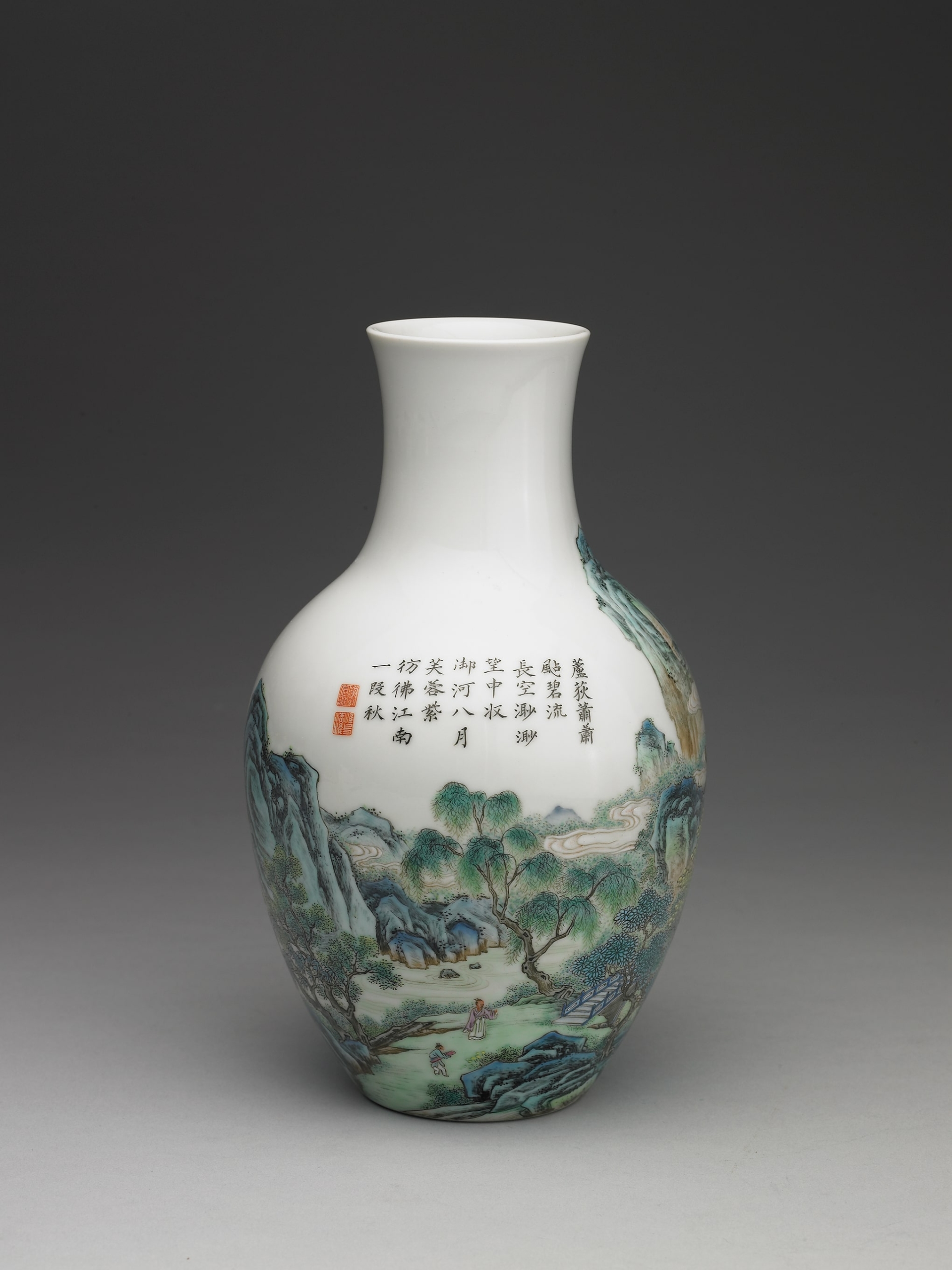
Guanyin vase with landscape and figure in yangcai painted enamels. Date: Qianlong reign (1736-1795). National Palace Museum, Taipei, Taiwan. Like many yangcai vases, this one is adorned with one of Qianlong's poems. The emperor claimed that writing poems was his favorite leisure activity. Throughout his lifetime, he wrote more than forty thousand pieces. While falangcai porcelain were adorned with poems from the Tang or Song dynasties, many yangcai artworks produced in Jingdezhen were embellished with imperial poems and paintings.
3.2.4 Diffusion beyond imperial workshops
Although the yangcai style originated as an imperial product, its techniques gradually influenced other ceramic centers. Knowledge of enamel decoration, including pigment preparation, firing methods, and painting techniques, spread beyond strictly controlled court production. This diffusion contributed to the broader transformation of Chinese ceramic decoration during the 18th and 19th centuries. However, imperial Yangcai wares remained distinguished by their superior craftsmanship and rigorous quality control.
3.3 Stylistic Characteristics
3.3.1 Western-inspired subject matter
Yangcai decoration is notable for its frequent incorporation of Western-inspired imagery. Scenes depicting European figures, architectural settings, and exotic botanical subjects appear on some Qianlong-period porcelains. These motifs reflect the Qing court’s curiosity about foreign cultures and its engagement with European visual materials. Such imagery often derives from prints, illustrated books, or objects brought to China through diplomatic and commercial exchanges.
Architectural vedute, which depict European buildings in convincing perspective, constitute a distinctive category of Yangcai subjects. These subjects, which would have seemed exotic and marvelous to Chinese viewers unfamiliar with European architecture, demonstrate the systematic use of linear perspective, one of the most technically challenging aspects of Western-influenced decoration. The Jade Spring Mountain vase (玉泉山), which sold at Christie's Hong Kong in 2018, exemplifies this category with its detailed rendering of a particular Beijing site in a Western style.
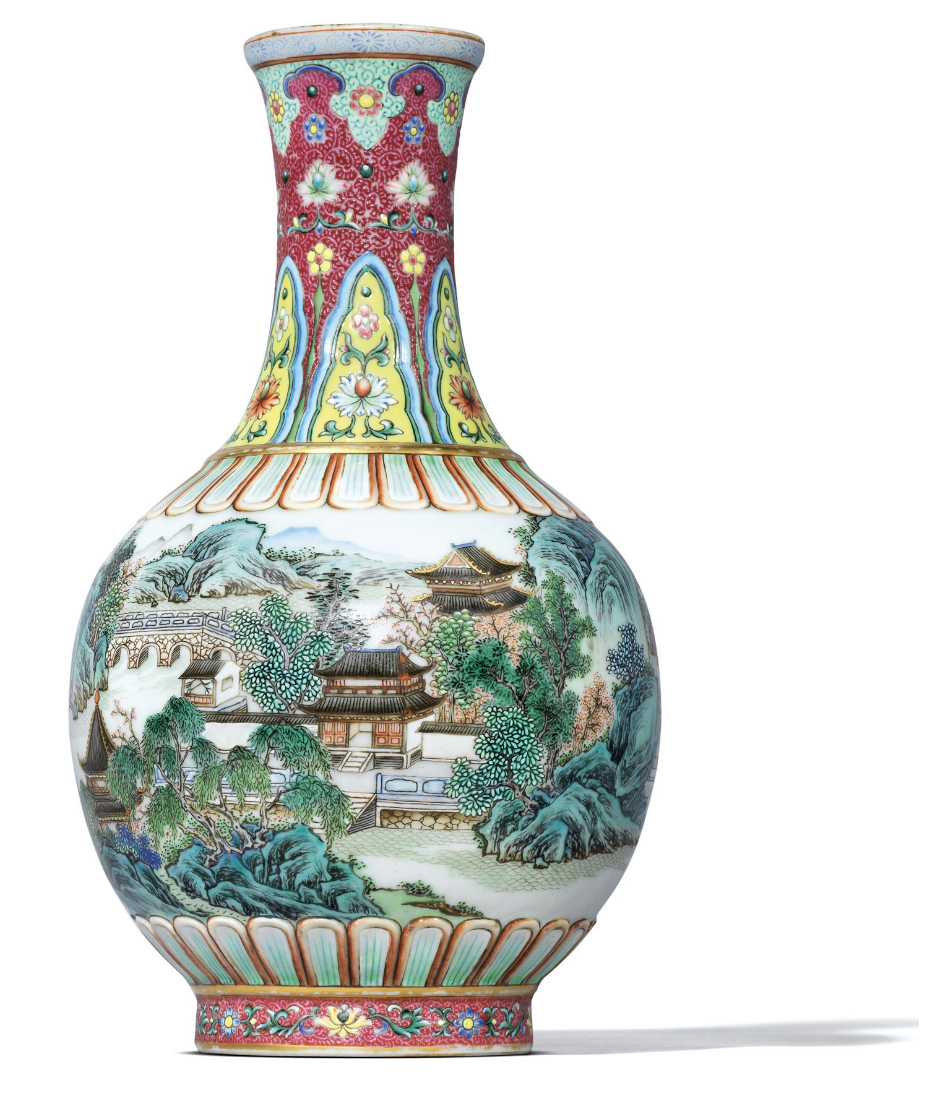
Extremely rare imperially inscribed yangcai ‘landscape’ vase, called ‘Jade Spring Hill’ vase. Date: With Qianlong six-character seal mark in underglaze blue and of the period (1736-1795). Height: 7½ in, 19.1 cm. Auctioned by Christie's Hong Kong in 2018. "While Jade Spring Hill had been the site of royal pavilions and gardens for centuries, among all of China’s rulers it was probably Qianlong who cherished Jade Spring Hill the most. The vase features a calligraphic excerpt from a poem he wrote, as a young prince in 1729, called In Celebration of Autumn Harvest When Travelling to the Jade Spring Mountain. In it, Qianlong declares how joyful it is to encounter the sights, sounds and smells of the area in autumn." (from Christie's article, 5 minutes with... Emperor Qianlong’s yangcai ‘Jade Spring Hill’ vase)
Botanical specimens depicted with scientific accuracy and often identified by inscriptions reflect the influence of European natural history illustrations on Yangcai decorations. Aligning with the Qianlong Emperor’s documented interest in systematic knowledge and classification, these subjects demonstrate the application of Western anatomical observation techniques to Chinese decorative contexts. The yanghua (洋花, or "foreign flowers") motif, featuring European species such as tulips, roses, and daisies, became a Yangcai staple, lacking an equivalent in Falangcai or Fencai repertoires.
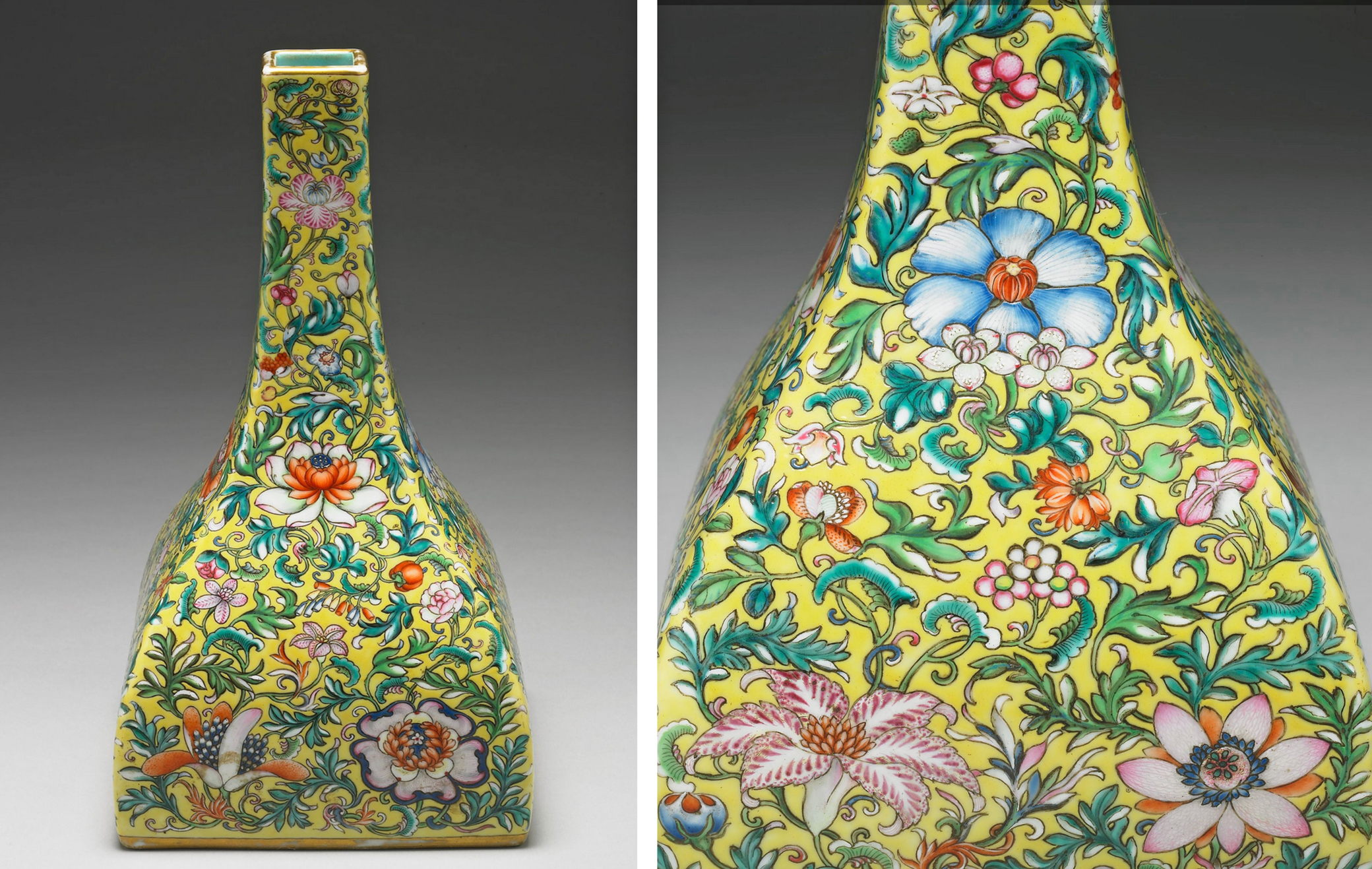
Square vase with Western flowers on a yellow ground in yangcai painted enamels. Date: Qianlong reign (1736-1795). National Palace Museum, Taipei, Taiwan.
The following yangcai decorated yellow-ground vase is an excellent example of the advanced technical innovations in porcelain manufacturing during the Qianlong period.
"Its execution and design is particularly successful, making it an unusual creation accomplished in the technique of sgraffiato with painted floral motif in the special yangcai palette. The method of sgraffiato, where a formal design is incised into a solid background colour, was a new style developed by the court artist Tang Ying in the Palace Workshops in the Forbidden City. It was a technique first applied to painted falangcai porcelains fired during the Kangxi reign in the Palace Workshops, and subsequently introduced to the Imperial kilns at Jingdezhen, where the majority of such wares came to be designed and manufactured after the initial presentation to and approval from the emperor. (...)
The vase is a successful synthesis of classical Chinese taste and Western decorative technique and palette. Firstly, its shape, while slightly altered in its proportions from bottle vases characteristic of this period, is one of the most revered classical types known from as early as the Song dynasty (960-1279). Early Qianlong period wares are products of much experimentation, especially in their shape, and the present vase is no exception. In addition to using new decorative techniques and colour palette, it was also expected that in form there would be a variance from the norm. The broader foot and slightly more rounded body, with a marginally wider mouth rim than expected from wares of this form, are suggestive of the potter’s intension to create a bottle vase with a difference yet still keeping the classical model in mind. (...). The vase displays Western shading techniques, represented by light spots and the use of white pigment on leaves and flower petals. The use of yangcai helped create the illusion of light and shadow and brought a degree of three-dimensionality to the overall composition. The colours are also noticeably more delicate and lighter in shade than the more conventional palette used at the time. The arrangement and generous placing of the floral design is also Western in style. Furthermore, the use of light-yellow for the ground is most unusual for porcelain, and better known from Beijing enamelled wares first produced by Jesuit missionary artists working in the Qing court. According to Liu Liang-Yu, yellow was a primary colour tone of decoration on Qing painted enamel wares on metal. The employment of gold for the rim and border design, as seen on this vase, further suggests the influence of Beijing enamel on its aesthetics." (from the essay ‘Adding Flower to Brocade (Jin Shang Tian Hua)’, A Magnificent Qianlong Yangcai Vase by Hajni Elias, Department of History of Art, Cambridge University).
Another Western influence is evident in the opulent flowers masterfully enameled on the exterior, including stylized lotus, passiflora, anemone, lily, pomegranate, honeysuckle, iris, narcissus, rose, aster, peach blossom, and morning glory. Many of these flowers can be defined as yanghua, or "foreign flowers."
- Passiflora (native to the Americas, it was introduced to the East via European trade route);
- Anemone (often associated with European botanical studies and introduced as a "foreign" motif in Chinese imperial ceramics);
- Narcissus (while some species are native to China, the specific stylization in Yangcai often mimics European cultivars);
- Rose (although roses are native to China, the "Western-style" rose with its specific shading and heavy petals was a hallmark of Western influence on Chinese art);
- Aster (European and North American varieties were often distinguished from the local Chinese "chrysanthemum" style in these decorative programs);
- Morning glory (while found globally, certain large-flowered varieties were introduced from the Americas to Europe and then to the East).
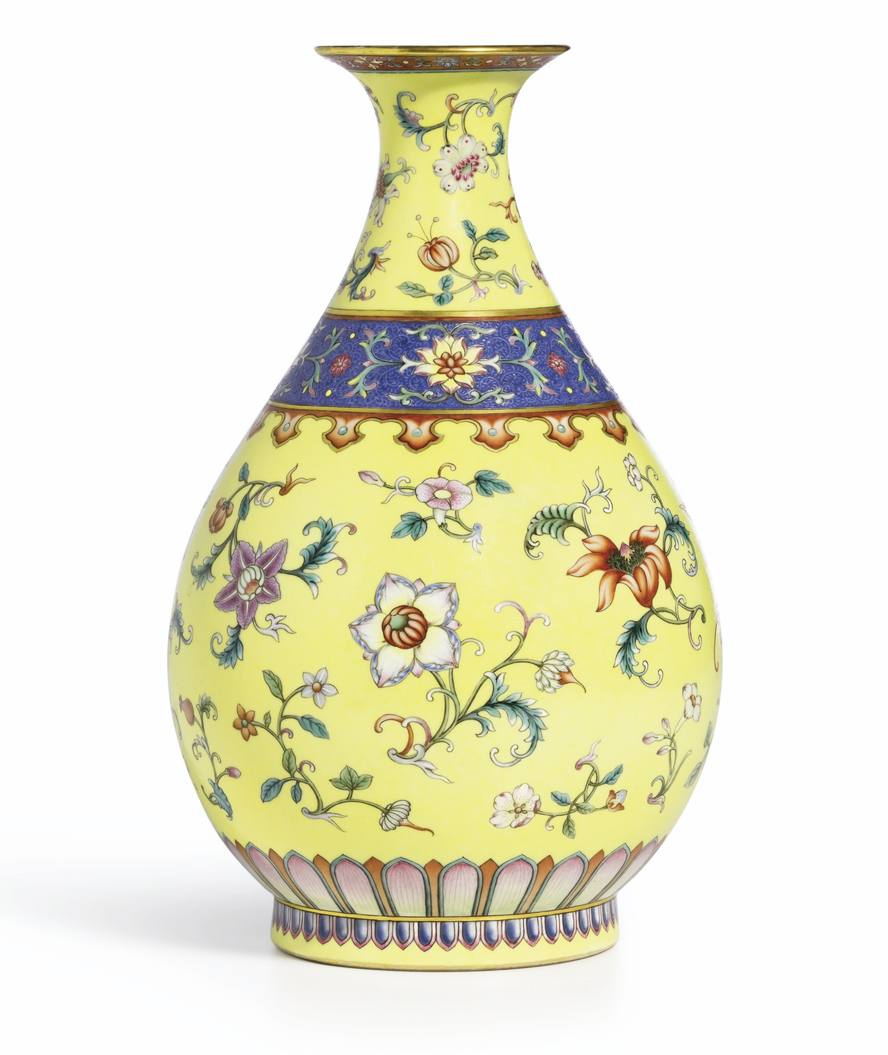
A magnificent and rare yellow-ground yangcai vase of elegant yuhuchun form, masterfully enameled with an opulent design of large luxuriant flower heads on a ground of brilliant lemon-yellow. It is finely engraved using the sgraffito technique with a dense scroll of feathery arabesques. Date: With Qianlong mark and of the period. Auctioned by Sotheby's Hong Kong in 2014 for HKD 57,240,000.
3.3.2 Framed panels and ornamental borders
A common compositional format in Yangcai decoration is the use of reserved panels (开光), known as "kaiguan". In this format, pictorial scenes are enclosed within shaped frames against patterned or colored backgrounds. Borders often include floral or geometric ornamentation.
The kaiguan format, in which decorative scenes are enclosed within shaped reserves against contrasting grounds, was particularly elaborated in Yangcai production. While this format has Chinese precedents in lacquer and textile decoration, its Yangcai application likely drew inspiration from European medal and plaque designs, as well as the framed miniature paintings that were popular in 18th-century European interior design.
The reserved panel variant with a brocade ground (锦地开光), with its dense geometric or floral patterns surrounding pictorial scenes, represents a synthesis of Chinese textile design conventions and European enamel decorative practice. The technical demands of this format—precise registration of panel boundaries, harmonious color coordination between the ground and reserved areas, and maintenance of a visual hierarchy—contributed to the elevated status of successful Yangcai production.
The Western antecedents of the Yangcai reserved panel format can be traced back to European ceramic and metalwork decorations, particularly the framed medallions and cartouches of Baroque design. Adapting these elements to Chinese ceramic practice involved significant transformation. The proportional relationships, ornamental vocabulary, and color schemes were modified to align with Chinese aesthetic expectations, even when the enclosed scenes depicted European subject matter.
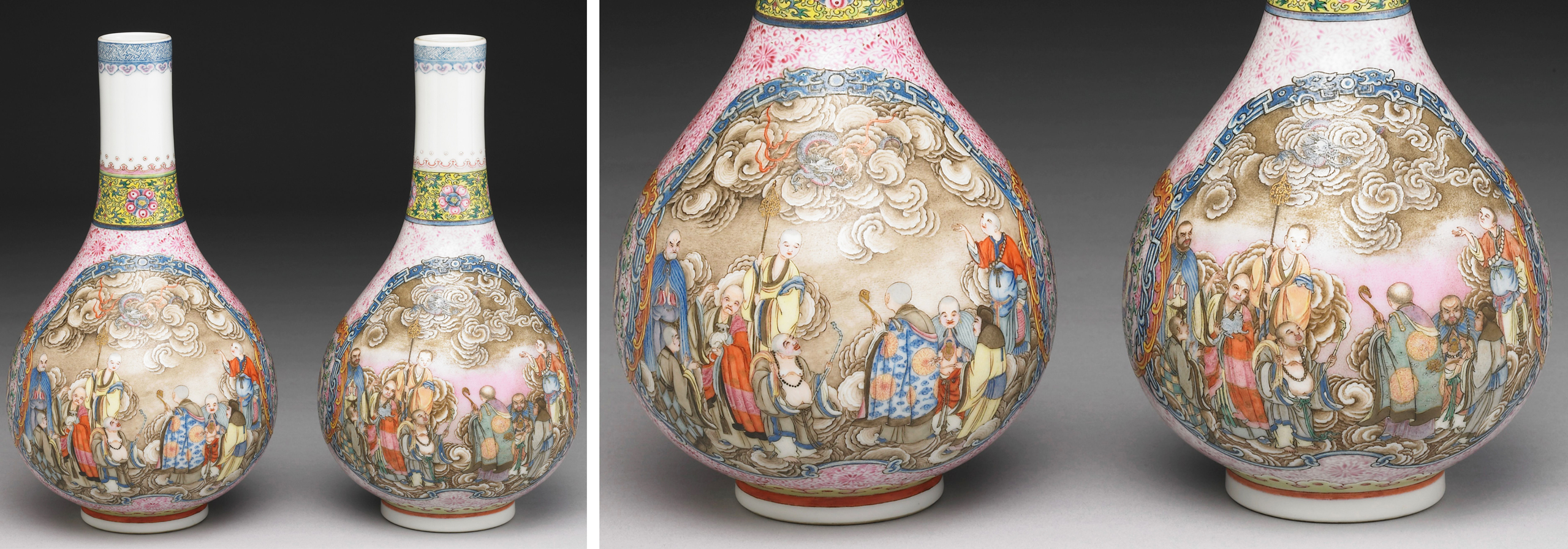
Gall-bladder-shaped vase with the "Eighteen Lohans " motif in yangcai painted enamels. Date: Qianlong reign (1736-1795). National Palace Museum, Taipei, Taiwan.
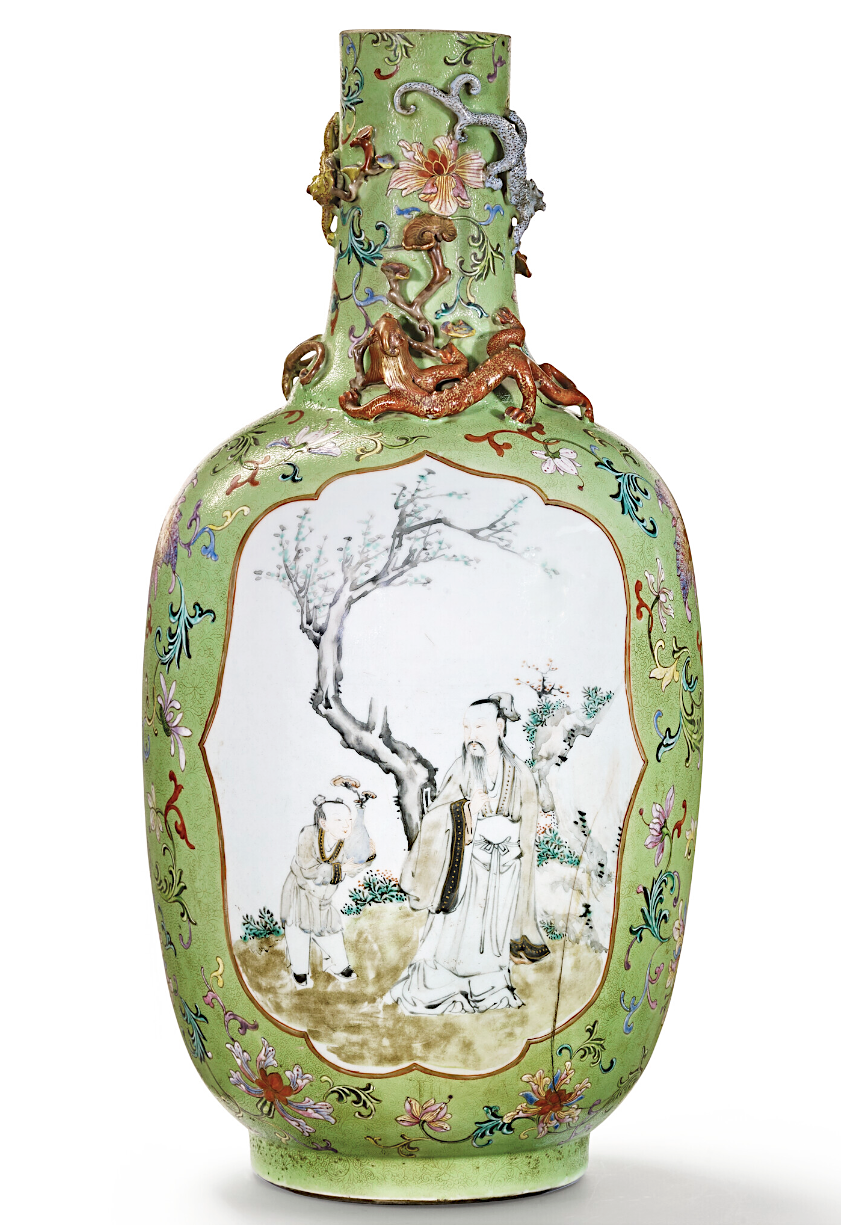
Large yangcai vase adorned with two large, multi-lobed medallions. One depicts a young woman standing near a crane and the other depicts a scholar standing near a servant holding a vase containing lingzhi. Both scenes are set against a green background adorned with incised floral motifs, large lotus flowers, and leafy scrollwork. Height: 49 cm, 19 1⁄4 in. Auctioned by Christie's Paris in 2022.
3.3.3 Brilliant enamel colors
Yangcai maintains the chromatic intensity and surface luminosity that distinguish all boron-containing enamel techniques from fencai, which was developed later. The glassy brilliance of well-fired yangcai is comparable to falangcai and produces exceptional visual effects that were particularly suited to the elaborate decoration and grand scale of Qianlong-period production.
Typical palettes include:
- vivid pinks and reds;
- brilliant yellows;
- deep cobalt blues;
- bright greens;
- white enamel highlights.
These colors were combined to create richly decorative compositions that suited the tastes of the Qianlong court.
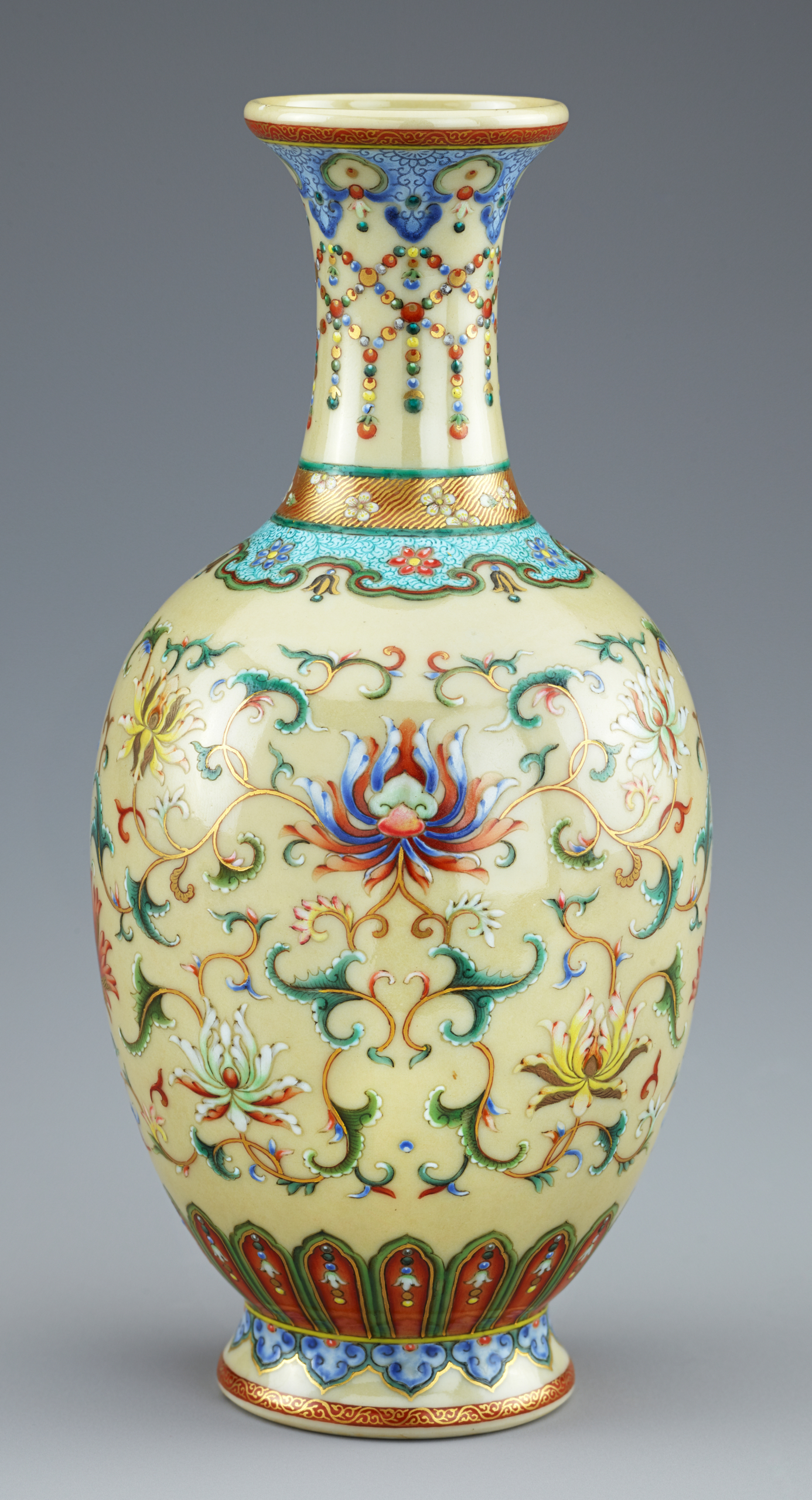
Yangcai porcelain vase with enamel decoration on a very pale cafe-au-lait ground. Date: With Six character mark of the Qianlong reign and of the period. Dimensions: 20.3 x 9.6 cm; 8 x 3 3/4 in. Freer Gallery of Art Collection, Smithsonian Institution, Washington D.C., USA.
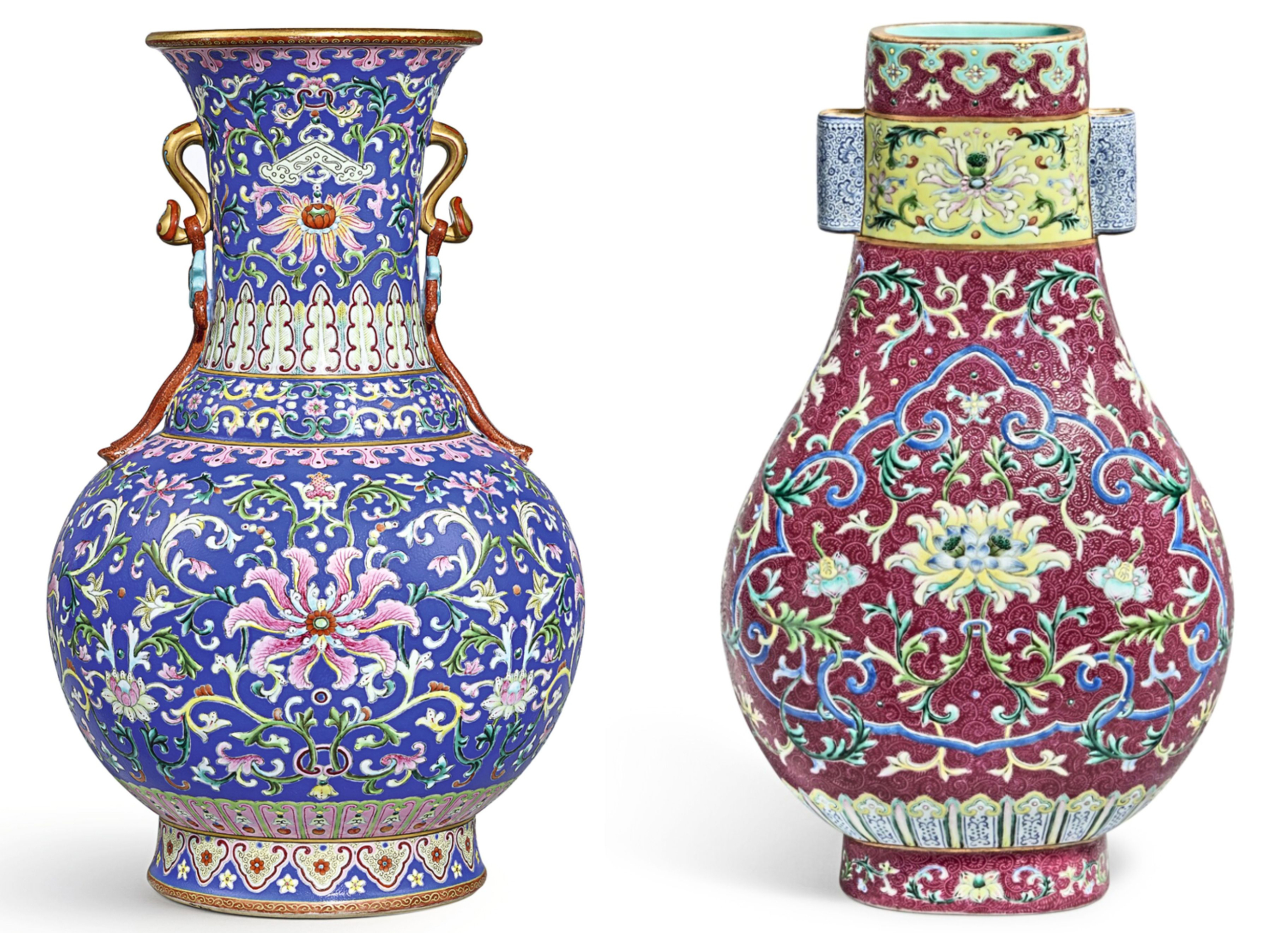
LEFT: A magnificent and rare large yangcai blue-ground 'lotus' vase with ruyi handles. Date: With iron-red seal mark and of the period of Qianlong. Height: 36.7 cm, 14 1/2 in. Auctioned by Sothebys Hong Kong in 2018.
RIGHT: An impressive ruby-ground 'yangcai' sgraffiato 'lotus' vase. Date: With seal mark and period of Qianlong. Height: 10 in., 25.5 cm. Auctioned by Sothebys New York in 2024.
3.3.4 The unprecedented complexity in porcelain decoration
The integration of Western enamel techniques with traditional Chinese decorative arts resulted in an unprecedented level of complexity in porcelain decoration during the Qianlong golden age. During this period, Chinese porcelain achieved unparalleled technical sophistication through mastery of the sgraffito technique and reticulated designs. This integration produced a distinctive aesthetic balancing technical precision and artistic expression, setting new standards for porcelain decoration that influenced generations of ceramic artists.
Sgraffito, from the Italian sgraffiato, involves applying layers of colored slip or enamel to a ceramic surface and then scratching through these layers to reveal contrasting colors beneath. In Qianlong porcelain, this technique reached new heights of sophistication through precise control of layer thickness and scratching depth.
The sgraffito technique poses three main technical challenges.
The process required multiple firings and meticulous attention to the chemical properties of the different enamel layers. Artists had to understand how colors would interact during firing and how scratching depth would affect the final appearance. Qianlong artisans developed specialized tools for sgraffito work, including precise scratching instruments made from bamboo, metal, and precious stones. These tools allowed for unprecedented detail in decorative work.
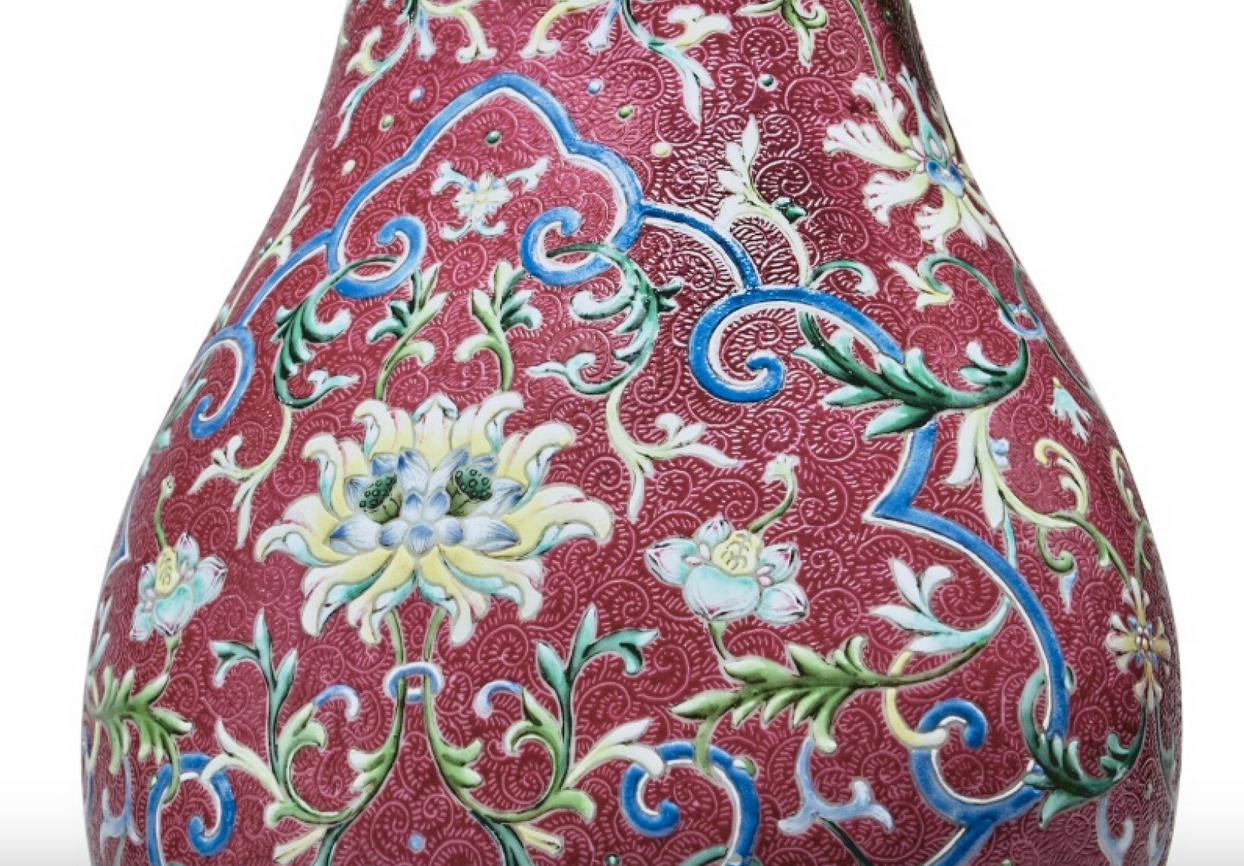
A detail of the sgraffito technique on a vase shown earlier. Auctioned by Sothebys New York in 2024.
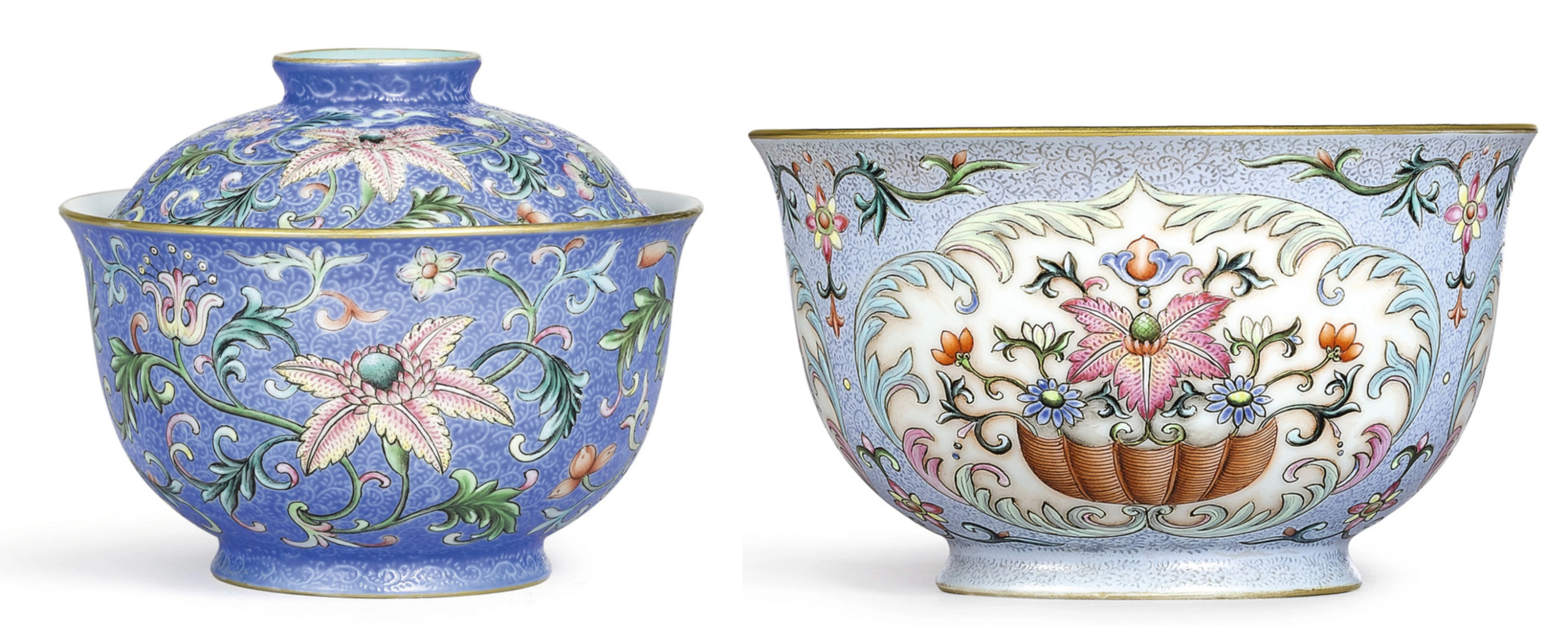
LEFT: A masterly enameled blue-ground yangcai sgraffito 'floral' bowl with cover. Date: With seal marks and period of Qianlong. Auctioned by Sotheby's Hong Kong in 2017 for HKD 6,700,000.
CENTER: An extremely rare and superbly enamelled blue 'yangcai' sgraffito 'floral' bowl. Date: With seal mark and period of Qianlong. Auctioned by Sotheby's Hong Kong in 2017 for HKD 8,500,000.
Reticulated Porcelain Design
Reticulated porcelain is characterized by delicate openwork patterns and is one of the most technically demanding achievements in ceramic art. The technique involves creating intricate patterns of holes or openings while maintaining structural integrity, a feat that requires an exceptional understanding of materials and technical skill. Qianlong reticulated pieces often feature hundreds of openings formed individually, each requiring precise timing and temperature control during the forming and firing processes.
"Reticulated yangcai vases with double walls (jiaceng linglong) represent one of the last great innovations developed by Tang Ying (1682-1756), the imperial kilns’ creative supervisor, specially for the Qianlong Emperor. The time they were conceived in the early 1740s saw the production of some of the most exquisite porcelains at the imperial ateliers inside the Forbidden City in Beijing, where porcelains were treated like paintings; but Beijing could only operate on a small scale, both in terms of quantity and size. The imperial workshops at Jingdezhen were not limited in this way and Tang Ying clearly realized that he needed to exploit this advantage to the fullest, if he wanted to impress the Emperor. In his development of yangcai at Jingdezhen, he emphasized exclusive designs and individual attention to each piece or pair. Every piece was a technical tour de force involving dozens of different techniques and production processes. Some, like reticulated vases, were so challenging that he apologized to the Emperor for not submitting more to the Palace." (Regina Krahl, A Glimpse of the Past, Screened through the Present).
During the Qianlong period, reticulated designs reached new levels of sophistication and were often combined with sgraffito techniques to create pieces of extraordinary complexity and beauty. Integrating sgraffito and reticulated techniques required balancing material properties across different decorative elements, demonstrating the pinnacle of imperial workshop capabilities.
Qianlong workshops developed new enamel formulations specifically for these complex techniques, including low-lead enamels for fine sgraffito work and specialized fluxes for reticulated structures.
Technically sophisticated porcelain pieces were often given as diplomatic gifts to European courts. These pieces served as cultural ambassadors, demonstrating Chinese technical and artistic superiority.
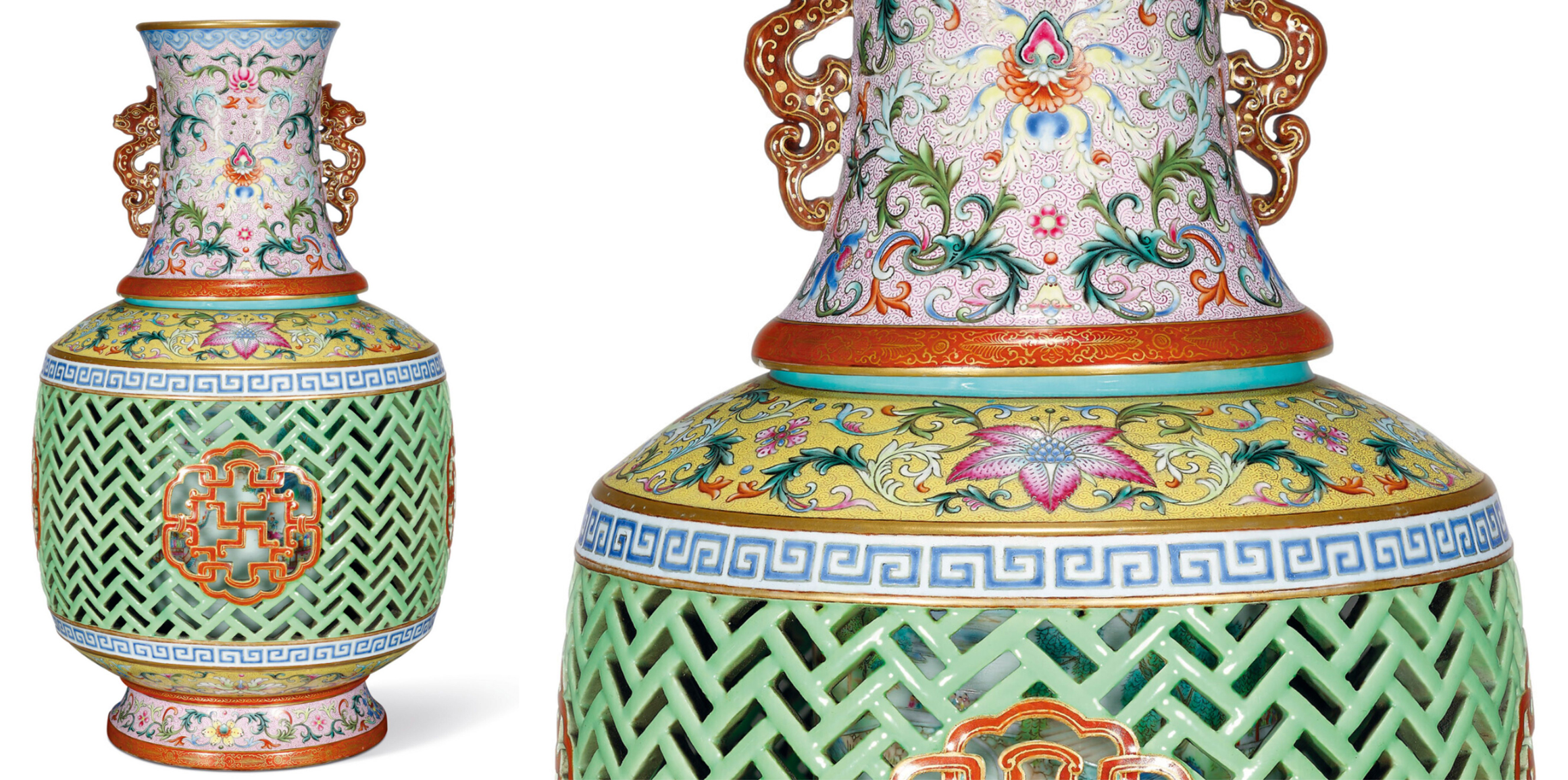
A magnificent yangcai reticulated and rotating ‘dragon boat’ vase. Date: With Qianlong six-character seal mark in underglaze blue and of the period (1736-1795). Height: 15 3/4 in., 40 cm. Auctioned by Christie's Hong Kong in 2023 for HKD 40,305,000.
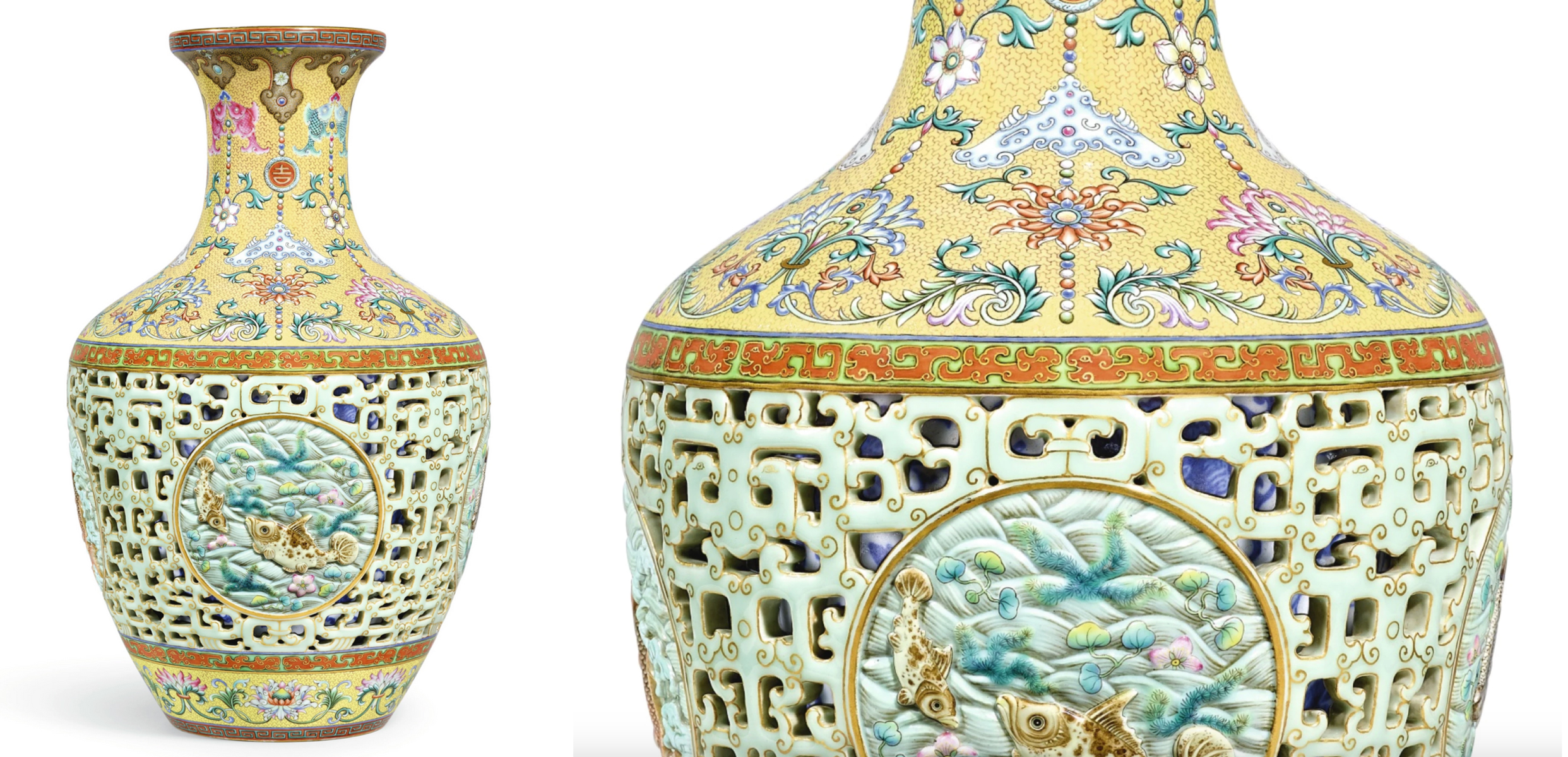
An important and exquisitely enameled yangcai reticulated ‘fish’ vase. The openwork design of this vase is composed of highly stylised archaistic dragons, which are borrowed from archaic ritual bronzes. Date: With blue-enamel seal mark and period of Qianlong. Height: 40.8 cm, 16 1/8 in. Auctioned by Sotheby's Hong Kong in 2018 for HKD 149,091,000.
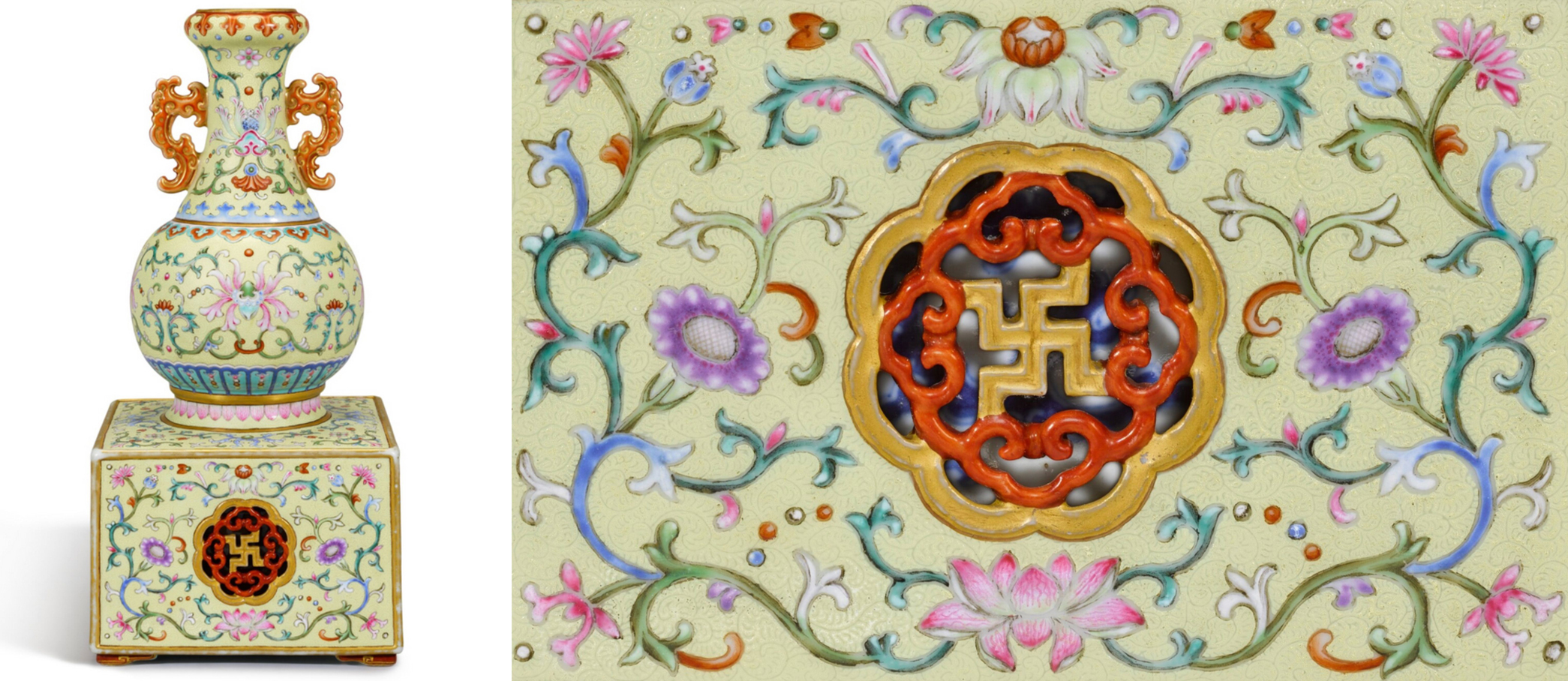
An extremely rare yellow-ground yangcai reticulated vase. Date: With seal mark and period of Qianlong. Height: 26.1 cm. Auctioned by Sotheby's New York in 2023.
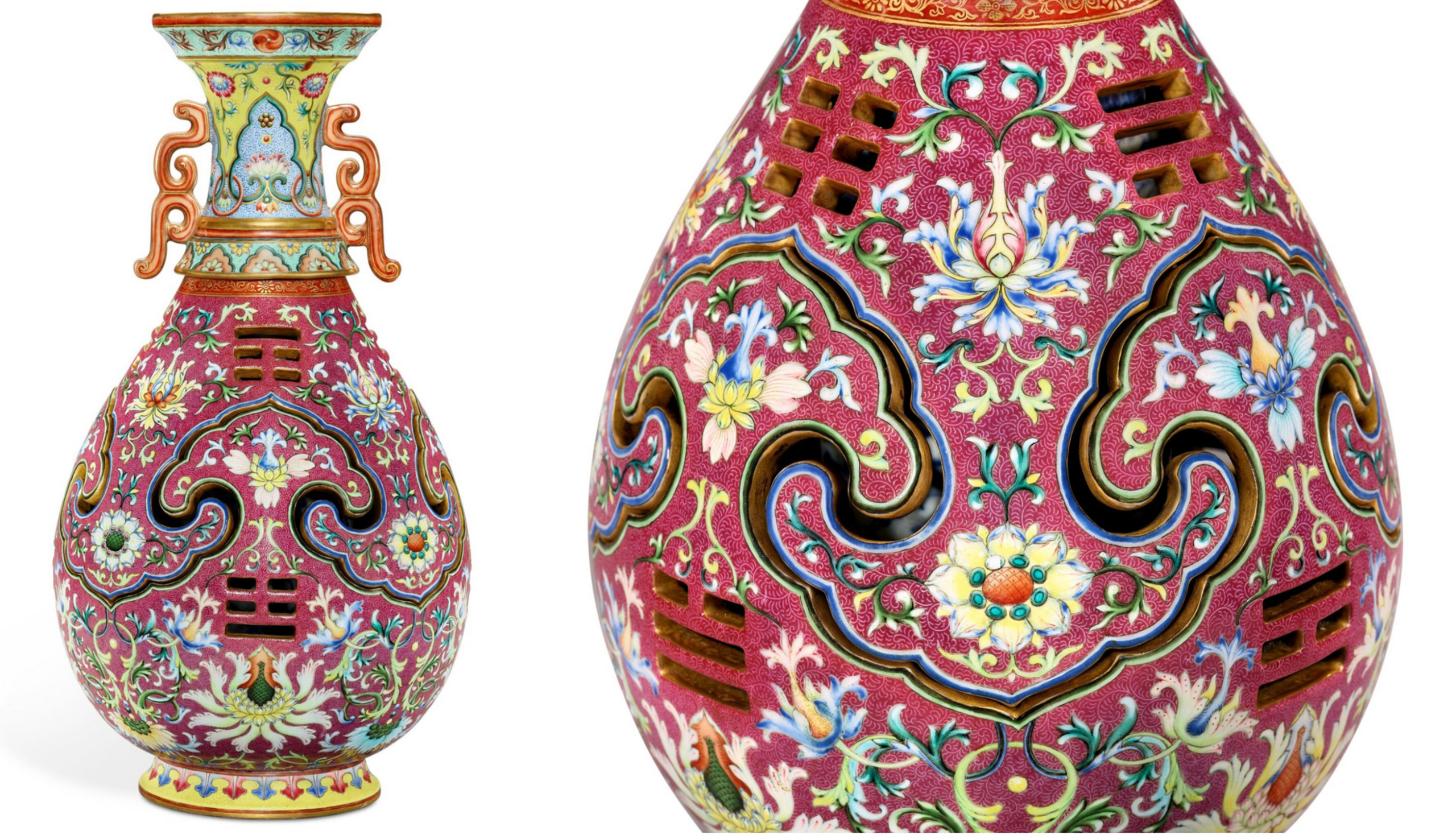
A magnificent and rare ruby-ground yangcai 'trigram' reticulated vase. The bright ruby ground has been finely incised in sgraffito with dense feather arabesques. Date: With seal mark and period of Qianlong. Height: 31 cm. Auctioned by Sotheby's Hong Kong in 2022 for HKD 177,463,000.
3.3.4 Distinguishing Yangcai from Falangcai
Technically, Yangcai and Falangcai are closely related. In connoisseurial practice, the distinction between the two relies primarily on criteria of workshop attribution rather than technical or stylistic differences. Falangcai is identified by its origin in the Beijing palace workshop, which is documented through imperial inscriptions, seal marks, and archival records of production. By contrast, Yangcai is identified by its Jingdezhen imperial kiln origin. It typically bears standard imperial reign marks and lacks the personalized inscriptions characteristic of Beijing production.
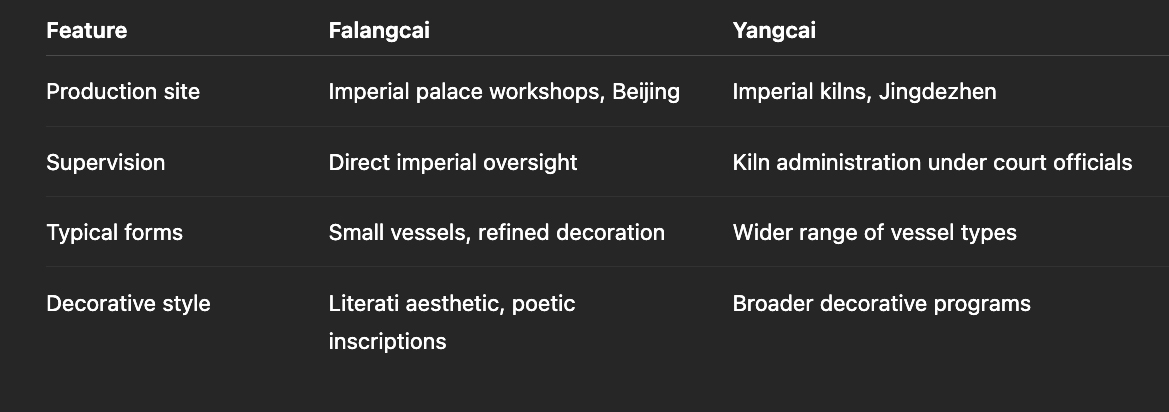
While this distinction is institutionally significant, it does not correspond to technical or aesthetic differences at the material level. The pigments, firing methods, and decorative techniques used in both categories are fundamentally identical. The practical consequences of this distinction in attribution are substantial for collection formation and market valuation. Falangcai, with its documented imperial provenance and extreme rarity, commands prices that substantially exceed those of the finest Yangcai, sometimes by an order of magnitude or more for comparable pieces.
However, recent scholarship has questioned whether this distinction merits the weight assigned to it in traditional connoisseurship. Some authorities treat Falangcai and Yangcai as regional variants of a single technique. Liao Baoxiu’s four-point distinction — painting method (Chinese versus Western), production location (Beijing versus Jingdezhen), paired piece correspondence (identical versus varied), and inscription content (classical poetry versus imperial poems and seals) — provides a practical framework, though it is complicated by the Qianlong Emperor’s arbitrary reclassification of pieces between categories.
3.4 Cultural Significance
3.4.1 Evidence of Sino-European artistic exchange
Yangcai is the most extensive material representation of Sino-European artistic exchange in Qing ceramic history. It demonstrates the transfer of European enamel technology and the adaptation of European aesthetic conventions to Chinese contexts. Developed at Jingdezhen, the global center of porcelain production, the technique ensured this exchange would influence ceramic production far beyond the immediate circle of imperial patronage. Technical knowledge and decorative motifs diffused through commercial networks to regional kilns and export markets.
The Western subject matter characteristic of yangcai—European figures, architectural vedute, and botanical specimens—provided Chinese viewers with visual access to foreign cultures otherwise available only through textual descriptions or the limited presence of foreigners at designated trading ports. This visual exoticism, carefully controlled through imperial supervision of production, demonstrated the Qing court’s cosmopolitan knowledge while maintaining clear boundaries between Chinese and foreign cultural domains. The resulting synthesis, in which European techniques and subjects were adapted to Chinese formats and functions, represents a distinctive mode of cross-cultural encounter that differs fundamentally from uncritical adoption or rigid rejection of foreign influence.
3.4.2 Technological bridge to later developments
Yangcai played a crucial role in the broader evolution of Chinese enamel decoration. By transferring enamel technology from palace workshops to Jingdezhen's major production center, yangcai facilitated the diffusion of technical knowledge that influenced later ceramic traditions. This development paved the way for new decorative styles to emerge during the late Qing period.
Yangcai served as a critical technological bridge between court-controlled imperial production and wider commercial ceramic manufacturing, enabling the diffusion of enamel technology that would ultimately transform Chinese ceramic decoration. Despite official prohibitions, the technique's development at Jingdezhen, where imperial and private kilns operated in close proximity, facilitated inevitable technical transfer. The resulting fangyangcai (仿洋彩) production, though varying widely in quality, established enamel decoration as a viable commercial technique that influenced regional kiln production throughout the 19th century.
This bridging function had significant consequences for the subsequent development of Chinese ceramic art. The technical knowledge developed through imperial yangcai production, including pigment formulations, firing protocols, and decorative methods, provided a foundation for expanded enamel production during the late Qing and Republican periods. The aesthetic conventions established through yangcai, particularly the integration of Western techniques with Chinese styles, influenced subsequent developments, including the "light crimson colors" (浅绛彩) and "new colors" (新彩) techniques of the 19th and 20th centuries. Thus, yangcai represents not merely a specific historical technique, but also a transformative moment that reconfigured the possibilities of Chinese ceramic decoration.

Alyx Becerra
OUR SERVICES
DO YOU NEED ANY HELP?
Did you inherit from your aunt a tribal mask, a stool, a vase, a rug, an ethnic item you don’t know what it is?
Did you find in a trunk an ethnic mysterious item you don’t even know how to describe?
Would you like to know if it’s worth something or is a worthless souvenir?
Would you like to know what it is exactly and if / how / where you might sell it?
