

THE PINK FAMILY: CHINA AND THE WEST 13
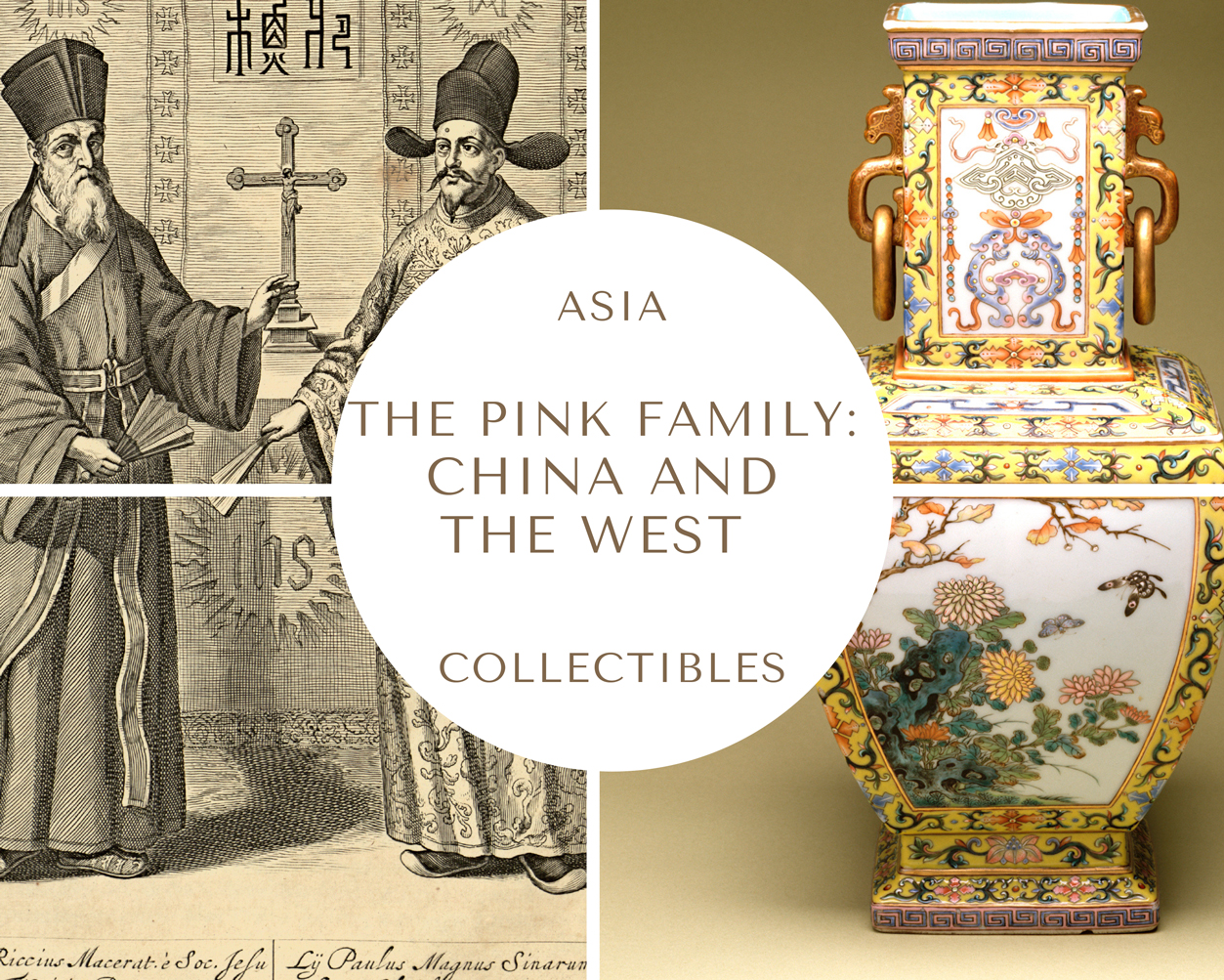
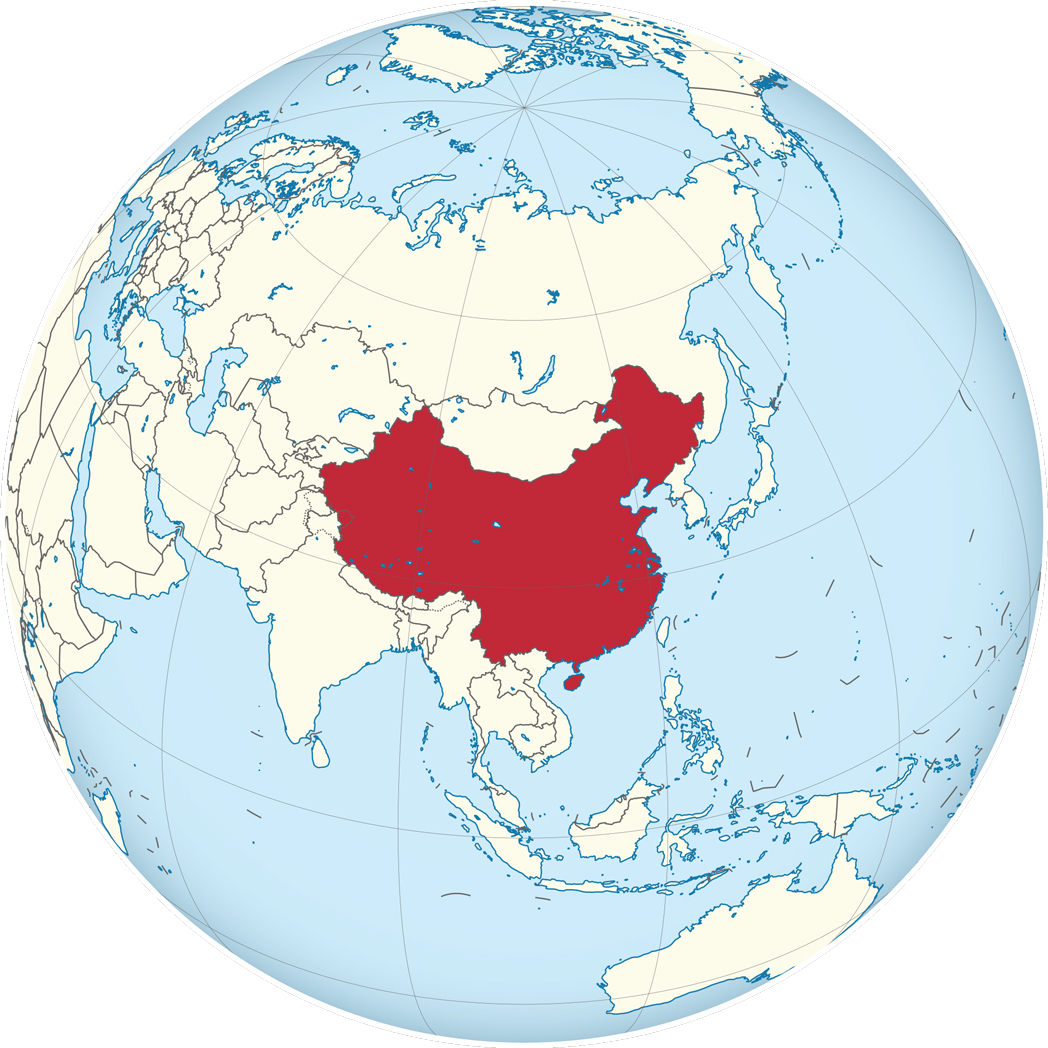
Current China on the globe.
Under the Creative Commons Attribution-Share Alike 3.0 Unported license.
This map is for illustrative purposes only. The Ethnic Home does not take a position on territorial disputes.
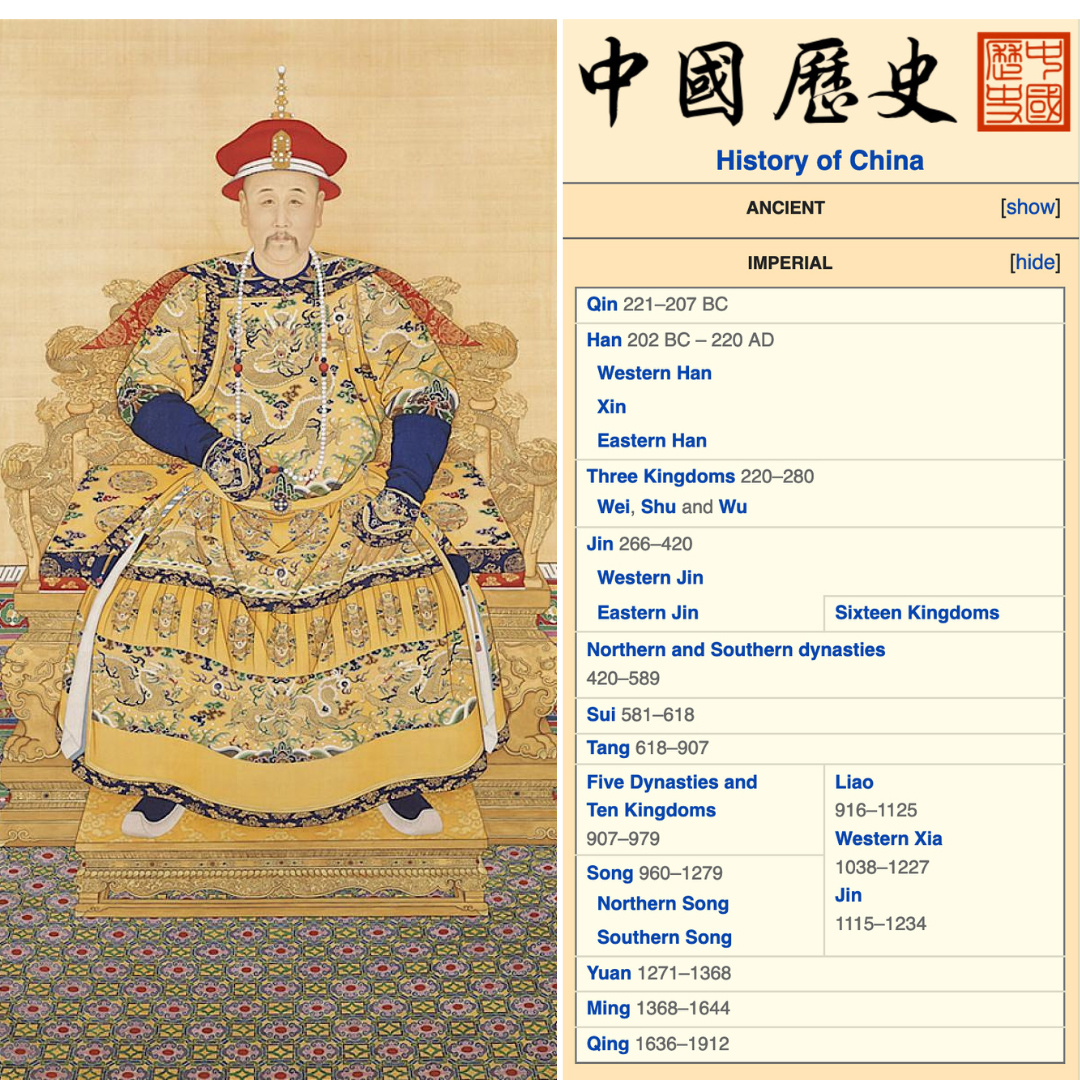
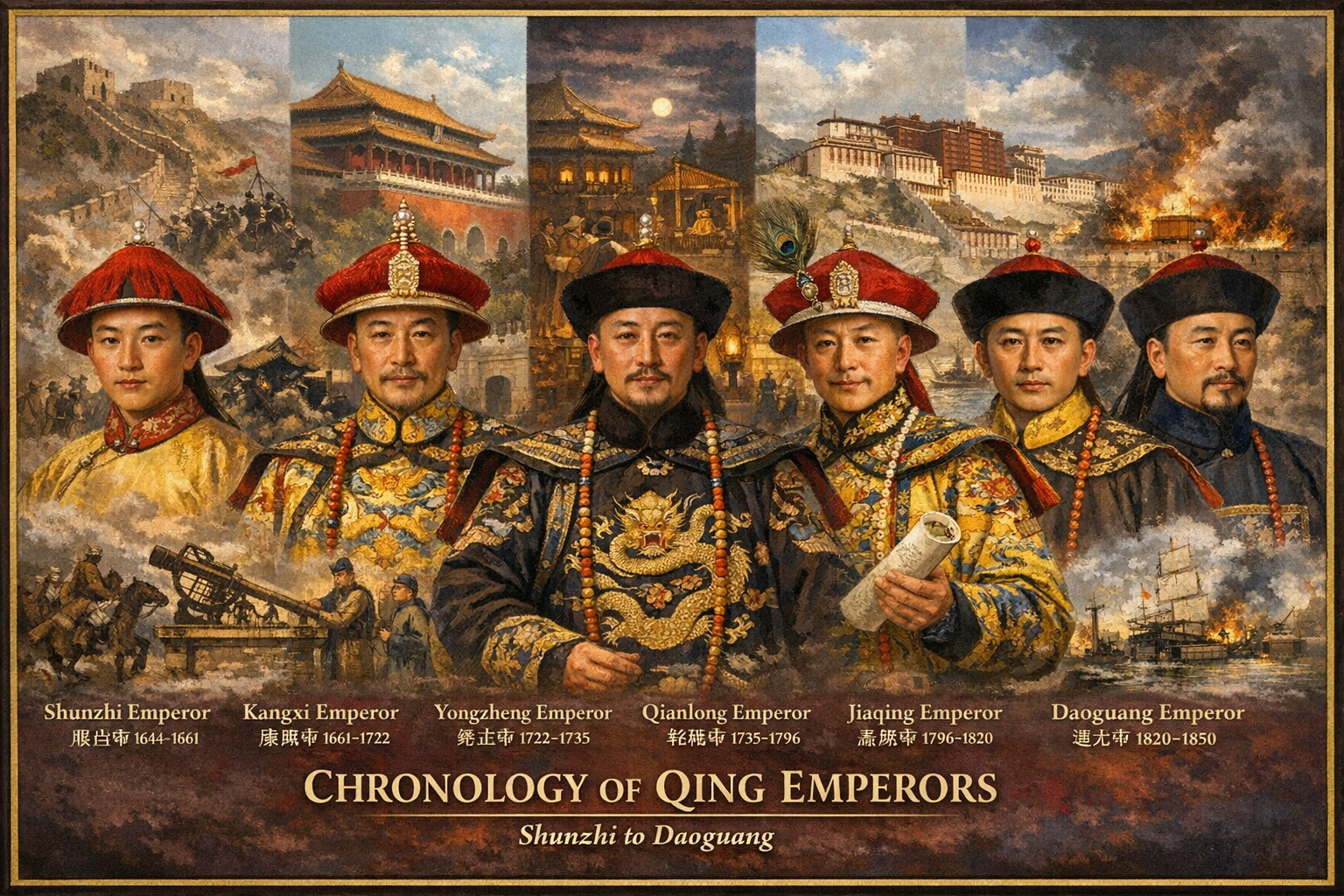
LEFT: Portrait of the Yongzheng Emperor in Court Dress, by anonymous court artists, Yongzheng period (1723—35), Qing Dynasty. Hanging scroll, color on silk. The Palace Museum, Beijing. Public Domain.
RIGHT: History of China, Imperial Dynasties, source: Dynasties in Chinese history, Wikipedia.
PROCESS OVER PALETTE:
THE CHINESE SYSTEM OF CERAMIC CLASSIFICATION 2
FENCAI (粉彩): THE INDIGENOUS SOFT-ENAMEL TRADITION
4.1 Technical Innovation and Material Science
4.1.1 The Absence of Boron and the Development of a Distinct Enamel System
The most significant technical distinction between fencai and falangcai or yangcai is the absence of boron in the enamel glass matrix. Scientific analysis has demonstrated that fencai enamels primarily consist of lead-alkali-silicate glass rather than the lead-boron formulations characteristic of falangcai and yangcai. Similar to traditional Chinese overglaze colors, fencai employs a lead-alkali-silicate glass matrix without boron addition; however, it is modified through the introduction of arsenic-based opacifiers that produce its distinctive soft, pastel appearance.
The absence of boron has multiple technical consequences. Fencai requires lower firing temperatures than boron-containing enamels, such as falangcai or certain yangcai palettes. Firing temperatures are typically around 700–750°C rather than 780–850°C. The resulting surface is less glassy and brilliant. It has a softer, more matte quality that Chinese connoisseurs describe as fenzhi (粉质, "powdery") or ruan (软, "soft"). While the color range is extensive, it differs in character from boron enamels, with more muted tones, subtle gradations, and an overall effect that is more delicate and restrained. The soft, luminous, finely modulated visual effect of fencai decoration helped give rise to the name "powder colors" (粉彩)..
Modern scientific studies have confirmed that fencai enamels consistently lack detectable boron, providing a reliable criterion for distinguishing them from yangcai and falangcai enamels. Studies by the Palace Museum, Tsinghua University, and the Shanghai Institute of Ceramics have demonstrated boron content below the detection limit in fencai samples. This is in contrast to the 5–15% B₂O₃ content typical of falangcai and yangcai enamels. This "boron criterion" has become the foundation for modern scientific classification, overriding the inconsistent terminology of historical sources.
4.1.2 Glass-White (boli bai, 玻璃白) and Arsenic-Based Opacification
The development of glass-white (boli bai, 玻璃白), an opaque white enamel used as both a pigment and a modifier for other colors, was the key technological innovation that enabled fencai decoration.
Glass-white is typically produced using a lead-based glass that contains arsenic compounds, which act as opacifiers. When fired, the enamel forms extremely fine crystalline structures within the glass matrix. These microstructures scatter light and produce an opaque white appearance.
When mixed with colored enamels, glass-white softens and lightens the hue, enabling artists to create the pastel tones characteristic of fencai decoration.
The introduction of glass-white enabled painters to:
- lighten strong pigments;
- produce smooth tonal gradations;
- create delicate shading effects;
- expand the available color palette.
This innovation is one of the most significant technical developments in Qing ceramic decoration.
4.1.3 The Rendering Technique (xuanran, 渲染法)
The distinctive visual qualities of fencai decoration are closely associated with the rendering technique known as xuanran (渲染). Instead of applying flat areas of color separated by outlines, fencai painters used gradual shading to model forms. They diluted pigments and applied them in layers to produce subtle transitions between light and dark tones.
This technique drew upon long-established principles of Chinese ink painting, particularly the use of graded washes to suggest depth and volume.
The process typically involved several stages:
- preparation of a glass-white base layer;
- application of diluted colored enamels;
- gradual shading using soft brushes;
- low-temperature firing to fix the pigments.
By carefully manipulating color density and brushwork, artisans could produce remarkably naturalistic effects in floral, landscape, and figure subjects.
4.1.4 Firing Conditions and Expanded Color Range
Fencai pieces were fired at low temperatures, typically around 700–750°C, after the porcelain body and glaze were finished. The relatively low firing temperature preserved the delicate tonal variations produced by glass-white mixtures.
Since glass-white could be combined with many different pigments, fencai decoration supported a wide range of colors, including:
- pale pinks;
- lavender and purple tones;
- soft greens;
- pastel yellows;
- light blues.
The ability to vary pigment concentration also allowed artists to create a continuous range of intermediate shades. This flexibility made fencai particularly well-suited to pictorial decoration.
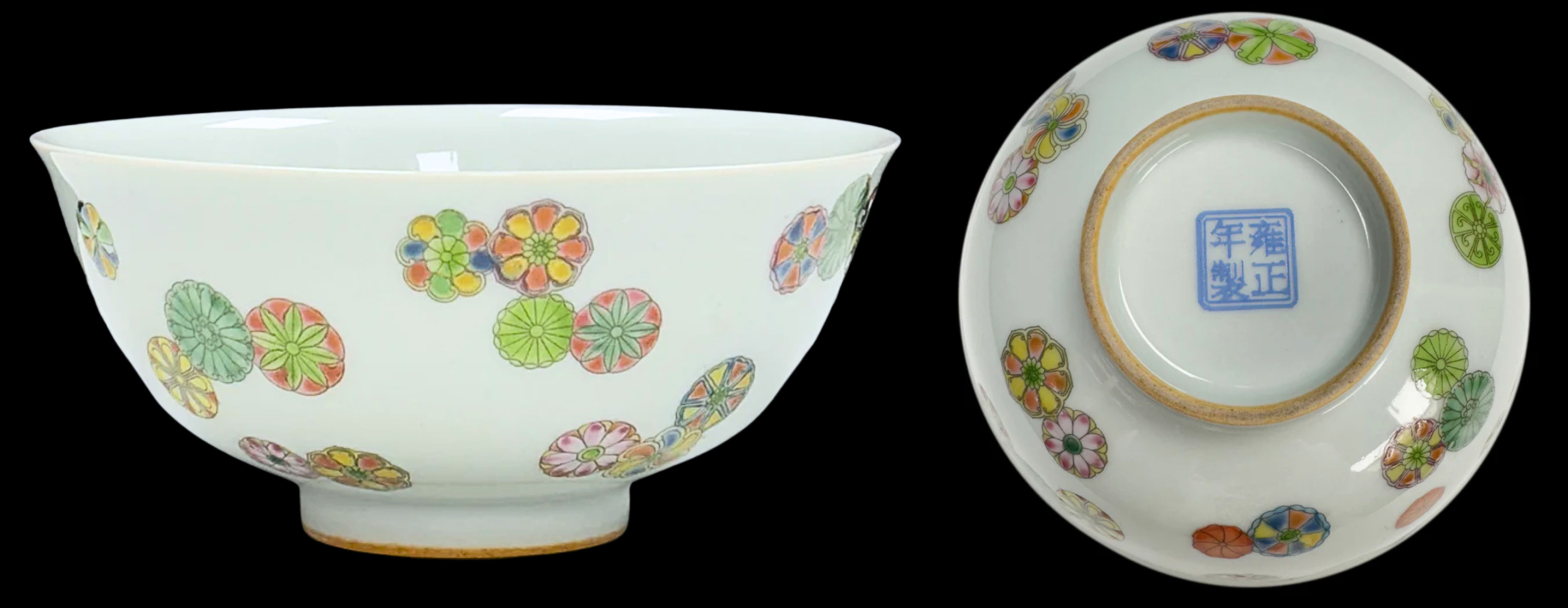
Fencai/Famille Rose Bowl with “Flower Balls” motif. Date: Yongzheng reign. Dimensions: height 2.7 cm, 1.06 in; rim diameter 5.9 cm, 2.32 in. Matungart, Hong Kong, China.
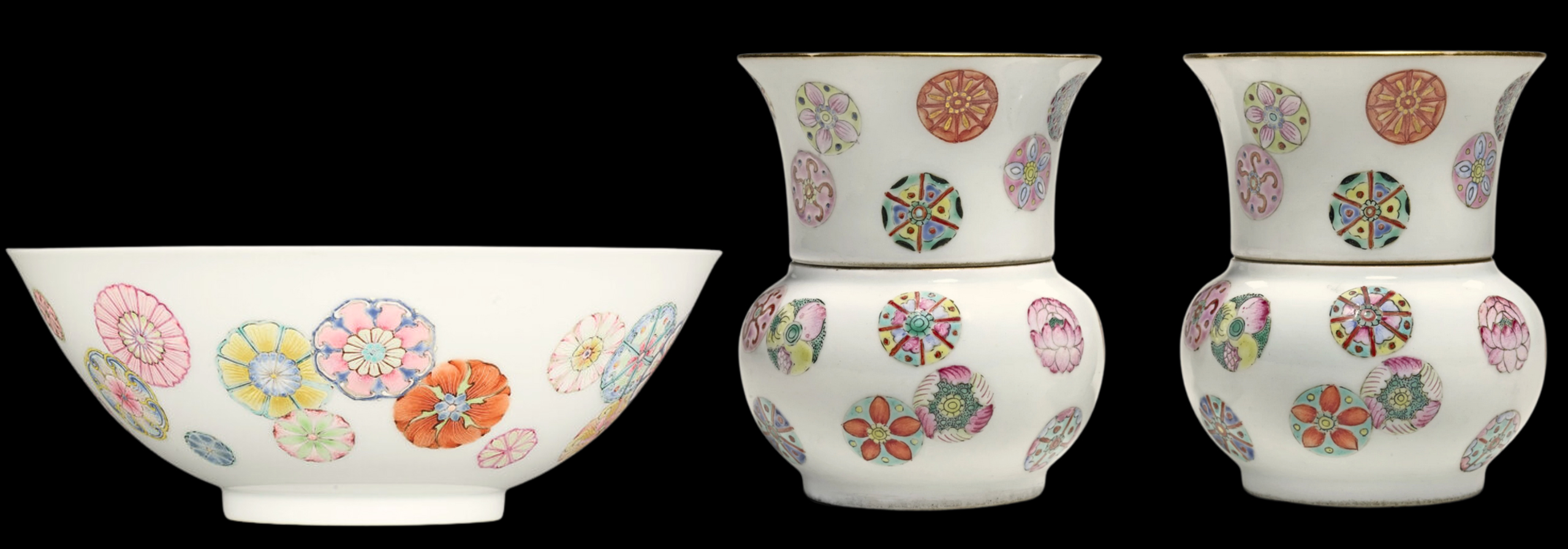
LEFT: Fencai/Famille Rose very fine bowl with “Flower Balls” motif. Date: Yongzheng reign. Dimensions: diameter 22.4 cm, 8 7/8 in. Auctione by Sotheby's Hong Kong in 2018.
RIGHT: A pair of fencai/famille rose 'flower-balls' wine cups and warmers. Date: With seal marks and of the period of Daoguang. Height: 9.6 cm, 3 3/4 in. Auctioned by Sotheby's London (UK) in 2019.
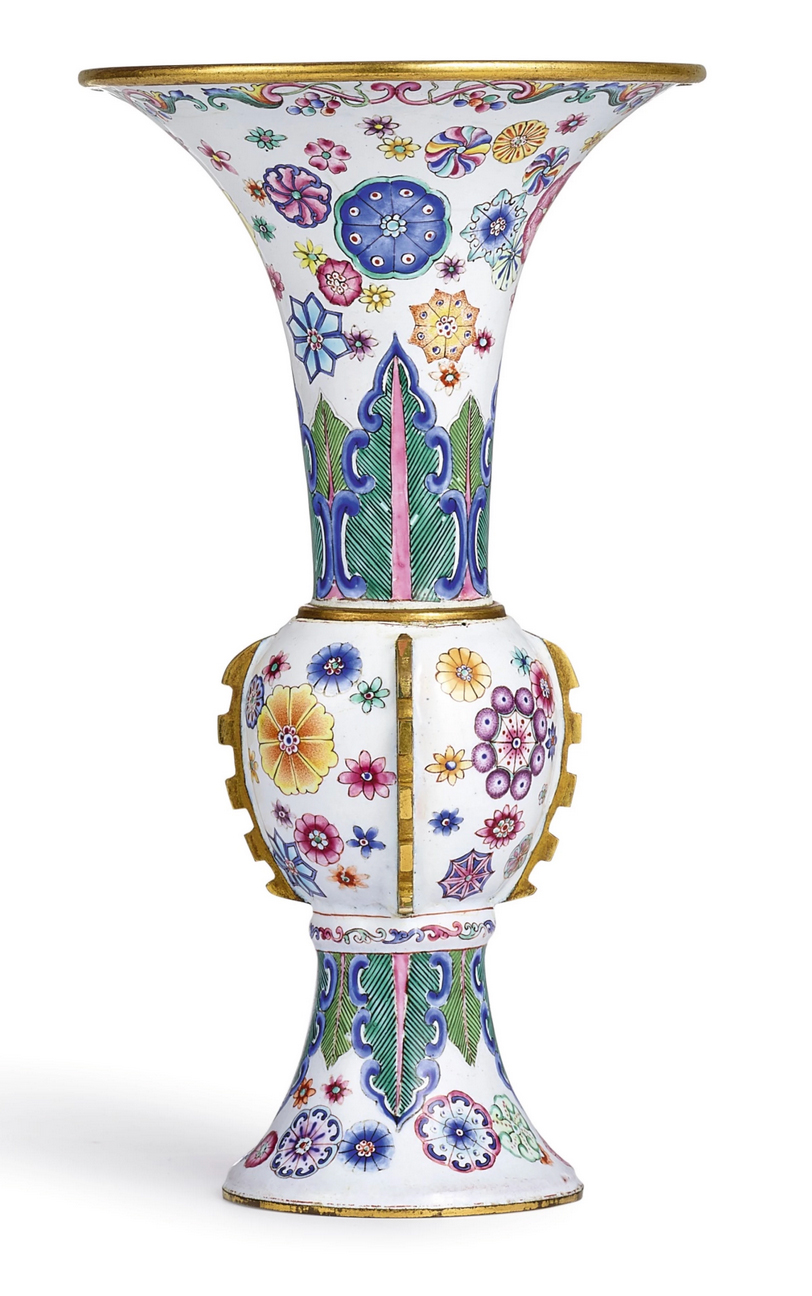
A rare imperial enamel 'flower ball' vase with gu mark. Medium: Fencai enamel painted gilt-bronze, Canton enamel. Dated: Qianlong reign. Height: 18.7 cm, 7 3/8 in. Auctioned by Sotheby's Hong Kong in 2018.
4.2 Historical Development
4.2.1 Origins During the Late Kangxi Period
The origins of fencai can be traced back to the late Kangxi period. During this time, Chinese artisans began experimenting with enamel pigments that were introduced through contact with Europe. Their early attempts to recreate the visual effects of falangcai decoration resulted in experiments with alternative pigment formulations that used locally available materials. These experiments eventually produced the glass-white opacifier that became central to the Fencai technique. Though the term "fencai" does not appear in early Kangxi records, the technical foundations of the style were established during this period.
4.2.2 The Refinement during the Yongzheng Period
Fencai decoration reached a high level of refinement during the Yongzheng reign (1723–1735). Porcelains from this period are widely admired for their elegance and technical precision. Yongzheng Fencai wares often display:
- thin, finely potted porcelain bodies;
- restrained decorative compositions;
- delicate color palettes;
- exceptional quality of painting.
These pieces reflect the emperor’s well-known preference for refined and understated aesthetics.
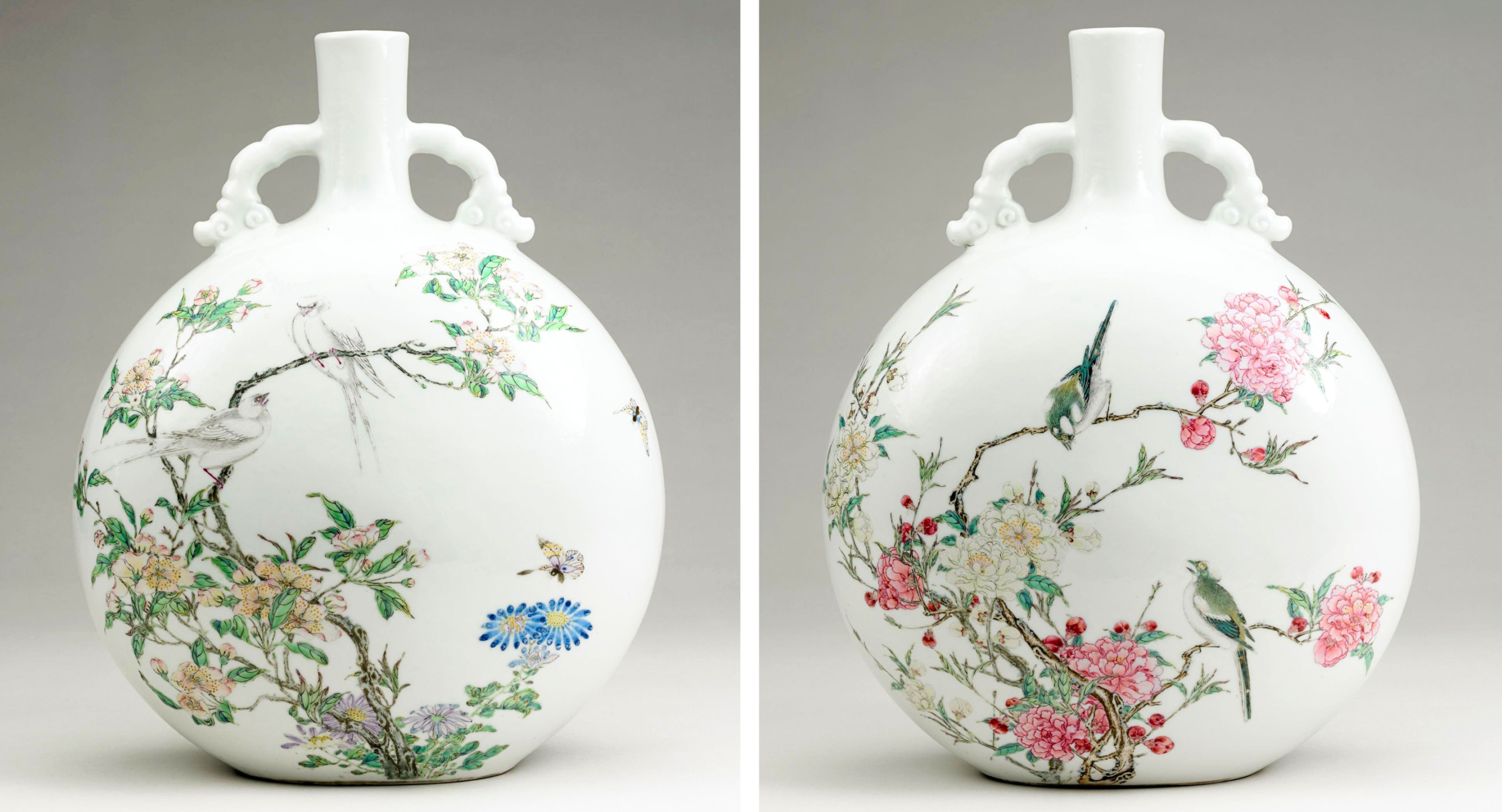
Porcelain with underglaze cobalt-blue and opaque fencai enamels. Made in Jingdezhen. Date: With Yongzheng seal mark and period, 1723–35. Height: 29.3 cm. © The Trustees of the British Museum, London, UK. "On one side, two bai tou weng birds (白頭翁,literally "white-headed old man") are shown on the branches of a white and pink flowering branch; on the other side, a pair of white birds are shown perched in a different type of blossoming tree with a pair of butterflies fluttering above blue and purple asters. The detail used in the painting is remarkable, reflecting both the court commissioning of this piece and the supervision of its manufacture at the imperial kilns atJingdezhen. Each group of naturalistic leaves is composed of up to four different shades of green and the shading on the blossoms is extraordinarily well defined. New colours include a blue enamel for the aster which replaced underglaze blue; a white enamel for the birds’ wingsand puce for the birds’ legs and beaks. The birds are a rebus for 白頭富貴,bai tou fugui, "white haired in old age may you enjoy riches and honour". (From the British Museum texts).
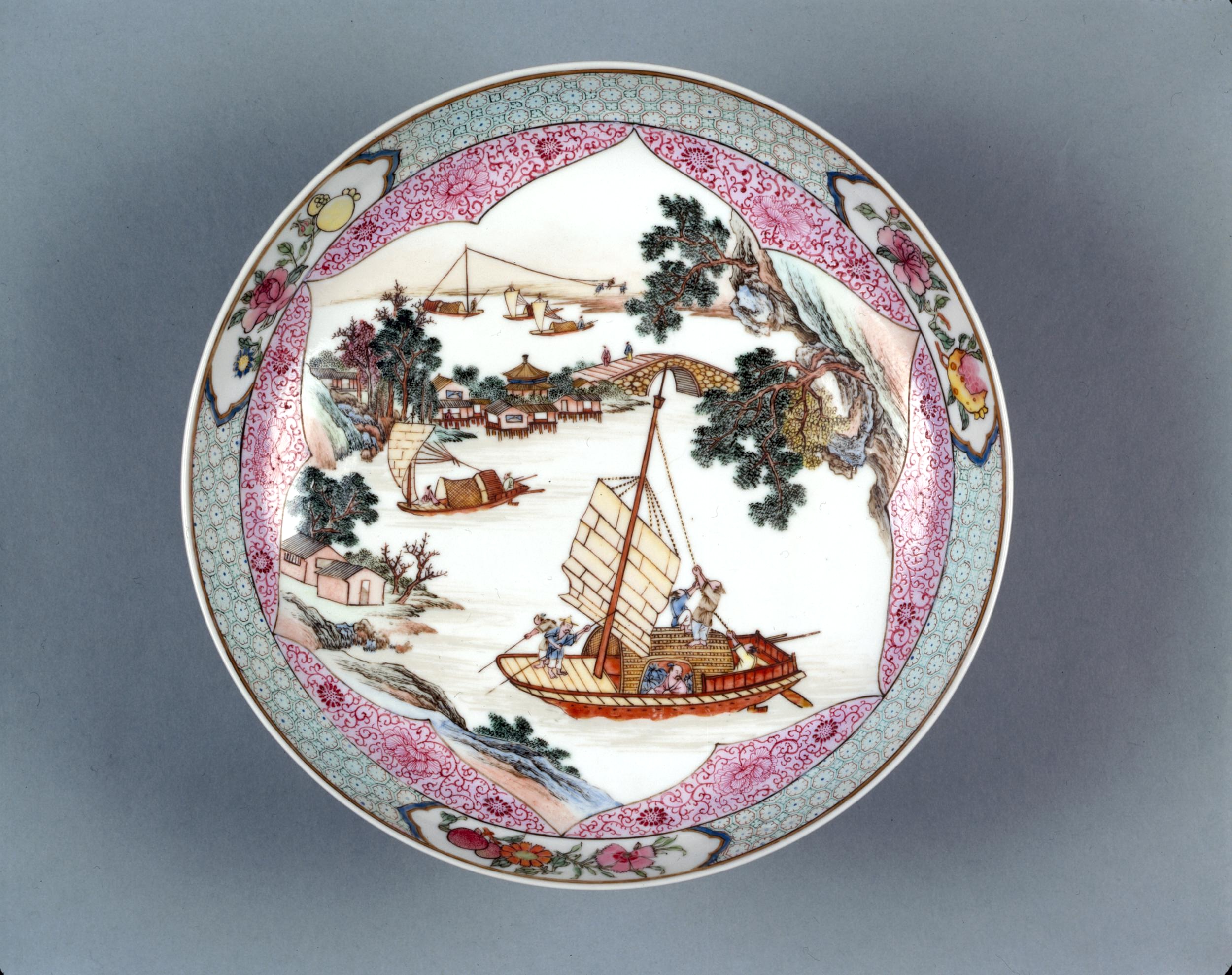
Porcelain with fencai enamels made in Jingdezhen in 1720–1740, during Yongzheng emperor’s reign. This saucer-dish shows the West Lake at Hangzhou. Dimensions: diameter 20 cm, height 3.8 cm. © The Trustees of the British Museum, London, UK.
4.2.3 Expansion during the Qianlong Reign
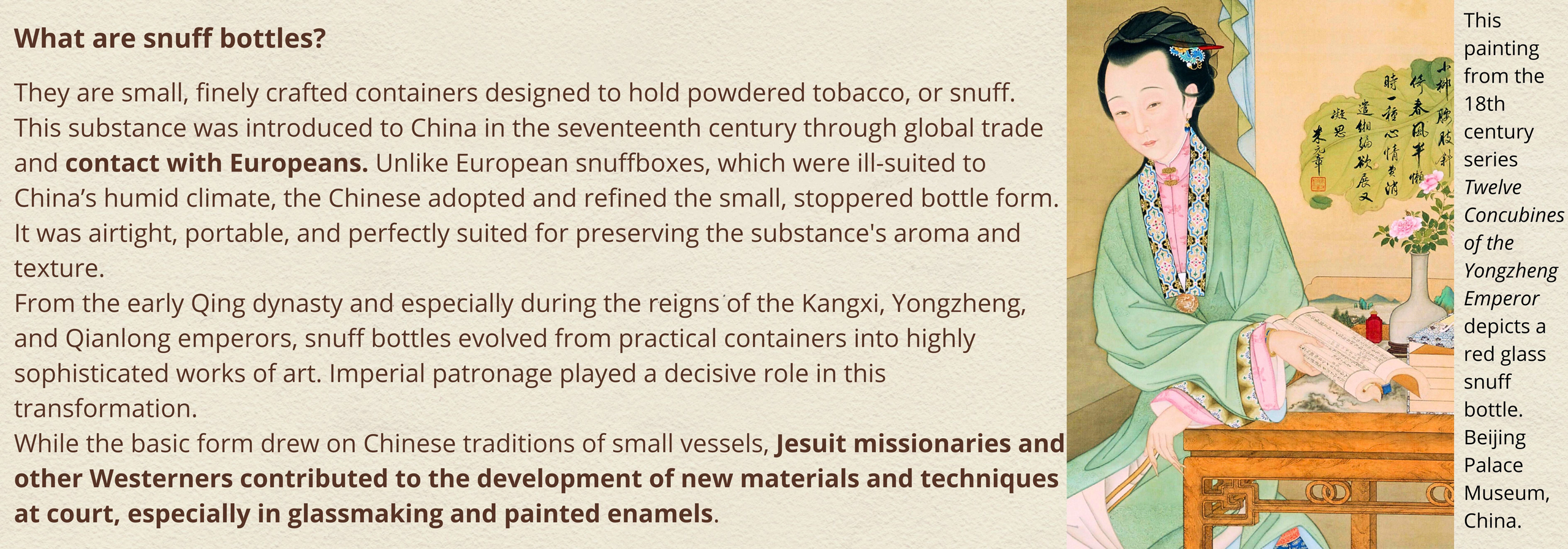
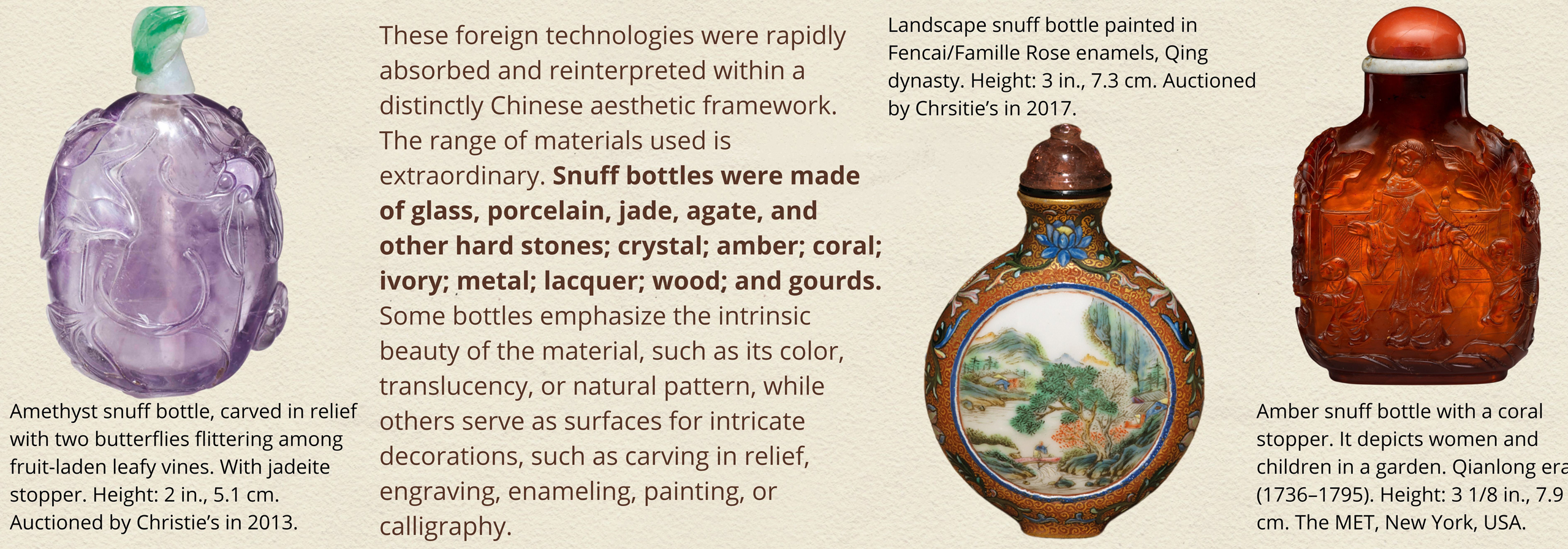
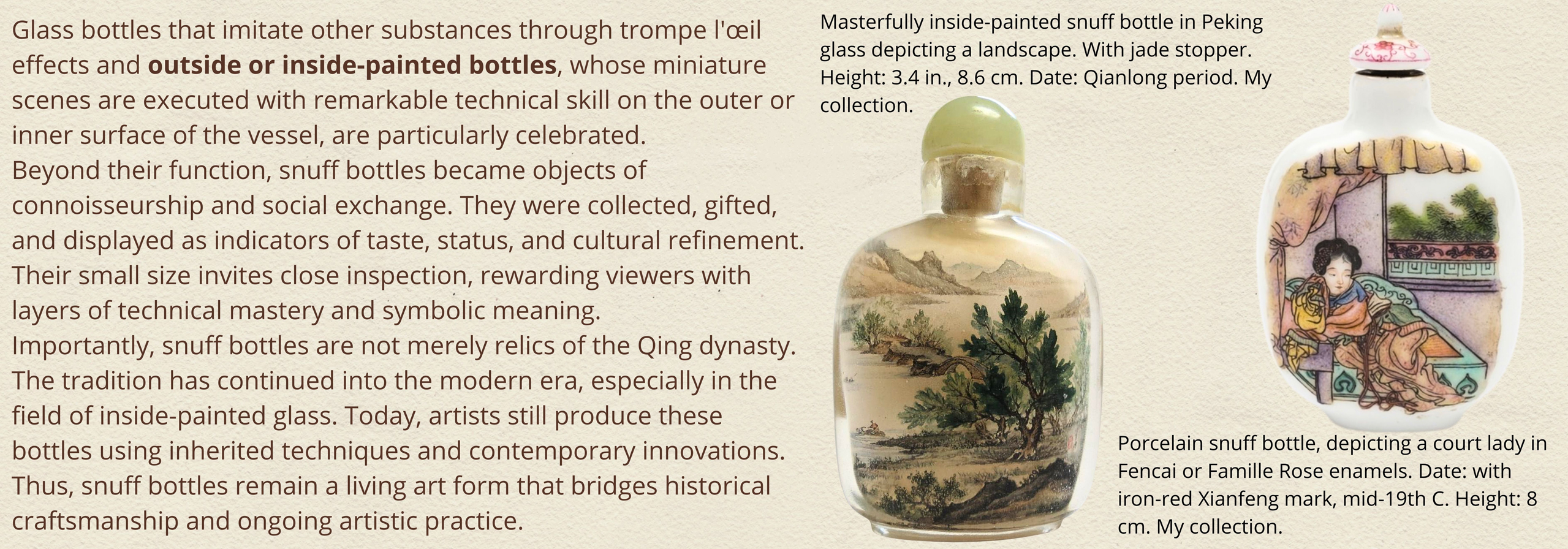
During the Qianlong period (1736–1795), there was a dramatic increase in the production of fencai porcelain. As the technique was widely adopted in Jingdezhen, it was applied to various vessel forms, such as vases, bowls, dishes, decorative plaques, and snuff bottles.
Decorative programs also became more elaborate, incorporating dense arrangements of auspicious symbols, floral motifs, and narrative scenes.
While many Qianlong fencai pieces demonstrate exceptional craftsmanship, some scholars have suggested that the period's emphasis on complexity sometimes overshadowed the subtle elegance observed in earlier Yongzheng pieces.
4.2.4 Later development and widespread adoption
Unlike falangcai and yangcai, which remained closely associated with imperial production, fencai decoration spread widely throughout the Chinese ceramic industry. The relative accessibility of its materials and techniques enabled numerous workshops to adopt the method. By the 19th century, fencai had become one of the most common decorative styles in Chinese porcelain. Its influence continued into later developments in ceramic decoration during the late Qing and Republican periods.
4.3 Stylistic Characteristics and Artistic Achievement
4.3.1 Pastel tonalities and the “powdery” surface effect
The most distinctive visual characteristic of fencai is its pastel colors and "powdery" surface, achieved by systematically using glass white as a diluent and an opacifier. Unlike the glassy, saturated colors of falangcai and yangcai, fencai colors appear to emerge from within the porcelain surface. They have a soft, diffused quality that minimizes surface reflection and emphasizes chromatic subtlety. This "powdery" effect is not merely a technical byproduct, but rather, a deliberately cultivated aesthetic value reflecting Chinese painting traditions that privileged ink wash gradation over saturated color.
While the reduced surface gloss of fencai is technically a consequence of arsenic-opacified glass chemistry, it was positively interpreted by contemporary connoisseurs as being appropriate to scholarly taste and refined sensibility.
The tactile dimension of fencai—the slight surface texture detectable upon close inspection—also distinguishes it from the mirror-smooth finish of falangcai. This texture, resulting from the microcrystalline structure of glass white, was presumably valued as evidence of craftsmanship and authenticity of materials, though there is limited documentary evidence of contemporary tactile evaluation.
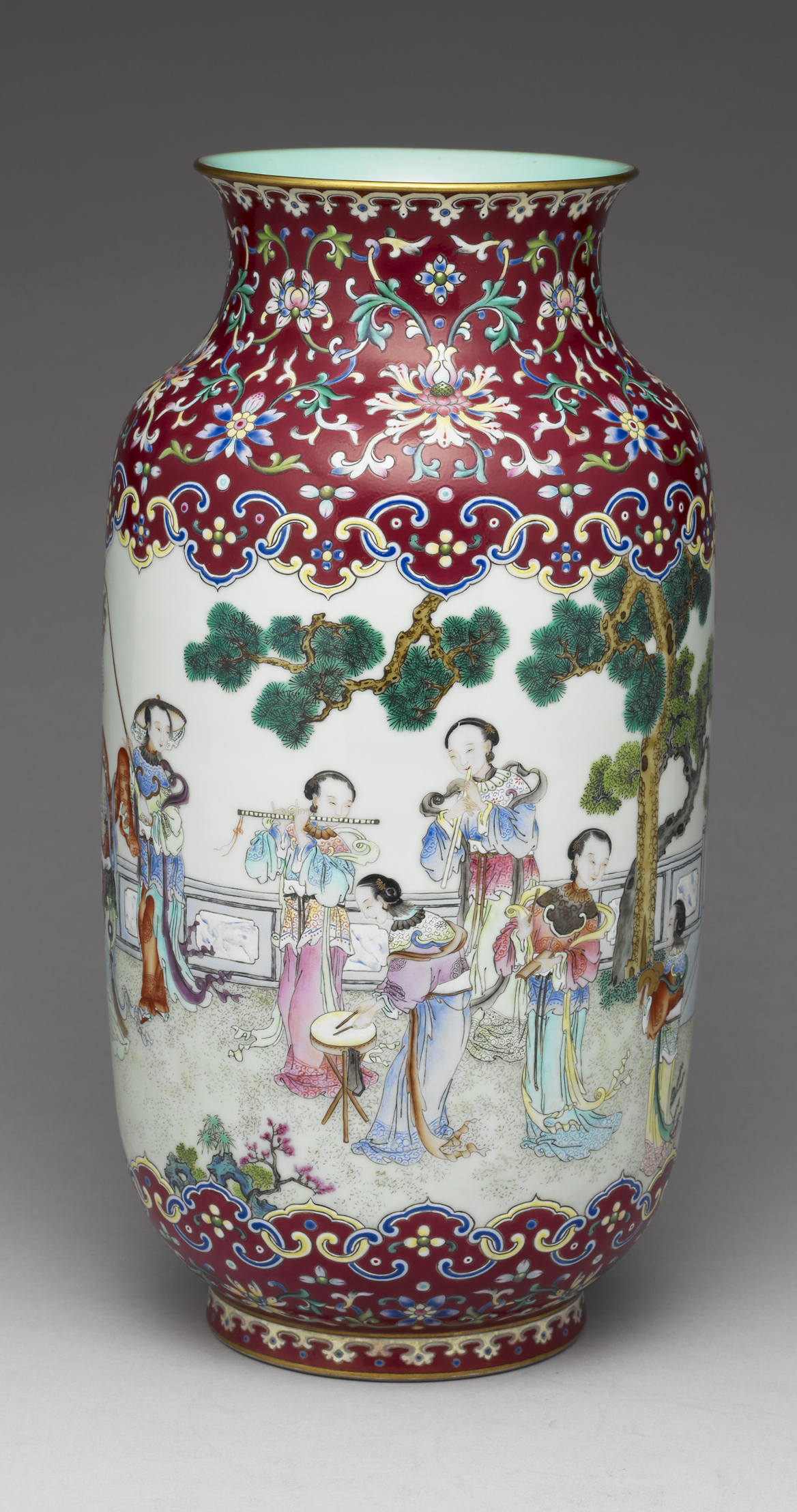
Porcelain vase with ladies dancing and playing music, painted in fencai polychrome enamels. Date: Qianlong reign. National Palace Museum, Taipei, Taiwan.
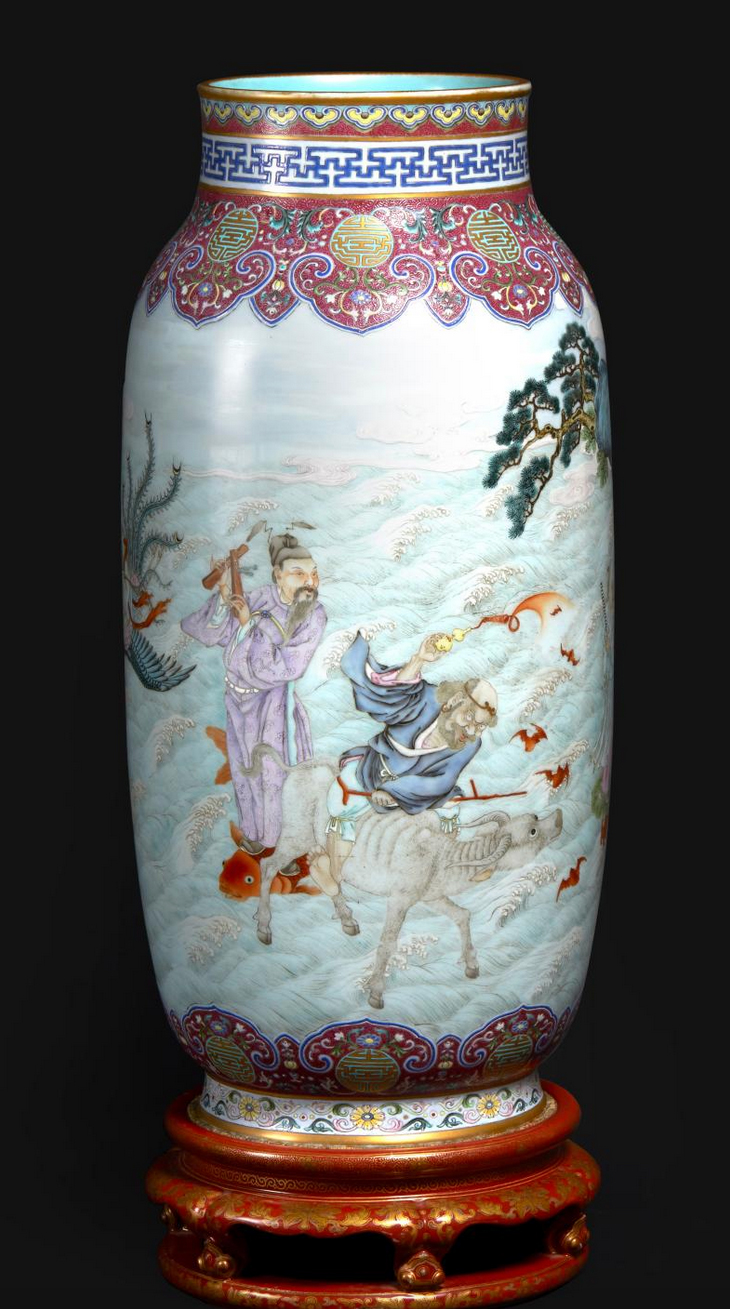
Lantern vase, called deng long zun. Medium: Fencai polychrome and gold enamelled porcelain. Date: With Qianlong’s six-character mark in iron-red in zhuanshu under the base. Dimensions: height 47.7 cm. Auctioned in 2020 by Art Rémy Le Fur & Associés, Hôtel Drouot, Paris, France.
4.3.2 Integration with Traditional Chinese Painting Conventions
Fencai reached its peak artistic expression by systematically incorporating traditional Chinese painting conventions, especially the bird-and-flower and landscape styles from the Song, Yuan, Ming, and Qing periods. The technique's compatibility with ink wash aesthetics facilitated this integration. The rendering method produced effects of tonal gradation and atmospheric depth that paralleled rather than contradicted established painting practices.
The employment of court painters and academically trained artists in fencai design, particularly for imperial commissions, ensured that pictorial conventions were accurately transmitted and adapted appropriately. The small scale of many fencai objects, comparable to album leaves or fan paintings, encouraged concentrated appreciation and direct comparison with paintings on silk or paper.
This painting-centered aesthetic development increasingly distinguished fencai from yangcai, which maintained stronger Western references. By the mid-Qianlong period, high-quality fencai had effectively abandoned explicit exoticism in favor of purely Chinese decorative programs. Meanwhile, yangcai continued to incorporate European subjects and techniques as positive aesthetic values.
4.3.3 The Mògǔ (没骨, boneless) Technique and Floral Naturalism
The mògǔ (没骨, boneless) technique, in which forms are defined by color areas rather than outlines, achieved particular prominence in fencai floral decoration. Derived from the Chinese painting tradition, this technique is particularly associated with Yun Shouping (恽寿平,1633–1690) and the Changzhou school. It was technically enabled by fencai’s rendering capabilities and aesthetically harmonized with its pastel tonalities.
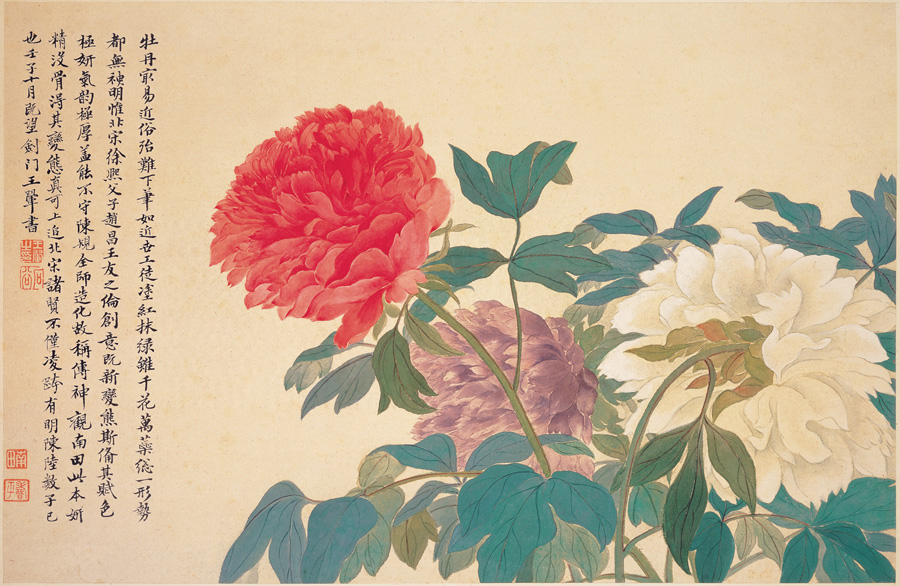
Yun Shouping, Peonies (牡丹). Medium: Album leaf, ink and colors on paper. Dimensions: 28.5 x 43.1 cm. National Palace Museum, Taipei, Taiwan.
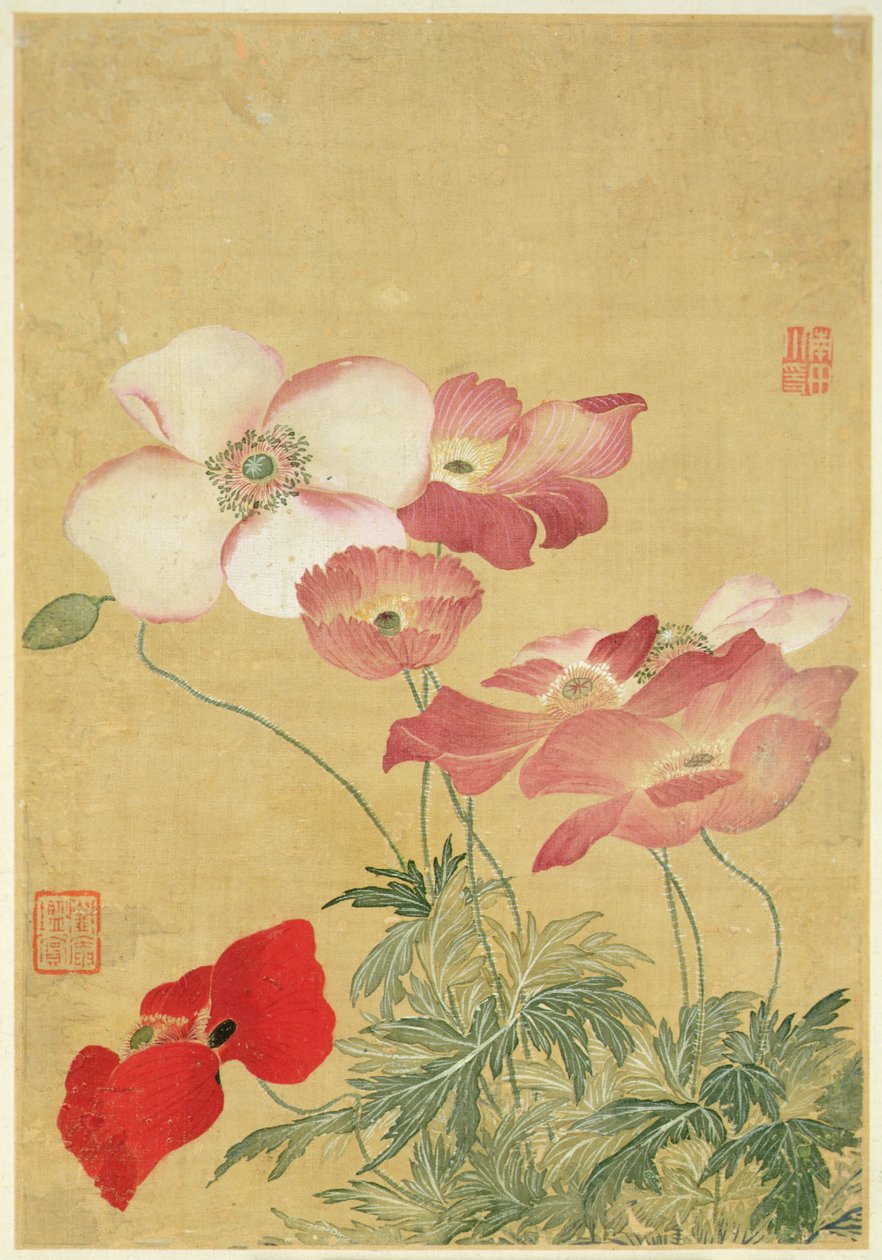
Yun Shouping, Poppies. Medium: Album leaf, ink and colors on paper.
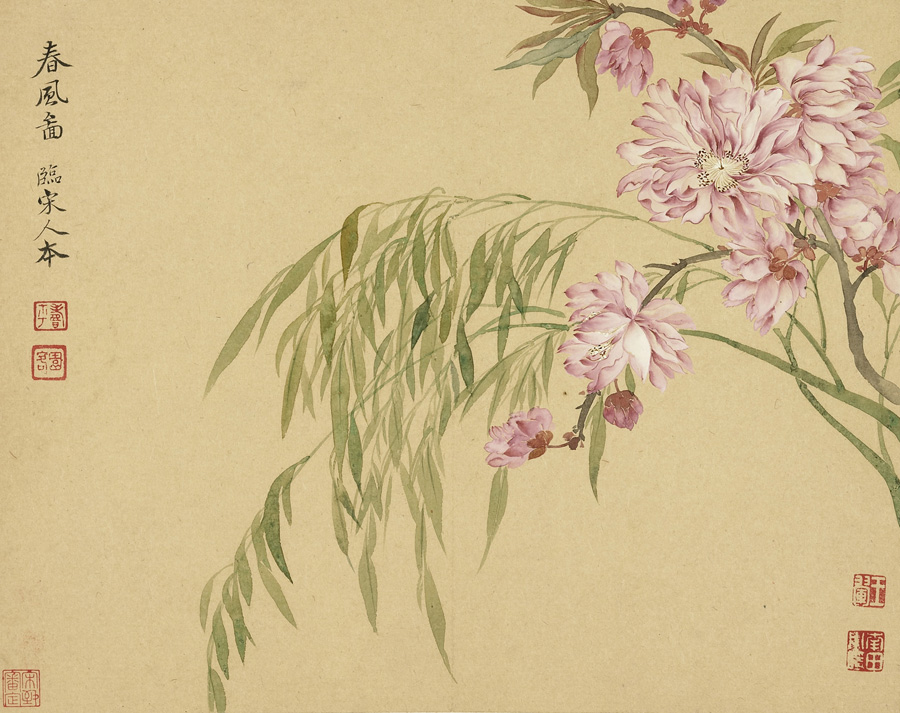
Yun Shouping: A Spring Breeze (春風圖), Album leaf, ink and colors on paper, 26.3 x 33.4 cm, National Palace Museum, Taipei, Taiwan.
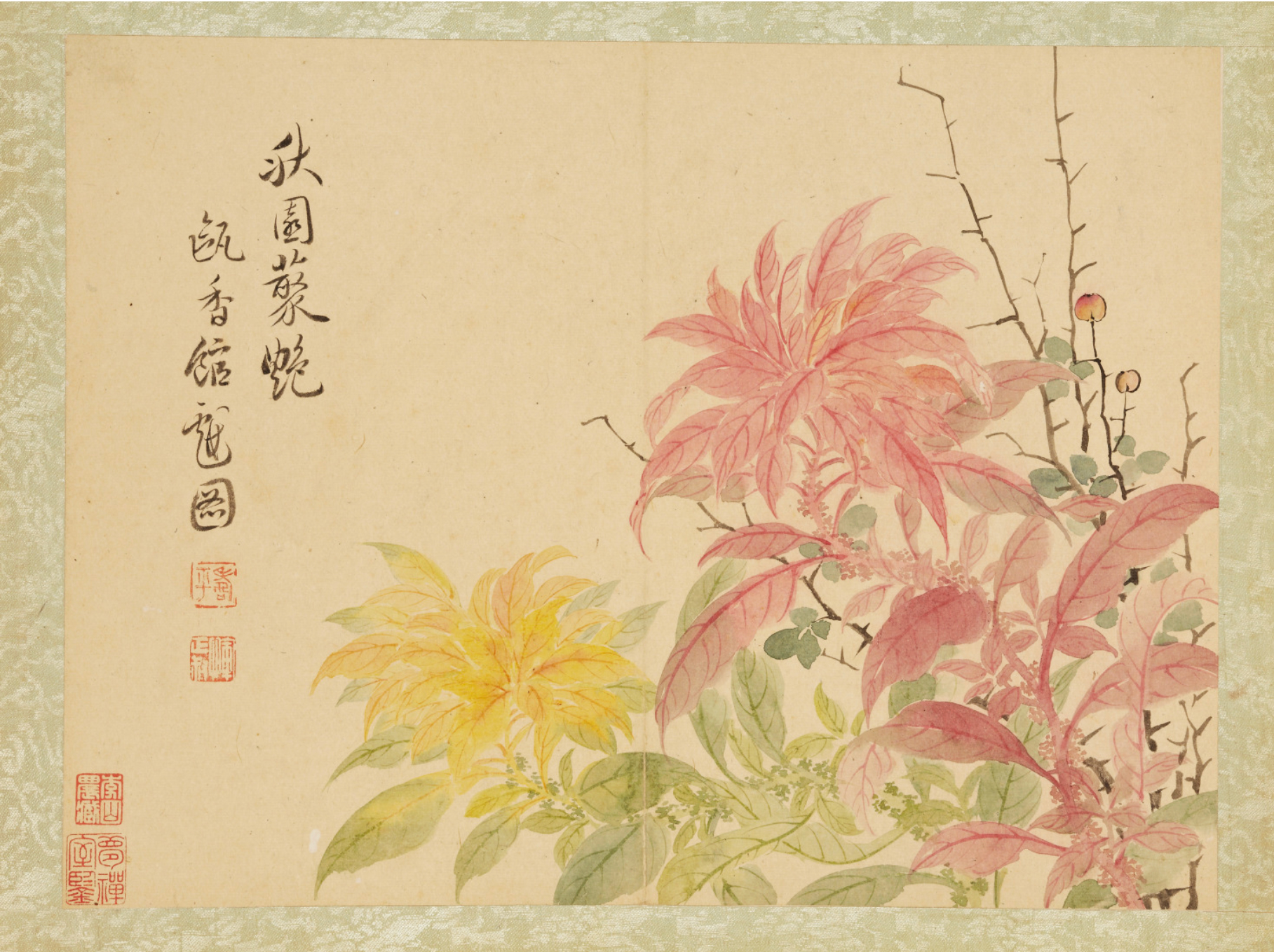
Yun Shouping, Bamboo, Fruits and Vegetables. Medium: Ink and color on paper. Phoenix Art Museum, AZ, USA.
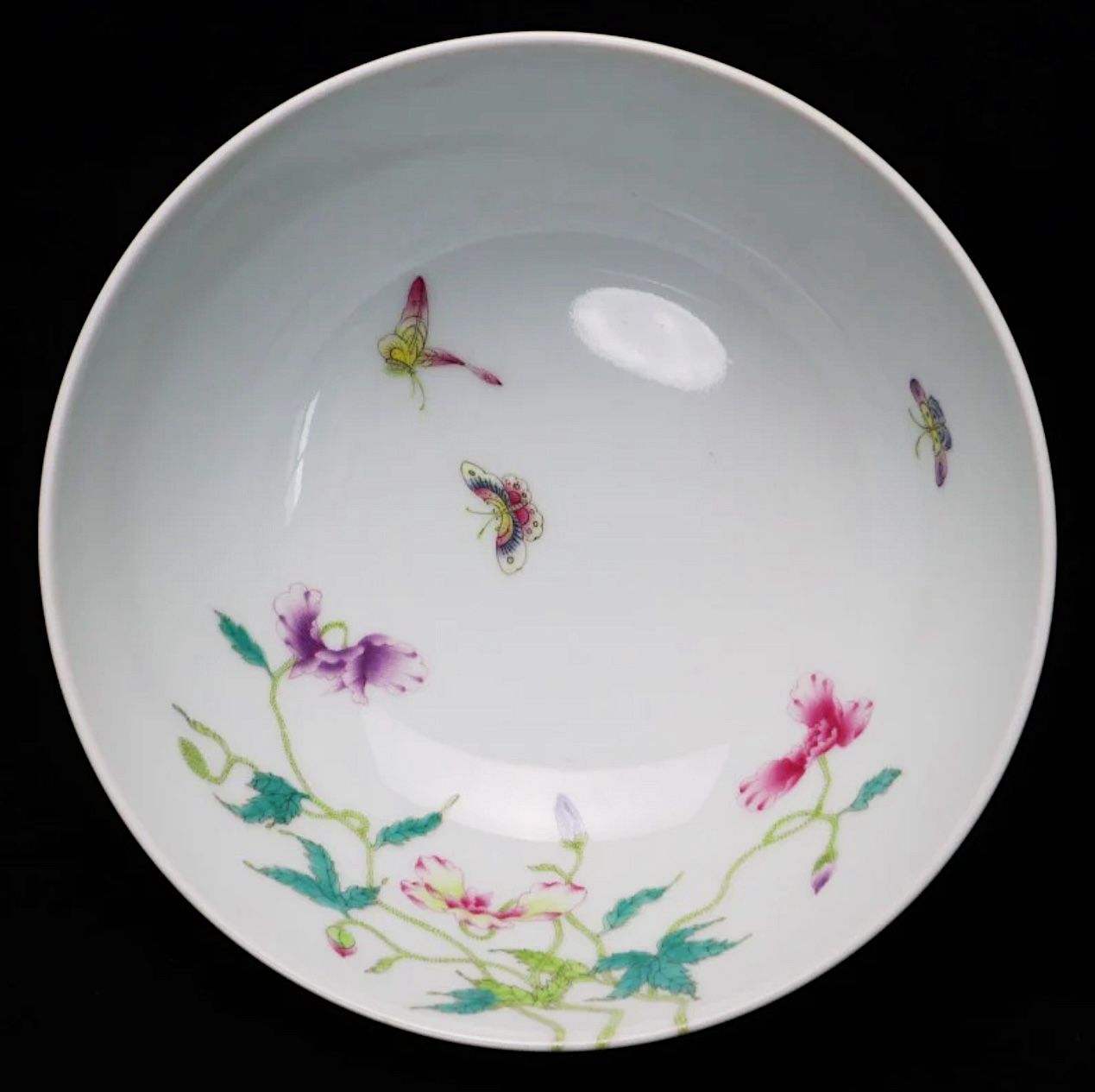
Fencai/Famille rose bowl, painted with the boneless method; the petals are delicately shaded in gradations of rouge pink and soft yellow, creating a lifelike, translucent effect, while the stamens are highlighted with fine touches of gold powder, radiating brilliance. Date: Yongzheng reign. Matungart, Hong Kong.
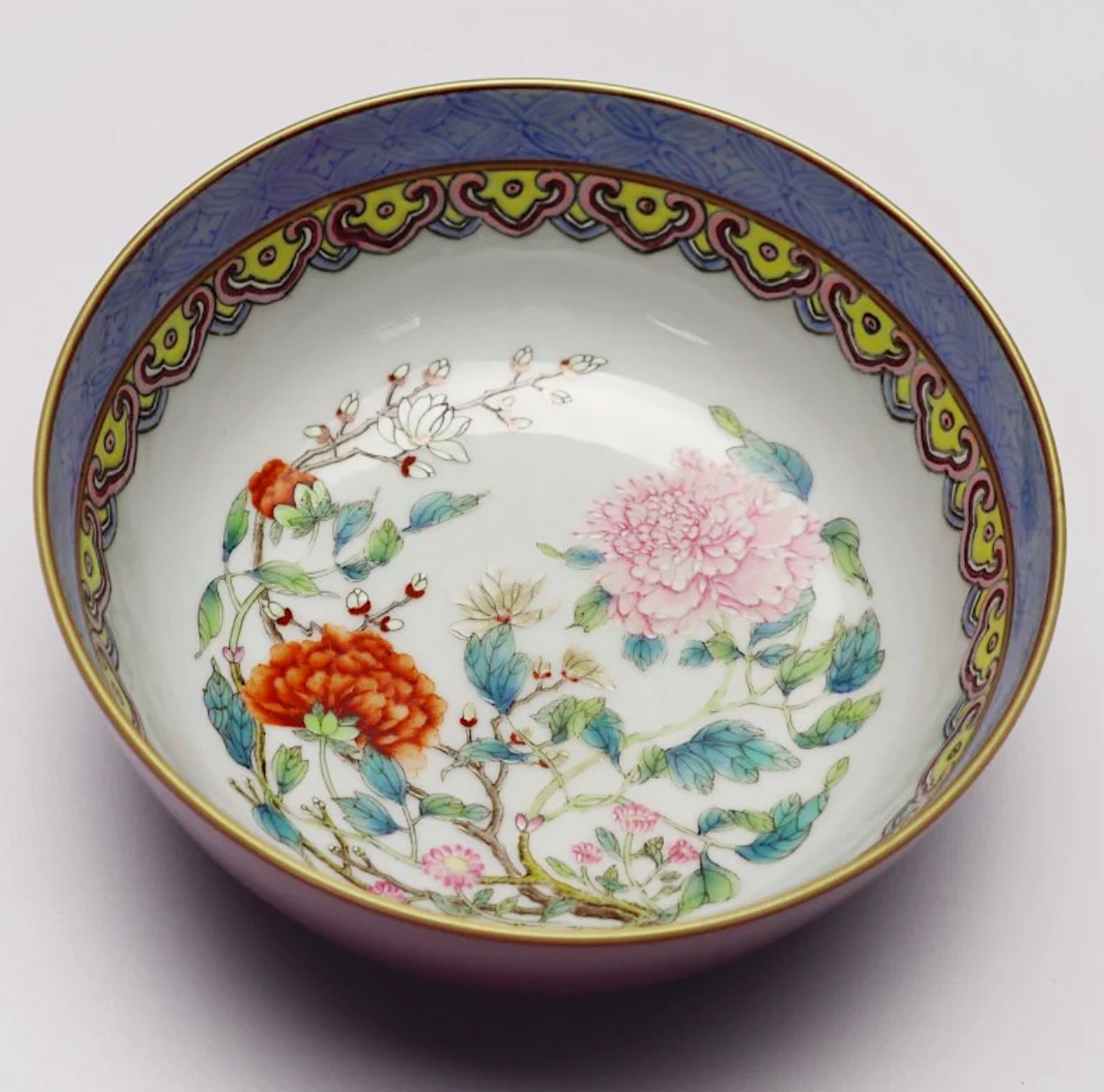
Fencai/Famille rose Bowl. The painting technique draws from the refined traditions of the court academy, combining both “boneless” and outline-and-fill methods. Date: Yongzheng reign. Matungart, Hong Kong.
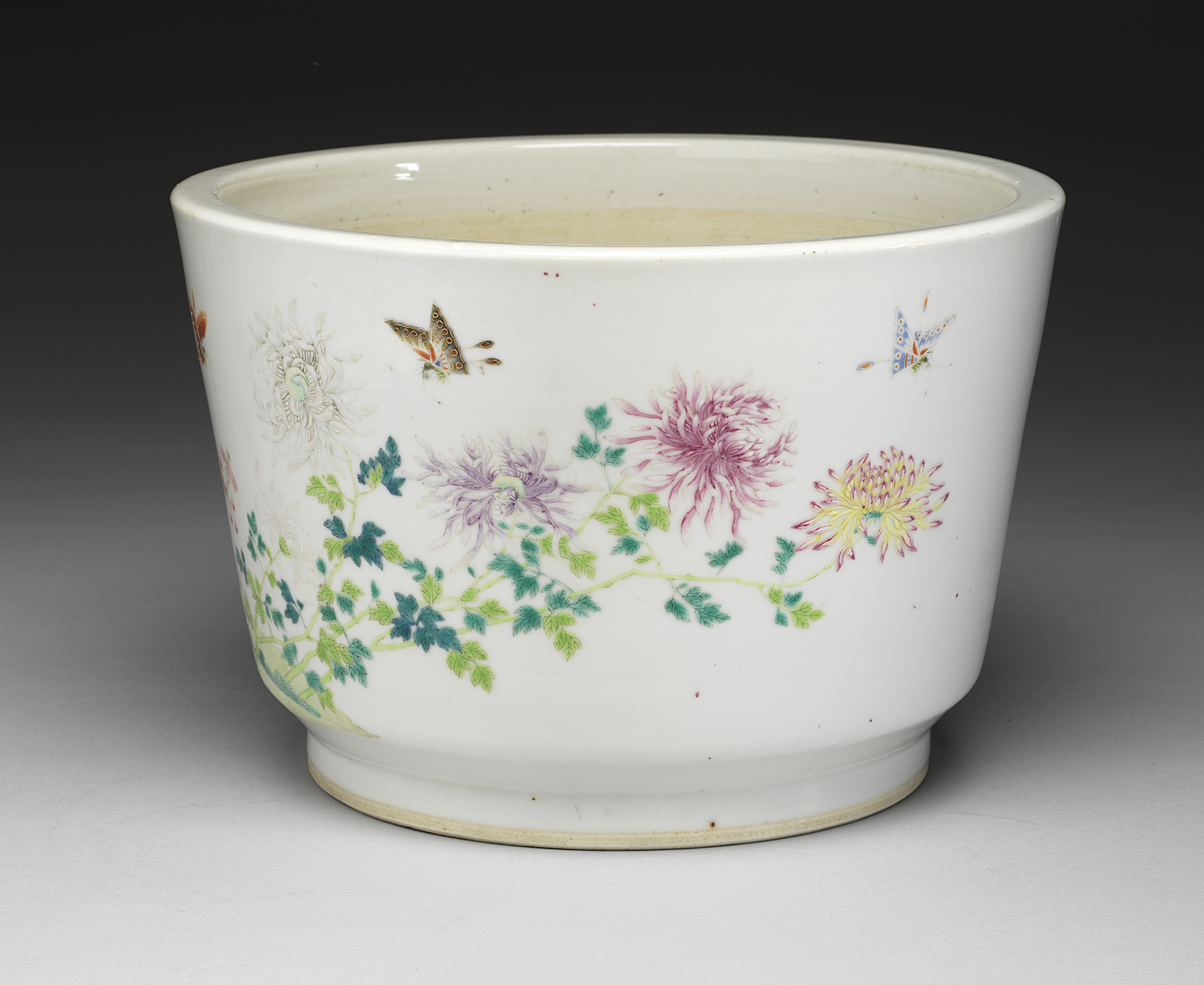
Porcelain planter with flower and butterfly decoration in fencai painted enamels. Date: Qing Dynasty, 19th century. Dimensions: height 16.6 cm, mouth diameter 25.5 cm. National Palace Museum, Taipei, Taiwan.
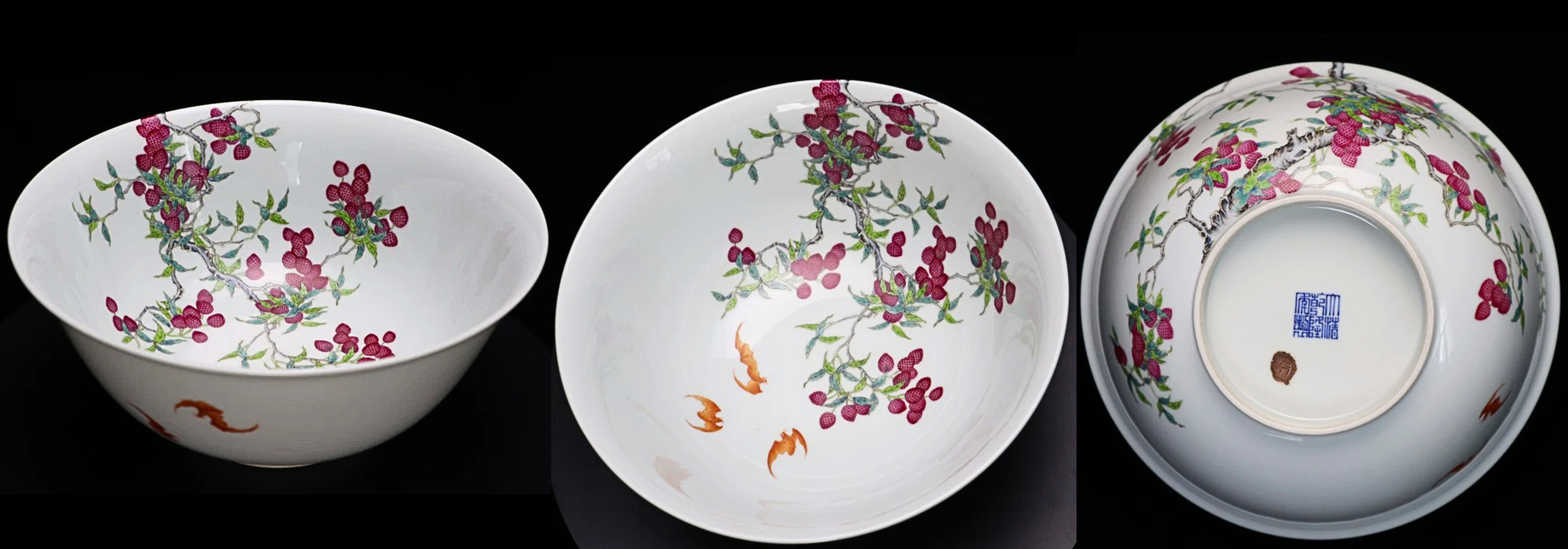
Fencai/Famille rose porcelain plate featuring a lychee motif symbolizing "abundant fortune and prosperity". Date: Qianlong period. Dimensions: height 11 cm, rim diameter 24 cm. Matungart, Hong Kong.
Fencai floral naturalism, which involves accurately depicting botanical species with attention to seasonal variation, growth habits, and symbolic associations, represents a significant achievement in ceramic decoration. The Yongzheng "peach" vessels, with their precise rendering of fruit, blossoms, and foliage, exemplify this style at its finest. The Qianlong period expanded the floral repertoire to include hundreds of distinct species, many of which had documented symbolic and medicinal associations. This demonstrates the cultural depth of Fencai botanical imagery.
The technical demands of boneless floral painting in fencai were substantial. Craftsmen had to mix precise colors to achieve naturalistic hues, use controlled brushwork to suggest dimensional form without outline, and fire pieces carefully to preserve subtle tonal gradations. The survival of numerous masterpieces from the imperial productions of the Yongzheng and Qianlong periods testifies to the achievements of Jingdezhen craftsmen in meeting these demands.
4.3.4 Decorative Versatility: From Imperial to Folk Production
Fencai's broadest stylistic achievement was its decorative versatility, which enabled its effective application across the full range of Qing ceramic production, from imperial masterpieces to inexpensive folk wares. This versatility resulted from the technique's material accessibility. Glass white could be manufactured with locally available materials, and the basic rendering method could be adapted to varying skill levels and time constraints.
Imperial fencai maintained rigorous technical perfection standards, including multiple firings, careful color control, and detailed pictorial execution. Commercial fencai employed abbreviated procedures, including fewer firings, simpler color schemes, and more formulaic decorative programs. Export fencai developed distinctive styles adapted to European and American market preferences, including armorial decorations, European landscapes, and modified color palettes.
While this stylistic range is potentially confusing for modern classification, it was presumably transparent to contemporary consumers, who could reliably distinguish quality levels by price, vendor, and visual inspection. The persistence of "fencai" as a unified category across this quality spectrum reflects the technique's fundamental technical identity rather than aesthetic equivalence between imperial and folk production.
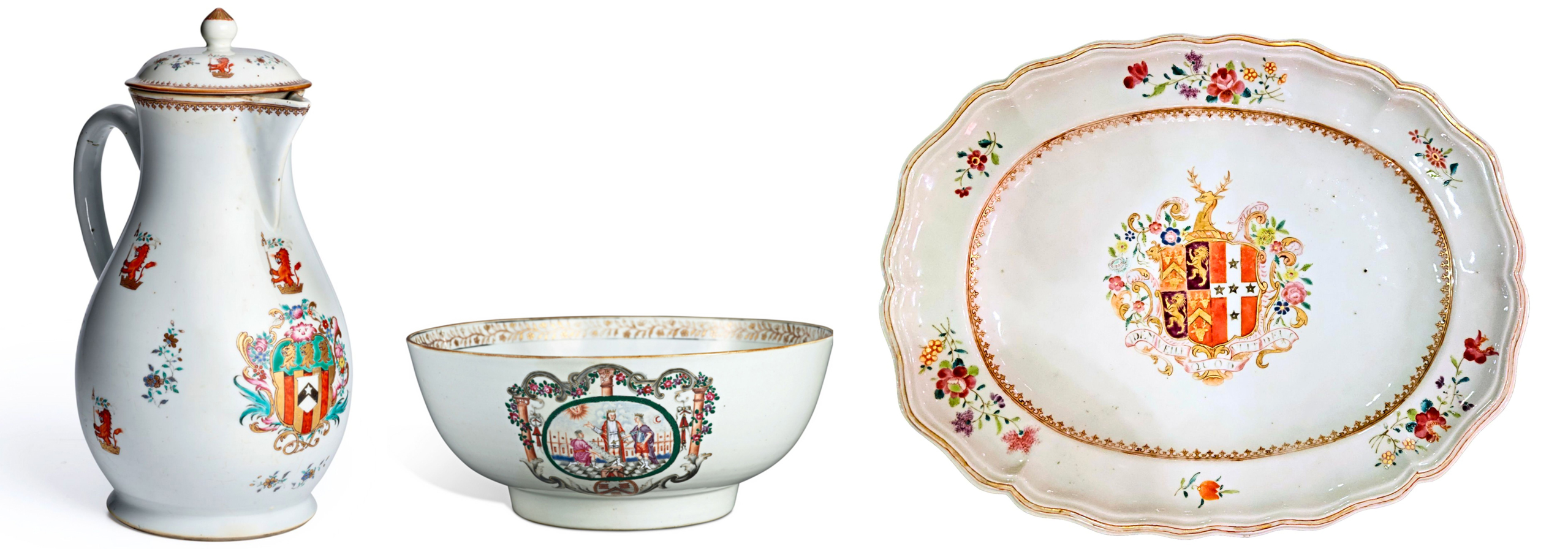
LEFT: A rare Chinese export fencai porcelain armorial ewer with cover made for the British market in the Qianlong period, ca. 1765. Height: 15 in., 38 cm. Auctioned in 2026 by Bonhams New York, USA.
CENTER: A Rare Chinese Export Fencai/Famille-Rose 'Masonic' Armorial Punch Bowl, made in the Qianlong Period, ca. 1780. Diameter 11 3/8 in., 28.9 cm. Auctioned in 2025 by Sotheby's New York, USA.
RIGHT: A fine Chinese export fencai porcelain armorial dish, made for the British market under the Qianlong's reign, ca. 1755. Dimensions: width 16 in., 40.64 cm. 1st DIBS.
4.4 Cultural Significance
4.4.1 The Democratization of Enamel Decoration Beyond Court Circles
Fencai's most significant cultural achievement was the democratization of enamel decoration. It extended techniques and aesthetic effects, which were previously restricted to imperial circles, to broader social strata. This democratization was not only quantitative—more objects distributed more widely—but also qualitative. Fencai produced ceramic decorations that were meaningfully continuous with elite traditions yet accessible to non-elite consumers.
This democratization occurred through technology transfer from imperial to commercial kilns via craftsman mobility and competitive imitation, reduced material costs through the substitution of domestic materials for imported ones, and the adaptation of decorative programs through the simplification of complex pictorial subjects and the development of formulaic motifs. While these mechanisms are sometimes characterized as "debasement" in traditional connoisseurship, they enabled genuine aesthetic participation by social groups excluded from imperial patronage.
The social range of Fencai consumption—from imperial collections to official gifts, commercial purchases, and export trades—makes it a valuable index of Qing material culture. Archaeological evidence from domestic sites, shipwreck cargoes, and foreign collections documents this range with increasing precision, enabling the reconstruction of Fencai's global circulation.
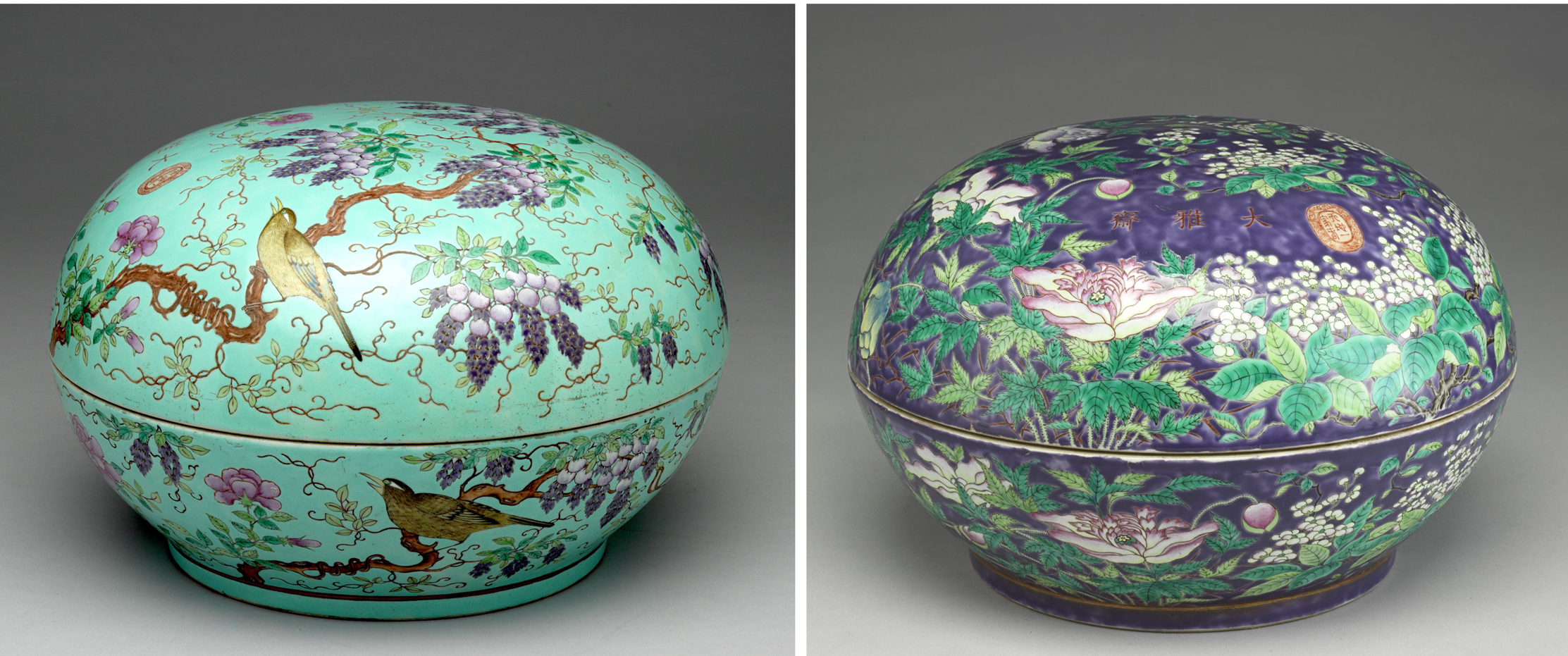
LEFT: Box decorated with birds and flowers on a lake-green ground. Painted with fencai polychrome enamels. Date: Guangxu reign, 1874-1908. National Palace Museum, Taipei, Taiwan.
RIGHT: Box with flower and bird decoration on a purple ground. Porcelain painted in fencai enamels. Date: 1862-1874. Height: 19.5 cm. National Palace Museum, Taipei, Taiwan.
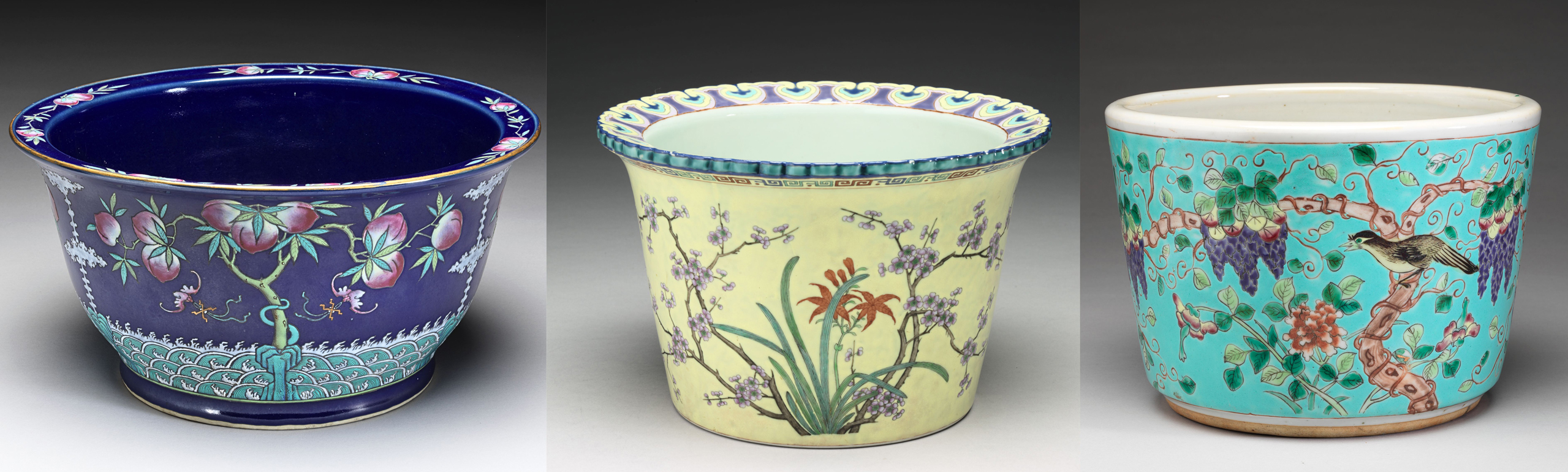
LEFT: Planter with decoration of fortune and longevity on a blue ground. Porcelain painted in fencai enamels. Qing dynasty. Height: 16.7 cm. National Palace Museum, Taipei, Taiwan.
CENTER: Planter with daylily pattern. Porcelain painted in fencai enamels with "Tihedian zhi" mark. Date: 1875-1908. Height: 16.2 cm. National Palace Museum, Taipei, Taiwan.
RIGHT: Planter with wisterias and bird decoration on a blue ground. Porcelain painted in fencai enamels. Qing dynasty. Height: 18.2 cm. National Palace Museum, Taipei, Taiwan.
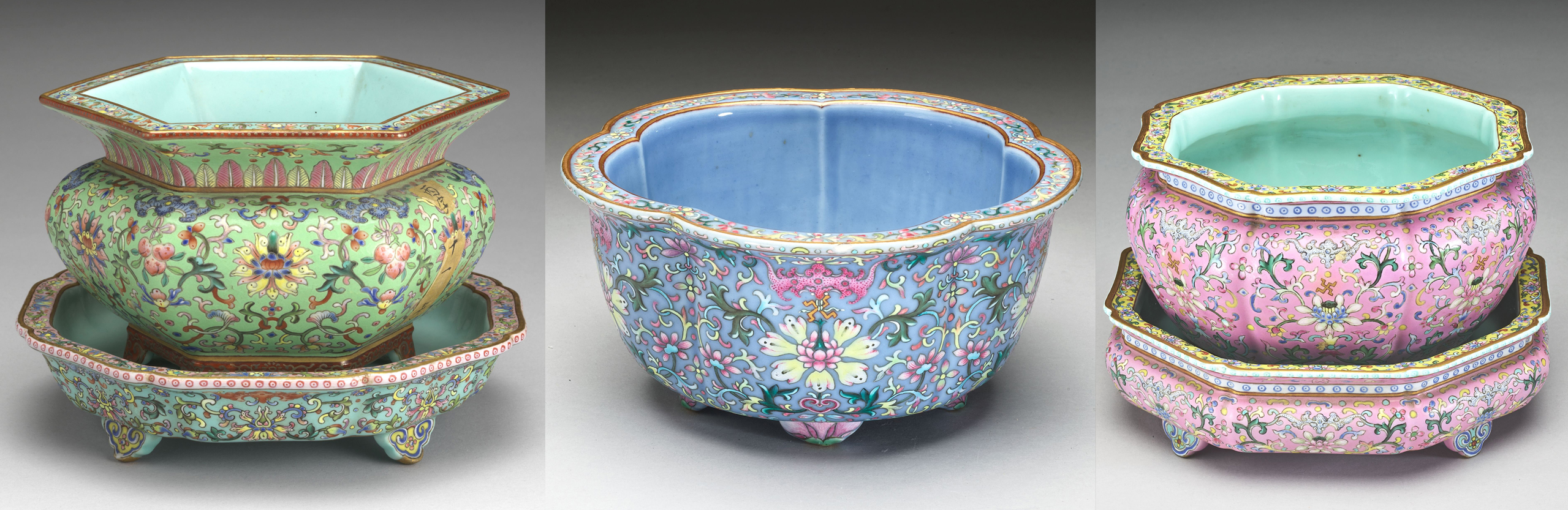
LEFT: Hexagonal planter with floral decoration on a green ground. Porcelain painted in fencai enamels. Qing dynasty. Height: 10 cm. National Palace Museum, Taipei, Taiwan.
CENTER: Plum-blossom-shaped planter with floral decoration. Porcelain painted in fencai enamels. First half of the 19th century. Height: 8.2 cm. National Palace Museum, Taipei, Taiwan.
RIGHT: Planter and pot stand with floral decoration on a pink ground. Porcelain painted in fencai enamels. Height: 9.5 cm. Qing dynasty. National Palace Museum, Taipei, Taiwan.
4.4.2 Fencai as a Synthesis of Native and Foreign Technical Knowledge
Fencai is a unique form of technical synthesis that combines foreign enamel technology with Chinese ceramic and painting traditions in a way that differs significantly from Falangcai and Yangcai. While the latter techniques maintained an explicit Western reference as a positive value, Fencai progressively naturalized its foreign technical components within Chinese aesthetic frameworks.
This synthesis is particularly evident in the rendering technique. The basic method of color gradation through diluted application has European antecedents in oil painting and enamelwork. However, the Fencai adaptation employs brushwork conventions, compositional principles, and aesthetic criteria derived from Chinese ink painting. The resulting technique is not merely "Chinese painting in enamel" but a genuinely hybrid form that transformed both its constituent traditions.
While the arsenic-based glass white system is technically distinct from European boron-opacified enamels, it may have been developed using knowledge of European opacification methods, suggesting that the "indigenous" character of fencai should not be overstated.
4.4.3 Lasting influence on subsequent ceramic traditions
Fencai had a profound and enduring influence on subsequent Chinese ceramic production, extending well beyond the Qing period into the Republican era and continuing to the present day. The basic technical system—lead-alkali glass, arsenic opacification, and the rendering method—remained the standard for Chinese overglaze enamels through the early 20th century. Modifications were primarily in the area of pigment chemistry, with less toxic materials being substituted for arsenic rather than a fundamental reformulation taking place.
The qiǎn jiàng cǎi (浅绛彩, light crimson colors) movement of the late 19th century, associated with artists such as Cheng Men (程门) and Wang Shaowei (王少维), explicitly revived fencai’s painting-centered aesthetic. These artists applied literati painting conventions to ceramic decoration with renewed scholarly self-consciousness. Similarly, the Zhushan Eight Friends (珠山八友) of the Republican period similarly drew on fencai technical and aesthetic precedents in their attempt to elevate ceramic painting to the status of fine art.
Though arsenic substitution and environmental regulation have modified actual production, contemporary Jingdezhen practice maintains fencai technical knowledge through formal apprenticeship and institutional training. The persistence of the technique as a living tradition, alongside archaeological and scientific research on historical fencai, ensures its continued relevance in understanding Qing ceramic achievements.
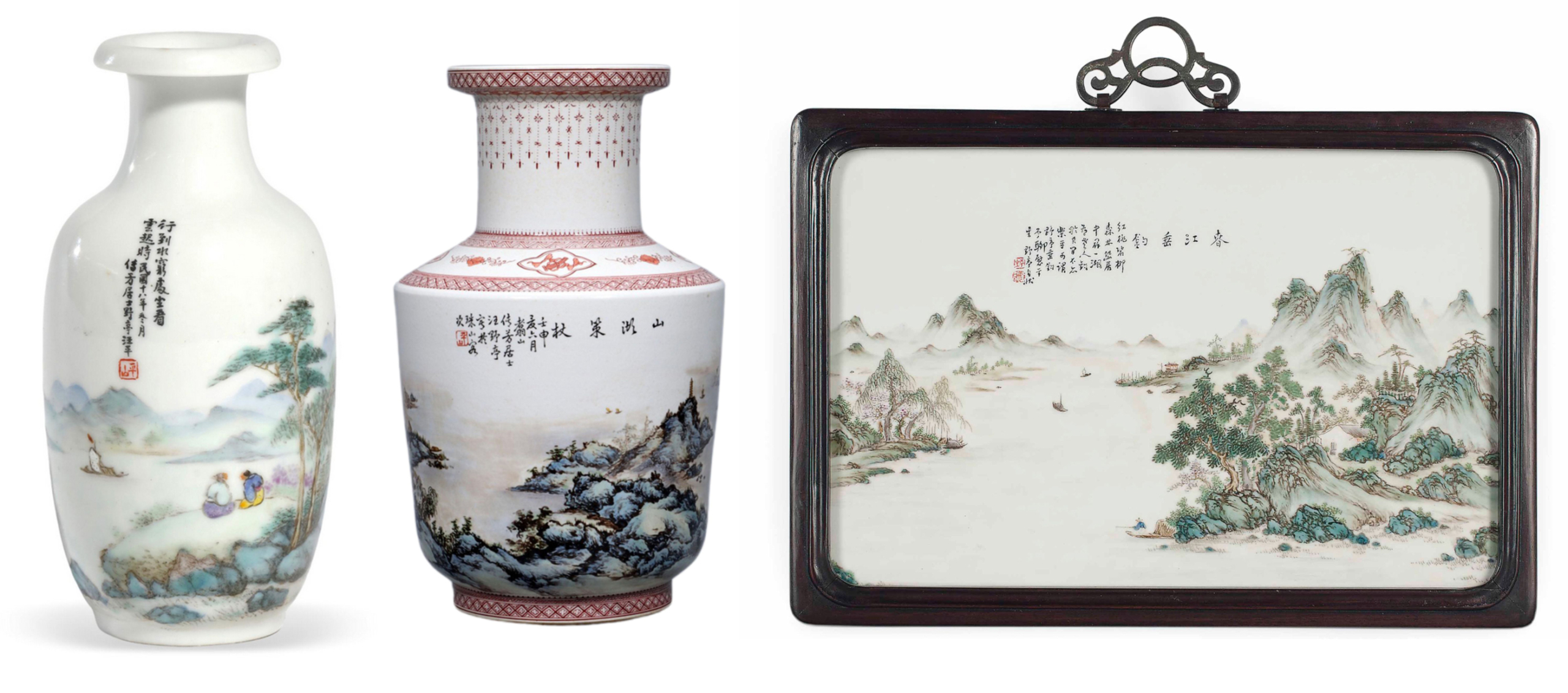
Wang Yeting (1884–1942) was one of the "Eight Friends of Zhushan." He studied at the Jiangxi Ceramics School in Poyang in 1906 and found success with his landscape paintings.
LEFT: A landscape vase by Wang Yeting. Dimensions: height 13 cm. Auctioned in 2025 by Tokyo Kirin Auction, Tokyo, Japan.
CENTER: Fencai/Famille Rose mallet vase by Wang Yeting. Dimensions: height 38.5 cm, belly diameter 24 cm. Auctioned in 2025 by Mega International Auction, San Gabriel, CA, USA.
RIGHT: A Fencai/Famille Pose panel, chun jiang chui diao, by Wang Yeting. Dimensions: 9¾ in. x 14¾ in., 24.5 cm. x 37.6 cm; with original wood frame. Auctioned in 2012 by Christie's London, UK.
INTERCULTURAL SEEING: BEYOND THE SURFACE OF PORCELAIN
The time has come to pause and gather the threads of what has been unfolding. We must ask ourselves what all of this truly amounts to. What began as an inquiry into European and Chinese classification systems and Chinese ceramic traditions has revealed something far more expansive. We are no longer only speaking about porcelain. We are talking about ways of seeing, habits of thought, and the conditions under which cultures encounter one another.
Therefore, this reflection is not solely addressed to specialists, collectors, or historians of Chinese ceramics.
I have spoken at length about Chinese porcelain. You have surely noticed the persistence, and perhaps even the affection, with which I return to the subject. However, such insistence would be unjustified if this material did not carry something more than just aesthetic refinement or technical brilliance within it. It would not merit such attention if it did not quietly yet insistently open onto something more human, more complex, and more revealing about the nature of cultural experience itself.
Of the many histories that converge in this material, one stands out: the encounter between Jesuit missionaries and the intellectual and artistic world of the Qing imperial court. This episode is often narrated in terms of influence or transmission but deserves to be understood differently. It is not merely a story of East meeting West or knowledge being transferred from one civilization to another. Rather, it is a rare and instructive example of what a genuine intercultural encounter can be—and, just as importantly, what it is not.
It was not a seamless fusion. It was not peaceful harmony, free of tension or misunderstanding. Like all human enterprises, it was marked by asymmetries, limitations, and moments of misrecognition. And yet, despite—or perhaps because of—these imperfections, the encounter proved extraordinarily fertile. It generated new forms, techniques, and visual languages in both the East and West. It expanded the horizon of what was possible without dissolving the identities of the involved traditions.
This is why the history of Jesuit activity in China, especially in the arts and sciences, should be viewed not as a story of influence, but as a model of intercultural interaction. It shows us that cultures do not simply absorb one another nor remain untouched and sealed off. They meet, resist, translate, transform, and metabolize. In doing so, they produce forms that fully belong to neither side yet are intelligible only in relation to both.
This perspective compels us to reconsider the tools we use to approach objects like Qing porcelain. It requires us to move beyond classifications that present themselves as neutral, self-evident, or purely descriptive. After all, the name we give something shapes what we are able—or unable—to see.
The term famille rose is a revealing example. At first, it seems like a harmless, convenient label identifying a palette of soft pink enamels characteristic of certain Qing porcelains. It seems to describe what is immediately visible and satisfies the desire for clarity and order. However, this clarity comes at a cost. By reducing the object to a visual category, the term erases the historical processes that made that palette possible.
The experimental workshops of the imperial court, the circulation of techniques, the presence of Jesuit intermediaries, and the gradual transformation of materials through intercultural exchange—what makes it significant—disappear behind the name. The label presents the result as if it were self-originating. It naturalizes what is, in fact, the product of an encounter. The 'famille rose' label obscures the very intercultural process that produced it.
In contrast, approaching the same object through a Chinese classification framework that considers dynasty, reign, kiln, technique, chemical composition, and material process reveals a different understanding. The object is no longer reduced to how it looks. Rather, it becomes a point of convergence of places, practices, temporalities, and relationships. Its appearance is no longer an endpoint but an entry point into a network of meanings and influences.
This difference is subtle yet significant. One system tends to stabilize and simplify, while the other tends to unfold and connect. One system prioritizes immediacy, while the other invites reconstruction. It is within this second movement that the intercultural dimension of Qing ceramics becomes visible, not as an external addition but as something inherent to the objects themselves.
Adopting such a perspective does more than refine our knowledge of porcelain. Rather, it is to accept a broader intellectual responsibility, recognizing that every act of classification carries an implicit philosophy and that every object we study exceeds the categories we impose on it.
Ultimately, Chinese porcelain offers more than just beauty or historical interest. It offers a lesson in attention. It teaches us that what we see depends on how we have learned to look and that sometimes we must unlearn our initial way of seeing to perceive what has been there all along.
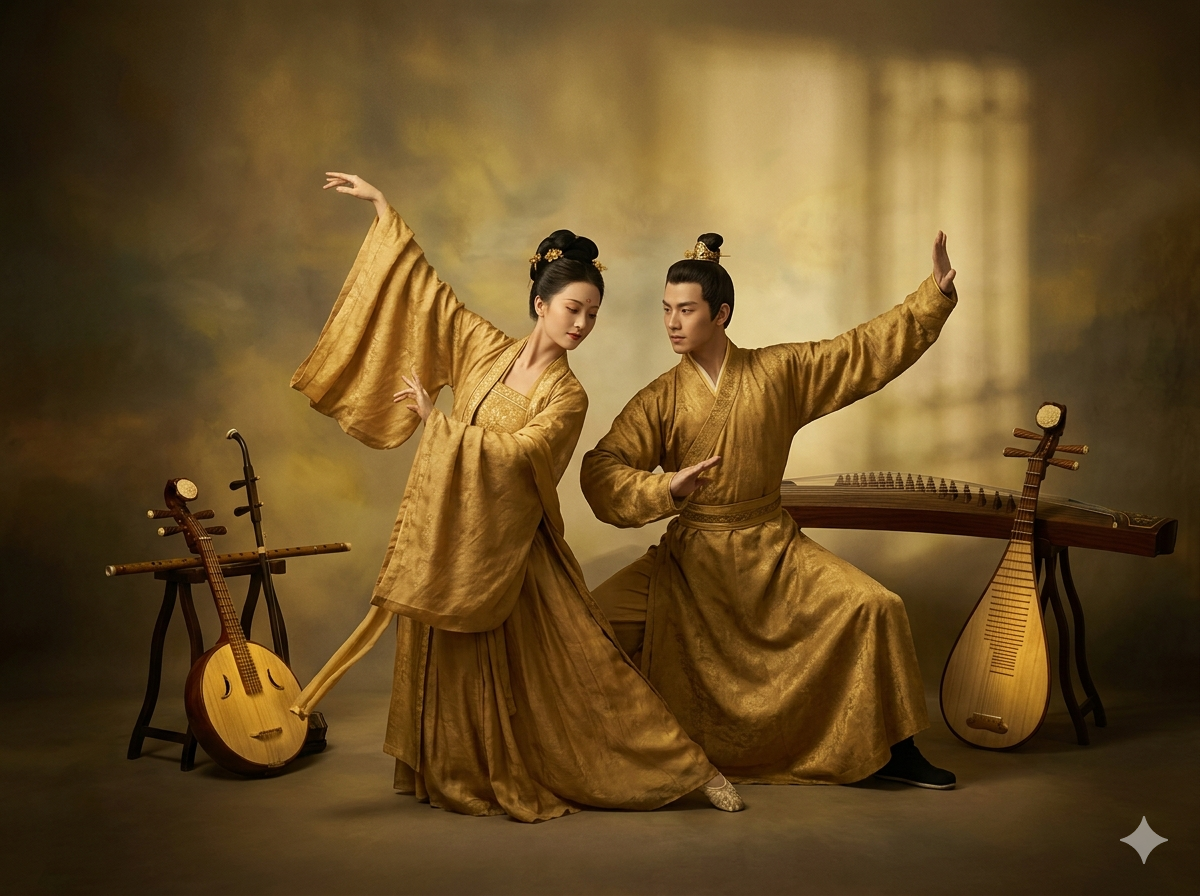
Wingchun 咏春 | Spring Festival Gala of Chinese New Year Eve 2024.
Jesuit Mediation and the Visibility of Intercultural Process in Qing Ceramic Classification
One of the most revealing consequences of adopting a Chinese classificatory perspective on Qing ceramics is that it brings into sharper focus a dimension that the European famille system tends to obscure: the active role of intercultural exchange and the technical and artistic mediation of Jesuit missionaries and Western artisans at the Qing court.
The Limits of the “Famille Rose” Label
Within the European famille system, famille rose is a stylistic category defined by soft pink enamels and an expanded palette. Typically, it is treated as a phase in the evolution of Chinese porcelain decoration—something that "emerges" in the late Kangxi period and flourishes under Yongzheng and Qianlong.
However, this framing is deceptively neutral. By classifying famille rose primarily as a visual phenomenon, the system suppresses the historical question: How did this palette become possible in the first place?
The term itself provides no indication that the introduction of pink enamels depended on new overglaze technologies closely tied to European enamel practices, particularly those associated with glassmaking and painted enamels that were introduced to China through missionary networks. In other words, the famille rose label presents the result but not the process.
Jesuits and the Qing Court: Agents of Technical Translation
During the late 17th and early 18th centuries, Jesuit missionaries like Giuseppe Castiglione (郎世宁) worked under the Kangxi, Yongzheng, and Qianlong emperors. They were painters, astronomers, and mediators of material knowledge.
Their contributions included:
- The introduction of European enamel techniques (falangcai 琺瑯彩);
- Knowledge of opaque white enamels, which enabled tonal modulation.
- Influence on illusionistic shading and volumetric modeling;
- Participation in court workshops where experimentation with materials took place.
Rather than simply "borrowing" these innovations, the Chinese imperial workshop system transformed them, particularly at Jingdezhen and in the Beijing palace ateliers. The result was not Europeanization, but rather, hybridization—a new ceramic language combining Chinese forms, imperial symbolism, and Western-derived techniques of color and shading. The result was a new form of art.
Why the Chinese Classification Makes This Visible
When we shift from the famille system to a Chinese descriptive framework, something important happens.
Instead of saying “famille rose vase,” one might describe an object as follows:
- Yongzheng or Qianlong reign;
- Zaobanchu or Jingdezhen;
- Falangcai, yangcai or fencai enamels;
- Specific decorative technique (e.g., layered overglaze painting);
- Motif and symbolic program.
This kind of description does not isolate color as the defining feature. Rather, it directs attention toward process, site, and technique.
And once we ask:
- What kind of enamel is this?
- Where was it produced?
- Which workshop system developed it?
the role of court experimentation—and therefore of Jesuit-mediated knowledge transfer—becomes much harder to ignore.
In this sense, the Chinese system does not automatically explain intercultural exchange; rather, it creates the conceptual space in which such explanations become necessary.
Visibility and Invisibility: Two Epistemologies
The European famille system naturalizes hybridity by presenting famille rose as simply another Chinese decorative style.
In contrast, the Chinese approach historicizes hybridity by situating objects within networks of production, patronage, and technical innovation. Thus, what appears as a purely stylistic category in one system becomes evidence of global entanglement in another.
A Subtle but Crucial Point
It would be an overstatement to say that the Chinese system always makes Western influence explicit. However, it accomplishes something more important: it preserves the conditions under which influence can be recognized.
By maintaining attention to
- kiln structures,
- workshop organization,
- imperial patronage,
it allows historians to reconstruct the presence of foreign knowledge within Chinese production.
By contrast, the famille system tends to flatten these conditions into a surface effect.
Hybrid Objects, Layered Histories
This comparison reveals a broader methodological insight.
Objects such as Yongzheng or Qianlong enamel porcelains cannot be simply labeled as "Chinese" or "European-influenced." They are products of layered technical histories.
- Chinese ceramic mastery provided the structural and aesthetic foundation;
- Western enamel knowledge expanded the chromatic and pictorial possibilities.
- The imperial court orchestrated their synthesis.
To see this complexity, one must look beyond color.
This is precisely what the Chinese classification tradition encourages us to do when taken seriously.
The Fiction of Purity, the Work of Encounter
Remember what I wrote about Navajo textile art in Part 5: Purism in art is not only unconvincing; it is intellectually untenable.
The wind that stirs the painter’s hand has crossed ten thousand tongues.
No form of art is born in isolation, and none survives by sealing itself against the world. The ideal of artistic purity—guarded, uncontaminated, intact—is not a principle but a fiction, sustained by nostalgia and fear. Cultural mixing does not inevitably produce value, but the refusal of it produces sterility. Art lives in exposure.
All traditions are, in fact, accumulations: layers of contact, sedimented over time. What we call identity is not origin preserved, but transformation stabilized. Indian classical music bears the trace of Persian transmission through Mughal culture; Yuan blue-and-white porcelain emerges from both technical innovation and cross-cultural convergence. These are not exceptions. They are the rule.
To insist on purity is to mistake preservation for life. What is perfectly preserved is often already dead.
As Kwame Anthony Appiah observed, “cultural purity is an oxymoron.” The history of Navajo textile art makes this visible with particular clarity: the adoption of the Pueblo loom, the assimilation of Moqui (Hopi) motifs, the incorporation of Ute aesthetic preferences. Influence here does not dilute identity. It constitutes it.
The same holds, with greater intensity, for Qing porcelain. Read through the lens of purity, enamel wares appear derivative, even compromised. Read historically, they reveal something else: a site of encounter. Chinese ceramic knowledge, courtly ambition, Jesuit mediation, and Western enamel techniques converge—not to weaken the tradition, but to extend its expressive range. What emerges is not a diminished Chineseness, but a more articulate one.
Art does not endure by resisting contact, but by metabolizing it. Qing porcelain, like Navajo weaving, does not survive in spite of encounter. It survives through it.
Dance: “Koi” Performed by Zhou Shen, Lead Dancer: Hua Xiao Yi - 2024 CCTV Spring Festival Gala
The Coexistence of Classification Systems: Chinese Ceramics Between Description, History, and Interpretation
Chinese ceramics have never been described using a single language. They have traveled across courts, kilns, ports, museums, auction houses, and scholarly traditions, each of which has given them different names. The terms used by Western scholars, such as famille verte or famille rose, do not simply duplicate the Chinese traditions of describing wares by dynasty, reign, kiln, glaze, form, and decorative method. These are not two names for the same thing. They are two ways of determining an object's significance.
In Europe, the French famille terms emerged in the 19th century as a practical and influential way to classify Qing porcelains by enamel palette, especially famille verte and famille rose. These labels are primarily associated with Albert Jacquemart. Terms such as famille jaune and famille noire were used as related color designations, often as variants or subcategories rather than as pillars of an equal, original system. This palette-based language proved durable because it was legible, portable, and useful to collectors, dealers, and museums. It allowed observers to quickly move from visual impression to category.
This practicality should not be dismissed. The Western palette system helped create a shared language across collections and markets. It made comparison easier. It also shaped museum cataloging and collecting culture during the great expansion of European interest in Chinese ceramics in the 19th century. Figures such as Ernest Grandidier played a major role during this period. Grandidier’s collection entered the Louvre in 1894 and became a landmark of European engagement with Chinese porcelain.
However, the usefulness of the famille language also reveals its limitations. It prioritizes what the eye first sees: dominant color, enamel effect, and decorative surface. The language is strongest at distinguishing palettes and visual groupings but weaker at accounting for kiln tradition, technical process, object function, workshop practice, or the semantic density of motifs. It describes appearance well but explains cultural embeddedness less well. A vase called famille rose can be visually identified, but its historical and symbolic meaning remain unclear.
Descriptions of Chinese ceramics usually work differently. In museum practice and scholarly naming conventions, an object is often identified through a series of qualifiers, such as dynasty or reign, kiln or place of production, glaze, decorative technique, form, and object type. Recent ontology projects, such as TAO CI, demonstrate that this layered descriptive logic can be modeled formally. This type of naming does not ignore appearance; however, it rarely isolates appearance from the object's origin, historical placement, or making.
This distinction is important because classification is never neutral. Classifying something means deciding which features are primary and which are secondary. Historically, Western ceramic discourse separated "true" porcelain from other ceramic bodies with a firmness that arose from European technological and commercial concerns. In contrast, the Chinese usage of ci has often extended more broadly across high-fired wares than modern Western categories allow. This does not mean that one side was correct and the other was mistaken. Rather, it means that each tradition organized material knowledge according to different needs and habits of thought.
The same is true of historical perception. Western collectors often encountered Chinese ceramics detached from their original contexts and reinserted into cabinets, galleries, and markets. Chinese traditions more often preserved links between objects and their lineages, including reign, kiln, court taste, regional technique, and inherited repertoire. These are not mutually exclusive perspectives, but they produce different emphases. One begins with visual taxonomy, while the other begins with historical situatedness.
Nevertheless, it would be too simplistic to oppose "the West" and "China" as surface versus depth or empiricism versus wisdom. The Western palette system genuinely sharpened visual analysis. It helped scholars and collectors recognize shifts in enamel technology and taste. Meanwhile, Chinese systems were never perfectly unified or timeless. They changed, adapted, and absorbed external influences. Ceramics themselves refuse purity. For example, famille rose depended on enamel developments tied to the complex exchanges between China and Europe during the Kangxi, Yongzheng, and Qianlong periods. Guangzhou export wares, often called Guangcai or Canton enamels, clearly demonstrate that Chinese ceramics were produced within global circuits of demand, imitation, and reinvention.
This is why the coexistence of classification systems is not a problem to be solved but a condition to be understood. A single object can be intelligible in more than one order. A Qing export plate may be famille rose in a Western palette sense, Jingdezhen porcelain in a production sense, Guangcai in a trade-and-decoration sense, and an auspicious or hybrid object in a symbolic sense. None of these descriptions fully cancels the others. Each catches part of the object’s life.
The deepest lesson is philosophical. Works of ceramic art are not exhausted by their surfaces, but neither are surfaces trivial. Color is not merely superficial; it is often the first threshold of attention. Form is not merely utility; it stores habit, ritual, and convention. Glaze is not only chemistry; it is also touch, light, risk, and skill. Classification systems reveal what a culture has trained itself to notice. They are records of perception.
For that reason, a more adequate criticism of old European terminology should not consist in simply discarding it. The terms remain useful when used carefully and historically. But they should no longer claim total authority. They need to be re-situated beside Chinese descriptive traditions, technical histories, and indigenous categories. To do justice to Chinese ceramics, one must often speak in more than one register at once.
Classification is often imagined as a cold act, a filing of objects into drawers. But in art history it is also a drama of attention. Every label tells us not only what the object is supposed to be, but what the viewer was taught to value. In that sense, the meeting of Chinese and European ceramic vocabularies is not merely a clash of systems. It is a record of how civilizations looked at the same fired earth and saw different worlds in it.
Chinese ceramics endure because they invite both kinds of seeing. They reward the quick eye that notices palette, brilliance, and contour. They also reward the slower mind that asks where the clay came from, which kiln breathed into it, which reign framed its taste, which symbols whisper beneath the enamel, and how an object could leave one culture and acquire another vocabulary without losing its own silence. The task of scholarship is not to force that silence into one language only, but to let several truthful languages stand around it.
Auspicious Rain - Spring Festival Gala of Chinese New Year Eve 2024

Alyx Becerra
OUR SERVICES
DO YOU NEED ANY HELP?
Did you inherit from your aunt a tribal mask, a stool, a vase, a rug, an ethnic item you don’t know what it is?
Did you find in a trunk an ethnic mysterious item you don’t even know how to describe?
Would you like to know if it’s worth something or is a worthless souvenir?
Would you like to know what it is exactly and if / how / where you might sell it?
