

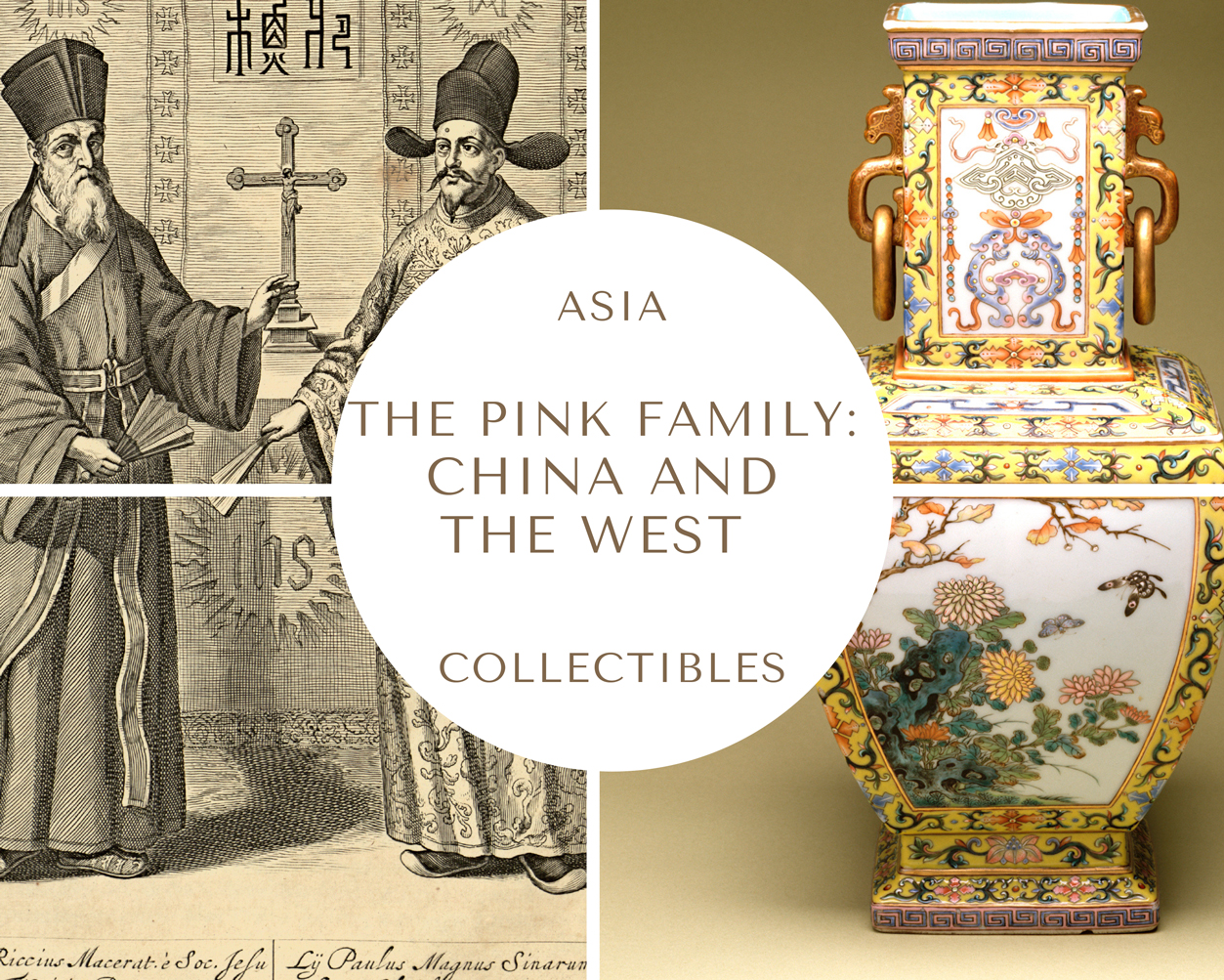
THE PINK FAMILY: CHINA AND THE WEST 10
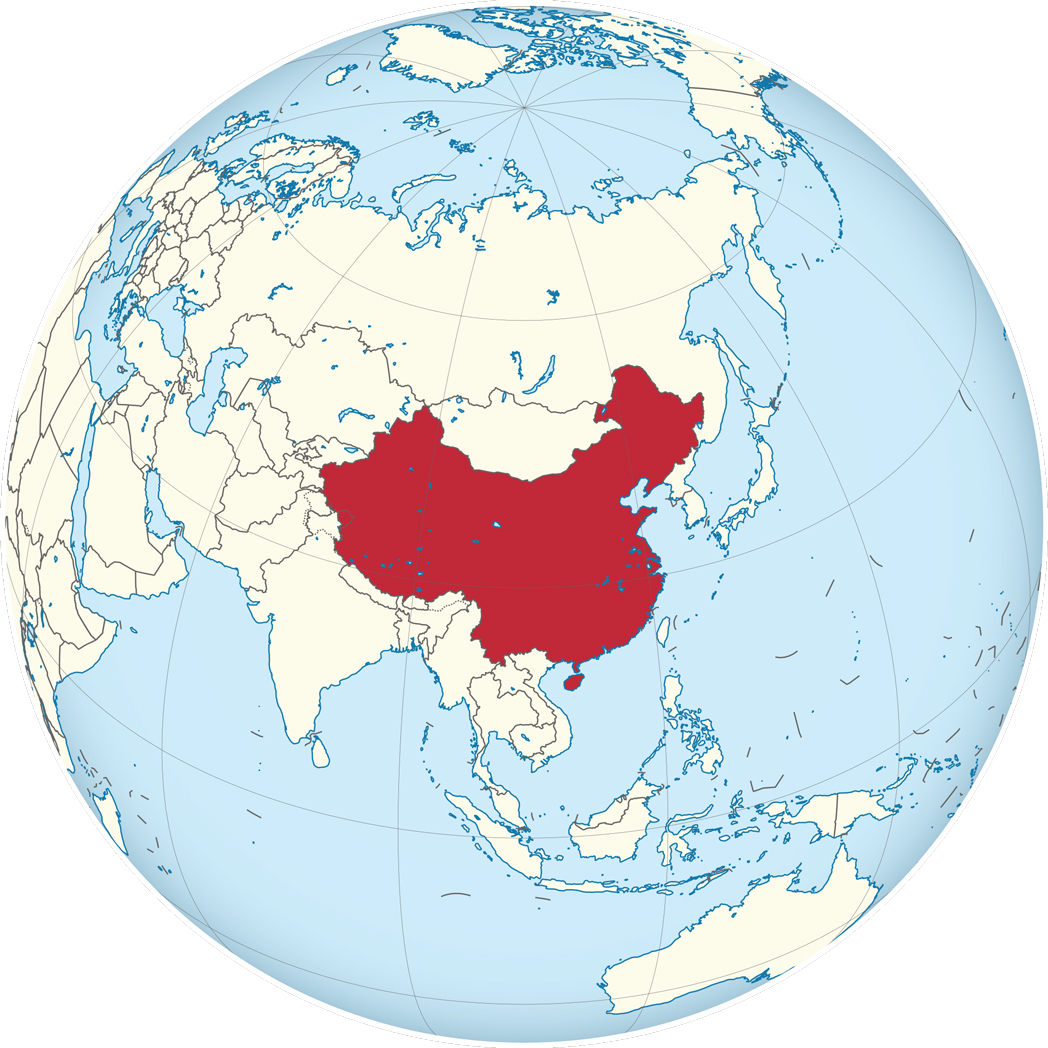
Current China on the globe.
Under the Creative Commons Attribution-Share Alike 3.0 Unported license.
This map is for illustrative purposes only. The Ethnic Home does not take a position on territorial disputes.
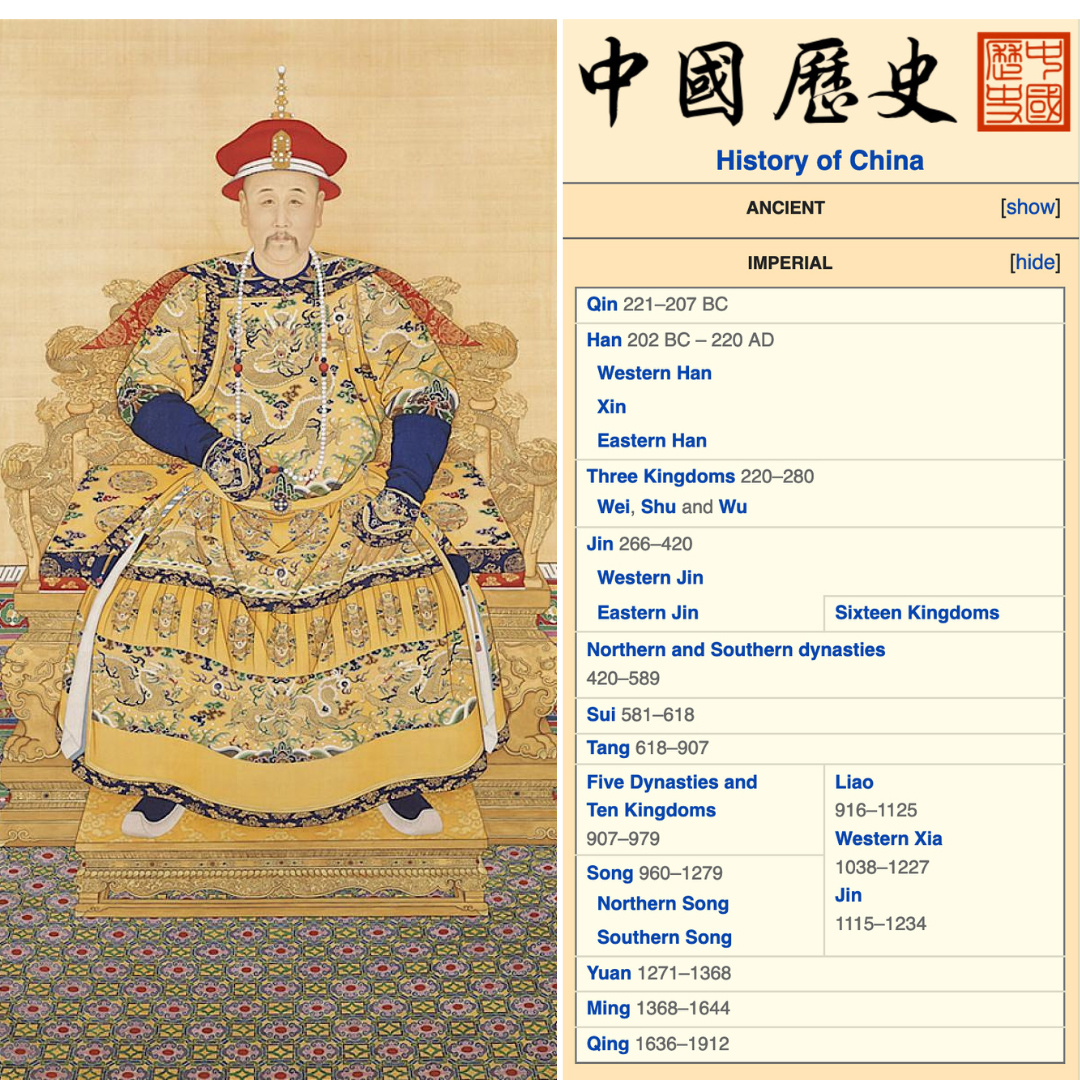
LEFT: Portrait of the Yongzheng Emperor in Court Dress, by anonymous court artists, Yongzheng period (1723—35), Qing Dynasty. Hanging scroll, color on silk. The Palace Museum, Beijing. Public Domain.
RIGHT: History of China, Imperial Dynasties, source: Dynasties in Chinese history, Wikipedia.
An Assessment of Matteo Ricci's Cross-Cultural Dialogue in China
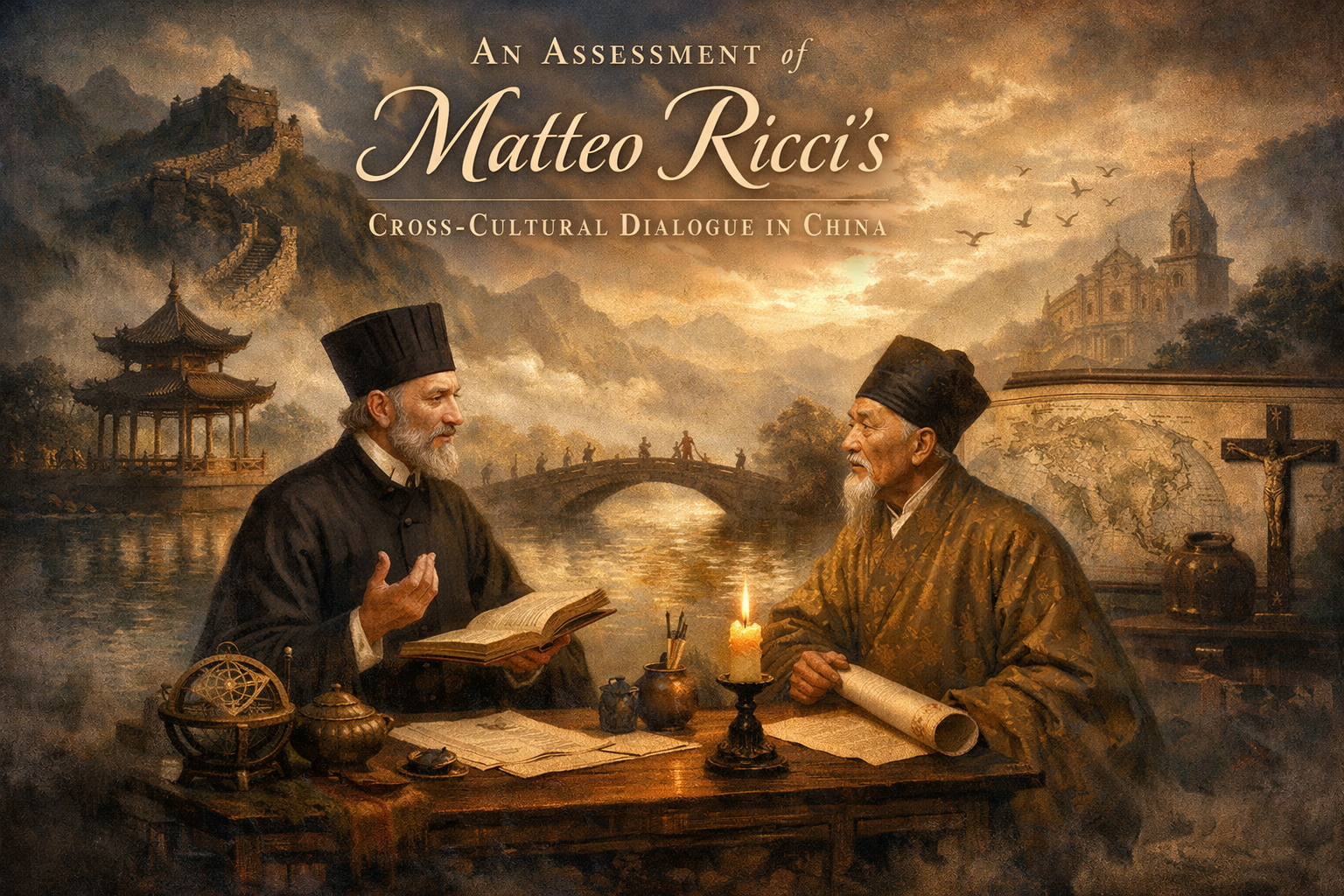
Contemporary scholarship emphasizes that, although Ricci’s mission opened unprecedented avenues for intellectual exchange between China and the West, the process was marked by asymmetry in intent and outcome. Ricci sought to establish common ground while remaining committed to preserving the integrity of Christian doctrine.
Although his approach was respectful of Chinese culture, his ultimate aim was evangelization. This dual commitment to cultural adaptation and religious conversion generated tensions that scholars regard as intrinsic to his cross-cultural project. "Ricci consistently emphasized the superiority of Christian revelation. His persona as a Confucian scholar was not intended to dissolve doctrinal boundaries, but rather to create a space in which Christian truths could be heard. Rule (1986) observes that Ricci’s cultural adaptation was instrumental in providing a pathway to dialogue whose ultimate aim was conversion. The tension between openness and exclusivity thus defined his mission." (Shuangyang Qi and Meng Yan, Matteo Ricci and Sino-Western Encounters in Late Ming China: Cultural Exchange, Adaptation, and Conflict, September 2025).
This analysis highlights a critical aspect of intercultural dialogue: respect and empathy do not negate the inherent asymmetry when one party seeks to transform another spiritually. Ricci’s mission was not a neutral, bidirectional dialogue in the modern sense. Rather, it was shaped by a clear purpose—religious conversion—which defined the boundaries and nature of the conversation. Ricci was not pursuing mutual philosophical synthesis for its own sake. His goal was to make Christian doctrine intelligible and persuasive within a Chinese conceptual framework.
Thus, while his approach opened intellectual and relational doors, it was ultimately constrained by theological exclusivity and an unequal distribution of aims.
His efforts to harmonize Chinese ethical concepts with Christian theology highlight another structural tension: the intersection of philosophical engagement and theological exclusivity. His reinterpretation of Chinese ritual practices, particularly ancestral rites, later sparked the Chinese Rites Controversy. This episode illustrates how the very accommodations that initially enabled dialogue became sources of deep conflict, both within the Catholic Church and between missionaries and Chinese intellectuals. It reveals the limits of intercultural synthesis when universalist truth claims collide with deeply rooted indigenous traditions.
Following Ricci’s death in 1610, the Chinese Rites Controversy erupted among Catholic missionaries. The dispute centered on the compatibility of Confucian and ancestral rites with Christianity. Were these practices permissible cultural traditions, or were they religious rituals considered idolatrous and incompatible with Christianity? Ricci’s intellectual descendants, the Jesuits, argued that these practices were civil, not religious, and could be tolerated to facilitate conversion. However, the Dominicans and Franciscans disagreed, branding the rites as idolatrous. The Vatican eventually weighed in. Initially tolerant, the Church reversed its position in 1704 and again in 1742 when Popes Clement XI and Benedict XIV formally condemned the rites and forbade Catholic participation. This decision eroded the Qing imperial court's trust, as such rituals were integral to political loyalty and moral order. Consequently, Christian missions lost favor, and the Church was viewed as antagonistic to Chinese cultural tradition. This position was not formally reversed until 1939, when Pope Pius XII took office.
This was not the only controversy to emerge in Ricci’s wake. Although he embraced some aspects of Confucianism, Ricci was highly critical of Buddhism and Daoism. As Tang (2016) notes, Ricci’s rejection of Buddhism and Daoism was framed not only in theological terms, but also as a strategy to align Christianity with the ruling Confucian ideology. In debates with monks such as Sanhuai, Ricci dismissed Buddhist metaphysics as nihilistic and socially harmful. Ricci’s rejection of Buddhism was partly strategic. By aligning Christianity with Confucianism and against Buddhism, he sought to embed his faith within the ruling ideology of the literati. In this sense, his polemics were less about genuine philosophical engagement than political positioning. However, this tactic reinforced antagonism between Christian converts and Buddhist communities, planting the seeds of later tension (Shuangyang Qi & Meng Yan, 2025).
Evaluating Ricci’s Intercultural Dialogue
Ricci’s project transcended the Chinese context; it catalyzed a transnational exchange of ideas. His writings influenced how Enlightenment Europe viewed China, prompting a reevaluation of Western beliefs about politics, ethics, and cosmology. As Pu Jingxin notes, Ricci "set a precedent for future intercultural exchanges" and helped lay the foundations for modern global dialogue. (Matteo Ricci’s Contribution to Sino-Western Cultural Exchange, 1583–1610, "Journal of Cultural and Religious Studies", 12 (11), November 2024).
Ricci’s legacy is ambivalent by nature:
Productive: His work enabled wide-ranging scientific, linguistic, artistic, and philosophical exchanges. His world maps, translations, and introduction of Euclidean geometry to Chinese audiences broadened intellectual horizons and provoked serious epistemological debates within Chinese scholarship. "Ricci's activities established the foundations of a Sino–Western dialogue that would reverberate across centuries, shaping both Chinese intellectual life and European perceptions of the Middle Kingdom." (Shuangyang Qi & Meng Yan, cited).
Tense: His mission also exposed the persistent conflict between historical-critical interpretation and the dogmatic demands of theological orthodoxy, culminating in ecclesiastical and cultural controversies.
Ricci’s dialogue with Chinese scholars marked a turning point in global intellectual history. It combined genuine admiration for Chinese civilization with a steadfast dedication to the Christian message. The encounter:
- Enabled profound philosophical and epistemological exchange.
- Reshaped Chinese and European intellectual traditions.
- Revealed the potential and limitations of intercultural dialogue in the face of non-negotiable doctrinal commitments.
Ricci remains a pivotal figure in the history of cross-cultural engagement. His life and work are rich in insight and are marked by the complexities of power, faith, and cultural translation.
Ultimately, Ricci’s story shows us that true intercultural dialogue is not about seeking perfect equivalence, but rather, building provisional bridges, fragile yet functional structures capable of bearing the weight of misunderstanding and difference. His memory palace, whether real or metaphorical, was built not of stone but of texts, relationships, and rituals—a delicate architecture that, for a time, spanned the immense distance between Rome and Beijing, the West and the East.
Even after his death, Ricci’s influence endured. His writings, converts, and legacy sustained the momentum of Jesuit missions in China. To fully understand this legacy, we must examine the dialogue he initiated through not only theological and philosophical frameworks but also the artistic, relational, and human dimensions of cultural exchange.
Who ultimately crossed Ricci’s imperfect, asymmetrical bridge, and what did they carry across? That is the question. Let us explore it not with equations, but with imagination. I promise there will be surprises.
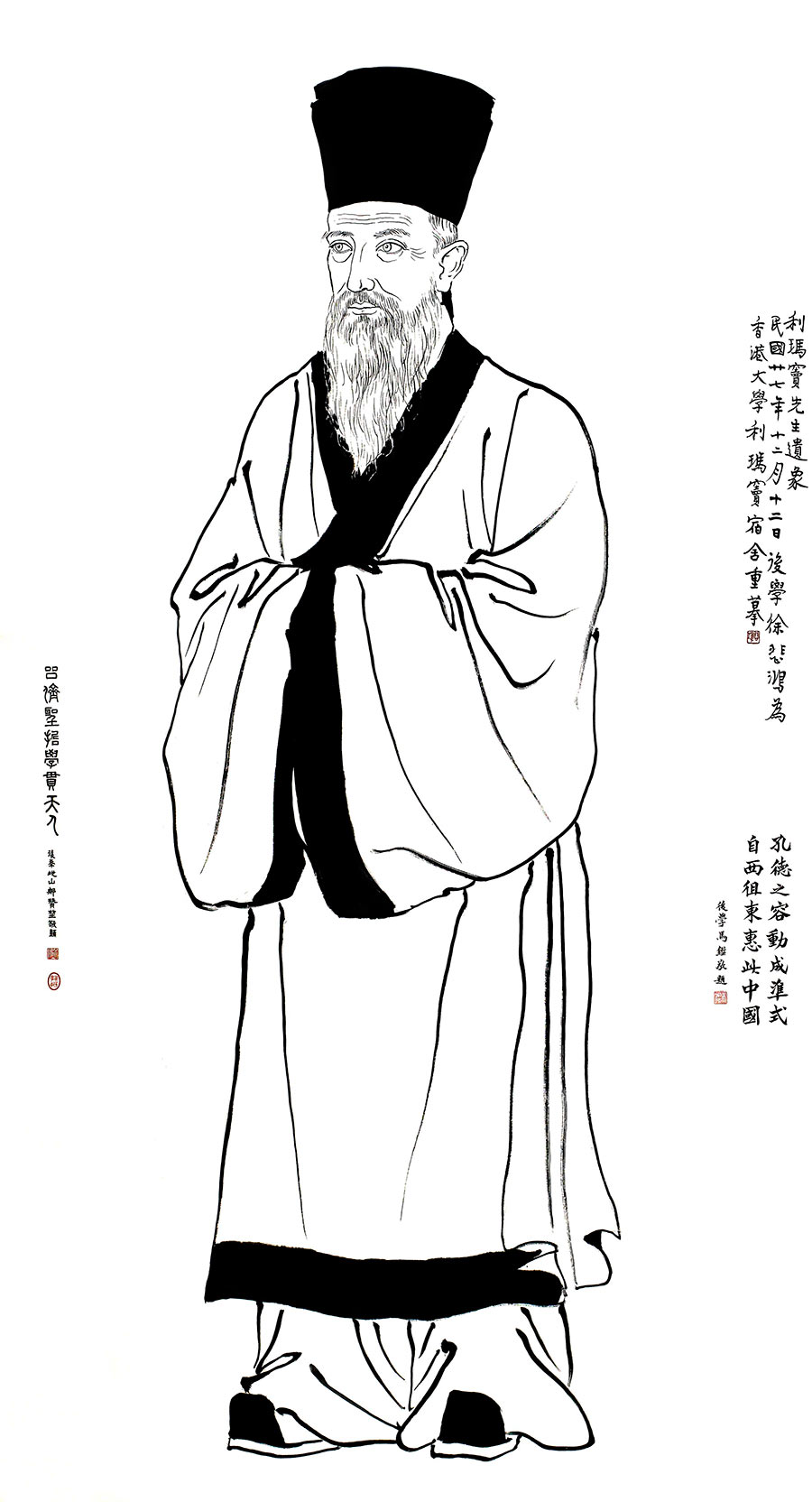
Matteo Ricci, attributed to Xu Beihong, 1938. Ink on paper. Courtesy of the University of Hong Kong Museum and Art Gallery.
"The Jesuit influence in China waxed and waned along with the state of diplomatic relations between China, Europe and the Papacy. With the dissolution of their order by the Pope, the Jesuits left China in 1773, but returned after their reinstatement in the 1840s. They continued to support Chinese culture at their seminary founded in Shanghai, introducing there the first systematic teaching of Western art in China. The artists whom they nurtured became major contributors to the Chinese art world, consciously following Castiglione's blending of Eastern and Western traditions. It is in this spirit that Xu Beihong (1895-1953) painted a portrait of Matteo Ricci, for the Ricci Institute at the University of Hong Kong, modeling his own infusion of naturalism into Chinese art on that of Castiglione". (Text by the National Palace Museum of Taipei, realized for the 2016 exhibition Giuseppe Castiglione - Lang Shining - New Media Art Exhibition)

From Ricci’s Missionary Vision to Castiglione’s Sino‑Western Synthesis: Jesuit Continuity in China
Matteo Ricci’s missionary approach in China was notable for its combination of religious, intellectual, and cultural strategies. Instead of relying solely on theological argumentation, Ricci and his fellow Jesuits used Western scientific knowledge, including astronomy, mathematics, cartography, and mechanical devices, to engage with elite Chinese interlocutors. By presenting these disciplines in classical Chinese and embedding them within Confucian moral discourse, the Jesuits positioned themselves as learned men of utility who could contribute to the intellectual life of the Ming literati. This multidimensional strategy secured the Jesuits a degree of cultural credibility and courtly access exceptional among early modern missionary enterprises.
Visual and material culture also formed part of this broader Jesuit engagement. Ricci and his colleagues introduced world maps, astronomical instruments, and engravings of biblical scenes or European urban landscapes. Although Ricci himself was not a trained artist, displaying and exchanging such visual materials emphasized the epistemological distinctiveness of European knowledge systems, particularly in fields such as cartography and geometric representation. Though formal artistic training was not yet a priority for the Jesuits in China, circulating these objects contributed to growing curiosity about Western modes of visualization. Technical discussions of perspective and pictorial theory, however, remained limited in this early period.
During the 17th century, the Jesuits cultivated cultural legitimacy by demonstrating their expertise in scientific fields. Their proficiency in areas such as astronomical prediction, calendar reform, and mathematics was particularly valuable during the early Qing dynasty, especially during the reign of the Kangxi Emperor (r. 1661–1722).
Jesuit scholars such as Ferdinand Verbiest and Adam Schall von Bell held official posts at the imperial court, often serving as calendrical experts or technical consultants. These roles offered structured access to court life beyond explicitly religious functions, reflecting the Jesuits' broader role as cultural brokers.
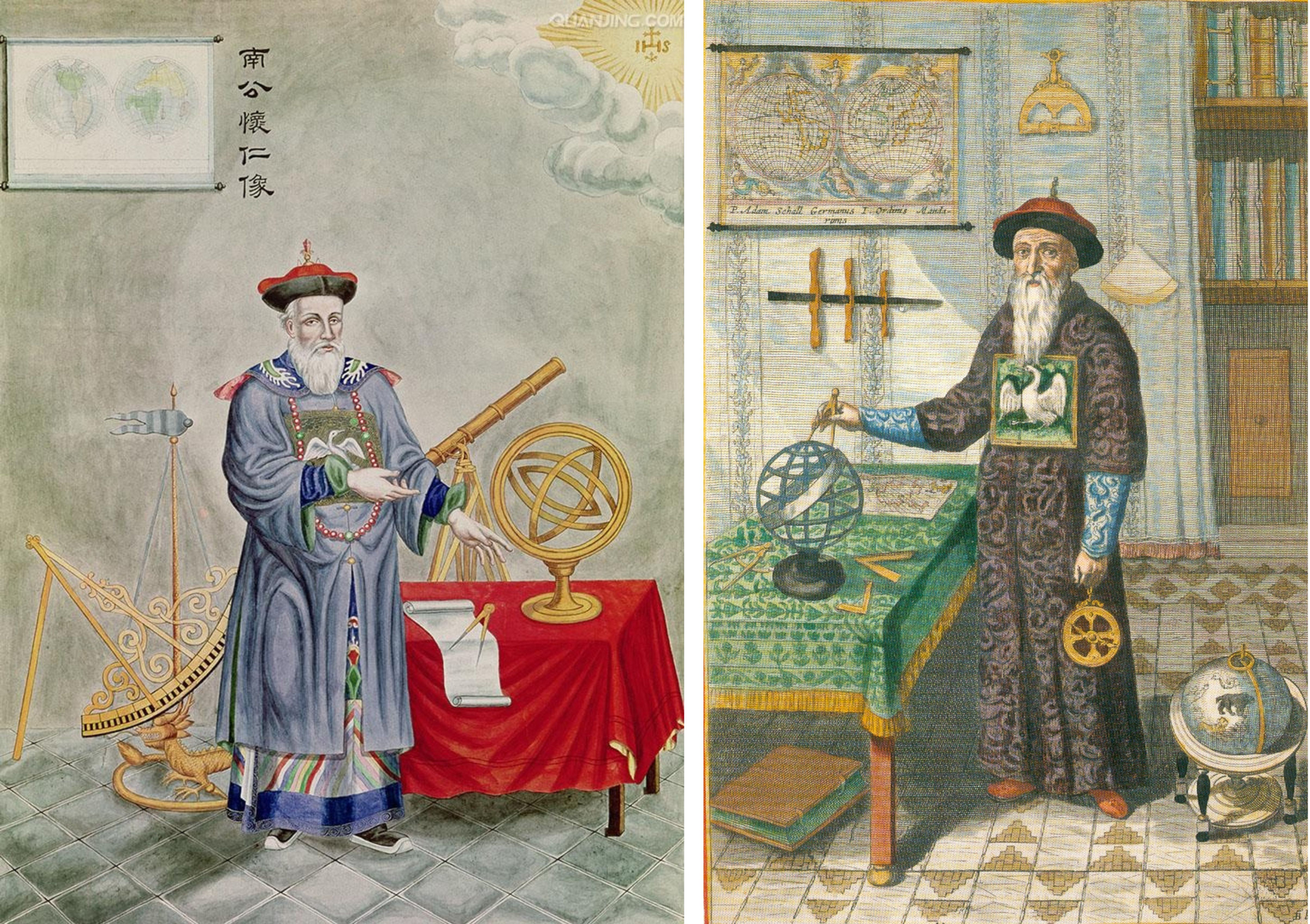
LEFT: A 1766 portrait of Ferdinand Verbiest (1623–1688), a Flemish Jesuit missionary who worked in China during the Qing dynasty. Verbiest became one of the most influential Westerners in Qing China. He served at the court of the Kangxi Emperor and led the Imperial Observatory in Beijing, modernizing Chinese astronomy with European methods. Verbiest also contributed to cartography, mechanics, and diplomacy, helping to solidify the Jesuits' scientific and political influence at court. His work exemplified the fusion of science and evangelization during the Jesuit China missions.
RIGHT: A portrait of German Jesuit Johann Adam Schall von Bell (1592–1666), who was a missionary in China during the Ming and Qing dynasties from 1622 until his death in 1666. Anonymous hand-colored engraving, 31.1 x 21 cm, 1667. Plate title: "P. Adam Schall Germanus I. Ordinis Mandarinus" ("Father Adam Schall, the German mandarin of the first order"), from Athanasius Kircher's Tooneel van China... Jan Hendrick Glazemaker (Amsterdam: Johannes Janssonius van Waesberge, 1668). A German Jesuit and Verbiest's predecessor, Schall von Bell played a crucial role in reforming the Chinese calendar under the Ming and early Qing dynasties. He was appointed director of the Imperial Astronomical Bureau and earned favor with the Shunzhi Emperor. He was later granted the rare privilege of being buried in Beijing. His life reflects the successes and vulnerabilities of missionary-scholars at the imperial court; he was imprisoned during a political backlash against Christian influence shortly before his death.
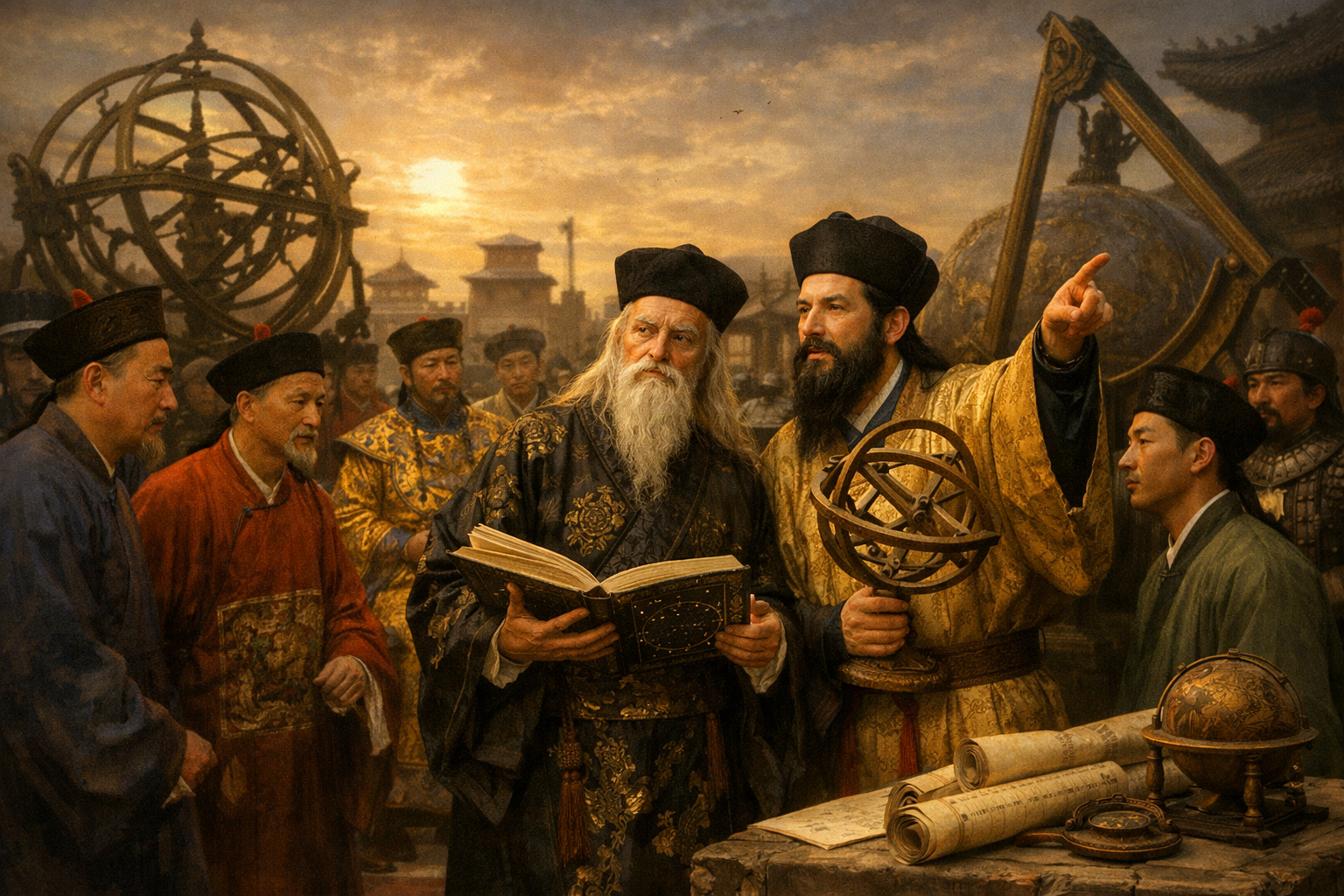
AI-generated illustration.
By the late 17th and early 18th centuries, this model had expanded to encompass visual culture. The Qing dynasty's interest in Western artistic techniques, particularly linear perspective, chiaroscuro, and naturalistic portraiture, generated specific requests for Jesuit artists. In response, the Society of Jesus began sending individuals with preexisting artistic training to meet these demands. Although Jesuit training focused primarily on theology, philosophy, and classical languages, missionaries with exceptional artistic, medical, or musical skills were often selected for specialized roles in foreign courts or scholarly settings. This pragmatic flexibility allowed the China mission to adapt to changing imperial interests without establishing a formal artistic curriculum within the order.
Giuseppe Castiglione (1688–1766), an Italian Jesuit trained in painting before entering the Society, exemplifies this dynamic. Sent to China in 1715, Castiglione entered imperial service under Kangxi and went on to serve the Yongzheng and Qianlong emperors. At court, he developed a distinctive style fusing European spatial illusionism with Chinese compositional conventions, formats, and materials. His body of work reflects a negotiated synthesis shaped by imperial patronage, court protocols, and his own capacity for cultural translation, rather than the imposition of a Western aesthetic.
By the mid-Qing period, artistic production had joined scientific and technical expertise as a core domain of Jesuit contributions to the imperial court. Paintings, alongside astronomical instruments and translated texts, functioned as diplomatic and epistemological instruments, facilitating exchange, aesthetic admiration, and soft power. Although the Qing state imposed increasingly strict limits on Christian evangelization, the Jesuits' emphasis on cultural accommodation persisted. Castiglione’s long and successful career illustrates how Ricci’s foundational approach of engagement through knowledge, aesthetics, and elite dialogue continued to evolve and adapt within the structures of Qing imperial culture. His legacy is not only an artistic achievement but also the culmination of the Jesuits' strategy of cultural mediation in China.
Giuseppe Castiglione in China: The Divine Brush That Bridged Empires
A Biographical Study of the Jesuit Painter Lang Shining (郎世宁) (1688–1766)
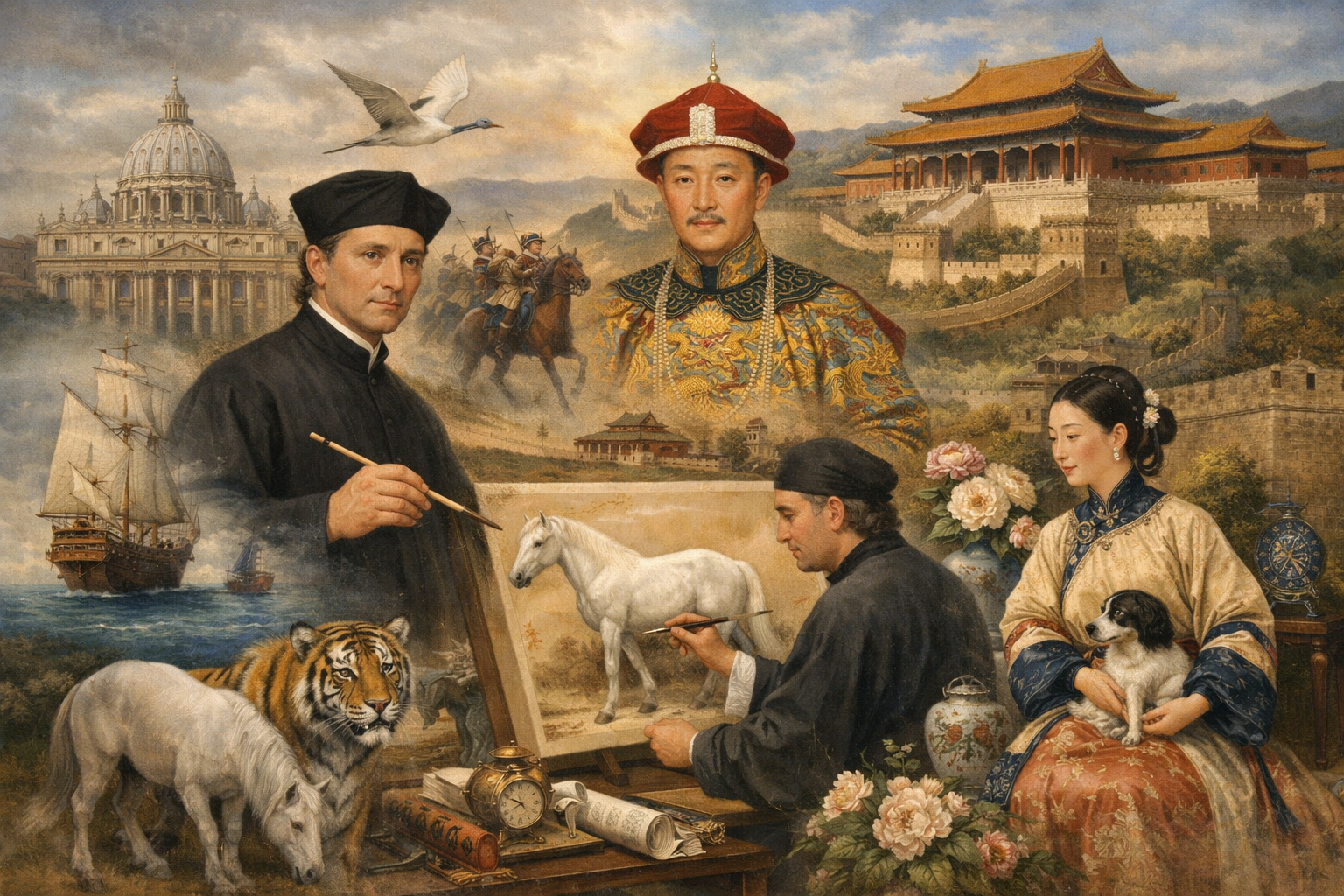
- The Milanese Novice and the Celestial Calling
In the golden autumn of 1688, the Baroque splendor of Bernini still echoed through Rome's colonnades, and the Kangxi Emperor of the Qing dynasty was consolidating his Manchu empire's hold over the Middle Kingdom. Giuseppe Castiglione was born that year in Milan—a city where Renaissance rigor met the theatrical flourish of the Seicento. Blessed with a precocious talent for painting, the young Castiglione entered the Jesuit order in Genoa at age 19 in 1707. He chose the path of a Jesuit brother rather than a priest, a status that allowed him to focus on artistic and cultural work rather than clerical duties.
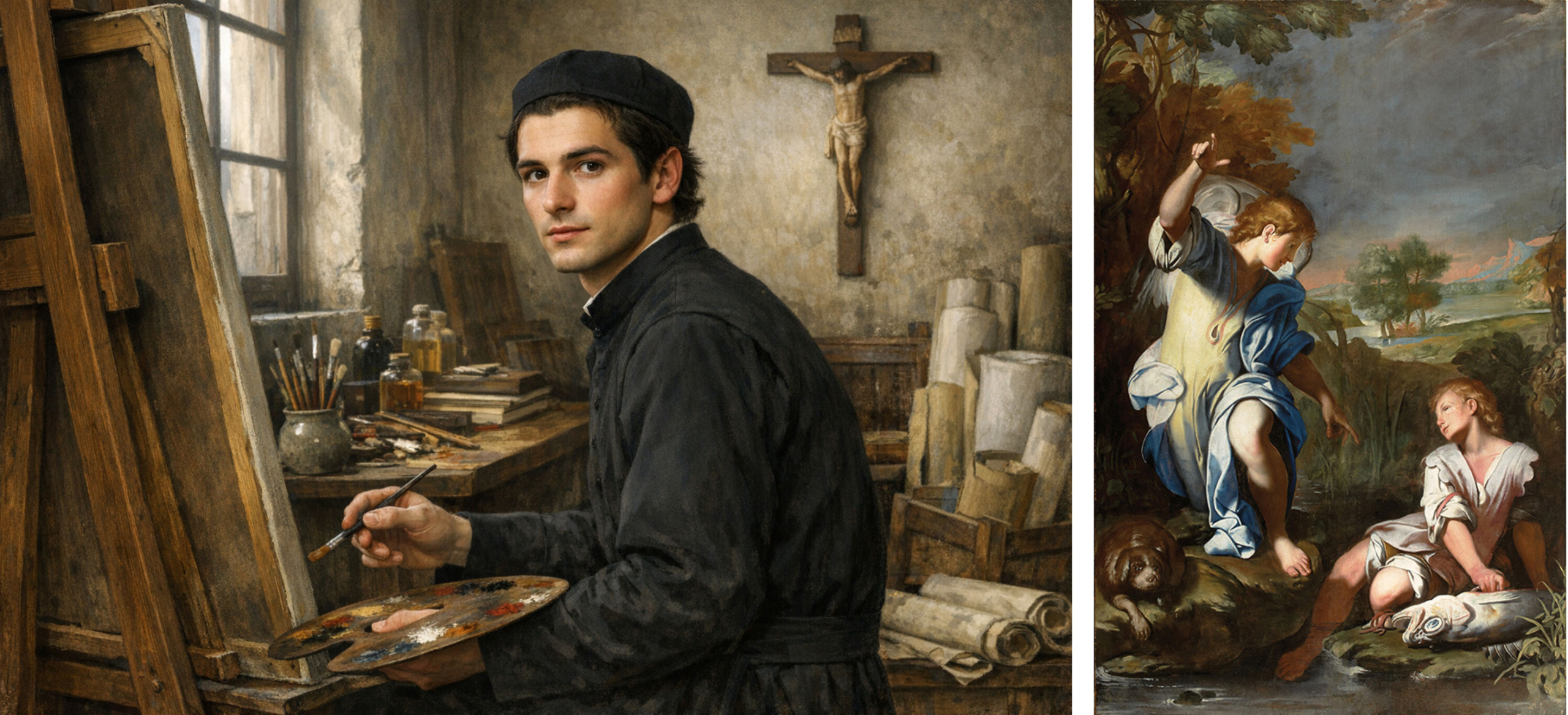
LEFT: Giuseppe Castiglione at age 21 in Genoa. AI-generated illustration.
RIGHT: Giuseppe Castiglione (attributed to), Tobias and the Archangel Raphael, oil on canvas. Dimensions: 272.5 × 181.5 cm. Collection of Pio Istituto Martinez, Genoa, Italy.
"The subject of this painting comes from the "Book of Tobit" in the Catholic Old Testament , the first section of the Christian Bible. In it, the son of Tobit, Tobias, is sent by his father to a distant land to collect a payment and is accompanied by the family dog. Due to the difficulty of the journey, God sent the archangel Raphael in human form to go with him. Heeding the angel's instructions, Tobias caught a giant fish and removed its heart, liver, and gall bladder, which he later used to drive away a demon and make medicine to cure his father's blindness. The strong lighting in this painting symbolizes the glory of God as the angel points the way. Tobias, basking in God's grace, appears gutting the fish. The method of treating the luster on the surface of the dog, fish, water, and hair can also be found in works that Castiglione did after arriving in China. The dramatic lighting and vast areas of shade, however, are rare in his later works". (From the texts prepared for the Giuseppe Castiglione Lang Shining new Media Art Exhibition, 2016, National Palace Museum, Taipei, Taiwan).
In the early years of his Jesuit vocation, Giuseppe Castiglione spent a formative period in Lisbon and Coimbra, from 1709 to 1714, honing his artistic skills. During this time, he undertook several ecclesiastical commissions, producing chapel panels and religious paintings in preparation for his eventual mission to China. In Coimbra, he contributed to the decoration of the Chapel of St. Francis Borgia at the Jesuit College—now part of the New Cathedral of Coimbra—where contemporary accounts praised his use of illusionistic perspective and intricate foliage.
Regrettably, none of the original chapel decorations have survived, and the authorship of existing works from that period remains uncertain. No securely attributed pieces from his Portuguese years exist today; those once linked to him in Lisbon and Coimbra have either been lost or are now considered doubtful. Still, it is clear that Castiglione was an active and capable artist during his time in Portugal, even if his recognized body of work begins only with his later contributions in China.
By the early 18th century, as the Qing imperial court grew increasingly intrigued by European painting techniques, the Jesuit leadership in Rome identified Castiglione as an ideal envoy—an artist whose talents could advance both religious and diplomatic aims. They saw in him not merely a skilled craftsman, but a cultural ambassador. This was no ordinary artistic commission: it served as a gateway for the Catholic Church to enter the Forbidden City.
Castiglione set sail for Asia and arrived in Macau on August 20, 1715, the 54th year of the Kangxi Emperor's reign. By the year's end, he had reached Beijing, carrying with him both crucifix and palette. There, under his new Chinese name—Lang Shining, meaning "He who brings peace to the world" (郎世寧)—he was ready to begin his service.
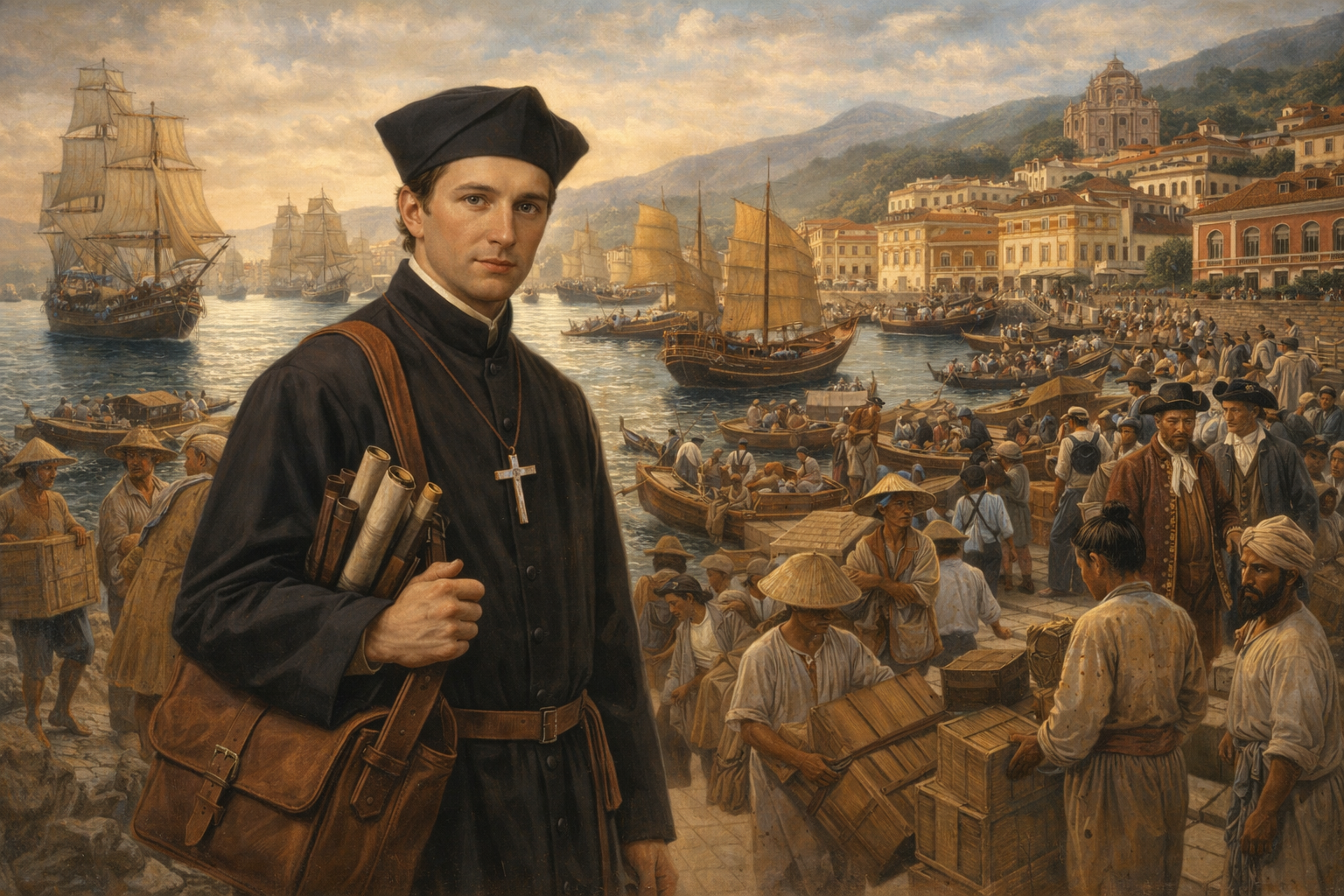
Giuseppe Castiglione upon his arrival at the harbor of Macau in August 1715. AI-generated illustration.
2. The Kangxi Interregnum: Roots in the Forbidden City
The years under the Kangxi Emperor from 1715 to 1722 represent a painful gap in Castiglione's artistic legacy. This period is defined by absence rather than presence. No paintings from these formative years survive; however, this absence is eloquent testimony to the painter's assimilation. Like a sapling transplanted into foreign soil, Castiglione spent these initial years establishing himself in the Qing bureaucracy through the Zaobanchu, the palace workshops where Chinese artisans and European specialists collaborated under imperial patronage.
What we know with certainty is that the elderly Kangxi Emperor, renowned for his intellectual curiosity about Western science and mathematics, welcomed the Italian Jesuit. Castiglione's presence was strategic; he was a painter, a potential proselytizer, and living proof of European cultural sophistication. Residing at the Dongtang (Eastern Church) near the Donghua Gate, Castiglione awaited occasional summonses to the inner court. There, he built the reputation that would enable his survival and eventual flourishing.
3. The Yongzheng Years: Auspicious Beginnings
The Yongzheng Emperor's accession in 1723 was a pivotal moment. Castiglione presented Gathering of Two Auspicious Signs, a hanging scroll that transformed political allegory into visual poetry. Arranged in a Song dynasty Ru-type vase on a bed of sandalwood were bingdi lotuses, intertwined grain stalks, and arrowheads, which proclaimed the new emperor's virtuous governance and legitimate succession. Yongzheng was so delighted by the work that, within days, he issued an imperial decree granting Castiglione six disciples to train in his methods.
Composed in ink and color on silk (158 × 85 cm), this painting demonstrated Castiglione's mature synthesis. Western chiaroscuro modeling brought each botanical specimen to life in three dimensions, while the composition honored Chinese traditions of auspicious symbolism. A companion piece, Gathering of Auspicious Signs, now in the National Palace Museum in Taipei, cemented his position. Throughout Yongzheng's eight-year reign, Castiglione served as the court's foremost chronicler of imperial legitimacy.
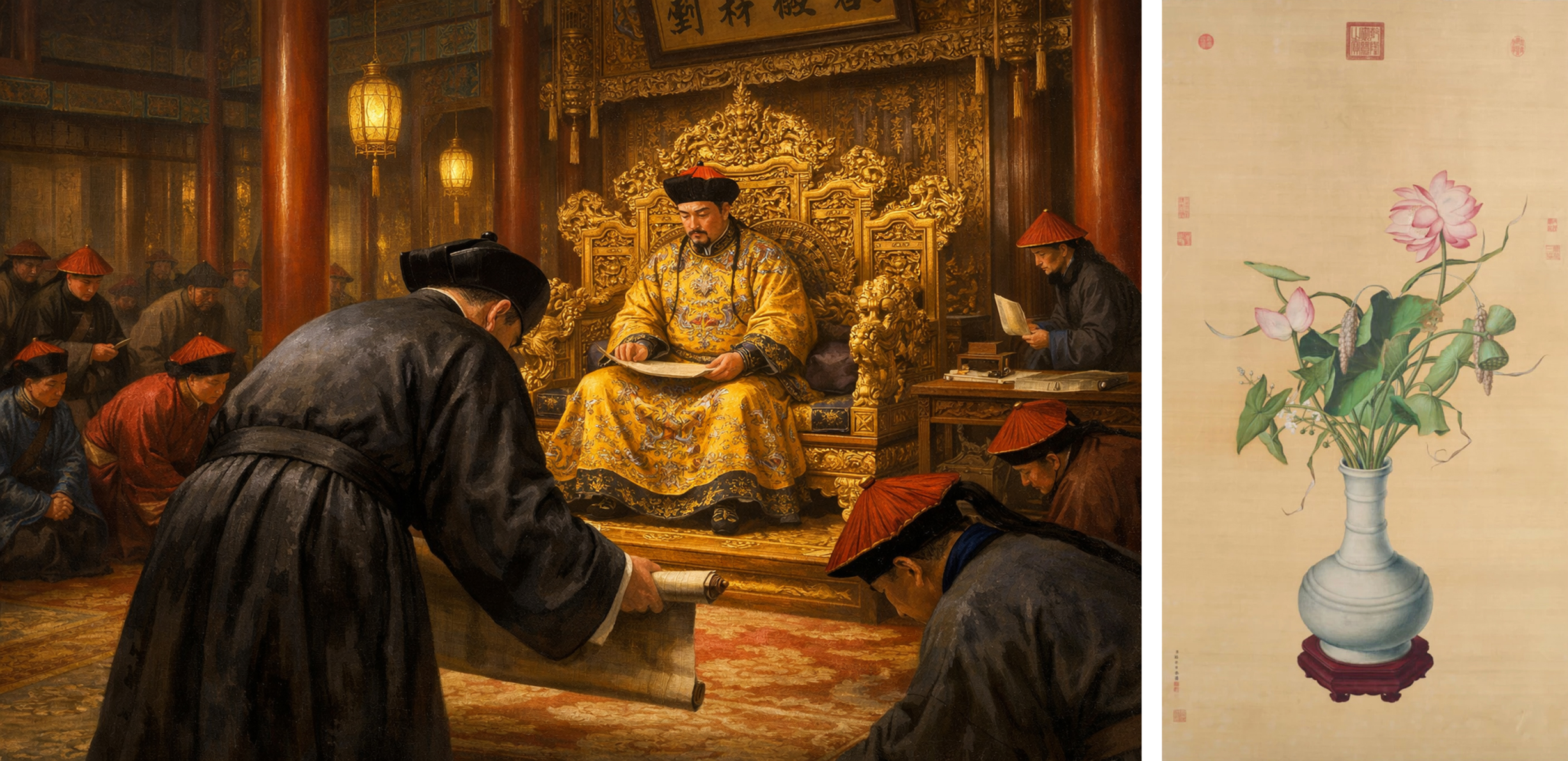
LEFT: After presenting his silk scroll to the new emperor, Giuseppe Castiglione rolls it up. So impressed was the emperor that he bestowed special favors on the artist in gratitude. AI-generated illustration.
RIGHT: Giuseppe Castiglione, Gathering of Two Auspicious Signs. Hanging scroll, ink and colour on silk,158 x 85 cm. On view at Sotheby's Maison in Hong Kong until 27 January 2026.
Two extraordinarily rare auspicious signs appeared simultaneously in the first year of the Yongzheng reign (1723), son of Kangxi Emperor. The first sign was lotus seed pods sharing a single stem with divided calyxes. The second sign was the news of a bountiful wheat harvest in Shandong Province of several hundred stalks of auspicious grain. Each stalk was vividly purple and bore two ears. The stalks had strong, upright stems that were over a foot long. These events were both interpreted as signs of Heaven's will to herald the new emperor's accession.
"According to Confucian ideals, the manner in which a ruler ascends the throne was important to the legitimacy of his rule. (...). It was on these grounds that the phenomenon of auspicious grain and Bingdi lotuses in the eight month of the first year was seen as a signifier the Yongzheng Emperor had received the Mandate of Heaven, thereby receiving Heaven’s blessings as the legitimate ruler of the Manchu-led Qing dynasty (1644-1912). This legendary account of the Yongzheng Emperor receiving the Mandate of Heaven in 1723 is immortalised on silk in Giuseppe Castiglione’s Gathering of Two Auspicious Signs. (...) Gathering of Two Auspicious Signs was received with such favour that merely days after Castiglione created the painting, an imperial decree granted him six individuals to study painting under his tutelage. The success of Gathering of Two Auspicious Signs and the subsequent companion painting Gathering of Auspicious Signs (now in the collection of the Taipei Palace Museum), executed during the same period of time, garnered the Yongzheng Emperor’s trust and laid the foundation for Castiglione’s position in the palace where he would ultimately be remembered as one of the most significant court painters in history. A third painting, compositionally similar to Gathering of Auspicious Signs and bearing the same name, was created in the third year of the Yongzheng reign (now in the permanent collection of the Shanghai Museum)." (From Denise Tsui, Yongzheng Emperor’s Mandate of Heaven: The Story Behind Giuseppe Castiglione’s Gathering of Two Auspicious Signs, November 2025, Sotheby's).
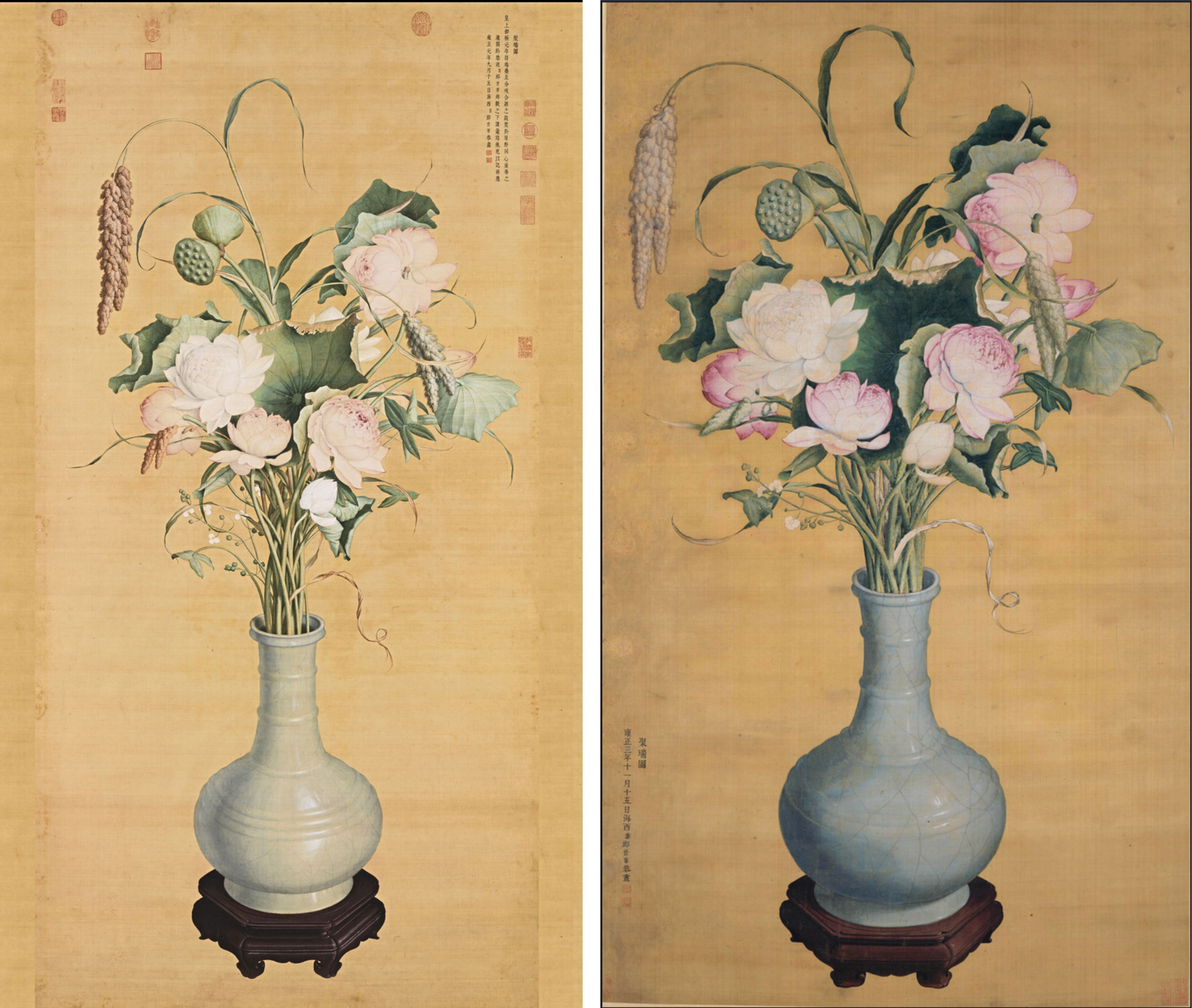
LEFT: Giuseppe Castiglione, Gathering of Auspicious Signs, hanging scroll. Medium: Ink and colors on silk. Dimensions: 173 x 86.1 cm. © National Palace Museum, Taipei, Taiwan.
RIGHT: Giuseppe Castiglione, A Bunch of Auspicious Flowers, hanging scroll. Date: 1725. Medium: Ink and colour on silk. Dimensions: 109.3 x 58.7 cm. © Shanghai Museum, China.
"In this painting is a celadon vase with an arrangement of auspicious plants such as dual-blossom lotuses and stalks of rice with two ears of grain, plants that have been used in painting since the Song and Yuan dynasties to symbolize sagacious rule. Giuseppe Castiglione signed his name in Chinese with the "Song-script" style of Qing court publications and included a date equivalent to 1723, the first year of the Yongzheng emperor's reign, making it his earliest dated work. An elevated point of view has been taken, allowing the viewer to peer into the neck of the vessel. Castiglione also used white pigment to highlight the shine on the glaze, enhancing the volumetric effect of this porcelain vase. As for the plants, Castiglione excelled at rendering gradated areas of color to express three-dimensionality and shading with a single source of light. The coloring overall is exceptionally refined, making the motifs appear as if radiating with brightness. The painting is a masterful example of how Castiglione translated Chinese subject matter using Western techniques. The vase shown here also appears similar to an imitation Ru-ware celadon with linear patterns in the collection of the National Palace Museum." (from the official texts by the National Palace Museum of Taipei, prepared for the 2015-2016 exhibition Portrayals from a Brush Divine).
AI-generated illustration.
Credible evidence suggests that Giuseppe Castiglione painted flowers, including peonies, with careful attention to form, light, and shading — a hallmark of his Sino-Western hybrid style. In works such as Flowers in a Vase and Immortal Blossoms of an Eternal Spring, Castiglione renders the petals, leaves, and blooms with layered tones and shading, suggesting an attentive study of his botanical subjects rather than a purely stylized convention. Scholars have noted that the treatment of the petals in Immortal Blossoms of an Eternal Spring displays nuanced light and shadow effects, as well as attention to naturalistic structure. This aligns with Castiglione’s known practice of integrating Western observational methods into traditional Chinese bird-and-flower painting.
4. Artistic Transformation and the New Court Style
Castiglione’s art is best understood as a creative fusion of European Baroque techniques and Chinese pictorial traditions. He had mastered oil painting, anatomy, perspective, and large-scale composition in Europe, tools that he adapted for use with Chinese materials, such as silk, ink, and mineral pigments.
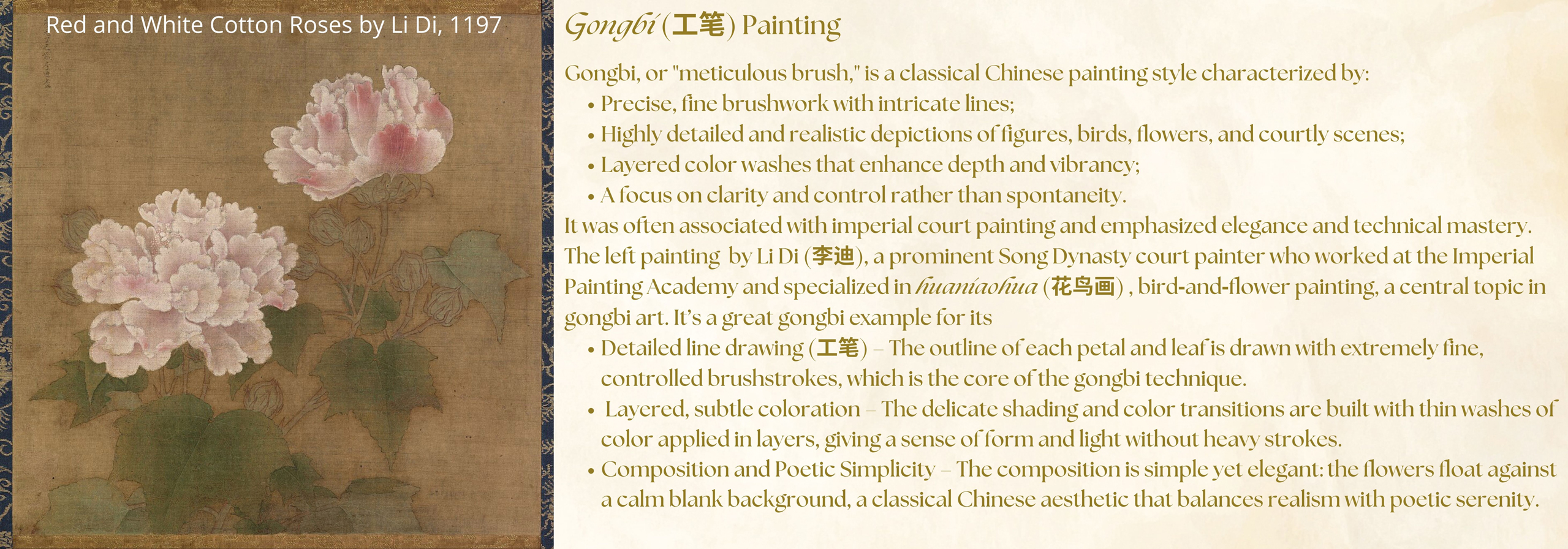
Instead of imposing European methods wholesale, he learned to integrate them with the gongbi (工筆) tradition of fine, detailed brushwork, which is highly valued in China. The result was a hybrid style that retained Western realism and spatial coherence yet harmonized with Chinese compositional rhythms and symbolic content.
This synthesis aligned perfectly with Qing imperial taste. The emperors valued paintings that both documented real events and embodied refined aesthetic expression. Castiglione’s work satisfied these demands with accurate representations informed by perspective and modeling and allusions to Chinese cosmological symbolism and poetic resonance.
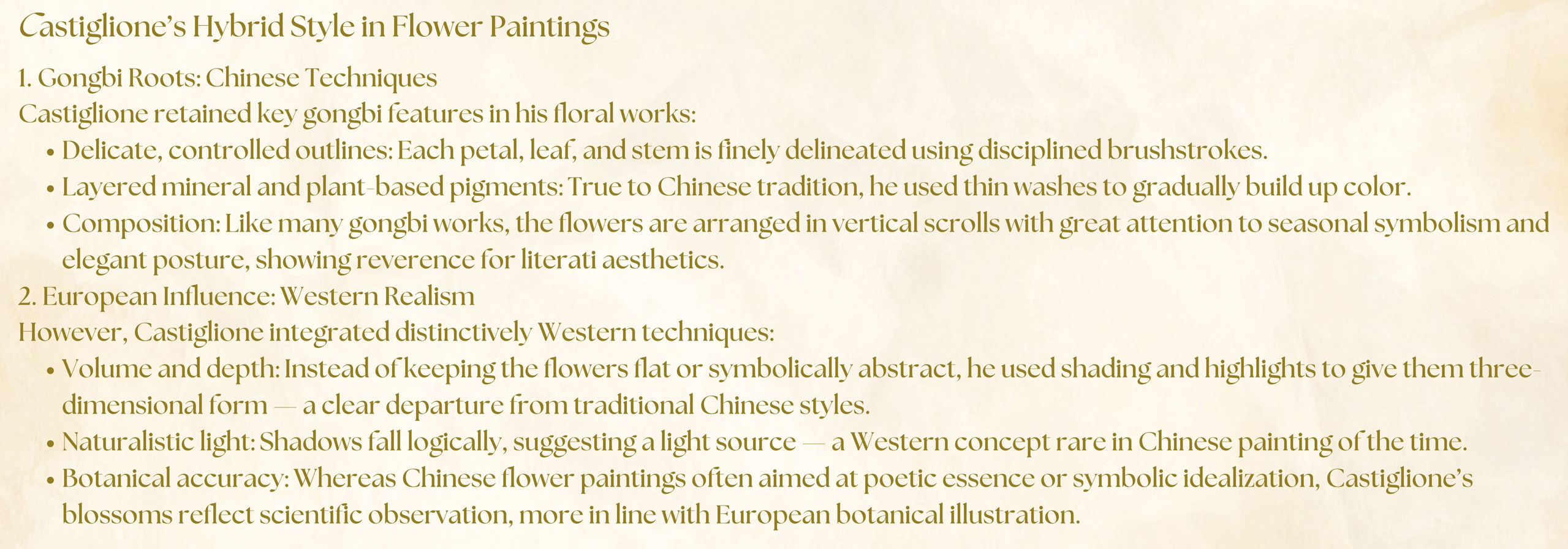
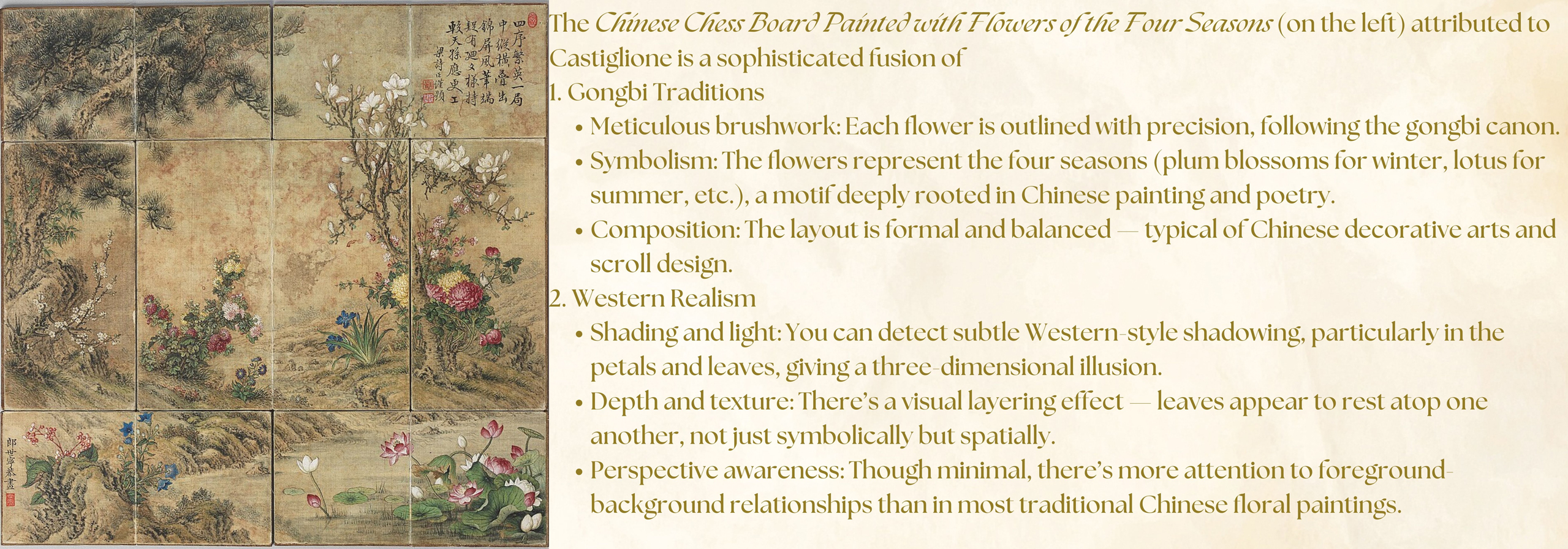
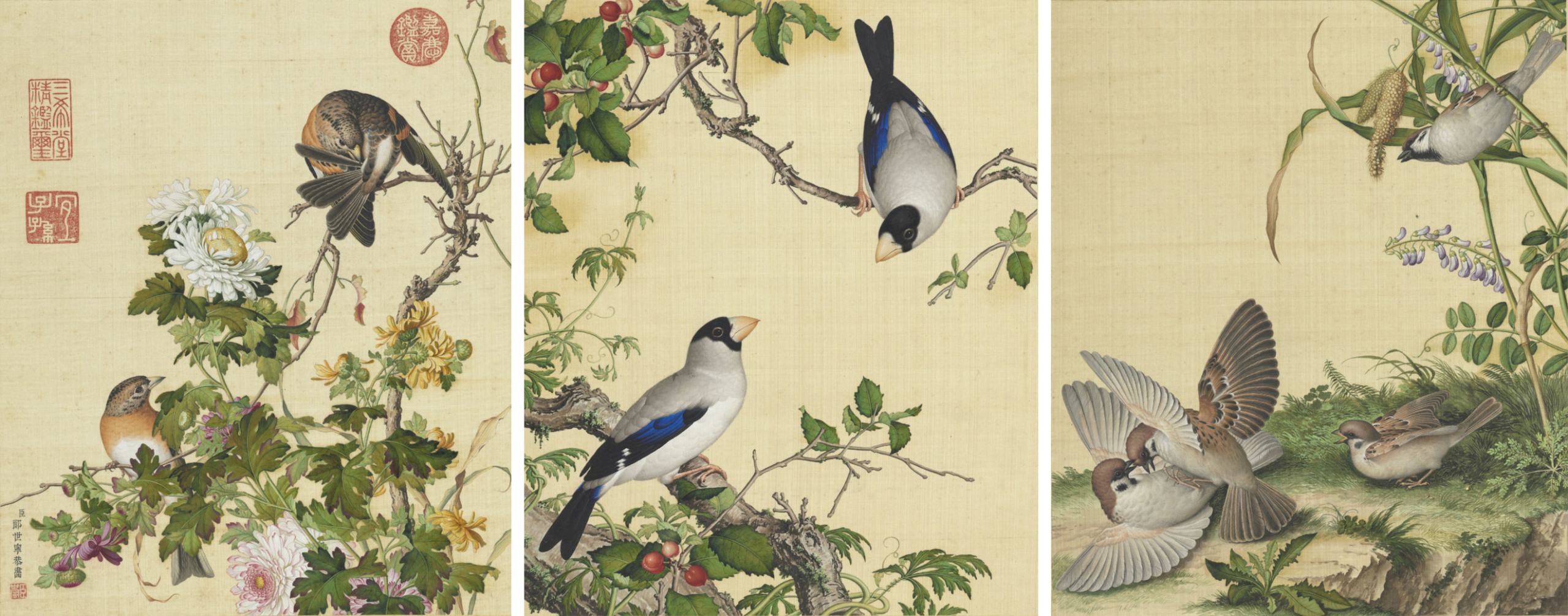
"The richness of Giuseppe Castiglione's bird-and-flower painting is marked by its difference from traditional Chinese methods. Forms often consist of shapes gradually built up with very few of the outlines normally seen in Chinese painting. "Immortal Blossoms in an Everlasting Spring" in the National Palace Museum collection is a typical example of such. In this album of paintings in ink and colors on silk, eight of them deal with flowers and the other eight bird-and-flower combina-tions. The last leaf is signed, "Reverently painted by Your Servitor, Lang Shining (Giuseppe Castiglione)." The precise forms rendered from life with bright and beautiful colors make this rep-resentative of a new model for academic painting that Castiglione formulated at the Qing court." (From the official texts by the National Palace Museum of Taipei, prepared for the 2015-2016 exhibition Portrayals from a Brush Divine).
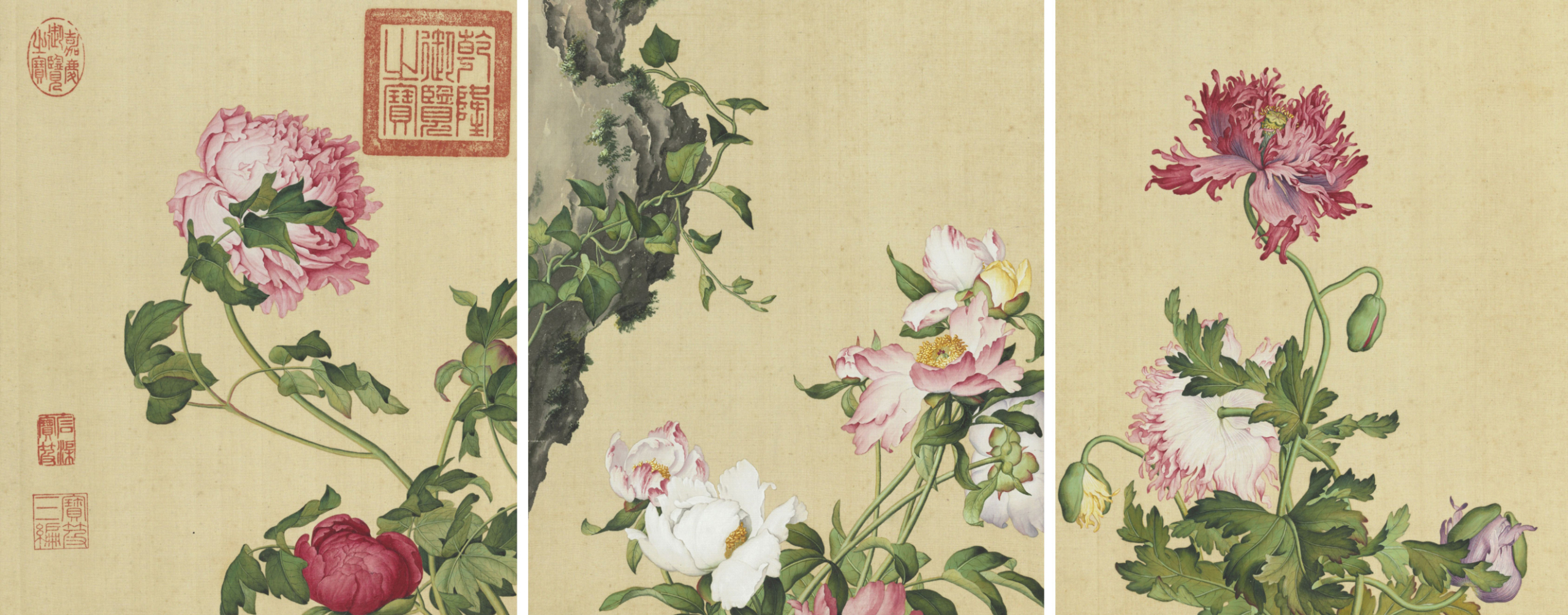
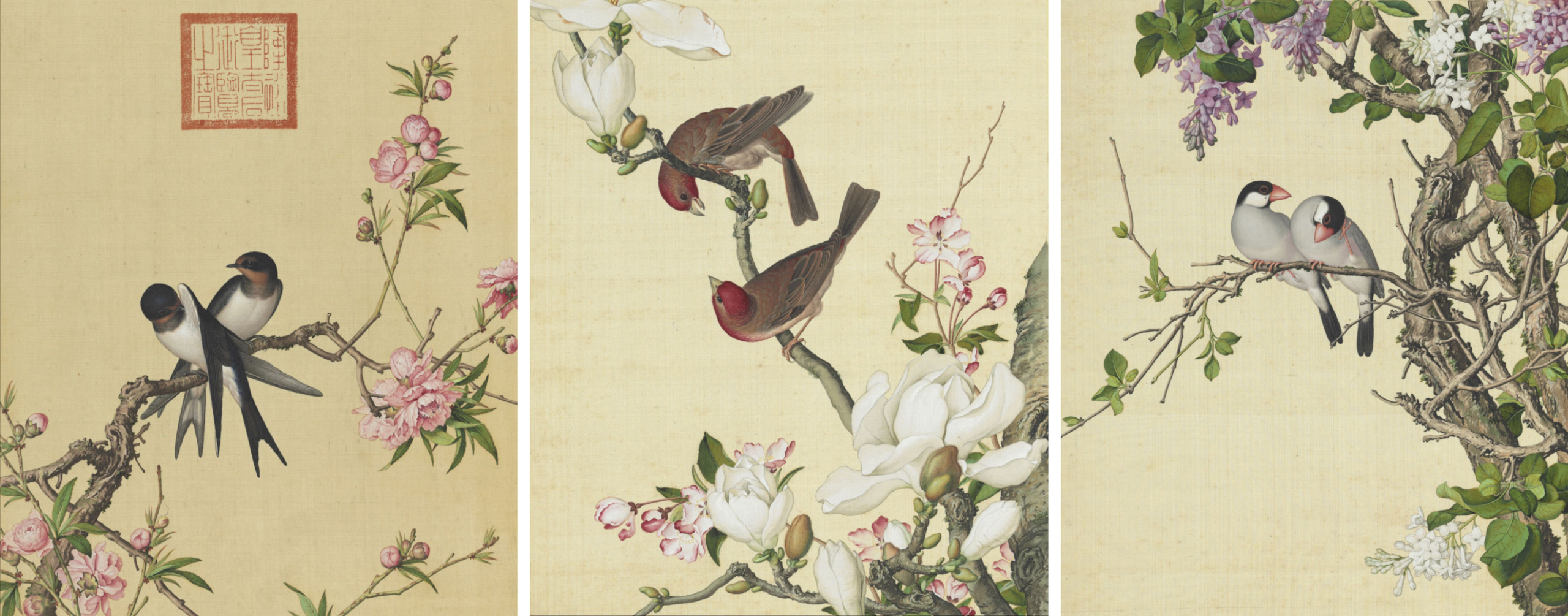
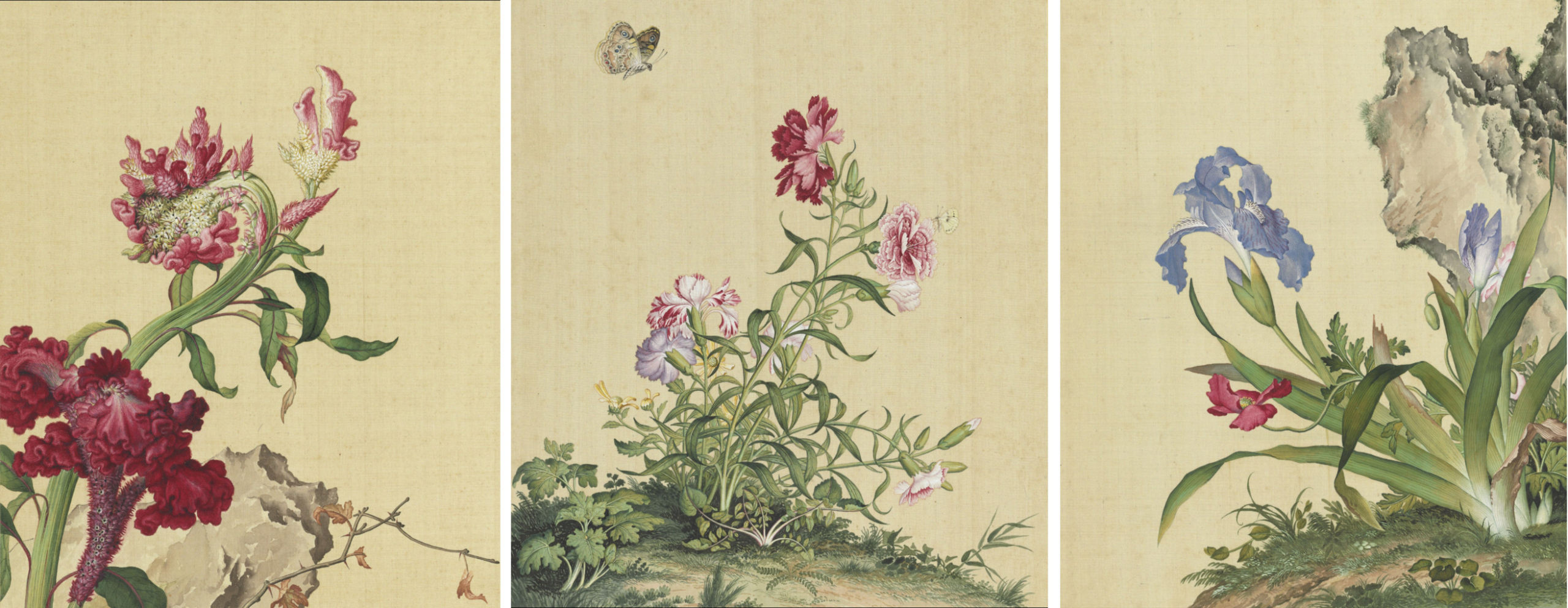
Giuseppe Castiglione's solid foundation in Western painting techniques is evident throughout Immortal Blossoms in an Everlasting Spring (Changchun Ruiying Tuce, 长春瑞应图册), a series of sixteen album leaves depicting flowers, fruits, and plants. The artist created this series during the Yongzheng reign (1723–1735), most likely between 1723 and 1725.
The album celebrates imperial virtues, seasonal renewal, and auspicious symbolism, aligning with the court's values of longevity, fortune, and harmony. The album consists of sixteen flower studies, including peonies, camellias, lotuses, magnolias, and plum blossoms. Castiglione's style represents his early fusion of European realism and shading techniques, such as light source, volume, and botanical accuracy, with Chinese subjects and formats, such as flowers as carriers of symbolic meaning. Each flower is paired with an inscription—a poem composed by the Yongzheng Emperor—that praises the elegance, purity, or moral significance of the depicted flora.
The gradations of the peony petals and the attention to areas of color reveal a Western influence. The petals of the white magnolia and cockscomb twist and turn in shades of color. The shadows fully reveal the artist's focus on the light source. The birds depicted in these album leaves are varied and animated. Their eyes are spirited and highlighted with white pigment. White coloring was also used for the rocks and branches to suggest brightness and volume. These depictions of birds and flowers are comparable to those on imperial painted-enamel porcelains, which testifies to the circulation and application of designs in different art forms at the Qing court.
"Castiglione not only painted the sixteen leaves in this album with meticulous care and coloring, the compositions are also quite innovative. In particular, he was able to reach beyond the traditional portrayal of birds in Chinese painting to achieve fantastic results in Western perspective and shading as well. Many places in the depiction of the birds and flowers reveal touches of light and shadow, the artist showing adept skill at using white pigment to highlight bright areas. The style throughout again relates to Castiglione's early Yongzheng manner." (From the official texts by the National Palace Museum of Taipei, prepared for the 2015-2016 exhibition Portrayals from a Brush Divine).
BELOW
Giuseppe Castiglione, Immortal Blossoms in an Everlasting Spring, Album leaves. Medium: Ink and colors on silk album leaf. Dimensions: 33.3 x 27.8 cm. © National Palace Museum (臺北故宮博物院), Taipei, Taiwan. The images below show only 12 of the 16 album leaves. To see all of the leaves, please go to this web page of the National Palace Museum of Taipei.
- Nature, Power, and Poetics in Early Castiglione
Giuseppe Castiglione’s early years at the Qing court (from 1715 to the late 1720s) were marked by stylistic experimentation and his gradual assimilation into the Chinese imperial painting tradition. Two notable works from this period, Dog Beneath Blossoming Flowers (花石瑞犬图) and Pine, Hawk, and Glossy Ganoderma (松鹰灵芝图), exemplify his evolving hybrid aesthetic prior to his monumental scroll, One Hundred Horses (1728). Both pieces reflect Castiglione's technical mastery of Western realism while adhering to the symbolic, compositional, and formal conventions of Qing court art.
Dog Beneath Blossoming Flowers (ca. 1723–1725)
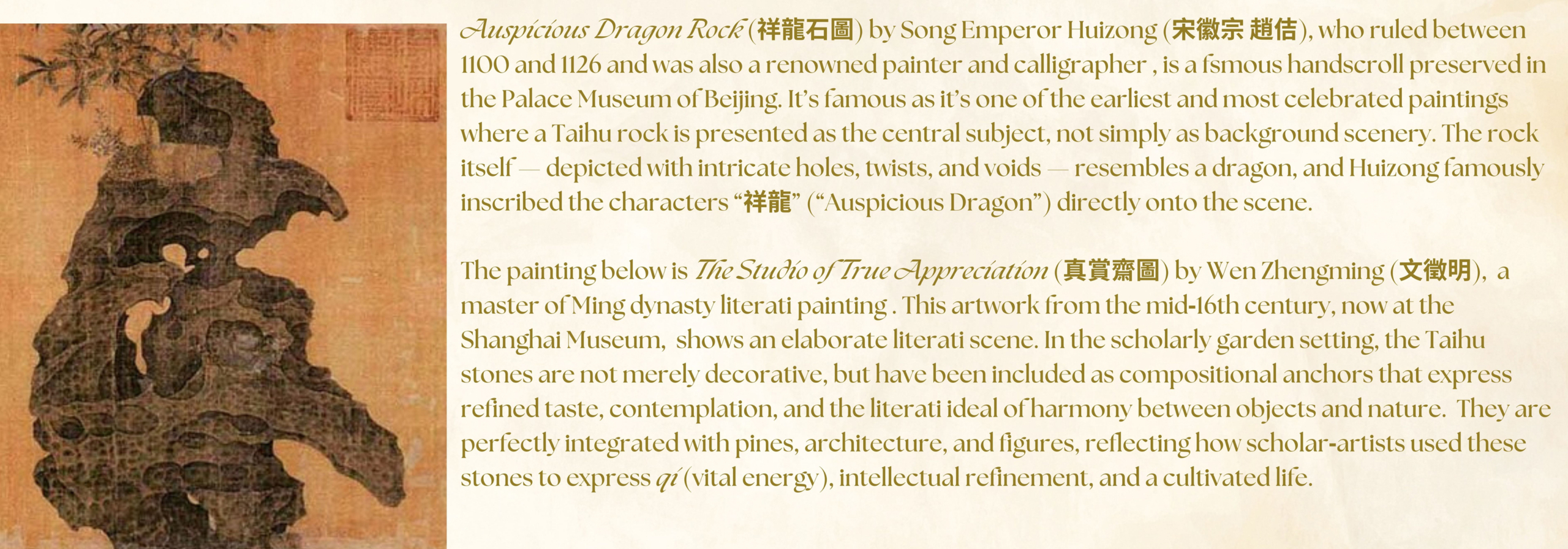
In Dog Beneath Blossoming Flowers (ca. 1723–1725), Castiglione depicts a brown, long-haired dog standing playfully beneath a branch of blooming peach blossoms, next to an intricate Taihu rock. This work exemplifies Castiglione’s early success in rendering lifelike textures — the dog’s fur is delicately modeled with directional light, a hallmark of European chiaroscuro — while embracing the symbolic motifs of Chinese bird-and-flower painting. The dog, likely a Pekingese or lap dog, symbolizes domestic peace, and the peach blossoms represent longevity and spring renewal.
The composition reflects Chinese vertical hanging scroll aesthetics, with the subject placed off-center and negative space balancing detail. Stylistically, this artwork belongs to the early Yongzheng period (1723–1735), suggesting a date around 1723–1725, a time when Castiglione transitioned from decorative arts to the more refined realm of imperial symbolism.
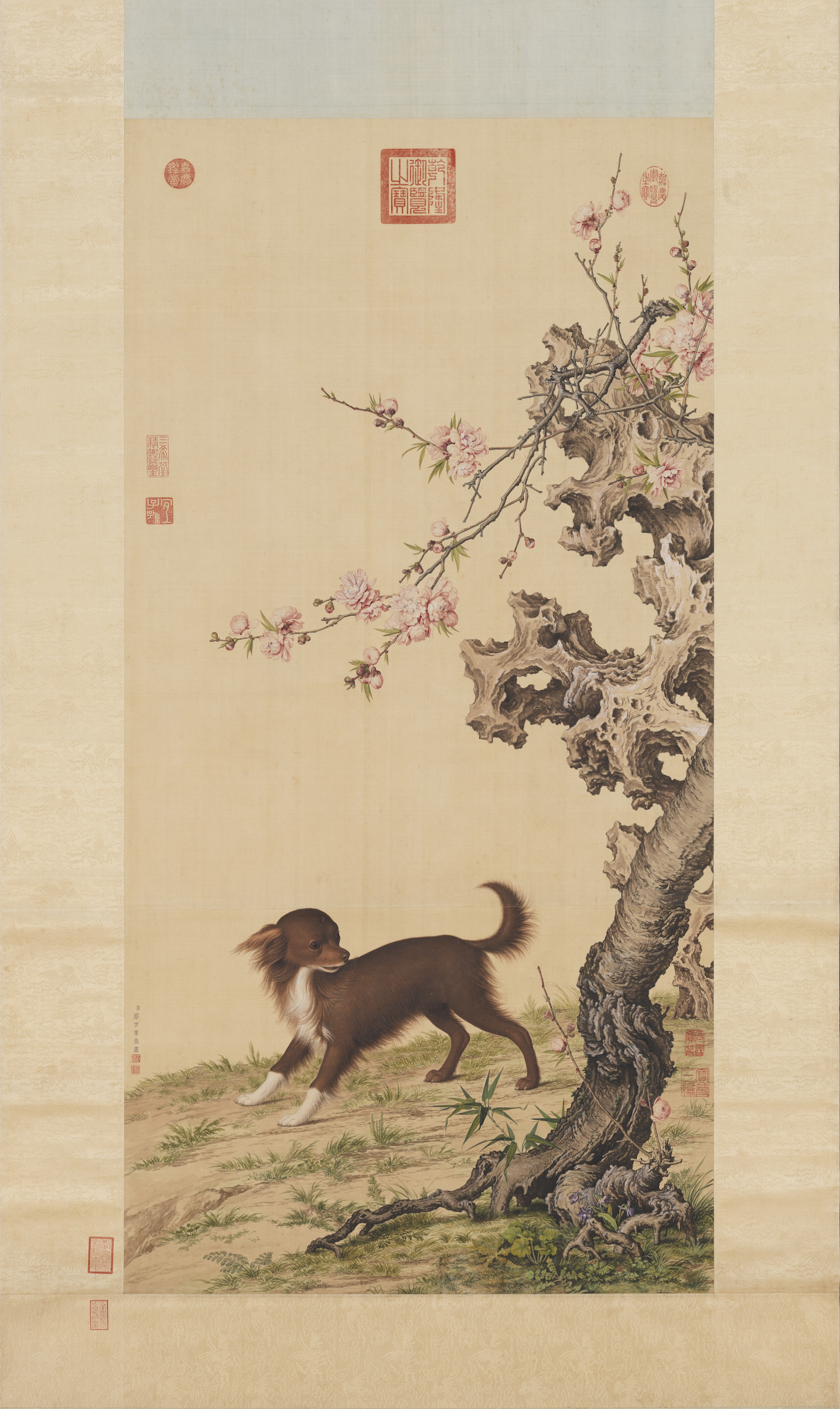
Giuseppe Castiglione, Long-haired Dog Beneath Blossoms or Dog Beneath Blossoming Flowers (中文(繁體:花底仙尨), hanging scroll, 1723-25. Medium: ink and colors on silk. Dimensions 123.2 x 61.9 cm (48.5 × 24.3 in). Collection National Palace Museum, Beijing.
Seeing the Unseen: Rethinking Beauty Through Taihu Rocks
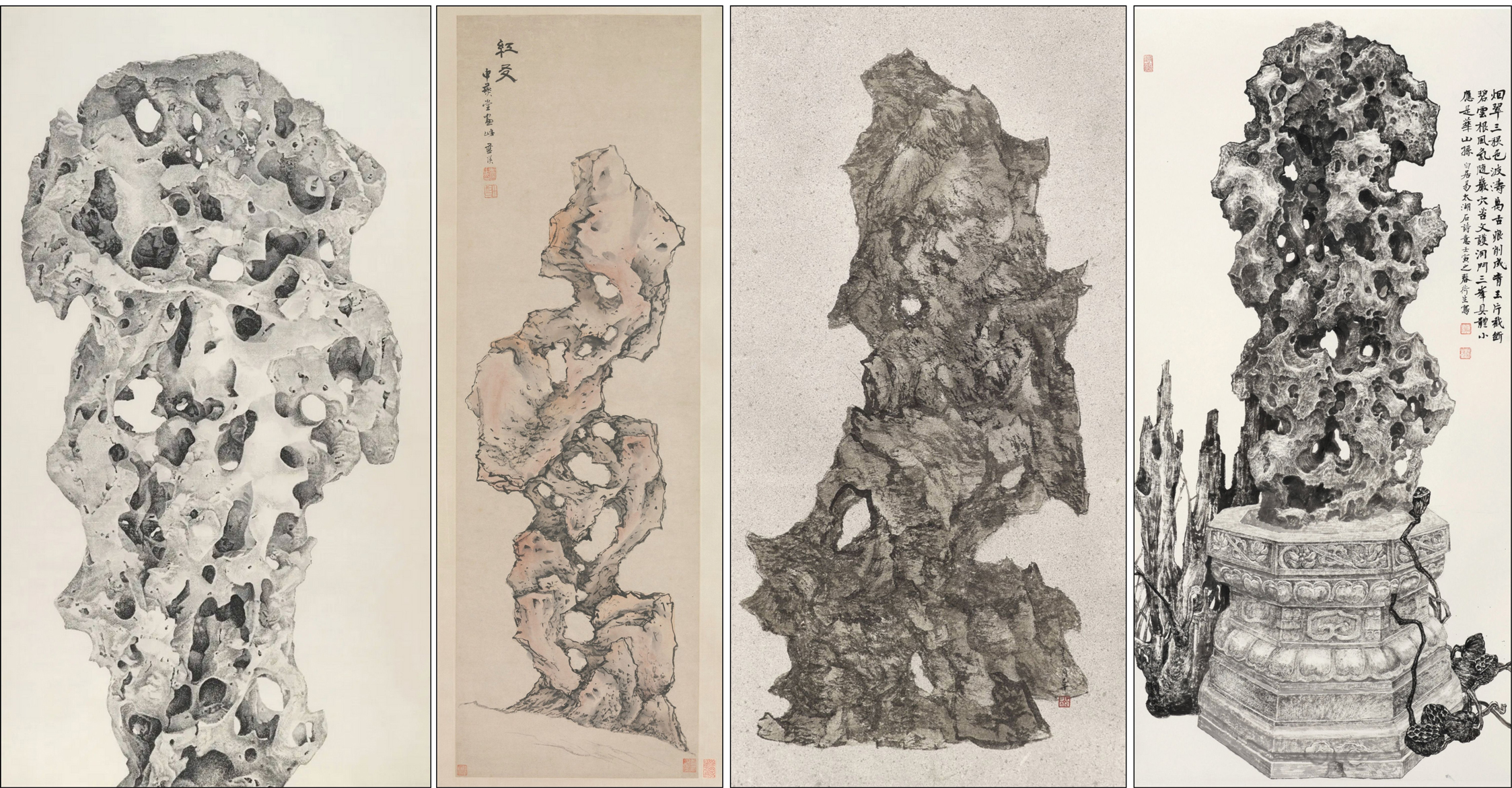
FROM LEFT TO RIGHT
Liu Dan (Chinese, born 1953), Taihu Rock from Jiemei Studio, 2006. Ink on paper. Dimensions: 110 × 67 3/4 in. (279.4 × 172.1 cm). Brooklyn Museum, New York, USA.
Lan Ying (Chinese, 1585–1664), Red Friend. Date: 17th century, Late Ming / Early Qing. Hanging scroll; ink and color on paper. Dimensions: 58 5/8 x 18 5/8 in. (148.9 x 47.3 cm). The MET, NewYork, USA.
C.C.Wang (aka Wang Jiqian, 1907-2003), Scholar Rock, 2001. Ink on paper. Dimensions: 54 1/2 x 28 3/4 in (138.3 x 73 cm).
Xia Hesheng, Rock of Taihu Lake, 2022. Ink on paper. Dimensions: 136.0 x 68.0 cm; 53 1/2 x 26 3/4 in. Private Collection.
Do you find Taihu rocks ugly, discomforting, or even perturbing?
Chinese Taihu rocks (太湖石), no matter how depicted, can be elusive to Western aesthetic sensibilities, and this reveals deep differences in how cultures frame beauty itself.
From a Chinese perspective, the appreciation of Taihu rocks rests on several philosophical pillars that simply don't have direct counterparts in Western art history.
First, the Aesthetics of "Imperfection" as Virtue
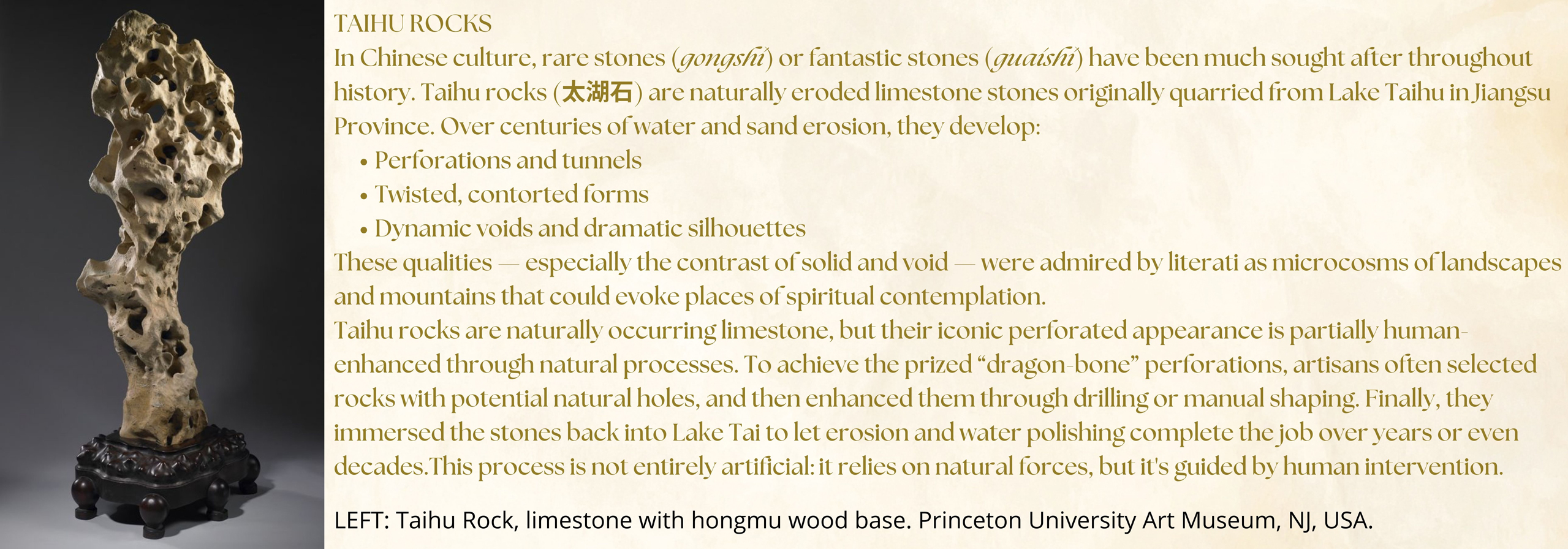
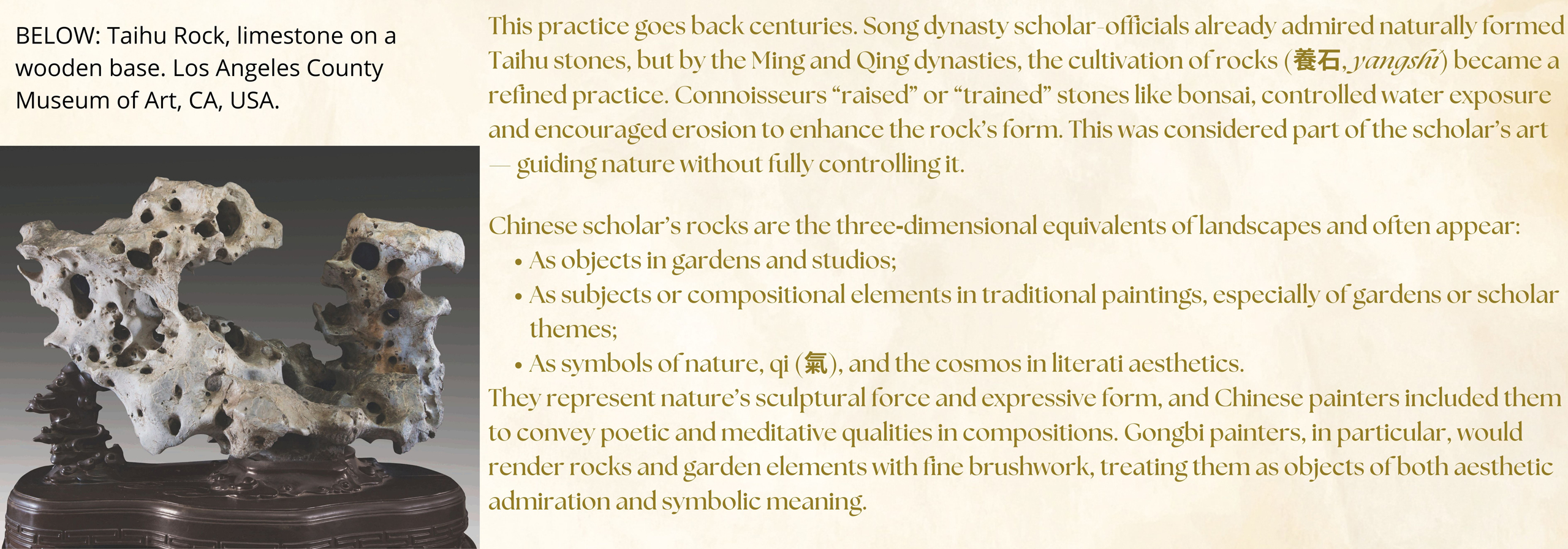
While Western aesthetics traditionally prized symmetry, proportion, and the "ideal form" inherited from Greek classicism, Taihu rocks celebrate precisely the opposite. Their value lies in the Four Virtues (瘦、透、漏、皱): thinness that suggests spiritual elevation, hollowness that implies openness to qi energy, perforations that create mysterious depth, and wrinkles that record time's passage. This isn’t mere formalism—it’s a Daoist worldview where ziran (自然, ‘spontaneous naturalness’) becomes a spiritual orientation. This resonates with the Japanese concept of wabi-sabi (侘寂), though the lineage is distinct.
Second, the Microcosm in the Macrocosm
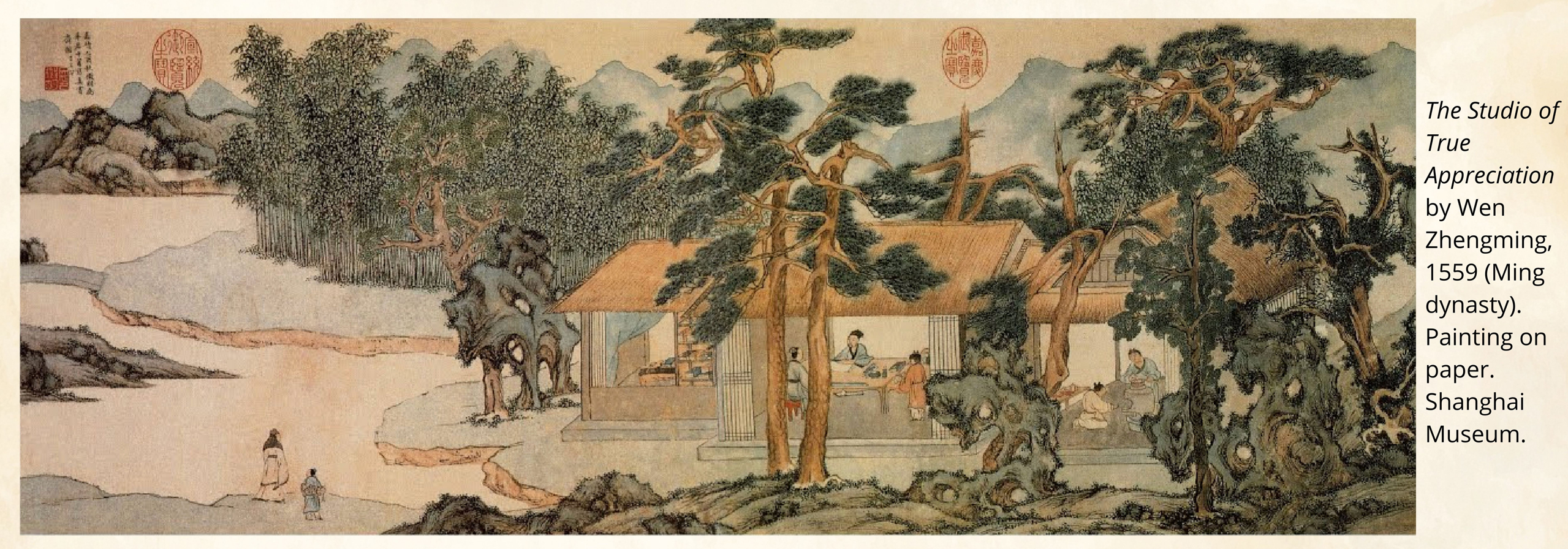
For Chinese scholars, these rocks weren't decorative objects but worlds-in-miniature. A single Taihu rock could contain mountains, caves, and clouds—inviting contemplative rujing (入境, "entering the landscape") without leaving the studio. This requires a mental leap: seeing a 3-foot rock as a 30-mile mountain range. Western landscape art typically separates viewer from vista; Chinese scholar rocks collapse that distance, demanding imaginative participation.
Third, the Artificial Perfection of "Naturalness
There's a profound paradox at the heart of Chinese literati aesthetics: the most prized "natural" forms were often the most artificially perfected. This reflects a key Daoist insight: that 'non-action' (wuwei, 无为) is not about doing nothing, but about acting in harmony with natural forces—so subtly that the human hand becomes indistinguishable from nature itself.
This reveals a layer of connoisseurship that might indeed be even more alien to Western aesthetics than pure naturalism would be.
The most valuable Taihu rocks were found by expert rock hunters who understood the scholarly aesthetic criteria intimately. They scoured Lake Tai for limestone that had eroded into promising forms, then through careful selection, elevated nature's accidents into art.
The "perfection" involved subtle human intervention—strategic soaking, acid treatments, or gentle mechanical enhancement to emphasize desirable features while maintaining the illusion of pure natural formation. The ideal was enhancement so skillful it attained ziran—not raw wildness, but a higher-order spontaneity that emerges from effortless accord between human intention and natural process.
The Cultivation of Randomness is another crucial element, perhaps the most sophisticated concept—humans working with natural processes, guiding erosion over decades, or selecting rocks that showed particular promise, then staging them to maximize their scenic qualities. It's a collaboration between human intention and geological time.
What scholars truly valued wasn't "pure nature" but nature perfected by understanding. The human hand was meant to be invisible, not absent—a distinction that separates Chinese scholar aesthetics from both pure naturalism and explicit craftsmanship.
All this creates an aesthetic that might be challenging for Westerners:
- First, to see beauty in twisted, "imperfect" forms;
- Second, to appreciate that these "natural" forms represent sophisticated human discernment and subtle intervention;
- Third, a western eye is not trained to see absence (the holes, the voids) as presence—the Daoist xu (虚) where emptiness is fullness.
To a Western eye trained on classical ideals and contemporary beauty standards, these rocks can appear disturbing, nonsensical, incomplete, or even a sort of monstrous reversal of smoothness, thus triggering an almost visceral sense of unpleasantness or wrongness. This reaction isn't superficial; it's rooted in profoundly different aesthetic ontologies.
Why They Read as "Ugly" to Western Perception?
Western aesthetics, from Greek proportion to Renaissance harmony, embeds the idea that beauty is a miraculous and graceful combination of health, smoothness, completeness, and idealized form. We instinctively associate asymmetry with injury, holes with decay, and contortions with deformity. The Taihu rock's "Four Virtues" (瘦、透、漏、皱) directly invert these values:
- 瘦 (shòu, "thin/leanness"): Not elegant elongation, but a gnarled, skeletal quality that might suggest privation or illness.
-透 (tòu, "permeability"): Those deep, tunnel-like perforations challenge the Western instinct for solidity and wholeness—like seeing a body pierced through.
- 漏 (lòu, "leakage/perforation"): The multiple holes create a sense of fragmentation, as if the rock is dissolving or riddled with wounds.
- 皱 (zhòu, "wrinkles/texture"): The convoluted surface reads not as weathered wisdom, but as chaotic, purposeless scarring.
The "perturbing" quality comes from this cognitive dissonance: Western eye sees organic form, but form that is "wrong" by every measure of classical beauty. It's the aesthetic equivalent of the uncanny valley—nearly familiar but unsettlingly alien.
What effort must Giuseppe Castiglione, a man of the late Italian Renaissance, have made to appreciate these rocky contortions and paint them (not often, to be honest)?
The Chinese Re-Framing: Virtue in the "Defects"
From the literati perspective, these features aren't flaws to tolerate but visible manifestations of noble character:
- Contortion (皱) is textual: each groove is a line of cosmic calligraphy, recording the patient work of water and time. It's not chaos; it's history made legible.
- Piercing (透/漏) is spiritual: the holes are channels for qi circulation. The rock isn't fragmented; it's permeable to the cosmos. A solid, unblemished rock would be dead—impermeable and spiritually inert. The voids (虚, xū) are as important as the stone (实, shí), embodying the Daoist truth that emptiness gives function.
- Leanness (瘦) is ethical: the rock's austerity mirrors the scholar's own rejection of worldly excess. It's an act of disciplined self-cultivation projected onto mineral form.
The Deeper Divide: Passive vs. Active Beauty
Western beauty often invites admiration, a completed form to be appreciated from a distance. The Taihu rock demands contemplative participation. You must mentally enter it, project yourself into its caves and crevices, and complete its meaning through imagination. What a Westerner sees as "ugly absence," the scholar sees as space for the mind to inhabit. In Chinese thought, this participatory gaze is not accidental—it is cultivated. Concepts like gongfu (功夫, "disciplined practice"), xin (心, "the heart-mind"), and you (游, "aesthetic wandering") describe the scholar’s inward journey through the rock’s imagined terrain.
So the "perturbation" you may feel is actually the first necessary step in its aesthetic function: it disrupts your conventional gaze and forces you into a different mode of seeing—one where beauty is not given but co-created through philosophical engagement. The rock is ugly until you bring the right cultural-mental framework to it; then it becomes profound. This makes it less an object of art than a tool for transformation.
Now let's return to Giuseppe Castiglione.
Pine, Hawk, and Glossy Ganoderma (ca. 1725–1727)
This monumental vertical hanging scroll depicts a white hawk perched on a rugged cliff. The hawk is flanked by a gnarled pine tree, a rushing waterfall, and lingzhi mushrooms (Ganoderma). The painting is technically impressive and deeply infused with imperial symbolism. The white hawk (鹰) is associated with vigilance and martial prowess and is often used as a metaphor for the emperor's power or his military elite. The pine symbolizes steadfastness; the lingzhi, immortality; and the torrent, dynamic energy. The eagle’s anatomy — its feathers, talons, and gaze — is rendered with Castiglione’s European anatomical accuracy. Yet, it stands in sharp contrast to the stylized, symbol-laden natural elements.
Created around 1725–1727, the painting demonstrates Castiglione's growing integration into the court's pictorial language, showcasing his increasing mastery of spatial layering and Chinese ink-and-color brushwork, particularly evident in the rocky textures and vegetation.
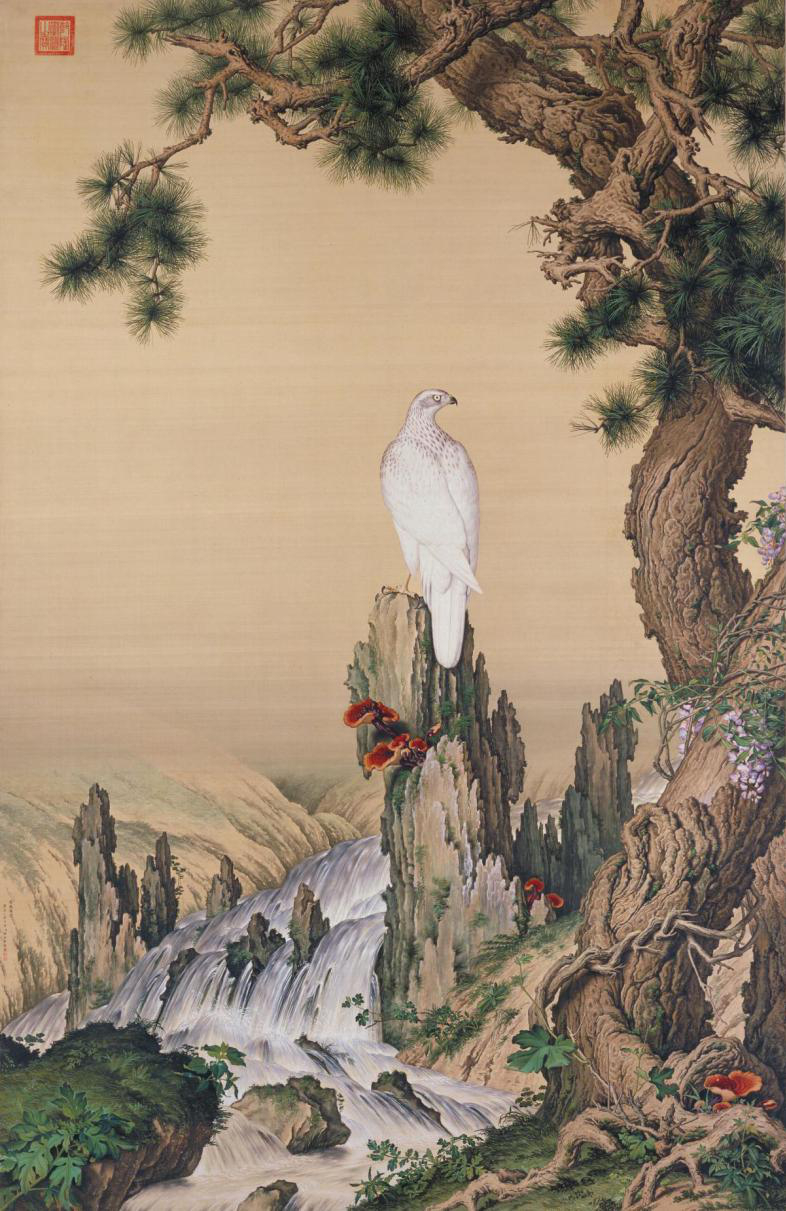
Giuseppe Castiglione, Pine, Hawk and Glossy Ganoderma, hanging scroll, 1725-27. Medium: ink and color painting on silk. Dimensions: height 242.3 cm (95.3 in), width: 157.1 cm (61.8 in). Collection National Palace Museum, Beijing.
The last two works demonstrate Castiglione’s synthesis of two pictorial systems: Western realism and Chinese allegorical aesthetics. In Dog Beneath Blossoming Flowers, he experiments with scale and narrative intimacy. In contrast, Pine, Hawk, and Glossy Ganoderma engages with the visual grandeur and iconography expected of imperial commissions.
Both paintings foreshadow his later works, such as One Hundred Horses, in which Castiglione's fusion becomes more mature, monumental, and ideologically charged. Thus, these early scrolls mark an important developmental stage in both Castiglione’s career and the emergence of a new hybrid court style under the Qing.
- One Hundred Horses (百駿圖, 1728)
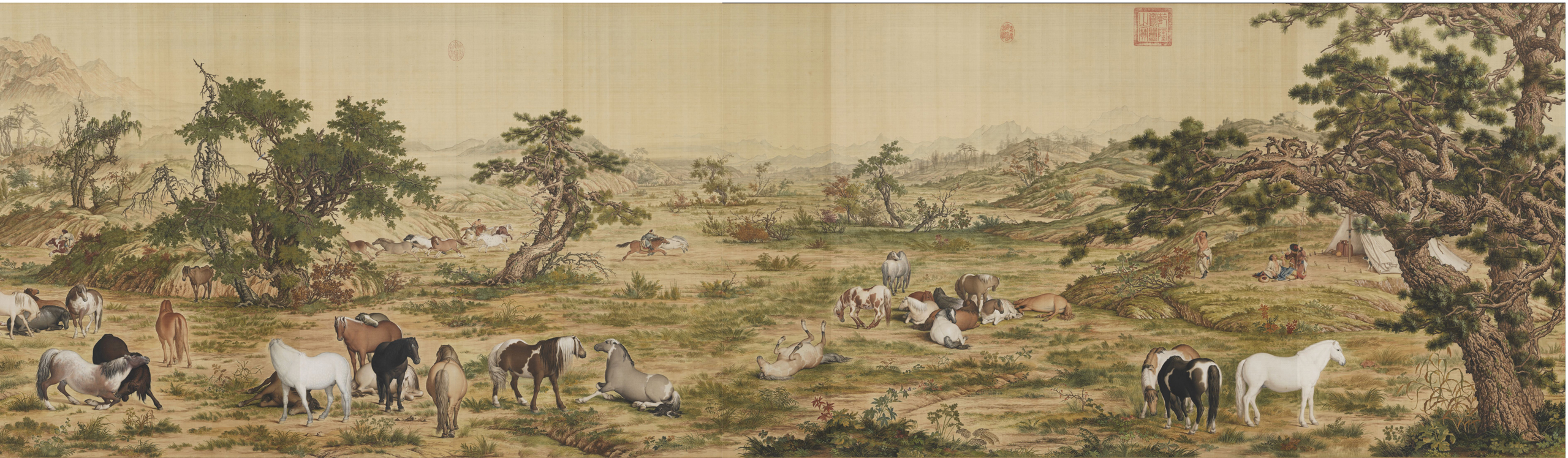
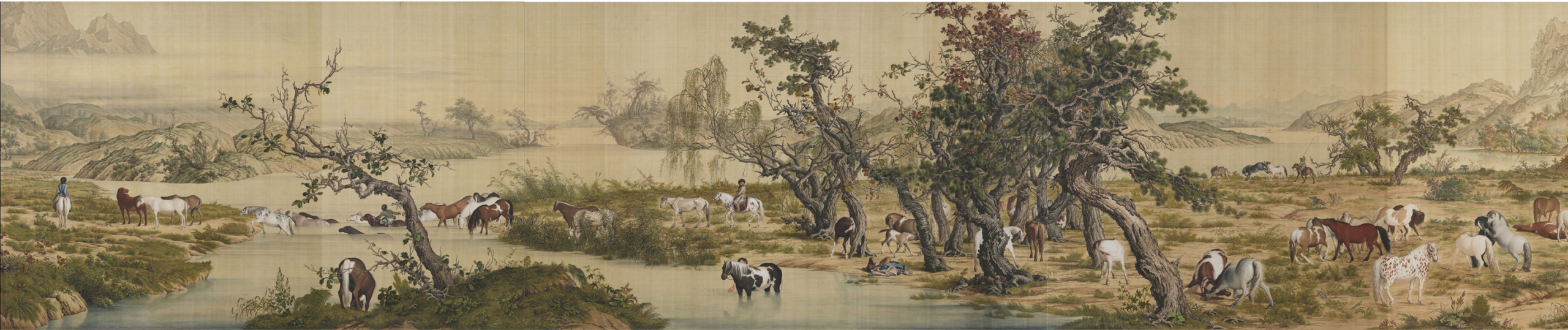
One of Castiglione’s most celebrated works is the handscroll One Hundred Horses (Baijun Tu, 百駿圖). Archival evidence from the Qing imperial household confirms that Castiglione received the commission in 1724 and finished the painting in 1728, during the reign of the Yongzheng Emperor.
This monumental silk painting, which spans eight meters, depicts a wide array of horses in various poses and attitudes. The horses are meticulously rendered with a consistent light source and spatial depth, which is uncommon in traditional Chinese painting. This piece exemplifies Castiglione's ability to combine Western observational realism with Chinese scroll composition. It ingeniously integrates Western and Chinese styles: Renaissance perspective constructs receding landscapes in which horses, rendered with the anatomical precision he learned from European equine studies, engage in pastoral dramas. Yet, the composition flows with the rhythmic cadence of Chinese handscroll conventions, inviting the viewer's eye to travel through time and space (from right to left!).
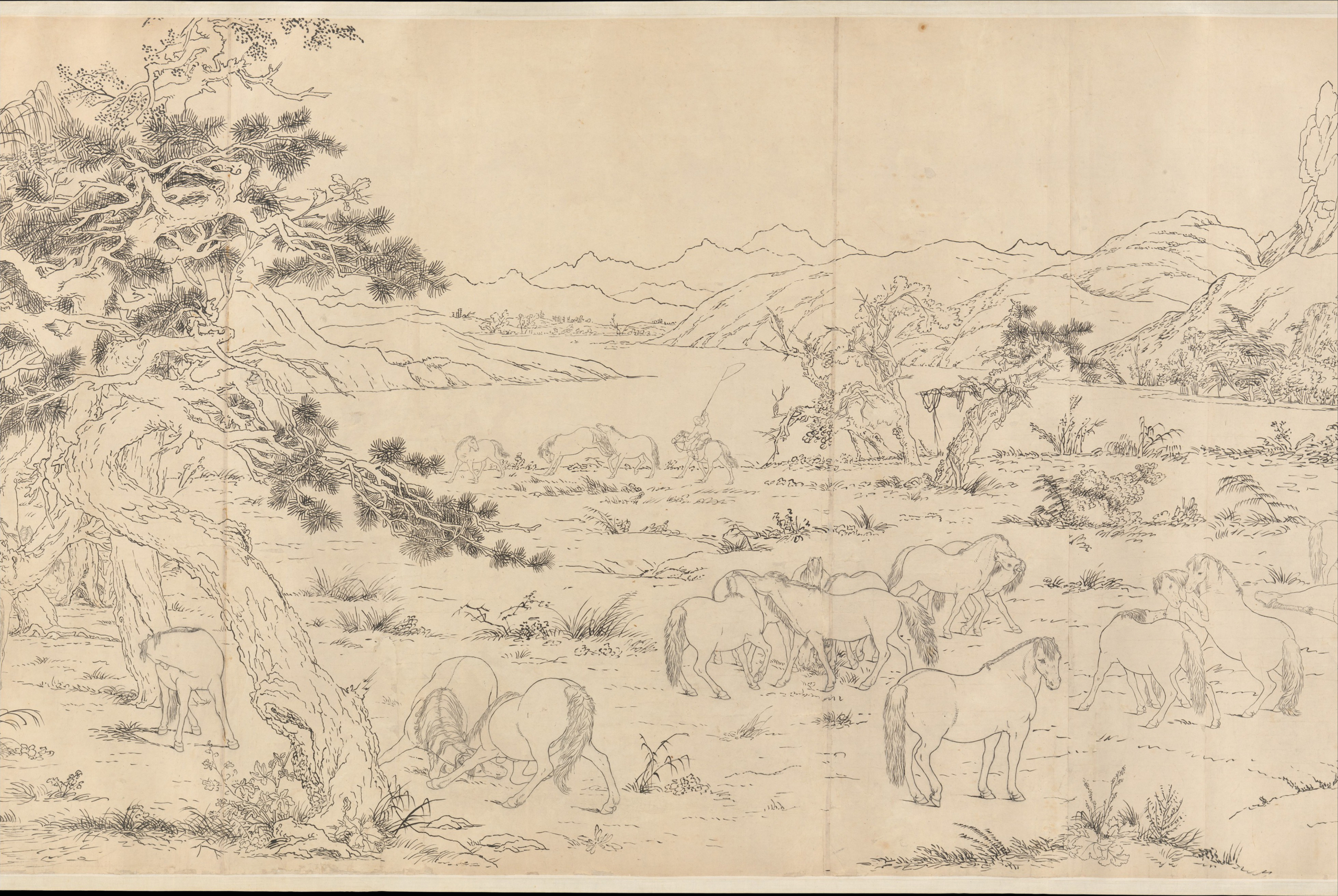
A preparatory draft survives, revealing Castiglione's meticulous process. He applied Western methods of painting from life while retaining Chinese aesthetic principles, rendering each horse as a character in a Confucian parable of hierarchy, harmony, and natural order. The scroll's fame was immediate and enduring, establishing a template for court painting that would persist for decades.

Giuseppe Castiglione (Lang Shining 郎世寧), One Hundred Horses, preparatory draft. Date: 1723–25. Medium: ink on paper. Image dimensions: 37 in. x 25 ft. 10 3/4 in. (94 x 789.3 cm). The MET, New York, USA.
BELOW
A detail of the One Hundred Horses preparatory draft. The MET, New York, USA.
"This monumental scroll, a unique example of a Castiglione preparatory drawing, is the model for one of Castiglione's most famous paintings, the One Hundred Horses scroll preserved in the National Palace Museum, Taipei. The drawing, although done with a brush rather than a pen, is executed almost exclusively in the European manner. Landscape is represented using Western-style perspective, figures are often shown in dramatically foreshortened views, and vegetation is depicted with spontaneous arabesques and cross-hatching. The large scale of the painting also suggests a European influence, as if Castiglione had taken a typical Western canvas and extended its length to make an architectural frieze." (The MET curators).

Giuseppe Castiglione, One Hundred Horses, handscroll. Medium: ink and colors on silk. Dimensions: 94.5 x 776 cm. © National Palace Museum, Taipei, Taiwan.
BELOW
The One Hundred Horses handscroll from right to left. This enlarged view allows you to see most of the details.
- Giuseppe Castiglione as a Court Painter – From the Early to the Middle Period
After completing his celebrated One Hundred Horses scroll in 1728, Castiglione solidified his position at the Qing court. He then entered a period of artistic maturation, during which his subject matter expanded and the fusion of Chinese and European visual languages deepened.
During the late Yongzheng period and early Qianlong reign (1735), Castiglione became the primary portraitist for the imperial family and high-ranking officials. His portraits demonstrate a clear progression toward integrating Western naturalism—modeling of volume and light—with Chinese court representation conventions. Figures are rendered with subtle shading and spatial presence yet are set against surfaces and compositions that adhere to Chinese pictorial norms.
He painted portraits of the imperial family — carefully composed figures in rich attire — which conveyed status and ritual identity more than individual psychology. His workshops also produced group scenes with multiple figures that balanced intricate court protocols with a sense of depth uncommon in traditional Chinese portraiture.
Castiglione did not work in isolation, but rather alongside Chinese painters and court artisans. Court painting in Qing China was a collective enterprise. Castiglione worked within the Imperial Painting Academy alongside Chinese artists who specialized in different styles and techniques, such as landscape, figure, and architecture. His role in the Academy meant that collaborating with Chinese painters was the norm. Chinese painters often assisted with backgrounds and secondary figures, while Castiglione executed principal faces and key elements, synthesizing styles across traditions. He introduced European techniques such as linear perspective, oil painting, and chiaroscuro, but they were adapted to Chinese formats, such as handscrolls and hanging scrolls, and aesthetic values. The goal was not to replace Chinese art, but rather to enhance it with foreign elements that appealed to imperial tastes.
Around the 1730s–1740s, Castiglione expanded into bird‑and‑flower (花鳥) painting and still‑life subjects for the court. These works were often commissioned by the crown prince (the future Qianlong emperor) and palace elites. Works from this period demonstrate:
- Detailed observations of peonies, chrysanthemums, orchids, and plum blossoms with delicate brushwork and gentle modeling, reflecting Chinese literati aesthetics enhanced by Western illusionistic space.
- Fruits and symbolic flora, such as pomegranates, peaches, and grapes, appear as auspicious motifs in palace décor and are often rendered with traditional line and light-based shading techniques.
The following works illustrate how Castiglione’s technique continued to evolve beyond mere novelty of European methods toward a nuanced hybrid style respectful of Chinese subject matter and iconography.
Flowers in a Vase (清郎世寧畫瓶花 軸) was painted during the transition between the late Yongzheng and early Qianlong periods (ca. 1720s–1730s). It depicts peonies and other flowers arranged in an ornate vase — a traditional bird-and-flower subject rendered with careful shading and volumetric color influenced by Western light effects.
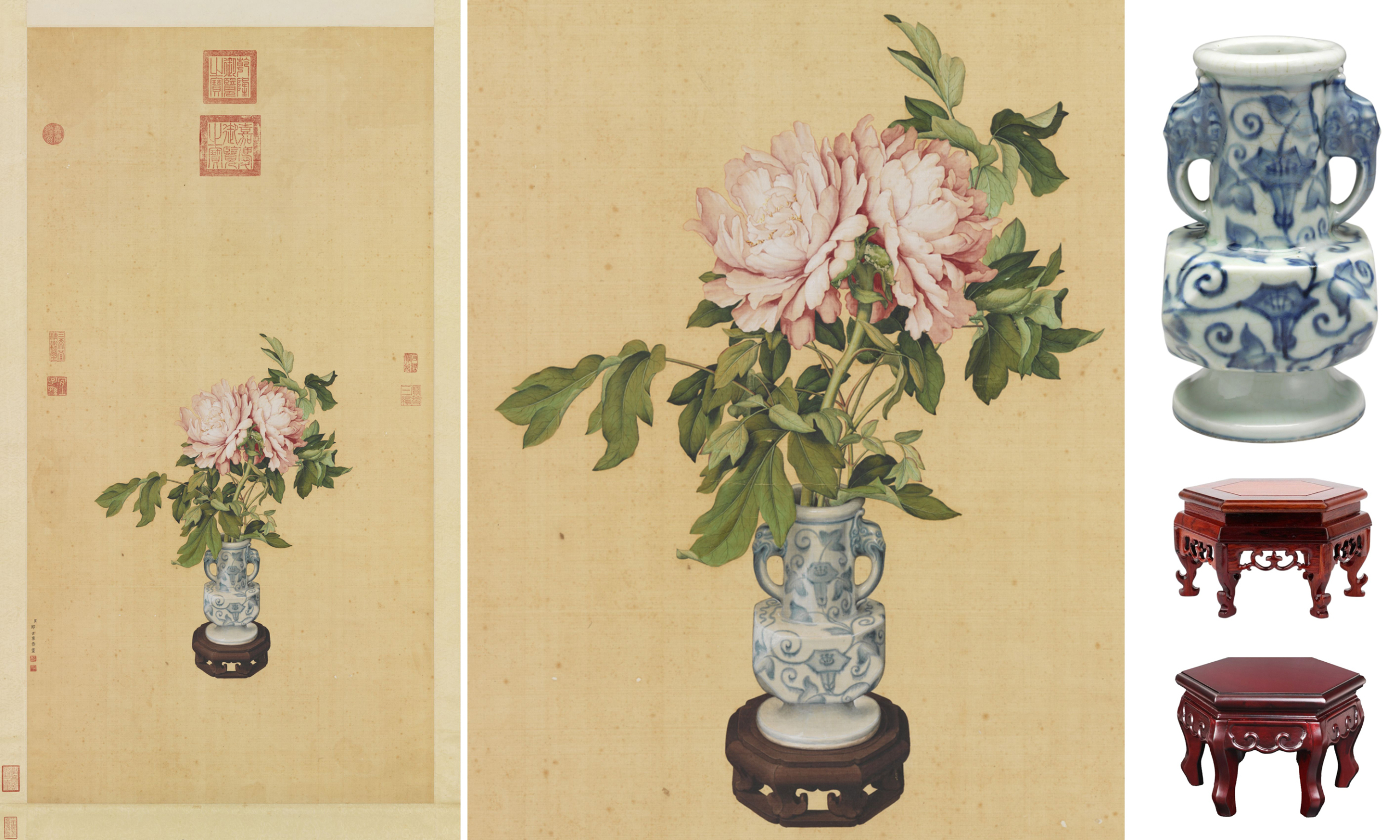
LEFT AND CENTER: Giuseppe Castiglione, Vase of Flowers or Flowers in a vase, undated. Hanging scroll. Medium: ink and colors on silk. Dimensions: 113.4 × 59.5 cm. © National Palace Museum, Taipei, Taiwan. "This hanging scroll is undated, but the style of Giuseppe Castiglione's signature ("Respectfully painted by Your Servitor, Lang Shining") is similar to that on Gathering of Auspicious Signs. According to archives from the Qing dynasty court, in the third lunar month of the Yongzheng emperor's fifth year (1727), Castiglione went to the Old Summer Palace (Yuanmingyuan) to paint a twin-blossom peony, perhaps the one shown in this scroll. The peony petals here were outlined with light red and then shaded with areas of color to give them volume, being also treated with white pigment to suggest a slight shine. The stems and leaves are likewise shaded for a three-dimensional effect, once again demonstrating Castiglione's new style adapting Western techniques. The form of the porcelain vase is unique as well, being similar to an angular Xuande underglaze-blue of the Ming dynasty with morning-glory decoration. Castiglione used a special way of interpreting the glaze, reducing the intensity of the blue while heightening the luster of the surface, adding white lines to enhance details for the reflection as well. This painting fully conveys a conscious attitude toward manipulating the effects of light and shadow." (Text by the curators of the National Palace Museum, Taipei)
RIGHT, TOP TO BOTTOM: 1. Ming dynasty Xuande reign porcelain vase with morning-glory decoration in underglaze blue, similar to those painted by Castiglione. © National Palace Museum, Taipei, Taiwan. 2. Some examples of traditional wooden stands.
In China, small wooden stands, often finely carved from hardwoods such as zitan, huanghuali, or hongmu (rosewood), serve aesthetic and symbolic purposes. They elevate prized objects, such as porcelain, jade, and bronze vessels, emphasizing their value and creating visual separation from the surface below. Using a stand shows respect for the object and aligns with Confucian principles of hierarchy and decorum. The stands' design complements rather than competes with the objects they hold, often echoing forms found in traditional furniture or architecture. In paintings like Vase of Flowers by Castiglione, the inclusion of a stand reflects the enduring Chinese tradition of displaying objects and subtly signals the elevated status of the imperial Xuande-period porcelain vase.
Pair of Cranes in the Shade of Flowers marks a pivotal moment in Giuseppe Castiglione’s career at the Qing court. At this time, his artistic style had evolved beyond initial experimentation, achieving a harmonious balance between European naturalism and Chinese symbolic tradition. Created around 1728–1736, during the final years of the Yongzheng reign and possibly extending into the early Qianlong period, the painting reflects Castiglione’s growing authority as a court painter entrusted with auspicious and ideologically significant subjects.
The painting depicts two cranes standing beneath flowering branches and beside scholar's rocks in a tranquil garden. Castiglione renders the birds with remarkable anatomical precision. The modulation of their plumage, subtle weight distribution in their stance, and soft modeling of volume reveal his European training. At the same time, the overall structure—vertical format, asymmetrical balance, and generous negative space—fully conforms to Chinese bird-and-flower painting conventions.
In Qing visual culture, cranes are powerful emblems of longevity, harmony, and moral purity. They are often associated with ideal governance and cosmic order. Their pairing suggests concord and stability, and the surrounding flowers and rocks reinforce themes of seasonal renewal and cultivated elegance. These symbolic layers closely align with the court’s ideological needs during the dynastic transition from the Yongzheng to the Qianlong era, when continuity, legitimacy, and auspicious renewal were paramount.
Stylistically, the painting falls between Castiglione's exploratory works of the early 1720s and the monumental One Hundred Horses (1728). Here, realism is no longer asserted as a novelty, but rather, it is carefully subordinated to courtly decorum and symbolic clarity. The result is a work of quiet authority that demonstrates Castiglione’s successful internalization of Qing imperial aesthetics while retaining the technical finesse that distinguished him within the court atelier.
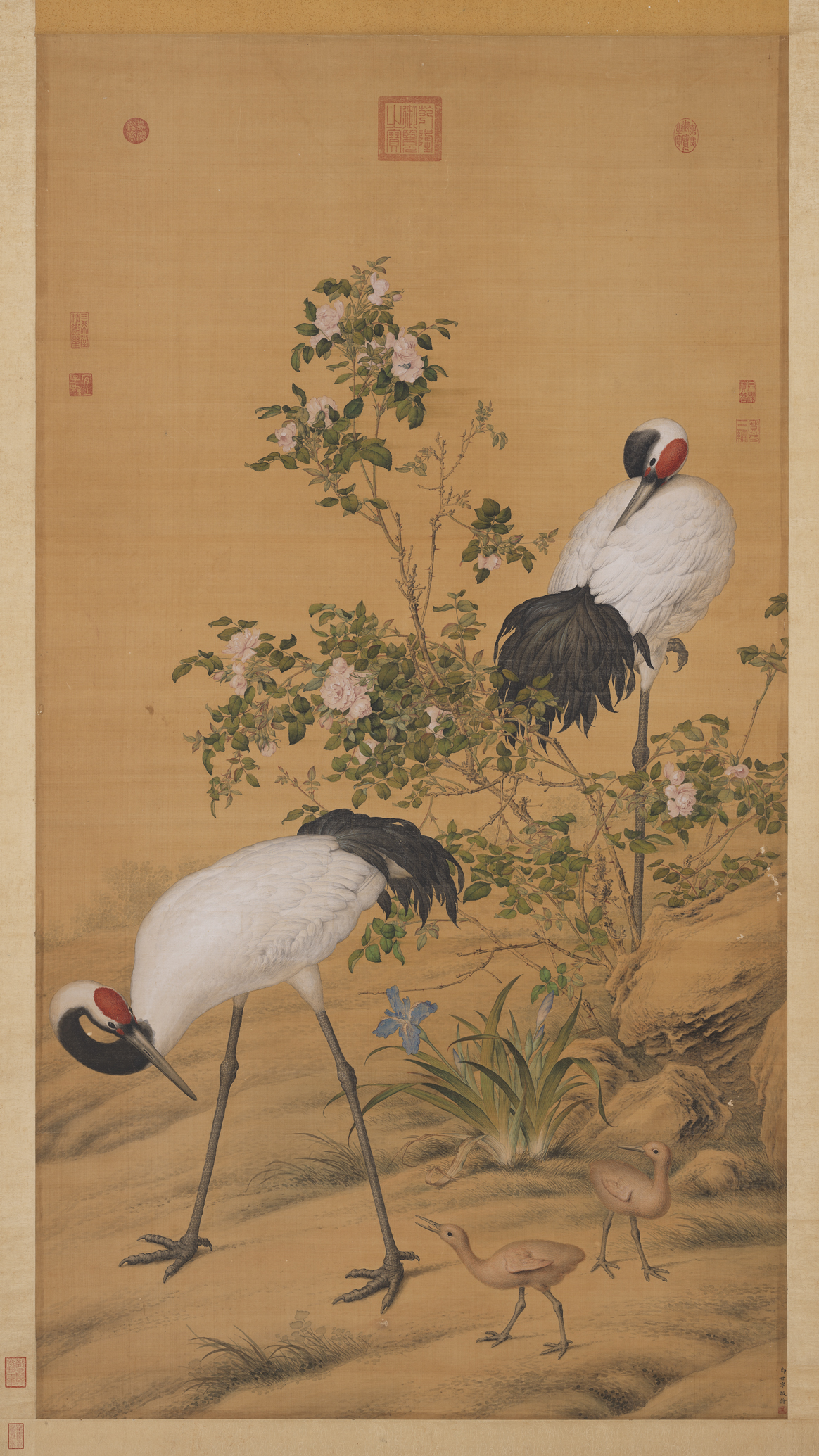
Giuseppe Castiglione, Pair of Cranes in the Shade of Flowers, Hanging scroll. Date: circa 1728–1736. Medium: Ink and color on silk. National Palace Museum, Taipei (臺北故宮博物院).
In the following years, Castiglione's trajectory will reflect several key developments.
Spatial Depth and Modeling: Compared to his earlier work, such as One Hundred Horses, his mid-career paintings demonstrate a more confident use of light and shadow to suggest three-dimensional form, particularly in fabrics, flesh, and botanical subjects.
Integration with Chinese Conventions: Although he was trained in European techniques, Castiglione adopted Chinese compositional hierarchies, such as the preference for flat pictorial space in backgrounds and the selective use of perspective. This approach yielded a balanced hybrid style rather than a complete transplantation of techniques.
Collaborative Production: Rather than working alone, Castiglione collaborated with Chinese court painters from the Imperial Painting Academy. He learned from their mastery of calligraphic brushwork and symbolic content. These collaborations produced works that were innovative yet acceptable to imperial taste.
- The Qianlong Era: Zenith of a Syncretic Style
During the sixty-year reign of Qianlong (1735–1796), Castiglione transformed into a Qing institution, reaching the zenith of his artistic career at the imperial court. His role expanded beyond that of a portraitist to include that of a visual propagandist for the emperor's reign. He crafted idealized images that conveyed Qianlong's power, cultural refinement, and benevolence. In his 50s and 60s, the Jesuit painter developed a style known at court as xianfa, or the "line method." This style seamlessly combined Chinese and Western elements, earning it recognition as a distinctive high Qing court manner.
Under Qianlong, the Qing Empire reached its greatest territorial extent and cultural confidence. Castiglione's hybrid style, blending Western techniques such as perspective and chiaroscuro with Chinese conventions like the silk scroll format and symbolic representation, aligned perfectly with the emperor’s vision of a cosmopolitan yet controlled image of rule. Castiglione adapted his art to fit Chinese tastes while subtly embedding European realism, gaining him high favor and consistent imperial patronage.
Working alongside the Ruyi Hall painters, Castiglione produced imperial portraits that captured not only the emperor's likeness, but also his political cosmology.
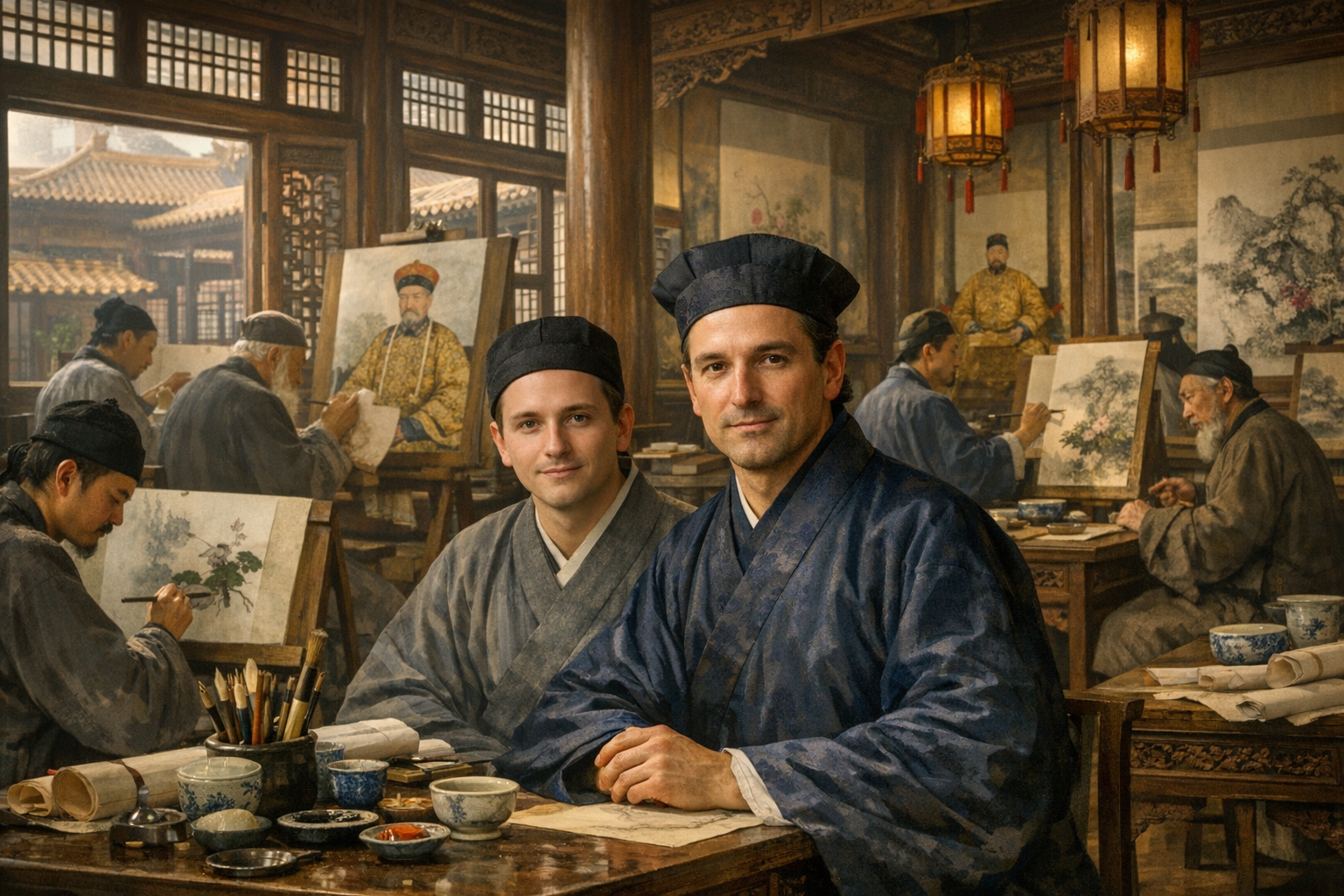
Giuseppe Castiglione and the young Jesuit Jean-Denis Attiret at the Ruyi Hall in the Forbidden City. AI-generated illustration.
The Ruyi Hall (如意馆, Ruyi Guan) was a specialized painting atelier located within the Forbidden City that produced artworks for the emperor. It was not a public studio but rather a court institution where elite Chinese and foreign artists collaborated on paintings blending European techniques, such as perspective, shading, and realism, with Chinese themes and aesthetics, including bird-and-flower painting, figure painting, and landscapes. The name Ruyi (如意) means "as you wish" — a phrase often associated with imperial blessings or good fortune — and reflects the decorative and auspicious purpose of much of the artwork created there. Giuseppe Castiglione is the best-known member of the Ruyi Hall painters, who included European Jesuit painters, such as Jean-Denis Attiret and Ignatius Sichelbart, as well as Chinese court painters who adopted or collaborated with European techniques. Together, they produced paintings for imperial commissions, including portraits of emperors and consorts, documentary paintings of military campaigns, large-scale decorative panels and hanging scrolls, and architectural and landscape renderings. These collaborative works formed a unique fusion of East and West. They are known for their hybrid style, which deeply influenced Qing court art and set a precedent for cross-cultural artistic exchange.
Despite their distinct institutional roles, the Ruyi Hall painters and the Qing Imperial Painting Academy (画院, Huayuan) were deeply interconnected, especially during the reign of the Qianlong Emperor (r. 1735–1796). The Qing Imperial Painting Academy, a formal continuation of earlier dynastic art academies, was largely staffed by Chinese court painters who upheld many literati traditions in painting, such as the landscape, figure, and bird-and-flower genres. These painters worked within a system that emphasized classical brush techniques, poetic themes, and calligraphic expression. However, they were also expected to meet the increasing demands of imperial patronage. In contrast, Ruyi Hall emerged as a more specialized and technically innovative atelier within the Forbidden City. Despite these differences, the two institutions were deeply intertwined in practice. Personnel occasionally moved between the two institutions or collaborated on specific projects. Some Chinese court painters who trained at the academy were invited to collaborate with Jesuits at the Ruyi Hall, and vice versa. This interchange was particularly evident in large-scale commissions ordered by the Qianlong Emperor, who took a hands-on approach to the artistic life of his court. The transfer of techniques between the two groups was intentional and part of a broader imperial agenda. The Jesuits were encouraged to teach their Chinese counterparts European methods, and many Qing painters began incorporating elements such as linear perspective and shading into their work. Conversely, European painters had to adapt their styles to conform to Chinese aesthetic expectations. This resulted in a distinctive fusion that defined Qing court art during the 18th century.
Portrait of the Qianlong Emperor in Court Dress (1736)
This portrait was produced in 1736, the first year of Qianlong's reign. This official state portrait was likely commissioned to commemorate his ascension to the throne and establish an authoritative imperial image for ritual and political purposes. The painting was intended for display in palace halls and use in ceremonies affirming the emperor's legitimacy and Confucian virtue.
The emperor is depicted facing forward, seated upright, wearing a richly embroidered yellow dragon robe that symbolizes supreme authority. The composition is symmetrical and dignified, aligning with traditional Chinese norms of imperial portraiture that emphasize stability and centrality. However, Castiglione introduced subtle Western elements, such as delicate chiaroscuro around the face, nuanced shadowing, and a more volumetric treatment of hands and garments. Unlike earlier Chinese portraits, which tend to be linear and flat, Castiglione's version gives the figure a soft, three-dimensional presence, maintaining a sense of solemn detachment appropriate to the emperor's status.
The neutral, undecorated background focuses attention entirely on the emperor. This approach echoes Chinese aesthetics of moral clarity while allowing Castiglione to integrate the focus on the individual characteristic of European portraiture.
This portrait encapsulates the dual purpose of Qing imperial art: affirming dynastic legitimacy through tradition and elevating the emperor's image through innovative aesthetics. By blending Western techniques with Chinese formats, Castiglione created a refined and authoritative visual icon of Qianlong's sovereignty. This established a new mode of court portraiture that would be emulated by later Qing court artists.
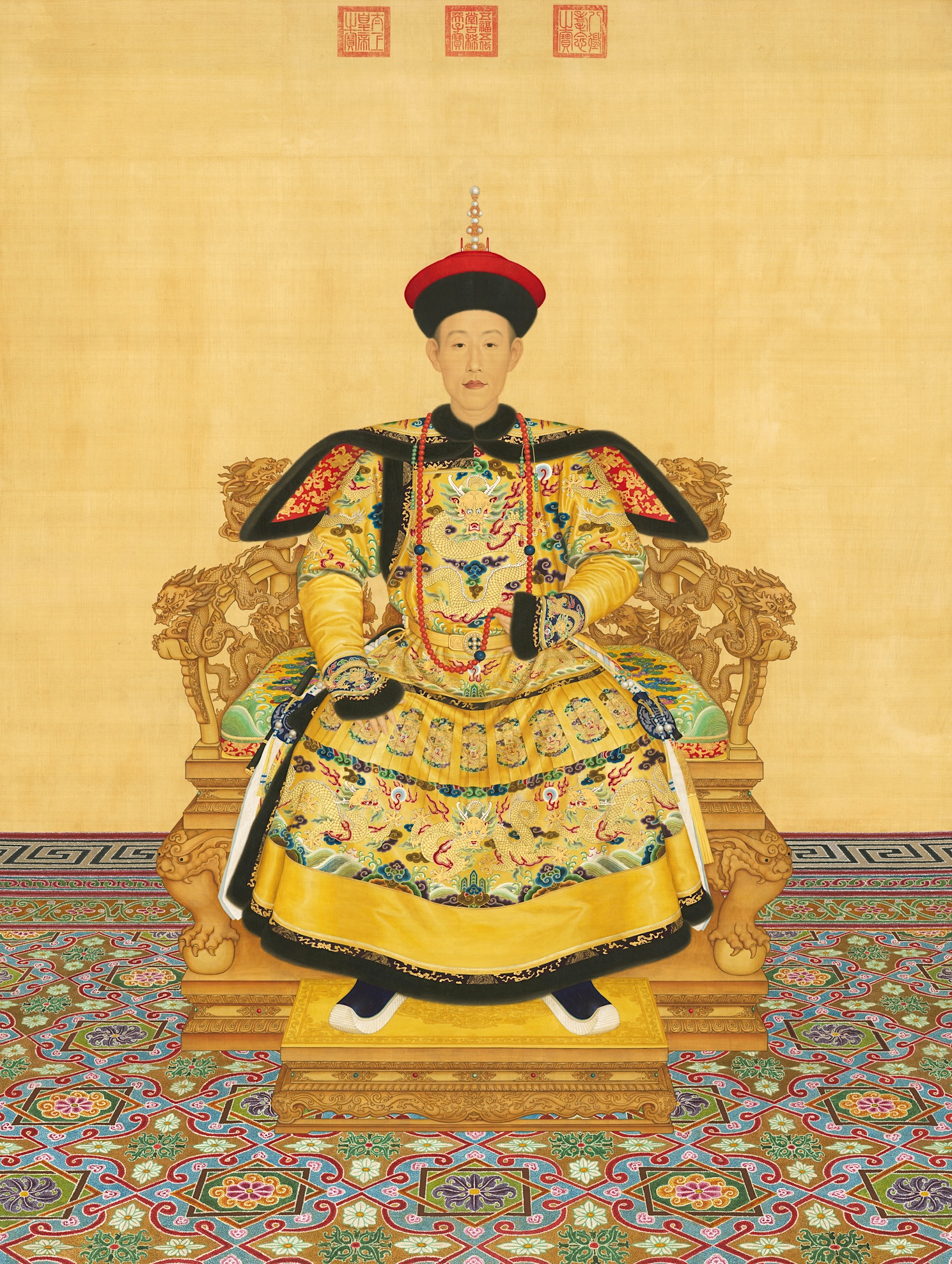
Giuseppe Castiglione, Portrait of the Qianlong Emperor in Court Dress, painting on silk, 1736. The Palace Museum, Beijing.
BELOW
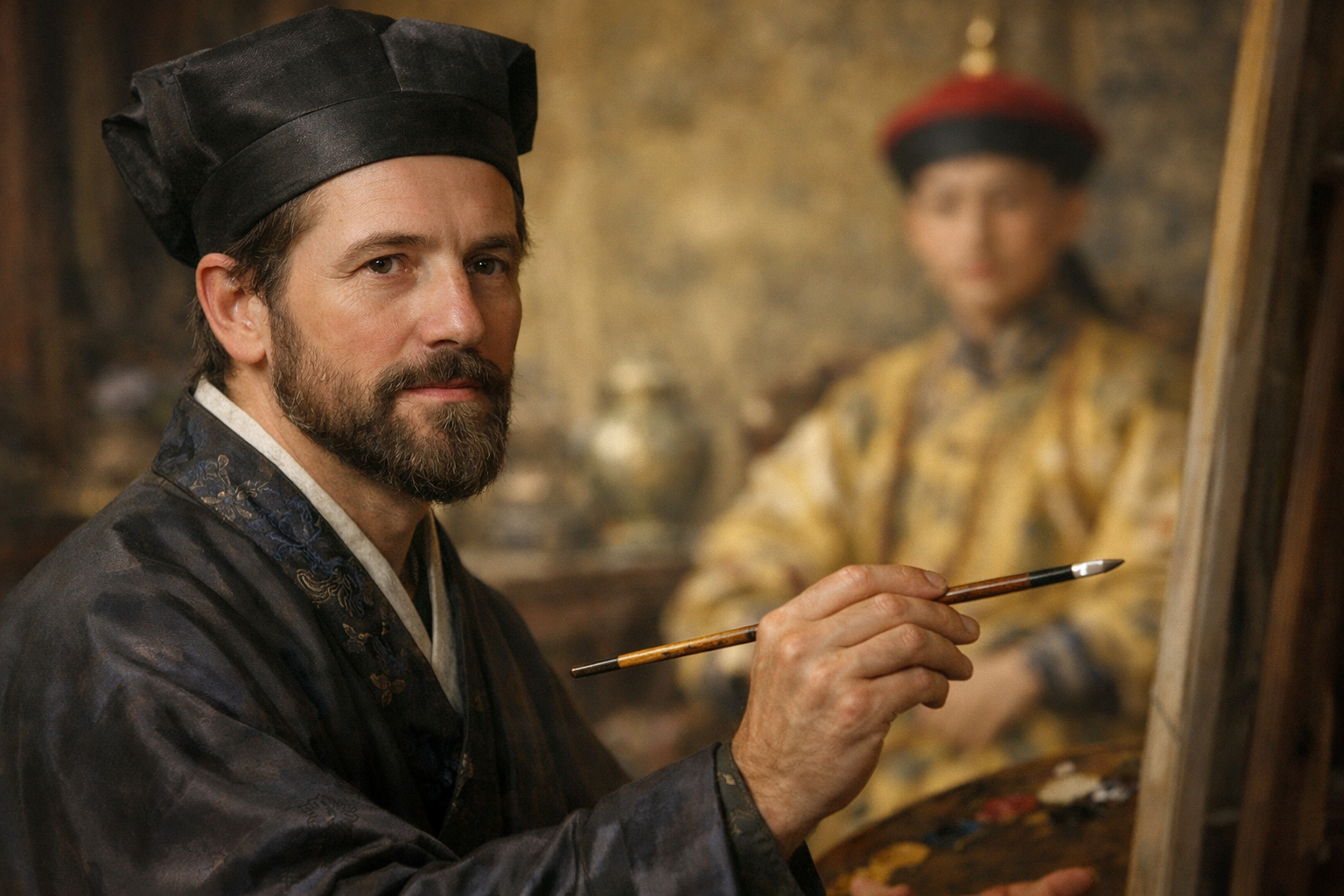
Castiglione painting the portrait of Qianlong Emperor. AI-generated illustration.
Portraits of the Qianlong Emperor and His Twelve Consorts (1736–1770s)
This monumental handscroll was started around 1736 and completed over the course of several decades, extending into the 1770s. Its creation was prompted by dynastic and ceremonial occasions; it served as a visual record of the emperor and his official consorts and was likely updated as new women were elevated to higher court ranks. The emperor titled the scroll Mind Picture of a Well-Governed and Tranquil Reign himself, linking personal memory with imperial ideology.
The scroll begins with a portrait of the young Qianlong, followed by his empress and eleven consorts. Each woman is depicted with distinct facial features and expressions. The women are depicted in sumptuous Manchu court attire, their garments detailed with intricate patterns and textures.
Castiglione painted the emperor and the higher-ranking women himself; the later sections were likely completed by his disciples or other court painters in his style. This technique blends the clarity and color of Chinese brushwork with European modeling. Faces are gently rounded, eyes and mouths are individualized, and garments are rendered with subtle shading that suggests form.
The scroll’s format reflects Chinese pictorial traditions of sequential portraiture, which were often used in genealogical records and temple displays. However, the realism and attention to individuality mark a departure from earlier, more generic female portraiture. The scroll presents a vision of the imperial household that is both hierarchical and personal.
This artwork served as both a dynastic record and a visual representation of Confucian harmony within the imperial household. It reflects Qianlong's desire to portray his reign as orderly, prosperous, and stable. The hybrid style captures the social function of court portraiture as well as the emotional nuances of personal likeness. Castiglione's influence is particularly evident in the dignity and humanity he imparts to each figure.

Giuseppe Castiglione, Portraits of the Qianlong Emperor and His Twelve Consorts, handscroll, 1736–70s. Medium: Ink and color paint on silk. Dimensions: 53.8 x 1154.5 cm (21 3/16 x 454 1/2 in.). The Cleveland Museum of Art, John L. Severance Fund, USA.
BELOW
Detail of the portrait of Qianlong and his primary wife, Empress Xiaoxianchun, 孝賢純皇后 (1712–1748). The face modeling—soft, volumetric, and subtly realistic—is characteristic of Castiglione’s hand, while the costumes and decorative embroidery were likely rendered by specialized Chinese court painters.
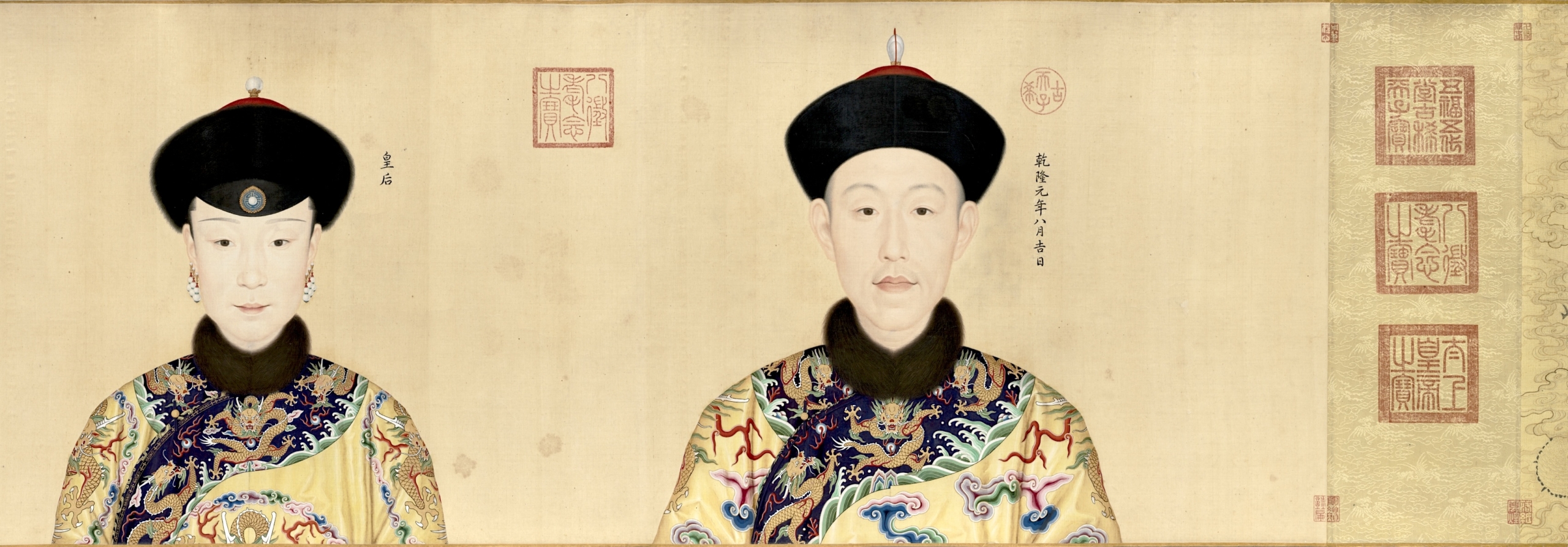
Together, these two portraits (the Portrait of the Qianlong Emperor in Court Dress and the Portraits of the Qianlong Emperor and His Twelve Consorts) demonstrate the dual nature of Qing court art under Castiglione: simultaneously ceremonial and personal, traditional and innovative. The former projects political authority and ritual gravitas, while the latter offers a glimpse into the private and familial dimensions of imperial life. Castiglione's fusion of European techniques with Chinese visual culture yielded technically proficient works and a novel visual language of empire. These portraits are instruments of statecraft and memory that embody the power, aesthetics, and ideology of one of China’s most culturally dynamic reigns.
The Qianlong Emperor Surrounded by Children at the Yuanmingyuan on New Year's Eve (1738)
This painting depicts an intimate and informal moment of the Qianlong Emperor celebrating New Year's Eve at Yuanmingyuan, also known as the Old Summer Palace. He is surrounded by playful children who symbolize prosperity, happiness, and dynastic continuity.
Style and Symbolism: While the faces and fabrics are rendered with Western realism, the scene is composed with traditional Chinese motifs, such as auspicious objects and harmonious family themes. The children playing with toys, lanterns, and firecrackers serve as visual metaphors for the joy and abundance of the new year.
Political Message: The work portrays the emperor as a father to the nation and a virtuous man, reinforcing the Confucian ideal that familial harmony reflects good governance.
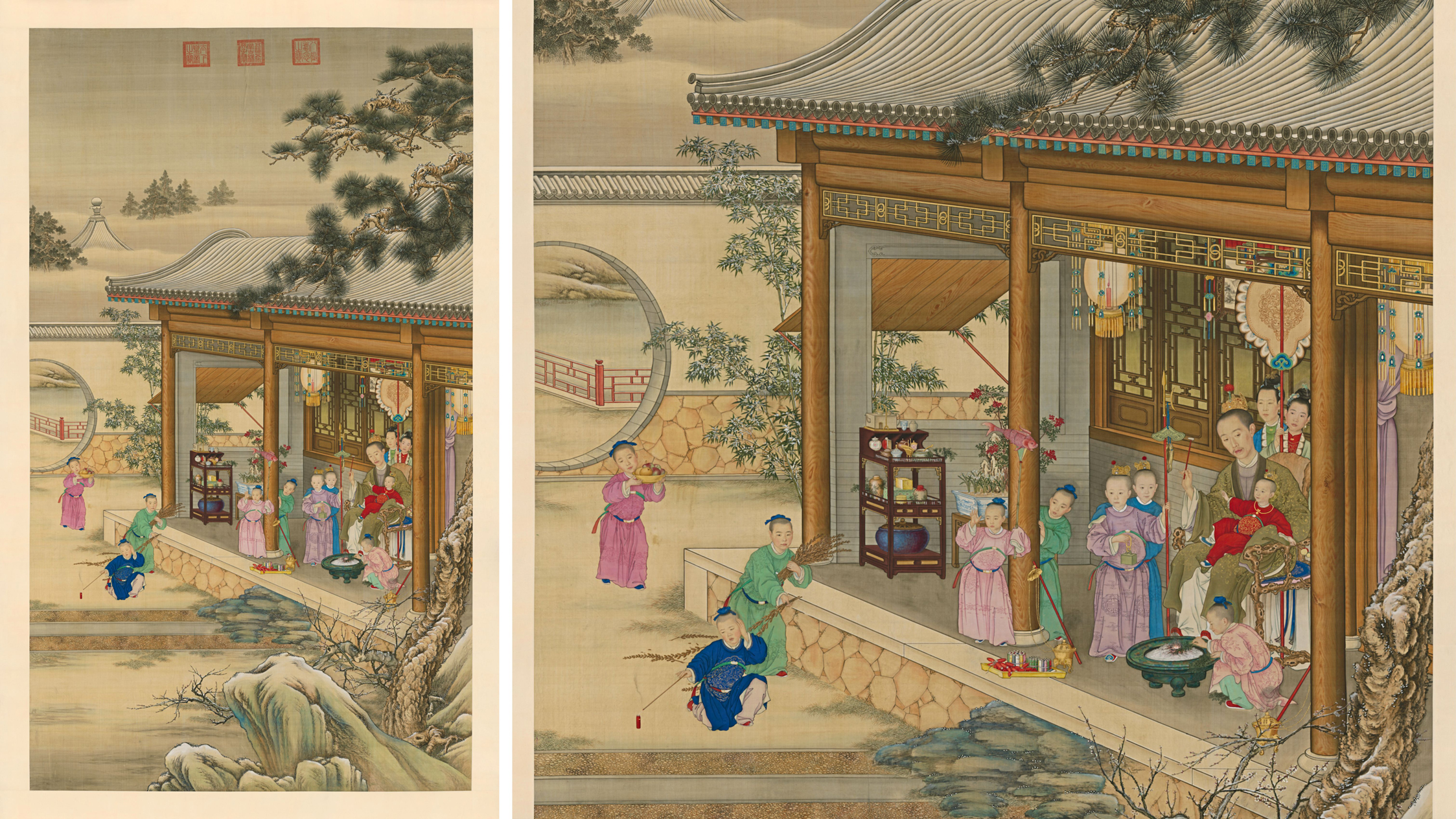
Giuseppe Castiglione, The Qianlong Emperor and the Royal Children on New Year’s Eve (general view and detail), hanging scroll, 1736-37. Medium: Ink and colour on silk. Dimensions: height 384 cm (12.5 ft); width: 160.3 cm (63.1 in). The Palace Museum, Beijing.
The Qianlong Emperor Viewing Paintings (ca. 1746–1750)
This formal composition depicts the emperor examining artwork in a refined, scholarly setting, surrounded by attendants.
Imperial Persona: Qianlong saw himself as a great patron of the arts, collector, and connoisseur. This painting reinforces that self-image by highlighting his engagement with literati culture and his refined taste.
Artistic Fusion: Castiglione’s use of linear perspective, shadowing, and architectural space reveals his European training. However, the subject matter, setting, and brushwork adapt to Chinese visual rhetoric.
Subtle Hierarchy: The emperor is physically and compositionally elevated, positioned centrally and attended to by courtiers, which emphasizes his cultural supremacy.
These works exemplify how Castiglione’s artistry was co-opted to express imperial ideology in visual terms. The Qianlong period was the most politically rich and stylistically mature phase of his career. They also underscore how art under an empire serves aesthetic and strategic functions, celebrating not just beauty but also authority and power.
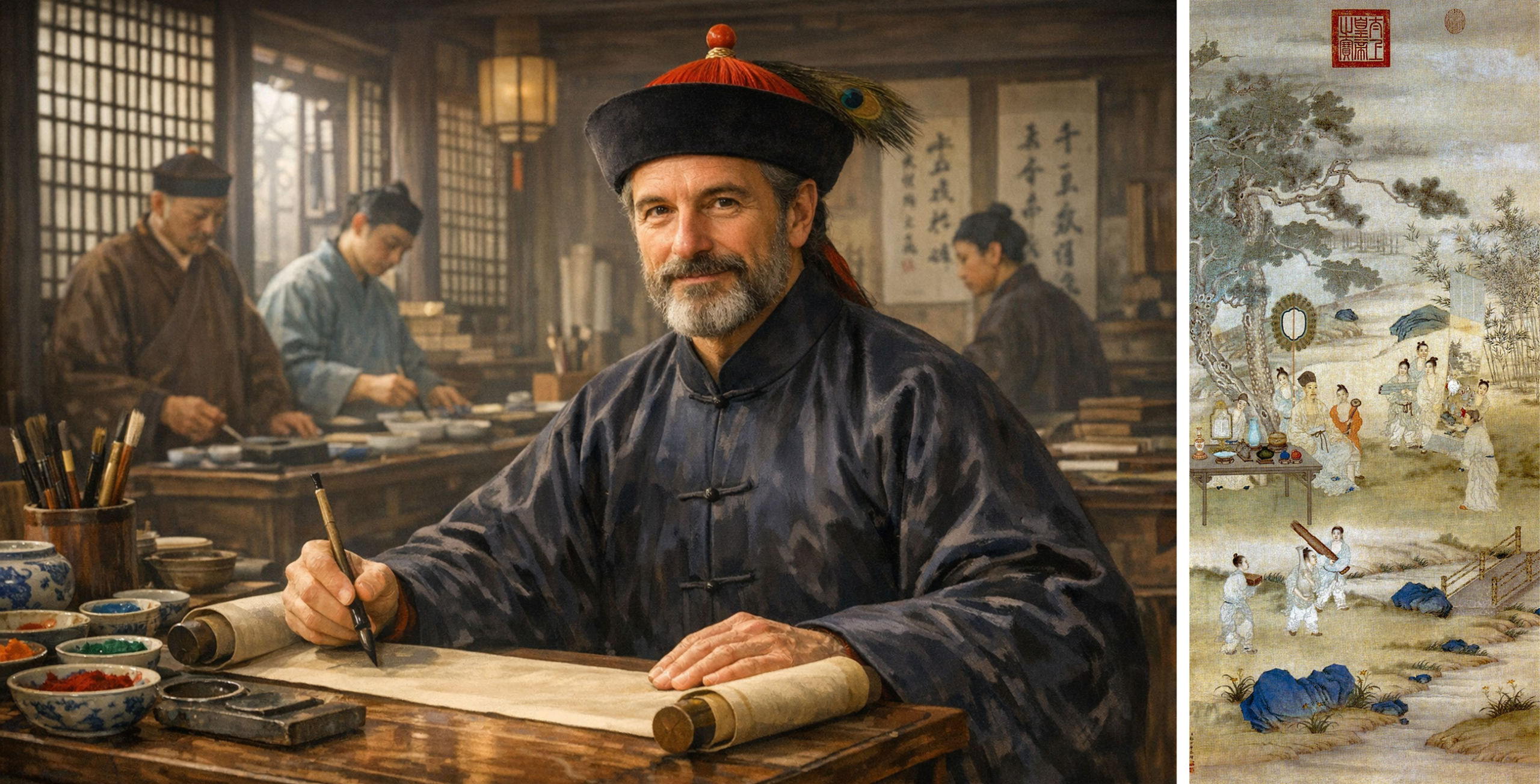
LEFT: Giuseppe Castiglione painting a handscroll inside the Ruyi Hall in ca. 1746-1750. AI-generated illustration.
RIGHT: Giuseppe Castiglione, Emperor Qianlong inspects paintings, handscroll, ca. 1746-1750. Medium: Ink and color painting on paper. Dimensions: height: 136.4 cm (53.7 in); width: 62 cm (24.4 in). The Palace Museum, Beijing.
Portrait of Imperial Noble Consort Huixian in Court Robes (1750s)
Attributed to Giuseppe Castiglione and the painters of the Qing Imperial Workshop, this painting depicts Imperial Noble Consort Huixian (1712–1745), a prominent concubine of the Qianlong Emperor. Although she died relatively young, she was posthumously honored with the title of Imperial Noble Consort, the second-highest rank among the emperor’s consorts. This portrait was likely produced after her elevation, possibly posthumously, as part of a courtly series of consort portraits for commemorative and ancestral purposes.
These types of images were used for both imperial household remembrance and ritual veneration in the Palace of Earthly Tranquility and other ancestral halls, especially during mourning rituals and formal family gatherings. They also served as visual documents of rank and court hierarchy.
This formal portrait shows Consort Huixian seated on an elaborately carved dragon throne, a symbol of imperial power. She wears a richly embroidered chaofu, a court robe worn only during the most formal state occasions. The robe features:
- Five-clawed dragons pursuing flaming pearls across a sea-wave and cloud background. These motifs are reserved for high-ranking members of the court and directly reference the emperor's cosmic mandate.
- A red ceremonial headdress with phoenix motifs and pearl pendants denoting her status as an imperial consort of the highest rank.
- Intricate textile decorations rendered in brilliant mineral-based pigments, such as azurite and malachite, which were traditionally used in silk painting.
- The floor covering is a typical red-and-gold imperial carpet, and the throne base's architecture subtly echoes Buddhist altar design.
This work is emblematic of Castiglione’s influence. It was likely completed with his assistance or by court painters trained in his style, particularly those in the Imperial Painting Academy under his direction. Hallmarks of his style include:
- Facial modeling using subtle shading. The sitter’s face is pale and idealized with gentle transitions of light that suggest depth and softness. This is in contrast to the flatter treatments of earlier Chinese portraiture.
- Three-dimensional realism in hands, jewelry, and folds of fabric, likely inspired by Castiglione’s Jesuit training in European oil painting and chiaroscuro techniques.
- Architectural and ornamental accuracy in the rendering of the throne, showing an unusual Western sense of perspective and plasticity. These features were introduced to Chinese court art by Castiglione and other Jesuit painters.
Yet the composition retains strict Chinese symmetry and ceremonial frontality, which is appropriate for a portrait intended to honor and immortalize, rather than capture, a fleeting likeness. The blending of European illusionism with Chinese ritual formality creates a distinctly Qing visual language that is both hieratic and humanized.
The image portrays not just a woman, but a state figure, a living emblem of dynastic order and feminine virtue. Her attire, posture, and expression convey restraint, majesty, and perfect decorum — essential values in the Confucian court system.
The Portrait of Imperial Noble Consort Huixian is a refined example of Qing imperial portraiture, in which Castiglione’s Western techniques have been fully absorbed into the visual and ideological framework of the Chinese court. The result is a painting that is ritually correct, artistically innovative, and culturally hybrid—a visual embodiment of Qing cosmopolitanism and courtly discipline. This painting is part of a broader shift during the Qianlong era, when portraiture became a tool of dynastic memory. It was regulated by etiquette yet animated by the personal touch of cross-cultural artistry.
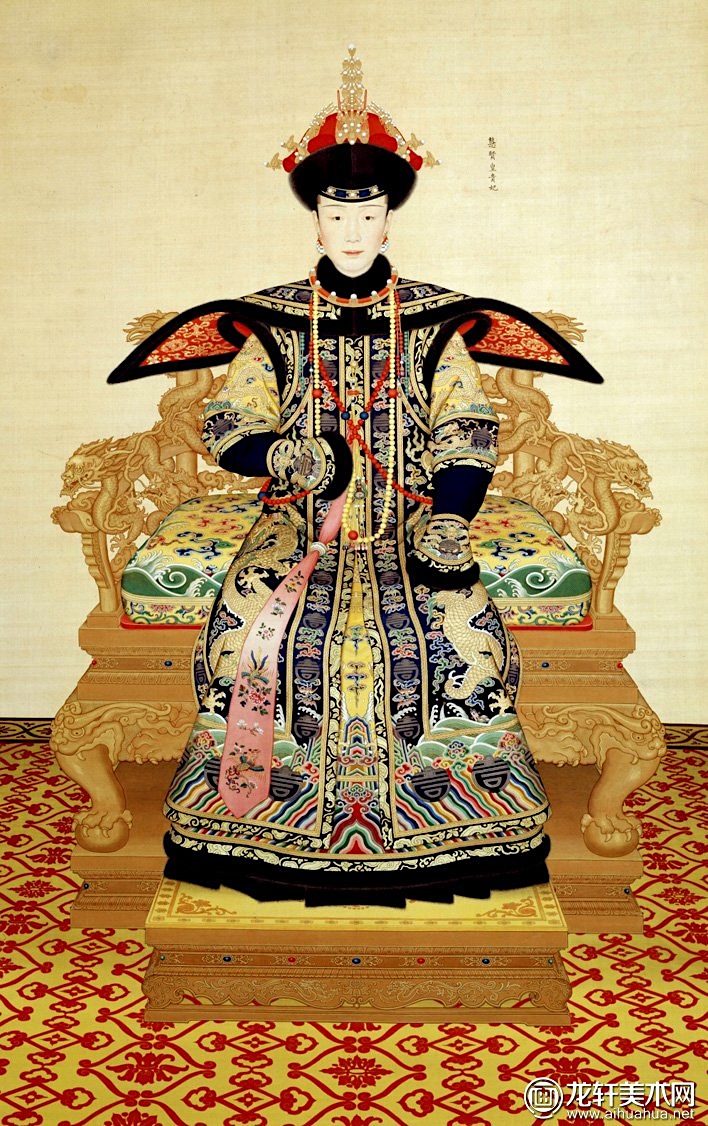
Giuseppe Castiglione and Qing Imperial Painting Academy, Portrait of Imperial Noble Consort Huixian in Court Robes (慧贤皇贵妃朝服像), hanging scroll. Date: ca. 1745–1750s (likely posthumous; Huixian died in 1745). Medium: Ink and color on silk (traditional Chinese mineral pigments). Dimensions: height ~220–240 cm; width ~130–150 cm. The Palace Museum, Beijing.
The Qianlong Emperor in Ceremonial Armor on Horseback and the Great Review Portrait (1750s)
Among Castiglione’s most spectacular large-format artworks are two equestrian portraits of the Qianlong Emperor: The Qianlong Emperor in Ceremonial Armor on Horseback and The Great Reading Axis of the Emperor Qianlong (大閱圖軸). These portraits were likely created in the 1750s, in connection with imperial military reviews and martial inspections that reinforced Qing authority and martial virtue. The emperor appears as both civil sovereign and warrior ruler, in full ceremonial armor.
In both paintings, Qianlong is portrayed riding a horse adorned with resplendent court armor, which is richly embroidered with dragons and auspicious motifs. The attention to equine anatomy, textile sheen, and facial modelling betrays Castiglione’s European training, while the use of flat backgrounds and minimal shadowing adheres to Chinese court tradition. The setting in The Ceremonial Armor portrait features a more naturalistic landscape, while The Great Reading Axis presents a more stylized background with accompanying calligraphy that emphasizes the ideological message.
These portraits represent a distinct mode within Qing imperial imagery: the emperor as military paragon. They function not only as likenesses, but also as imperial propaganda—affirming Qianlong’s status as both enlightened Confucian monarch and supreme commander of the Qing legions. Castiglione’s ability to endow the emperor’s presence with both realism and grandeur allowed these works to transcend mere portraiture and become tools of visual statecraft.
These portraits are instruments of statecraft and memory that embody the power, aesthetics, and ideology of one of China’s most culturally dynamic reigns.
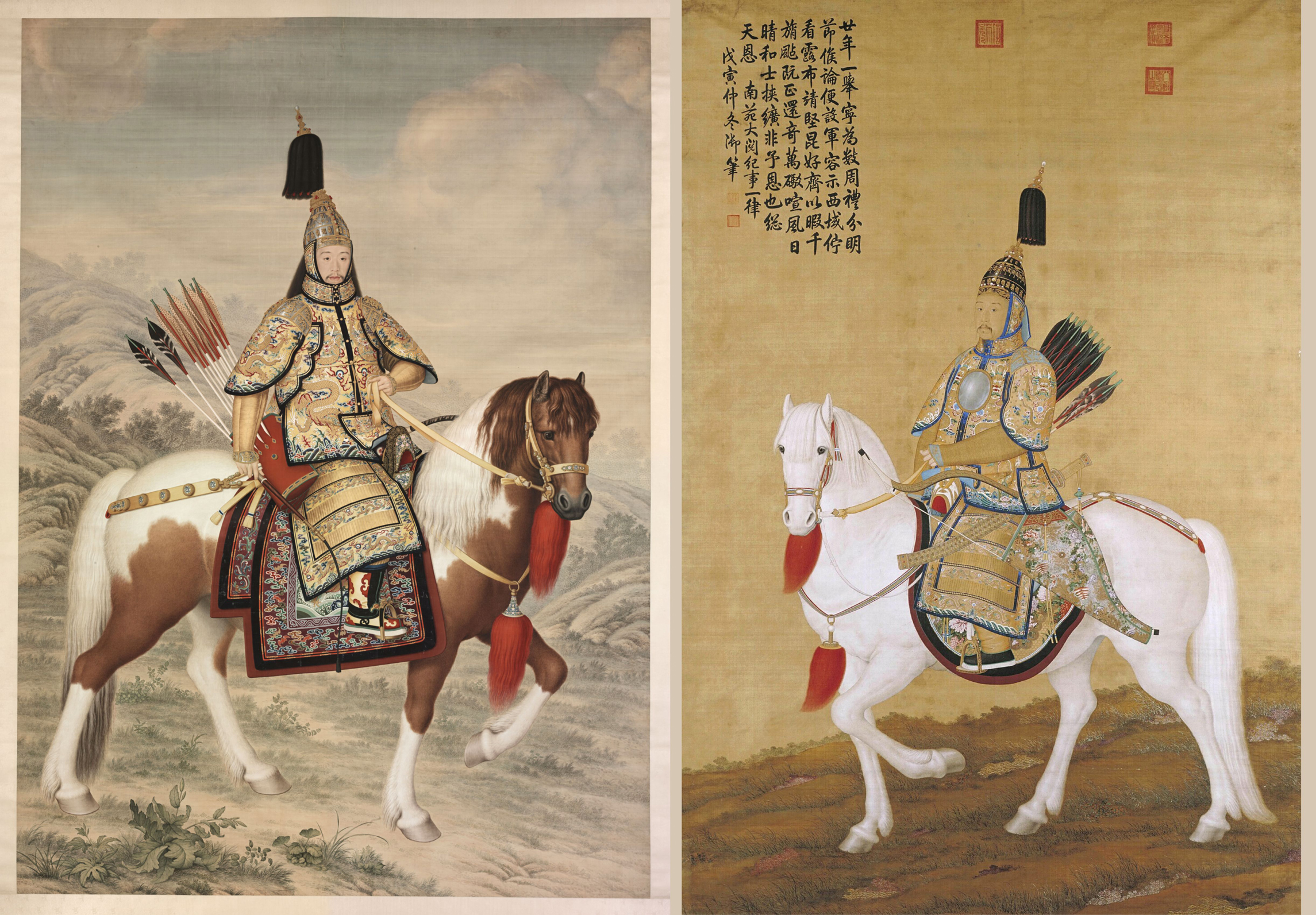
LEFT: The Qianlong Emperor in Ceremonial Armor on Horseback (清 乾隆戎装骑马像轴), hanging scroll (vertical composition) attributed to Giuseppe Castiglione with collaboration from the Imperial Painting Academy. Date: ca. 1758 (Qianlong reign, 23rd year); likely painted in conjunction with military inspection tours or symbolic martial campaigns. Medium: Ink and color on silk. Dimensions: Approx. 234 × 152 cm. National Palace Museum, Taipei, Taiwan. The Qianlong Emperor is shown mounted on a piebald horse, wearing full ceremonial court armor, holding the reins and surrounded by visual cues of martial authority. He carries a bow and a quiver of arrows; the horse is elaborately tacked and adorned with imperial motifs. The setting features stylized mountains and landscape, giving depth and context to the scene.
RIGHT: The Great Reading Axis of the Emperor Qianlong (乾隆皇帝大阅图轴 or Dàyuè tú zhóu), hanging scroll attributed to Giuseppe Castiglione, possibly with assistance from Tang Dai 唐岱, Jin Tingbiao 金廷標, and other court painters. Date: ca. 1743–1749 (early-to-mid Qianlong reign). Medium: Ink, color, and gold on silk. Dimensions: Approx. 238 × 163 cm. Palace Museum, Beijing (故宫博物院), included in the permanent Qing imperial portrait collection. The Qianlong Emperor, in ceremonial battle armor, is portrayed mounted on a white horse, participating in a grand imperial review (dàyuè), a ritual military parade or inspection. The emperor holds the reins and is surrounded by rich detail, including imperial insignia, weaponry, and an open plain. The background is more austere than in the previous artwork, and the composition features a poetic inscription and imperial seals. The inscription includes a poem written by the Qianlong Emperor in Chinese (upper left), reflecting on the virtues of governance, preparedness, and military power. The several imperial seals (e.g., “乾隆御览之宝”) reinforce imperial authorship and legitimacy.
Consort of the Qianlong Emperor with the Young Jiaqing Emperor, ca. 1763–1765
Attributed to Giuseppe Castiglione, this quietly evocative painting was executed during the mid-Qianlong period. It offers a rare, intimate glimpse into the private life of the Qing imperial family. It depicts a consort of the Qianlong Emperor delicately positioned behind an open window as she gently supports a young child identified as the future Jiaqing Emperor through inscription or contextual association. Castiglione is better known for his formal imperial portraits and grand ceremonial works, but this painting belongs to a subtler visual tradition at the Qing court. It reflects domestic harmony, maternal virtue, and dynastic continuity.
The painting is rich in architectural and symbolic framing. It divides the scene vertically between an elaborately decorated sleeping chamber above and a balcony overlooking a garden below. This architectural cutaway format, likely influenced by Chinese interior painting conventions and European perspective constructions, serves a compositional function and encodes thematic meaning. The upper chamber signifies quietude and privacy, and the open lower scene suggests connection, growth, and imperial posterity.
The woman, presumed to be one of Qianlong’s favored consorts or concubines, is rendered with the refined idealization of the face common in Qing female portraiture: serene, pale, and emotionally reserved. She wears courtly attire embroidered with auspicious floral motifs, and her expression is tender yet composed. Her subtle, protective gesture toward the child positions her as both nurturer and transmitter of imperial values.
The young boy wearing a red robe reaches out toward the viewer or the space beyond the window. Unlike his mother, his face is individualized and animated, possibly referencing Castiglione’s interest in Western portraiture and child studies, where psychological presence is emphasized. The backdrop of bamboo and peonies, classic Chinese symbols of resilience and feminine beauty, enhances the domestic setting and reinforces dynastic virtue: bamboo for strength and peonies for elegance and legacy.
In terms of technique, the painting exemplifies Castiglione’s mature visual synthesis. The architectural precision and spatial depth suggest European training, while the flat yet layered treatment of the surface, restrained palette, and careful rendering of textiles remain rooted in Chinese palace painting traditions. The light filtering into the room and the shadows cast across the carved window elements demonstrate an understanding of naturalistic illumination calibrated for visual harmony rather than realism.
Ultimately, this painting is not merely a domestic genre scene; it is a work of dynastic narrative and ideological subtlety. It projects the continuity of the Qing lineage, the moral dignity of the emperor’s consorts, and the ideal of filial succession. Though intimate in tone, it is deeply political in function: a portrait of motherhood that is, in effect, a portrait of empire.
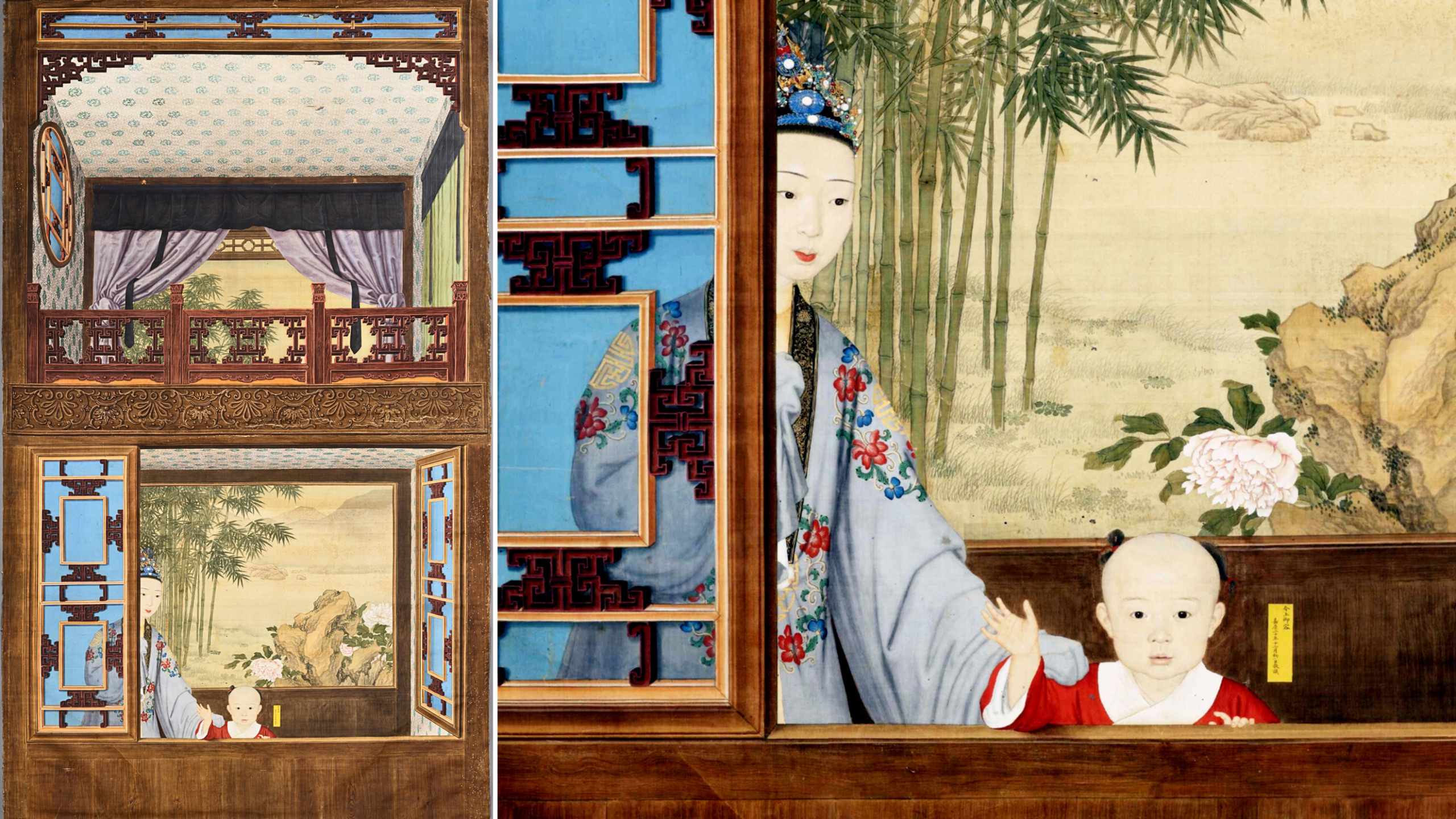
Consort of the Qianlong Emperor with the Young Jiaqing Emperor, ca. 1763–1765, attributed to Giuseppe Castiglione and collaborators from the Qing court atelier. Ink and color painting on silk. Dimensions: height 326.5 cm (10.7 ft), width 186 cm (73.2 in). Palace Museum, Beijing. Left: the whole painting; right: a detail on the lower section.
This remarkable double-register painting depicts a rare intimate domestic scene from the Qing imperial court. Upper section: An interior space with a curtained canopy bed and elegant wooden latticework. Empty, possibly symbolic of imperial space or private quarters. Lower section: A Qing consort (possibly Empress Xiaoyichun) looking out of an open window with a young child, likely Yongyan (永琰), the future Jiaqing Emperor, who reigned from 1796 to 1820. The child wears red robes, a color traditionally associated with prosperity and youth, and is depicted reaching forward in a lively, natural gesture.. Note Note the illusionistic architecture, shading of the window recess, and spatial depth, all of which are hallmarks of Castiglione’s European technique. The fine detail of the wood grain, carved fretwork, and silk patterns aligns with traditional Chinese painting aesthetics and Qing imperial taste. The subtle modeling of the mother and child's faces and the emotional warmth between them mark this work as distinct from traditional Chinese portraiture. The painting likely celebrates the early life of the Jiaqing Emperor, born in 1760. Given that Castiglione died in 1766 and the child appears to be under five years old, the painting likely dates to around 1763–1765. Intimate court portraits were rare but not unprecedented. They were often used by the emperor for private enjoyment, documenting imperial lineage and reinforcing the continuity of the Qing dynasty.
- Imperial Animals and Courtly Representation: Castiglione’s Horses and Dogs
Though he is especially celebrated for his imperial portraits, Castiglione also produced a remarkable series of animal paintings commissioned by the court. These paintings documented tribute animals, ceremonial gifts, and the emperor’s hunting companions. Two series of individual animal portraits exemplify middle-period Qing court painting, integrating Western observational realism with traditional Chinese brushwork and compositional sensibilities: the series depicting ten prized horses and the series of ten noble dogs.
Ten Prized Horses Series
Castiglione’s series of paintings of Ten Prized Horses (十骏图; sometimes called Ten Steeds) was produced in the mid‑18th century under the patronage of the Qianlong emperor. Court records and archival workshop files indicate that the emperor ordered Castiglione to paint ten large portraits of fine steeds brought as tribute by Mongol nobles and other border peoples. These animals were not generic; each was named and had been given special imperial titles reflective of their origin, color, and character. This underscores the Qing court’s emphasis on animal portraiture as a symbolic and diplomatic practice.
Pictorially, the Ten Horses paintings combine meticulous draftsmanship and life observation with ceremonial inscription. Castiglione applied his European training, which was grounded in direct observation and an understanding of spatial depth, to capture the anatomy, coat texture, and posture of each horse. At the same time, traditional Chinese compositional conventions remain evident. For example, there is an emphasis on character and mood rather than dramatic chiaroscuro. The horses are usually placed in measured, uncluttered spaces with minimal landscape references, which allows the animals’ forms and expressions to dominate. Thus, these portraits document zoological detail while conveying the grandeur of the Qing imperial stables. They illustrate the emperor’s power and the enriched visual language of the Qing court under Castiglione’s direction.
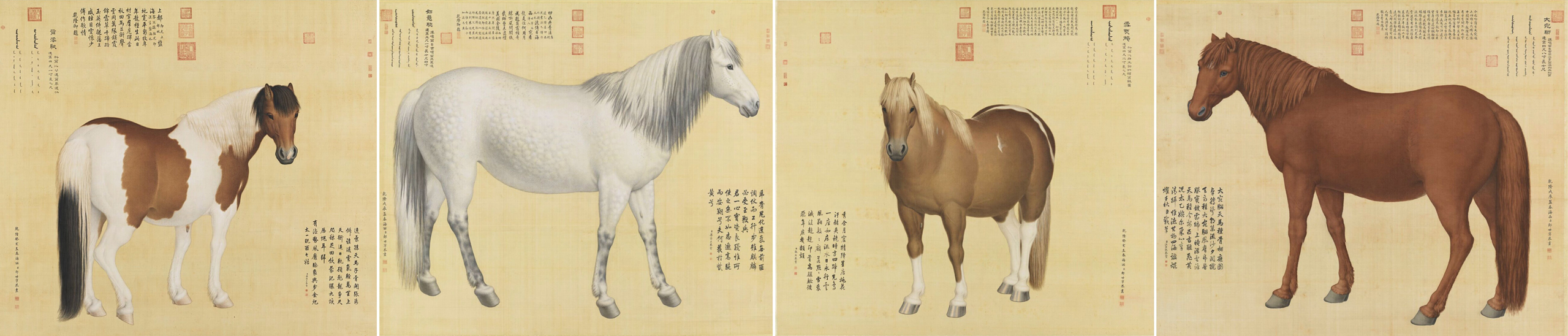
Ten Prized Horses (十骏图 ) or Ten Steeds, attributed to Giuseppe Castiglione. Date: Qianlong 8th year (1743) for the earliest set; a later related set in 1748 (some versions only three horses by Castiglione himself). Medium: Ink and color on silk. Format: Ten individual, vertical portraits of horses on their own scrolls. The horses are typically life-sized or nearly life-sized. Dimensions: Vary per scroll; for example, official NPM records list dimensions for individual scrolls such as Ten Steeds – “Snow‑Flake Eagle” approximately 526 × 311 cm overall. This image shows only four out of ten horses; they are from left to right: Nieh-yun Shih, Ten Steeds – "As-You-Wish" Piebald, Ten Steeds – “Snow‑Flake Eagle”, and Ta-Wan-Liu. These ten individual tribute or prized horses were presented to the Qianlong Emperor and each of them was named and described with inscriptions in Chinese, Manchu, and Mongolian, indicating horse name, provenance and donor. The Ten Prized Horses series is held in the National Palace Museum (Taipei, Taiwan), within the museum’s Qing imperial painting collection.
Ten Noble Dogs Series
Several years after completing the Ten Horses, Castiglione was commissioned again in 1747 to produce a companion series of animal portraits: the Ten Noble Dogs (十駿犬圖). This series depicts the Qianlong emperor's prized hunting dogs, which were either owned by him or presented to him. The portraits hang as a set of vertical scrolls, each with inscriptions in Chinese, Manchu, and Mongolian identifying the dog’s name and the donor who presented it to the emperor. This highlights the multilingual ceremonial context of the Qing court. Nine of the dogs are slender hunting hounds that resemble sighthounds. The tenth dog is a large Tibetan mastiff that is often nicknamed the "heavenly lion."
In terms of visual style, Castiglione’s animal portraits retain the Sino-Western synthesis that characterizes his other works. The dogs' fur, musculature, and gaze are rendered with refined attention to light and surface detail, giving each animal a palpable physical presence. Meanwhile, the backgrounds, including plants, rocks, and tree branches, are often rendered in a more traditional Chinese style, suggesting the possibility of collaboration with other court painters on these elements. The overall effect is not merely documentary; it conveys the personalities of the dogs and situates them within the ritualized world of the Qing court, where hunting was both a pastime and a ceremonial expression of imperial authority.
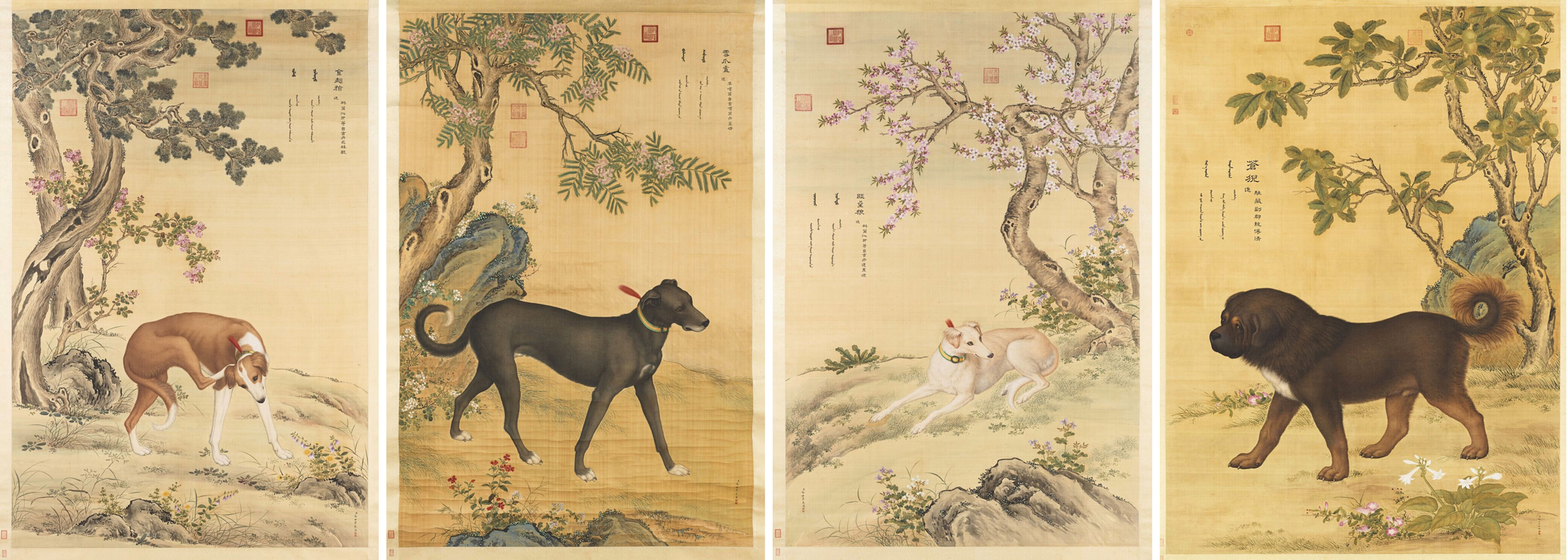
Giuseppe Castiglione with possible assistance from the Qing Imperial Painting Academy, Ten Noble Dogs (十骏犬图, Shí jùn quǎn tú), aka Portraits of Ten Prized Dogs or The Ten Champion Hounds, 1747 (Qianlong reign, 12th year). The image shows 4 out of the ten individual hanging scrolls; from left to right: Medium: Ink and color on silk. Dimensions: each scroll approx. 191 cm × 107 cm. National Palace Museum, Taipei, Taiwan. The image shows only four out of the original ten dogs; they are from the left: Chin-ch'ih-hsien, Xue-zhua-lu, Shan-hsing-lang, and Ts'ang-ni-ch'uan. The last one is a large black-and-brown Tibetan mastiff, nicknamed the “Heavenly Dog” and often interpreted as an imperial bodyguard or guardian symbol.
Each scroll features a single dog in full profile. The dogs are life-size and usually depicted against a neutral background or stylized ground with minimal vegetation. The dogs are depicted with highly individualized physical features, coats, and markings. These hunting dogs of various breeds, primarily Mongolian sighthounds and one Tibetan mastiff, were gifted to the Qianlong Emperor by frontier officials and foreign tributaries. The titles and descriptive inscriptions are written in three languages: Chinese, Manchu, and Mongolian. They record the dog’s name, origin, and main trait (e.g., courage, loyalty, or speed). This series celebrated the dogs as symbols of imperial power, loyalty, and hunting culture. It also served as a court record of valuable animals and as ideological propaganda that reinforced Qing dominance over the Inner Asian borderlands.
The Ten Horses and Ten Noble Dogs series illustrate the breadth of Castiglione’s artistic achievements beyond court portraiture. He brought a new realism, grounded in observation and technical finesse, to Qing court painting while respecting and integrating Chinese traditions of brushwork, silk, and symbolic representation. These series serve as visual records of prized animals and as cultural artifacts reflecting the cosmopolitan, ceremonial, and diplomatic milieu of the Yongzheng and Qianlong courts.
- The Poetics of Nature and Elegance in Castiglione’s Late Animal Paintings
Lemur from Cochin and Peacock Spreading Its Tail Feathers are examples of works from Giuseppe Castiglione’s late, fully mature phase at the Qing court. Created after the major series Ten Prized Horses (1743) and Ten Noble Dogs (1747), these two compositions reflect a pivotal evolution in Castiglione’s artistic approach, shifting from formal tribute portraiture to more intimate, refined studies of individual animals, often exotic.
By this period, Castiglione had achieved a remarkable synthesis of European naturalism and Chinese visual poetics. The texture, shading, and spatial poise he employs in these later works demonstrate a level of technical precision and aesthetic restraint that surpasses his earlier ceremonial commissions. In Lemur and Peacock, Castiglione distills form with subtle command of surface and detail. He evokes not only biological accuracy, but also a quiet elegance that resonates with scientific curiosity and imperial taste. These paintings are as much meditations on visual beauty as they are records of the Qing court's collections and wonders.
Lemur from Cochin (交趾之猨)
This painting portrays a lemur, an animal unfamiliar to most Chinese audiences, believed to have arrived as a tribute from Cochin (present-day Vietnam) or Southeast Asia. Castiglione depicts the animal perched on a rocky outcrop surrounded by branches and sparse foliage. The lemur’s long, curling tail and large, alert eyes are emphasized, capturing its exoticism and alert temperament. Unlike traditional Chinese animal paintings, which often idealize or stylize wildlife, Castiglione emphasizes biological specificity. The creature’s pose, fur texture, and limb articulation reveal close observation and probable study from life. This painting records a tribute animal and participates in the Qing court’s emerging interest in natural history, collecting, and visual encyclopedism.
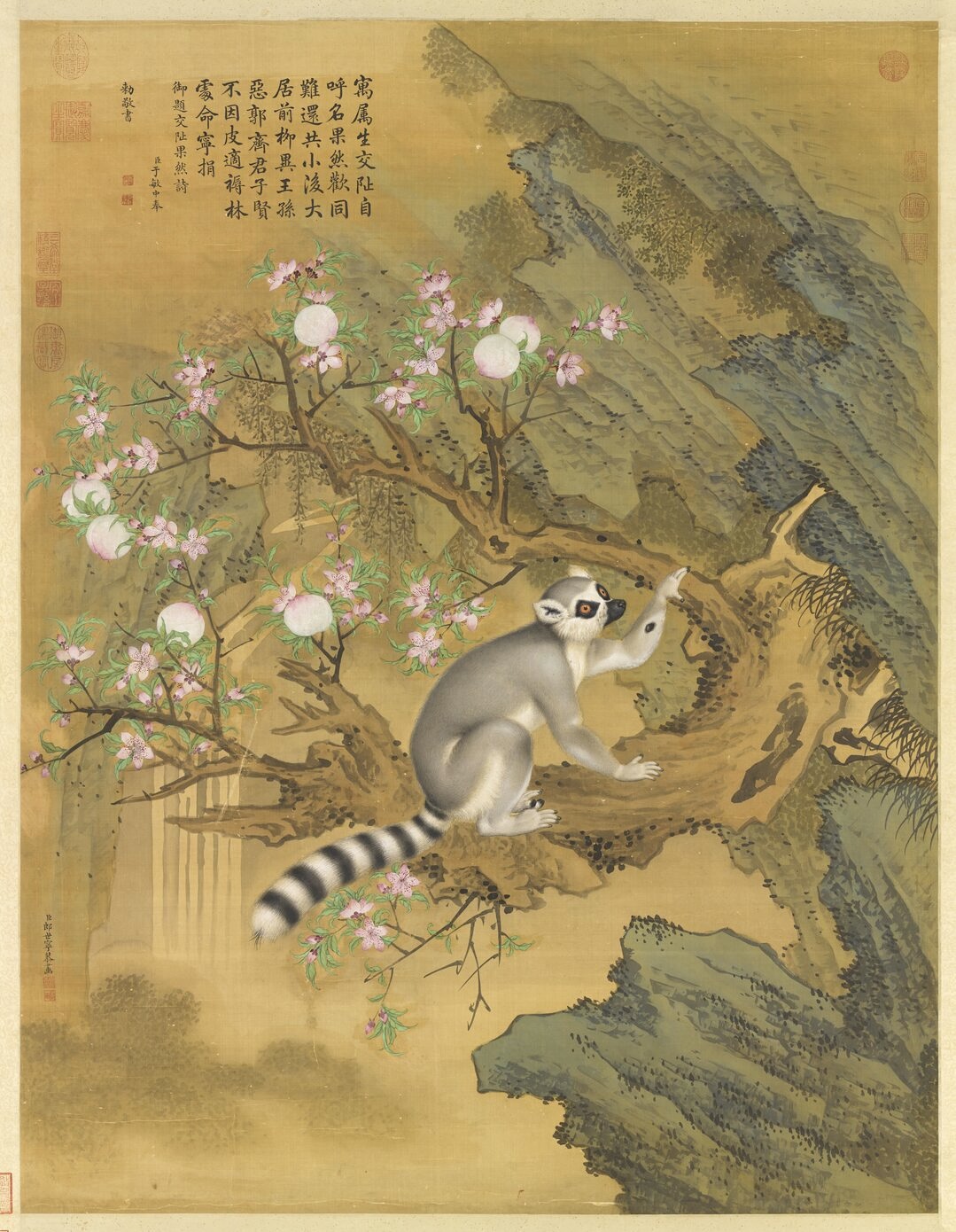
Giuseppe Castiglione, Lemur from Cochin (Chinese: 交趾之猨), hanging scroll, made in mid-18th century, Qianlong period. Medium: Ink and color on silk. Dimensions: Approximately 120 cm × 60 cm. National Palace Museum, Taipei, Taiwan.
Peacock Spreading Its Tail Feathers (开屏孔雀图)
In Peacock Spreading Its Tail Feathers, Castiglione captures the moment when a male peacock opens his iridescent fan for display. This painting is a tour de force of decorative and anatomical rendering. Castiglione brings the bird’s complex feather pattern to life with remarkable precision. The peacock's body is shaded to create the illusion of volume and depth, and each eye-spotted feather in its tail is painted with meticulous detail and rhythmic repetition. The image resonates with imperial symbolism, as the peacock’s magnificence echoes the glory of the Qing state, and with naturalistic elegance, drawing from Western painting traditions. The bird is placed in a simple outdoor setting that allows the full expanse of its tail to dominate the composition. The painting functions as both a study of nature and a symbol of imperial grandeur and cosmopolitan taste.
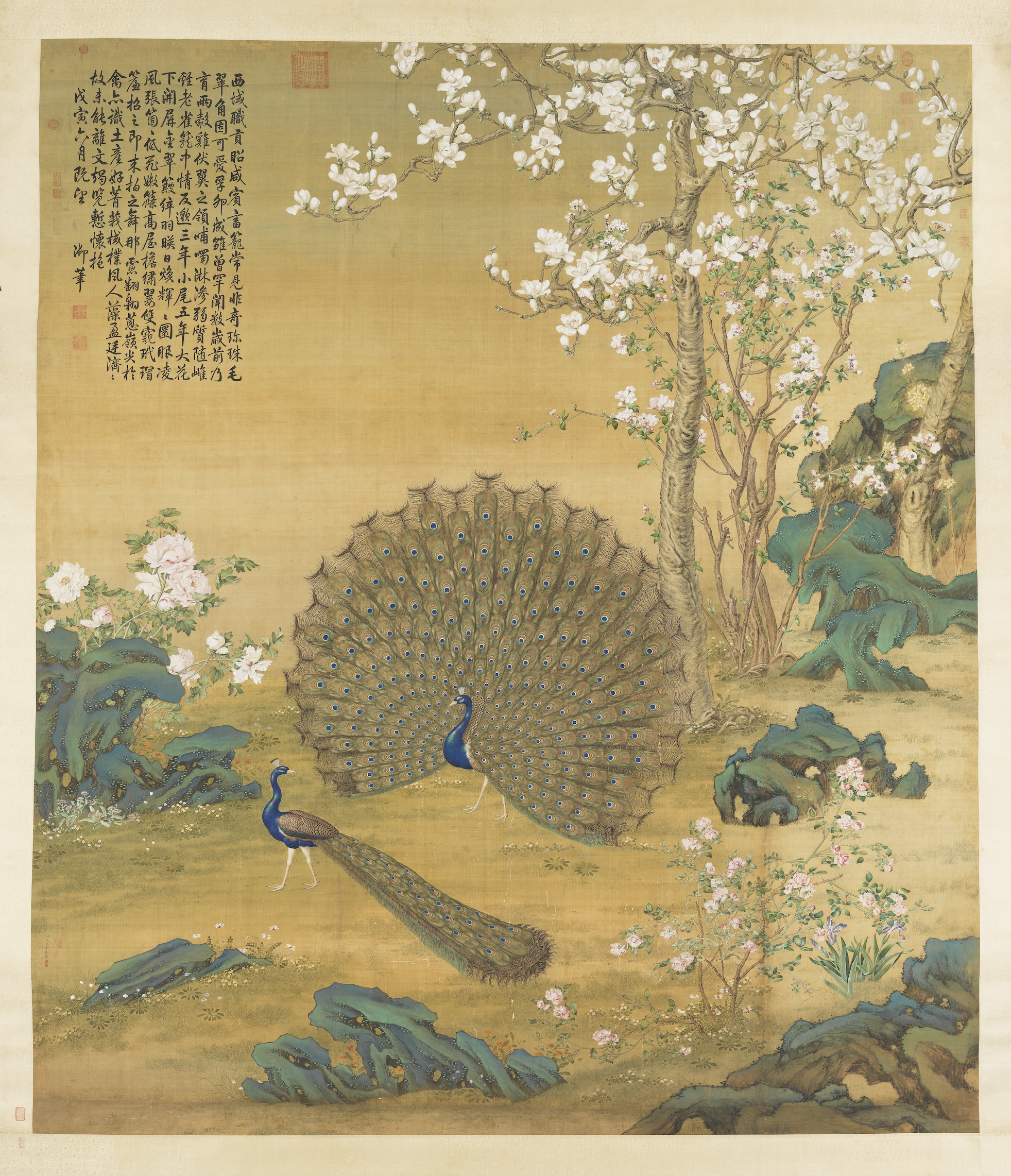
Giuseppe Castiglione, Peacock Spreading Its Tail Feathers (Chinese: 开屏孔雀图), hanging scroll. Date: likely created in the 1750s–60s, possibly among Castiglione’s final decade of work. Medium: Ink and color on silk. Dimensions: Approx. 160 cm × 100 cm. National Palace Museum, Taipei, Taiwan.
The painting depicts a male peacock in full display, tail fully extended, surrounded by light foliage or rock garden elements. Extraordinary detail in plumage; fine gradation of color in feathers; illusionistic depth in body and ground plane; restrained Chinese framing. Have you noted the Taihu rocks?
- The Yuanmingyuan (Old Summer Palace) — A Cultural Crossroads
One of the best examples of these collaborations can be found at the Yuanmingyuan, an expansive imperial retreat located outside Beijing. Castiglione and other Jesuits, such as Michel Benoist, contributed to the design of certain garden pavilions and water features.
From 1747 to 1759, Castiglione served as the principal designer of the Western-style buildings at the Yuanmingyuan. These structures—fountain pavilions, Baroque facades, and trompe l'œil perspectives—represented Europe as Qianlong envisioned it: a fantasy of mechanical marvels and architectural grandeur. The Dashuifa (Great Fountain) and the Xiyanglou (Western Mansions) combined Chinese architectural functions with European decorative elements. Castiglione's training in illusionistic perspective, first demonstrated in the Jesuit chapel in Coimbra decades earlier, created painted vistas where waterworks performed hydraulic ballets. Though these buildings were destroyed in 1860 during the Second Opium War, they survive in engravings and in Castiglione's own painted records. These records attest to a time when the Qing Empire could envision itself as a synthesizer of world civilizations.
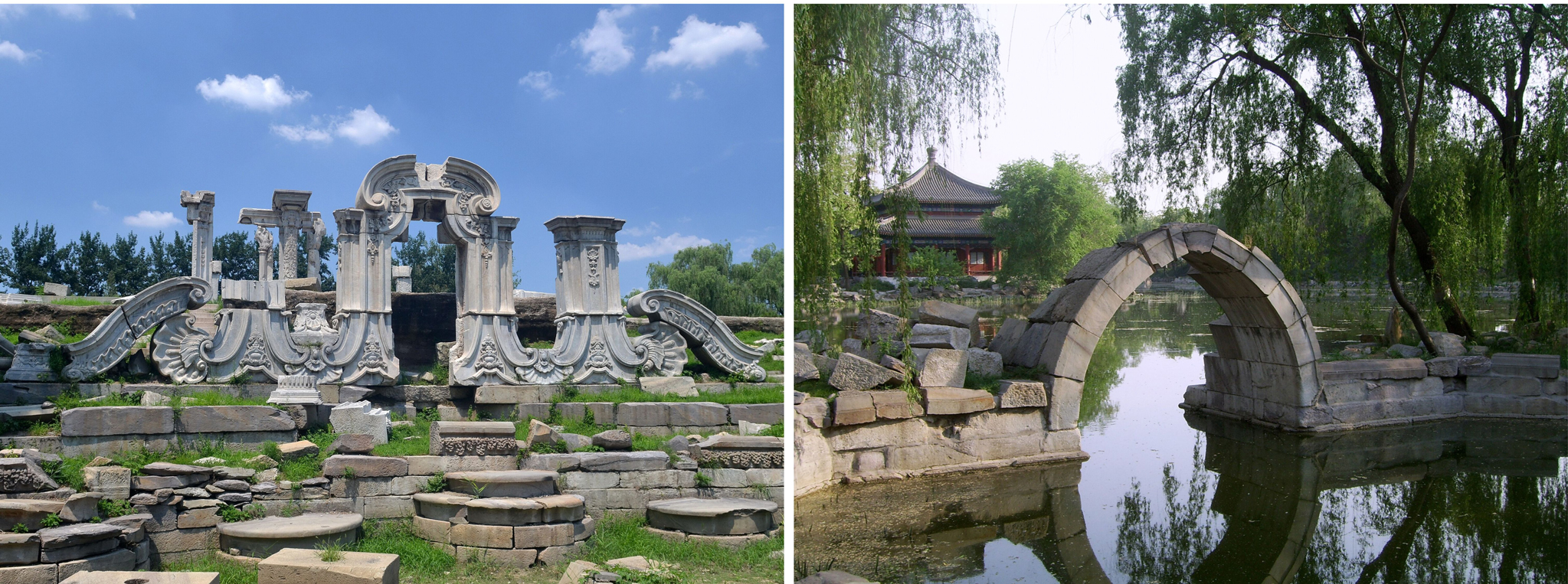
The remains of the Yuanmingyuan, also known as the Old Summer Palace, are shown here. Built in the 18th century near Beijing, the Old Summer Palace was an imperial garden-palace complex renowned for its vast and harmonious blend of Chinese and European architecture, as well as its lakes, pavilions, and landscaped gardens. It symbolized Qing imperial grandeur before it was destroyed in 1860.
"Garden of Perfect Brightness, Yuanmingyuan (圓明園): it's the name of one of China’s most iconic monuments and tourist destinations. Its importance, more to Chinese than to foreign visitors, lies in the fact that it was an imperial palace and garden that was almost completely pillaged and destroyed by British and French troops in 1860. As such it has become a symbol of China’s subjugation at the hands of foreign powers in the 19th century, and hence a focal point of modern Chinese nationalism. Ironically its very power as a symbol rests in its physical invisibility—there is almost nothing to see except the ruins of European palaces that formed one part of the entire garden. Although there is “no there there,” the Yuanmingyuan is everywhere in the Chinese national consciousness." (The Garden of Perfect Brightness by Lillian M. Li).
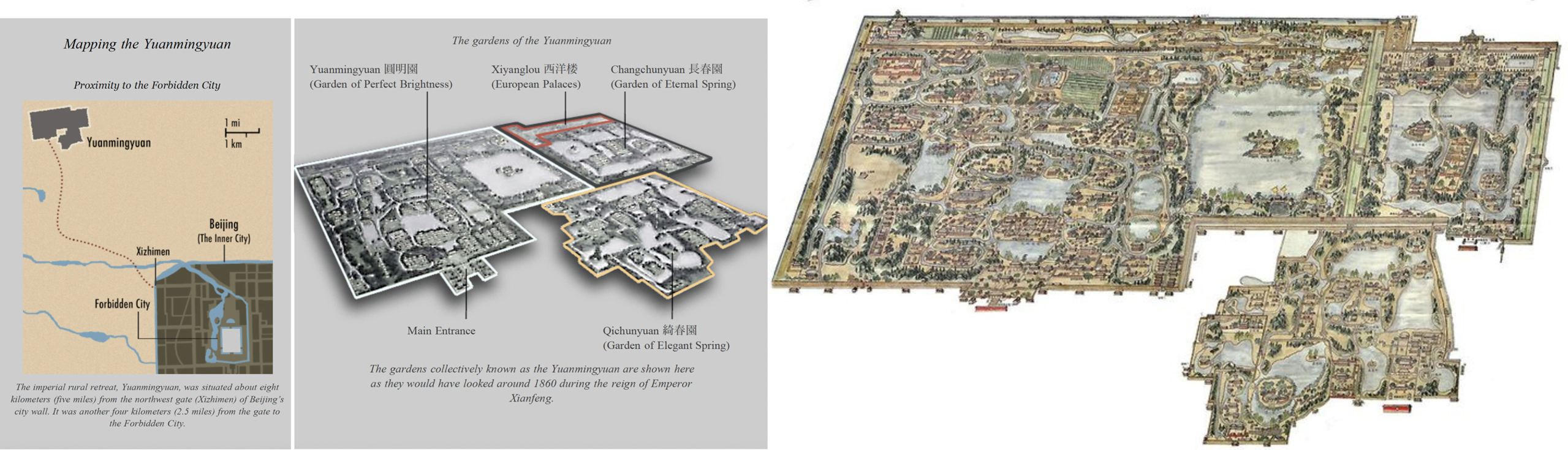
These maps show where the Yuanmingyuan complex was located and how it was structured. The two maps on the left are from The Garden of Perfect Brightness by Lillian M. Li.
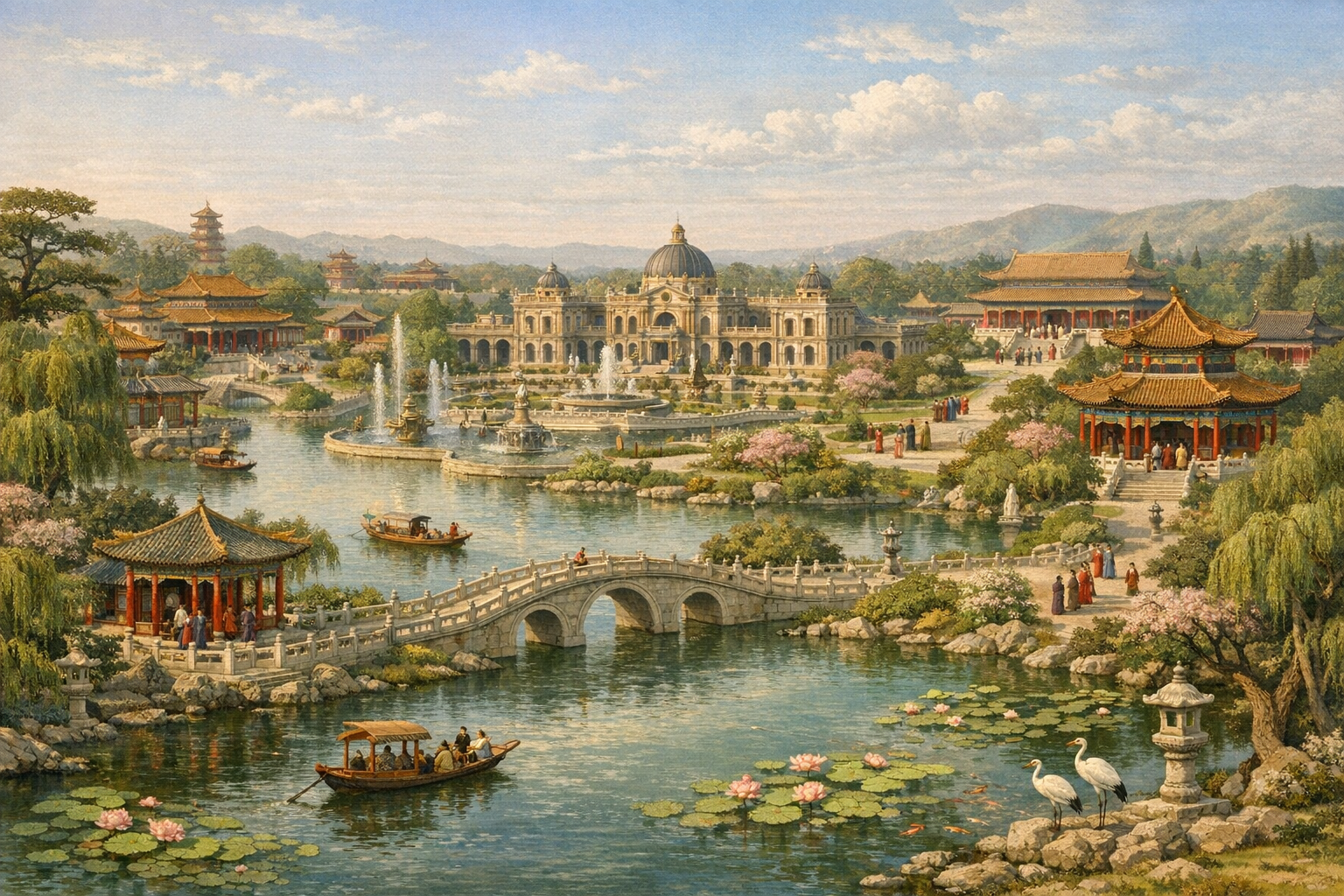
This AI-generated illustration of a section of Yuanmingyuan is not a faithful reconstruction but a palusible representation of how the complex must have looked between the late 18th and early 19th centuries.
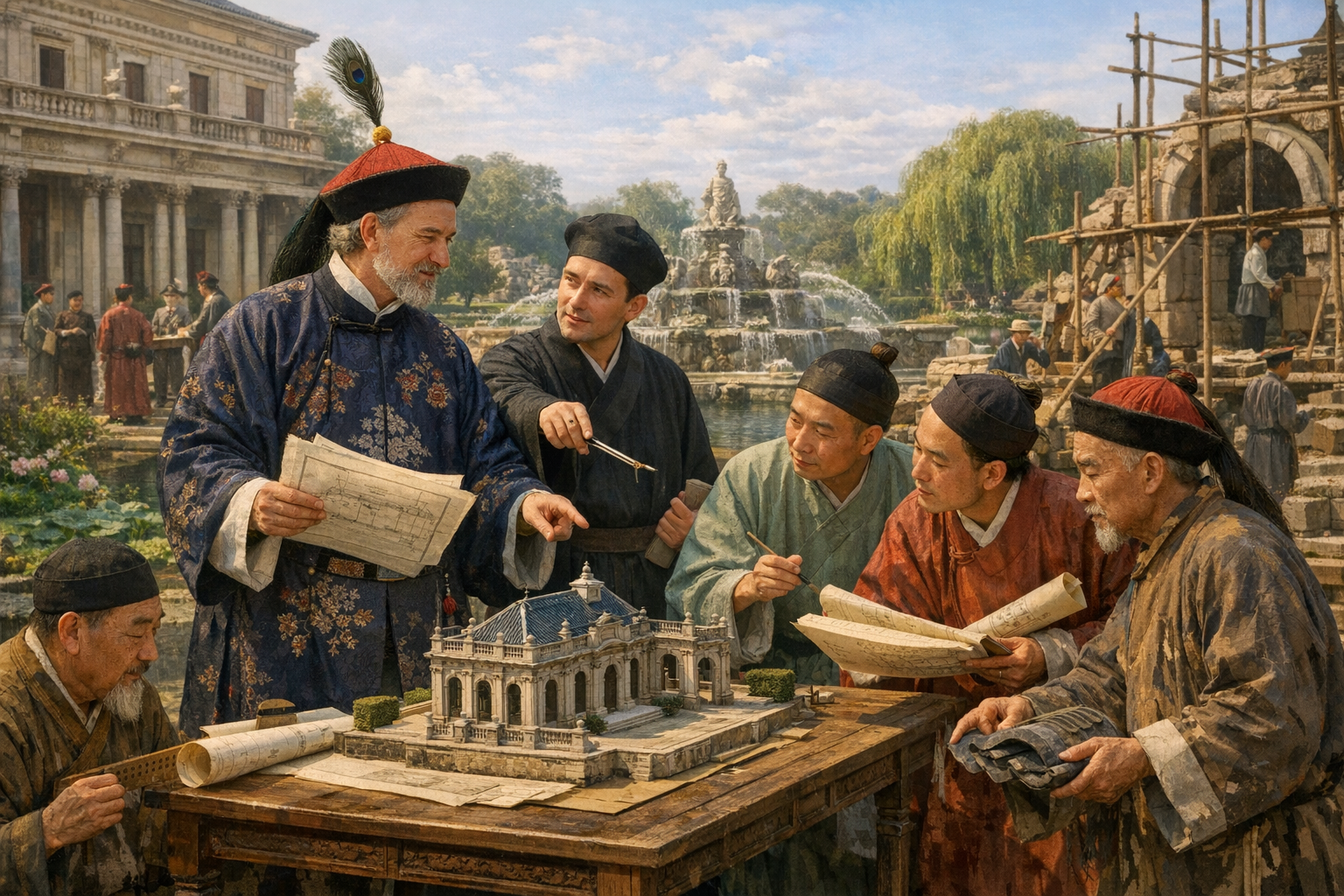
Giuseppe Castiglione and Michel Benoist collaborating with Chinese architects and engineers at Yuanmingyuan. AI-generated illustration.
Between 1747 and 1766, Giuseppe Castiglione and Michel Benoist contributed to the design and decoration of the Western-style section of the Yuanmingyuan, known as the Xiyang Lou (Western Mansions). This period marked the height of the Qianlong Emperor’s ambitious efforts to incorporate European-style architecture and hydraulic engineering into the imperial garden-palace complex. Castiglione passed away in 1766, yet the project persisted under the direction of other Jesuits and court artisans until around 1770. Benoist (1715–1774), whose Chinese name was Bái Jìn (白晋), was a French Jesuit missionary, scientist, and engineer. He arrived in China in 1744 and was soon appointed to serve at the Qing court. Inspired by Versailles and European palace gardens, he designed complex fountains, waterworks, and mechanical devices for the Yuanmingyuan. Benoist collaborated closely with Castiglione and other Jesuits to design the Xiyang Lou, incorporating Baroque facades, formal gardens, and fountains, which were uncommon in traditional Chinese design. Benoist’s engineering expertise helped bring the emperor's vision of a cosmopolitan imperial paradise blending East and West to life. Castiglione and Benoist represent the pinnacle of Sino-European artistic collaboration in Qing court culture, and the Yuanmingyuan is their greatest joint legacy.
- Castiglione’s Administrative Role — Beyond Painting
His role extended into court administration: by the later years of his life, he was entrusted with supervision of imperial workshops and gardens, training Chinese apprentices and shaping the visual culture of the Qing court.
As he rose in favor and seniority at court, Castiglione’s duties extended well beyond painting:
- Workshop Supervisor: In his later years, he oversaw the Imperial Workshops (Zaoban Chu), which included teams responsible for painting, ceramics, textiles, architecture, and decorative arts.
- Training Apprentices: He taught Chinese artists Western techniques and learned from them. This mutual exchange helped evolve a unique Sino-European visual style.
- Shaping Court Aesthetics: By supervising design and production, Castiglione helped define the visual identity of Qianlong’s reign, from official portraits to architectural ornamentation.
His legacy lies in how he navigated and bridged two artistic traditions, leaving behind a body of work that symbolizes both imperial power and global exchange.
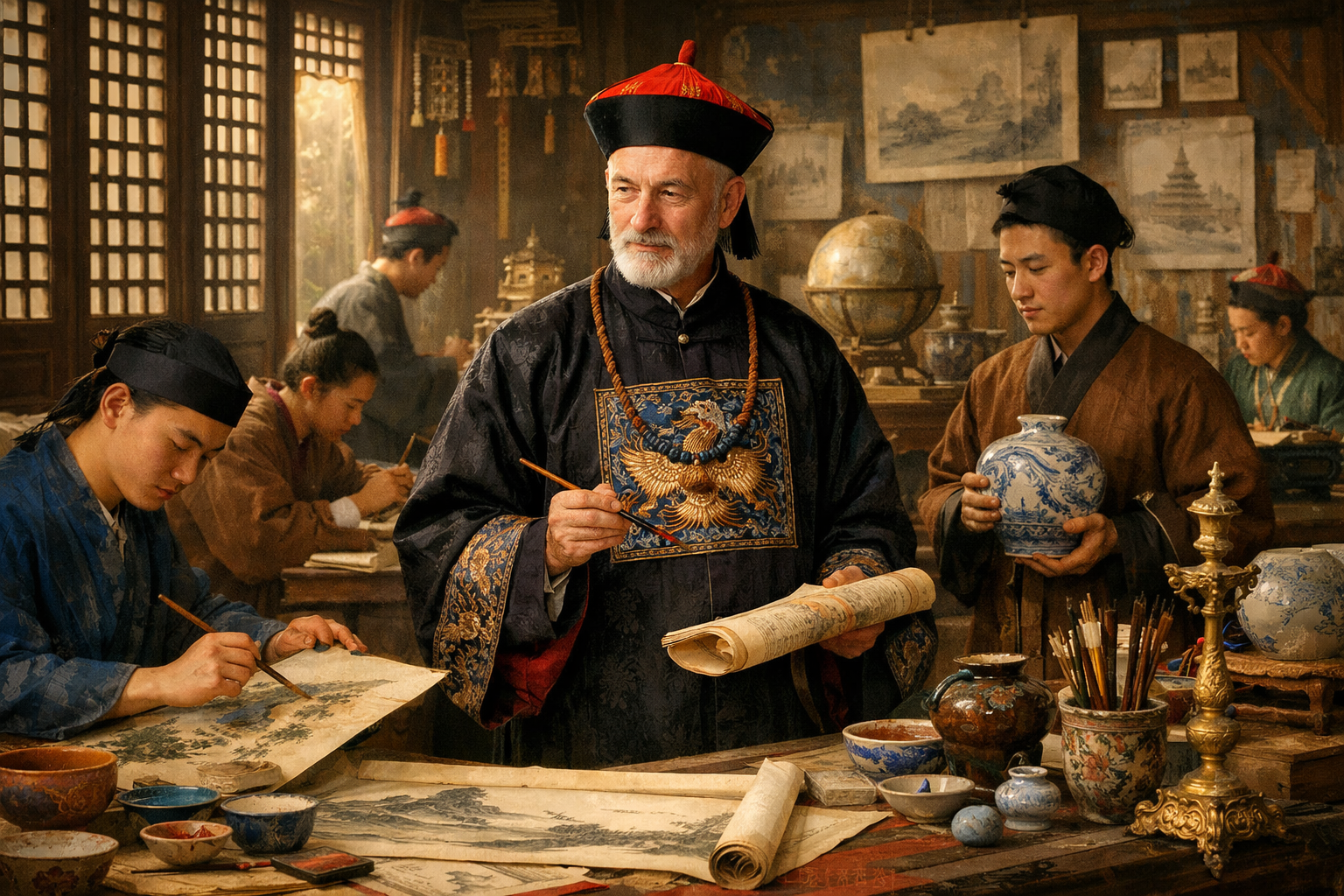
Giuseppe Castiglione overseeing the Imperial Workshops (Zaoban Chu). AI-generated illustration.
Castiglione's influence extended beyond painting to the decorative arts and propaganda. He designed painted-enamel porcelains that combined Rococo colorism with Chinese decorative motifs. These objects traveled along tribute routes as tangible evidence of imperial cosmopolitanism.
- Late Career and Military Portraiture: Giuseppe Castiglione in the 1760s
As he entered his seventies, Giuseppe Castiglione's career at the Qing court under the Qianlong Emperor shifted from grand ceremonial portraiture and tribute animal series to subjects associated with military power, diplomatic representation, and imperial propaganda. Although he had previously produced equestrian portraits, such as the ceremonial Portrait of the Qianlong Emperor in Armor on Horseback, the 1760s marked the final decade of his creative life. During this period, a new generation of works reflected the emperor’s military self-fashioning and the continued fusion of European observational naturalism with Chinese court aesthetics. Castiglione's position at court remained secure. He was not only a painter, but also a teacher and mentor to Chinese and Jesuit apprentices. He oversaw imperial workshops and contributed to artistic programs tied to Wen (civil order) and Wu (martial authority).
Macang Lays Low the Enemy Ranks (瑪瑺斫陣圖卷), 1759
Macang Lays Low the Enemy Ranks is a rare and historically significant 18th-century Qianlong-era battle scene handscroll produced under the direction of Giuseppe Castiglione. The painting documents the military achievements of a Qing officer named Macang (瑪瑺) during the imperial campaigns to pacify rebellions in the western regions, notably among the Dzungar and Muslim Uighur groups, in the turbulent 1750s and 1760s. Rather than a purely ceremonial portrait, this painting is a narrative battle scene that blends Western figurative realism with the tradition of Chinese historical painting. It emerged from Castiglione's late-period artistic production, a time when the Qianlong court increasingly used visual imagery to record and glorify military exploits.
Traditionally, Chinese battle scenes were fairly stylized and schematic. Castiglione's scroll, however, is remarkable for its focused narrative moment, centering on Macang at a decisive instant in combat. The composition is reduced to its dramatic essentials. Macang, wounded but determined, is depicted drawing a bow toward a fleeing enemy. An already struck foe lies prone before him. The tension of motion and psychological resolve is expressed through the economy of lines and careful placement within the handscroll’s horizontal sequence. Though the background is sparse, the painting's clarity of gesture and figural interaction convey the bravery and urgency of combat. This aligns with the Qianlong Emperor's interest in visually documenting real episodes of imperial military valor.
The scroll also carries an imperial inscription by Qianlong himself. Written after the event, the inscription is appended to the painting and praises Macang’s courage. It also orders the work’s production as an official commemoration. Such imperial commentary was crucial in situating the painting as a historical record and a court-sanctioned celebration of martial achievement. It demonstrates how, in its later decades, the Qianlong court harnessed painting not merely as ornament, but also as propaganda and historiography. As a Jesuit working in the imperial atelier, Castiglione worked within the Chinese tradition of narrative handscrolls, subtly incorporating Western naturalistic figuration. This reflects his mature synthesis of the two visual cultures.

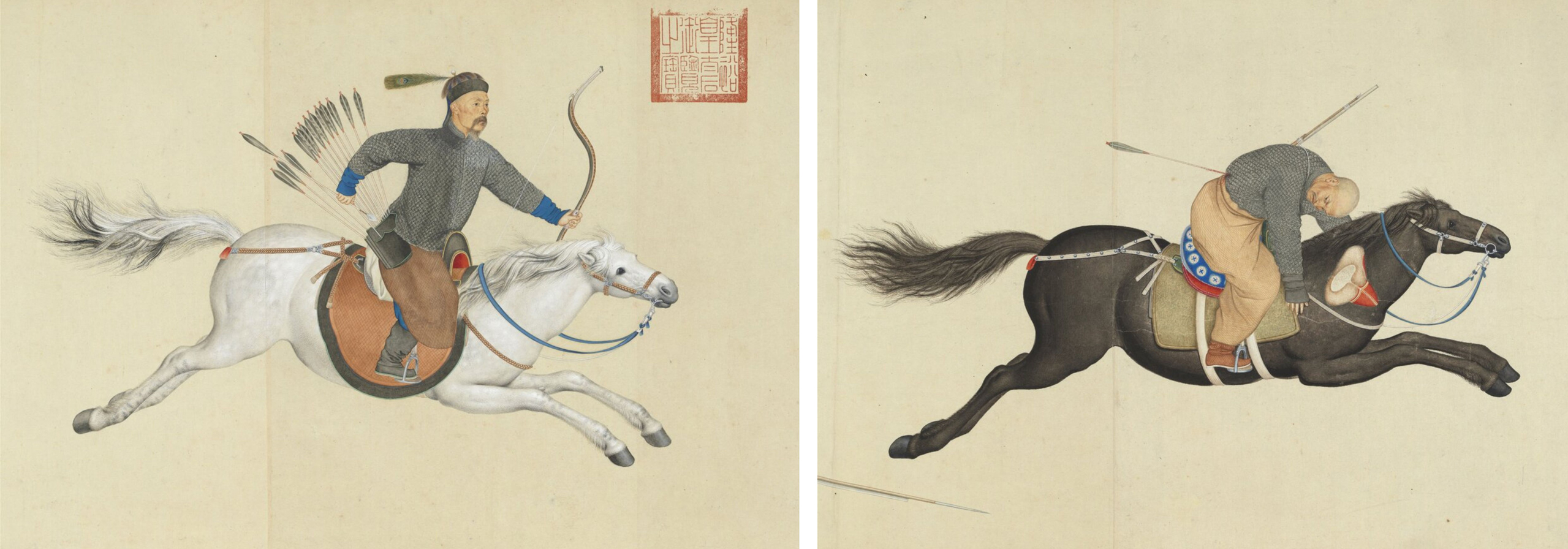
Giuseppe Castiglione, Macang Lays Low the Enemy Ranks (清郎世寧畫瑪瑺斫陣圖卷), Handscroll, 1759. Medium: Ink and colors on paper. Dimensions: Approx. 38.4 × 285.9 cm. National Palace Museum, Taipei, Taiwan.
This is a single, extended narrative battle scene depicting the warrior Macang overcoming an enemy during the Qing campaign in the western regions. The central action shows Macang drawing an arrow toward a wounded foe. Other weapons, including a spear on the ground, reinforce the narrative of bravery and confrontation. The Qianlong Emperor commissioned this artwork as a commemorative chronicle of Macang’s meritorious actions in suppressing frontier rebellions during the Xinjiang campaigns. Qianlong appended an imperial eulogy to the scroll, reinforcing its function as visual imperial historiography and political celebration. Castiglione chose to portray a single dramatic episode rather than a panoramic battle. He applied Western-influenced naturalistic modeling, volumetric bodies, and expressive postures within a predominantly Chinese handscroll format. The minimal landscape allows the figural action and psychological intensity to dominate.
Late Tribute Animal Portraiture: Four Afghan Steeds, 1763
In addition to imperial portraiture, one of the last surviving animal portrait commissions in Castiglione’s late career is a series known as Four Afghan Steeds. Painted in 1763, shortly before his death, the series depicts four magnificent horses presented as tribute by Ahmad Shah Durrani of Afghanistan. Each horse is rendered in meticulous detail and bears inscriptions in multiple languages, including Uyghur, Chinese, Manchu, and Mongolian, that record the animal’s name, origin, and symbolic status. The horses' depictions show remarkable continuity with Castiglione’s earlier horse portraits (such as Ten Prized Horses, 1743), but with a more mature treatment of light, musculature, and stance, suggesting a lifetime of refinement in handling both subject and medium. These paintings are among Castiglione’s final horse portraits and exemplify how tribute objects continued to be integrated into the visual culture of the Qing court even at the end of his career.

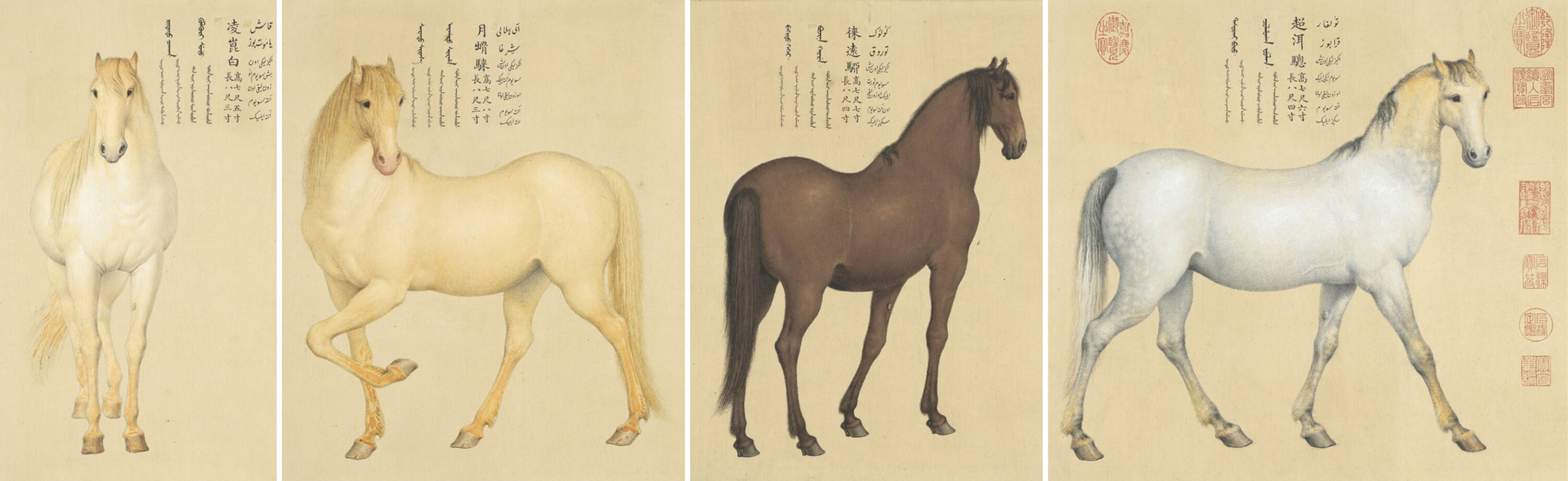
Giuseppe Castiglione, Four Afghan Steeds (爱乌罕四骏图), continuous horizontal silk scroll with four individual horse portrayals, 1763. Medium: Ink and pigments on silk. Dimensions: Approx. 40.7 cm height × 297.1 cm width. National Palace Museum, Taipei, Taiwan.
The work was commissioned in 1763 after the Qianlong Emperor of the Qing dynasty received four Afghan horses as a gift from Emir Ahmad Shah of Afghanistan. This gift symbolized political engagement during a time of volatile Sino-Afghan relations. Castiglione, around 74 years old at the time, created the artwork by combining Western modeling techniques, which use light and shade to suggest volume, with Chinese linear brushwork. Inscriptions in four languages — Chinese, Manchu, Mongolian, and Uyghur — identify each horse and record their names and specifications, reflecting the multicultural realm of the Qing Empire. While the horses are detailed, they lack gender distinction, possibly due to Castiglione’s Jesuit restraint regarding overt physical depictions. The horses are arranged from right to left, as is customary for Chinese horizontal scrolls. Cháorèngōng (walking right, gray/piebald), Láiyuánliù (three-quarter view, chestnut), Yuèkúlái (yellowish), and Línkùnbáixi ("Magic Horse" in Mongolian, frontal view, gray/white).
The Qing Military Battle Illustrations (1764–1765)
In 1764, at the age of 76, the Italian Jesuit painter was entrusted with an ambitious project by the Qianlong Emperor. He was tasked with producing preliminary drawings for a series of sixteen illustrations depicting the Qing dynasty’s major military campaigns in the Western Regions. These were the vast frontier territories northwest of the empire that had been the focus of prolonged and often brutal military campaigns against the Dzungars and Muslim polities during Qianlong’s reign.
The emperor's decision to commission such a series reflected his desire to memorialize the Qing victories in visual form, essentially as state propaganda blended with imperial self‑representation. Rather than leaving these scenes solely in the realm of court painting, he commanded that the master drawings be sent to Paris to be transformed into copperplate engravings and printed for wider dissemination. This represented an extraordinary cultural undertaking: Chinese imperial imagery reproduced by Western engraving techniques and then brought back to China. Once drafted in Beijing, the battle scenes were dispatched to France, where they were entrusted to the atelier of Charles‑Nicolas Cochin, engraver to King Louis XV. There, a team of French engravers executed the plates using copperplate etching and engraving techniques, methods that were technically demanding and time‑intensive. The goal was to faithfully translate the Chinese court paintings into finely detailed prints, a process involving both acid etching (eau‑forte) and careful line work with a burin to achieve clarity and grace in each scene.
Castiglione was designated as the principal draughtsman of the series, working alongside other European Jesuit painters at the Qing court, such as Jean‑Denis Attiret, Ignatius Sichelbarth, and Jean‑Damascène Sallusti. The imperial order specifically charged him with preparing the designs for scenes such as the storming of the camp at Gädän‑Ola and the lifting of the siege at the Black Water River—episodes drawn from decisive moments in the 1755–1760 Western campaign. These two drawings, in particular, are widely acknowledged as the last major contributions Castiglione made for the Qing court before his death two years later.
Although the series was completed only after much deliberation and time spent executing it in Paris, its completion in the late 1760s and early 1770s enabled these visual texts to return to China. There, they were bound into albums or kept on display in the imperial collections.
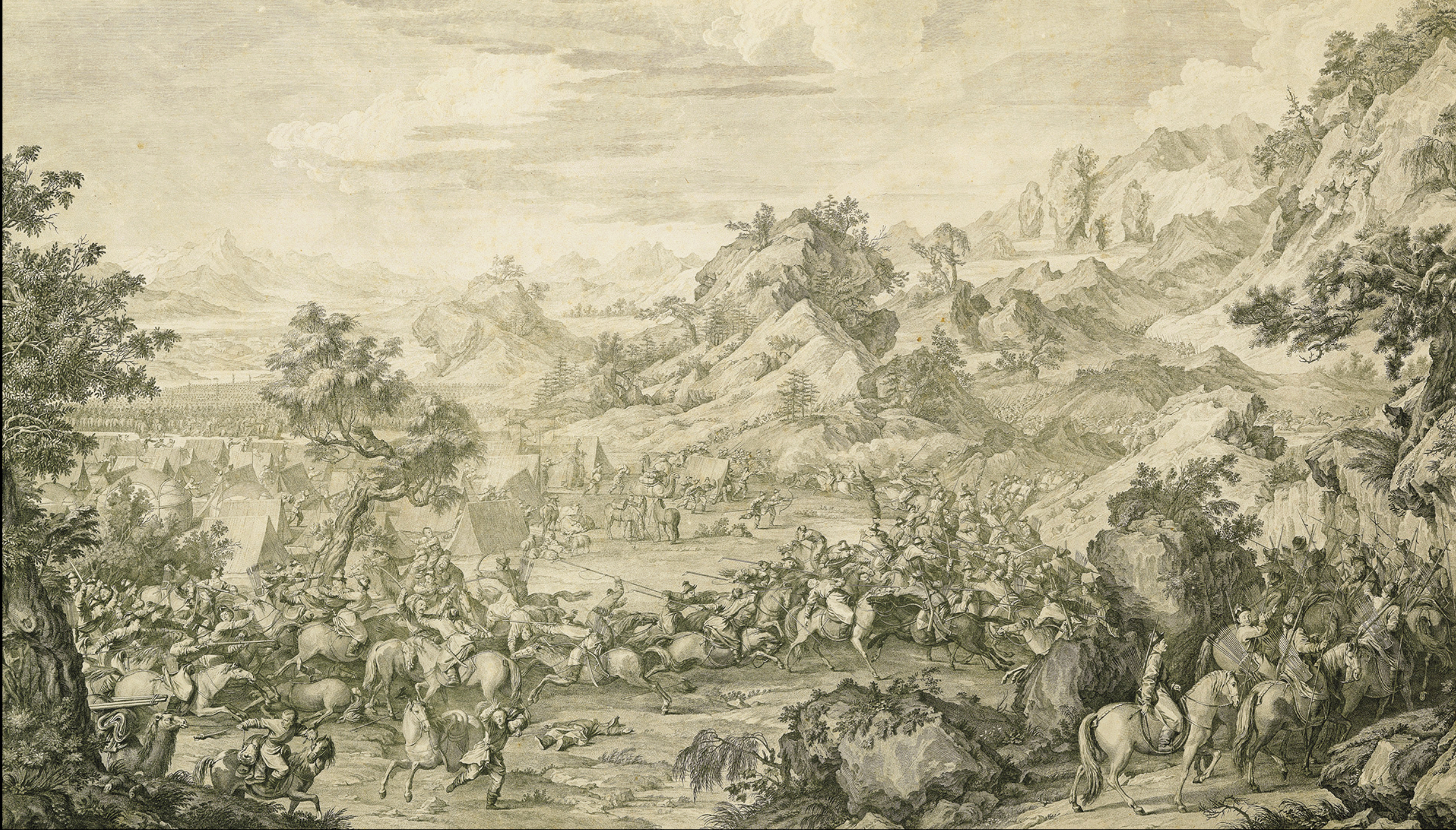
Copperplate engraving of the Storming of the Camp at Gädän-Ola from the Victory in the Pacification of Dzungars and Muslims. Drafted by Giuseppe Castiglione, directed by Charles-Nicolas Cochin (1715-1790), engraved by J. Ph. Le Bas (1707-1783), finalized in 1769 at Paris, France. National Palace Museum, Taipei, Taiwan.
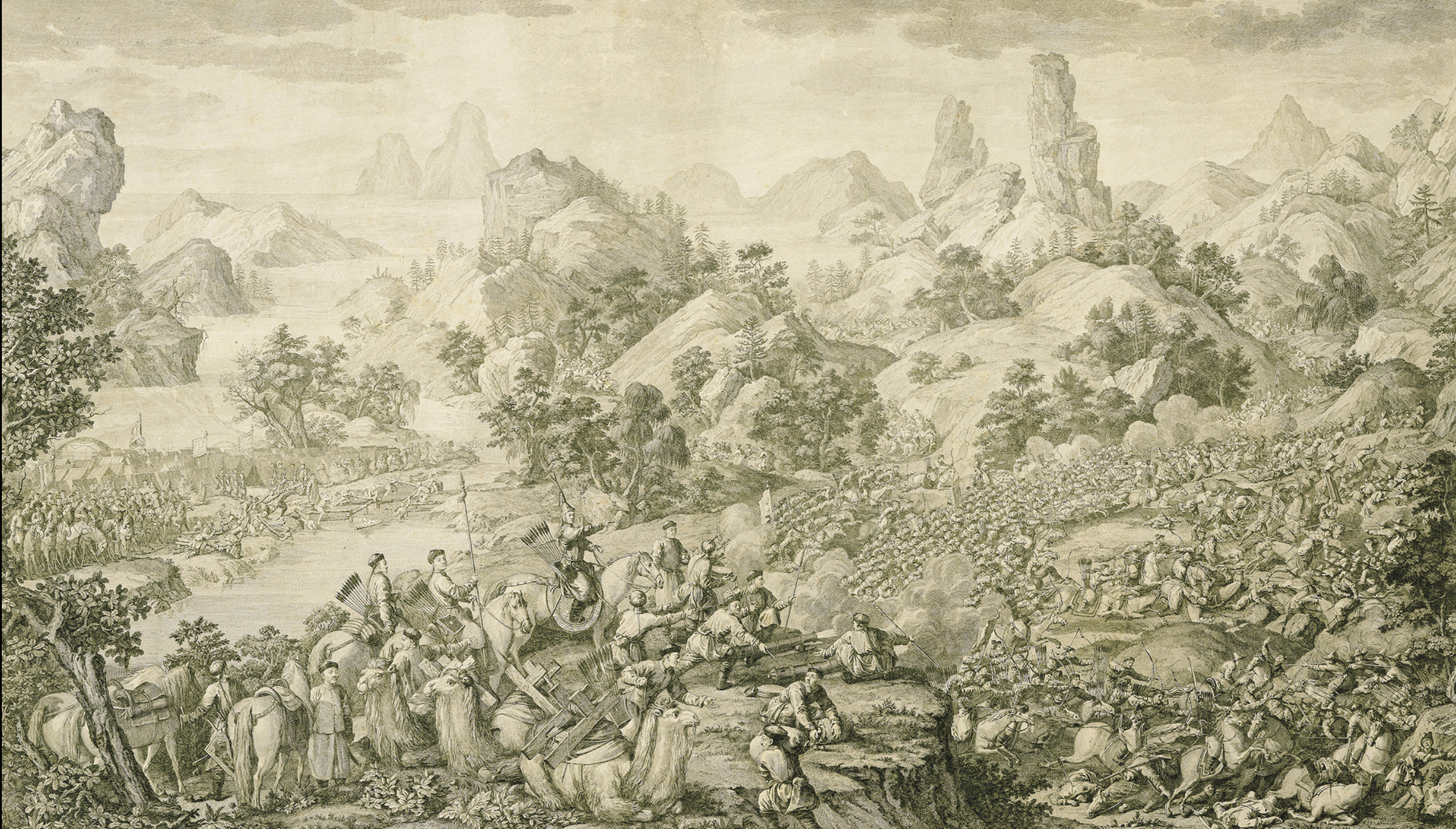
Copperplate engraving of the Storming of the Camp at Gädän-Ola from the Victory in the Pacification of Dzungars and Muslims. Drafted by Giuseppe Castiglione, directed by Charles-Nicolas Cochin (1715-1790), engraved by J. Ph. Le Bas (1707-1783), finalized in 1771 at Paris, France. National Palace Museum, Taipei, Taiwan.
Castiglione’s later works reveal his continued dedication to naturalistic representation and cross-cultural synthesis. Although his formal subjects, such as horse portraits, battle scenes, and imperial manifestations, reflect the priorities of the imperial atelier rather than personal artistic exploration, his commitment remains evident. By the 1760s, his workshop had become a training ground for young Chinese artists. Many of these artists adopted Castiglione's techniques of shading, perspective, and compositional structure. They also engaged in a mutual exchange of ideas with established Chinese painters. This exchange contributed to the evolution of a distinctive Sino-European style at the Qing court, the influence of which extended beyond Castiglione's lifetime. In fact, there is some tension in the scholarship regarding Castiglione’s influence. Some traditional narratives highlight his role as a transmitter of European techniques and a catalyst for a hybrid style at the Qing court. On the other hand, some modern art-historical perspectives emphasize that his impact on broader trajectories of Chinese art was limited or localized. A deeper look suggests the truth lies somewhere between these extremes: the Italian Jesuit's influence was significant within the context of Qing court painting but did not spark a general stylistic revolution across Chinese art as a whole.
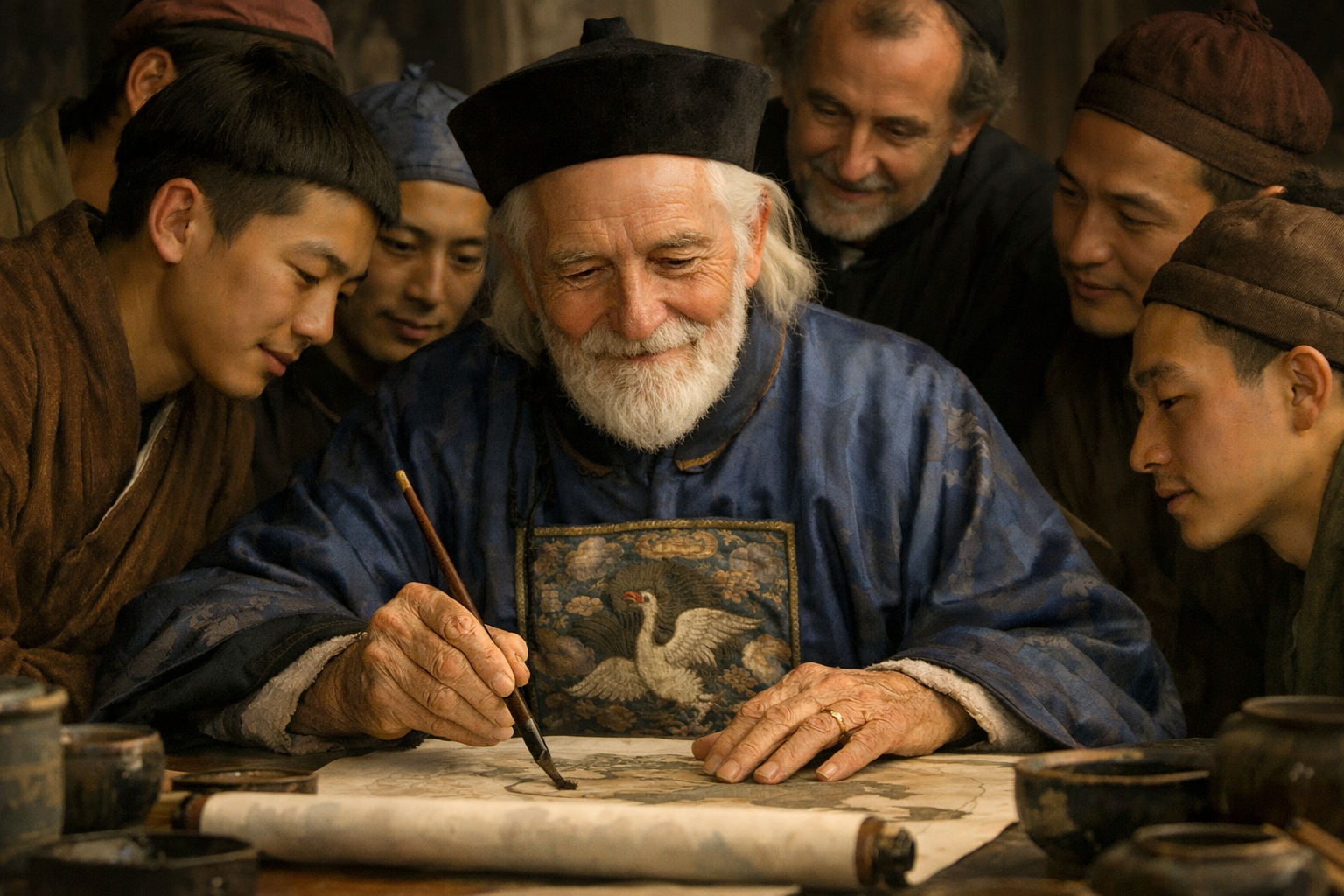
AI-generated illustration.
- Death and Posthumous Honors
Giuseppe Castiglione passed away in Beijing on July 17, 1766, just two days before his 78th birthday. As no contemporary source records a specific illness or event, modern scholarship concludes that he died of natural causes associated with advanced age.
The Qianlong Emperor personally honored his passing by writing an obituary in Chinese praising his service and ordering the erection of a memorial stele in his honor — a distinction rarely given to foreign artists. Qianlong also decreed an imperial funeral and a posthumous promotion to vice minister, a rank normally reserved for loyalists who had served in civil administration for decades. This honor acknowledged that, for fifty-one years, Castiglione had been more than a minor technician: he had been a cultural architect of the Qing vision and a respected man, as the archives record.
Castiglione was buried in the Jesuit cemetery at Zhalan in Beijing, alongside fellow missionaries who had also served at the Qing court. The emperor posthumously granted him a higher rank, underscoring the high esteem in which he was held as both an artist and a figure of cultural exchange. These honors confirm that Castiglione's death occurred at the end of a long and respected career at the Qing court.
Giuseppe Castiglione’s life and art represent a remarkable chapter in cultural history — one in which artistic mastery became a bridge between continents, philosophies, and imperial worlds. By fusing European techniques with Chinese pictorial traditions, Castiglione created a unique visual language that resonated with the Qing court's highest echelons and left an indelible mark on eighteenth-century Chinese art. His legacy is the xianfa aesthetic, a visual Esperanto that enabled the Qing court to express its universal aspirations. In Castiglione's syncretic paintings, we witness genuine dialogue, not cultural colonialism—East learning from West, West appropriating East, both transformed. The National Palace Museum's 2015 tricentennial exhibition gathered one hundred objects, each of which testifies that this Jesuit painter became irrevocably Lang Shining, the "World-Nourishing" divine brush.
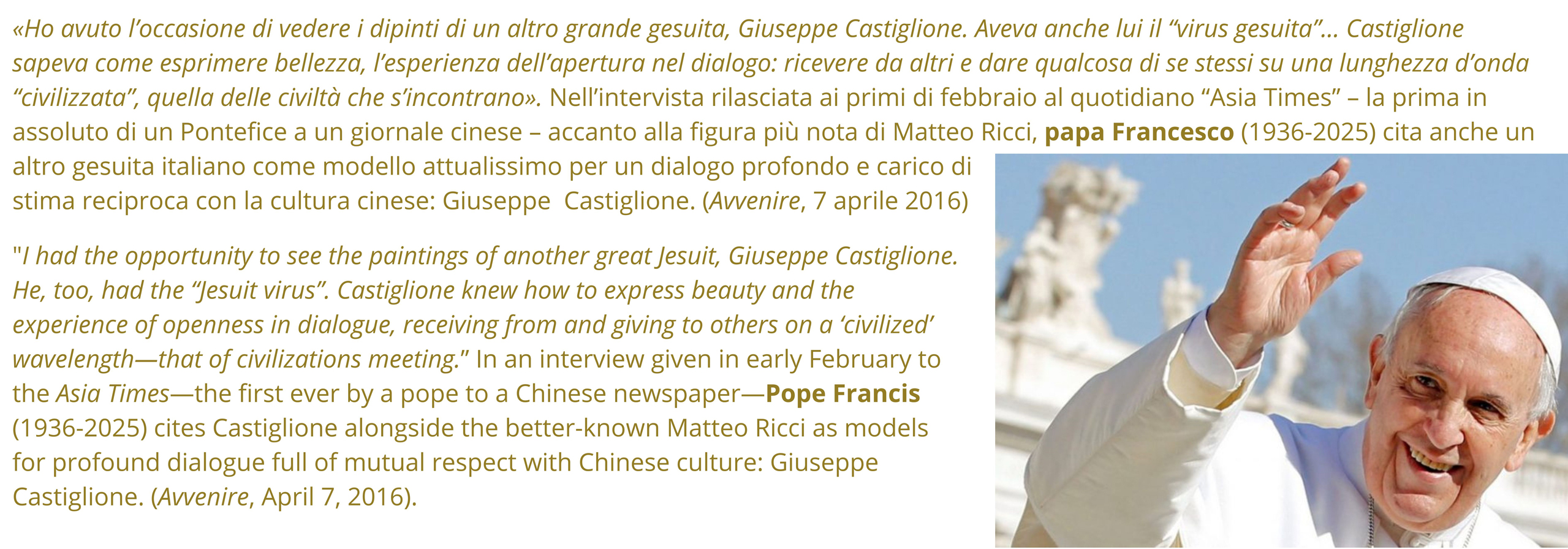
Giuseppe Castiglione (郎世宁): A Portrait of the Man Behind the Canvas
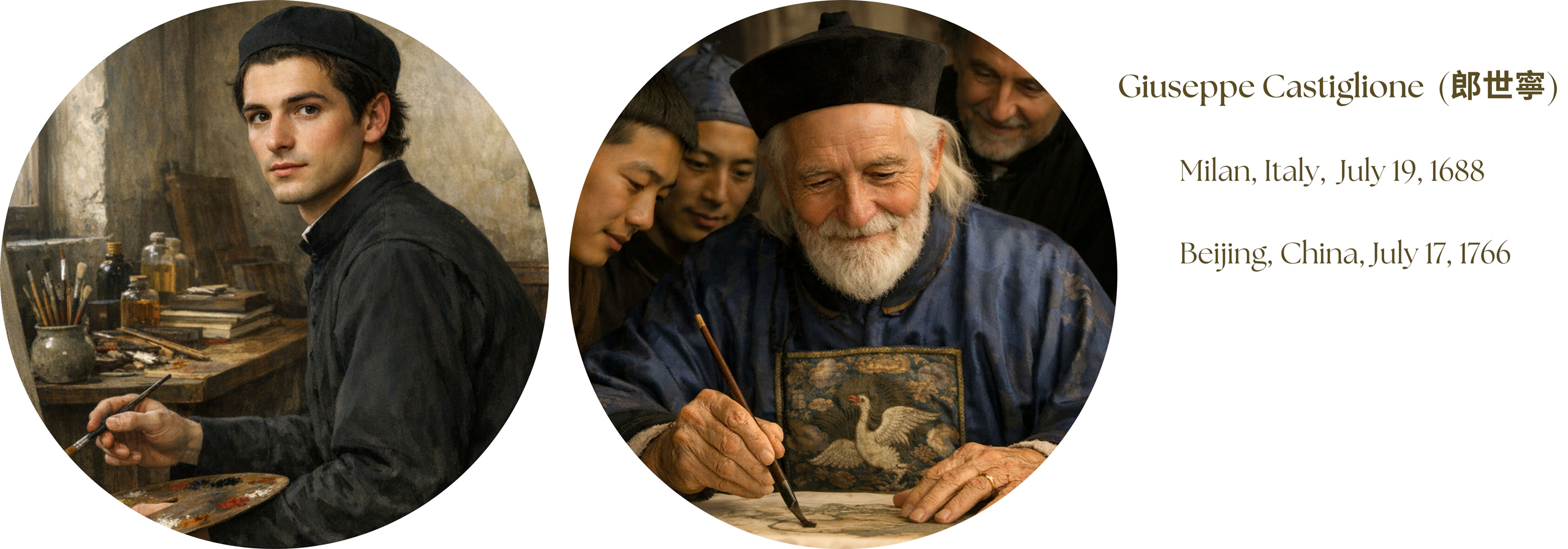
Physical appearance
Giuseppe Castiglione was a figure whose physical presence in China was as distinctive as his artistic style. As an Italian Jesuit navigating the complex social and cultural landscape of the Qing dynasty's imperial court, his Western appearance was a defining and constant feature. While historical and academic sources do not provide a comprehensive portrait, they offer crucial glimpses into how his looks were perceived and the challenges they presented. His features, typical of an 18th-century European man, stood in stark contrast to Chinese standards of the time. This made him a subject of curiosity and a figure who struggled to fully assimilate.
The most direct and frequently cited description of Giuseppe Castiglione's physical appearance comes from Chinese sources that highlight his distinctly European features: a "high nose bridge" (鼻梁高耸) and "deep-set eyes" (眼窝深邃) . The same sources that detail Castiglione's facial features further note that his appearance was considered "unusual" or "different from ordinary people" (异于普通人). This assessment underscores the social impact of his physical presence. In the context of 18th-century Beijing, a city that, while cosmopolitan, was still deeply rooted in its own cultural and aesthetic norms, a European man would have been a rare sight.
The term "unusual" suggests a perception that went beyond mere curiosity, hinting at a sense of foreignness that could be a barrier to social integration. The sources explicitly state that this unusual appearance made it difficult for him to "blend into local life" (让他很难融入当地的生活) . This observation is crucial because it connects his physical characteristics directly to the social and cultural challenges he faced. Despite his immense talent and the high regard in which the emperors held him, his foreign appearance was a constant reminder of his outsider status—a physical manifestation of the cultural bridge he was attempting to build through his art.
Nie Chongzheng (聂崇正) , a leading expert on Qing court painting and a researcher at the Palace Museum, offers significant insights based on his extensive studies. He suggests that Castiglione was likely "slim" (身材偏瘦) because, as a Jesuit missionary, he would have led a disciplined and moderate life, which could have contributed to his lean physique.
A "Gentle" and "Affable" Demeanor
Nie's assessment of Castiglione goes beyond his physical build to include his demeanor, which Nie describes as "gentle" and "peaceful" (个性平和). The expert also notes that, as a missionary, Castiglione would have needed to be affable, a quality essential for building relationships and navigating the treacherous political landscape of the Qing court. This "gentle" demeanor would have been a significant asset, enabling him to interact with emperors, princes, and court officials with diplomacy and respect. This contrasts sharply with the image of a brash or overbearing foreigner, suggesting instead a man sensitive to the cultural nuances of his environment who adapted his behavior accordingly. His slim figure and gentle, affable personality paint a picture of a non-threatening man well-suited to the role of cultural and artistic mediator.
Personal Temperament and Character
His ability to serve at the Qing court for over fifty years under three emperors—Kangxi, Yongzheng, and Qianlong—speaks to his diplomatic tact, prudence, cultural sensitivity, and personal resilience. This temperament was the cornerstone of his remarkable and enduring success at the court. Serving three successive emperors required artistic genius as well as a character of exceptional resilience, adaptability, and virtue. Historical accounts and scholarly analyses depict a man whose inner qualities were as impressive as his artistic achievements. He was described as humble, gentle, and deeply dedicated to his craft. His ability to navigate the treacherous political landscape of the imperial court, maintain the favor of three distinct rulers, and foster collaborative relationships with Chinese artists speaks volumes about his character.
Although Castiglione arrived as a missionary deeply committed to his faith, he soon learned that overt evangelization was impossible within the strict protocols of the Forbidden City. Instead of expressing his frustration publicly, he channeled his religious commitment into artistic endeavors, focusing on painting and cultural exchange. This deliberate choice suggests a temperament inclined toward accommodation, patience, and strategic engagement rather than confrontation. His work impressed the emperors with its naturalistic shading and perspective. It demonstrated not only technical skill, but also quiet confidence and flexibility in artistic expression. This allowed him to adapt European methods to Chinese conventions.
Castiglione’s personality also surfaces indirectly through his long-term relationships with court artists. He collaborated closely with Chinese painters and craftsmen, and historians note that his collaborative attitude fostered mutual learning and respect rather than seeking dominance of Western methods. This suggests a temperament that valued humility, collegiality, and intellectual curiosity rather than rigid adherence to a single tradition. His ability to negotiate stylistic compromises, such as minimizing Western shadows at the emperor’s request, reflects artistic pragmatism and personal diplomacy. He was also described as warm and understanding. This is particularly evident in his interactions with collaborators and students, where he demonstrated patience and a supportive attitude. A specific example of Castiglione's supportive and empathetic nature is provided in the Beijing Palace Museum publication in his relationship with the French Jesuit painter Jean Denis Attiret, known in China as Wáng Zhì Chéng (1702–1768). When Attiret first arrived in China, he struggled to adapt to the new environment and the demands of the court. Recognizing his colleague's difficulties, Castiglione took it upon himself to offer comfort and encouragement. He "patiently consoled" Wang and encouraged him with the emperor's favor. He even helped Wang prepare his paints and promised to assist him with his work.
These traits, combined with his artistic talent, allowed Castiglione to become a respected and beloved figure within the palace community, not just a court painter. This is a testament to his ability to build bridges between different cultures through his personal character, moral strength, and art.

Alyx Becerra
OUR SERVICES
DO YOU NEED ANY HELP?
Did you inherit from your aunt a tribal mask, a stool, a vase, a rug, an ethnic item you don’t know what it is?
Did you find in a trunk an ethnic mysterious item you don’t even know how to describe?
Would you like to know if it’s worth something or is a worthless souvenir?
Would you like to know what it is exactly and if / how / where you might sell it?
