

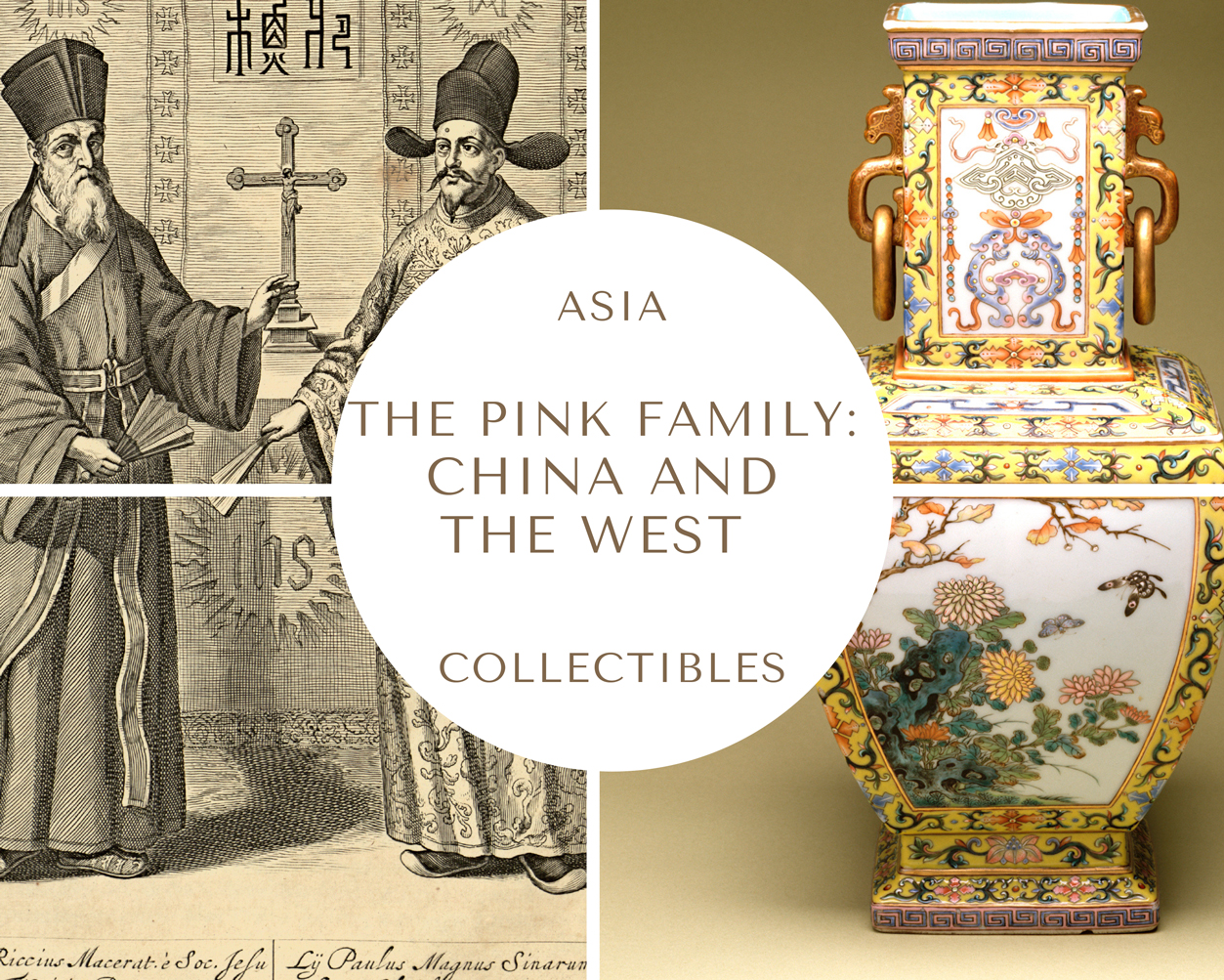
THE PINK FAMILY: CHINA AND THE WEST 11
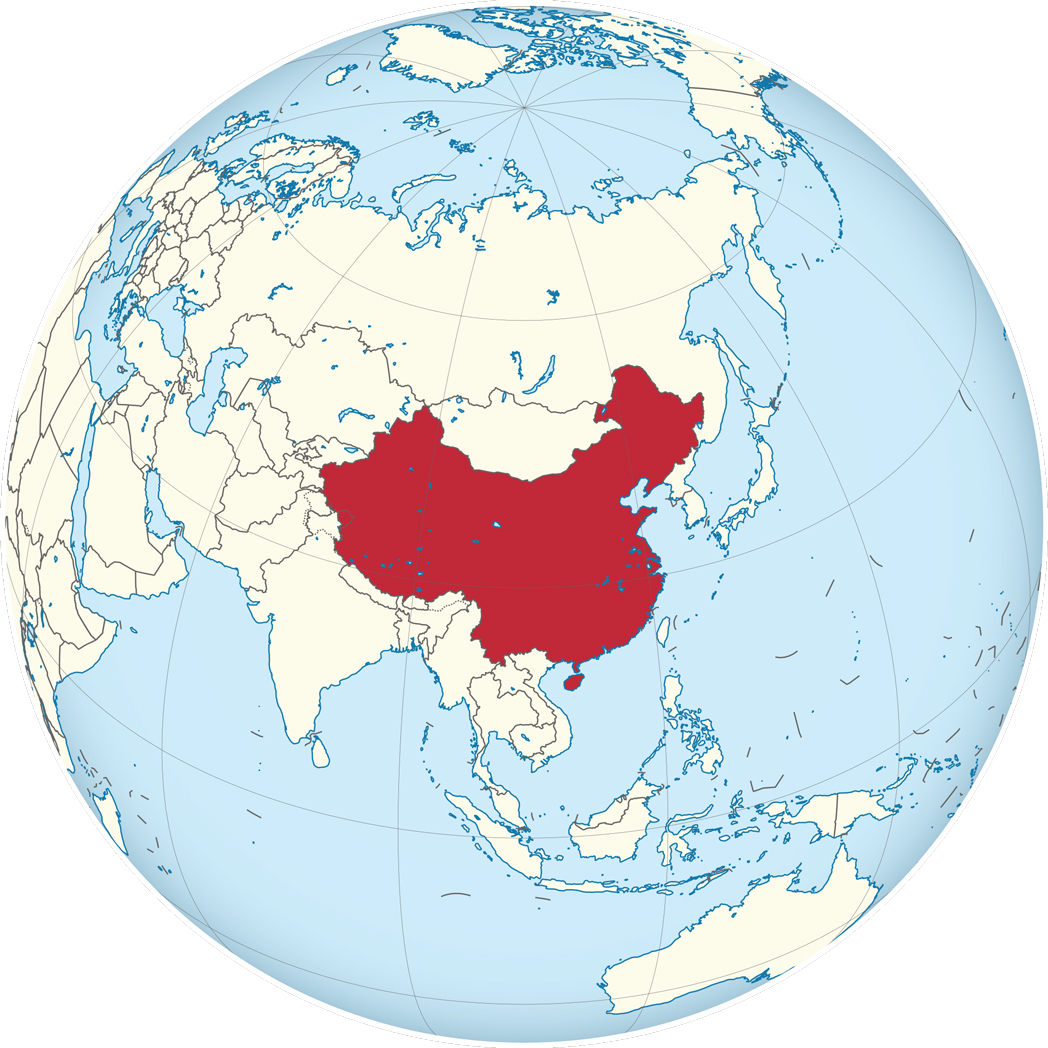
Current China on the globe.
Under the Creative Commons Attribution-Share Alike 3.0 Unported license.
This map is for illustrative purposes only. The Ethnic Home does not take a position on territorial disputes.
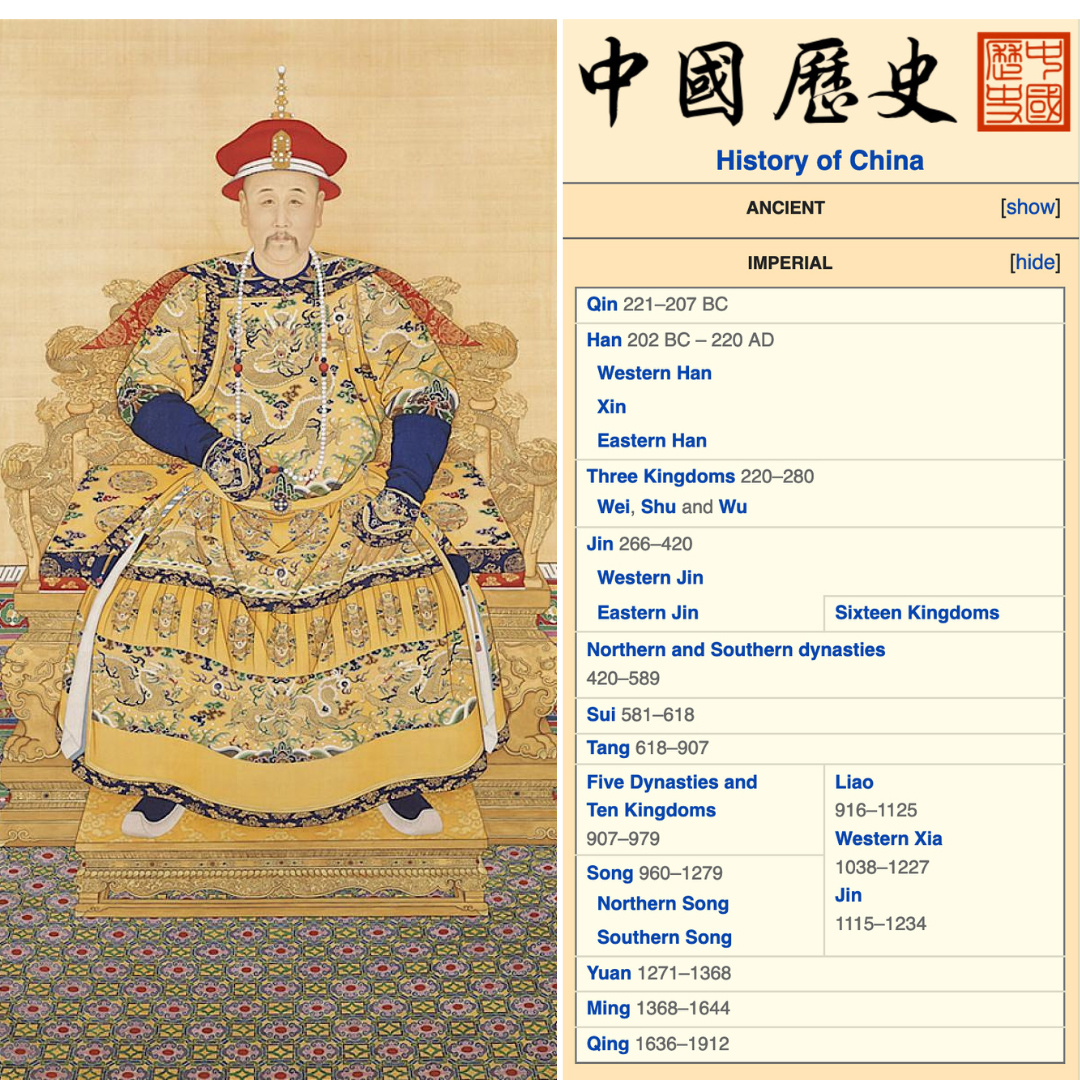
LEFT: Portrait of the Yongzheng Emperor in Court Dress, by anonymous court artists, Yongzheng period (1723—35), Qing Dynasty. Hanging scroll, color on silk. The Palace Museum, Beijing. Public Domain.
RIGHT: History of China, Imperial Dynasties, source: Dynasties in Chinese history, Wikipedia.
Let's start with exquisite porcelain pieces—objects that bear traces of empires, workshops, and unexpected encounters. Among the most fascinating are those linked to the Jesuits at the Qing court, either directly or indirectly.
One such piece is a superbly enameled porcelain box and cover bearing a Yongzheng period (1723–1735) reign mark. Art historian Regina Krahl notes that the Yongzheng emperor greatly valued auspicious imagery, especially motifs promising longevity, protection, and legitimate rule. Peaches (桃 táo) are among China’s most powerful symbols of longevity; eight (八 bā) is a lucky number; and flowering peach branches were believed to ward off evil. Court artists, such as the Italian painter Giuseppe Castiglione (1688-1766), presented the emperor with paintings heralding good fortune. Court artisans fashioned ruyi scepters that granted wishes in many different materials. The emperor surrounded himself with portents of good luck.
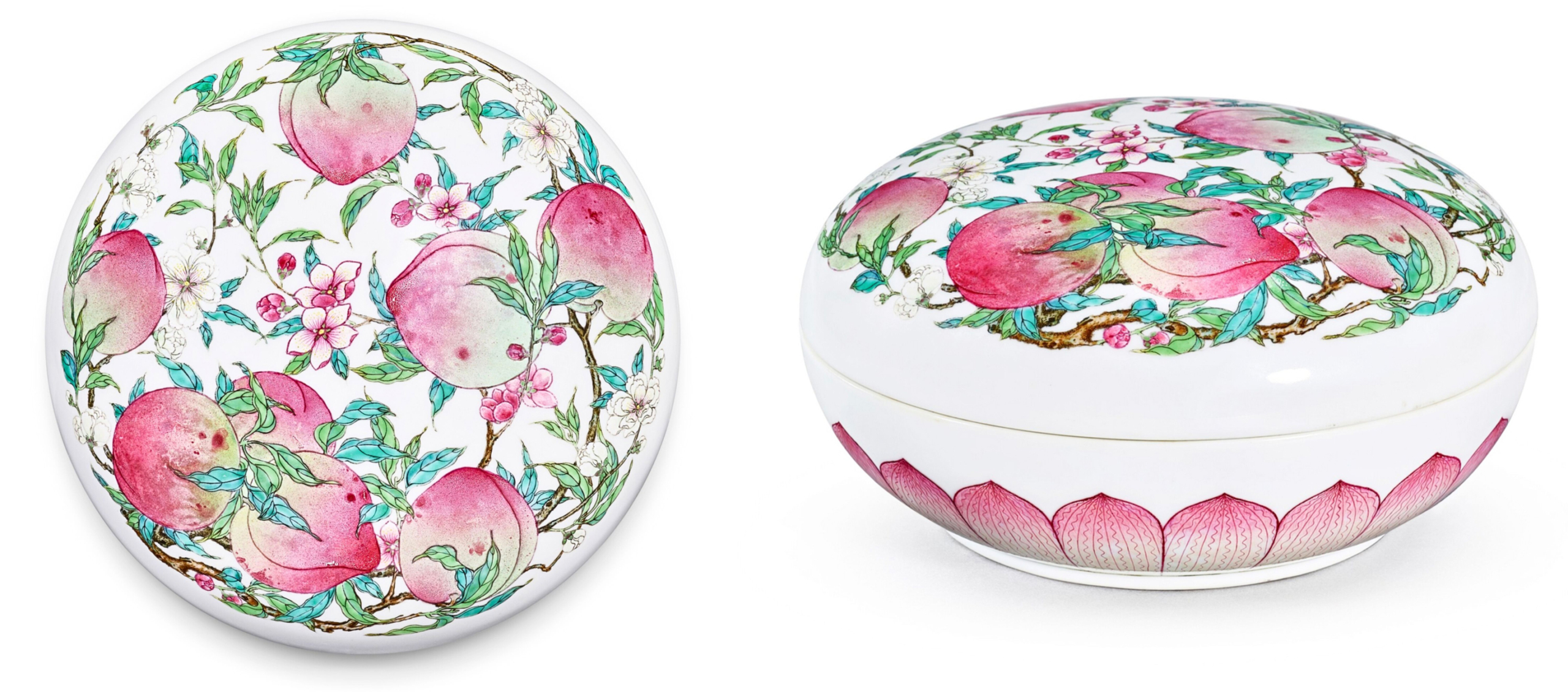
This medium-sized box (with a diameter of 19.2 cm) was sold at Sotheby’s Hong Kong (2021) for HKD 34,660,000. Using today’s approximate mid‑market exchange rates, this is equivalent to US$ 4,437,000 and € 3,764,000.
In Western terminology it is described as "Famille Rose"; in Chinese ceramic vocabulary, this palette is most commonly called 粉彩 (fěncǎi), literally “powdery/pastel colours.”
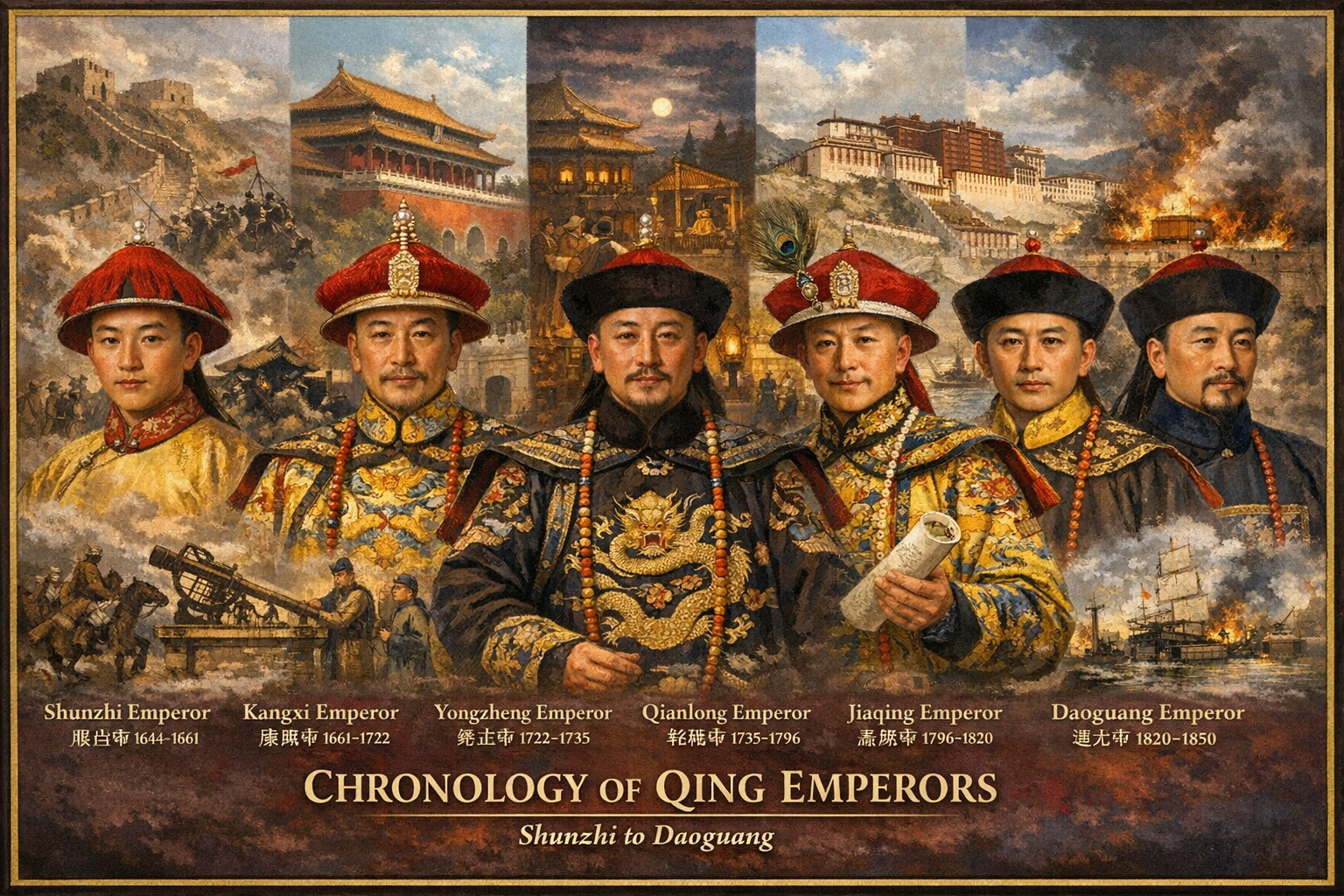
Below, you can admire a magnificent pair of Chinese vases crafted during the Qianlong Emperor's reign from 1736 to 1796. The Qianlong Emperor, often referred to as the fifth Qing emperor, was actually the fourth to rule China. He was the favorite son of the Yongzheng Emperor and the greatest patron of Giuseppe Castiglione.
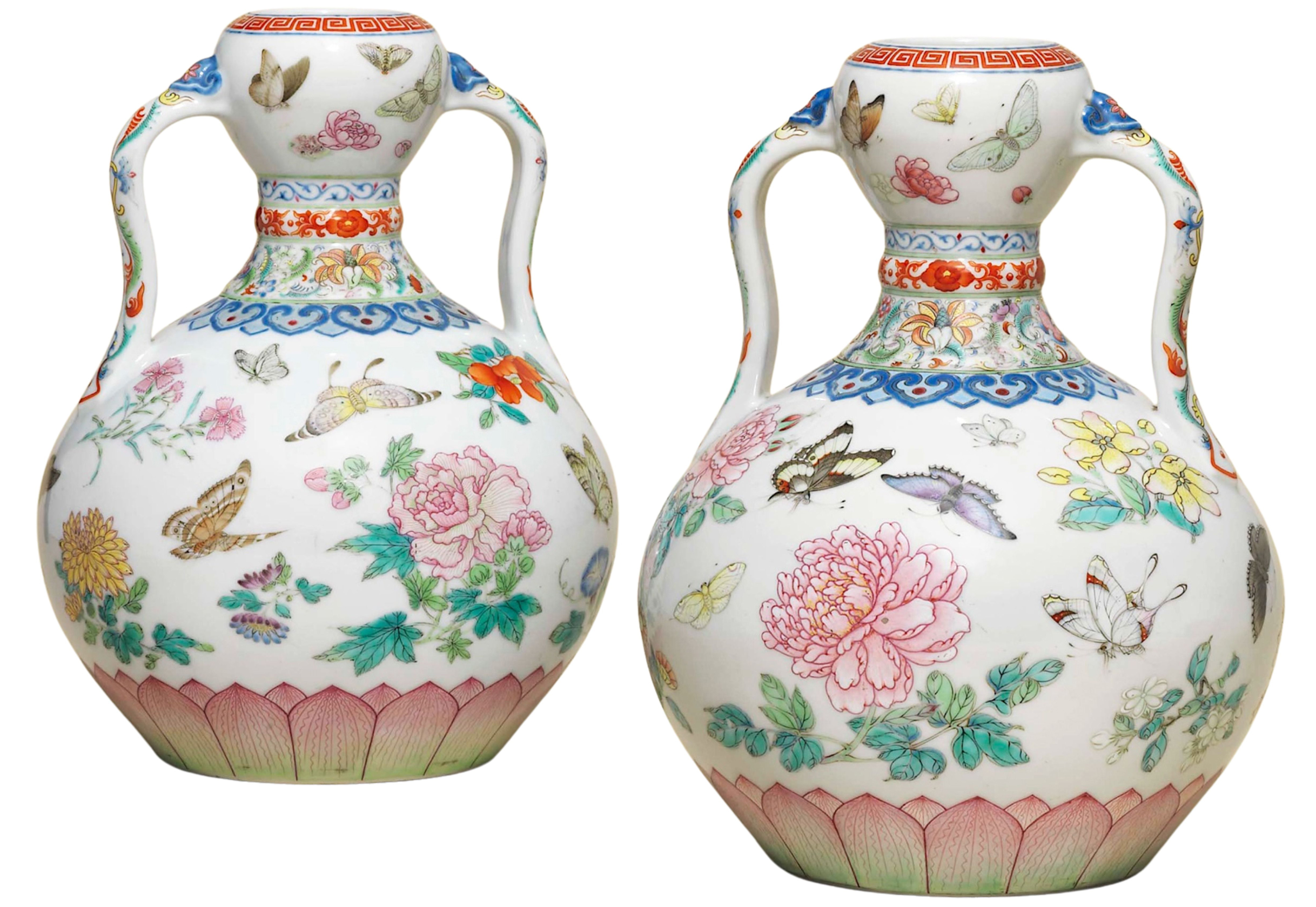
Christie’s catalogs this pair as “A magnificent pair of Famille Rose ‘butterfly’ double-gourd vases” with Qianlong six-character seal marks in underglaze blue and dating to 1736–1795. The catalog further notes that the decoration relates to a small group of Qianlong porcelains painted in fǎlángcǎi (琺瑯彩) enamels, a term often associated with imperial, court-controlled enamel techniques.
The decoration includes a rich variety of auspicious flora:
- 海棠花 (hǎitánghuā) – crabapple blossom
- 牡丹 (mǔdān) – peony, symbol of wealth and honor
- 木芙蓉 (mùfúróng) – hibiscus mutabilis
- 月季 (yuèjì) – Chinese rose
- 菊花 (júhuā) – chrysanthemum
- 山茶花 (shāncháhuā) – camellia
Butterflies (蝶, dié) function as rebuses in Chinese visual culture. Through phonetic association and symbolic layering, they evoke joy, longevity, and harmonious union. The gourd shape itself (葫芦, húlú) carries connotations of protection, fertility, and continuity.
This pair was sold by Christie's London on May 9, 2017, for £ 14,725,000 (also published by Christie's as US$ 19,054,150).
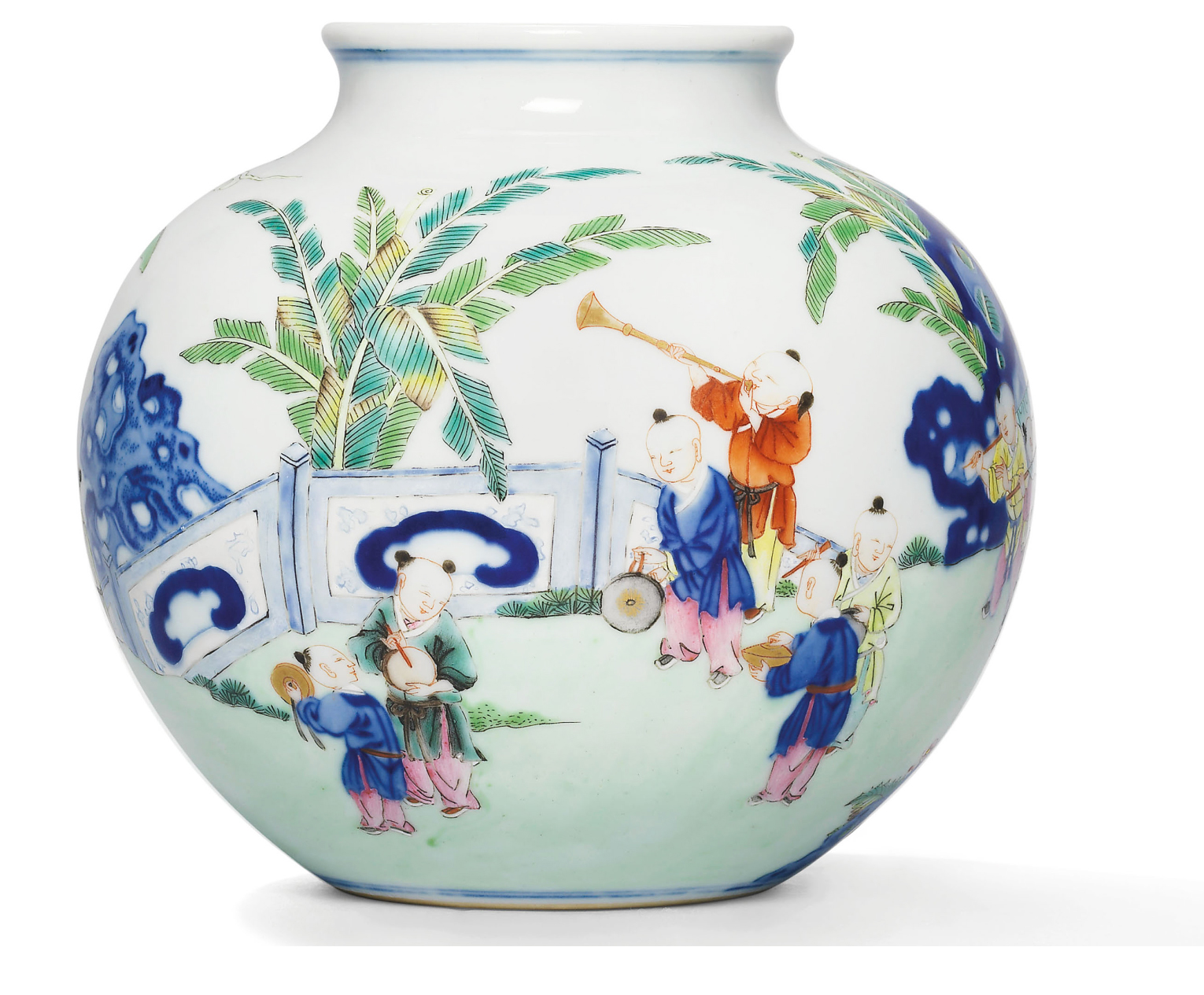
A fine and very rare Famille Rose ‘boys’ jar with Qianlong six-character seal mark and of the period (1736-1795). Height: 6 in., 15.3 cm. Auctioned by Christie's in 2017.
Christie's experts defined this jar as being decorated in bright underglaze blue and doucai with Famille Rose elements.
Before we explore the connection between the "Famille Rose" and the Jesuits, it is important to understand the meaning of this enigmatic term. "Famille Rose" is a French expression meaning "Pink Family," and it is always referred to in French for a reason. Now, let’s explore why.
Fencai, falangcai, and doucai are Chinese terms that only partially align with what is meant by "Famille Rose." This is more than a mere question of terminology. It is far from trivial; together, we’ll see just how much it reveals.
THE ALLURE OF CHINESE PORCELAIN AND THE NEED FOR CLASSIFICATION
For centuries, Chinese porcelain has captivated the world, its delicate forms and vibrant colors symbolizing the pinnacle of ceramic artistry. From the imperial courts of Beijing to the drawing rooms of European aristocracy, these objects have been treasured not merely as functional wares but as profound expressions of culture, technology, and aesthetic philosophy . The very nature of porcelain—its translucency, its resonant sound when struck, and its ability to hold a flawless glaze—set it apart from other ceramics, celadons included, creating an aura of mystery and desirability. As these wares traveled across continents, particularly from the 16th century onward, they sparked a global fascination, leading to the establishment of "Chinoiserie" as a dominant artistic trend in 18th-century Europe.
This immense popularity, however, created a practical challenge: how to make sense of the vast and diverse array of porcelain being produced, collected, and traded? The need for a systematic way to categorize, describe, and understand these objects became paramount for scholars, collectors, and dealers alike. This necessity gave rise to two fundamentally different, yet equally influential, systems of classification: one developed in 19th-century Europe, focused on visual appearance, and the other rooted in traditional Chinese scholarship, centered on technical and historical origins.
The European approach, driven by a burgeoning interest in connoisseurship and scientific study, sought to impose order on the bewildering variety of Chinese wares arriving in the West . This led to the creation of a color-based taxonomy that grouped porcelains into "families" defined by their dominant enamel hues. This system, while intuitive and accessible, was an external framework applied to the objects, reflecting the European perspective and collecting priorities of the time.
In contrast, the traditional Chinese system of classification was an indigenous practice, developed over centuries by potters, scholars, and connoisseurs within the culture that created the porcelain. This system was not primarily concerned with surface color but with the deeper, more intrinsic qualities of the objects: the specific kiln where they were fired, the technical methods used in their creation, and the historical period in which they were made.
Understanding this dichotomy is crucial for anyone seeking a comprehensive appreciation of Chinese porcelain, as it reveals that the way we see and name these objects is shaped by the cultural lens through which we view them.
THE EUROPEAN "FAMILLE" SYSTEM
In the 19th century, French and other European connoisseurs developed a visually driven typology that became standard in the art market. One key figure was Albert Jacquemart, a French art historian and author of Histoire de la porcelaine (1862). His classifications were defined almost entirely by the dominant appearance of overglaze enamels on late Ming–Qing export wares and were widely repeated in catalogs (Abrigeon, 2018).
The European "family" system has three main characteristics that also define its limitations:
- It was market-oriented and emerged in sales catalogs, museum catalogs, and collection guides. Color families helped "brand" groups of export wares for collectors and raise prices (Abrigeon, 2018).
- It was chronologically imprecise: Color groups were sometimes treated as chronological stages, but dating could be imprecise because visual style, not kiln archaeology, was prioritized.
- It was technically coarse. Bodies from Jingdezhen, Dehua, or Canton enameling workshops might be grouped together as "famille rose" based on palette alone, despite differences in paste or firing.
Famille Verte (“Green Family”) Porcelain
Famille Verte is a classification of Chinese overglaze enamel porcelain. It is distinguished by a palette dominated by translucent green enamels and complemented by iron red, yellow, aubergine, and blue. Coined by Western collectors in the 19th century, this term describes a style that was developed and refined primarily during the Kangxi reign (1662–1722) of the Qing dynasty.
It represents a direct evolution of the Ming dynasty's Wucai ("Five Colors") tradition, with significant advances in enamel quality, range of colors, and firing precision. Famille Verte porcelains are considered one of the technical and artistic pinnacles of Qing ceramic history.
Rose Kerr states, "The famille verte palette, developed under the Kangxi emperor, marks a period of brilliance at Jingdezhen, blending Ming traditions with new refinements in glaze chemistry and kiln control" (Chinese Ceramics: Porcelain of the Qing Dynasty, 1986).
Famille Verte porcelain is decorated with overglaze enamels, i.e. colors painted on a glazed and fired porcelain body, then fired again at a lower temperature (800–900°C) to fuse the decoration without altering the glaze. The palette includes:
- Translucent greens derived from copper-based enamels
- Iron red (hematite)
- Aubergine (purple), from manganese and cobalt mixtures
- Yellow and blue, usually in limited areas
- Black is used for outlines and shading and is occasionally mixed with cobalt to create bluish tones.
Opaque white enamel is typically absent, and the white porcelain body itself serves as a key compositional element.
Stacey Pierson states: “Famille Verte decoration is characterized by brilliant, translucent enamels that lie on the surface of the glaze like miniature panes of colored glass.” (Chinese Ceramics: A Design History, 2009)
Signature Visual Features
- Halo effect: A subtle diffusion or iridescent edge caused by the interaction between the overglaze pigment and the underlying glaze produces a soft, glowing transition between colors.
- Painterly quality: Artisans used fine brushes and layered strokes to create expressive figurative details, naturalistic shading, and atmospheric settings.
- Meticulous line work: Black enamel (and occasionally gilding) was used to delineate forms with graphic precision.
Common Themes
- Narrative scenes: Episodes from classical literature, Daoist immortals, and courtly leisure.
- Floral and avian motifs: Peonies, lotuses, chrysanthemums, and birds in lush, seasonal compositions.
- Mythical animals: Qilins, phoenixes, and dragons often appear in symbolic or auspicious arrangements.
- Decorative borders: Key patterns, ruyi heads, or brocade motifs frame central reserves.
Famille Verte porcelain was largely developed during the Kangxi reign, though its roots lie in late Ming wucai ware, and some stylistic continuities persisted into the Yongzheng period. Scholars generally date the peak production period to around 1680–1720. During this time, both imperial kilns and private workshops in Jingdezhen produced pieces of extraordinary technical finesse.
Famille Verte enameling eventually gave way to Famille Rose enameling. The latter emerged during the Yongzheng reign (1723–1735) and was characterized by opaque pastel hues, particularly pinks, which were made possible by colloidal gold. However, earlier famille verte pieces are often considered superior in terms of brilliance, transparency, and precision of brushwork.
Valenstein states: "Although Famille Rose brought subtler effects and naturalism, it is in Famille Verte that we see the finest execution of enamel painting in the Qing dynasty" (A Handbook of Chinese Ceramics, The Metropolitan Museum of Art, 1989).
Famille Verte porcelains were produced for both the imperial market and the export market. Larger pieces, such as rouleau vases, baluster jars, and charger dishes, were often intended for display. Smaller items, such as snuff bottles, brush pots, and tea wares, circulated widely across Asia and Europe, especially through the Dutch East India Company (VOC) trade routes.
While the famille system of classification is a Western invention, it remains a useful framework for understanding enamel typologies. Famille Verte, with its luminous glazes, complex compositions, and rich narrative content, remains one of the most highly regarded styles of Qing porcelain.
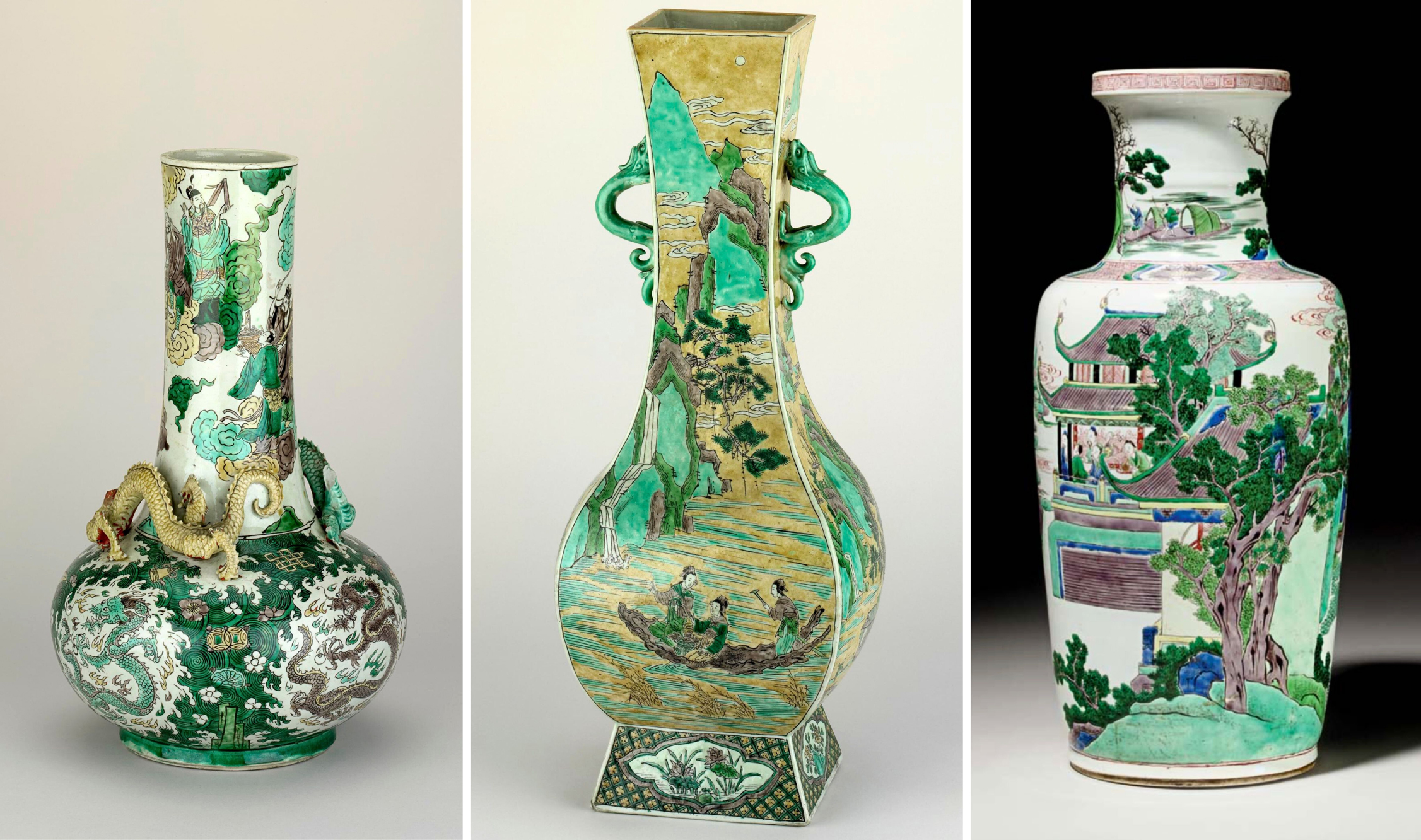
LEFT: Enameled porcelain bottle decorated with a famille verte palette showing a dragon, waves, and the Eight Immortals. It was made during the Kangxi reign (1662-1722). Height: 14 inches (35.56 cm). © The Trustees of the British Museum, London, UK.
CENTER: Four-sided porcelain vase with a square foot and side handles. Decorated with landscape and figural scenes in famille verte enamels. It was made during the Kangxi reign (1662-1722). Height: 53 cm (20.87 in). © The Trustees of the British Museum, London, UK.
RIGHT: Enameled porcelain rouleau vase decorated with a famille verte palette. Made during the Kangxi reign (1662–1722). Height: 17 3/4 in. (45 cm). It was auctioned in 2007 by Christie's in New York, USA.
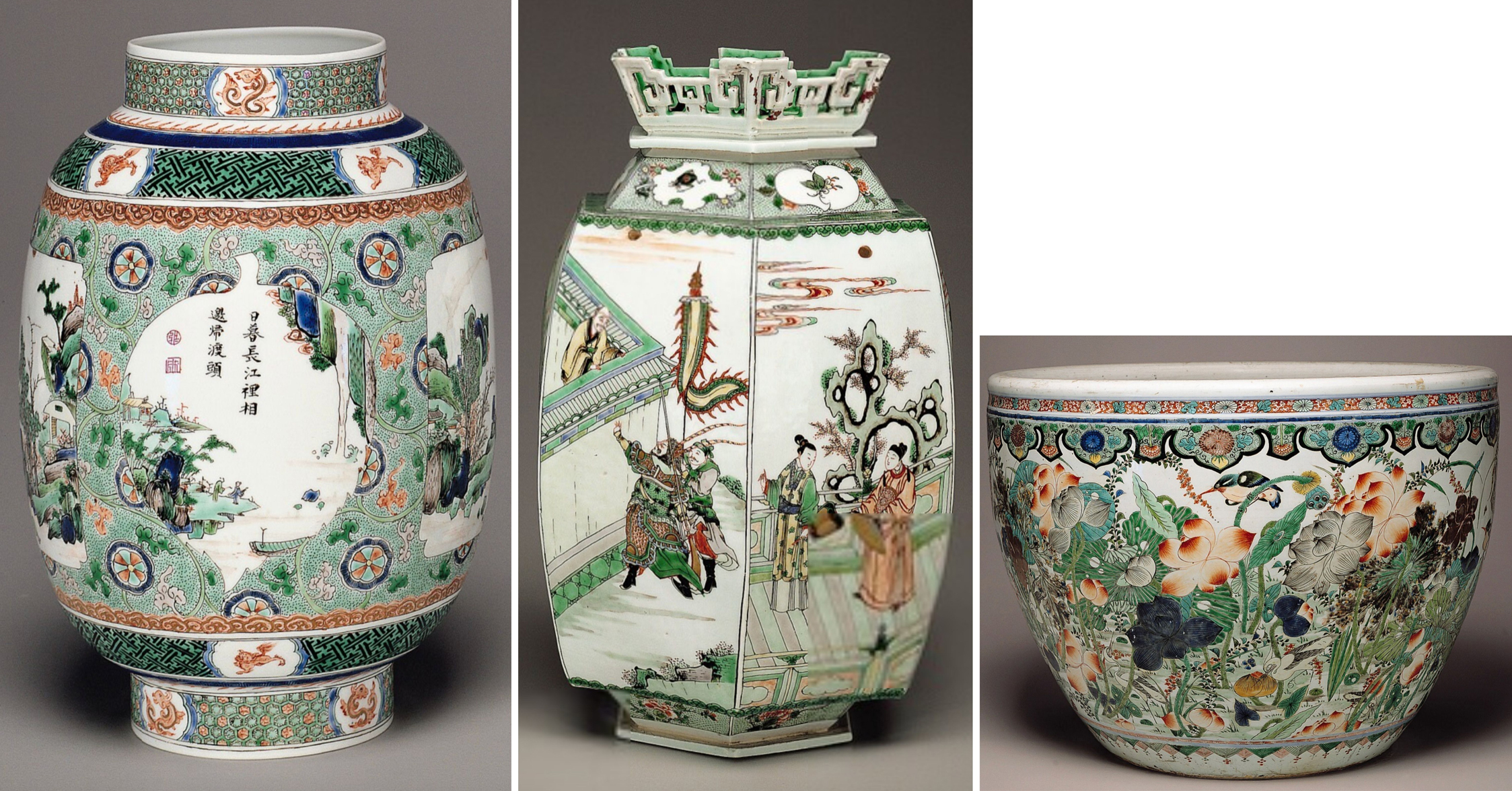
LEFT: Porcelain lantern with overglaze Famille Verte enamels, made during the Kangxi period (1662–1722). Dimensions: 8.5 x 6 in. © National Gallery of Art, Washington, USA.
CENTER: Porcelain hexagonal lantern with overglaze Famille Verte enamels, made during the Kangxi reign (1662–1722). Dimensions: 28.5 x 19.4 cm (11 1/4 x 7 5/8 in.). © National Gallery of Art, Washington, USA.
RIGHT: Porcelain large fish bowl with overglaze Famille Verte enamels. Made during the Kangxi reign (1662–1722). Dimensions: 42.9 × 58.3 cm (16 7/8 × 22 15/16 in.). Weight: 80 lbs (36.288 kg). © National Gallery of Art, Washington, USA.
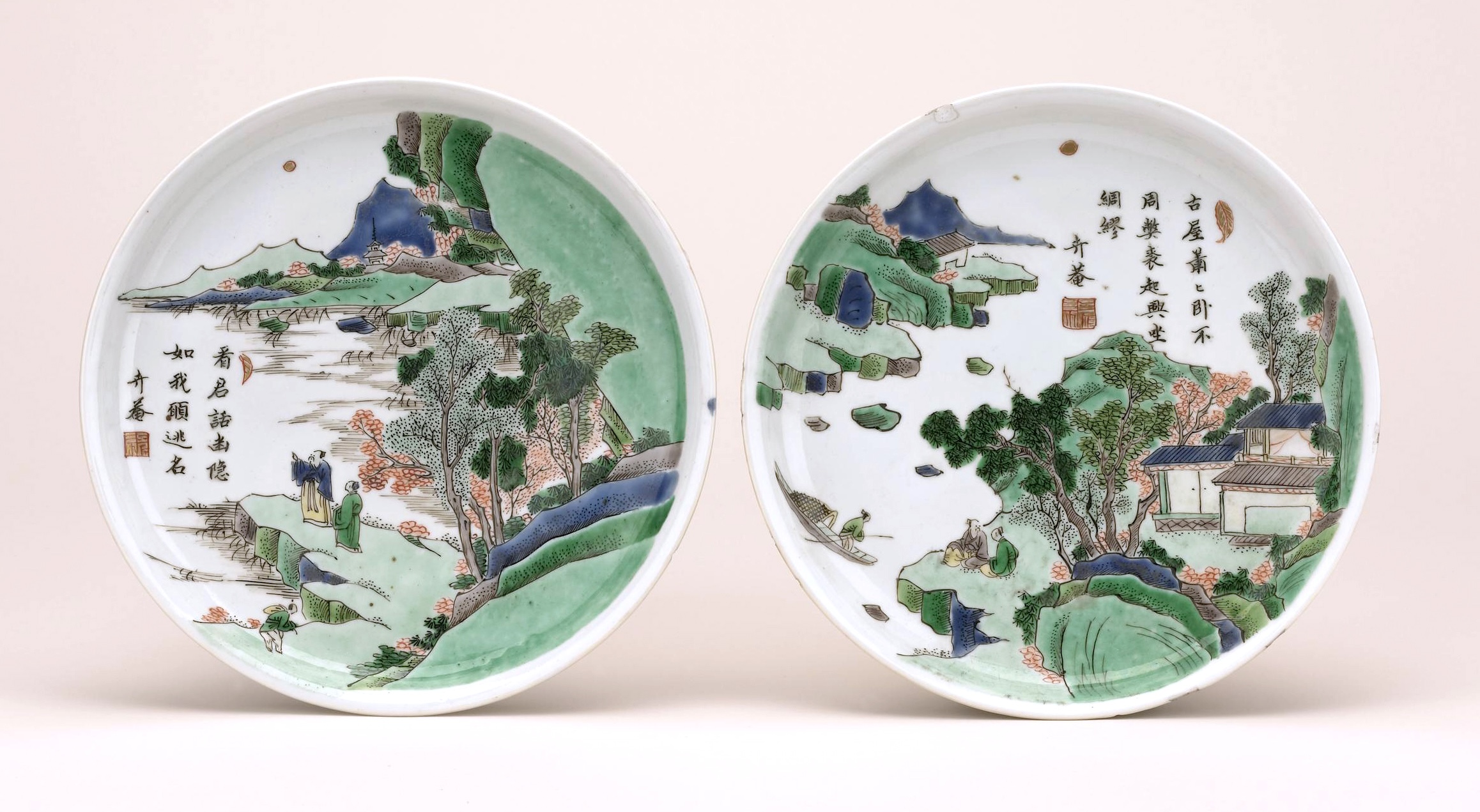
A pair of Famille Verte enameled porcelain dishes. They are decorated with southern Chinese landscapes, figures, and an inscription. They were made in Jingdezhen during the Kangxi reign (1662–1722) of the Qing dynasty. Diameter: 8.13 in. (20.65 cm). © The Trustees of the British Museum, London, UK.
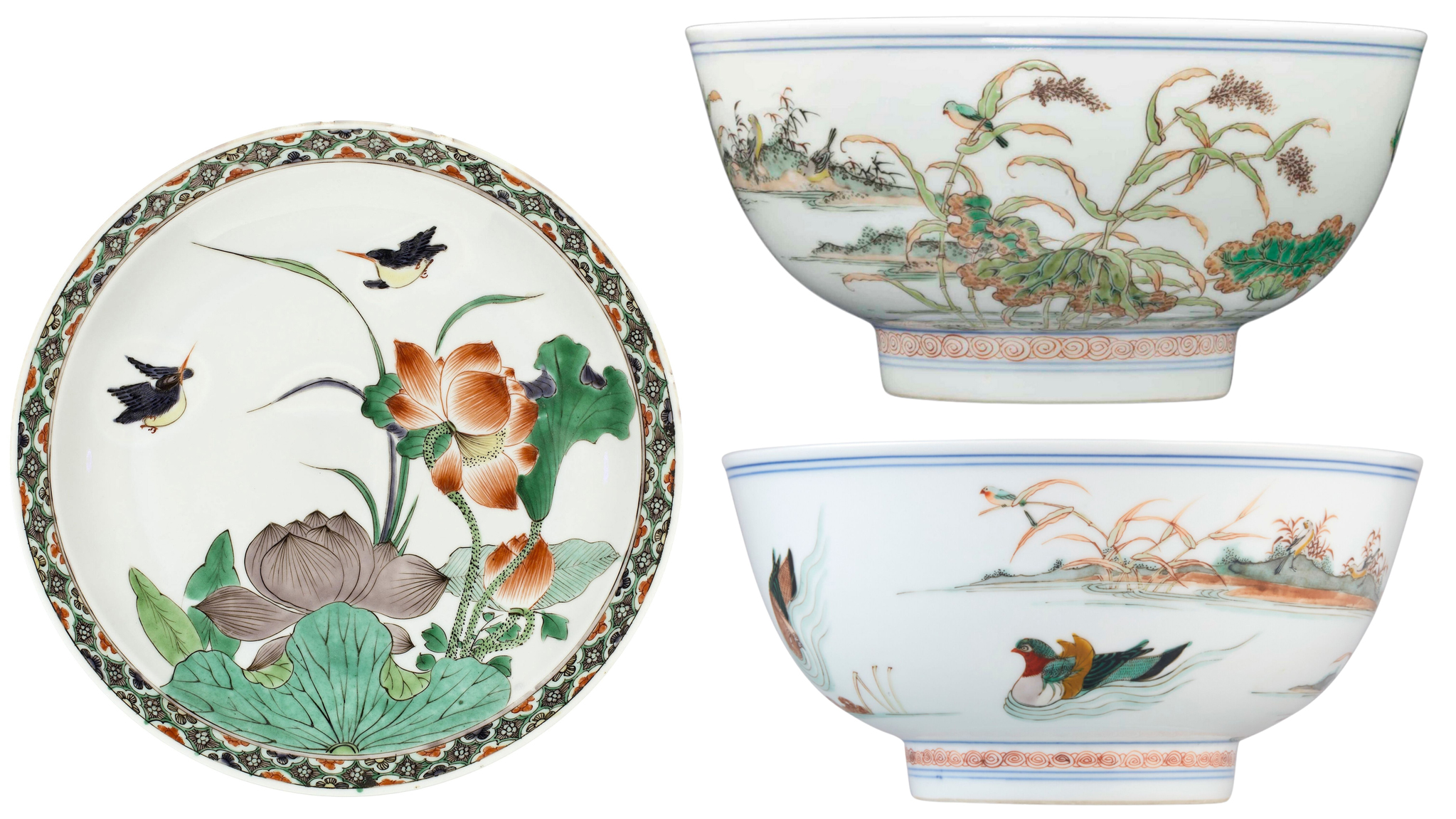
LEFT: Plate with lotus blossoms and a kingfisher. Date: Kangxi Reign (1662–1722) Medium: Porcelain painted with overglaze famille verte enamels. Diameter: 10 1/16 in (25.6 cm). Art Institute of Chicago, IL, USA.
TOP RIGHT: A very rare bowl. Date: Kangxi Reign (1662–1722). Medium: Porcelain painted with overglaze famille verte enamels. Diameter: 6 3/4 in. (17 cm). It was auctioned in 2014 by Christie's New York. The exterior of the bowl is finely decorated with two mandarin ducks swimming in a lotus pond and several smaller birds perched on the shore, on a rock, and in the tall grasses. A pair of birds is in flight above. The foot is encircled by an iron-red scroll within underglaze blue borders." (From the Christie's catalog.)
BOTTOM RIGHT: A rare "mandarin ducks and lotus pond" bowl. Date: Kangxi Reign (1662–1722) Medium: Porcelain, painted with overglaze famille verte enamels. Diameter: 7 in. (17.5 cm). It was auctioned in 2024 by Christie's Hong Kong. "The bowl has deep, rounded sides and is finely decorated on the exterior with a continuous scene of two mandarin ducks swimming in a pond surrounded by lotuses and reeds. Below them are other smaller birds. The foot is encircled by an iron-red scroll." (From the Christie's catalog.)
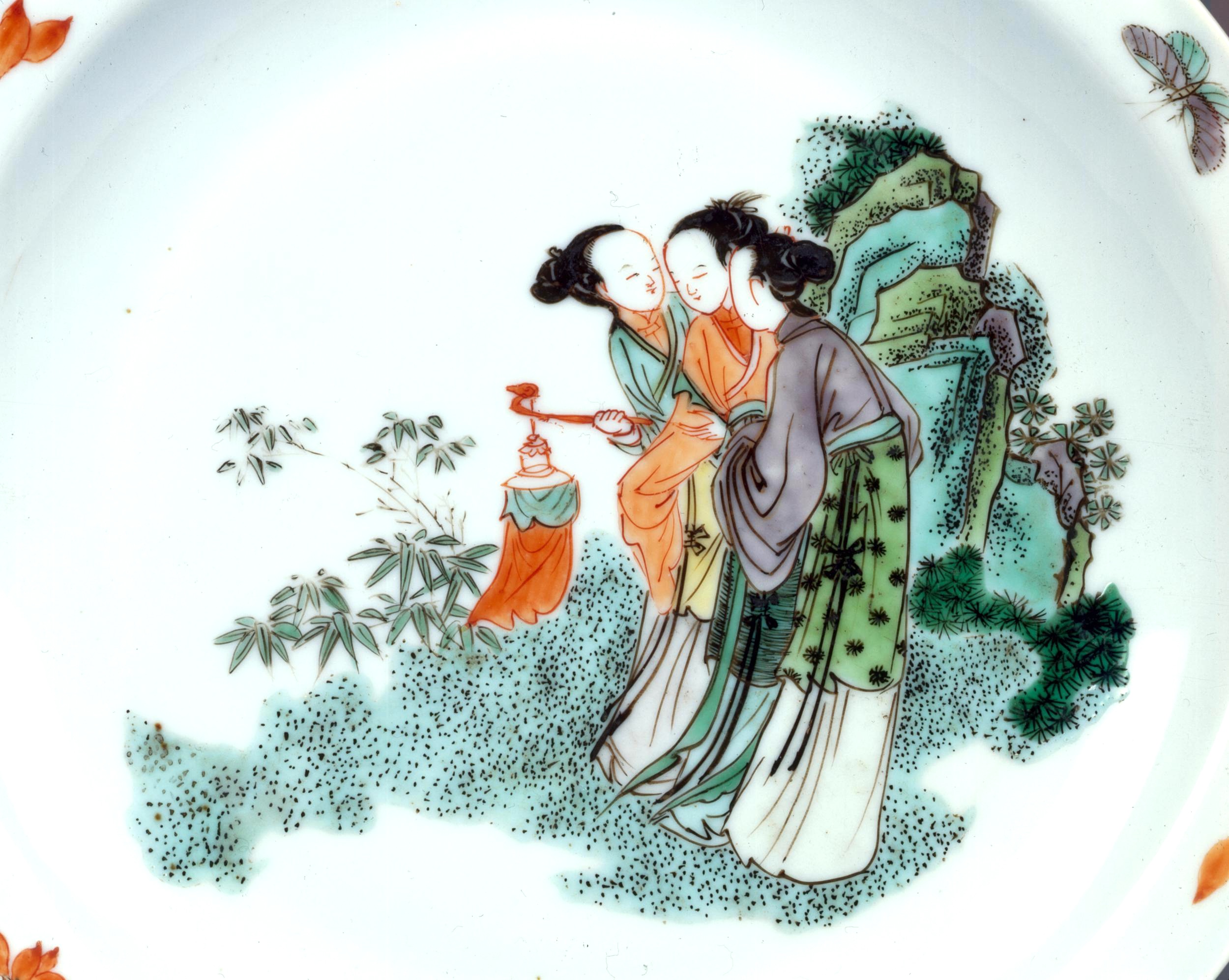
Detail of a porcelain dish with flattened rim. The dish depicts a landscape scene with rocks, bamboo, and pine trees. Below this scene are three ladies painted in "Famille Verte" enamels. It was made in Jingdezhen during the Kangxi reign (1662–1722) of the Qing dynasty. Diameter: 17.4 cm (6.85 in). © The Trustees of the British Museum, London, UK. This enlargement shows the texture of the "Famille Verte" enamels.
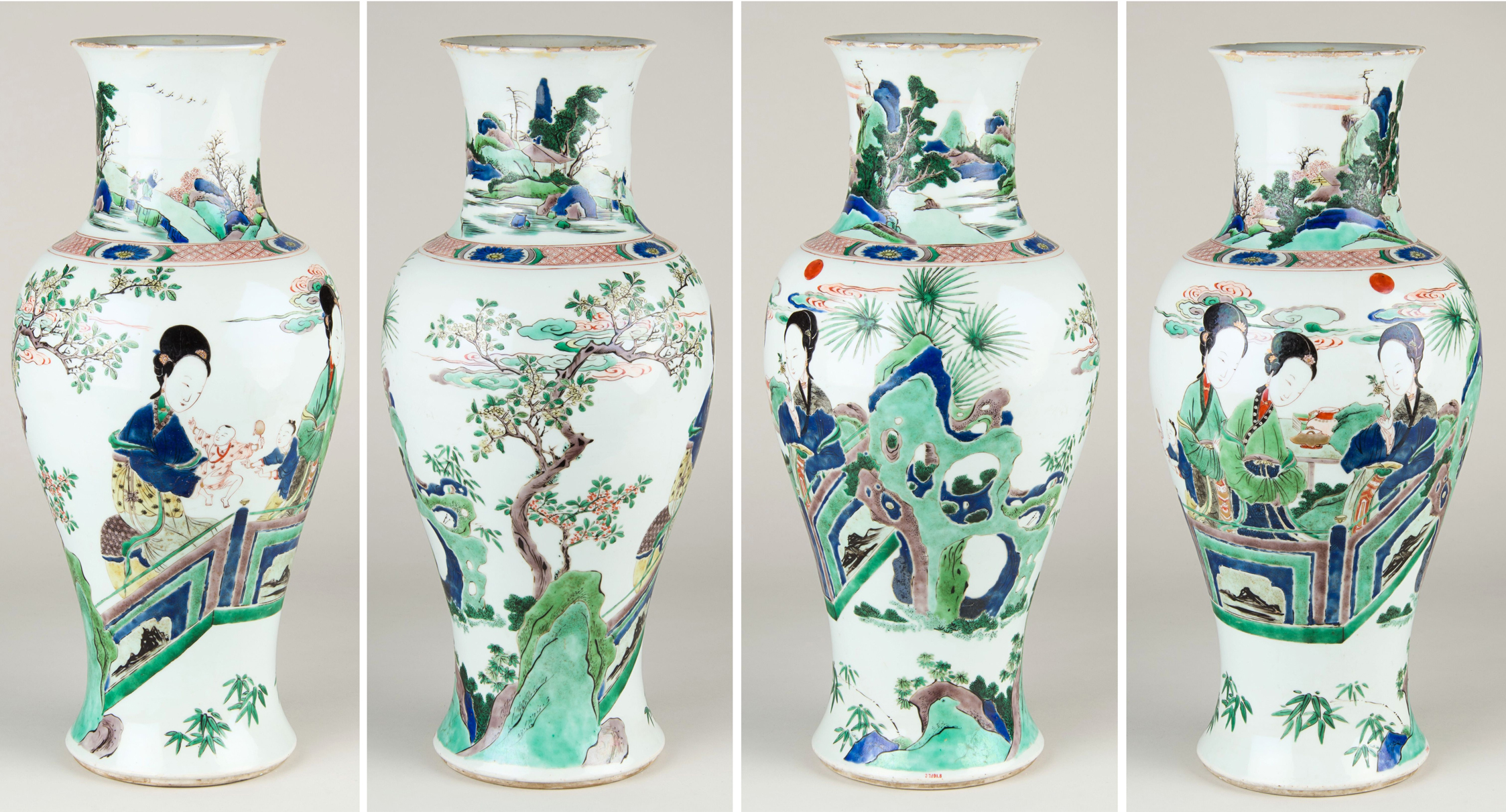
This porcelain vase is painted in Famille Verte enamels on all sides and depicts a garden scene with a large Taihu rock, women enjoying fragrant flowers and burning incense, and children playing. It was made during the Kangxi reign (1662–1722) of the Qing dynasty. Height: 17 5/8 in. (44.8 cm). The Metropolitan Museum of Art, New York, USA.
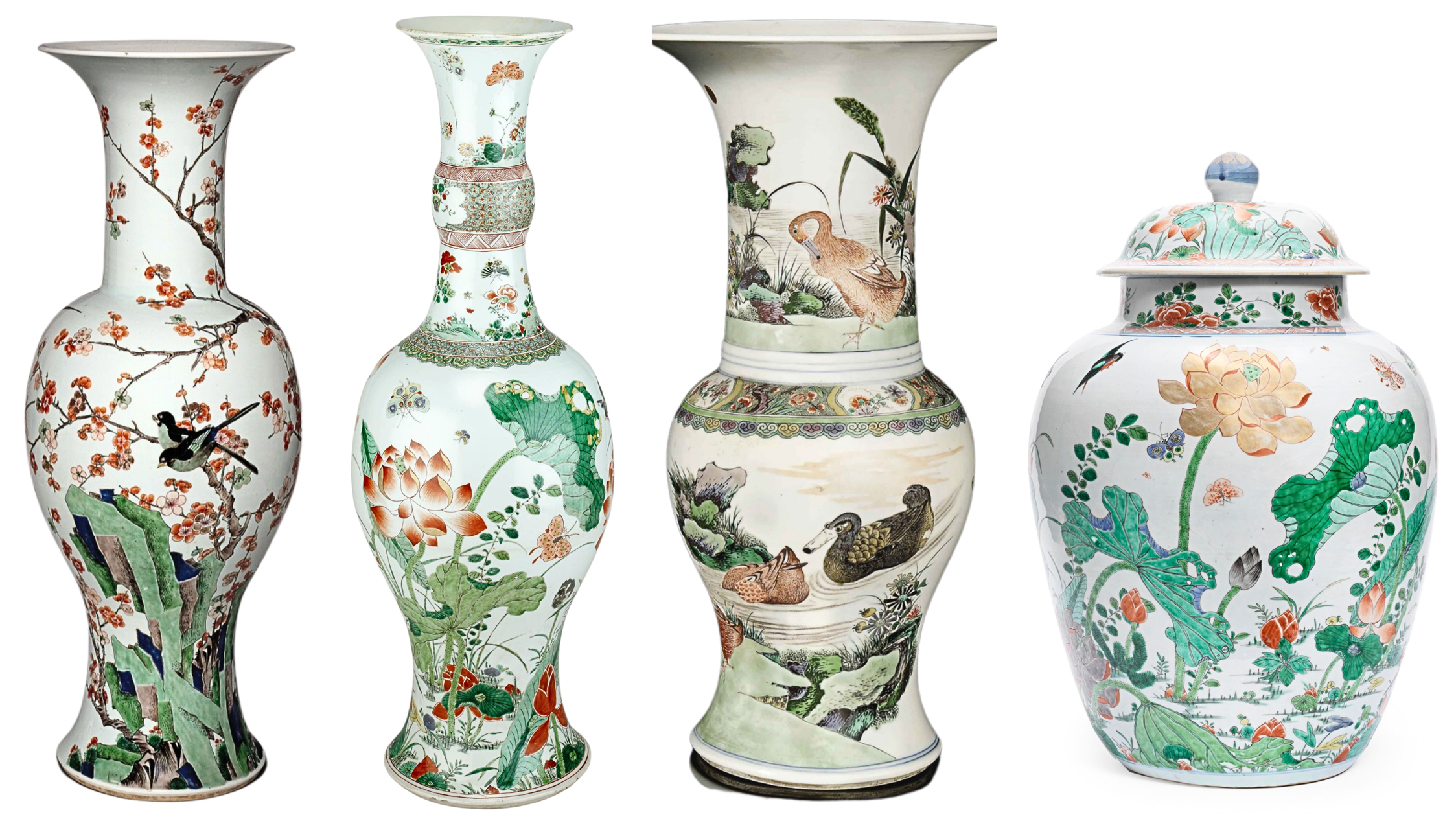
LEFT TO RIGHT
1. Baluster Vase. Porcelain with overglaze famille verte enamels. It was made during the Kangxi reign (1662-1722). Dimensions: 74.1 x 28 cm (29 3/16 x 11 in.). © National Gallery of Art, Washington, USA.
2. Enameled and gilded porcelain vase painted with flowers, birds, butterflies, and insects in "Famille Verte" enamels. It was made during the Kangxi reign (1662-1722). Height: 72 cm (28.35 in). © The Trustees of the British Museum, London, UK.
3. A "phoenix tail" vase made of Famille Verte porcelain. It was made during the Kangxi period (1662-1722) or later. Height: 17 3/4 in. (45.2 cm). Auctioned in 2011 by Christie's, London, UK. "Enameled around the body with a continuous rocky landscape and a group of resting ducks, the tall, flaring neck depicts a similar scene" (From the Christie's catalog.)
4. Large "lotus pond" baluster jar with cover in famille verte porcelain. It was made during the Kangxi reign (1662-1722). Height: 59 cm (23 1/4 in). It was auctioned in 2014 by Bonham's in London, UK.
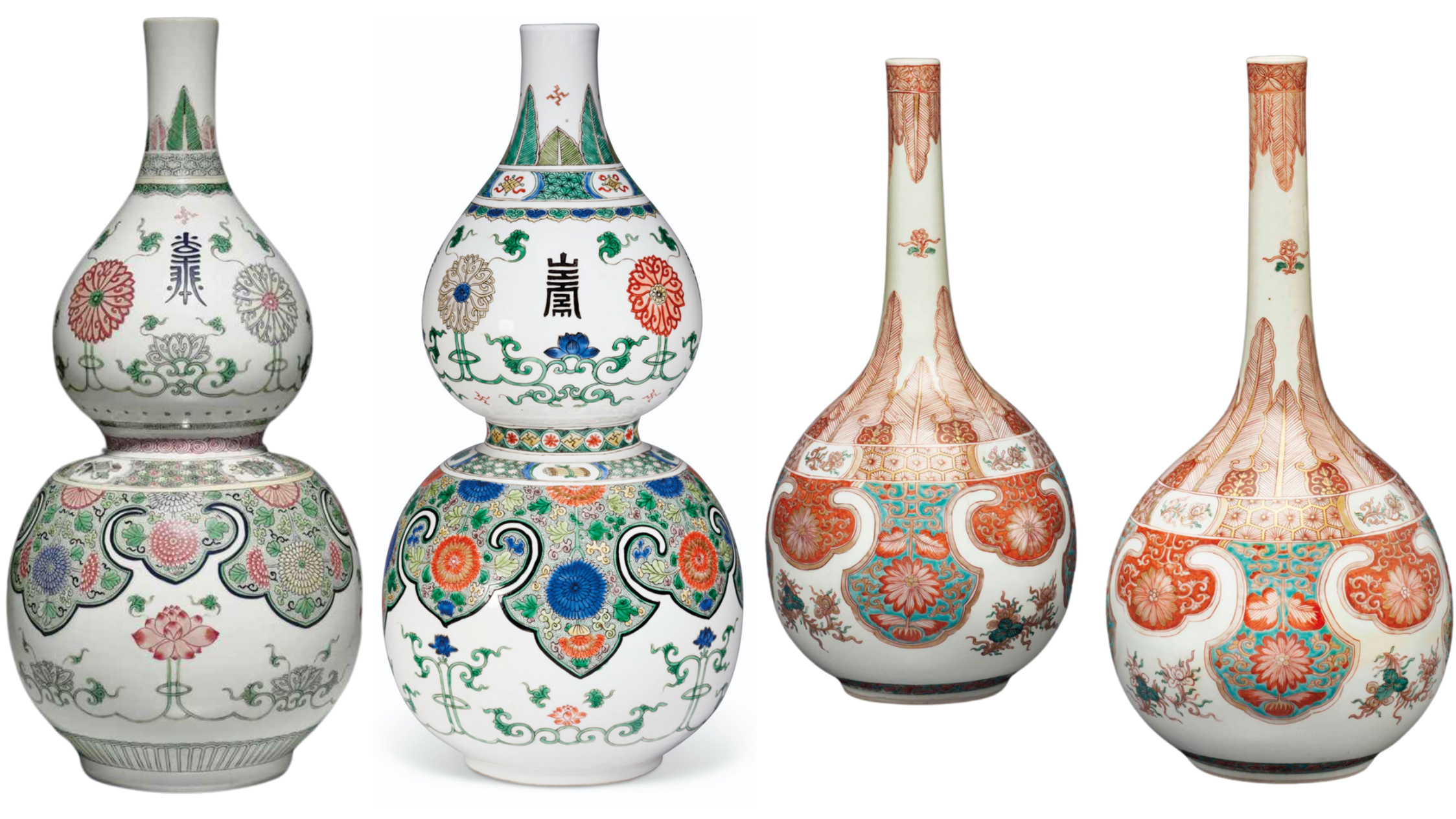
LEFT TO RIGHT
1. A double gourd vase made of Famille Verte porcelain. It was made during the Kangxi reign (1662-1722). Height: 17 7/8 in. (45.4 cm). It was auctioned in 2011 by Christie's New York. "The lower and upper bodies are decorated with conjoined lotus sprays. Those on the lower body are set between a chrysanthemum lappet border and a chrysanthemum-filled ruyi collar. Those on the upper body are interspersed with shou characters written in black. All are within decorative borders" (From the Christie's catalog.)
2. A double gourd vase made of Famille Verte porcelain. It was made during the Kangxi reign (1662-1722). Height: 17 3/4 in. (45 cm). It was auctioned in 2020 by Christie's New York. "The upper body is decorated with alternating chrysanthemum blossoms and shou characters. The lower body has a border of pendent ruyi heads containing chrysanthemum scrolls on a stippled ground, all within stylized borders" (From the Christie's catalog.)
3 & 4. A pair of unusual Famille Verte porcelain bottle vases. They were made during the Kangxi reign (1662–1722). Height: 17 7/8 in. (45.4 cm). Auctioned in 2015 by Christie's New York. "Each vase is finely potted with a globular body that rises to a tall, slender neck. They are decorated in iron-red, turquoise, green, and gold, and feature four stylized lotus sprays below the flower-filled cloud collar. This collar hangs from the diaper band on the shoulder, and upright leaf tips rise from it at the base of the neck. Another band of leaf tips hangs from the diaper border at the mouth rim" (From the Christie's catalog.)
Famille Noire (“Black Family”) Porcelain
"Famille Noire" refers to a distinct subtype of decorative Qing dynasty overglaze enamel porcelain featuring a predominantly black background beneath richly colored decoration in the style of "Famille Verte." Like its counterparts famille verte, rose, and jaune, the term originated in 19th-century French connoisseurship and is still used in Western art historical and curatorial discourse to categorize Chinese export porcelains based on enamel palette and ground color.
Famille Noire is not a distinct enamel family but rather a variant of famille verte that uses the same polychrome palette of green, yellow, aubergine, iron red, and black over a white-glazed porcelain body. As with all famille verte wares, the decoration is executed with overglaze enamels and fired in a secondary kiln process at a lower temperature..
Margaret Medley states: “Famille noire is properly a famille verte type, its chromatic drama arising from the black ground, not from any change in enamel chemistry or application.” (The Chinese Potter, 1976)
The black ground in famille noire wares is typically an overglaze enamel applied to glazed and fired porcelain. The black enamel, often derived from manganese- and cobalt-based compounds, was selectively painted into background areas not occupied by main decorative motifs:
- Peonies, lotuses, and flowering branches;
- Birds, butterflies, and mythical animals;
- Courtly scenes or immortals, especially on larger vessels.
This creates a luminous interplay of vivid colors against a deep, velvety black, producing a jewel-like visual effect that is highly prized by historical and modern collectors alike. The black enamel enhances contrast, intensifies color perception, and adds a theatrical quality to the porcelain surface.
According to Rosemary Scott, “The use of a black enamel ground in famille noire enhances the chromatic brilliance of the enamels and suggests a lacquer-like surface, with striking visual impact.” (For the Imperial Court: Qing Porcelain from the Percival David Foundation, 1997)
In institutional and academic usage, Famille Noire is consistently treated as a subcategory of Famille Verte, based on three principal criteria:
- Shared enamel palette: Green, aubergine, yellow, iron red, and occasional blue—identical to famille verte wares.
- Shared technique: Overglaze decoration on a white porcelain body, fired in a second kiln.
- Ground as variant: The black ground is an aesthetic adaptation rather than a technical or material break.
Consequently, major museum collections (e.g., the British Museum, the Metropolitan Museum of Art, and the Victoria & Albert Museum) catalog these pieces as "Famille Verte with black ground" or "Famille Noire (Famille Verte type)."
High market demand for famille noire in late 19th- and early 20th-century Europe, particularly in France and Britain, led to the widespread practice of "clobbering," the retrospective application of black enamel to earlier famille verte wares by dealers or restorers. This was often done to export pieces with sparse decoration to enhance their market appeal by transforming them into "famille noire" objects.
- Valenstein wrote: “Clobbered wares were a response to market demand rather than kiln innovation. Many so-called famille noire pieces are 19th-century alterations, not authentic Kangxi products.” (A Handbook of Chinese Ceramics, 1989)
These modified wares can sometimes be identified by the following:
- Poorly bonded black enamel;
- Inconsistent wear patterns;
- Overpainting of original motifs;
- Black enamel covering glaze flaws or firing cracks.
Due to their complex history of modification and forgery, genuine Kangxi-period Famille Noire pieces are relatively rare. Authentication often requires scientific testing, including:
- Microscopic pigment analysis
- Thermoluminescence (TL) dating
- X-ray fluorescence (XRF) spectroscopy
Most authenticated Famille Noire porcelains date from the Kangxi reign (1662–1722), particularly the late Kangxi period (ca. 1680–1720), when technical innovations in Jingdezhen enabled more ambitious uses of colored grounds and elaborate enamel schemes. Some revival pieces were made during the Yongzheng and Qianlong reigns, and later 19th-century reproductions, both in China and abroad, further complicated the market and scholarly record.
For this reason, careful provenance research and connoisseurship remain essential in attributing Famille Noire wares.
Famille Noire porcelain occupies a unique place in the taxonomy of Qing enamel wares as a visually striking variation of the Famille Verte tradition, elevated by its dramatic black background and resulting chromatic brilliance. While long admired by collectors, its history is intertwined with the influence of the Western market and altered wares, making scholarly precision essential for its interpretation.
In current museum and academic contexts, Famille Noire porcelain is best described as "Famille Verte with a black enamel ground," which acknowledges its technical continuity and distinctive aesthetic.
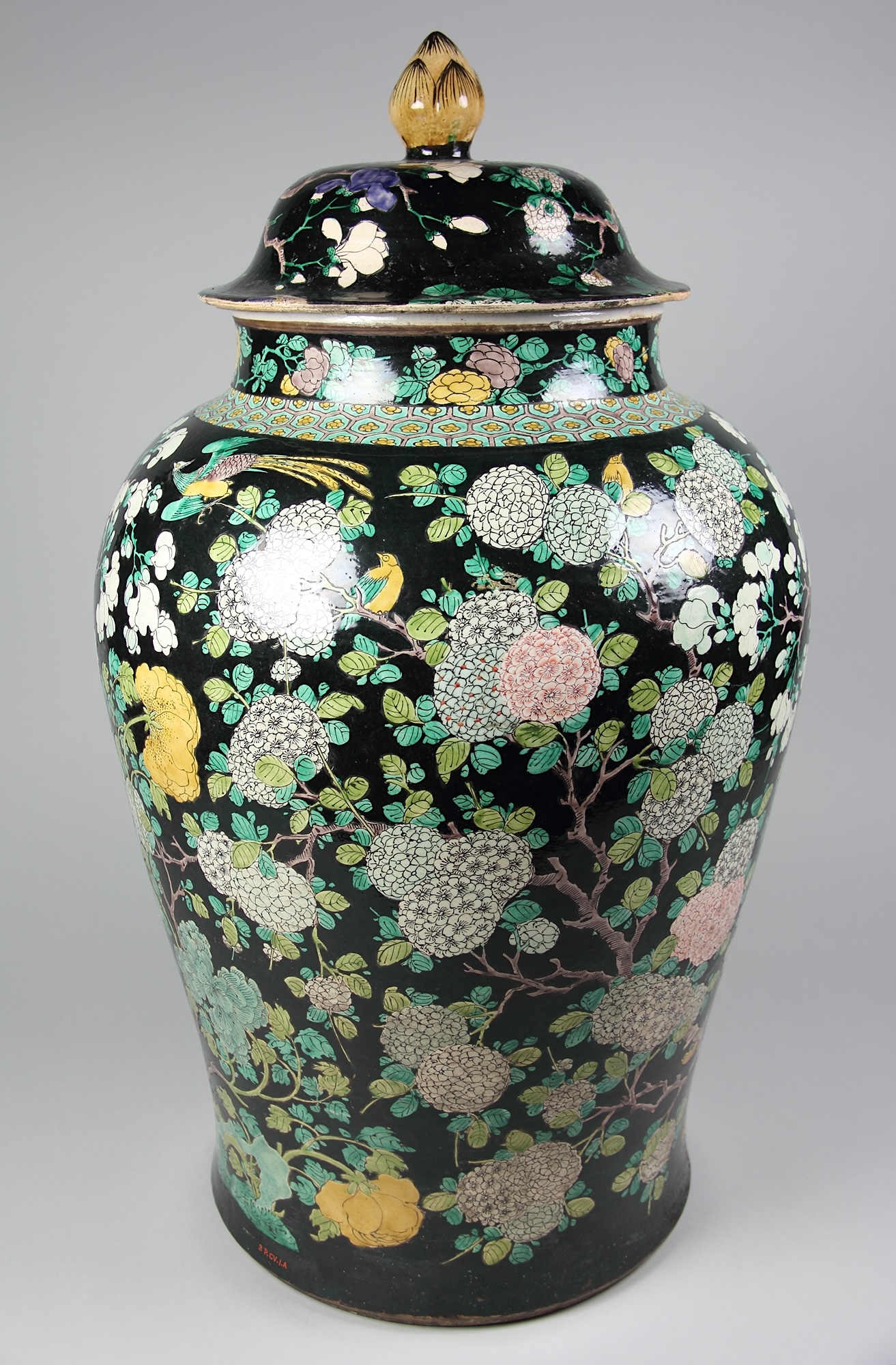
Covered jar made in Jingdezhen during the Kangxi reign. Medium: Porcelain painted with Famille Noire enamels. Dimensions: height 26 7/8 in.; 68.3 cm. The MET, New York, USA.
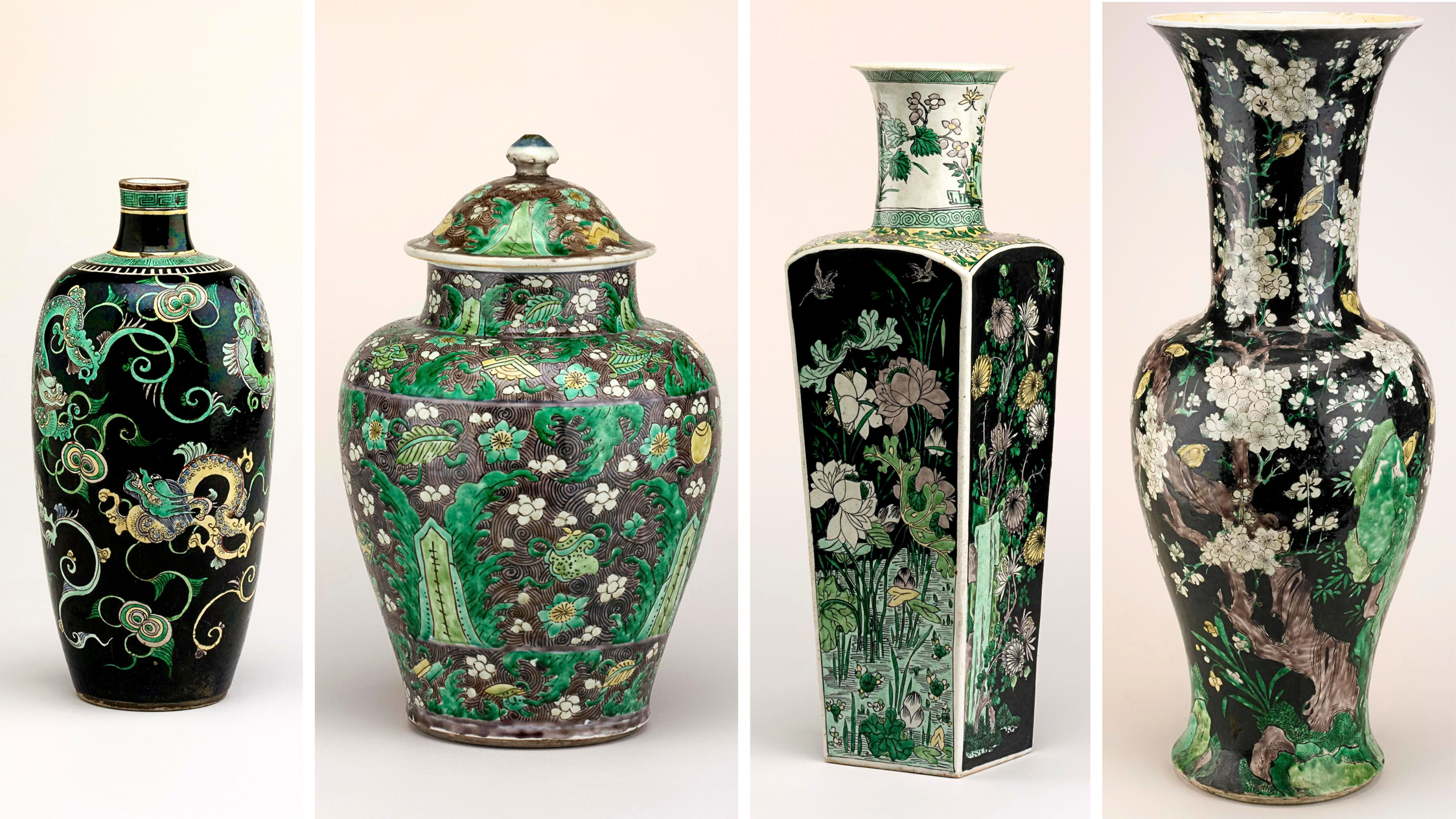
LEFT TO RIGHT
1. Vase decorated with dragons. Made of enamelled Famille Noire porcelain during the Kangxi reign (1662–1722) of the Qing dynasty. Height: 23.88 cm, 9.40 in. © The Trustees of the British Museum, London, UK.
2. Lidded vase decorated with flowers. Made of Famille Noire enamelled porcelain during the Kangxi reign (1662–1722). Height: 39.37 cm, 15.50 in. © The Trustees of the British Museum, London, UK.
3. Square sided vase, decorated with lotus, chrysanthemum, plum and peony. Made of Famille Noire enamelled porcelain during the Kangxi reign (1662–1722). Height: 47 cm, 18.50 in. © The Trustees of the British Museum, London, UK.
4. Vase decorated with flowers, rabbits and birds. Made of Famille Noire enamelled porcelain during the Kangxi reign (1662–1722). Height: 68.58 cm, 27 in. © The Trustees of the British Museum, London, UK.
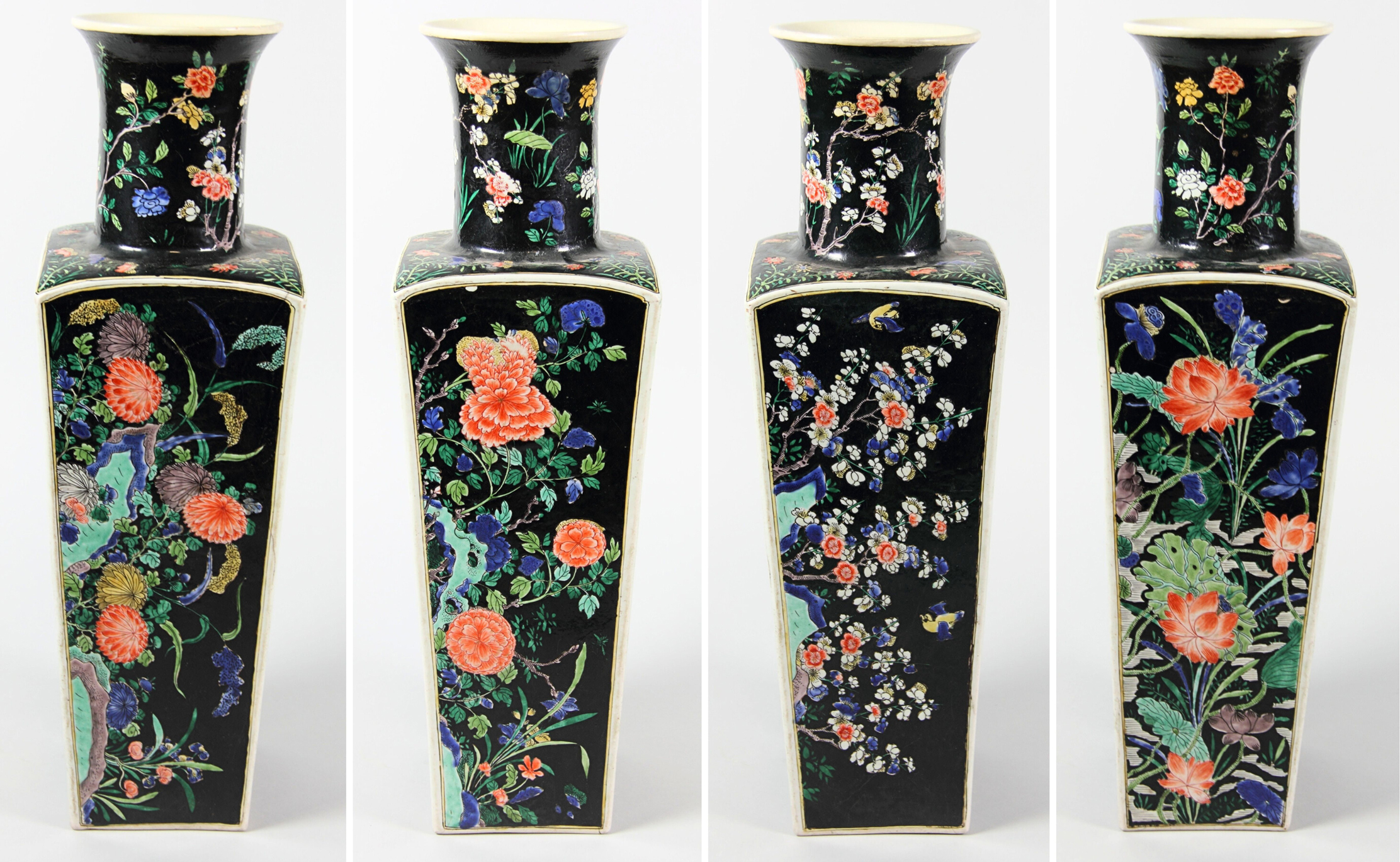
Square vase with scenes of the four seasons. Porcelain painted in polychrome enamels over a black ground (Famille Noire). Made in Jingdezhen in the 19th century, during the Qing dynasty. Height: 19 1/2 in., 49.5 cm. The MET, New York, USA.
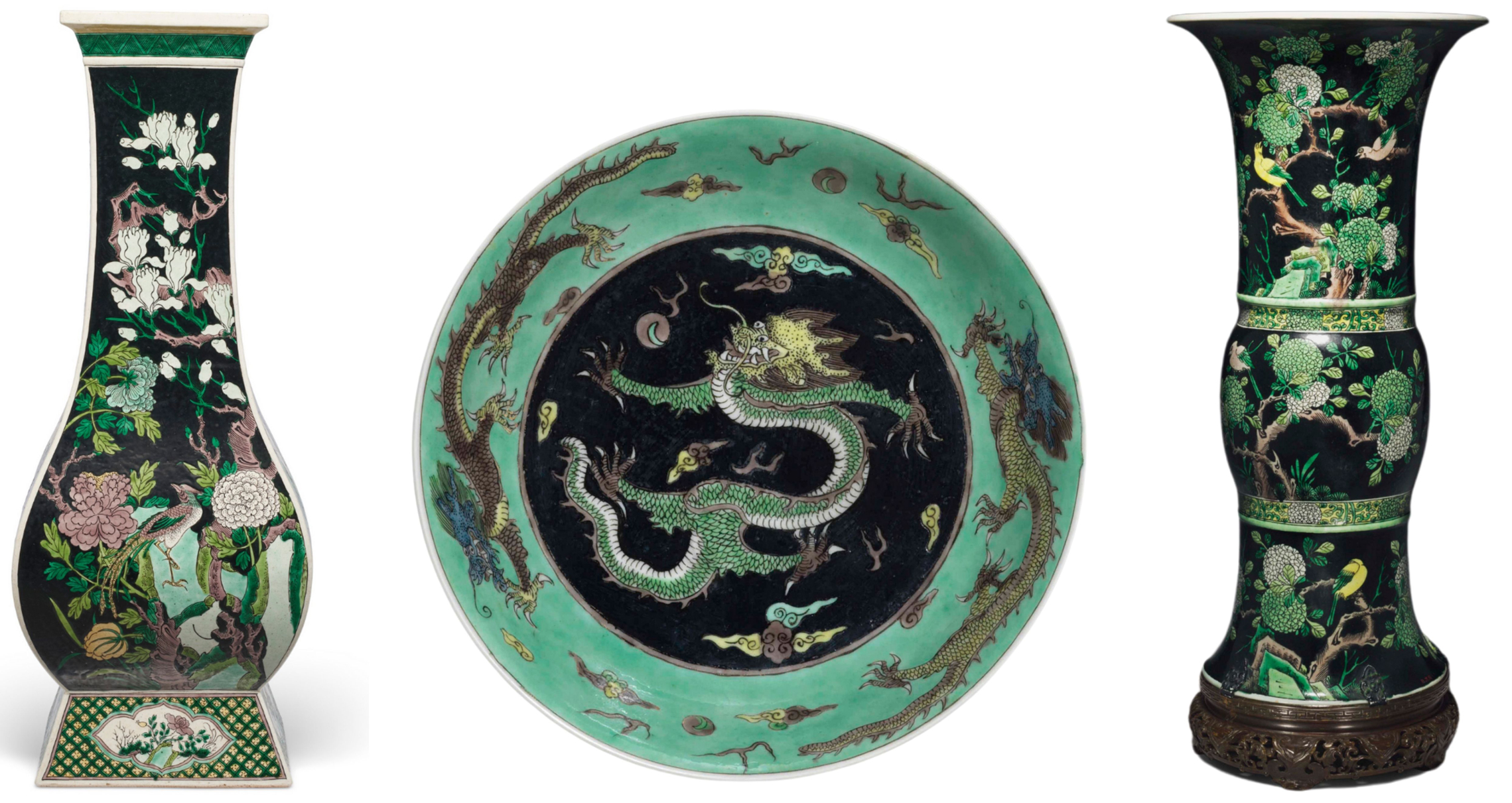
LEFT: A large square vase in Famille Noire porcelain from the 19th century. Height: 21 in., 53.3 cm. Auctioned in 2020 by Christie's New York, USA. "Each side is decorated with birds amongst the Flowers of the Four Seasons, peony and magnolia, lotus, chrysanthemum and prunus, all reserved on a black ground." (from Christie's catalog).
CENTER: A 'five dragon' dish in Famille Noire porcelain. Made during the Kangxi reign, 1662-1722. Diameter: 7 in., 17.7 cm. Auctioned in 2018 by Christie's London, UK. " The dish is decorated to the centre with a famille noire panel enclosing a five-clawed dragon chasing the flaming pearl amongst flame and cloud scrolls, surrounded by two striding dragons chasing the flaming pearl on a green ground. The exterior is decorated with two further striding dragons, all reserved on a bright yellow ground. The base has an apocryphal Hongzhi mark." (from Christie's catalog).
RIGHT: A beaker vase in Famille Noire porcelain. Made during the Kangxi reign, 1662-1722. Height (without the wooden stand): 17 in., 43.2 cm. Auctioned in 2017 by Christie's New York, USA. "The vase is decorated in polychrome enamels with birds amidst hydrangea branches on a black ground divided into three registers by narrow bands further decorated with hydrangea. Raised on a wood stand attached by painted clips." (from Christie's catalog).
Famille Jaune (“The Yellow Family”) Porcelain
A post-18th-century Western art-historical term, Famille Jaune describes a specific subtype of Qing dynasty porcelain characterized by a dominant yellow enamel overglaze. Within the conventional famille system developed by European connoisseurs and collectors, Famille Jaune denotes wares that use the Famille Verte enamel palette applied over a yellow background rather than the usual white.
Therefore, Famille Jaune is not a chromatically independent "family," but rather a variant within the Famille Verte group, differentiated primarily by its distinctive yellow background. This classification adheres to the Western color family system, which labels wares according to their dominant enamel palette.
Rosemary Scott states: “Famille jaune is essentially famille verte decoration on a yellow ground, and is best seen as a decorative variation within the famille verte category.” (The Porcelain of Jingdezhen, Transactions of the Oriental Ceramic Society, vol. 60).
The yellow ground, typically applied as an overglaze enamel, varies from pale lemon to deep egg-yolk hues and serves as the principal visual field against which the rest of the composition is executed. The decoration itself employs the Famille Verte palette, including translucent green enamels in multiple shades, iron red, aubergine purple, yellow, blue, and black. These colors are often highlighted with gold and occasionally feature white porcelain left in reserve.
This technique results in richly colored, high-contrast surfaces. In some cases, the enamels are applied over a transparent glaze. In rare examples, especially earlier ones, they are painted directly onto the biscuit and then covered with a glaze, a technically demanding and less common practice.
As Margaret Medley notes, “The hallmark of famille jaune is not simply its yellow ground, but the integration of Kangxi famille verte decoration within this chromatic framework.” (The Chinese Potter, Phaidon, 1976)
It is important to distinguish Famille Verte from Famille Rose wares on yellow grounds. While both feature yellow backgrounds, the overglaze palette of the latter employs opaque pastel enamels, which are characteristic of the Famille Rose group (developed slightly later, around the 1720s). In strict academic usage, only Famille Verte-type decoration on a yellow field qualifies as famille jaune.
Though this distinction is sometimes blurred in auction catalogs and non-specialist writing, scholarly convention maintains clear boundaries based on palette lineage. As Stacey Pierson states, “Famille Jaune is derived from Famille Verte; the application of Famille Rose enamels on yellow grounds belongs to a different technical genealogy and should not be conflated with Famille Jaune proper.” (Chinese Ceramics: A Design History, V&A, 2009)
Most Famille Verte porcelains are associated with the Kangxi period (1662–1722), a time of remarkable innovation at the Jingdezhen kilns. This period saw the introduction of diverse ground colors and refined overglaze enamel techniques. Famille Jaune became a favored style for imperial use and export markets, especially in the form of rouleau vases, dishes, and bowls.
Production continued into the Yongzheng (1723–1735) and Qianlong (1736–1795) periods, with further refinements in enameling and composition. Later, the style experienced revivals in the 19th century, particularly in export-oriented wares that echoed Kangxi aesthetics, often with denser decoration and heavier enamels.
Due to the extended production period and stylistic variability, scholars recommend anchoring individual objects chronologically and technically. For example:
"Kangxi period famille jaune rouleau vase with famille verte enamels on a yellow ground" rather than the more generalized "famille verte vase."
"Famille Jaune Vase."
This precision avoids anachronistic or overly broad attributions that proliferated in 19th- and early 20th-century collector circles.
Famille Jaune exemplifies the dynamic interplay between ground color innovation and enamel decoration in Qing dynasty porcelain. Though it is often grouped under a Western-imposed taxonomy, its aesthetic and technical identity firmly rests within the Famille Verte lineage, distinguished only by its luminous yellow backdrop.
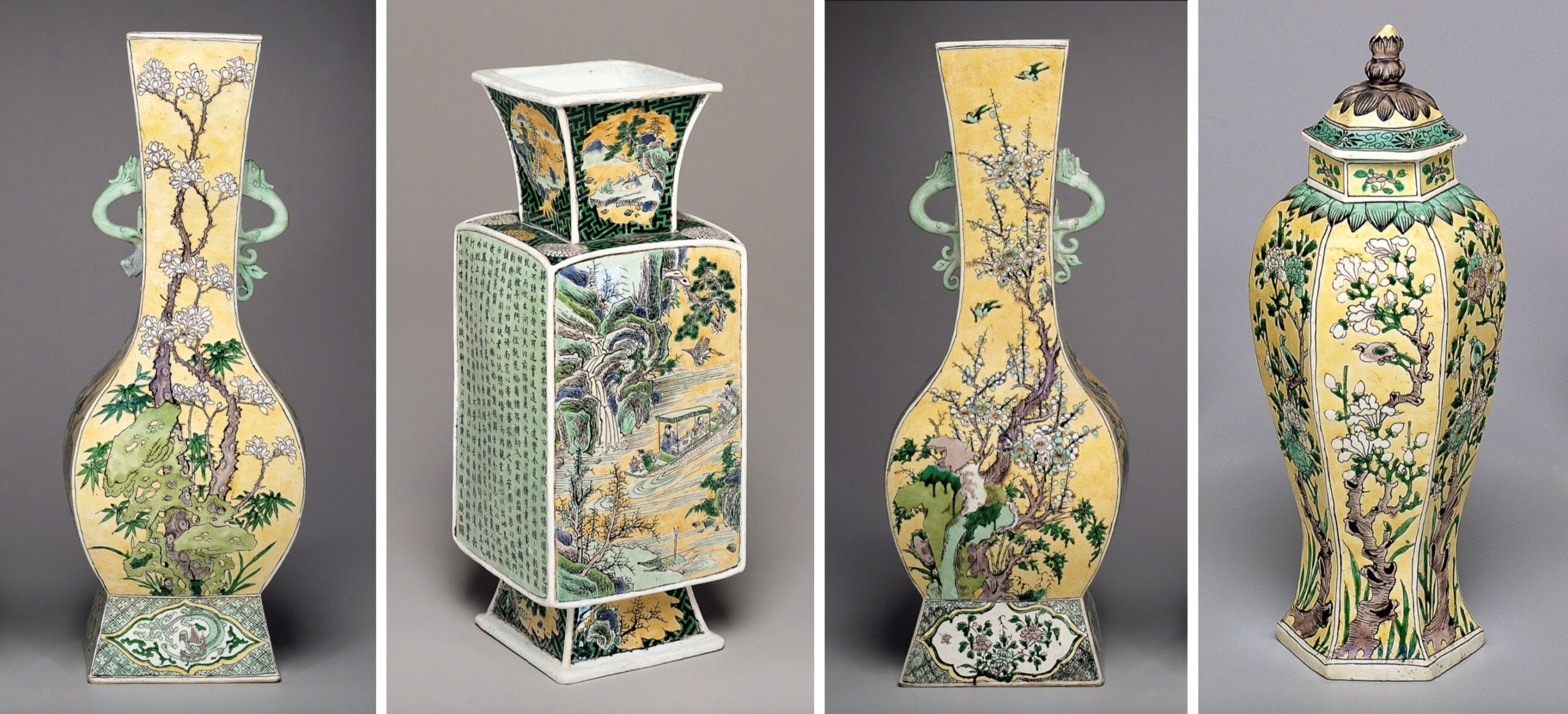
LEFT TO RIGHT
1. Porcelain vase from the Kangxi period, 1662–1722. Medium: Porcelain with Famille Jaune enamels. Height: 56.5 cm, 22 1/4 in. © National Gallery of Art, Washington, USA.
2. Rectangular vase illustrating poems by Tao Qian and Su Shi. Date: Kangxi period, 1662–1722. Medium: Porcelain with Famille Jaune and Famille Noire enamels. Dimensions: 35.6 x 14 x 14 cm, 14 x 5 1/2 x 5 1/2 in. © National Gallery of Art, Washington, USA.
3. Porcelain vase from the Kangxi period, 1662–1722. Medium: Porcelain with Famille Jaune enamels. Height: 56.1 cm, 22 1/16 in. © National Gallery of Art, Washington, USA.
4. Hexagonal covered jar from the Kangxi period, 1662–1722. Medium: Porcelain with Famille Jaune enamels. Height with lid: 30.5 cm, 12 in. © National Gallery of Art, Washington, USA.
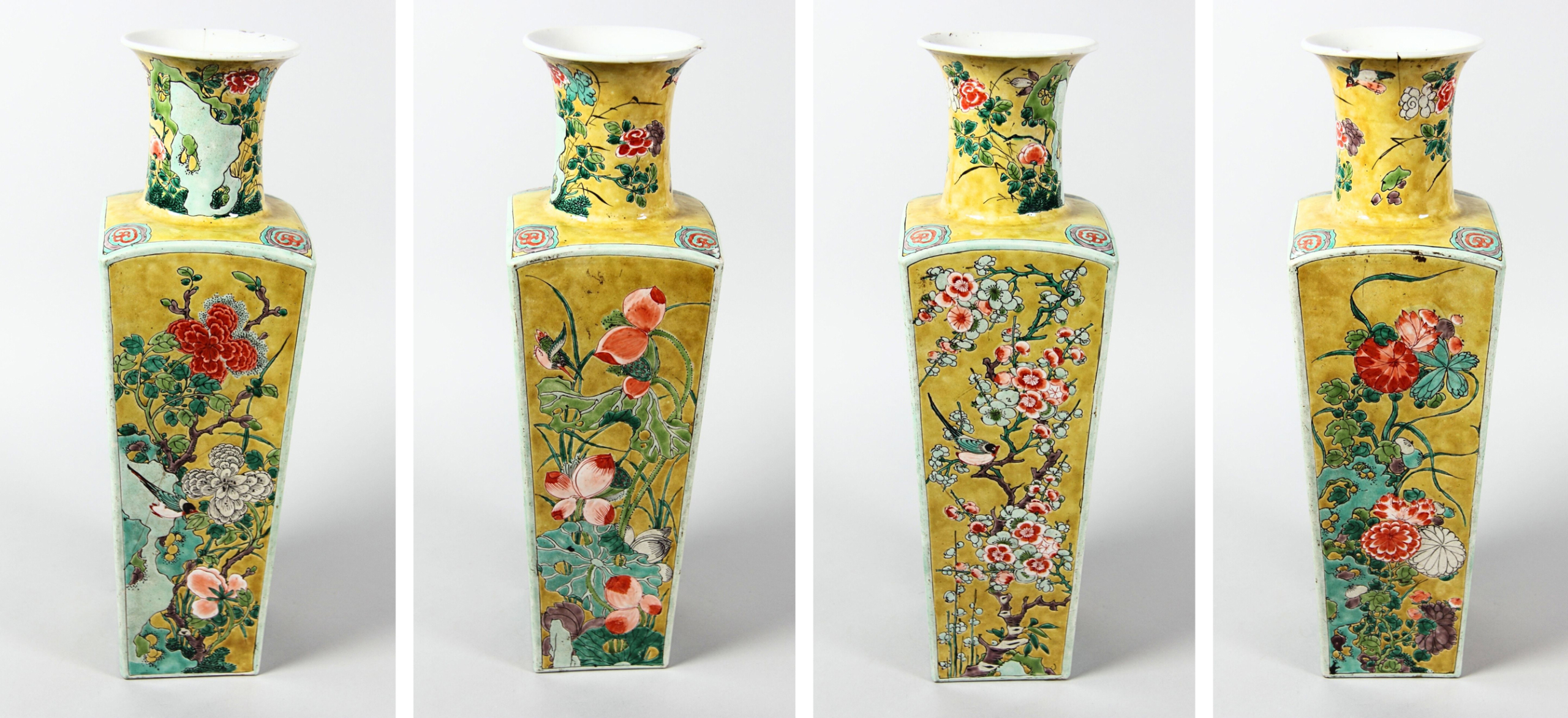
A square vase with scenes of the four seasons, made in Jingdezhen during the 19th century. Medium: Porcelain painted in Famille Jaune polychrome enamels. Height: 19 in., 48.3 cm. The MET, New York, USA.
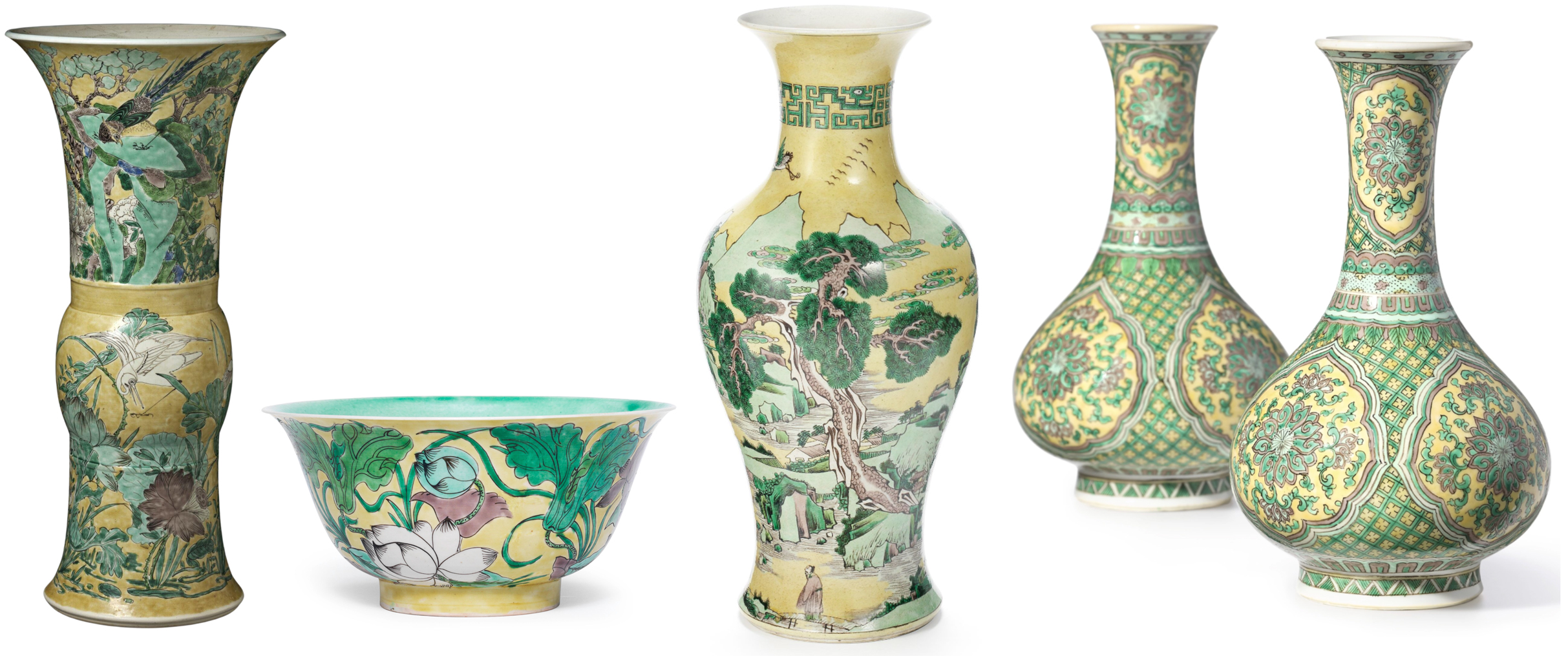
LEFT TO RIGHT
1. A beaker vase made in Jingdezhen during the Kangxi period (1662-1722). Medium: porcelain painted with polychrome enamels in the Famille Jaune palette. "Painted in three shades of green, manganese-purple, blue enamel and black on a yellow ground. On the lower half with storks and lotuses; on the upper half with peony, magnolia, blossom and birds". Height: 45.7cm. Victoria & Albert Museum, V&A South Kensington, UK.
2. A 'lotus pond' bowl in Famille Jaune porcelain. Made during the early during the Kangxi period (in the 17th century). Diameter: 19.5 cm, 7 3/4 in. Auctioned in 2014 by Bonham's London, UK.
3. A rare baluster vase in Famille Jaune porcelain, made during the Kangxi period (1662-1722). Height: 41.8 cm, 16 1/2 in. Auctioned in 2019 by Bonham's, London, UK.
4 & 5. A rare, high-quality pair of vases in Famille Jaune porcelain from the Kangxi period (1662-1722). Decorated in the sancai glaze combination of amber-yellow, green and brown. Auctioned in 2016 by Sotheby's Hong Kong.
The following porcelain pieces may look like Famille Jaune enamelled items, but they are not. They are made of Famille Rose porcelain, which has a yellow background. Both have yellow backgrounds, but the second one's overglaze palette uses opaque pastel enamels, which are typical of the Famille Rose group. We'll talk about that next. For now, enjoy these extraordinary pieces, many of which came from the imperial court.
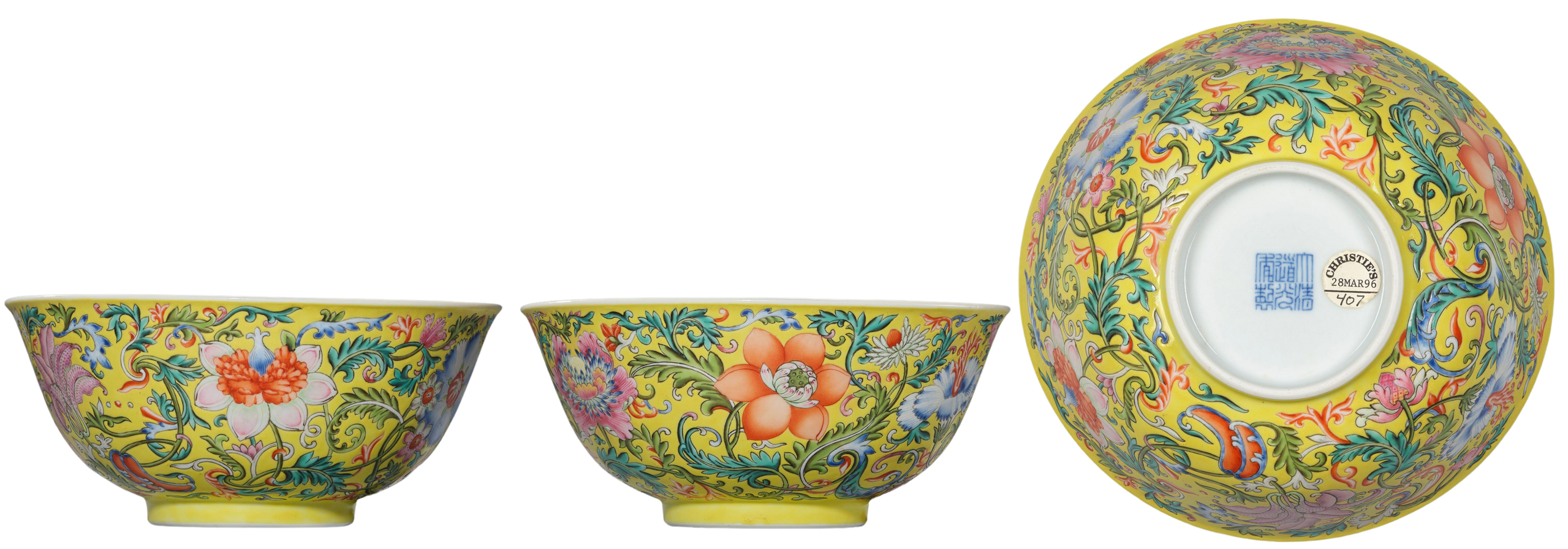
An exceptional imperial 'floral' bowl in yellow-ground Famille Rose porcelain. Date: Daoguang seal mark and of the period. Diameter: 18.7 cm, 7 3/8 in. Auctioned in 2024 by Bonham's Hong Kong. "Brilliantly enamelled in vibrant colours of pink, coral-red, blue, green, and white with various blooming flowers including lotus, peony, chrysanthemum and hibiscus, all borne on dense leafy scrolls with further florets reserved on a bright yellow ground, the interior decorated with five iron-red bats, fitted wood stand, box.(...) Superbly enamelled with full flowering blossoms, demonstrating the exceptional level of aesthetic and technical craftsmanship achieved during the Daoguang reign. The prototype of this type first appeared in the Kangxi period, where the same design was later shared by a number of bowls during the Qianlong reign, and continued into the Daoguang period, indicating the particular popularity of this design at the Imperial court." (from Bonham's catalog).
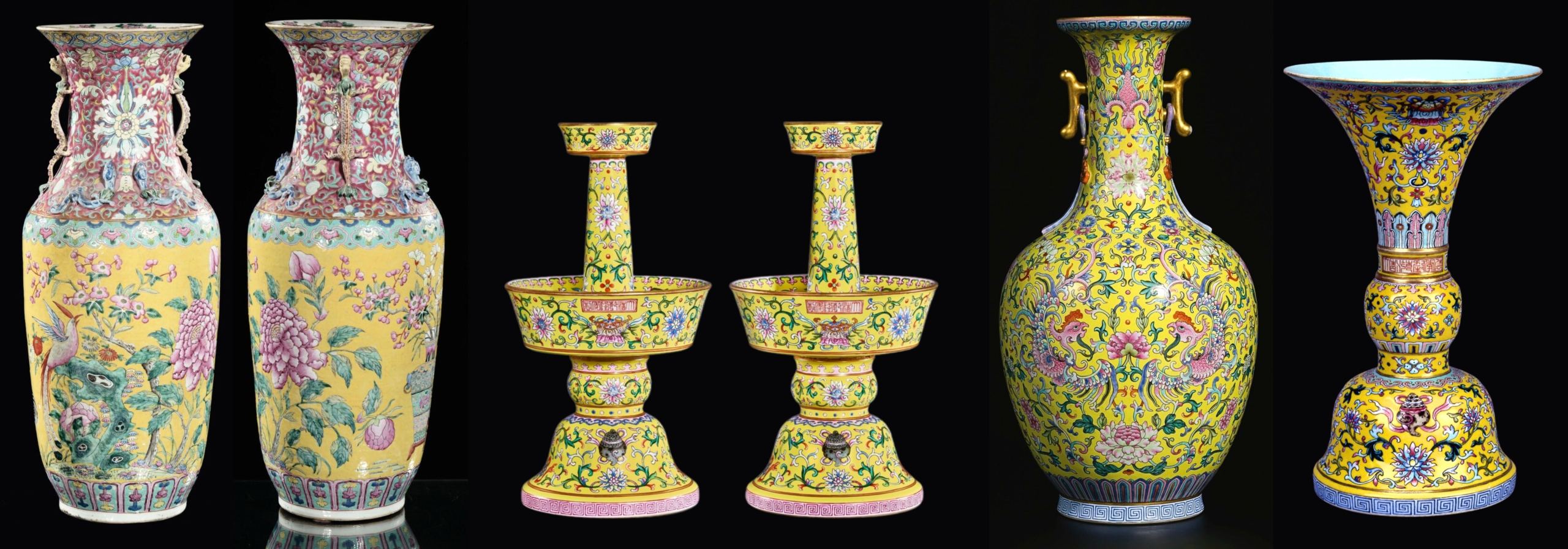
LEFT TO RIGHT
1 & 2. Two sides of a single porcelain vase in Famille Rose enamels on yellow-ground with naturalistic decoration, 19th century. Auctioned in 2014 by Cambi Casa d'Aste, Milan, Italy.
3 & 4. A rare pair of imperial candlesticks from the Qianlong reign (乾隆, 1736–1795). Medium: yellow-ground Famille Rose porcelain. Height: 28 cm. Auctioned in 2021 by Sotheby's Hong Kong for 2,520,000 HKD, roughly 277,000 euros and 323,000 US dollars at today’s rates. "The present pair of candlesticks is particularly notable for its beautifully painted Buddhist ornament against a ground in the imperial colour of yellow. The Eight Buddhist Emblems (bajixiang) skillfully rendered among scrolling lotus were a popular motif of the Qianlong period. A devout Buddhist and practitioner of Tibetan Buddhism, the Qianlong Emperor commissioned the furnishing of the Buddhist temples and ancestral halls with ritual vessels made from the finest materials, such as cloisonné enamel, bronze and porcelain. Candlesticks of this form belong to this group of ritual wares, which were produced in a range of palettes and sizes and would have been made for one of the altars where the Emperor and his family worshipped. Presenting the traditional bajixiang, ruyi bands and lotus scrolls, these candlesticks represent the classic style of altar wares of the period." (From Sotheby's catalog).
5. A fine 'phoenix' vase in brilliantly enameled. Medium: Famille Rose porcelain on a yellow-ground. Date: made during the Qianlong reign (乾隆, 1736–1795). Height: 37.5 cm, 14 3/4 in. Auctioned by Sotheby's in 2016.
6. “Eight Treasures ((八宝, babao) and Lotus” gu-shaped vase with scrolling branches. Date: Qianlong reign (乾隆, 1736–1795). Medium: Yellow-ground Famille Rose porcelain. Dimensions: Height: 25 cm; Mouth diameter: 15.5 cm; Base diameter: 12.6 cm. Wuhan Museum, China. Its form (gu) imitates ancient bronze ritual shapes, showing the Qianlong court’s revivalist interest in antiquity. Yellow was a color associated with the emperor, and yellow backgrounds were strictly reserved for court use, especially in combination with fine enamels. The Eight Treasures are Buddhist and Daoist symbols conveying auspicious meanings, frequently seen on ritual and palace items. Its dense but symmetrical decoration, not cluttered, is consistent with court aesthetic. The use of negative space on the interior of the mouth (turquoise glaze) contrasts with the richly decorated exterior, balancing visual intensity. The lotus scrolls and stylized borders show refined brushwork and enamel control, a mark of Jingdezhen imperial kilns. Given its form and symbolism, this gu-shaped vase was likely used for palatial display or ritual purposes within the Forbidden City or another imperial compound. It embodies the synthesis of antiquarian taste and decorative splendor promoted under Emperor Qianlong.
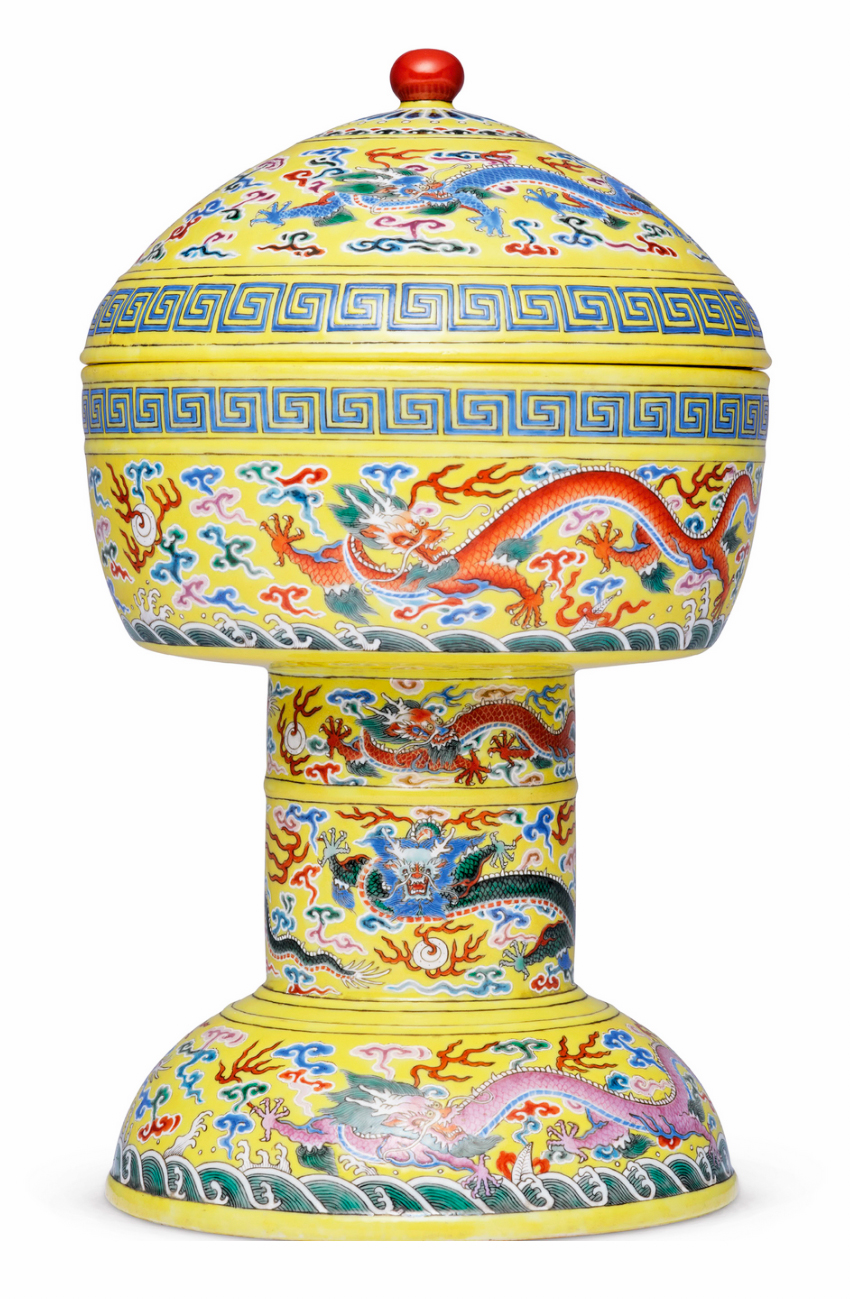
A magnificent piece: a very rare ‘nine dragon’ deng and cover in Famille Rose porcelain on a lemon yellow ground. Made during the Qianlong reign (1736-1796). From the Imperial ceramics - Yidetang Collection. Height: 10 ¾ in., 27 cm. Auctioned in 2021 by Christie's Hong Kong for over 11 million HKD, roughly 1.21 million euros and 1.41 million US dollars today.
In Chinese, dēng (登 / 鐙/ 燈, depending on the context) can denote a pedestal-like vessel, lamp, or stand. In porcelain, it usually indicates a raised ritual or display form rather than a simple plate. A "nine dragon" deng refers to an item decorated with nine dragons, drawing on the highly auspicious "nine dragons" motif in Chinese art and imperial symbolism. The number nine is linked to the emperor and completeness. Dragons on porcelain typically signify imperial authority, cosmic power, and auspicious protection.
Famille Rose (“The Pink Family”) Porcelain and the Red-Ground Variant
Famille Rose is a type of Chinese porcelain with a special glaze that makes it soft and opaque. It is known for its pink color, which is called "rose-pink." Introduced in the early 1700s, Famille Rose developed as a technical and aesthetic successor to Famille Verte, and quickly became the dominant decorative style during the Yongzheng (1723–1735) and Qianlong (1736–1795) reigns of the Qing dynasty.
The palette's distinctive softness was made possible by an important innovation: adding colloidal gold, also known as 'purple of Cassius', to produce the characteristic pink enamel. As Rose Kerr, the former head of the Far Eastern Department at the Victoria & Albert Museum, explains: "The ability to mix opaque enamels with subtle gradation allowed for a level of realism in Chinese porcelain that had never been achieved before." (Rose Kerr, Chinese Ceramics: Porcelain of the Qing Dynasty, 1986).
This new way of making porcelain changed how it was decorated. It let artisans create effects like the look of fog, light, and skin. They could also make flowers and people look more lifelike than ever before..
Technical Foundations and Aesthetic Characteristics
The Famille Rose palette is known for its opaque, pastel colors—rose pink, pale yellow, soft green, lavender, and turquoise—applied in overglaze enamels. These colors were different from the earlier translucent enamels of Famille Verte. Artists could mix these colors however they wanted. This allowed them to create painterly effects and naturalistic details.
The overglaze enamels were usually put on top of a glazed and fired porcelain body. Then, the whole thing was fired again at a lower temperature (around 800–900°C). This process kept the luster of the enamels while stopping them from mixing with the base glaze.
Suzanne G. Valenstein describes the start of Famille Rose as an important moment in Qing ceramic history. She says that it matched the court's preferences and the needs of international markets. "The porcelain ateliers (workshops) that were supported by the emperor's court started to reflect a growing global perspective. Famille Rose, with its elegance and adaptability, became the hallmark of that transformation." (Suzanne G. Valenstein, A Handbook of Chinese Ceramics, The Metropolitan Museum of Art, 1989).
Subjects ranged from scenes from the imperial court and Daoist immortals to cherubs, armorial designs, and studies of plants, reflecting both domestic and foreign tastes.
Timeline and Development
Experimental pieces with rose-colored enamel may have appeared as early as the late Kangxi period (around 1710–1720), but Famille Rose reached its full potential during the Yongzheng reign, especially under the leadership of Tang Ying (1682–1756), who was in charge of the imperial kilns at Jingdezhen.
The palette stayed the same through the Qianlong period. The designs became more and more detailed and the enamel layering became more complex. The Famille Rose style continued until the 19th century, influencing the styles that emerged during the Tongzhi and Guangxu reigns. It also inspired porcelain that was exported to Western collectors.
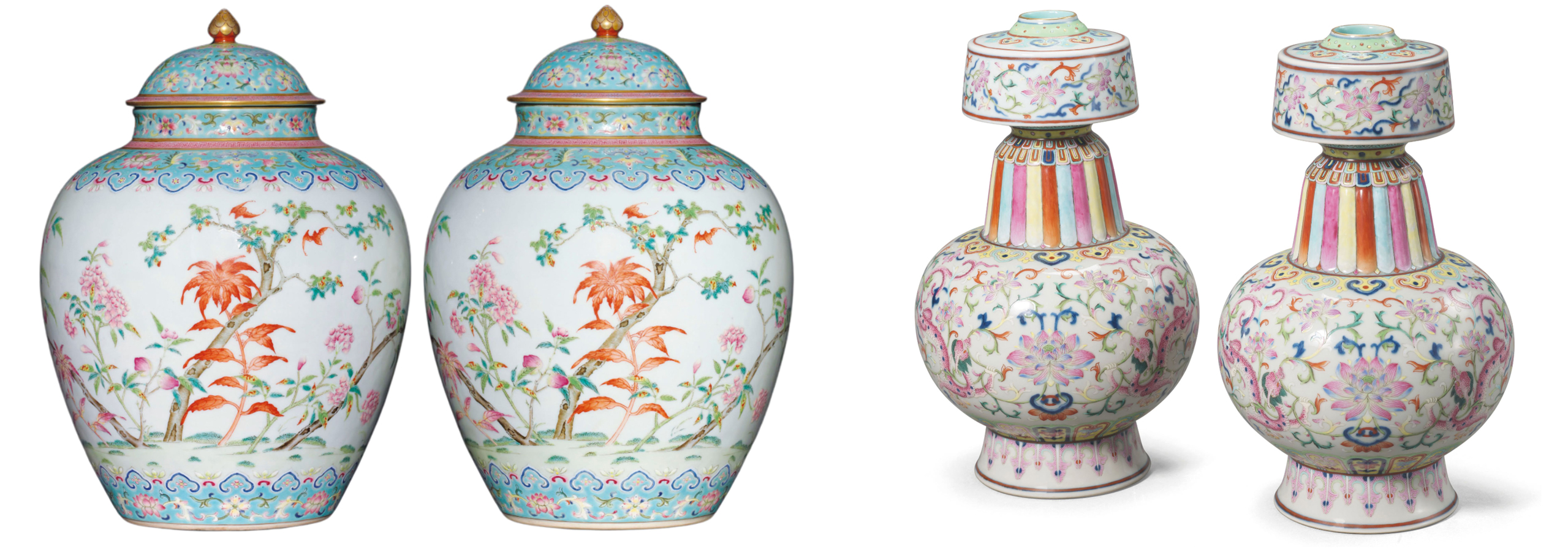
Two pairs of Famille Rose porcelain items.
LEFT: A rare pair of Famille Rose 'flowers and peaches' jars with covers. Date: With Daoguang six-character iron-red seal marks and of the period (1821–1850). Height: 11 1/8 in., 28.2 cm. Auctioned by Christie's Hong Kong in 2013. "Each globular jar is delicately painted around the exterior with a continuous scene depicting iron-red bats amidst trees and stalks bearing various fruits and blossoms including chrysanthemum, Chinese amaranth, peony and peach, between two turquoise-ground bands bordered by alternating ruyi heads and magnolia flower heads, one decorated with bats between lotus sprays with tendrils bearing peaches, the other with alternating lotus and prunus sprays. The neck is encircled by a band of floral sprays, above a ring of ruby fretwork on a pink ground between gilt borders. The domed cover is similarly decorated with bats between lotus sprays bearing peaches, between a band of classic scrolls in pink and ruyi-heads on a lime ground. The cover is surmounted by a bud finial painted with overlapping petals picked out in gold, brown and iron red." (from Christie's catalog).
RIGHT: A pair of Famille Rose Tibetan-style altar vases, benbaping. Date: With Qianlong six-character seal marks in underglaze blue and of the period (1736–1795). Diameter: 5 7⁄8 in., 15 cm. Auctioned by Christie's Hong Kong in 2021. "Each globular body is finely decorated with chilong and lotus heads amongst leafy tendrils framed by a band of stylized lappets above the foot and a ruyi-head band to the shoulder. The moulded neck is decorated with slim petals imitating a Tibetan banner, surmounted by a drum-shaped top decorated with further scrolling lotus." (from Christie's catalog).
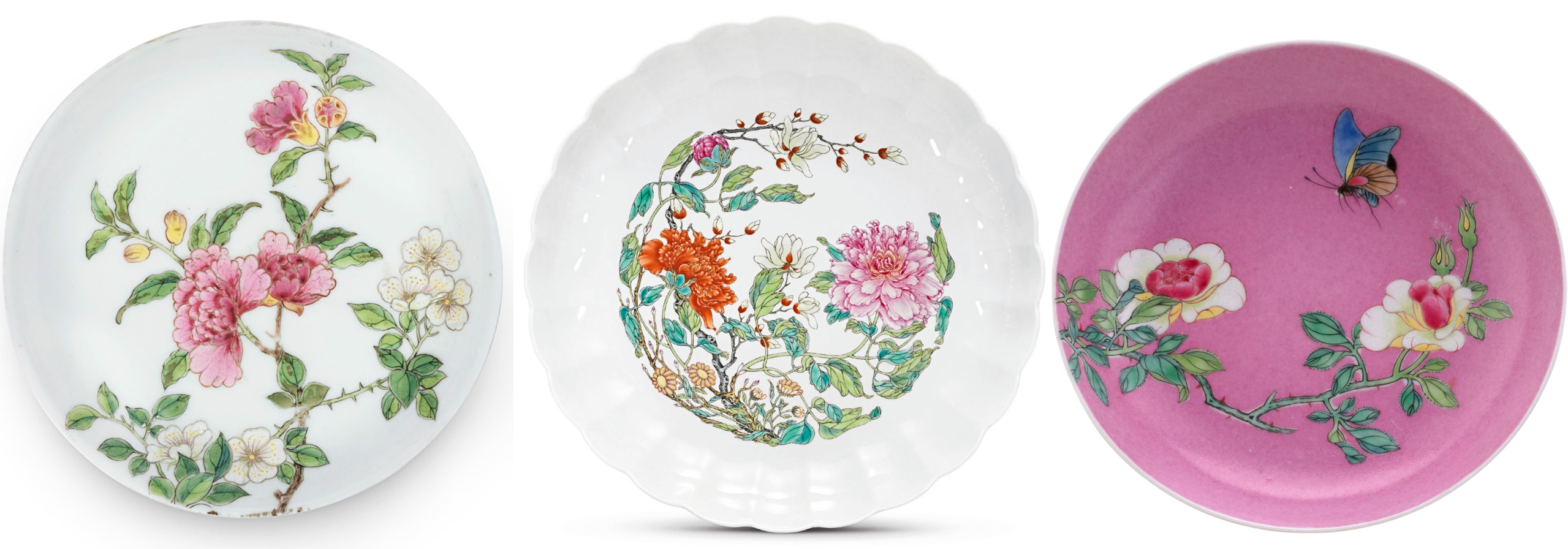
LEFT TO RIGHT
1. A Famille Rose porcelain, ruby-back saucer dish. Date: Yongzheng period (1723–1735). Diameter: 11.5 cm, 4 1/2 in. Auctioned in 2016 by Bonham's London. "Delicately potted, the dish with semi-eggshell thin body, is enamelled to the interior with with prunus and peony, while the back is covered in a ruby enamel." (from Bonham's catalog).
2. A fine and very rare Famille Rose chrysanthemum dish. Date: With Yongzheng six-character mark in underglaze blue within a double circle and of the period (1723–1735). Diameter: 9 in., 23 cm. Auctioned by Christie's Hong Kong in 2016. "The dish is moulded with twenty-four flutes rising from a straight foot ring, and finely enameled to the centre with two peony blossoms in pink and iron-red borne on branches with leaves in green enamels of graduated tones, amid magnolia branches and asters." (from Christie's catalog).
3. A Famille Rose porcelain saucer with ruby back. Date: Yongzheng period (1723–1735). Diameter: 11.7 cm. © The Trustees of the British Museum, London, UK.
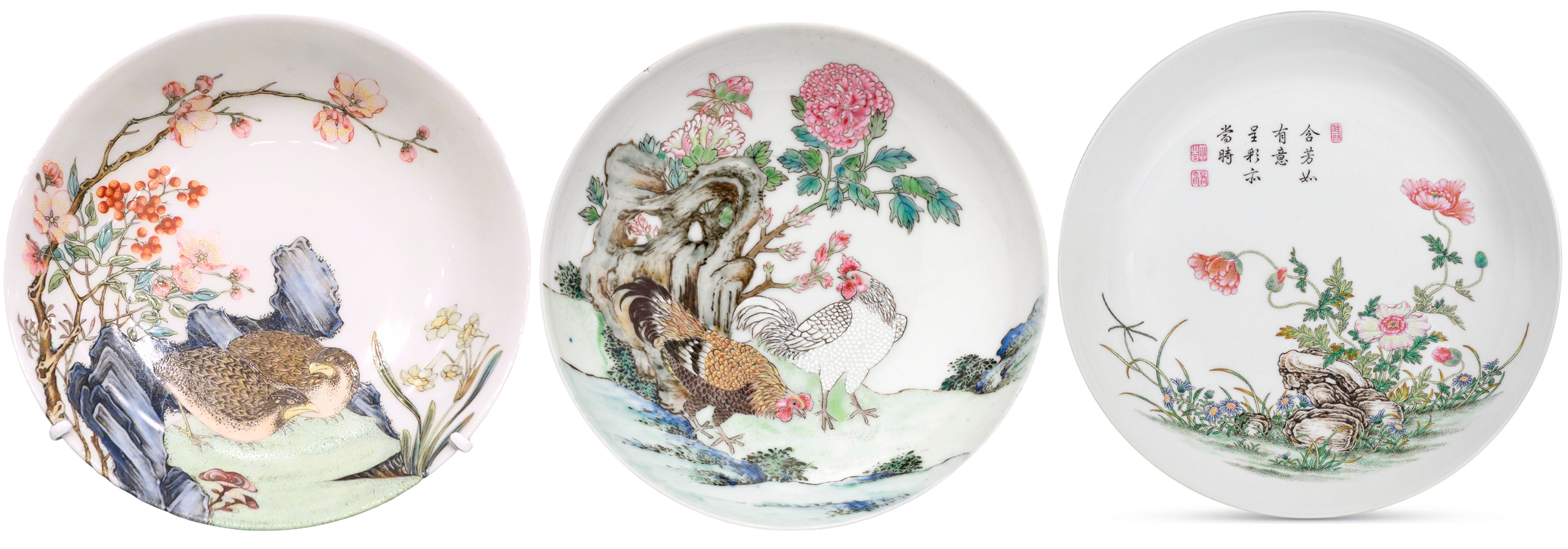
LEFT TO RIGHT
1. A Famille Rose porcelain saucer with motifs celebrating prosperity, made in Jingdezhen in the Yongzheng period (1723–1735). Asian Art Museum of San Francisco, CA, USA. Creative Commons.
2. A Famille Rose porcelain saucer decorated with cockerels and flowers, with inscription and ruby back. Date: from the Yongzheng period (1723–1735). Diameter: 15.5 cm. © The Trustees of the British Museum, London, UK.
3. A fine famille rose yellow-back 'poppy' dish. Date: With Yongzheng six-character mark within a double circle and of the period (1723–1735); the enamels possibly later. Diameter: 8 1/4 in., 20.9 cm. Auctioned by Christie's Hong Kong in 2002. "The interior of the dish is finely decorated with pink poppy sprays, blue asters and rocks, below a poetic inscription which eulogises the fragrance and brilliant colours of the flowers, and three red seals each containing two characters reading jia li (beauty), si shi (four seasons) and chang chun (eternal spring) respectively. The exterior is applied with a bright lemon yellow enamel." (from Christie's catalog).
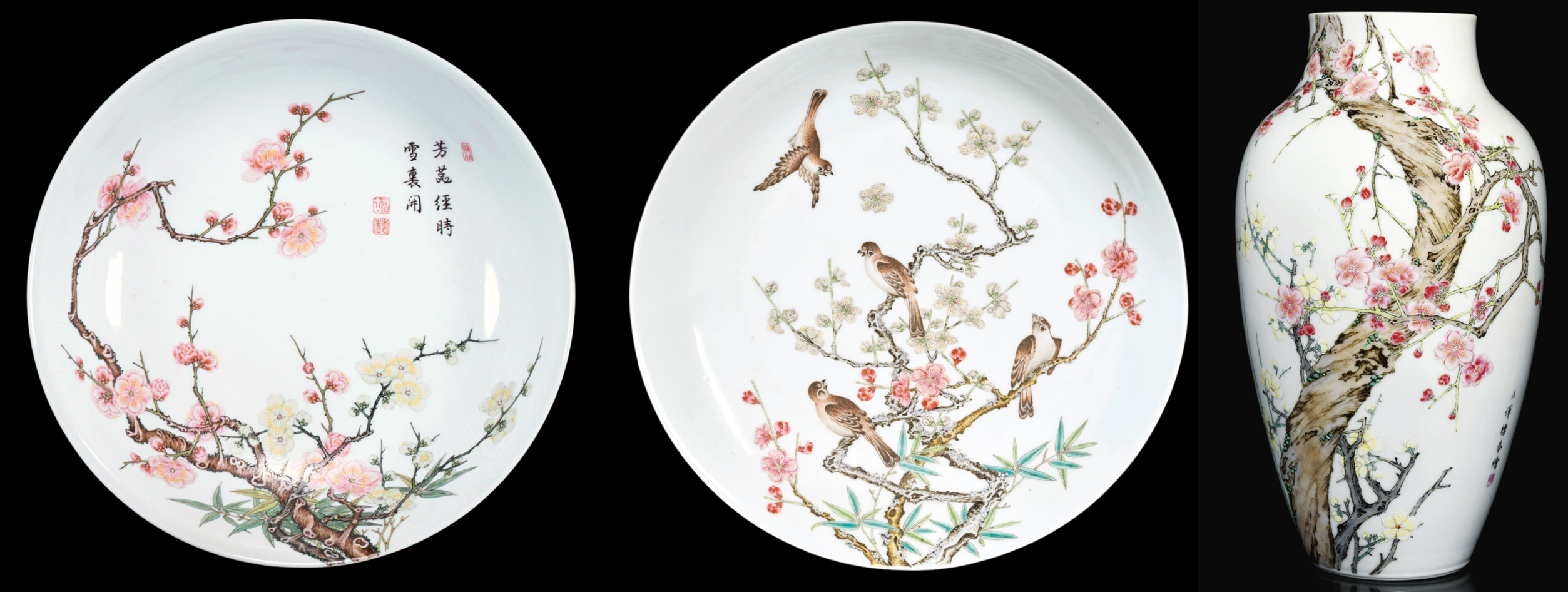
LEFT TO RIGHT
1. An exquisite Famille Rose porcelain plum-tree plate, with backside painted thickly with olive-green. Date: from the Yongzheng period (1723-35). © National Institutes for Cultural Heritage, Tokyo National Museum, Japan.
2. A very rare and fine Famille Rose porcelain 'flowers and birds’ dish with an extremely rare black back. Date: With Yongzheng six-character mark within a double circle in underglaze blue and of the period (1723-1735). Diameter: 19.4 cm, 7 in. Auctioned by Christie's London in 2025. "The four birds on this dish are Eurasian tree sparrows (Passer montanus, 樹麻雀). These are auspicious birds symbolising happiness and the arrival of spring, and while they are less common on porcelains, sparrows, oftenshown with bamboo, have been a favoured subject for Chinese painters on silk and, later, paper since Songtimes. (...). The admiration of the Yongzheng emperor for fine bird and flower painting on imperial porcelain can be seen from the range of bird and flower depictions on falangcai 琺瑯彩 vessels preserved in the collection of the National Palace Museum, Taipei. (from Christie's catalog).
3. A Famille Rose porcelain 'prunus' vase from the early 20th century. Height: 10½ in., 26.6 cm. Auctioned by Christie's London in 2008. "Of ovoid form, finely enamelled around the body with a gnarled and brightly blossoming prunus tree, with an apocryphal Qianlong mark, 'respectfully painted by Yun Biao'." (from Christie's catalog).
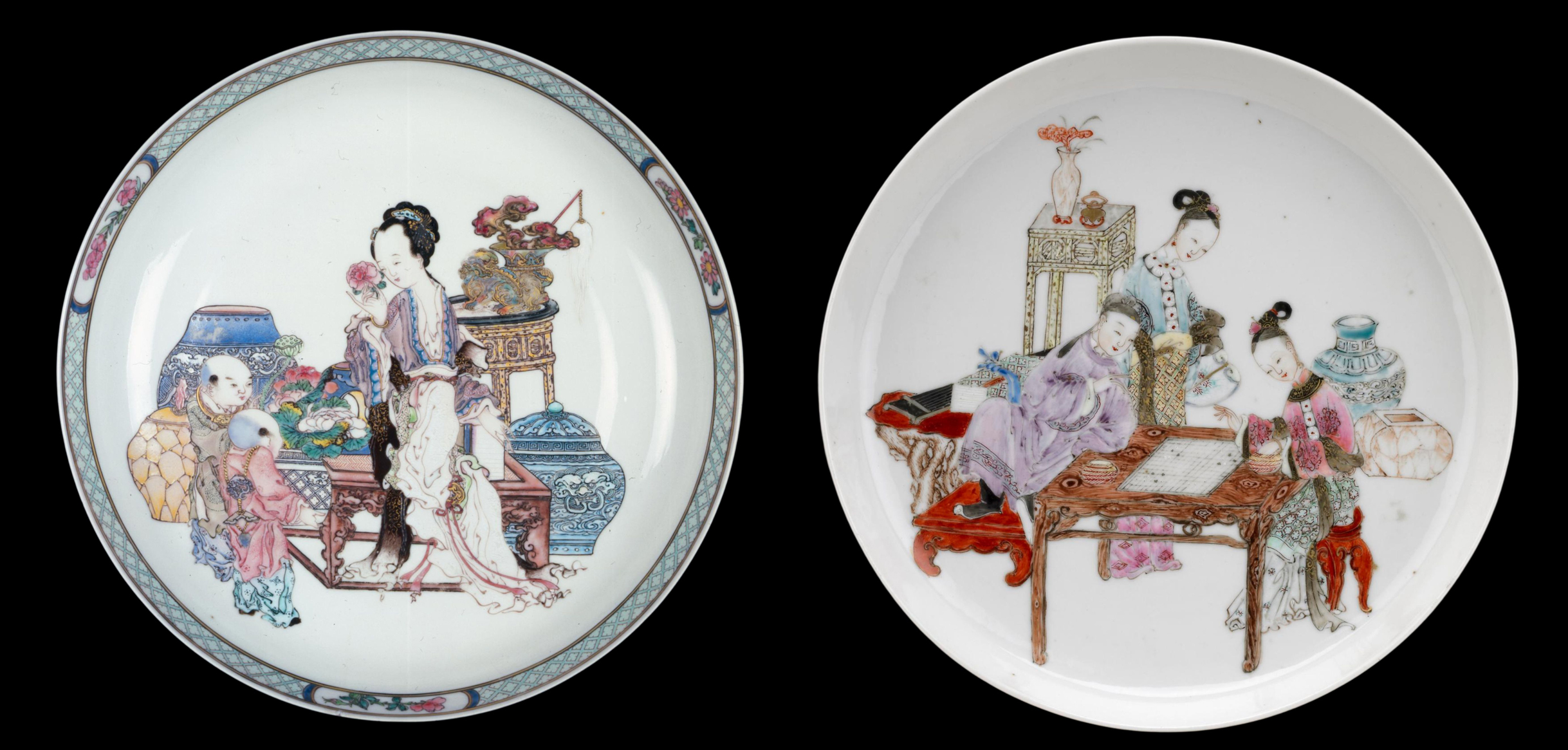
LEFT: A porcelain saucer-shaped dish with rounded sides and flat base. The dish has a fine white eggshell body. It depicts a lady sitting on a rectangular lacquered stool, holding a peony in her left hand. Painted in Famille Rose palette enamels. Made in Jingdezhen in 1720-1740. Diameter: 19.8 cm. © The Trustees of the British Museum, London, UK.
RIGHT: A Famille Rose enamelled porcelain dish depicting a scholar and a lady playing a game of wei qi, watched by another lady. Made in 1736-1795. Diameter: 16.5 cm. © The Trustees of the British Museum, London, UK.
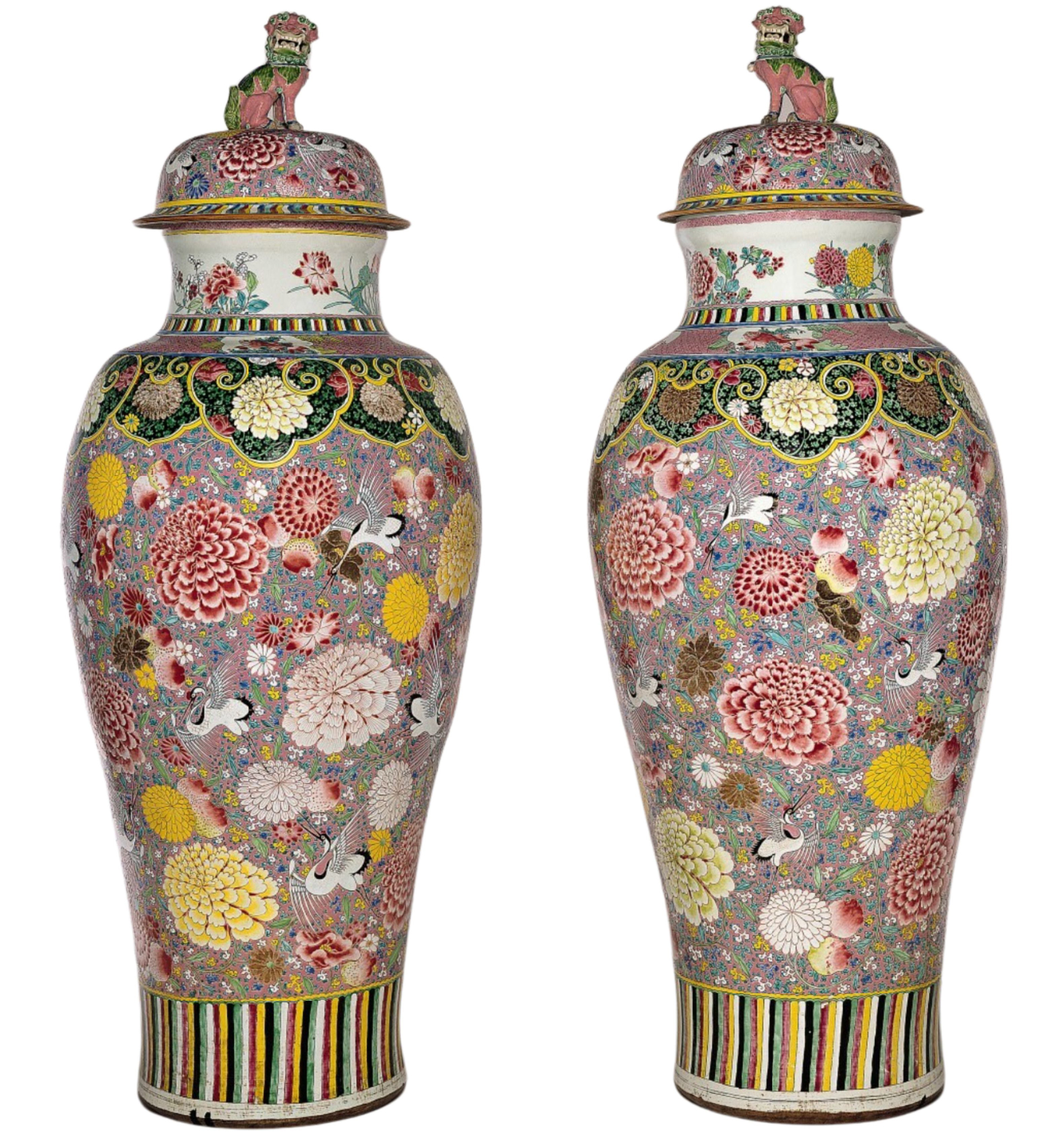
A pair of impressive covered baluster jars from the late 18th century (Qianlong reign). Medium: porcelain with overglaze Famille Rose enamels. Dimensions (with cover): 133 x 49.7 cm; 52 3/8 x 19 9/16 in. © National Gallery of Art, Washington, USA.
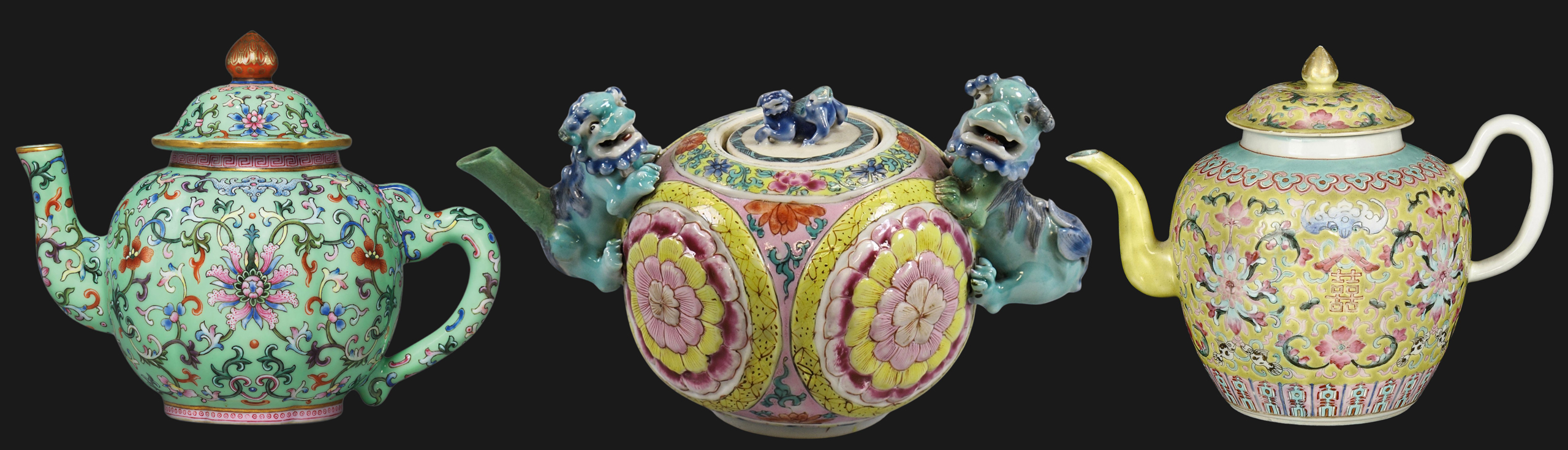
LEFT: A superb and rare turquoise-ground Famille Rose lobed teapot and cover with Qianlong six-character seal mark in iron red and of the period (1736-1795). Width: 6 ¾ in., 17.3 cm. Auctioned by Christie's Hong Kong in 2018. "The body of the teapot is fi nely moulded into six lobes, delicately decorated on each side with a largelotus blossom borne on scrolls, interlinked with a pale blue bat above, ruyi- head below, and smallercamellias on the sides, all against a soft pale turquoise ground. The spout and handle are similarlydecorated with fl orettes borne on scrolls, the top of the handle picked out with the head of anarchaistic dragon. The domed cover has a similarly lobed rim, decorated with four lotus blooms,surmounted by a bud fi nial painted with gilt overlapping petals against an iron-red ground. Theinteriors and base are applied with turquoise enamel. The rims are gilt." (From the catalog).
CENTER: A Famille Rose teapot and cover from the Yongzheng period. Medium: Porcelain with relief decoration. Dimensions: height 4 in., 10.2 cm; width 7 in., 17.8 cm. The MET, New York, USA.
RIGHT: A Famille Rose yellow ground teapot and cover with Daoguang iron red seal mark and of the period (1821–1850). Decorated with stylized hibiscus flowers above twin-fish motifs divided by gilt shou characters suspended from bats and musical chimes, between ruyi and petal-shaped lappets, the cover with similar hibiscus around a gilt knop finial. Dimensions: width 8 3/8 in., 21.3 cm. Auctioned by Christie's London in 2011.

A Stratum Exposed
The pair of impressive covered baluster jars from the late 18th century and the teapots in the previous pictures show a sorto of "filled" aesthetic: they display what Chinese ceramic scholarship identifies as the 百花不落地 bǎihuā bùluòdì, "Hundred Flowers Not Touching the Ground" or 花锦 wànhuā jǐn, "Brocade of Ten Thousand Flowers" style.
The Bǎihuā bùluòdì style started during the late Yongzheng period. According to recent research, during the Yongzheng period, Tang Ying created the "hundred flowers not touching ground" decoration, which later became popular in the Qianlong and Jiaqing periods.
This style has several defining characteristics:
- Total surface saturation: Every available spatial unit is occupied by decorative elements—peonies, chrysanthemums, lotus blossoms, cranes, and Buddhist lions float across the surface without anchoring stems or visible ground lines.
- No empty space: The porcelain ground itself becomes virtually invisible beneath layers of enamel.
- Polychromatic density: Academic sources say that these pieces use at least 30 different colors. They need many master artisans to work on them for months.
Take a look at these Famille Rose porcelain pieces. They are great examples of the "reserved" style.
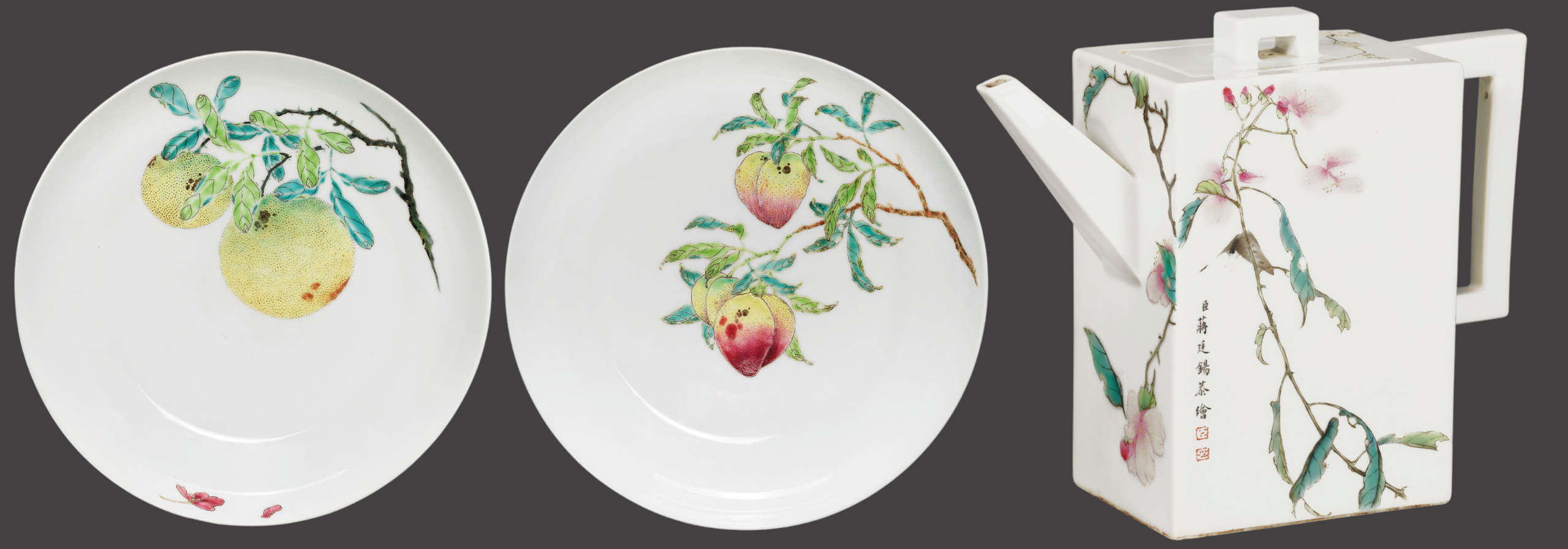
LEFT: A rare pair of Famille Rose ‘fruit’ dishes. Date: With Yongzheng six-character marks in underglaze blue within double circles and of the period (1723–1735). Diameter: 7 7/8 in., 20 cm. Auctioned by Christie's Hong Kong in 2017. "Each dish is finely potted with gently rounded sides rising from a short foot ring and superbly enameled in varying shades including pink, green, brown, yellow, white and black. One dish is decorated with three peaches growing on a gnarled branch, the other with two pomelos opposite a falling blossom." (From Christie's catalog).
RIGHT: A rare Famille Rose ‘butterfly and flower’ rectangular teapot and cover. Date: Qing dynasty. Height: 7 ¼ in., 18.5 cm. Auctioned by Christie's Hong Kong in 2024. "Two sides are inscribed with six characters reading chen Jiang Tingxi gonghui (respectfully painted by Official Jiang Tingxi), followed by seals reading chen (official) and yin (seal). The base is inscribed with a four-character seal mark reading baohe taihe (pursue and preserve the perfect harmony)". (From Christie's catalog).
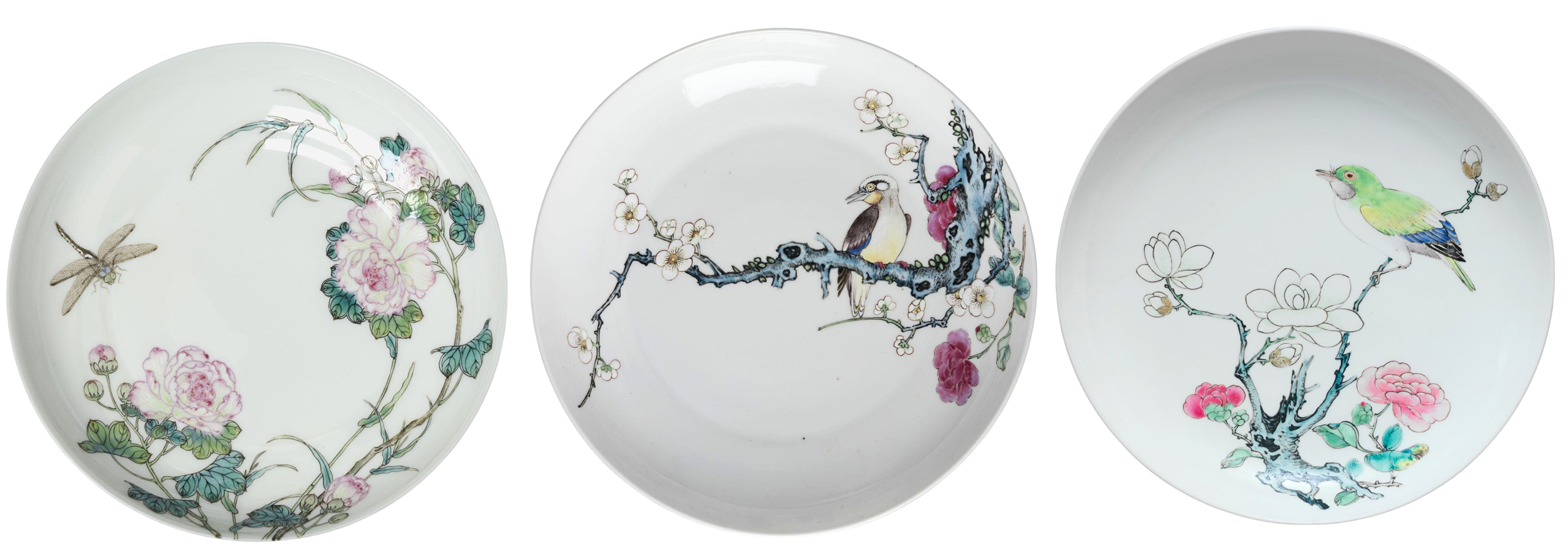
LEFT: An amazing dish made of porcelain painted with overglaze enamels in the Famille Rose palette, depicting peonie and a dragon-fly. The flowers carry over the rim from outside to inside. Made in Jingdezhen. Date: ca. 1736–50. Diameter: 13.6 cm. Victoria & Albert Museum - South Kensington, UK.
CENTER: A dish of 'eggshell' porcelain, painted in overglaze enamels in the Famille Rose palette, showing a kingfisher perched on the bough of a plum-tree in blossom, with sprays of peony. Made in Jingdezhen. Date: 1875-1900. Diameter: 20.6 cm. Victoria & Albert Museum - South Kensington, UK.
RIGHT: A dish with bird and flowers made in Jingdezhen. Date: ca. 1730–50. Medium: Porcelain painted in overglaze polychrome Famille Rose enamels. Diameter: 8 in., 20.3 cm. The MET Museum, New York, USA.
The porcelain items shown in the last two pictures look a lot like the paintings made during the Yongzheng period (yuànguà, 院画). Their approach is characterized by:
- Strategic deployment of blank space (liubai, 留白): The pristine white porcelain body functions as an active compositional element.
- Botanical naturalism: Peaches and pomelos appear as separate, scientifically observed objects rather than as part of a pattern.
- Calligraphic integration: The presence of written text indicates that the painting was directly painted onto the ceramic.
The term "court painting" (yuànguà, 院画) in Yongzheng ceramic studies refers to a specific system. In this system, Imperial workshop painters (huàshì 画士) created fěnběn (粉本, pattern drafts). These drafts were then transferred to porcelain surfaces by specialized ceramic painters (cíhuà gōng 瓷画工).
The Ruyi Guan (如意馆, Studio of As-Wished) archives show that Jiang Tingxi himself oversaw the creation of floral designs for imperial porcelain and that his paintings were directly copied onto ceramic surfaces. The dishes in the previous images show this direct transcription quality. They have a "boneless" wash effect, which was previously thought possible only on silk or paper.
The Liubai Aesthetic
All the porcelain shown above demostrate how blank space was used to create a specific look that was popular during the Yongzheng period. Let's look at their picture again..
- Left dish: The peony and dragonfly design takes up about 40% of the surface, with the rest being plain white. The branch's diagonal shape creates a sense of movement, which is a common feature in yuànhuà bird-and-flower painting.
- Center dish: The plum blossom and bird motif is even more restrained—perhaps 35% surface coverage—with the bird positioned at the visual center creating a focal point against expansive white space. This matches what expert Lü Chenglong says about the Yongzheng preference for "light and elegant colors, rich layers of color, and a fresh and graceful style." This item was made in Jingdezhen between 1875 and 1900. It is a later version of a style popular during the Yongzheng period.
- Right dish: The magnolia and bird design is also similar, with the branch structure dividing the space into sections while leaving large areas of white porcelain showing.
This "less is more" approach is very different from the Qianlong bǎihuā bùluòdì aesthetic we could see in the earlier images, where the colors on the surface are almost 95-100% saturated.
The rendering of floral elements appears to employ the "boneless" (mògǔ, 没骨) technique associated with Yun Shouping (恽寿平, 1633–1690) and transmitted through court painters like Jiang Tingxi (蒋廷锡, 1669–1732):
- No outline: The petals and leaves are defined through color washes rather than ink contours.
- Xūnrǎn (渲染) shades: The soft transitions from pink to white in the peonies, and the yellow-green modulation in the bird's plumage, demonstrate the "wash rendering" technique that the bōli bái (玻璃白, 'glass white') medium made possible.
- Powdery (fěnrùn, 粉润) surface quality: The enamel displays a unique soft, moist glow that's characteristic of the Yongzheng palette, achieved through layers of arsenic-based opaque white.
The motifs selected align with Yongzheng-era literati preferences:
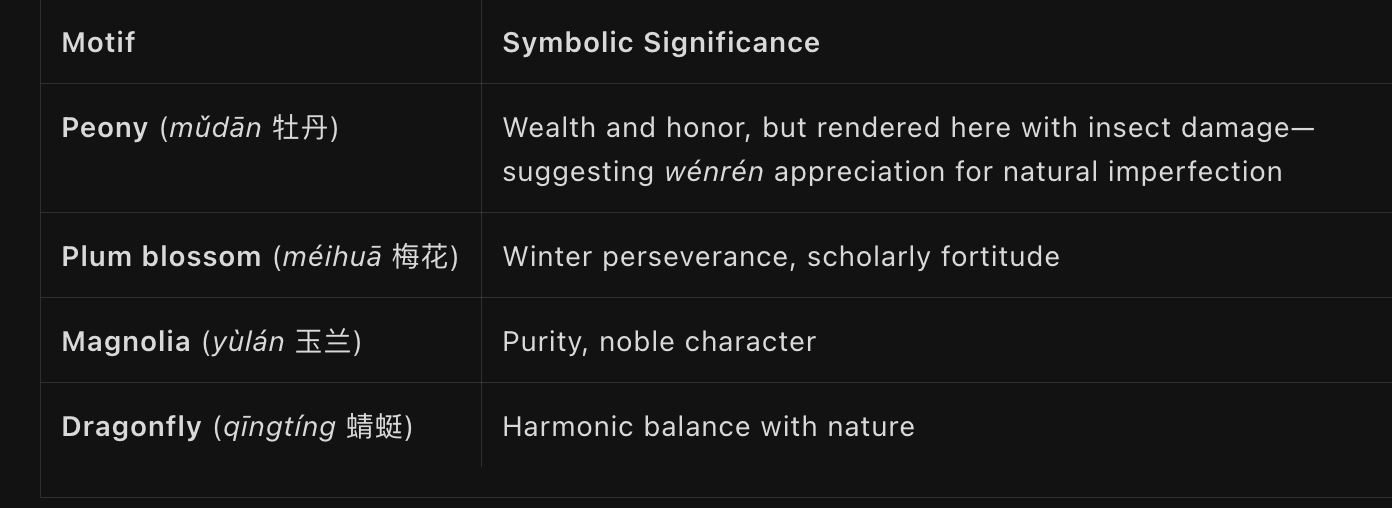
The insect on the left dish is particularly significant: this "wounded beauty" (cánquē měi, 残缺美) aesthetic reflects literati painting values that the Yongzheng court actively cultivated, whereas Qianlong imperial wares typically presented idealized, flawless nature.
The brushstrokes in these images are similar to those seen in court painting:
- Branch rendering: The gnarled texture of the plum branch (center dish) and magnolia trunk (right dish) shows the "axe-cut" (fǔpī cūn, 斧劈皴) texture strokes derived from landscape painting.
- Leaf veins: The leaves have two different types of patterns. One type is called 'delicate' shuānggōu (双钩, "double-outline"). The other type is called mògǔ. Jiang Tingxi combined these two types of patterns..
- Bird depiction: The anatomical precision and "alive-spirit" (shēngqì, 生气) in the birds' eyes align with the Rú Gǔ Zhāi (如古斋) court painting standards.
When compared to definitive Yongzheng fěncǎi specimens in museum collections (particularly the Palace Museum, Beijing and National Palace Museum, Taipei), these dishes share:
- The "elegant and refined" (xiùyǎ, 秀雅) palette: Restricted to soft pinks, pale greens, light blues, and muted yellows—never the saturated jewel tones of Qianlong wares.
- Asymmetrical composition: All three dishes employ the "one-corner" (yījiǎo, 一角) compositional formula derived from Southern Song mòxié (墨写, ink play) painting.
- Integration of calligraphic space: The visual rhythm treats blank areas as active compositional elements (jì bái dāng hēi, 计白当黑), not merely as ground.
The Yongzheng Synthesis: Literati Aesthetics on Porcelain
The Yongzheng Emperor's aesthetic philosophy was explicitly articulated in court records. According to the Huoji Dang (活计档, Archives of Workshop Activities), the imperial government always emphasized three things:
- "refined elegance" (文雅, wényǎ),
- "pure simplicity" (素净, sùjìng),
- "delicate grace" (秀气, xiùqì).
This was a deliberate choice to use the values of literati painting (wénrén, 文人) in imperial ceramic production.
The technical foundation for this aesthetic was established through:
- The "glass white" (bōli bái, 玻璃白) medium: This is an opaque white enamel that uses arsenic. It was used in a technique called xūnrǎn (渲染, meaning "wash rendering"). This technique was inspired by ink painting. It creates color transitions that look like ink washes.
- The "boneless" (mògǔ, 没骨) method: It is associated with the painter Yun Shouping (恽寿平, 1633–1690) and was passed down through his artistic descendant Jiang Tingxi (蒋廷锡, 1669–1732), whose court paintings directly supplied models for Yongzheng imperial porcelain.
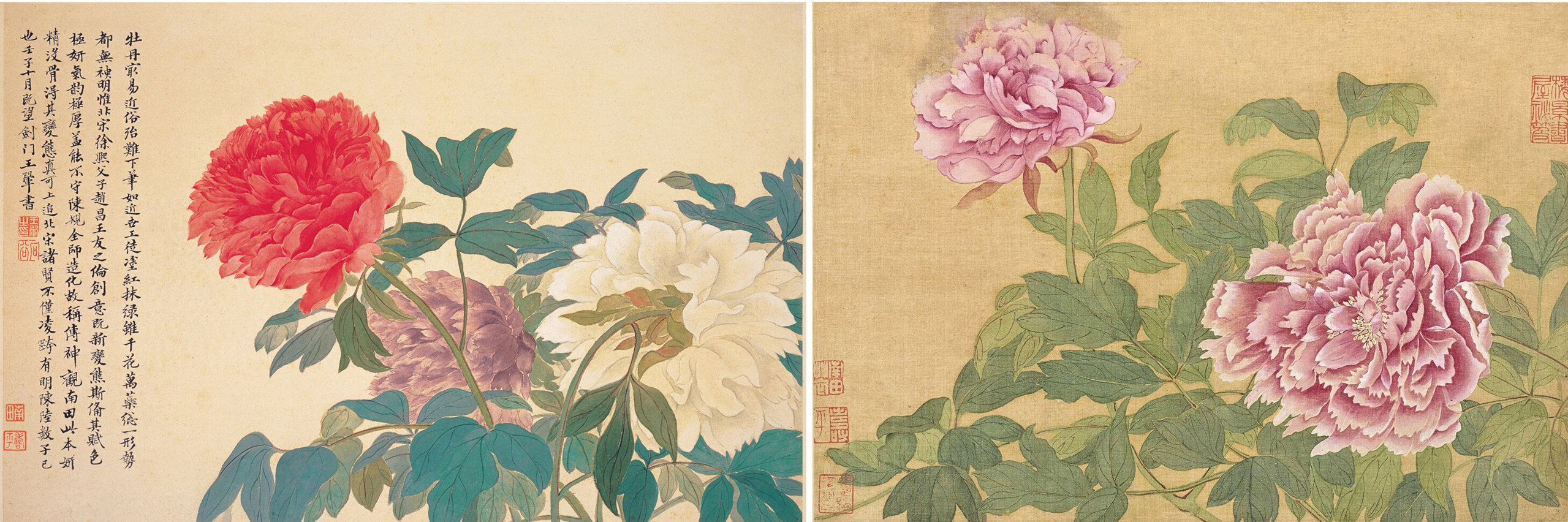
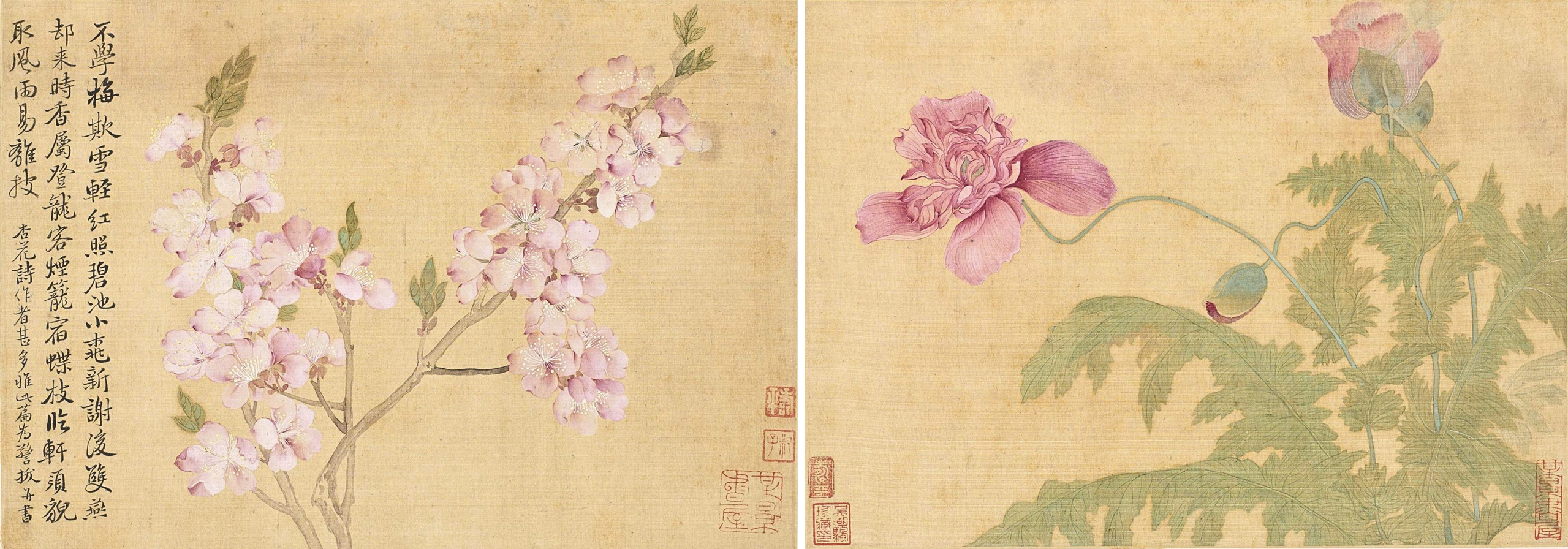
LEFT: Yun Shouping (1633–1690), Peonies, leaf of an album created with Wang Hui. Medium: Ink and colors on paper. Dimensions: height 28.5 cm, 11.2 in; width: 43.1 cm, 16.9 in. National Palace Museum, Taipei, Taiwan.
RIGHT: Yun Shouping (1633–1690), Flowers, album leaf. Medium: Ink and color on silk. Shanghai Museum, China.
BELOW: Yun Shouping (1633–1690), Flowers, album leaves. Medium: Ink and color on silk. Shanghai Museum, China.
Yun Shouping, original name Ge, was also known by his zi (designated name) Shouping and his hao (literary name) Nantian. A native of Changzhou, Jiangsu province, Yun Shouping, was one of the "Six Masters of the Early Qing" and excelled in landscape and flower painting. The last three album leaves were painted in the sixteenth year of the Kangxi reign (1677) when the artist was forty-five years old.
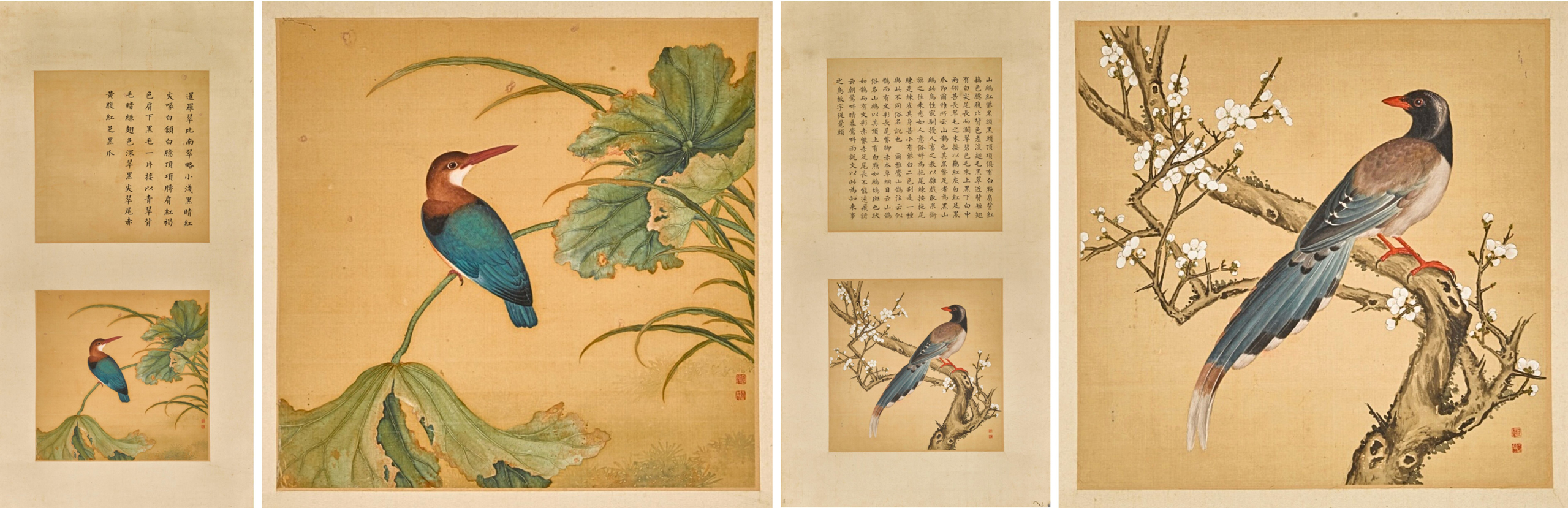
Jiang Tingxi, 1669 - 1732 蔣廷錫, An Imperial manual of Birds ⿃ 譜 五幅. Two frames out of a set of five. Medium: ink and colour on silk. Dimensions: 39 x 40 cm, 15⅜ x 15¾ in. Auctioned in 2023 by Sotheby's, Hong Kong.
Scholars have shown that the Yongzheng Famille Rose style was characterized by a preference for white spaces, light and elegant colors, rich layers of color, and a fresh and graceful style. The blank space was more than just empty space; it was an "activated void." In Chinese painting theory, this is called 计白当黑 (jì bái dāng hēi, "calculating white as black"). This means that the empty space has the same importance as the painted parts.
The Qianlong Transformation: Pattern Design Supremacy
During the Qianlong period, people started thinking about ceramic decoration in a new way. The bǎihuā bùluòdì style was the visual expression of High Qing imperial magnificence, as described by the Tao Ya (陶雅, "Ceramic Elegance"): "By the Qianlong period, decoration reached its zenith, with designs so intricate and precise, they bordered on the supernatural."
This change happened for many reasons:
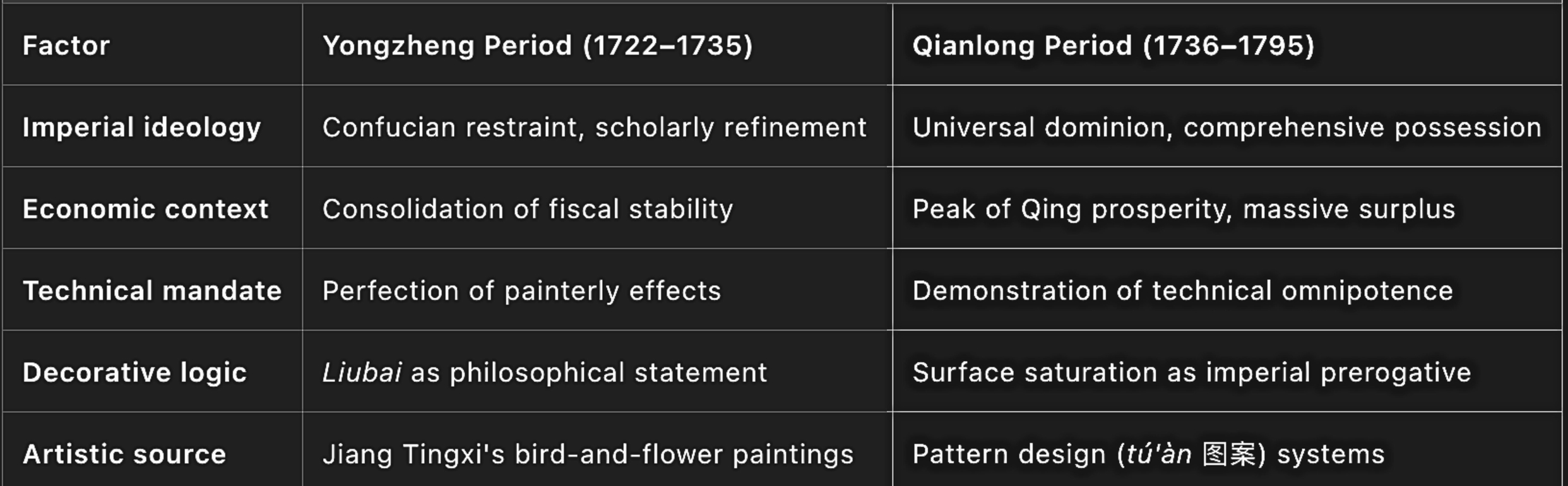
The Qianlong aesthetic represents what scholar Stacey Pierson identifies as "outward-focused" methodology, where technical virtuosity itself becomes the primary signifier of imperial power . The bǎihuā bùluòdì style, with its "flowers floating like celestial maidens scattering blossoms," transforms the ceramic surface into a self-sufficient ornamental universe requiring no external reference.
The Semiotics of Space – Liubai as Cultural Capital
The Yongzheng deployment of blank space encoded multiple layers of meaning:
- Philosophical: The root lies in the Daoist concept of wú 无 ("non-being") as the generative source of yǒu 有 (being); the white ground signifies potentiality rather than emptiness.
- Social: The ability to appreciate restraint (jiǎnyuē, 简约) over ostentation (fánhuá, 繁华) marked the connoisseur as possessing true wénrén cultivation, distinguishing imperial taste from merchant-class conspicuous consumption.
- Visual: The white porcelain body, achieving 77.5% reflectance in Yongzheng official wares, functioned as a luminous field that activated the enamel's distinctive "soft powdery" (fěnrùn, 粉润) quality through optical contrast.
Saturation as Imperial Totality
On the other hand, the Qianlong bǎihuā bùluòdì held different meanings.
- Political: The complete coverage of surface paralleled the Qianlong Emperor's territorial expansion and encyclopedic cultural projects, the Siku Quanshu (四库全书), and the Qinding Gujin Tushu Jicheng (钦定古今图书集成).
- Economic: The extraordinary labor investment (months of production, dozens of color applications) demonstrated the court's capacity to command resources without constraint.
- Visual-cultural: The elimination of ground reference creates a "pattern that covers everything" (màn dì, 满地) that goes beyond the limits of the ceramic object, suggesting it extends infinitely beyond the limits of the vessel.
Technical Art Historical Evidence
Scientific analysis shows that these differences in style are also reflected in the materials used. Colomban et al. compared Yongzheng and Qianlong shards using spectroscopy. This study revealed the following.
- Yongzheng pieces: Thinner enamel applications, higher arsenic content in white base layers, and color palettes limited to 8–12 distinct tones facilitate xūnrǎn
- Qianlong pieces: Multiple superimposed enamel layers, expanded chromatic range (more than 30 colors), incorporation of gold (jīncǎi, 金彩) and zhàdào (轧道, "sgraffito ground") techniques creating textured substrates for floral overlays.
The bǎihuā bùluòdì technique specifically required:
- Preliminary gōuhuà (勾画, "outline drawing") transferring court-designed fěnběn (粉本, pattern drafts) to three-dimensional surfaces;
- Guōhuī (锅灰, "charcoal ground") underpainting beneath floral elements;
- Sequential tián sè (填色, "color filling") and xǐrǎn (洗染, "washing") by specialized artisans;
- Final ground-color application (dìsè, 地色) in black, yellow, red, blue, or green—though white and black were considered most prestigious.
Two Paradigms of Qing Imperial Aesthetics
The contrast between the illustrated specimens encapsulates a fundamental tension in Chinese aesthetic theory between "substance" (zhì, 质) and "pattern" (wén, 文) and between "simplicity" (sù, 素) and "embellishment" (xuàn, 绚).
Here we anticipate what we will see in detail in the following chapters: the Yongzheng liubai aesthetic represents the Sinicization of Western enamel technology and the absorption of European Famille Rose pigments, introduced to China by Jesuit artists, into the pictorial conventions of Chinese literati painting, where "the charm of porcelain is not only its visual expression of traditional artistic design, but also the expression of emotion and meaning".

LEFT TO RIGHT
1. A fine and rare Famille Rose 'poppy' bowl, with Yongzheng six-character mark and of the period (1723-1735). Diameter: 3 5/8 in., 9.2 cm. Auctioned in 2008 by Christie's Hong Kong for 5,367,500 HKD, equivalent to US$ 685,000 € 580,000 today. "The bowl is finely potted and translucent with rounded sides, the exterior exquisitely enamelled with one pink, one white and one iron-red poppy, borne on long bristled stems with veined leaves emerging from the foot and meandering naturalistically around the body in varying shades of bluish and yellowish green, the interior enamelled with three small asymmetrically arranged flowerheads". (from Christie's catalog).
2. A very rare and exceptional Famille Rose 'daylily' cup with Yongzheng six-character mark in underglaze blue within a double circle and of the period (1723-1735). Diameter: 3 5⁄8 in., 9.2 cm. Auctioned by Christie's New York for US$ 1,381,000 erquivalent to € 1,173,850 today.
3. A fine Famille Rose ‘Sanduo’ bowl with Qianlong six-character seal mark in underglaze blue and of the period (1736-1795). Diameter: 6 in., 15.2 cm. Auctioned in 2016 by Christie's Hong Kong. "The bowl is enamelled on the exterior with three detached fruiting sprays including lychee, pomegranate and peach, forming the Three Abundances". (from Christie's catalog).
4. A Famille Rose ‘Sanduo’ bowl with Qianlong six-character seal mark in underglaze blue and of the period (1736-1795). Diameter: 5 7/8 in., 14.9 cm. Auctioned in 2024 by Christie's Hong Kong.
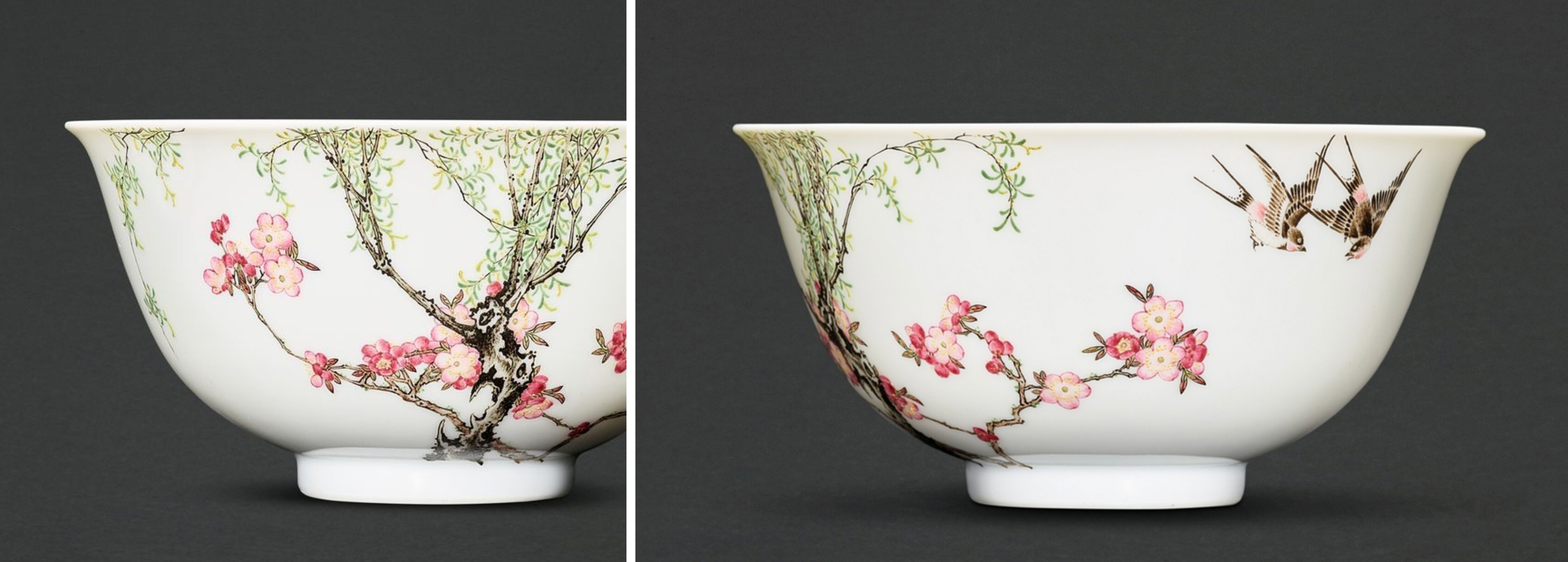
A highly important and superbly enameled imperial Falangcai ‘swallow’ bowl. Date: with blue enamel mark and period of Qianlong. Diameter: 11.3 cm. The porcelain probably is form the Yongzheng period, while the enamel was painted in ca. 1736. Auctioned in 2023 by Sotheby's Hong Kong for 198,220,000 HKD, roughly US$ 25.4 million and € 19.2 million.
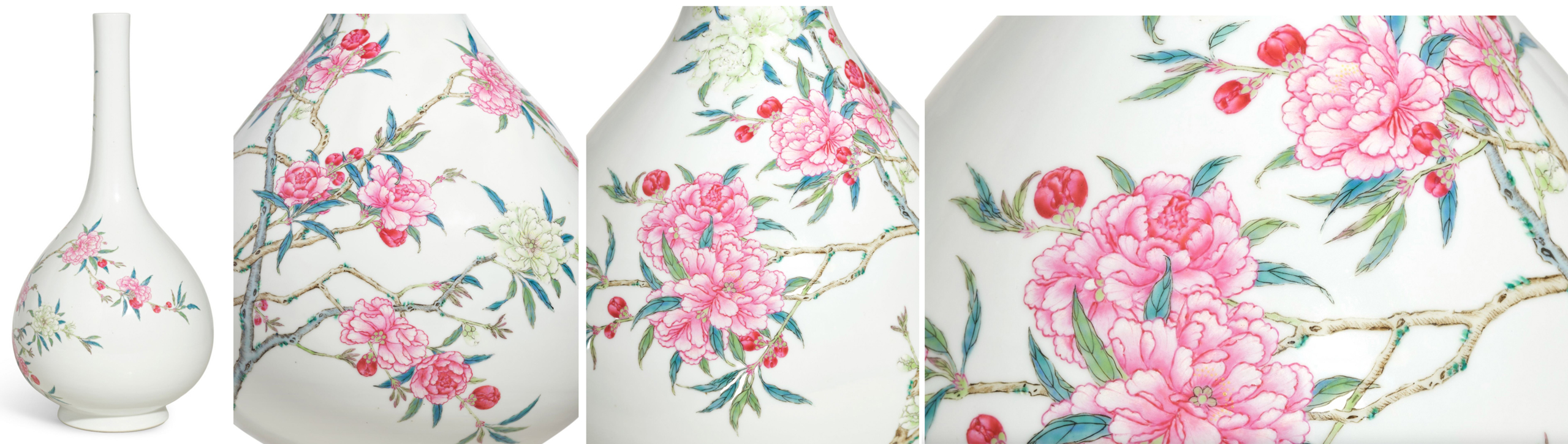
A superb and exceedingly rare large Famille Rose ‘peach tree’ bottle vase. Date: Mark and period of Yongzheng|清雍正 粉彩折枝桃花長頸膽瓶《大清雍正年製》款. Height: 44.6 cm. Auctioned in 2025 by Sotheby's Hong Kong (estimated value: over 50,000,000 HKD).
The Qianlong bǎihuā bùluòdì aesthetic represents the imperial supersession of painting by pattern and the transformation of porcelain surface into a textile-like brocade (jǐn, 锦) where technical complexity itself becomes the primary signifier. As the Tao Ya observed, this was "华缛极矣", the ultimate elaboration, where "the entire surface is covered with flowers, stems invisible, ground invisible, as if flowers float in infinite space".
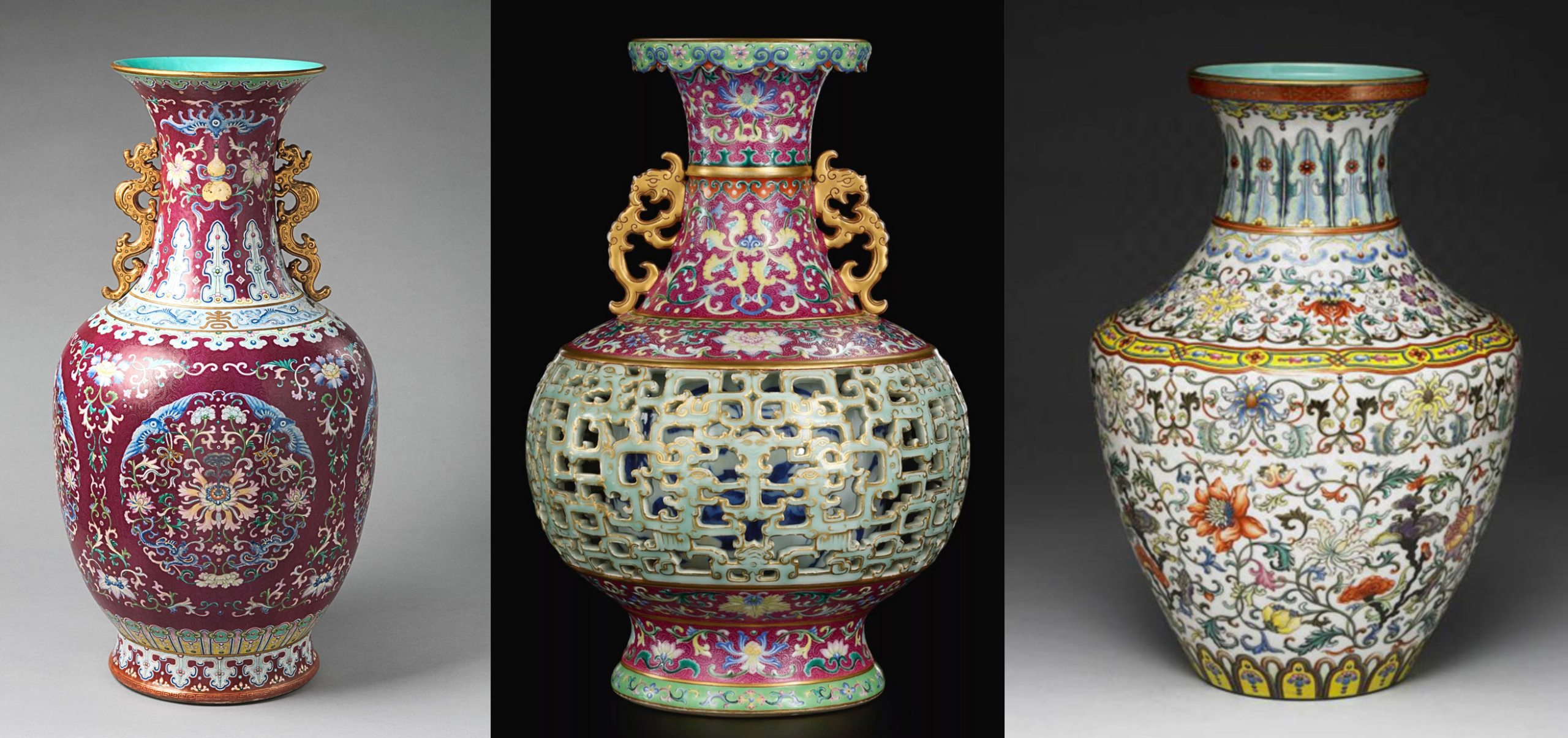
LEFT: Vase decorated with floral medallions, made in Jingdezhen. Date: Qianlong period (1736–95), mid-18th century. Dimensions: height 29 1/4 in., 74.3 cm; diameter 15 in., 38.1 cm. The MET, New York, USA. "This lavish vase, produced in the imperial kilns of the Qing dynasty, is a virtual compendium of auspicious images, including lotus, dragons, bottle gourds, and more. Particularly prominent are the bats; because “bat” (fu 蝠) sounds like “good fortune” (fu 福) in Chinese, the animals bear this symbolic meaning".
CENTER: A magnificent and highly important Yangcai reticulated vase seal mark and period of Qianlong emperor. Dated to the 12th day of the 8th month in the 7th year of the Qianlong period, corresponding to 1742. Height: 31.4 cm, 12 3/8 in. Auctioned in 2020 by Sotheby's Hong Kong for 70.406.000 HKD, equivalent today to US$ 9,030,000 and € 7,670,000.
RIGHT: A fine porcelain from the reign of the Qianlong Emperor. National Palace Museum, Taipei, Taiwan.
Both paradigms achieved perfection within their respective logics: the Yongzheng through restraint as cultivation, the Qianlong through magnificence as dominion. The pieces I showed you in the previous pages presents not merely decorative alternatives, but competing ontologies of imperial representation—the scholar-emperor's self-fashioning versus the universal monarch's totalizing vision.
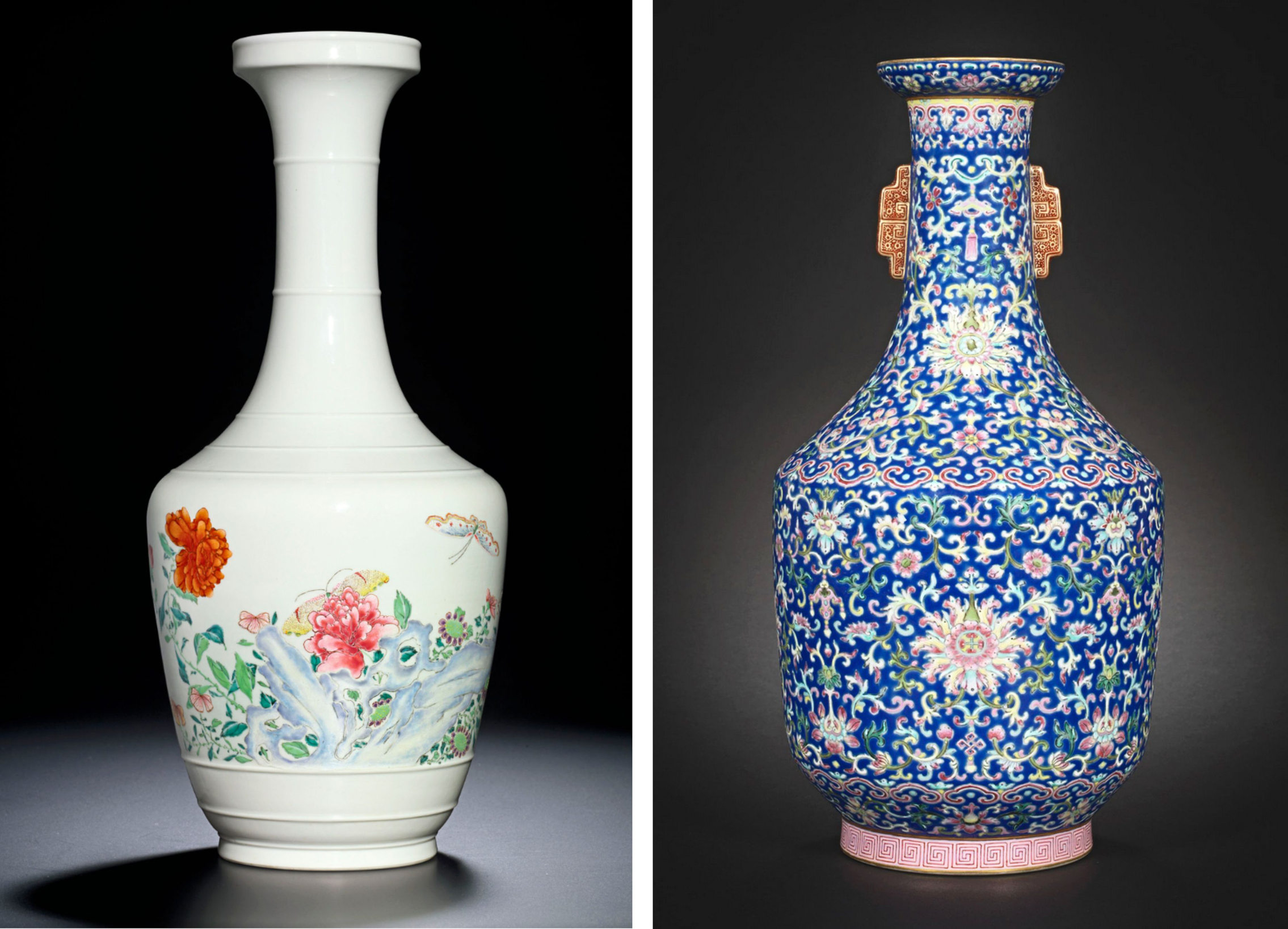
LEFT: A very rare Famille Rose 'floral' vase with Yongzheng four-character mark and of the period (1723-1735). Height: 15 in., 38 cm. Auctioned in 2013 by Christie's Hong Kong for HKD 6,030,000. "The vase is delicately potted with steep sides rising to rounded shoulders surmounted by a waisted neck and a galleried rim. The body is elegantly painted with a butterfly finely picked out in yellow, fuchsia and sky-blue in flight above flower sprays including peonies, chrsyanthemum, roses and lily issuing from pierced rockwork, while another butterfly soars nearby".
RIGHT: A Famille Rose blue-ground vase with Jiaqing seal mark and of the period. Height: 31.7 cm, 12 ½ in. Auctioned in 2013 by Bonham's London, UK.
However, we should note that both aesthetics coexisted: Qianlong also commissioned reserved-style pieces, while Yongzheng had some dense compositions. Thus, the shift is tendential, not absolute.
Famille Rose on Coral-Red Grounds
This last detour has shown how complex and layered both the art of porcelain in China and the undelying theoretical discourse are. Before delving into the analysis of Chinese classifications, alternative to the Western system of families, and then into the European origin of the Famille Rose pigments, there is one last aspect to clarify.
A common point of inquiry in porcelain classification pertains to whether Famille Rose wares featuring coral red or iron-red grounds constitute a separate “Famille” in the Western typological system. The answer, according to curators and scholars, is a definitive no.
The Western Famille terminology—Verte (green), Rose (pink), Jaune (yellow), Noire (black)—categorizes wares by dominant enamel palette, not by background color. Famille Rose pieces with red grounds retain the same overglaze palette, thus remaining within the same enamel tradition.
As Margaret Medley clarifies, “The so-called 'Famille' categories derive from the palette, not from the ground color. A rose-colored scene on a red field remains Rose, not Rouge.” (Margaret Medley, The Chinese Potter, 1976)
The red ground is typically composed of iron-based enamel, sometimes referred to as iron red or coral red (jiangdouhong 絳豆紅). This ground is applied beneath or around the Famille Rose decoration, but does not affect the enamel chemistry or application method of the overglaze colors. The result is a striking visual contrast, with soft pastel tones standing out against the bold vermilion field. While visually distinct, this combination is not considered a separaxte technical or stylistic “family.”
Thus, we have Famille Verte porcelain with coral-red ground, Famille Rose porcelain with coral-red ground, Famille Rose porcelain with yellow ground, and even Famille Rose porcelain with blue ground.

LEFT: A rare pair of coral-ground Famille Verte ‘floral’ bowls with Kangxi Yuzhi marks. Date: mede under the Kangxi Emperor period for the imperial court. Diameter: 11 cm, 4 3/8 in. Auctioned in 2018 by Sotheby's, Paris, France.
CENTER: A Famille Rose coral-ground 'prunus' cup with Qianlong seal mark and of the period. Diameter: 6.8 cm, 2 5/8 in. Auctioned in 2014 by Bonham's, London, UK.
RIGHT: Famille Rose bowl with flowers on a coral-red ground. Date: with Yongzheng reign mark (1723–1735). Dimensions: 6 × 11.8 cm, 2 3/8 × 4 5/8 in; diameter 11.8 cm, 4 5/8 in. Art Institute Chicago, IL, USA.
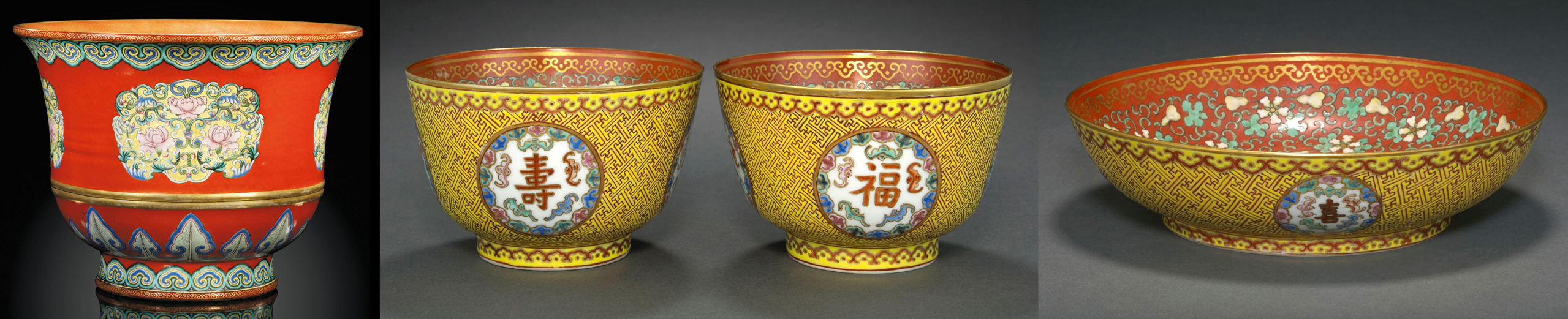
LEFT: A rare, large Famille Rose coral-ground jardinière with Qianlong underglaze blue six-character seal mark and of the period (1736-1795). Diameter: 15¼ in., 38.8 cm. . Auctioned in 2012 by Christie's, London, UK.
CENTER: A pair of coral-red and yellow ground bowls with Famille Rose decoration. Date: Guangxu period, 1875–1908. Dimensions: diameter 5 1/8 in, 13 cm; height 3 1/8 in, 8 cm. Auctioned in 2015 by Bonham's, San Francisco, CA, USA.
RIGHT: A coral-red and yellow ground porcelain dish with Famille Rose gourd vine decoration. Date: Guangxu period, 1875–1908. Diameter: 6 3/4 in, 17 cm. Auctioned in 2015 by Bonham's, San Francisco, CA, USA.
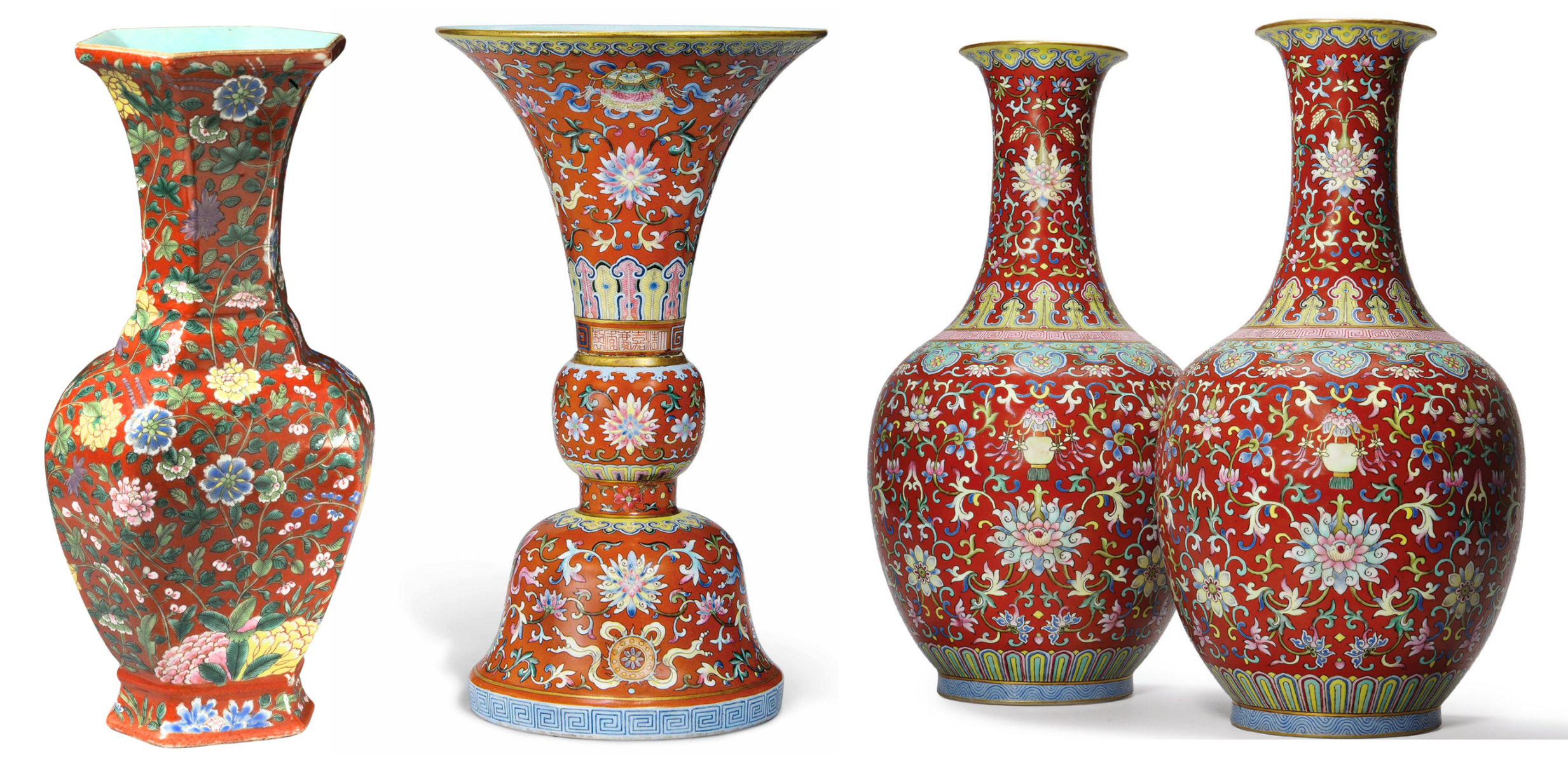
LEFT: A Famille Rose coral-red ground vase, made in Jingdezhen. Date: Qianlong period (1736-1795). Dimensions: height 26 cm, diameter 13 cm. Victoria & Albert South Kensington Museum, London, UK.
CENTER: A Famille Rose coral-red ground vase (gu), with Jiaqing six-character iron-red seal mark and of the period (1796-1820). Height: 10¾ in., 27.3 cm. Auctioned in 2014 by Christie's London, UK. "The slender vase is decorated to the exterior with The Eight Buddhist Emblems, bajixiang, interspersed by lotus scrolls and divided by ruyi, lappet bands and key fret borders. The interior of the mouth and base are enameled turquoise". (From Christie's catalog).
RIGHT: A rare pair of coral-red ground Famille Rose vases with Jiaqing six-character seal mark in iron red and of the period (1796-1820). Height: 13 1/4 in., 33.5 cm. Auctioned in 2017 by Christie's Hong Kong. " Each vase is finely enamelled and gilt to the body with tasseled lanterns above large lotus blooms and colorful scrolling flowers, all above a lappet band by the foot and below a ruyi-head band. The shoulder is decorated with a keyfret band below a band of stiff leaves, and the neck is decorated with further scrolling lotus supporting a vase filled with millet, all below a further ruyi-head band at the gilt rim. The interior and base are enamelled turquoise". (From Christie's catalog).
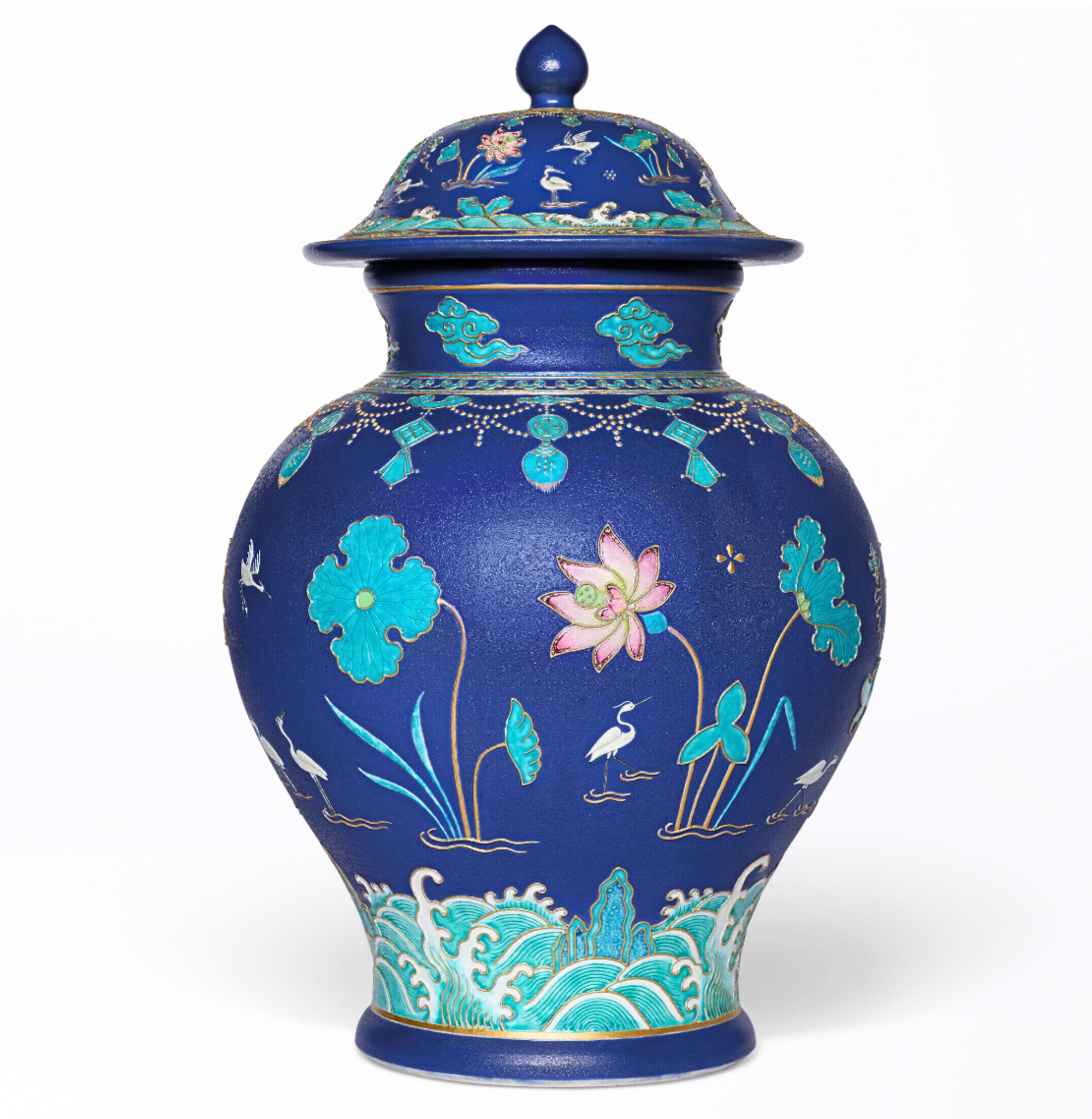
A magnificent and rare Famille Rose fahua-style jar and cover. Date: With Qianlong incised six-character seal mark and of the period (1736-1795). Height: 18 in., 45.7 cm. Auctioned in 2022 by Christie's Hong Kong for HKD 14,850,000.
This "baluster jar is finely decorated with a scene depicting white egrets in a lotus pond, all above a band of crashing waves to the foot. The neck is decorated with large scrolling clouds above a band of ruyi-heads and an elaborate band of tassels suspending from the shoulder. All outlines are finely gilded and raised against a rich sapphire-blue ground. The domed cover is similarly decorated with an egret and lotus pond scene enclosing the bud-shaped finial." (from Christie's catalog).
"This sumptuously-decorated lidded jar reflects the Qianlong Emperor’s admiration for two different decorative traditions – Ming dynasty fahua porcelains and cloisonné enamels on metal. Indeed, it would be fair to say that the current jar and cover combine the best of both these decorative techniques. On the one hand, the gilding of raised outlines, following the cloisonné custom, gives the jar a richness of surface and adds to its jewel-like quality. While, on the other hand, the trailed slip outlines and incised details, which are part of the fahua decorative technique, enabled the potter to achieve a far greater fluency of design than was possible in metal. The decorative technique known as fahua, which employs raised lines to provide outlines and colour divisions on ceramics decorated with enamel colours, seems initially to have been developed in the Yuan or early Ming dynasty by kilns in Shanxi province associated with the tile-making industry. This technique was most frequently combined with either a cobalt blue or a copper turquoise ground, but, to date, the earliest porcelain example recovered from the imperial kilns at Jingdezhen is a dish from the Xuande (1426-35) stratum decorated with green five-clawed dragons on a yellow ground. Similar pieces have also been found in the mid-Chenghua (1465-87) stratum at the imperial kilns. However, the acme of Ming dynasty fahua porcelain at Jingdezhen came in the late-15th – early-16th century, and is represented by handsome jars and vases, usually with cobalt blue or copper turquoise grounds and frequently adorned with bird and/or flower motifs. A corresponding decorative technique appeared in Chinese metalwork during the Yuan dynasty and gained popularity during the early Ming (see The Complete Collection of Treasures of the Palace Museum, Metal-bodied Enamel Ware, Commercial Press, Hong Kong, 1999, pp 6-7, no 5 and p. 19, no. 17). This technique, known as cloisonné enamel, involved the application of fine wire to the surface of the metal vessel (usually bronze) to form discrete areas, or cloisons, and provide the outlines for the decorative elements. The areas within and surrounding these elements were filled with enamels of different colours, which were fired and then the surface polished smooth, after which the exposed top of the wires was gilded. The ground colour for these metal-bodied cloisonné enamels was most frequently turquoise, but sometimes cobalt blue, white or occasionally yellow grounds were employed. Given the popularity of the lotus as an auspicious theme in both the painting and the decorative arts of China, it is not surprising that it provides one of the most popular, as well as the most visually successful, designs on the highest quality fahua porcelains of the middle Ming dynasty. (...) The current jar and cover are of unusually large size and of exceptional quality, and may well have been a special imperial order. The high regard in which such vessels were held by the Qianlong Emperor is evidenced by a court painting, c. AD 1771-2, in the collection of the Palace Museum, Beijing, by Yao Wenhan (active 1740s-70s), Zhou Ben (active 1760s-70s) and Yi Lantai (active 1748-86), depicting the emperor and his mother celebrating Empress Dowager Chongqing’s Eightieth Birthday. Among the precious items displayed on the table beneath the dais on which they are seated, is a pair of lidded jars of this type. (Essay by Rosemary Scott, Independent Scholar, Visiting Ceramics Research Fellow, Palace Museum, Beijing)
CONCLUSION
The strength of the Western famille system lies in its simplicity and immediate applicability; one can often identify a piece's "family" at a glance. However, its focus on surface appearance can be misleading, as it often overlooks the complex technical processes, regional variations, and historical contexts that define a piece's true identity and significance within its native culture. This system is, in essence, a classification of Chinese porcelain for a European audience. Now it's time to explore the Chinese classification.

Alyx Becerra
OUR SERVICES
DO YOU NEED ANY HELP?
Did you inherit from your aunt a tribal mask, a stool, a vase, a rug, an ethnic item you don’t know what it is?
Did you find in a trunk an ethnic mysterious item you don’t even know how to describe?
Would you like to know if it’s worth something or is a worthless souvenir?
Would you like to know what it is exactly and if / how / where you might sell it?
