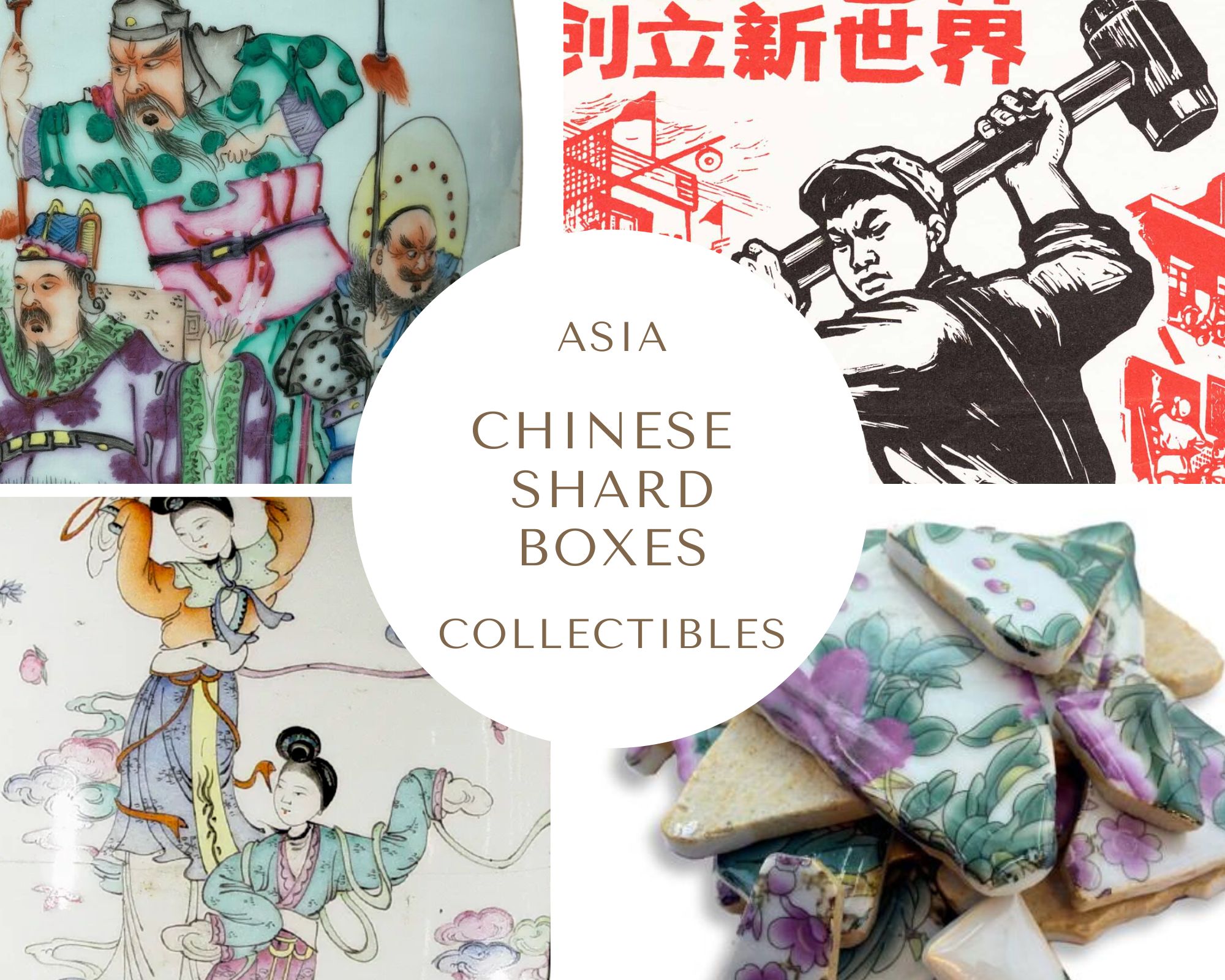
THE CHINESE SHARD BOXES
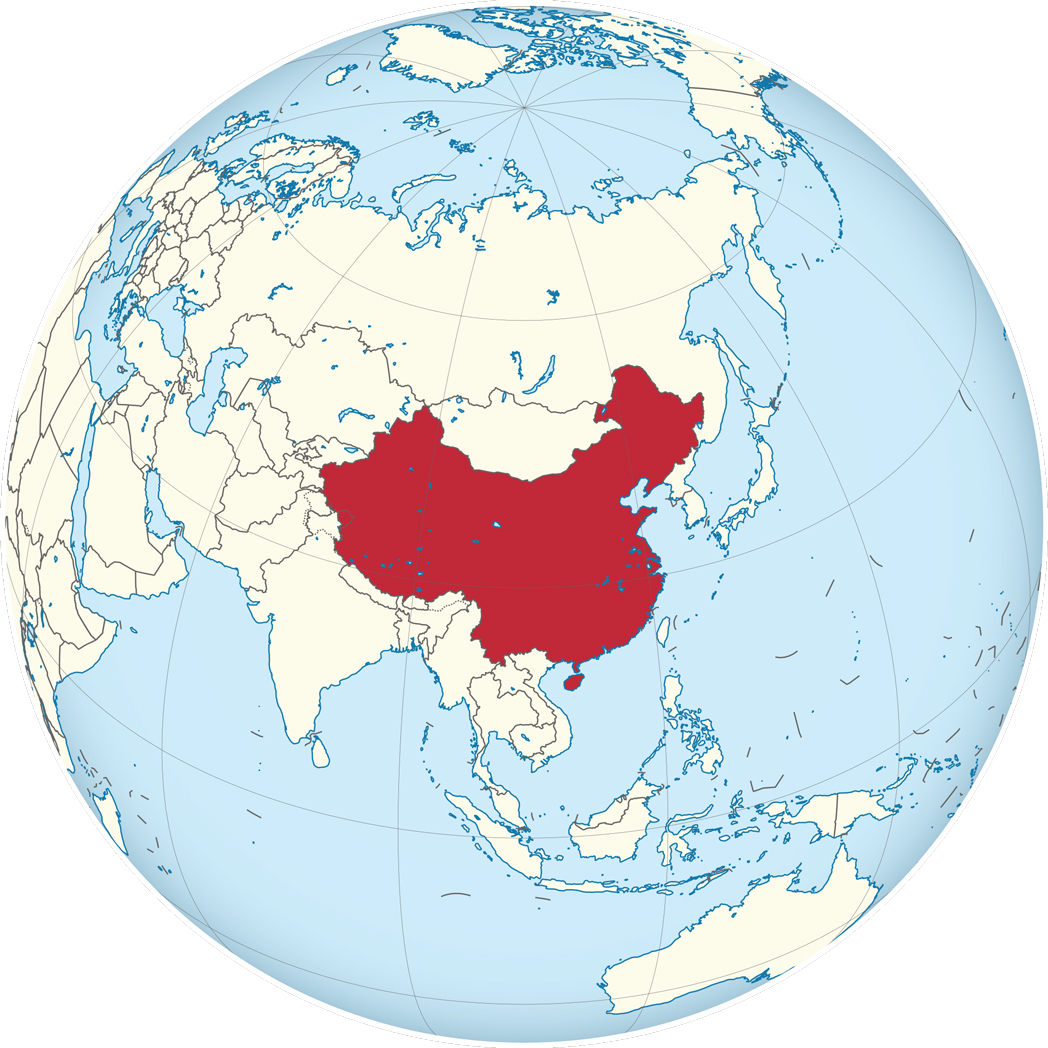
Current China on the globe.
Under the Creative Commons Attribution-Share Alike 3.0 Unported license.
This map is for illustrative purposes only. The Ethnic Home does not take a position on territorial disputes.
Gui Zhi Xiang (The Fragrance of the Gui Zhi) - Ancient Reminiscences of Jinling by Wang Anshi (Song) - Zi De Guqin Studio

STRANGE BOXES OF THE ‘NOTHING IS AS IT SEEMS’ TYPE
Take a look at this Chinese box.
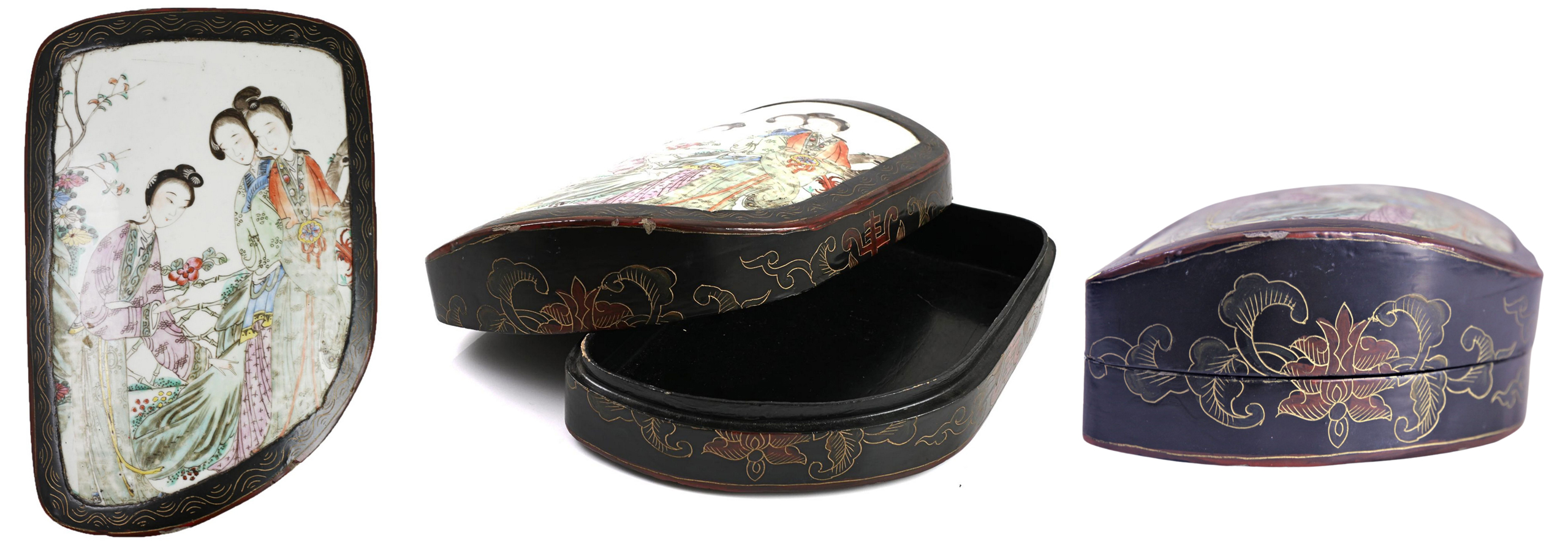
Dimensions: 2.5 x 8.5 inches; 6.35 x 21.59 cm. Auctioned in 2019 by Sarasota Estate Auction, Sarasota, FL, USA.
When viewed from the front, the lid has a very strange shape — it's clearly crooked. When viewed from the side, it appears to be an irregular concave curve. It's irregularly bent. And doubly crooked.
Look at the bottom of the box. It's very low compared to the box's overall dimensions. You can only really put tiny things in it.
There are different types of boxes. In some, the bottom and lid are the same height. In others, the lid is lower and fits perfectly onto the base. The box in the image has a lid that is higher than the base, which doesn't make much sense.
The lid is made of delicate, hand-painted porcelain mounted on a support structure that resembles hand-painted, decorated wood. However, it is not wood (for now, you will just have to take my word for it).
The hand painting is delightful, but the way it is framed is unusual, to say the least: why has the lower part of the figures been cut off?
Here's another Chinese box.
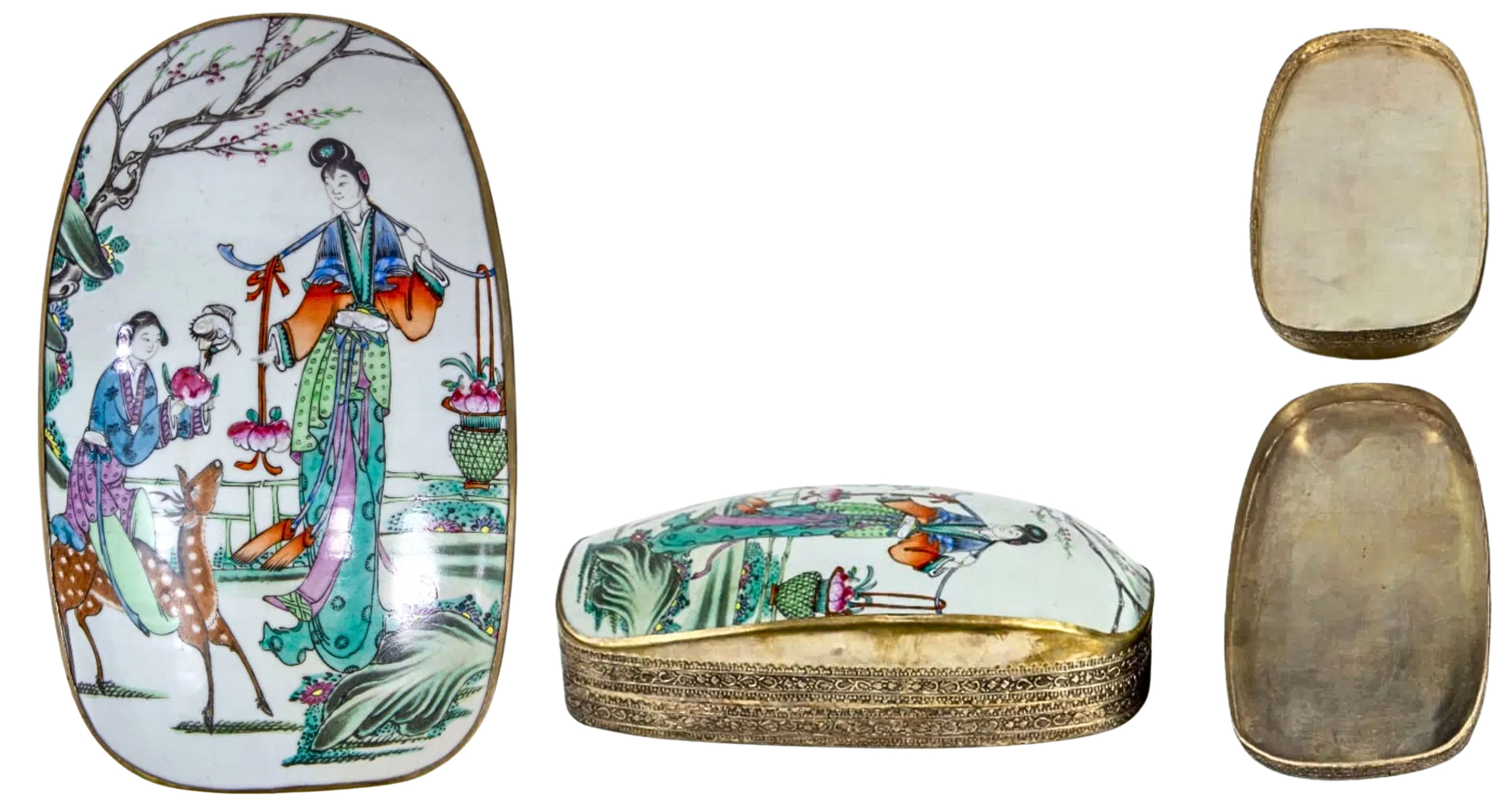
Chinese box. Dimensions: 9.5 x 5.5 x 2.75 inches; 22.86 x 15.24 cm. Auctioned in 2024 by District Auction, Seattle, WA, USA.
This box is barely fit for purpose as the bottom edge is very low. Although it looks like silver, it is probably silver-plated copper. The lid is set with hand-painted porcelain that was skilfully crafted during the Republican period and has an irregular and unusual curvature. Rather than depicting a gentle scene in a garden, the porcelain is a highly symbolic representation of Lan Caihe, one of the Eight Immortals of the Taoist tradition, carrying its emblem: a basket of flowers. The scene of an attendant leading a deer and holding a peach, with a crane perched above, is also full of hidden references. In Chinese art, deer symbolise immortality and appear as companions to Immortals, while the crane and the peach are two of the most important symbols of longevity.
Lan Caihe is a figure who has always fascinated me. As is my habit, I will digress briefly to tell you about this 'immortal' who is anything but feminine, romantic or delicate, like a bouquet of peonies.
THE AMBIGUOUS IMMORTAL: LAN CAIHE AND THE LIMINAL CURRENTS OF DAOIST DIVINITY
The Eight Immortals (八仙, Bāxiān), who emerged between the Tang and Ming dynasties, embody a democratic vision of transcendence. Each figure originates from a different social stratum, including generals, scholars, beggars and royalty, demonstrating that enlightenment is accessible to all.
As Philip Clart notes in his Leipzig University study, the Eight Immortals occupy a unique position between institutional Daoism (= Taoism) and popular religion, embodying "personal deliverance" rather than community-oriented worship. Unlike the celestial bureaucrats of the Daoist pantheon, these figures possess human flaws and wander the world in a "constant state of inebriation" while wielding magical tokens that bestow worldly benefits. Their iconographic programme, known as the 'Covert Eight Immortals' (暗八仙), reduces each member to a symbolic vessel: Zhongli Quan's fan, Li Tieguai's gourd and Lan Caihe's flower basket — objects that "can bestow life or destroy evil".
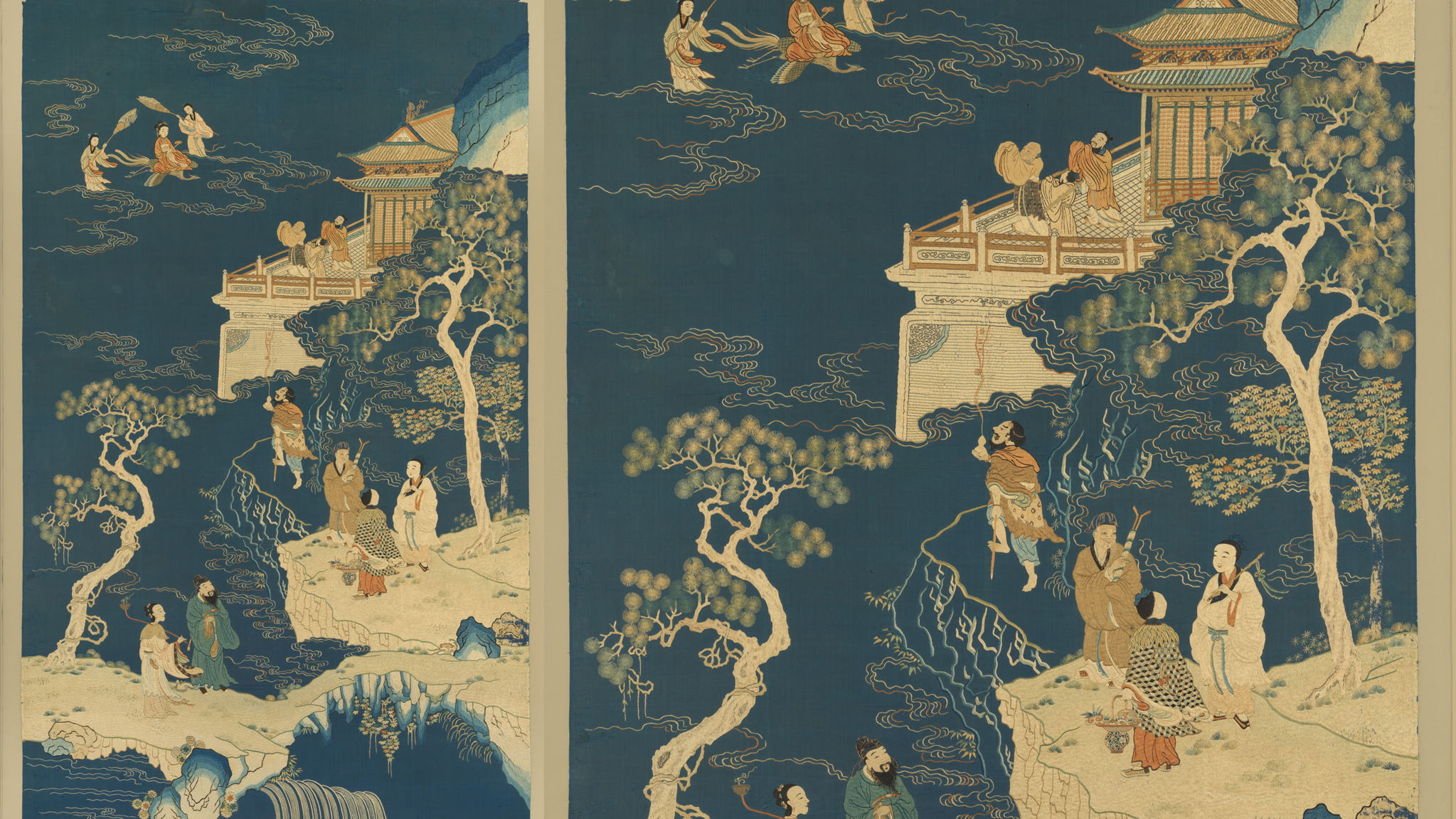
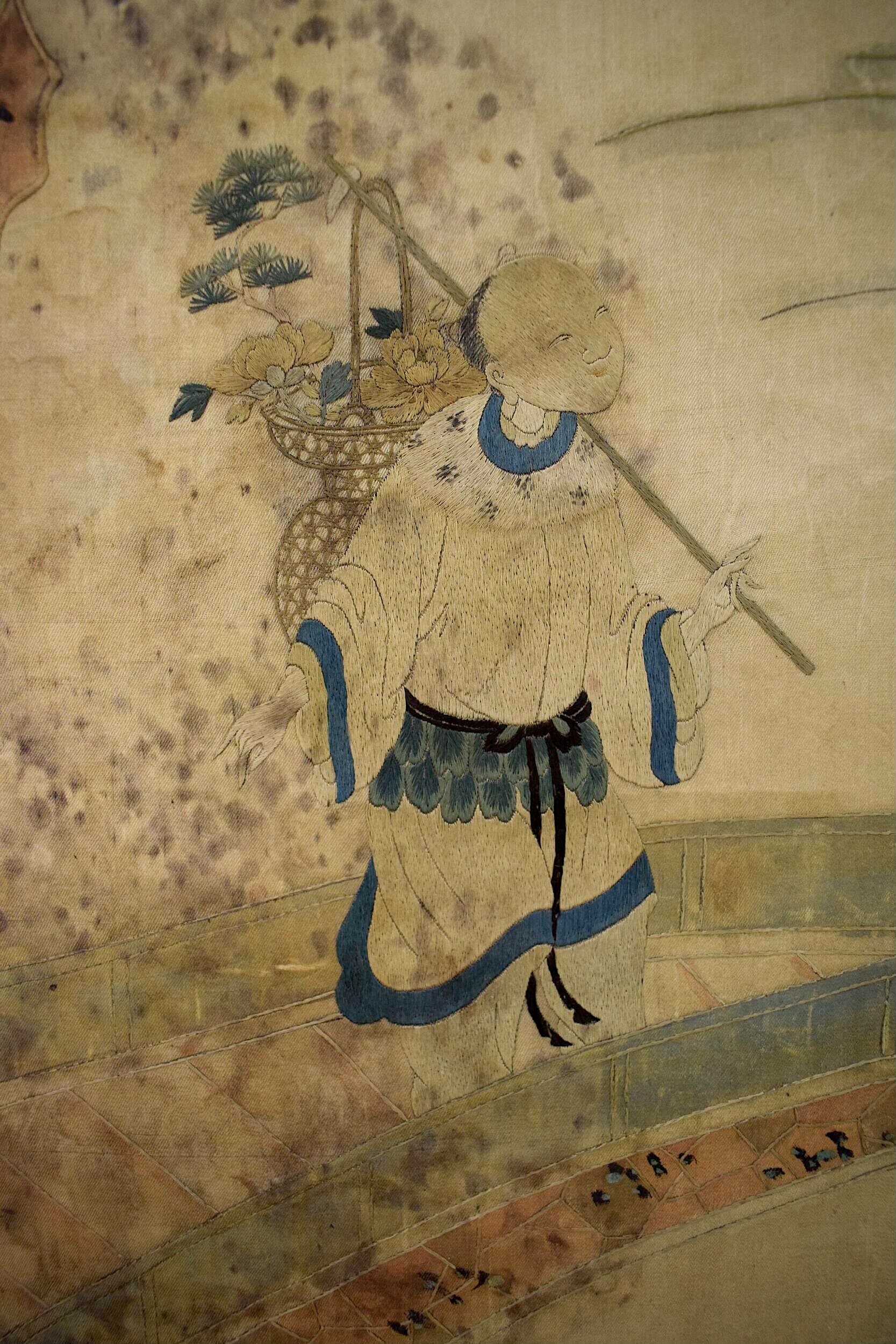
Embroidered silk panel with the Eight Immortals (Baxian) and God of Longevity (Shoulao). Made in China in the 18th century, during the Qing dynasty. Medium: Silk and metal thread embroidery on silk satin. Dimensions: 72 1/2 x 46 x 1 3/4 in.; 184.2 x 116.8 cm. The MET, New York, NY, USA.
In this panel, two Immortals stand on the terrace with the God of Longevity. Together, they salute the Queen Mother, who is riding a mythical bird (yuan) in the sky. In the foreground, two other immortals stand, while three more are depicted on a rock in the middle ground, with an eighth immortal behind them. Lan Caihe is depicted from behind with a basket of flowers in the group of three immortals on the rock.
Among the octet, Lan Caihe (藍采和) stands as the most enigmatic, challenging the categorical certainties of gender, age and identity in a way that reveals profound Taoist philosophical principles.
The birth of Lan Caihe
The earliest documented appearance of Lan Caihe appears in Shen Fen's Xu Xian Zhuan (續仙傳, "Supplementary Biographies of Immortals"), which was compiled during the Southern Tang dynasty (937–975 CE). This foundational text establishes the immortal's core identity as a "singing wandering beggar" dressed in tattered blue garments and wearing "a long wide belt and a shoe on one foot, with the other foot bare." This peculiar asymmetry — a single boot and one bare foot — immediately evokes a defiant stance against propriety and is interpreted by scholars as an act of "rebellion by a liberated spirit".
The name's significance is shrouded in historical confusion. While some modern interpretations suggest that Lan Caihe may derive from phonetic renderings rather than fixed semantics, traditional texts do associate the surname Lan (藍, “blue”) with visual and symbolic motifs. Later iconographic developments likely drew from the homophonic link between 藍 (blue) and 籃 (basket), which contributing to the evolution of Lan’s signature attribute — from clappers to a flower basket — though this transformation appears to be interpretive and post hoc.
Ming Dynasty (1368–1644) depictions consistently portray Lan as a a sixteen-year-old youth, though the Hunterian Museum at the University of Glasgow observes that portrayals shifted dramatically during this period towards "a child or youth, often wearing Yaji (丫髻, double buns)" — a hairstyle common to both boys and girls that is deliberately ambiguous in terms of gender.
The Gender Paradox: From Male Origins to Fluid Representations
While contemporary interpretations celebrate Lan Caihe's gender ambiguity, early sources predominantly depict the Immortal as male. The Baidu Baike entry (drawing from traditional sources) explicitly states that Lan is male and describes him as "originally male, often dressed in female attire". Yuan Dynasty poet Yuan Haowen's verses refer to "the old man in blue", confirming medieval perception of Lan as masculine. A Chinese Culture University dissertation on Eight Immortals narratives also treats Lan Caihe as male in its structural analysis of story patterns.
A pivotal metamorphosis unfolded during the Qing dynasty (1616–1912), reshaping Lan's image both on stage and in stories. In Gai Yu Cong Kao (陔餘叢考), scholar Zhao Yi recorded that there are "two female immortals: Lan Caihe and He Xiangu", thus explicitly re-gendering the figure. Research by the Hunterian Museum attributes this shift to theatrical conventions. "The role of children or youth in traditional opera usually belongs to the dan role (旦)... the dan role was usually considered female. Consequently, Lan Caihe's character was frequently depicted by male actors wearing female attire but retaining a male voice." This performance tradition created a "genderqueer" presentation that, like many Chinese theatrical roles, destabilised binary categories. Encyclopedia Britannica confirms this hybrid representation: "In Chinese theatre, Lan is dressed in women's clothing but speaks with a male voice."
Detail of a 14th-century embroidered and painted silk panel. Medium: Woven silk with embroidery in silk threads. The painting is on silk and the embroidery is mainly in stem, long and short stitches. Dimensions: 29.85 x 29.85 cm (11.75 x 11.75 inches). V&A East, London, UK. In this ancient panel, Lan Caihe is depicted as a young boy holding the two symbols that represent him: a hoe and a basket of flowers.
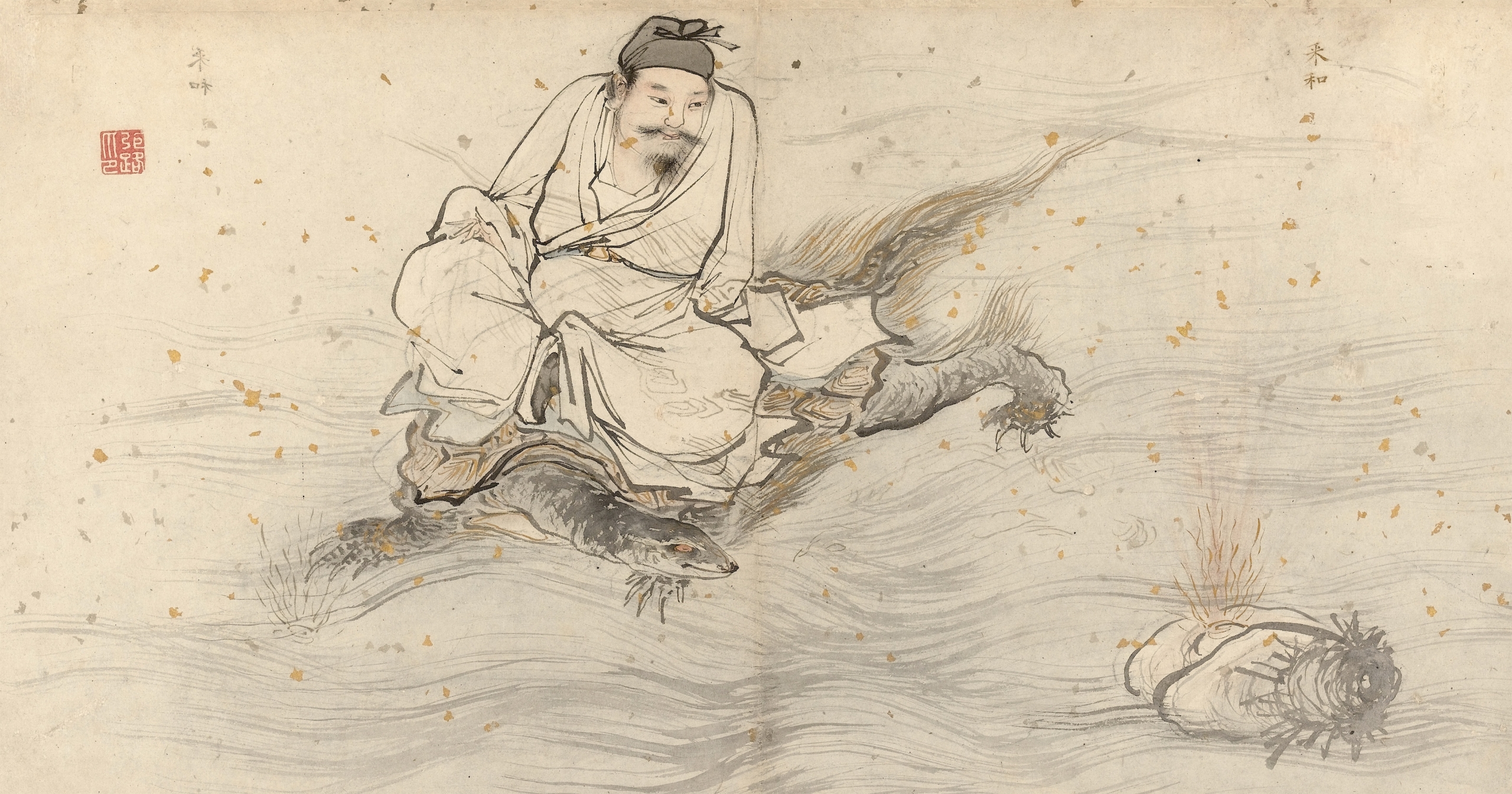
Zhang Lu (1464–1538), Lan Caihe from the Album of 18 Daoist Paintings, China. Date: early 16th century, during the Ming dynasty. Medium: Ink and light colors on gold-flecked paper; album leaf. Dimensions 31.6 × 59.3 cm. Shanghai Museum, China. Lan Caihe is depicted here as a mature man riding on the back of a turtle, a symbol of longevity.

Shen Shi 沈仕 (1488-1565), The immortal Lan Caihe in a cloudy sky upturning a basket of flowers, China, Ming dynasty. Medium: Ink and colors on silk. With a calligraphy sign by Shen Shi 沈仕 on the left part and four seals. Dimensions: 75 x 36.5 cm. Auctioned in 2021 by Adam's, Dublin, Ireland.
Modern Scholarly Interpretations
Contemporary academic analysis reinterprets this ambiguity as being of philosophical significance rather than merely textual confusion. In his study, Philip Clart positions the Eight Immortals as "unruly gods", whose anomic character renders them "unsuitable as foci of community worship", yet powerful symbols of individual aspiration. Within this framework, Lan Caihe's gender fluidity embodies the Daoist critique of rigid social constructs. The University of Glasgow exhibition notes that Lan is "the only immortal with an ambiguous gender identity and age, and is often characterised as eccentric and defying expectations".
Eberhard's Dictionary of Chinese Symbols interprets Lan's basket as a "magical symbol containing everything imaginable", emitting a fragrance that "wards off evil spirits". This interpretation links the gender ambiguity to the immortal's function as a liminal being who transcends worldly categories. The Hunterian Museum's analysis of a soapstone statue depicts the figure in traditionally feminine attire, such as Yunjian (雲肩) and Pibo (披帛), while referencing historical records describing Lan Caihe as male prior to the Qing Dynasty. This visual and textual tension reveals layered gender coding.
Age Ambiguity and Eccentric Behavior
Lan Caihe's age is as uncertain as their gender. Sources describe him as a "young person of about sixteen," a "young adult," or an "old person." The Mayway blog, citing traditional hagiographies, notes that people in Chang'an who saw Lan Caihe as children and then again in their old age were startled to find that he hadn't aged a day. The blog attributes this to achieved immortality. A Chinese Culture University thesis documents that Ming portrayals emphasized youthfulness and that he "often wore Yaji (double buns)," a style associated with prepubescent children. Meanwhile, Qing sources oscillate between youthful and mature representations.
This temporal instability is manifested through deliberately eccentric conduct, as documented across sources:
- Sartorial Contradiction: Examples include wearing woolen clothes in the summer and thin shirts in the winter, as well as sleeping naked in melting snowbanks while wearing thick clothes despite the heat in summer.
- Behavioral Paradoxes: A wandering beggar who sings "celestial songs" and gives money to the poor but spends his earnings at wine shops. He exists in a "constant state of inebriation" while dispensing wisdom.
- Physical Anomalies: The singular shoe, the "three-inch-wide wooden belt decorated with six dark wooden strips," and the combination of clappers and a flower basket create an iconographic program of deliberate asymmetry.
The Hunterian Museum interprets these traits as symbolizing "a carefree life untouched by worldly worries," but Clart's analysis suggests that such "unruly" behavior reflects the Immortals' role as deities of "individual and familial spiritual advancement" rather than communal order.
The Flower Basket: From Beggar's Trough to Magical Vessel
Lan Caihe's most consistent attribute, the flower basket, underwent significant semiotics evolution. Originally, the immortal carried a three-foot-long clapperboard (paiban, 拍板) for street performances, as documented in the Xu Xian Zhuan. A thesis from the Chinese Culture University traces how "his clappers were loaned to someone else, and the item in his hand became a flower basket," possibly through a homophonic association with the surname Lan (籃, "basket").
Some sources, especially those from earlier or regional traditions, also associate the immortal with a hoe (鋤頭), linking them with themes of cultivation and labor. These symbols reinforce Lan's connection to natural cycles and impermanence. The hoe appears in some woodblock prints and folk temple carvings, particularly in rural Daoist iconography. There, it symbolizes earthly detachment and the immortal's liminal status between laborer and transcendent being. Together with the flower basket, it suggests a connection to the earth, nature, and rebirth, reinforcing Daoist ideas of spontaneity (自然) and anti-structure.
By the Ming Dynasty, the basket had become central to Lan's iconography. The Tsinghua University Art Museum's Ming Dynasty screen painting depicts Lan Caihe and He Xiangu, both holding floral attributes that "present vigorous touches and fascinating strokes." The contents of the basket vary by context.
- Flowers: They symbolize impermanence and "the fleeting nature of material possessions".
- Fruit: Representing abundance and fertility.
- Herbs: Reflecting medicinal properties. In some modern interpretations, especially in herbalist or cultural blogs, Lan Caihe is associated with florists and gardeners, likely due to the symbolic significance of the flower basket. However, this role is not consistently attested in classical Daoist texts.
According to Eberhard's symbolic dictionary, the basket contained everything imaginable and exuded a protective fragrance, transforming a humble container into a magical symbol of plenitude and apotropaic power.
The Singular Shoe and Belt
The "boot on one foot, barefoot on the other" motif appears in various sources as a symbol of defiance. The Hunterian Museum interprets it as "a defiance of tradition or an act of rebellion," and the Mayway blog links it to the "Barefoot Immortal" (Chijiao Daxian) tradition in Daoism. The wooden belt, "three-inch wide" with "six dark wood strips," remains less examined but suggests ritual significance—possibly referencing the liuyi (六儀) six ritual instruments used in Daoist ceremony.
Performance Implements
The clappers (paiban) and later the castanets connect Lan to the youmin (游民), the itinerant performer class. The Chinese Culture University dissertation identifies clapper-singing as a core "plot unit" in Lan's stories, linking the Immortal to oral tradition and popular entertainment. This performance aspect explains the theatrical influence on gender representation: Male actors wore female attire on stage but retained a male voice when singing.
BELOW
A set of eight kesi woven silk panels depicting each of the Eight Immortals, Late Qing dynasty. Each of the aight scroll has the following dimensions: 78 1/2 x 16 1/4 inches; 199 x 41 cm. Sold for US $20,000 in 2017 by Bonham's Auction House, San Francisco, USA. Lan Caihe, depicted as a young boy wearing Yaji ("double buns"), is in the first panel.
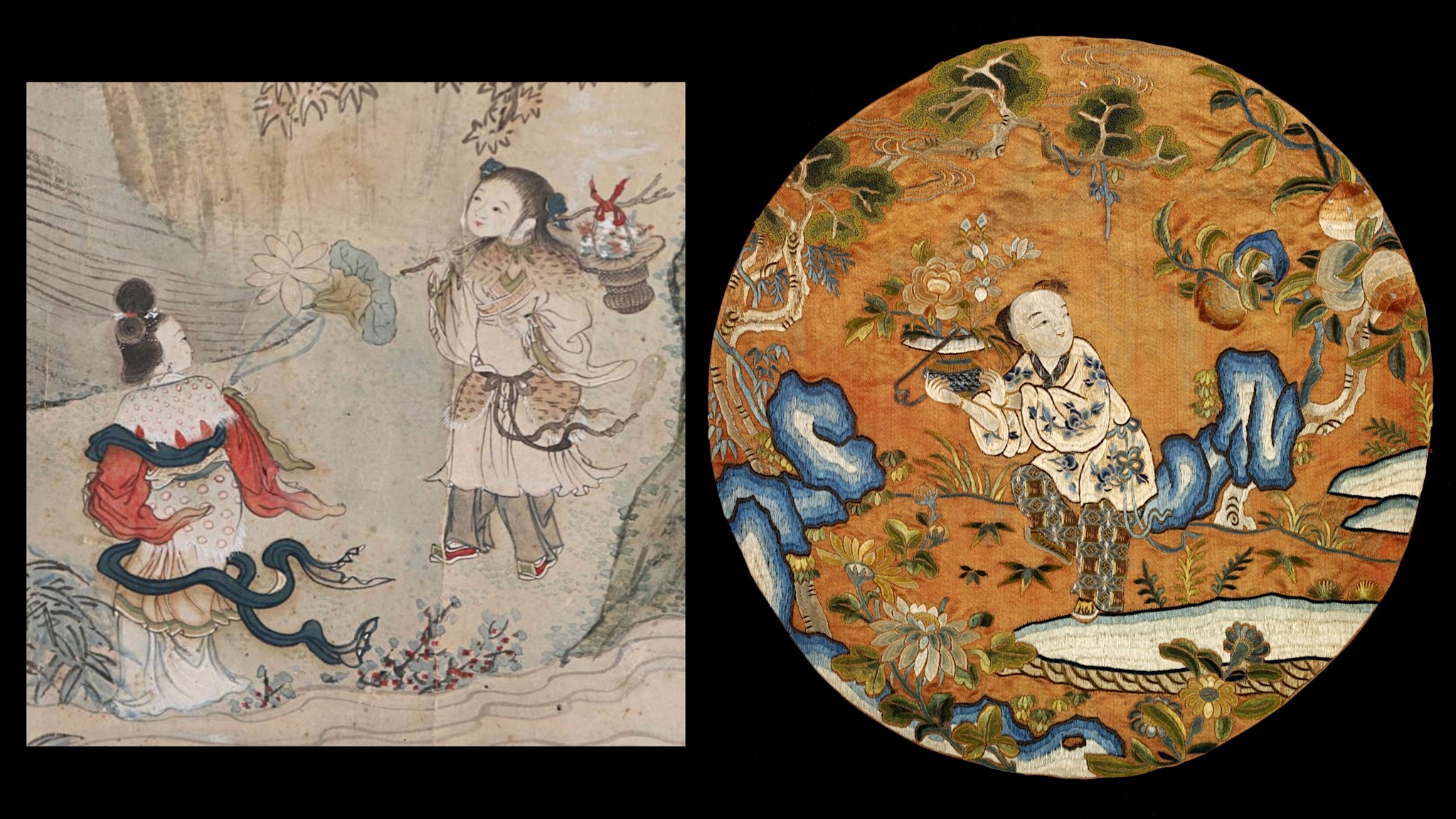
Lan Caihe as a child
LEFT: Detail of a Chinese Painting of the Eight Immortals, 19th Century or earlier. Medium: Ink on paper. Dimensions: 23 x 41 3/4 inches; 58.4 × 106.1 cm. Auctioned in 2015 by Butterscotch Auction Gallery LLC Bedford Village, NY, USA.
RIGHT: Embroidered roundel depicting Lan Caihe as a young boy holding a basket of flowers. Date: 19th century. Medium: Satin-weave silk with silk embroidery. Diameter: 25 cm. V&A East, London, UK
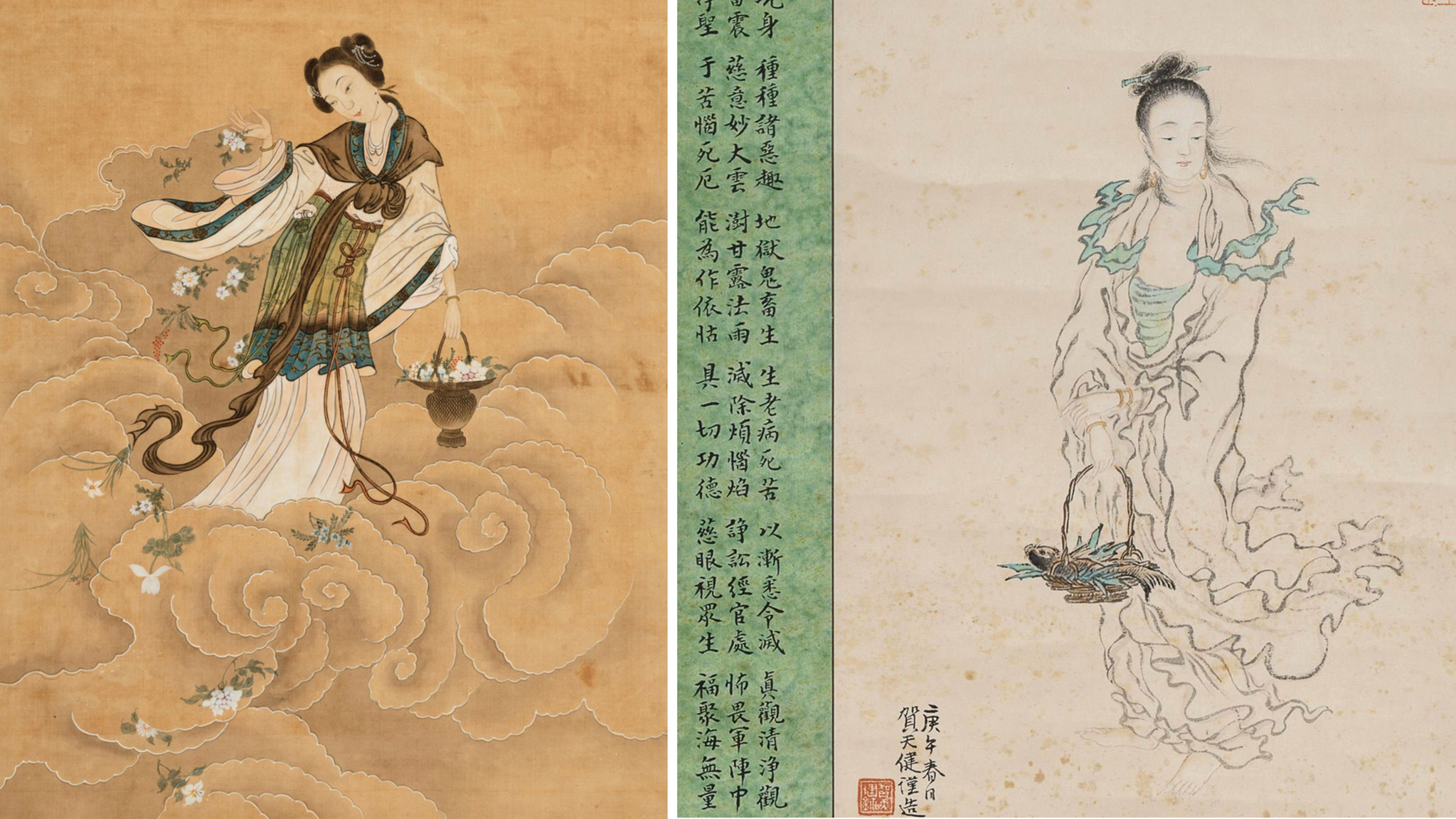
Lan Caihe as a graceful woman
LEFT: Chinese School, Qing Dynasty, The Daoist Immortal Lan Caihe <here portrayed as a young woman> with a Basket of Flowers. Medium: Ink and color on silk mounted to board. Dimensions: 39 3/4 x 30 in.; 101 x 76 cm. Auctioned in 2020 by Neal Auction Company, New Orleans, LA, USA.
RIGHT: Chinese School, 20th century. Lan Caihe. Mixed media on paper. Dimensions: 205 x 48 cm. Auctioned in 2023 by Casa d'Aste Babuino, Rome, Italy.
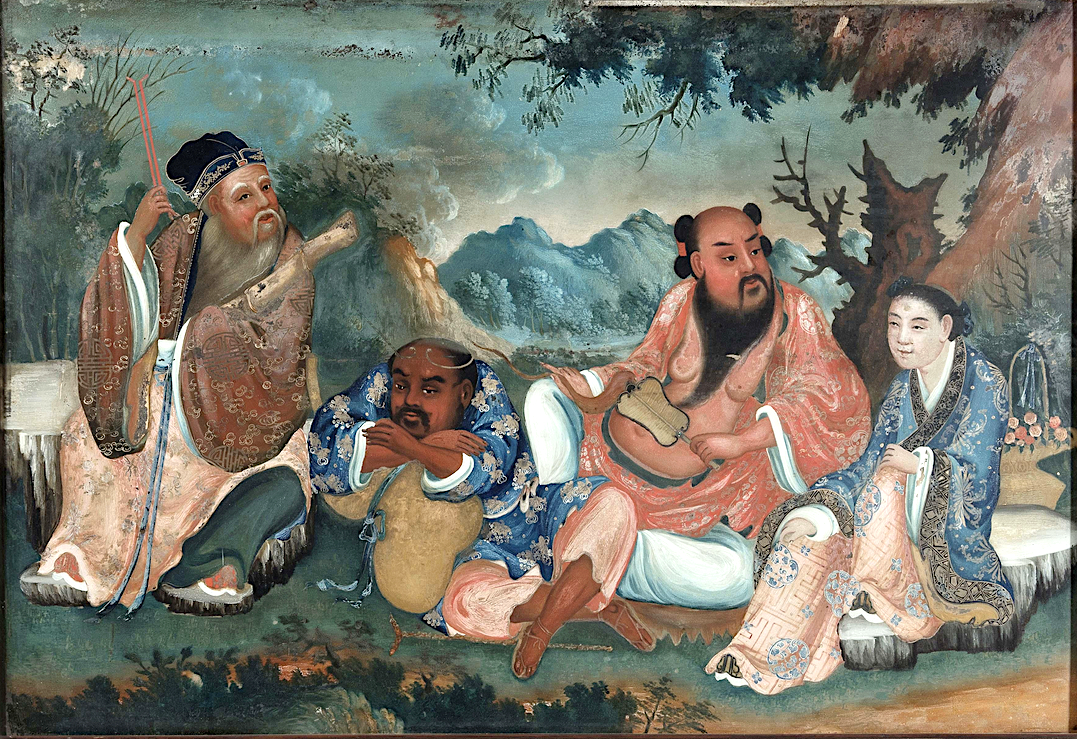
Lan Caihe as an adolescent
Polychrome painting on glass, China, 19th century. It depicts the Four Immortals Zhang Guolao, Zhongli Quan, Li Tieguai, and Lan Caihe, seated in idyllic natural surroundings. Dimensions: 53.5 x 74 cm. Auctioned in 2021 by Schuler Auktionen, Zurich, Switzerland.
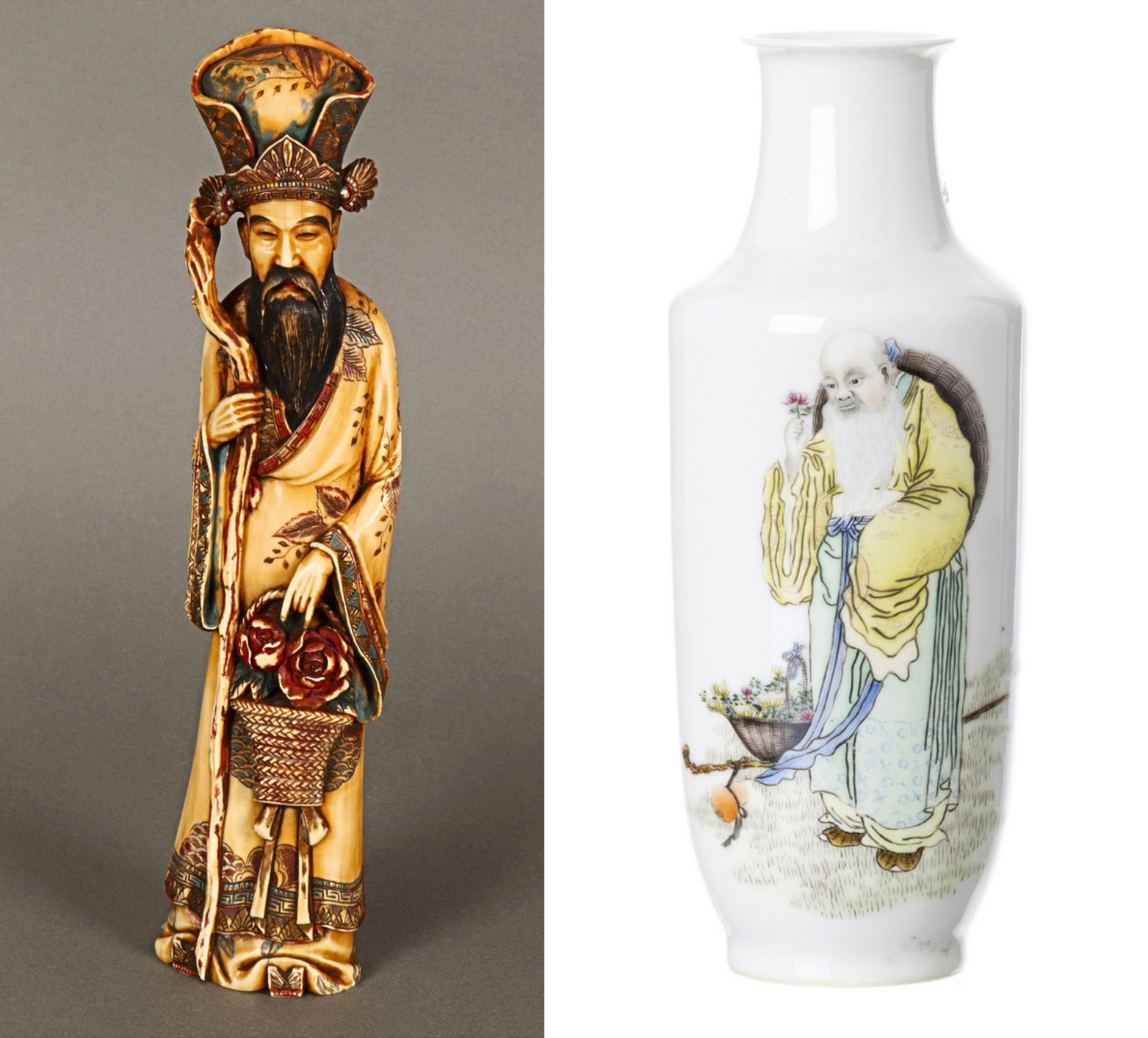
Lan Caihe as a mature/old man
LEFT: Hand-carved ivory figure depicting Lan Caihe holding a staff and a basket of flowers. China, Qing Dynasty. Medium: ivory with evidence of colored pigment and a mark on the base. Height 33.5 cm. Auctioned in 2020 by Aalders Auctions, Stanmore, Australia.
RIGHT: Porcelain vase depicting Lan Caihe, Republican Era. Height: 20.5 cm. Auctioned in 2023 by Marques dos Santos, Porto, Portugal.
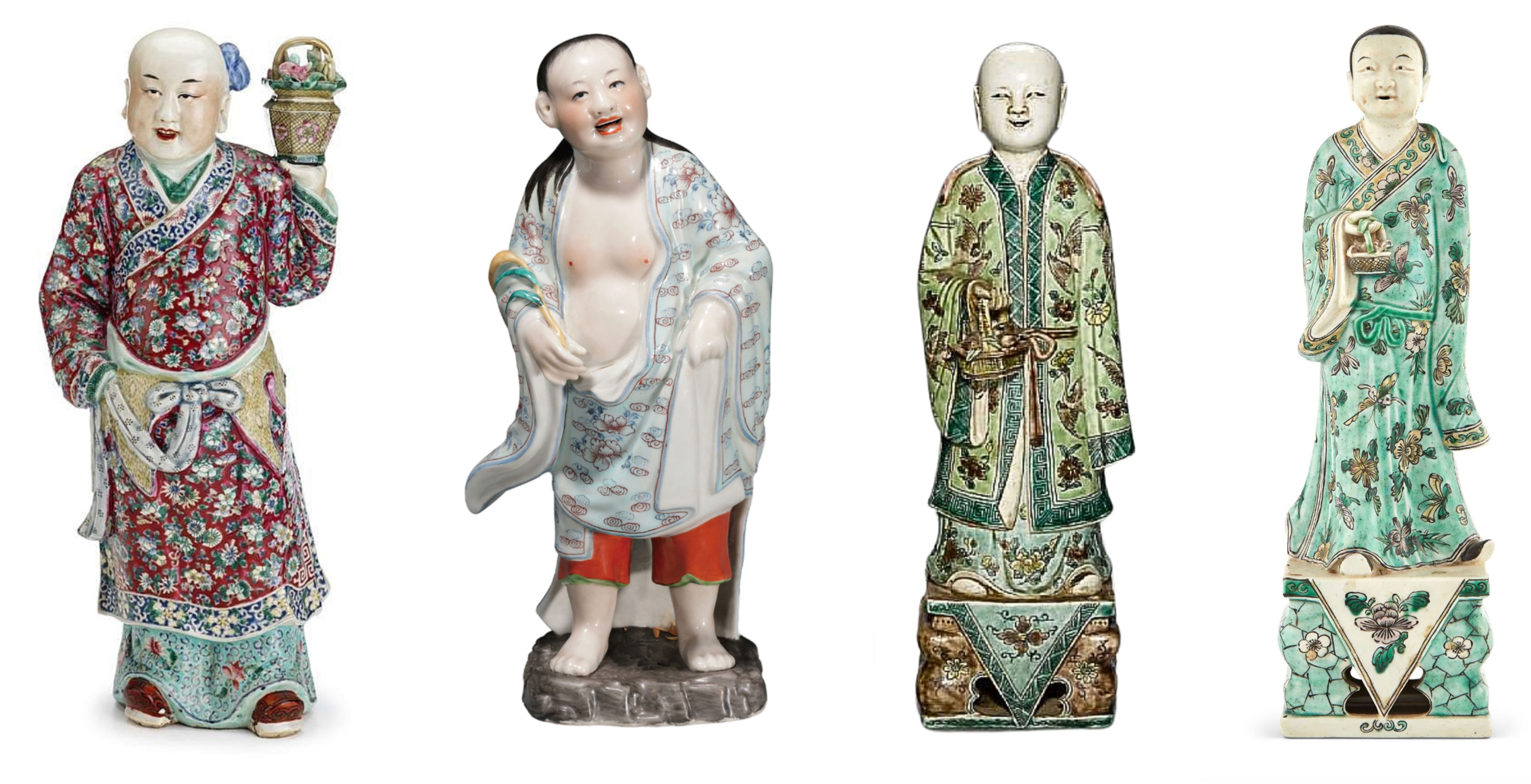
Lan Caihe as an undefinable, ambiguous, liminal figure
LEFT TO RIGHT
Porcelain figure of Lan Caihe from the Republican Period. Height 17 3/4 inches; 45.09 cm. Auctioned in 2011 by Freeman's, Philadelphia, PA, USA.
Porcelain figure of a smiling Lan Caihe. Height: 24 cm. Auctioned in 2018 by Singapore International Auction Pte Ltd., Singapore.
Porcelain figure of Lan Caihe. Height: 12 1/8 inches; 30.75 cm. Auctioned in 2011 by Bonham's, San Francisco, CA, USA.
A Chinese Famille Verte porcelain figure of Lan Caihe, Kangxi Period. Height: 12 inches; 30.48 cm. Auctioned in 2023 by DoyleAuctioneers & Appraisers, New York, NY, USA.
Philosophical and Cultural Implications
Lan Caihe's ambiguity serves multiple theological and social purposes.
- Ontological Subversion: Clart argues that the Eight Immortals act as vessels of "personal deliverance" that transcend communal structures. Lan's refusal of a fixed identity embodies the Daoist principle of ziran (自然, "spontaneity") and critiques mingjiao (名教, "Confucian normative teaching").
- Social Liminality: Lan's role as the patron of "beggars, minstrels, and the mentally ill," as documented by sources at UC San Diego, positions him at the margins of society, where conventional categories dissolve. This aligns with Victor Turner's concept of liminal deities who mediate structural transitions.
- Gender Theory: Modern commentators such as Yvonne Lau on the Mayway blog (2025) interpret Lan as genderfluid and suggest that premodern Chinese culture included spaces for gender variance. However, claims that "China was accepting and respectful of queerness for eons" may be an overgeneralization. While figures like Lan Caihe offered symbolic space to explore nonbinary identities, particularly in opera and popular religion, social attitudes toward gender nonconformity varied widely across dynasties and were often ambivalent or marginalizing.
- Iconographic Stability: Despite textual ambiguity, Lan's visual identity remained remarkably stable. The Hunterian Museum notes that "the use of a flower basket as a distinguishing feature remains consistent throughout the various versions," suggesting that material culture can preserve continuity when narrative details shift.
The Immortal as Empty Signifier
Lan Caihe is a deliberately under-determined figure whose power stems from their resistance to categorization. From a male beggar in Southern Tang texts, to a gender-ambiguous youth in Ming paintings, to a female-presenting opera character in Qing records, this immortal's transformations reflect evolving Chinese perceptions of identity, performance, and transcendence. Rather than revealing confusion, academic analysis reveals strategic ambiguity. By refusing to be defined by stable gender, age, or social role, Lan Caihe becomes a vessel for projecting the Daoist ideal of homelessness—not merely physical wandering, but existential freedom from the "ten thousand things" that fix and limit human potential.
The flower basket—at once empty and infinitely full. The single shoe—treading the threshold between order and abandon. The eternal youth—never aging, ever becoming. These paradoxes comprise what the University of Glasgow aptly describes as an "eccentric and defying expectations" deity. With Lan Caihe, Chinese religious imagination did not create a god of fixed identity but rather an immortal whose very existence questions the necessity of fixed identity, offering instead a model of transcendence through perpetual change.
My personal reading
Lan Caihe's ambiguity, changeability, and instability are an irreverent, laughing rebellion against the order and conventions of Confucianism. Lan Caihe demonstrates that overcoming the hierarchies and rigid structures Confucianism imposed on Chinese society paves the way for wisdom, growth, freedom, and creativity, not chaos. Lan Caihe exemplifies the deliberate dismantling of mingjiao (名教), the Confucian "teaching of names" that establishes social roles and proper conduct. Lan invites us to embark on a narrow and difficult path with lightness and laughter, offering an alternative to disorder and social disruption.
Lan Caihe's ambiguity, changeability, and instability also strike at the core of Daoist soteriology. They are an affirmation of appearance's irrelevance and impermanence. This reflects the Daoist-Buddhist synthesis concept of bianhua (變化), or transformation, where stable identity is an illusion perpetuated by attachment to form. Lan's refusal to maintain a consistent gender, dress, age, and social presentation is not about gender or sex, but about demonstrating that all attributes and appearances are contingent and ultimately discardable on the path to wisdom. All forms are extrinsic labels that must be transcended.
While contemporary interpretations that emphasize "genderfluid" or "queer" identities are not entirely incorrect, they operate within a different hermeneutic framework. Scholars like Yvonne Lau (2025) interpret Lan Caihe through modern LGBTQ+ lenses to reclaim historical space for gender diversity. However, this is a political interpretive project, not a historical claim about the acceptance of gender diversity in Ming or Qing society. Such readings risk becoming "forced" when presented as historical fact rather than as contemporary meaning-making.
Since the 1990s, queer theory has dominated the humanities and naturally seeks "precursors" in non-Western traditions. While this has legitimately uncovered suppressed histories, it can also overdetermine readings of ambiguity that originally served metaphysical rather than socio-sexual purposes.
However, two nuances merit consideration.
First, although rebellion and impermanence were the primary meanings, Lan's ambiguity also created space for non-normative gender performance in Chinese culture. Even unintentionally, the figure's theatrical manifestations allowed audiences to glimpse alternatives to rigid gender binaries.
Second, modern interpretations are not entirely baseless. The combination of Lan's ambiguities, along with the figure's defiance of social categories, does make "them" historically unique. This uniqueness invites, though it doesn't validate, contemporary gender-theoretical engagement.

Three Chinese boxes with porcelain lids depicting Lan Caihe. Late 19th - early 20th century. My collection.
- Clart, Philip. The Eight Immortals between Daoism and Popular Religion. University of Leipzig (Germany), 2003.
- Lan Caihe. *Encyclopedia Britannica*, revised by Matt Stefon, 1998/2024.
- Lau, Yvonne. Lan Cai He 藍採和 - A Genderfluid Chinese Deity. *Mayway Corporation*, 2025.
- Hunterian Museum, University of Glasgow. The Legend of Lan Caihe. Museum Studies Exhibition, 2024.
- Tsinghua University Art Museum. The Eight Immortals by Zhang Lu. Online collection, 2024.
- University of California, San Diego. Tales of the Eight Immortals. Compiled by David K. Jordan, 2010.
- 中国文化大学 (Chinese Culture University). "八仙故事研究" (Research on Eight Immortals Stories). Master's thesis, 2024.
- 南昌大学人文学院. Faculty publications on Eight Immortals studies, 2024.
Now, let's return to our pretty boxes with their decidedly bizarre shapes.
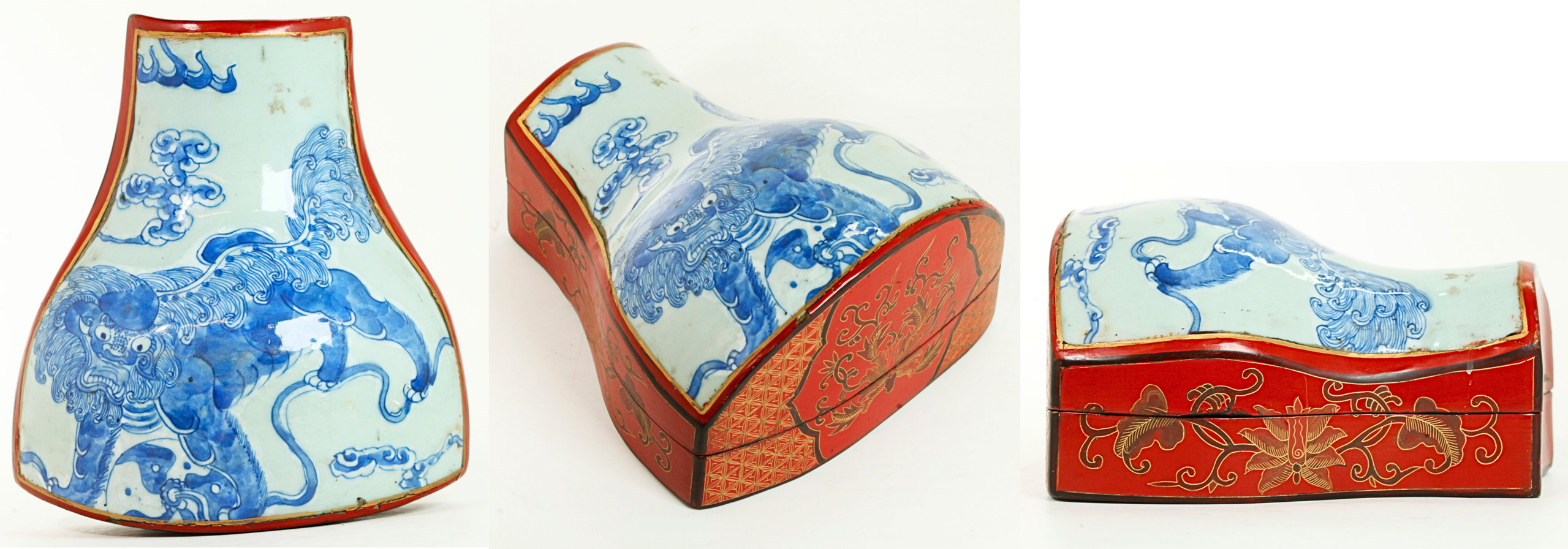
Dimensions: Height 4 3/4 inches (12 cm); width 8 3/4 inches (22.1 cm.). Auctioned in 2025 by Eddie's Auction, New York, NY, US.
The lid of this box is a 19th-century piece of Chinese blue-on-white slip-over crackle celadon mounted on an irregularly shaped red lacquer box decorated with hand-engraved scrolling flowers. As with the previous boxes, this one was not designed for easy use.
Does the peculiar curvature and unusual shape of the lid bring anything to mind?

On the right, a Chinese modern porcelain vase decorated with a traditional Foo Dog motif, similar to the old painting on the box. Vase dimensions: 16.5'' x 6.75'' x 6.75'' (42 x 17 x 17 cm). Auctioned in 2017 by Material Culture, Philadelphia, PA, USA.
These Chinese boxes are made from fragments of ancient porcelain and celadon vases. That's why they are known as "shard boxes" in the West.
They have odd, irregular shapes and are not quiet. They are "talking" boxes that reveal a significant part of China's history from an unusual perspective. Sit down and listen as the shards begin their stories.

THE PHOENIX IN FRAGMENTS
In the hushed galleries of memory, where porcelain whispers to porcelain, a peculiar alchemy exists, an art that transforms destruction into poetry and violence into reverence. The Chinese shard box is a witness to and testament of this transformation. Each fragment is a syllable in an epic of survival, and each box is a reliquary of what could have been lost forever.
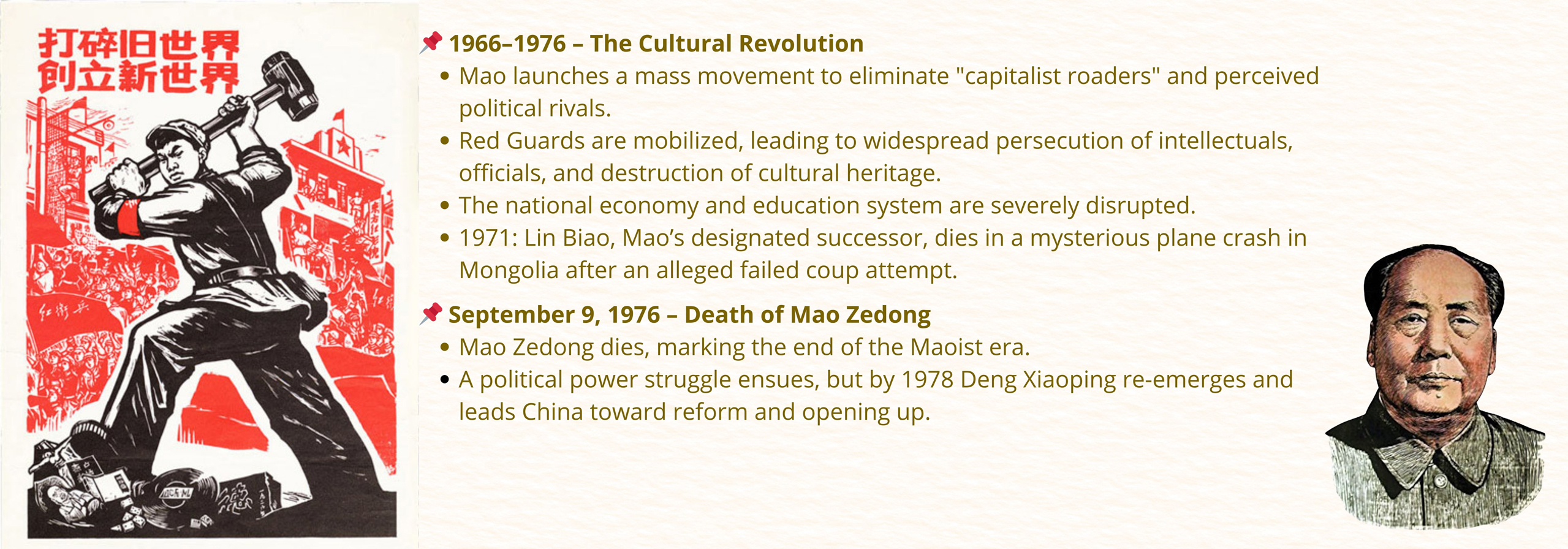
Imagine the terrible symphony of the Cultural Revolution—the ceramic corpses falling from mahogany shelves, the crystalline scream of Ming Dynasty bowls meeting concrete, and the hollow thud of Qing vases exploding against courtyard stones. From 1966 to 1976, China's most exquisite porcelains—those celestial blue-and-white dreams that once graced imperial tables and those eternal famille rose gardens—were condemned as "bourgeois excess." Owning them was a death sentence; their beauty was a crime against revolutionary purity.
“DESTROY THE OLD, ESTABLISH THE NEW”
THE CULTURAL REVOLUTION AND THE UNMAKING OF CHINA’S IMPERIAL ARTS
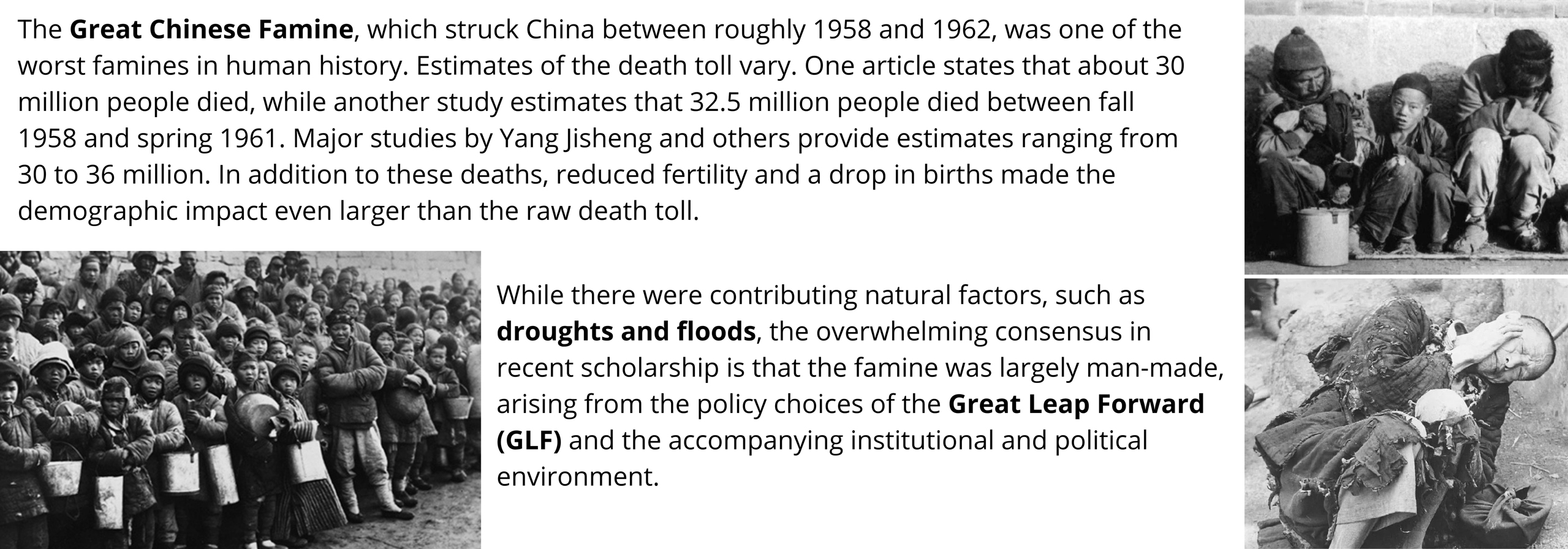
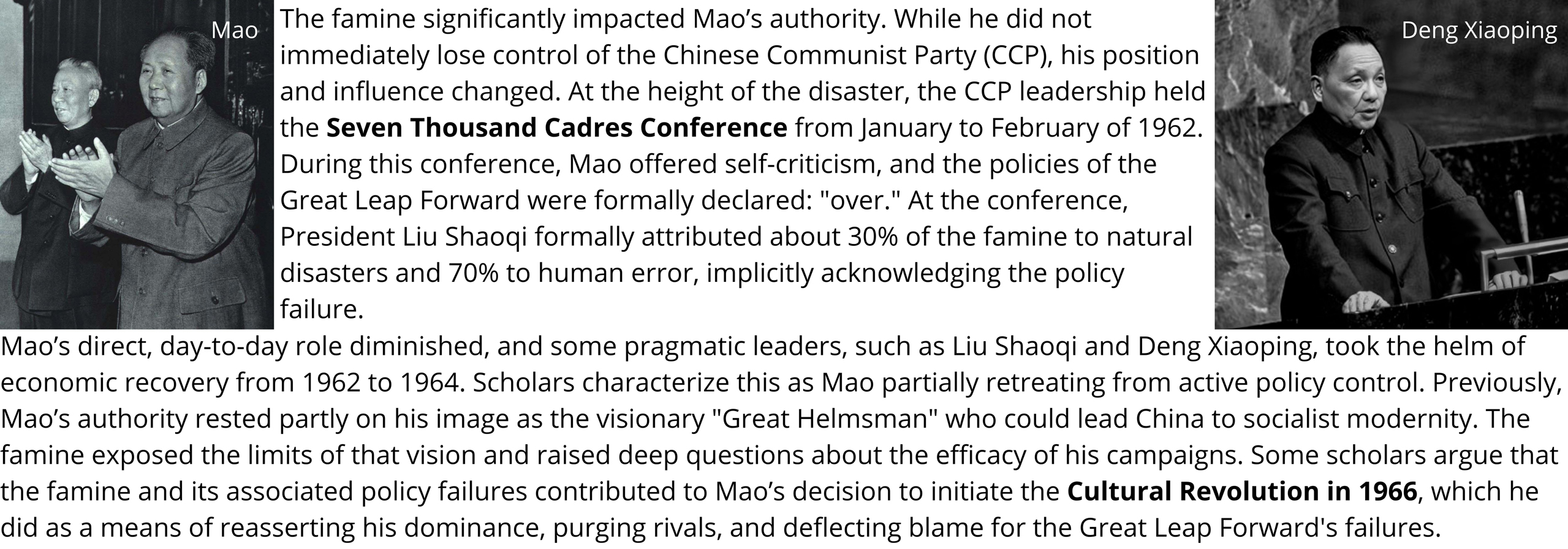
Mao Zedong’s revolution did not end with the seizure of power in 1949. Instead, it sought to reshape the world under its control. Following the disasters of the Great Leap Forward and the Great Famine, as well as the subsequent political isolation, Mao launched the Great Proletarian Cultural Revolution in 1966. His goal was to reclaim ideological primacy, purge rivals, and radicalize youth and society. He denounced "bourgeois" elements who were supposedly restoring capitalism and called on the young to "bombard the headquarters." The movement soon combined a high-level power struggle with a mass campaign to eradicate the "Four Olds" — old ideas, old culture, old customs, and old habits — turning culture itself into a battlefield.
Both Western syntheses (MacFarquhar & Schoenhals) and Chinese studies of heritage governance agree on the dual purpose of the Cultural Revolution: a political purge intertwined with an attempt to reengineer social meanings by attacking the tangible past.
The Chinese Cultural Revolution: Ideological Zeal and Terror
Launched by Mao Zedong, the Cultural Revolution was ostensibly a campaign to purge capitalist and traditional elements from Chinese society and reinvigorate revolutionary fervor among the masses. In reality, however, it unleashed a decade of political chaos, social upheaval, violence, and profound human suffering. Far from a mere ideological purge, the Cultural Revolution (CR) was Mao's desperate attempt to regain power. However, it exacted a devastating toll on China's intellectual, social, and material legacy.
By the early 1960s, Mao had retreated from day-to-day governance, ceding influence to pragmatic leaders like Liu Shaoqi and Deng Xiaoping. These leaders implemented market-oriented reforms, such as private farming plots, to stabilize the economy. These measures spurred growth, but they were anathema to Mao. He viewed them as a betrayal of pure communism because they fostered bureaucracy, corruption, and "revisionism." Mao feared that the CCP was becoming an elitist group detached from revolutionary ideals, and that his vision of continuous class struggle was being ignored.
The spark was ignited in late 1965 when Mao's wife, Jiang Qing, criticized cultural productions for promoting bourgeois themes. This prompted a broader assault on the arts and the intelligentsia. By May 1966, Mao had mobilized students at universities with "big character posters," denouncing administrators as "capitalist roaders." This escalated into the formation of Red Guard militias ((红卫兵), youthful paramilitary groups loyal to Mao, who were tasked with exposing "class enemies." "By August 1966, the so-called Red August, the mayhem was in full swing as Mao’s allies urged Red Guards to destroy the four olds: old ideas, old customs, old habits and old culture. Schools and universities were closed and churches, shrines, libraries, shops and private homes ransacked or destroyed as the assault on “feudal” traditions began". (Tom Phillips, The Cultural Revolution, "The Guardian", 2016).
The Red Guards did not limit themselves to destroying cultural relics, looting temples, burning books, and renaming streets and shops. They also physically attacked "class enemies" — teachers, intellectuals, and party officials who were not considered sufficiently revolutionary. For example, during Red August, many educators were publicly humiliated and tortured; some were killed or driven to suicide. The movement spread remarkably quickly and widely. One estimate is that, by late 1966, 12 million youths had gathered for large rallies around Beijing and in the provinces.
Blood started to flow when Mao ordered the security forces not to intervene. Between August and September of 1966 alone, nearly 1,800 people lost their lives in Beijing.
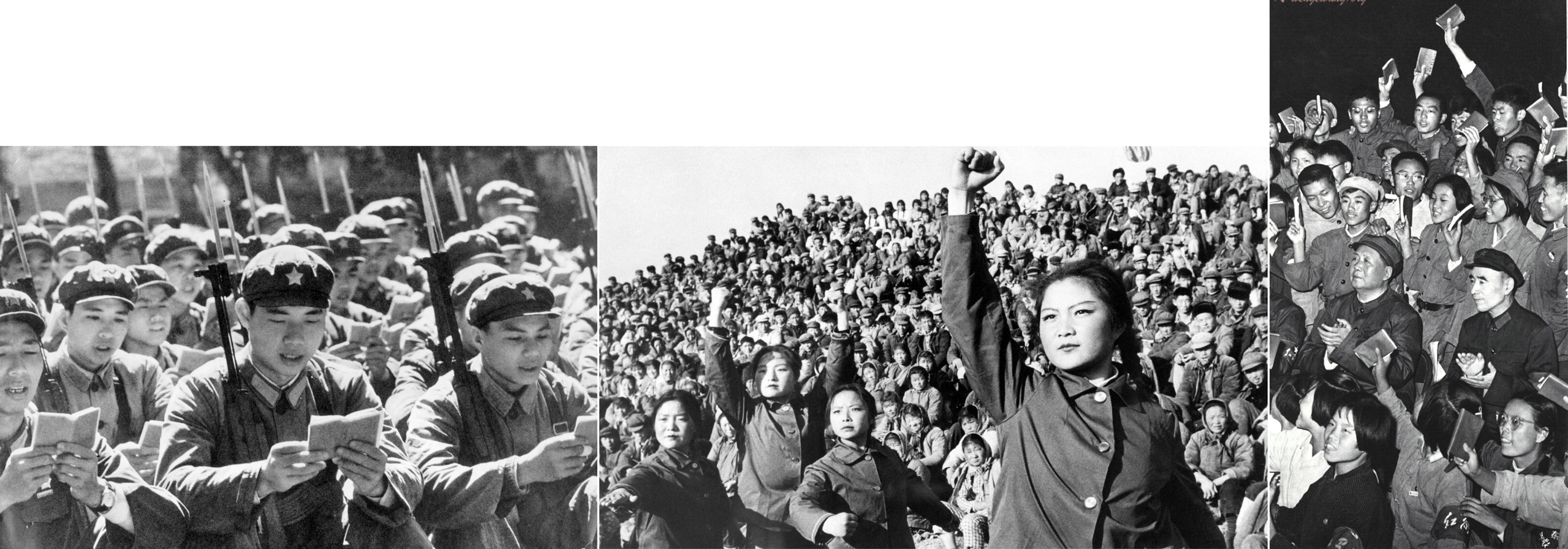
LEFT TO RIGHT
Red Guards in Beijing.
Chinese Red Guards in 1966. Photograph: Universal History Archive.
Mao and Lin Biao among Red Guards in Beijing, in November 1966. Public Domain.
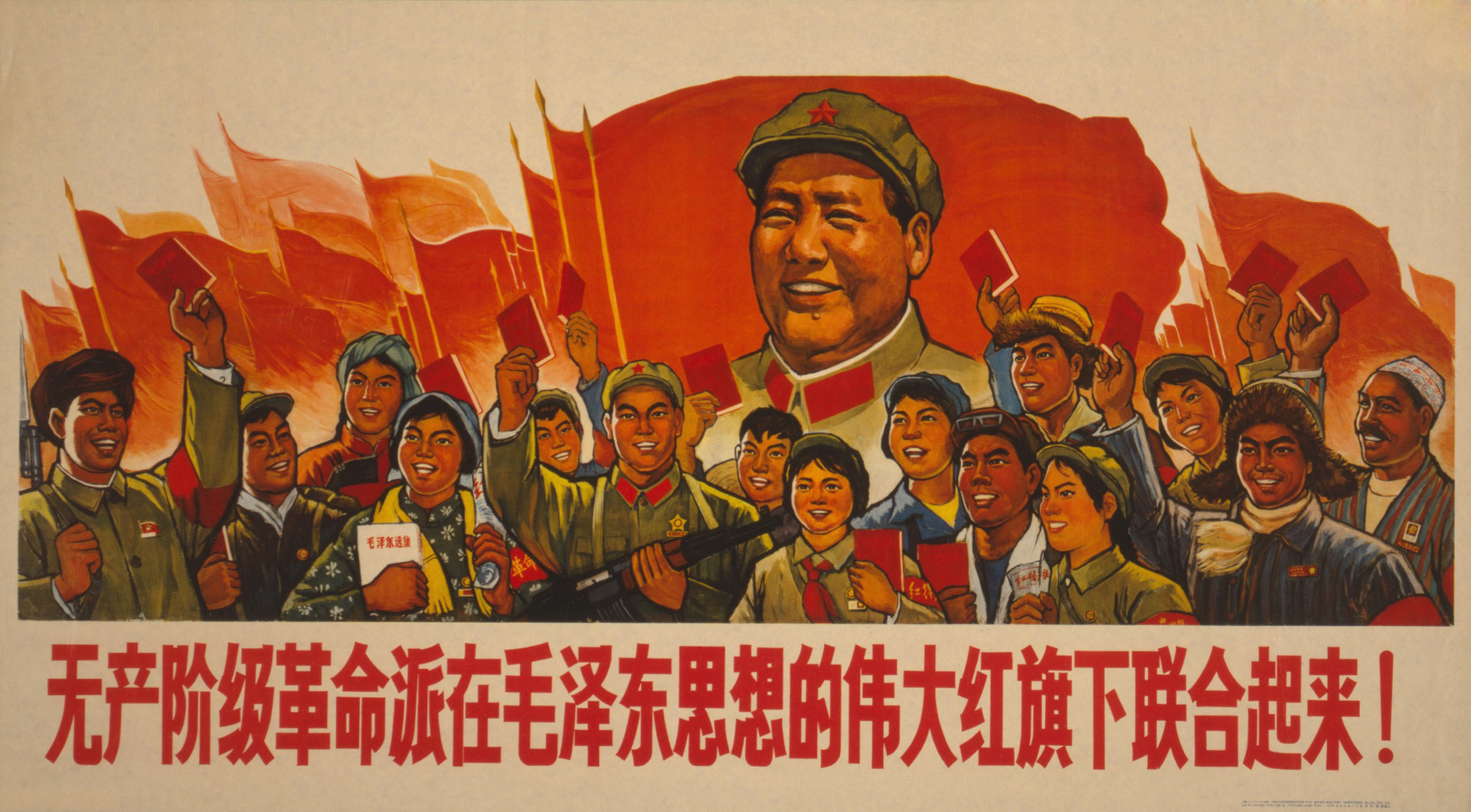
Proletarian revolutionaries unite under the great red banner of Mao Zedong Thought! - 无产阶级革命派在毛泽东思想的伟大红旗下联合起来!
This slogan and visual style are typical examples of propaganda supporting Red Guard activism and the key messages of the early Cultural Revolution period. The red flags and raised books (representing Mao's "Little Red Book") reflect the iconography typical of Red Guard mobilization, as do the people from various backgrounds. Posters like this one were widely distributed to encourage youth to join the Red Guards and support the movement to uproot "old" ideas, customs, and hierarchies.

Cultural Revolution propaganda posters
LEFT: Mao with Red Guards, 1967. Source: chineseposters.net.
RIGHT: Be the vanguard of the Party, Be the trailblazer in criticism and revision! - 当⽃私的尖兵,做批修的闯将!January 1968. Source: chineseposters.net.
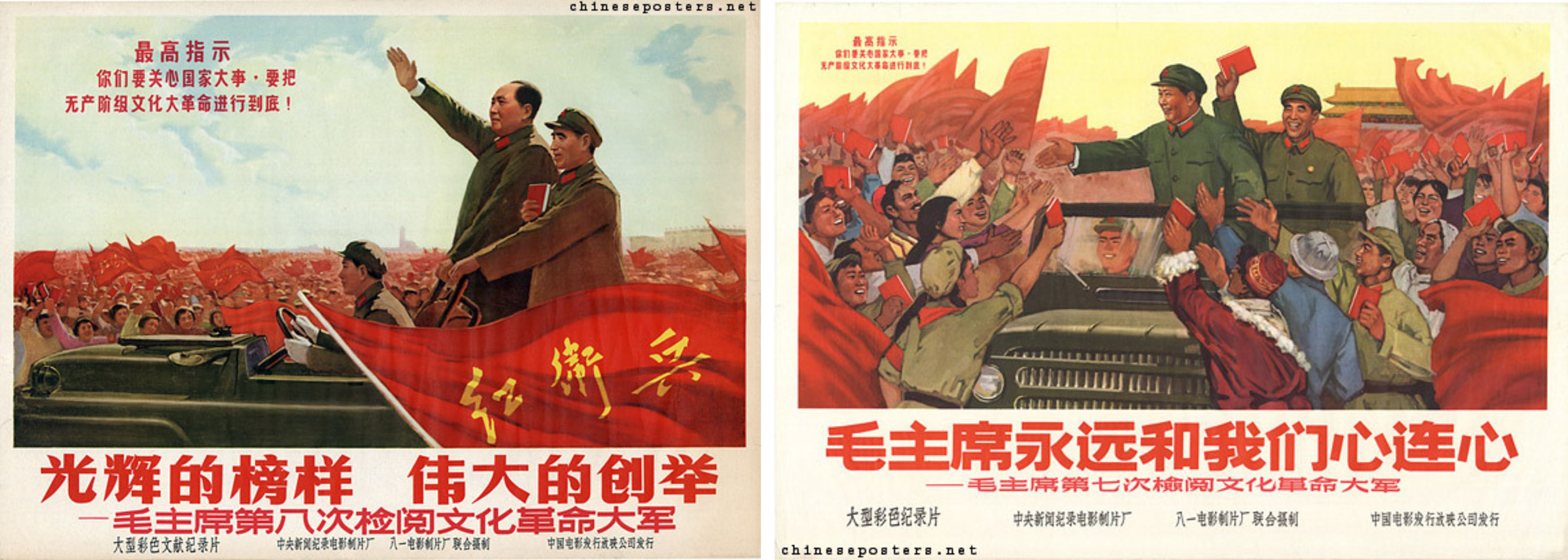
Cultural Revolution propaganda posters
LEFT: A Glorious Exemple, A Great Initiative: Chairman Mao's Eighth Inspection of the Cultural Revolution army - 光辉的榜样-伟⼤的创举-⽑主席第⼋ 次检阅⽂化⾰命⼤军. Late 1966 or early 1967. Source: chineseposters.net. " Mao inspected the Red Guards on Tian'anmen Square for the eighth time on November 11, 1966."
RIGHT: Chairman Mao is forever in our hearts— Chairman Mao's Seventh Inspection of the Cultural Revolution army - ⽑主席永远和我们⼼连⼼-⽑主席第七 次检阅⽂化⾰命⼤军. Late 1966 or early 1967. Source: chineseposters.net." Mao inspected the Red Guards on Tien'anmen Square for the seventh time on November 10, 1966."
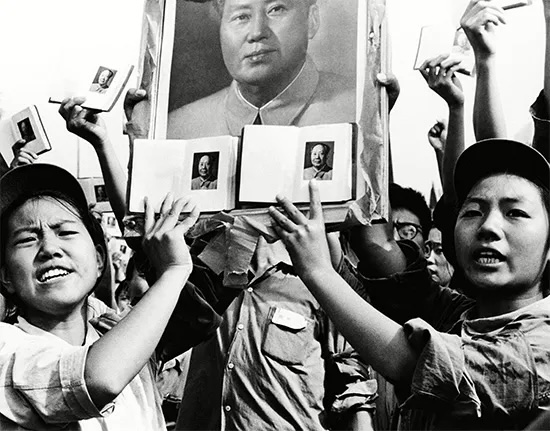
Cult of personality
Members of the Red Guard with the "Little Red Book" of Mao Zedong's sayings hold up a portrait of Mao. Beijing, 1966.
What began as a targeted purge devolved into systemic excesses and unchecked violence as the Red Guards interpreted the call to "bombard the headquarters" with lethal zeal. Schools and universities closed, freeing millions of young people to form factions that clashed over ideological purity. These factions often turned on families, teachers, and neighbors. Verbal denunciations escalated into physical assaults, including beatings and public humiliations, such as "struggle sessions," where victims were forced to confess fabricated crimes. There were also suicides under duress. By 1967, cities like Wuhan and Guangzhou were gripped by factional warfare, with armed confrontations killing thousands and wounding tens of thousands more.
1968–early 1970s: Control, Institutionalization and Continuation
"After the initial explosion of student-led “red terror”, the chaos spread rapidly. Workers joined the fray and China was plunged into what historians describe as a state of virtual civil war, with rival factions battling it out in cities across the country. By late 1968 Mao realised his revolution had spiralled out of control. In a bid to rein in the violence he issued instructions to send millions of urban youth down to the countryside for “reeducation”. He also ordered the army to restore order, effectively transforming China into a military dictatorship, which lasted until about 1971. As the army fought to bring the situation under control, the death toll soared." (Tom Phillips)
The revolution continued, but less as a spontaneous youth uprising and more under Party‑military control. The leadership’s focus shifted towards ideological campaigns, personality cult, and internal power‑struggles.
"Yet contrary to popular belief, the government was responsible for most of the bloodshed, not the Red Guards. “We read a lot of horror stories about students beating their teachers to death in the stairwell,” says Andrew Walder, the author of China Under Mao. “[But] based on the government’s own published histories well over half, if not two-thirds of the people who were killed or imprisoned during the Cultural Revolution suffered that from 1968 to early 1970” as the army moved in to halt the violence.
The lives of some of the Communist party’s most powerful figures were upended by the turbulence, including future leader Deng Xiaoping, who was purged in 1967, and Xi Zhongxun, the father of China’s current president Xi Jinping, who was publicly humiliated, beaten and sent into exile. President Xi’s half-sister Xi Heping is said to have taken her own life after being persecuted". (Tom Phillips)
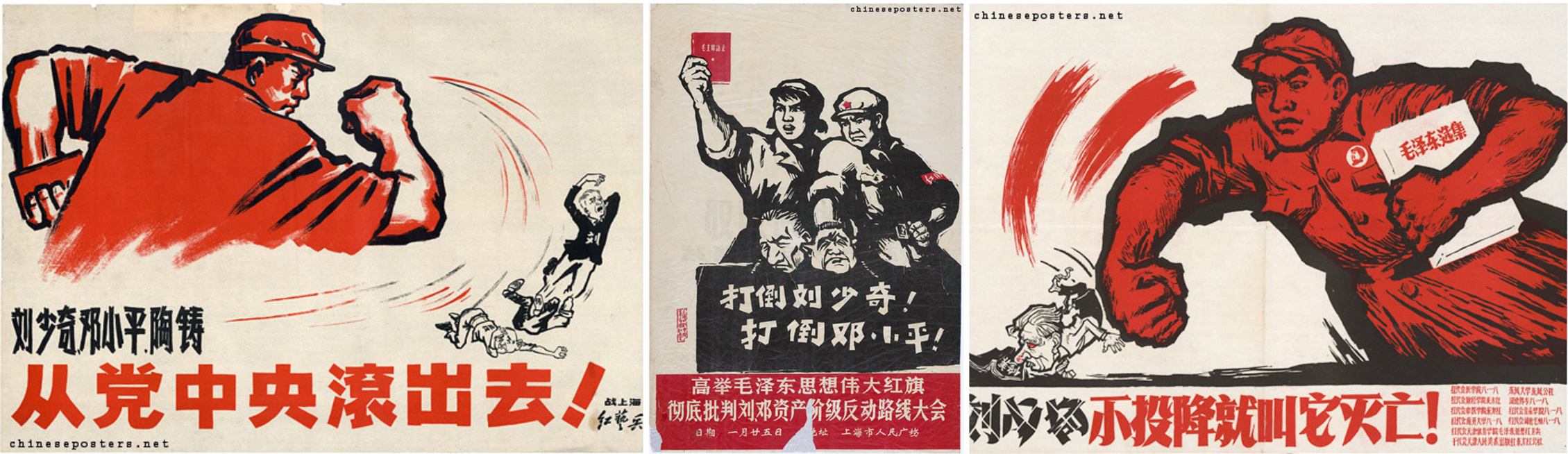
Maoist violent propaganda poster
LEFT TO RIGHT
Liu Shaoqi, Deng Xiaoping and Tao Zhu get the hell out of the Party Central Committee! - 刘少奇,邓⼩平,陶铸从党中央滚出 去!Published in 1966 by Battling Shanghai Red Guards. Source: chineseposters.net.
Down with Liu Shaoqi! Down with Deng Xiaoping! Raise high the great red banner of Mao Zedong Thought! - Conference to thoroughly criticize the reactionary bourgeois line of Liu and Deng - 打倒刘少奇!打倒邓⼩平!⾼举⽑泽 东思想伟⼤红旗 - 彻底批判刘、邓资 产阶级反动路线⼤. January 1967. Source: chineseposters.net.
Liu Shaoqi must surrender or face annihilation! - 刘少奇不投降就叫它灭亡! 1967. Source: chineseposters.net.
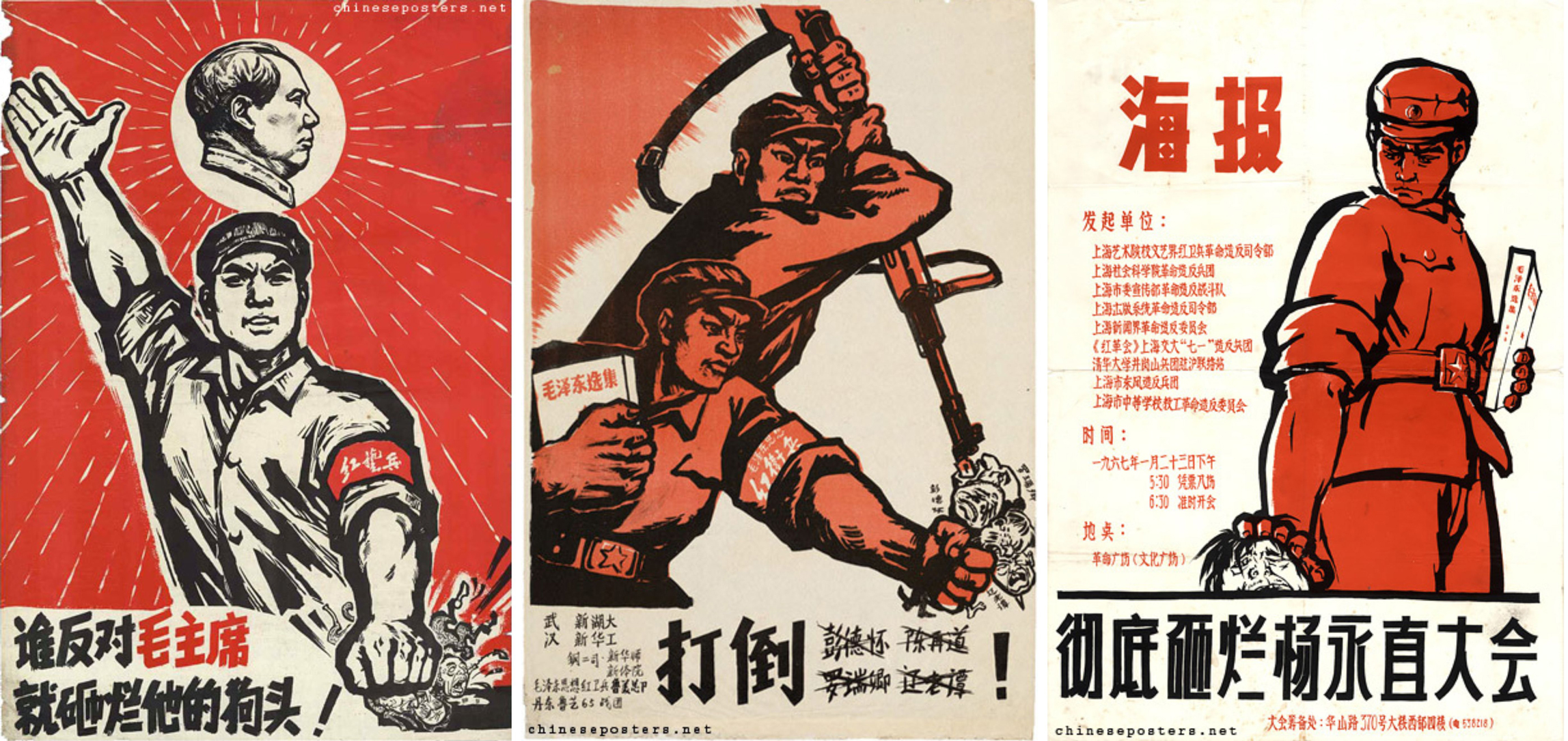
Maoist violent propaganda poster
LEFT TO RIGHT
Whoever opposes Chairman Mao will have their skull smashed!- 谁反对⽑主席就砸烂他的狗头! 1966 or 1967. Source: chineseposters.net.
Down with Peng Dehuai, Luo Ruiqing, Chen Zaidao, and Liao Laotan!- 打倒彭德怀,罗瑞卿,陈再道,辽⽼ 谭! 1967. Source: chineseposters.net. "Peng Dehuai is the best known among the four attacked here. He was Marshal of the People's Liberation Army, and criticized Mao during the Great Leap Forward. In 1966 he is arrested and maltreated. He dies in captivity in 1974. Luo Ruiqing, Chief of Staff of the PLA, attempts suicide after being accused and maltreated, but survived and was rehabilitated in 1975."
General assembly to thoroughly smash Yang Yongzhi - 彻底砸烂杨永直⼤会. January 1967. Source: chineseposters.net. " Announcement of a public assembly on January 23, 1967, on Culture Square (⽂化⼴场) in Shanghai, at that time renamed Revolution Square (⾰命⼴场). The goal of the assembly was criticizing Yang Yongzhi - 杨永直 (1917-1994), head of the Propaganda Department of the Shanghai Municipal Party Committee. He came under attack late 1966, and was forced to attend hundreds of criticism meetings to be publicly humiliated".
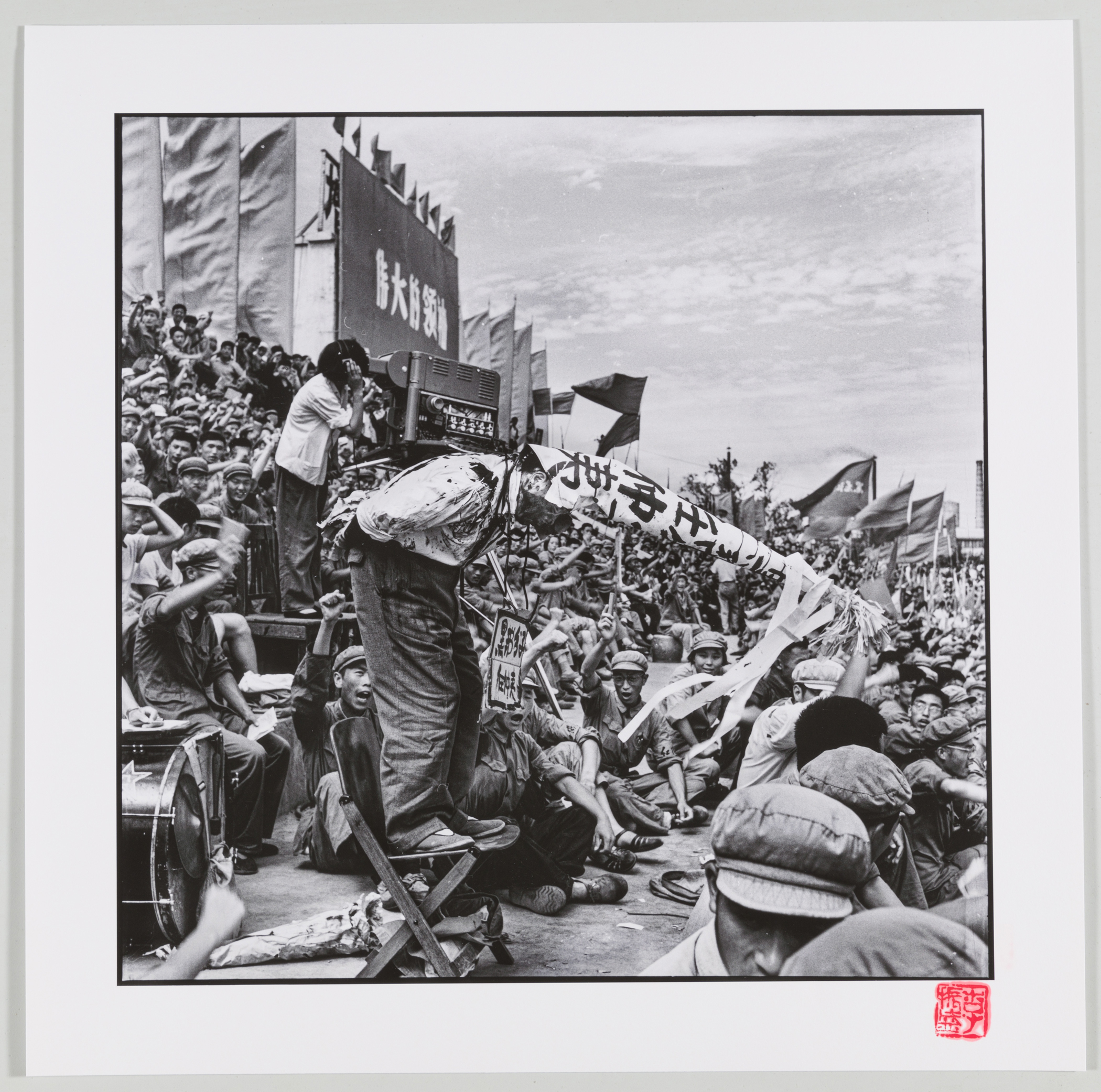
This photograph, The Struggle Session of Ren Zhongyi by Li Zhensheng (1966), captures a dramatic moment during China’s Cultural Revolution: a "struggle session." These were violent public events where individuals accused of being "class enemies" were publicly humiliated and accused. They were often physically abused to the point of death. Red Guards and party officials orchestrated these events to target intellectuals, politicians, and anyone seen as opposing Maoist ideology. They did so by consolidating party control through mass participation and emotional manipulation.
Struggle sessions (批斗大会) were signature acts of the Cultural Revolution. The accused were forced to kneel or stand before large crowds, sometimes wearing dunce caps or carrying accusatory signs around their necks. They were reviled, shouted at, often beaten, and forced to "confess" to supposed crimes against Mao Zedong Thought or socialist values. The crowd's emotional fervor was incited with banners, flags, slogans, and loudspeakers, as seen in the photograph. Staging, props, and orchestrated drama were employed to maximize humiliation and involvement.
Ren Zhongyi, the man in the photograph, was a prominent Communist Party official who later played a pivotal role in Guangdong's reform era. During the Cultural Revolution, he, like many other intellectuals and officials, became a target of struggle sessions, denounced as "bourgeois" or "counterrevolutionary" enemies. After the Cultural Revolution ended, Ren was formally rehabilitated and reinstated to senior positions.
Li Zhensheng, a Chinese photojournalist, took the photo. His work during the Cultural Revolution is internationally recognized for exposing the era's brutality and complexity. His images offer rare documentation because many photos of political violence were suppressed by the Communist Party. Li gained access by wearing a Red Guard armband and used his position at the Heilongjiang Daily to capture public denunciations, humiliations, and executions. The photograph is striking for its composition and detail, emblematic of Li's style. It shows an enormous crowd, banners and flags displaying ideological fervor, a film crew documenting the spectacle, and the forced participation of many individuals. The emotional intensity is palpable, evident in the contorted faces of the crowd and the rigid postures of those being humiliated. This image provides a visual and psychological record of an era defined by collective hardship, fanaticism, and profound social trauma. It remains an iconic document of the cruelty of the Cultural Revolution and the dangers of mass political hysteria.
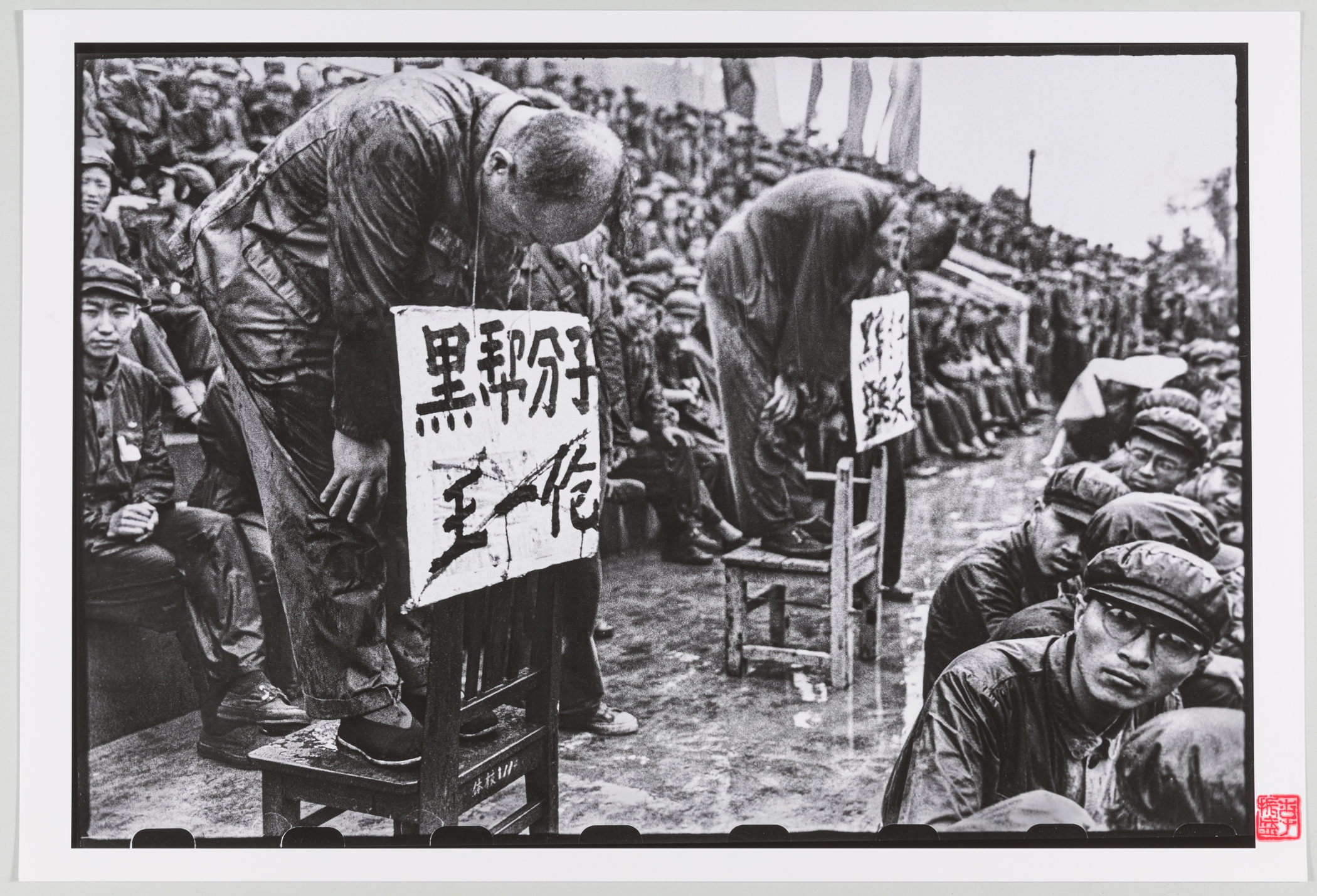
Top Party officials were denounced during a Red Guard rally. Photo by Li Zhensheng, 1966. The photograph captures the denouncement of top Chinese Communist Party officials at the height of the Cultural Revolution. The image shows the officials being forced to bow while standing on stools with large placards bearing their names and accusations hung around their necks. They are surrounded by crowds of Red Guards and local citizens. Such rallies were public humiliation rituals known as "struggle sessions," a hallmark of the Maoist campaign to purge "counter-revolutionaries" and "enemies of the people."
These mass events were designed to shame and humiliate those accused of political crimes, often for arbitrary or fabricated reasons, and force them to confess. Victims included top officials, intellectuals, teachers, and anyone suspected of not embracing Mao Zedong’s ideology. During these sessions, the accused were forced to wear signs with slogans or accusations, undergo verbal abuse, and sometimes endure physical violence, such as beatings or having their hair shaved off. The presence of large, fervent crowds amplified the pressure and psychological trauma.
The End of the Cultural Revolution and the Political Reckoning That Followed
The Cultural Revolution, one of the most tumultuous and destructive periods in modern Chinese history, officially ended in the fall of 1976. However, its conclusion was not a clean break. Rather, it was a process—a political unraveling, a symbolic reckoning, and an institutional pivot that reshaped the future of the Chinese Communist Party (CCP) and the nation it governs. The closing act of the Cultural Revolution did not simply unfold with Mao Zedong's death, but also with the purge and prosecution of the radical faction known as the Gang of Four. This group had risen alongside Mao's revolution, and ultimately fell with it.
How many lives were lost?
It's a complex question, as the Cultural Revolution left few reliable official records, and the Chinese state has never published comprehensive casualty data. The CCP never released an official nationwide death count. Regional variation was extreme—some provinces experienced mass killings, while others mainly endured political persecution. Indirect deaths (from imprisonment, famine, suicide, or forced labor) are difficult to distinguish from natural mortality in the data. Lastly, much evidence was destroyed or classified later on.
Therefore, historians rely on local archives, court records, memoirs, and demographic reconstructions to infer the national picture.
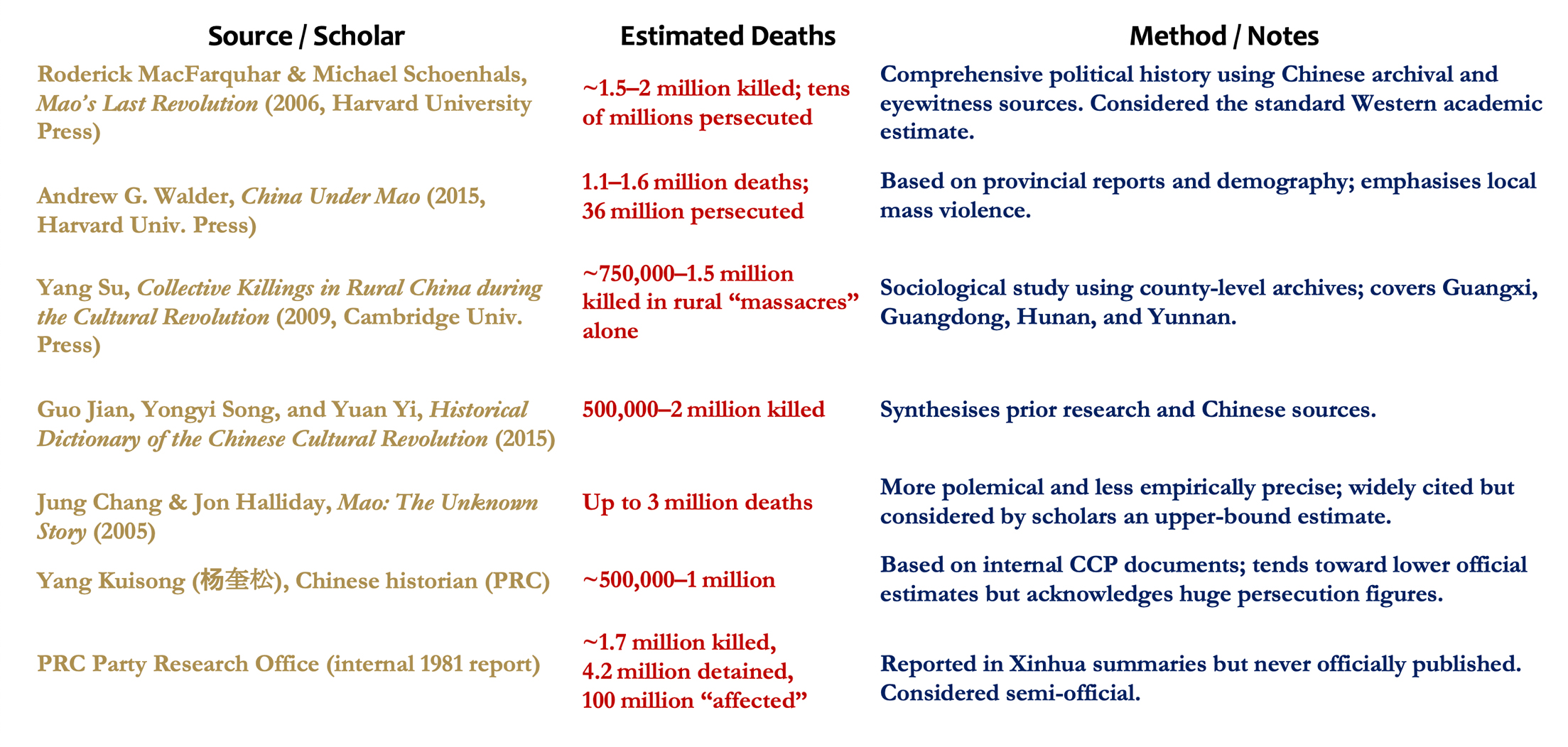
Taking all of this into account, most historians agree that there were between 1 and 2 million direct deaths, with tens of millions more experiencing persecution, torture, imprisonment, or forced displacement.
- Direct killings: 1–2 million
- Seriously persecuted (beaten, jailed, exiled, or sent to labor camps): 15–30 million
- People adversely affected (loss of work, education, or political status): up to 100 million.
MAO'S CONTROL OVER THE ARTS
During the Cultural Revolution (1966-76), art ceased to exist merely as art; it became a weapon, a mirror, and a march. Mao Zedong stood at the apex of this transformation, and his image was everywhere. In the shadows were the figures of the Gang of Four, most notably Jiang Qing (Mao's wife). The Gang of Four reshaped the visual arts and even porcelain into instruments of revolution through their cultural command.
Ideological Architecture
Mao had long insisted—since his earlier pronouncements, notably at the Yan’an Forum on Literature and Art (1942)—that art must serve the workers, peasants and soldiers; that it must bow before politics rather than the other way around. During the Cultural Revolution his call echoed with even more force: art was to be a revolutionary act, not a personal one. The Gang of Four took up this mantle of cultural vigil. As The Story of the Chinese Cultural Revolution, told through Ceramics writes: “The Gang of Four (...) maintained an iron‐fisted control of media and artistic production.” In practice, this meant that subject matter, style, and the institutions of production were strictly disciplined. Artists were no longer free to explore form and metaphor; they were engineers of ideology.
During the Cultural Revolution (1966–1976), ballet in China underwent a transformation, becoming a tool of political propaganda and artistic reform. Under the strong influence of Mao Zedong’s wife, Jiang Qing, traditional Western ballet techniques and forms were adapted to present new revolutionary narratives. The most famous examples are The Red Detachment of Women and The White-Haired Girl. The video above shows scenes from the original production of The Red Detachment of Women (1970).
Visual Arts: Content and Style Under Control
During this period, artistic themes were limited to a tightly controlled set of subjects: heroic workers, peasants, soldiers, and adoring masses before leaders. Mao's personality cult dominated the imagery.
Many previously acceptable styles were simultaneously denounced. Abstraction, Impressionism, and other styles deemed "bourgeois" or experimental were banned. Even traditional ink painting, long associated with literati and reflection, was subject to censorship. Instead, the authorities proclaimed allegiance to a blend of "Revolutionary Realism" and "Romantic Realism," rooted in Soviet-style portrayals of the masses and folk vernacular elements drawn from nianhua (New Year prints) to evoke popular resonance.
The result is a visual art scene not driven by exploration, but by deployment: paintings, posters, prints, and sculptures all calibrated to broadcast a single message. Artistic individuality was subsumed beneath a monolithic voice.
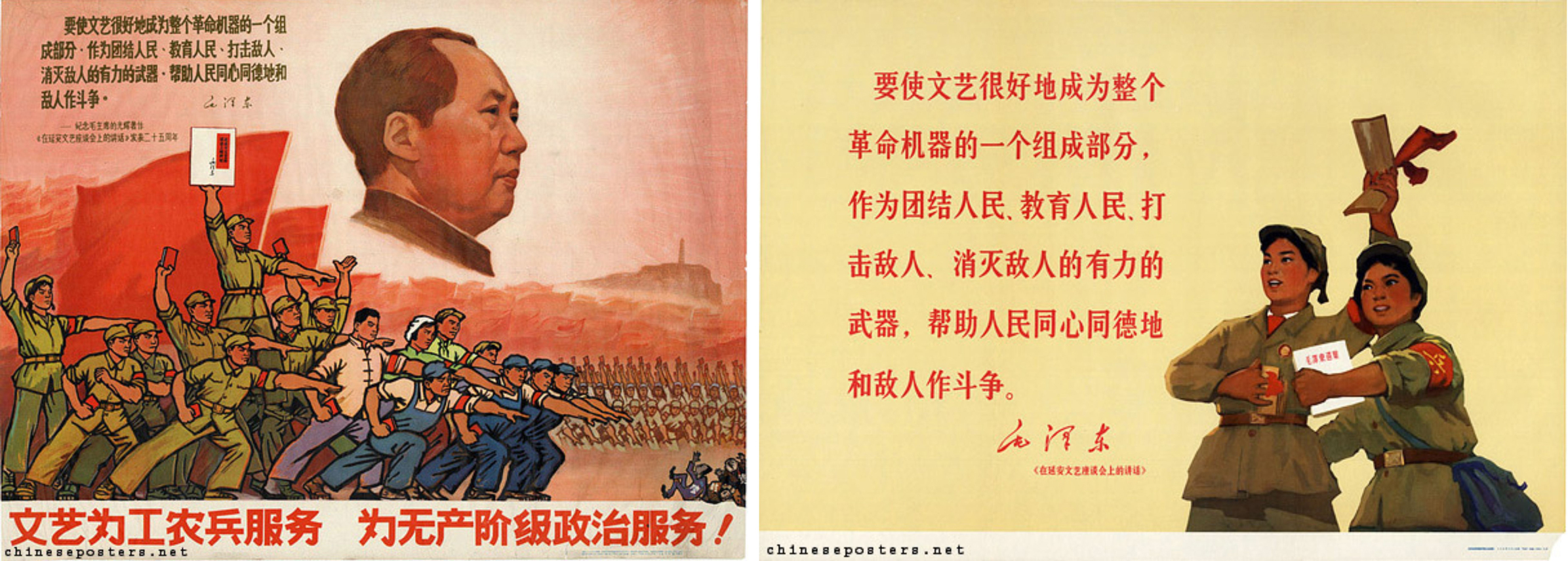
LEFT: Literature and art must serve the workers, peasants, and soldiers; they must serve the politics of the proletariat! - ⽂艺为⼯农兵服务为⽆产阶级政治服 务!- May 1967. Source: chineseposters.net. The Mao quotation top left is from Closing Remarks at the 1942 Yan'an Forum on Literature and Art, republished in the Little Red Book (chapter 32): 要使⽂艺很好地成为整个⾰命机器的 ⼀个组成部分, 作为团结⼈⺠,教育⼈ ⺠,打击敌⼈,消灭 ⼈的有⼒的武 器,帮助⼈⺠同⼼同德地和敌⼈作⽃ 争. We must ensure that literature and art fit well into the whole revolutionary machine as a component part, that they operate as powerful weapons for uniting and educating the people and for attacking and destroying the enemy, and that they help the people fight the enemy with one heart and one mind. The small caricatures under attack in the bottom right corner are marked with the characters 修 (xiu), 封 (feng) and 资 (zi): revisionism, feudalism and capitalism.
RIGHT: <Our purpose is to> ensure that literature and art fit well into the whole revolutionary machine as a component part, that they operate as powerful weapons for uniting and educating the people and for attacking and destroying the enemy, and that they help the people fight the enemy with one heart and one mind. (Quote from Mao). - 要使⽂艺很好地成为整个⾰命机械的 ⼀个组成部分,作为团结⼈⺠、教育⼈⺠、打击敌⼈、消灭敌⼈的有⼒的武器,帮助⼈⺠同⼼同德地和敌⼈作 ⽃争。March 1967, Source: chineseposters.net.
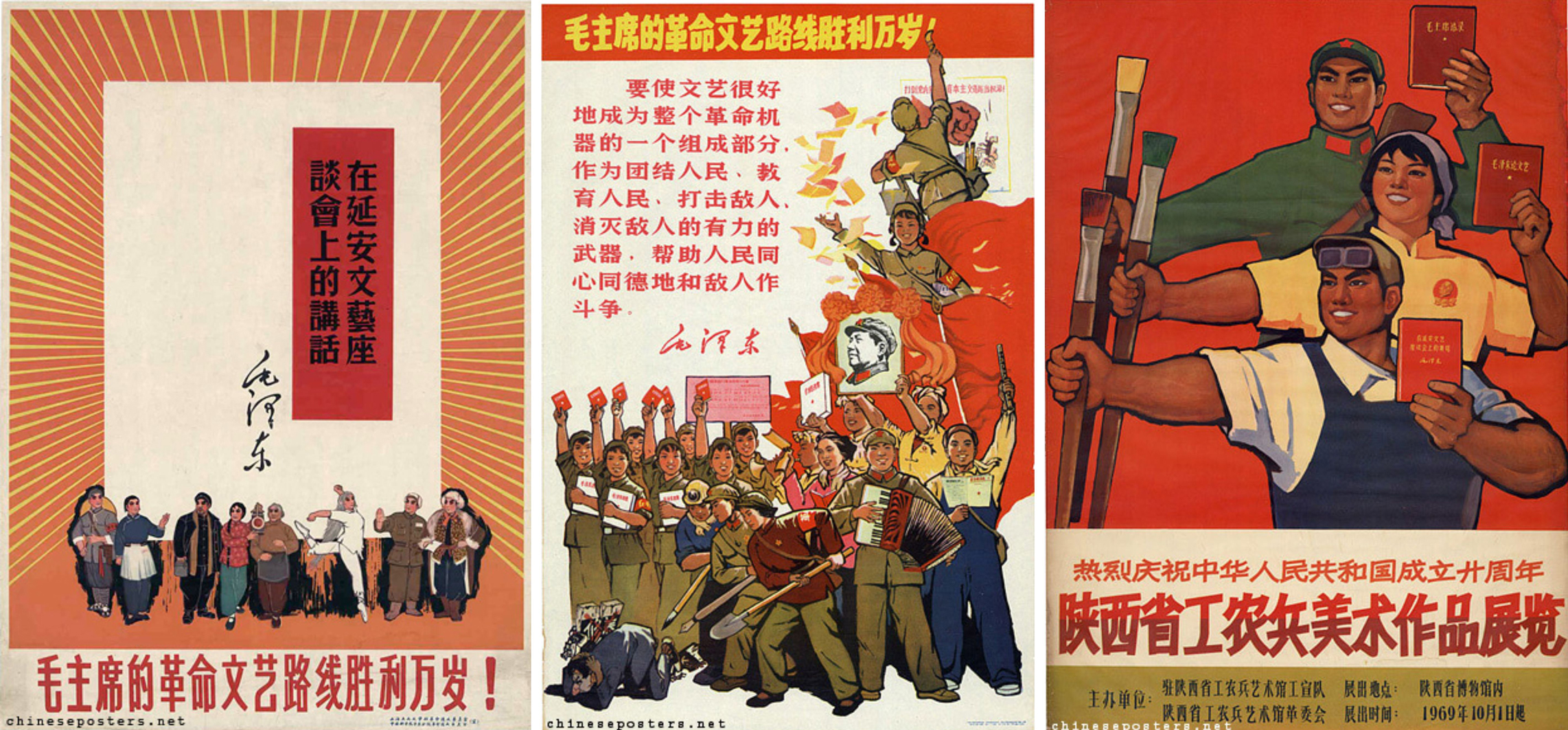
LEFT: Long live Chairman Mao's revolutionary line in literature and art! - ⽑主席的⾰命⽂艺路线胜利万岁! Ca. 1968. Source: chineseposters.net. "The book shown is an edition of Mao's 1942 Talks at the Yan'an Forum on Literature and Art (在 延安⽂艺座谈会上的讲话, Zai Yan'an Wen Yì Zuotanhui shang de Jianghua).
CENTER: Long live Chairman Mao's revolutionary line in literature and art! ⽑主席的⾰命⽂艺路线胜利万岁!August 1967. Source: chineseposters.net. "A worker, soldier and peasant with brush, pen and spade threaten a figure wearing a Liu Shaoqi mask, crouching in front of a pillory with chains and the characters 修养 (Cultivation - Xiuyang). This refers to Liu's influential 1939 publication titled e 论共产党员的修养 (How to be a good Communist), now attacked as a harmful rival to the Little Red Book and undermining correct Mao Zedong Thought."
RIGHT: Celebrating the 20th Anniversary of the Founding of the People's Republic of China - Exhibition of artworks of workers, peasants, and soldiers of the Shaanxi Province - 热烈庆祝中华⼈⺠共和国成⽴⼶周年- 陕⻄省⼯农兵美术作品展览. October 1969. . Source: chineseposters.net.
Porcelain and the Factory Floor of Revolution
Less often considered is how this logic extended into the realm of porcelain, with the thousand-year-old excellence of the Jingdezhen kilns now serving the Red Cause. (Please refer to several chapters of The Pink Family: China and the West to learn about the history of the Jingdezhen kilns.)
What did the revolution demand of those kilns?
First, management and artistic staff were disrupted. In the early years of the upheaval, factories were taken over by revolutionary groups. Managers and high-ranking artists were purged and sent to the countryside.
Second, the vessels themselves were reimagined. No longer were deities or classical literati scenes permissible. Instead, vases or jars bore images of the masses, Mao, or revolutionary scenes. The shapes could persist, but the imagery had to be revolutionary.
Third, while content was imposed, ceramicists retained a narrow corridor of technical freedom. Small "research groups" in the factories experimented with colors and compositions so long as they adhered to the correct political subject. In effect, porcelain, once an art of subtle refinement and private luxury, was transformed into a mass-political artifact—objects to decorate offices and be gifted within the state system bearing slogans, images, and ideology.
Cultural effect and paradox
This regime of control produced paradoxical effects. On the one hand, the visual arts and porcelain industries standardized instruments of propaganda, predictable and recognizable. However, new forms emerged within those constraints, including new decorative modes in porcelain and visual idioms that mixed realism and folk simplicity. The Story of the Chinese Cultural Revolution, told through Ceramics remarks that “despite the strict controls over imagery … this period was ultimately productive as it led to the development of new ceramic decoration styles, imagery, and sculptural models.”
Artists and factory workers themselves expressed ambivalent feelings: they resented the instability and the political violence, yet they sometimes appreciated the sense of solidarity, factory support and the dignity of being part of a mass enterprise. Yet the cost was real: art’s autonomy was surrendered, tradition disrupted, and the discipline of personal creativity replaced by the discipline of political utility. And this was, all things considered, a minor cost when compared to what we will discuss in the next chapter.
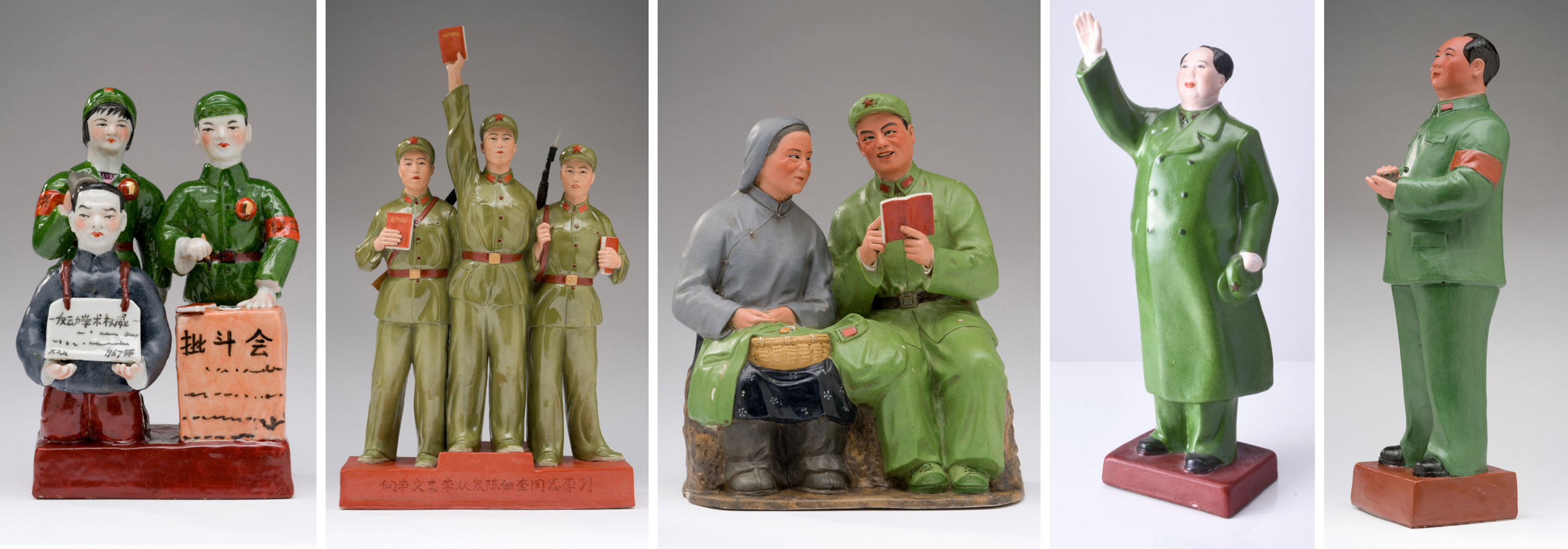
LEFT TO RIGHT
1. Criticize Reactionary Academic Authority, porcelain, 1967. Dimensions: 27.3 x 17.8 × 15.2 cm. The Story of the Chinese Cultural Revolution, told through Ceramics.
2. Learn from Comrades Li Wenzhong, Li Congquan, and Chen Diankui, porcelain. Dimensions: 53.3 x 32.1 x 13 cm. The Story of the Chinese Cultural Revolution, told through Ceramics.
3. Red Soldier teaching an old lady, porcelain. Dimensions: 28.9 × 24.8 x 17.2 cm. The Story of the Chinese Cultural Revolution, told through Ceramics.
4. A Chinese propaganda porcelain figure of Mao Tse Tung. Height: 19 cm. Auctioned in 2024 by Halls Holdings House, Battlefield, Shrewsbury, UK.
5. Mao, porcelain. The Story of the Chinese Cultural Revolution, told through Ceramics.
The Story of the Chinese Cultural Revolution, told through Ceramics is an online exhibit worth your time. Written by three scholars, Fiona Chalom, Ph.D., Li-Rong Lilly Cheng Ph.D., and Jamie Kwan, Ph.D., it's supported by the San Diego State University's Chinese Cultural Center and the San Diego Chinese Historical Museum.
LEFT TO RIGHT
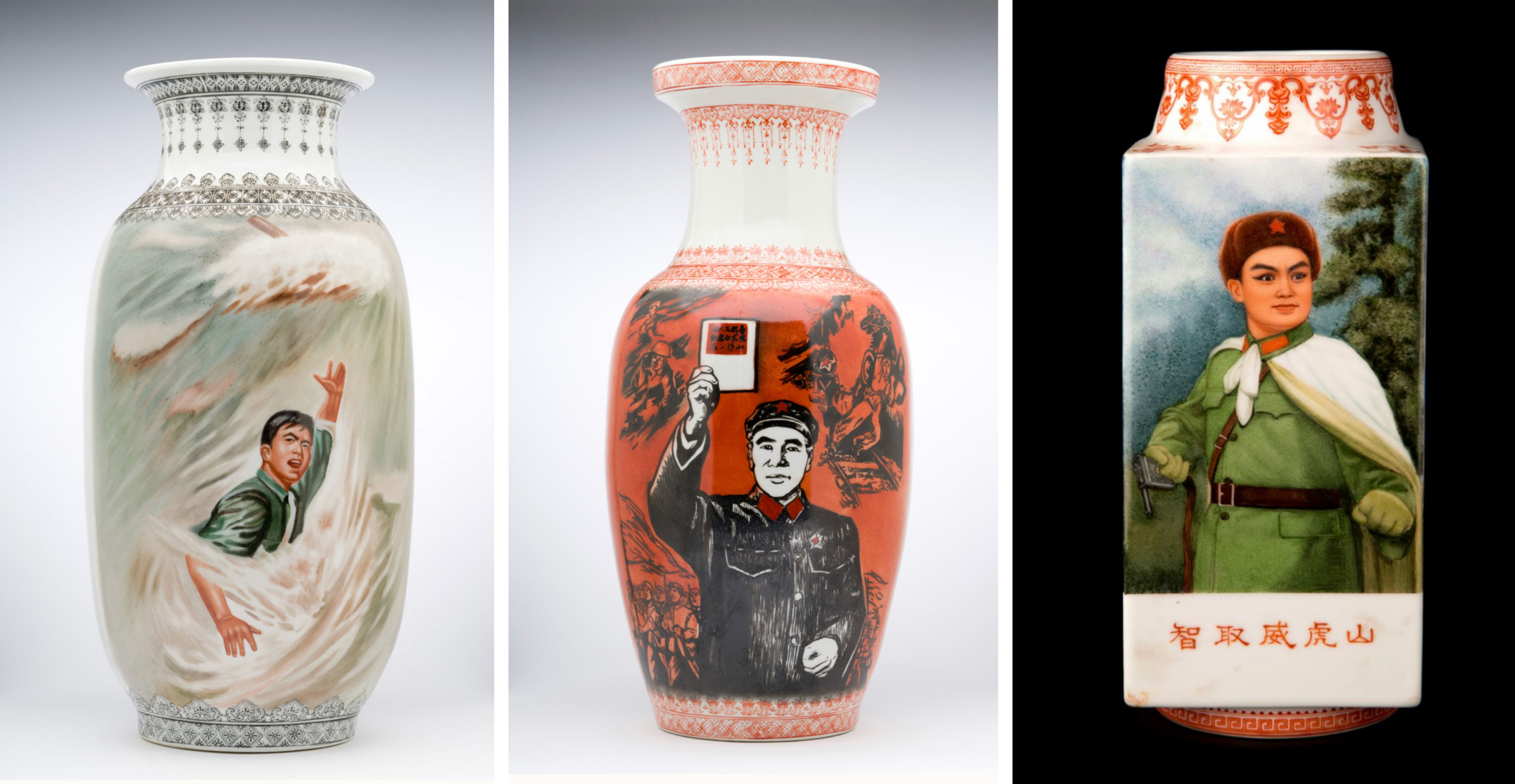
Learn from the example of revolutionaty youth, Comrade Jin Xunhua, porcelain made in Jingdezhen Art Porcelain Factory in 1972. Dimensions: height 43.8 cm, diameter 22 cm. The Story of the Chinese Cultural Revolution, told through Ceramics.
Vice-Chairman Lin Biao reads Chairman Mao’s Book, porcelain made by artist Wu Kang in 1969. Dimensions: height 47 cm; diameter 22.5 cm. The Story of the Chinese Cultural Revolution, told through Ceramics.
Rare 'cong' vase painted with propaganda subjects of the Chinese Cultural Revolution, marked 藝術瓷廠革命委員會敬絵, "Respectfully Painted by the Art Porcelain Factory for the Revolutionary Committee" in Jingdezhen. Auctioned in 2022 by Marco Polo Asian Art Auction, Milan, Italy.
Conclusion
During the Cultural Revolution, art became a battlefield, with guns pointed at canvases, porcelain vases, and posters. Under Mao and the Gang of Four, visual art and the ancient Jingdezhen porcelain craft were enlisted in the service of the revolution. The artists lost none of their technical skill, but they lost their freedom. They were no longer theaters of ambiguity, whispering multiple truths, but rather loudspeakers broadcasting one truth. The result was a landscape of objects and images that still strikes us today: refined in craft, yet constrained in spirit.
New forms were born in the ruins of tradition, but the artist ceased to wander in solitude and became the hand of the state instead. But the worst was yet to come. At least in this article.

Alyx Becerra
OUR SERVICES
DO YOU NEED ANY HELP?
Did you inherit from your aunt a tribal mask, a stool, a vase, a rug, an ethnic item you don’t know what it is?
Did you find in a trunk an ethnic mysterious item you don’t even know how to describe?
Would you like to know if it’s worth something or is a worthless souvenir?
Would you like to know what it is exactly and if / how / where you might sell it?