PUNJABI PIDHA WEDDING CHAIRS 2
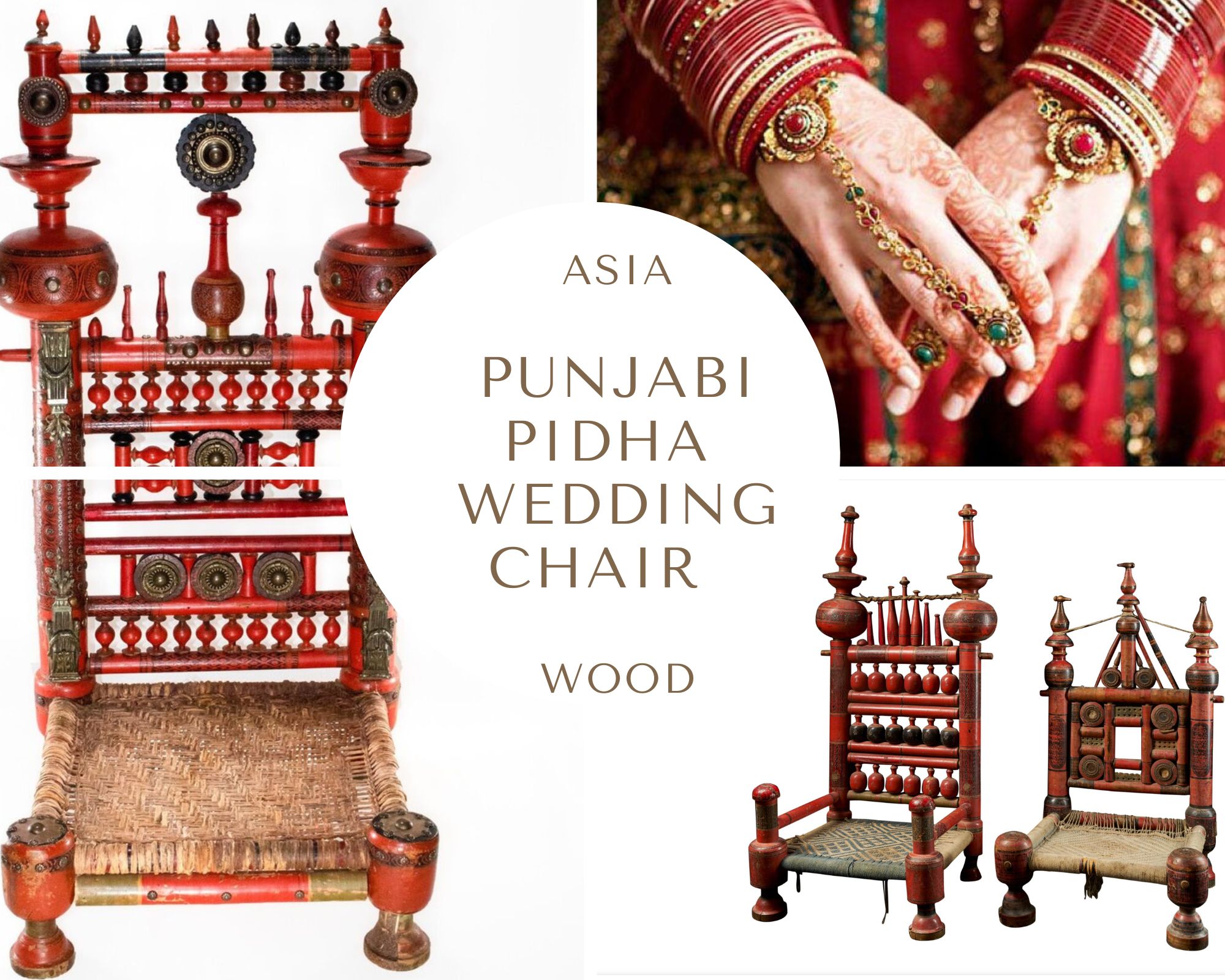
THE PIDHA: RITUAL FUNCTION AND SOCIAL MEANING
The Daaj: The Bridal Trousseau
The pidha’s deepest meanings are bound up with daaj, the Punjabi bridal trousseau. According to field research by the Design Innovation and Craft Resource Centre (DICRC) at CEPT University, families began planning a daughter’s trousseau furniture as soon as she was born. The pieces traveled with her to her husband’s home as gifts from her natal family and as a lasting sign of that family’s presence in her new life. [Design Innovation and Craft Resource Centre (DICRC), CEPT University. “The Bridal Trousseau: ‘Daaj’ Furniture” compiled by Rishav Jain. Google Arts & Culture]. Part of the trousseau was often the girl’s own work: during childhood she sewed sheets, pillows, and blankets that were later packed into a wooden chest and carried with her on her wedding day. [Myrvold, Kristina, Wedding Ceremonies in Punjab, in Journal of Punjab Studies 11, no. 2 (2004): 155–170].
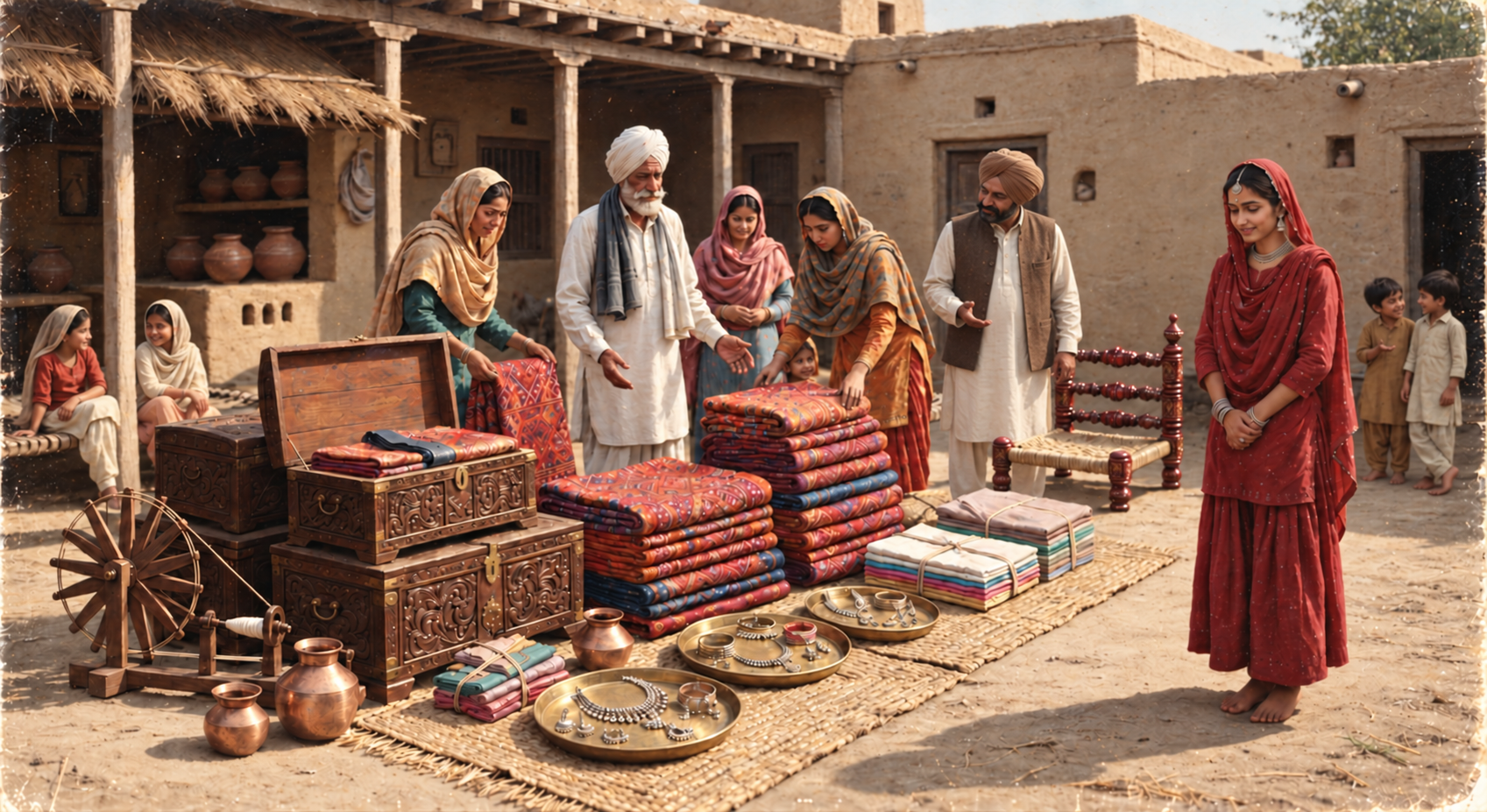
AI-generated illustration of a daaj display; not a historical record.
In Punjabi, daaj (ਦਾਜ) means dowry: the cash, clothing, jewelry, furniture and household goods that a bride’s father, brothers and other relatives give at her marriage. It is distinct from vari (ਵਰੀ), the clothes, jewelry and fine shawl that the groom’s family sends to the bride, traditionally at the wedding and today often at the shagun. Families present both as gifts of love, and both were traditionally put on display. But they are not equal halves of one trousseau. Daaj is far larger. Although dowry has been illegal in India since 1961, survey data show it was paid in about 95 percent of rural Indian marriages between 1960 and 2008, and Punjab is among the states where it rose. The Bridal Trousseau: ‘Daaj’ Furniture is DICRC’s Google Arts & Culture exhibit. It has photos of sandooks, manjas, charkhas, pakkhis, innus and a palang, all Daaj objects.
Anthropologists have long debated how to read such gifts. Jack Goody described dowry as a kind of “pre-mortem inheritance”: a daughter’s share of family property, handed over at marriage rather than at death. [Goody, Jack, and S. J. Tambiah, Bridewealth and Dowry, in Cambridge Papers in Social Anthropology 7. Cambridge: Cambridge University Press, 1973. Chan, William, Marital Transfers and Welfare of Women, in Proceedings of the International Conference on Applied Economics (ICOAE) 2011, 125–142. University of Hong Kong repository].
In South Asia the model has clear limits. How much control a bride kept over her goods varied, and over the 20th century what had been framed as voluntary giving hardened, in many families, into demands from the groom’s side that strained the bride’s family and exposed women to harassment and violence. Daaj furniture belongs to both stories. It expressed care and social standing, and it sat inside an economy of obligation.
DICRC lists the sandook (chest), manja (charpoy bed), charkha (spinning wheel), pakkhi (hand fan), and innu (a decorated ring for carrying a pot on the head) as the items most commonly given, with a blanket (khes), mattress (gadda), chest (peti), or chair (kursi) sometimes added. Several were made by women themselves: a bride-to-be decorated her own pakkhi and innu with colored thread, beads, and small bells. Furniture also made status visible. One villager told the DICRC team that a very large, richly ornamented sandook marked a daughter from a socially prominent family.
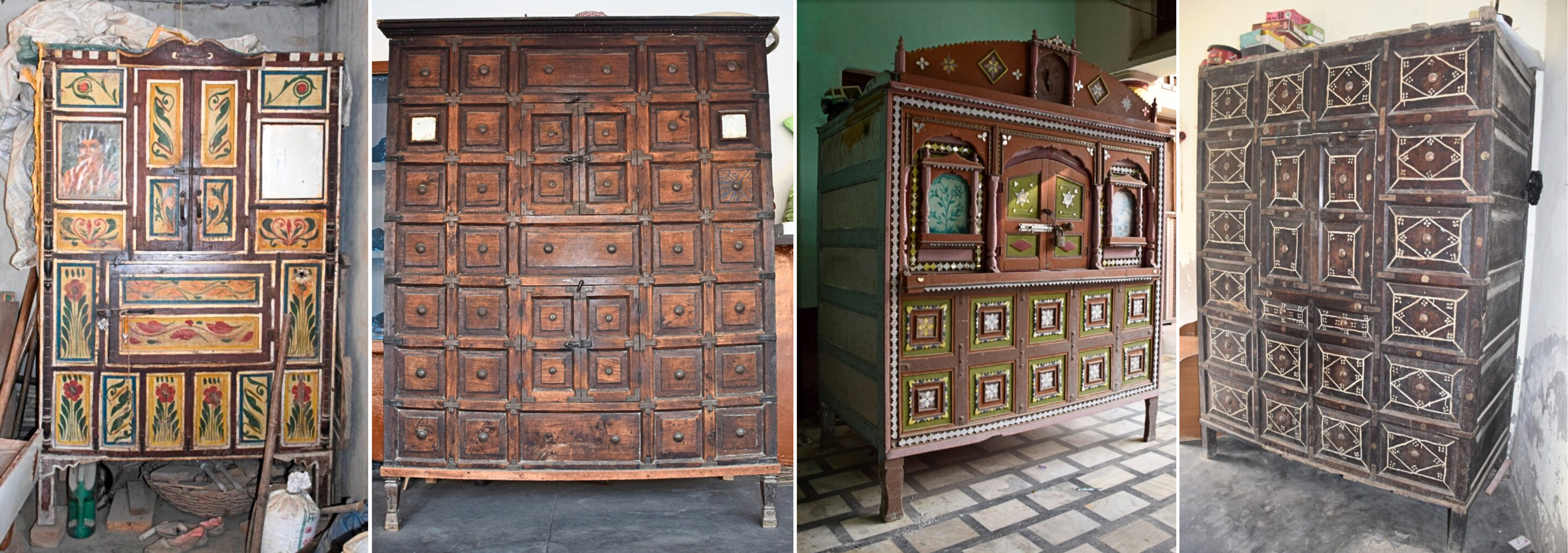
Punjabi sandooks.
The first on the left is a sixty years old piece, made from neem wood and elaborately painted. The last on the right hides a secret compartment in the shelf inside, which could be accessed by a sliding shutter. Craftspeople often designed sandook with hidden compartments that would be known only to the owner and were used to keep valuables and money. Traditionally, the entire sandook including the ornamentation and painting would be done by the mistri (carpenter) himself. The mistri would design the sandook based on the cost as budgeted by the owner.
Source: Vernacular Furniture of India by the Design Innovation and Craft Resource Centre (DICRC), India in collaboration with The South Asian Decorative Arts and Crafts Collection Trust (SADACC), UK.
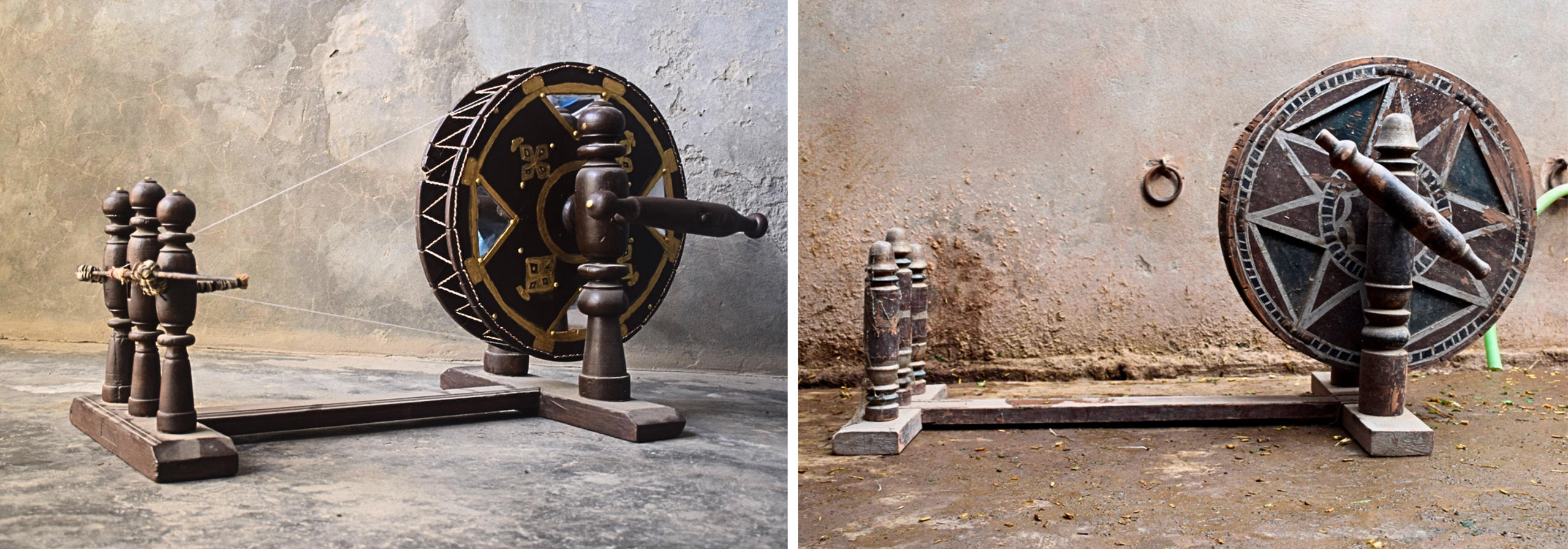
Punjabi charkhas or spinning wheels.
Cotton grows extensively across Punjab and this is directly related to the common use of charkha across the region. Women generally use a charkha while sitting on a pidhi (stool). Smaller objects like the boia (baskets) are used alongside the charkha. While the cotton is placed in one boia, another one is used to collect the yarn of thread being spun. The women make use of the spun cotton threads to weave or knit textile that is further used to make clothes, or decorate objects like pakkha (fun) or changair (low baskets). Source: Vernacular Furniture of India by the Design Innovation and Craft Resource Centre (DICRC), India in collaboration with The South Asian Decorative Arts and Crafts Collection Trust (SADACC), UK.

Didascalia/fonte dell’immagine

Alyx Becerra
OUR SERVICES
DO YOU NEED ANY HELP?
Did you inherit from your aunt a tribal mask, a stool, a vase, a rug, an ethnic item you don’t know what it is?
Did you find in a trunk an ethnic mysterious item you don’t even know how to describe?
Would you like to know if it’s worth something or is a worthless souvenir?
Would you like to know what it is exactly and if / how / where you might sell it?