The Hmong Embroidery 2
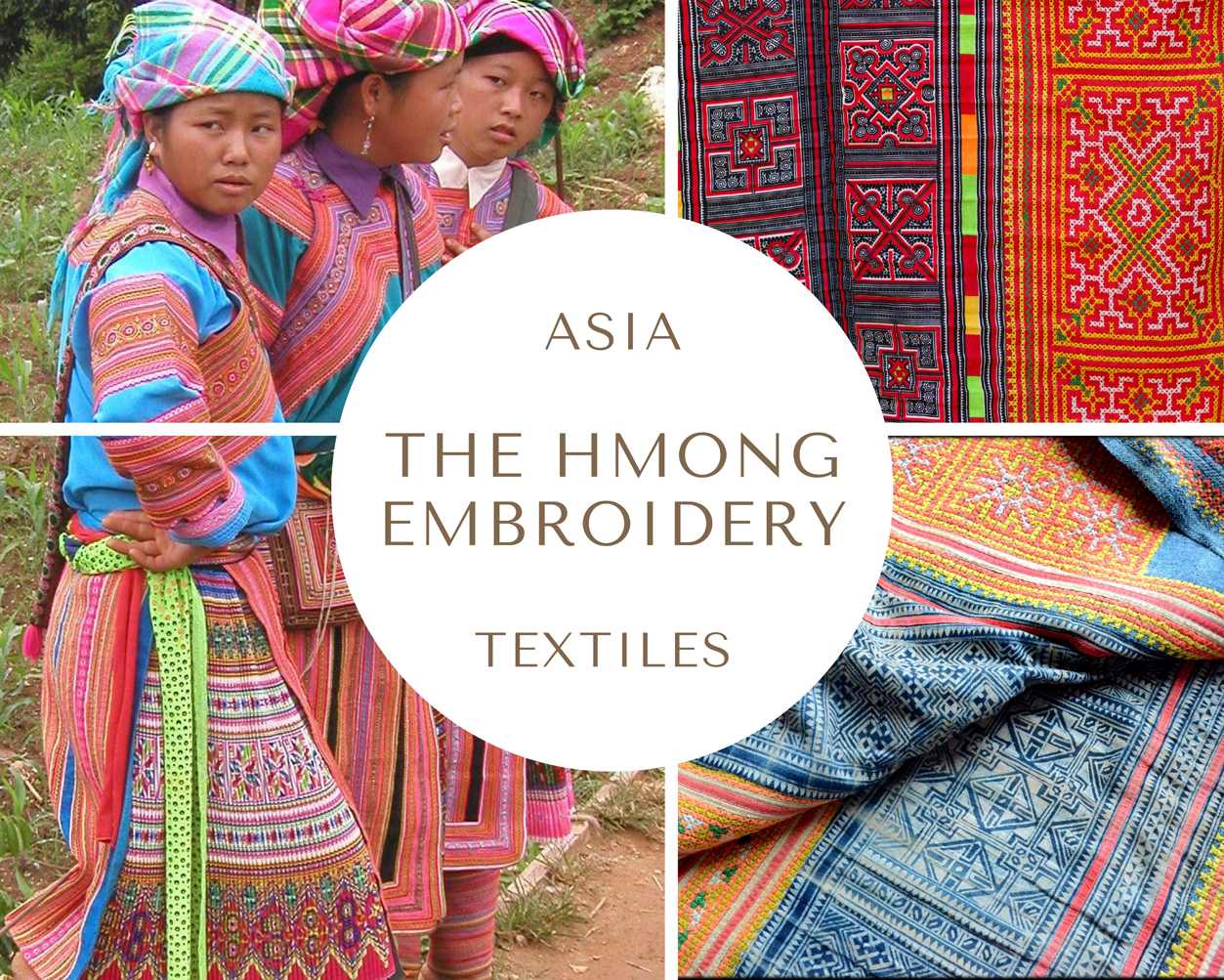
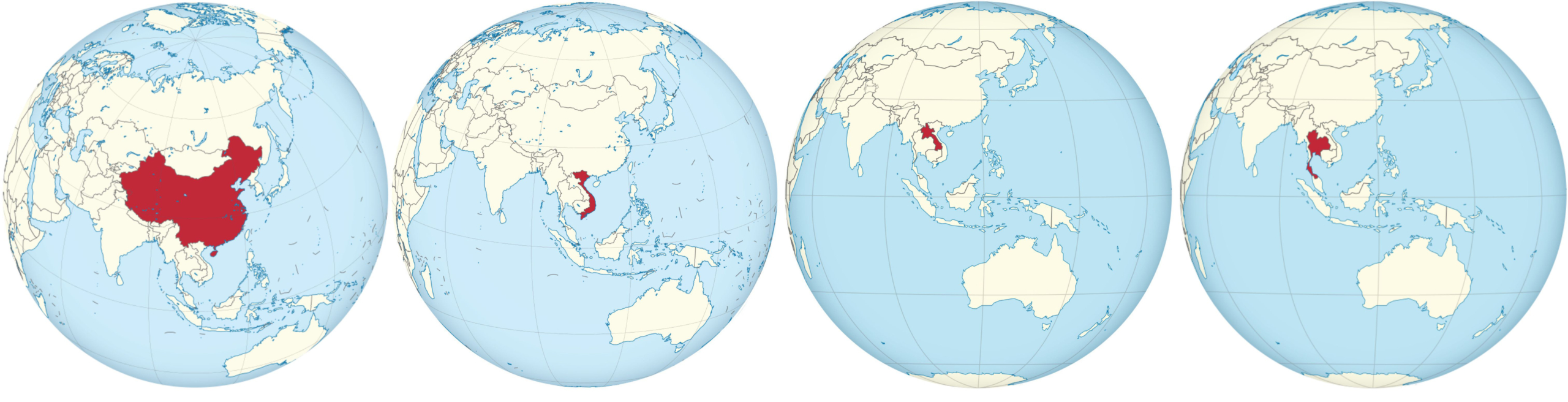
China, Vietnam, Laos, and Thailand on the globe.
Licensed under the Creative Commons Attribution-Share Alike 3.0 Unported.
A PEOPLE OF MANY COLORS
White, Green, Black, Red, Flower: Untangling the Hmong Subgroups
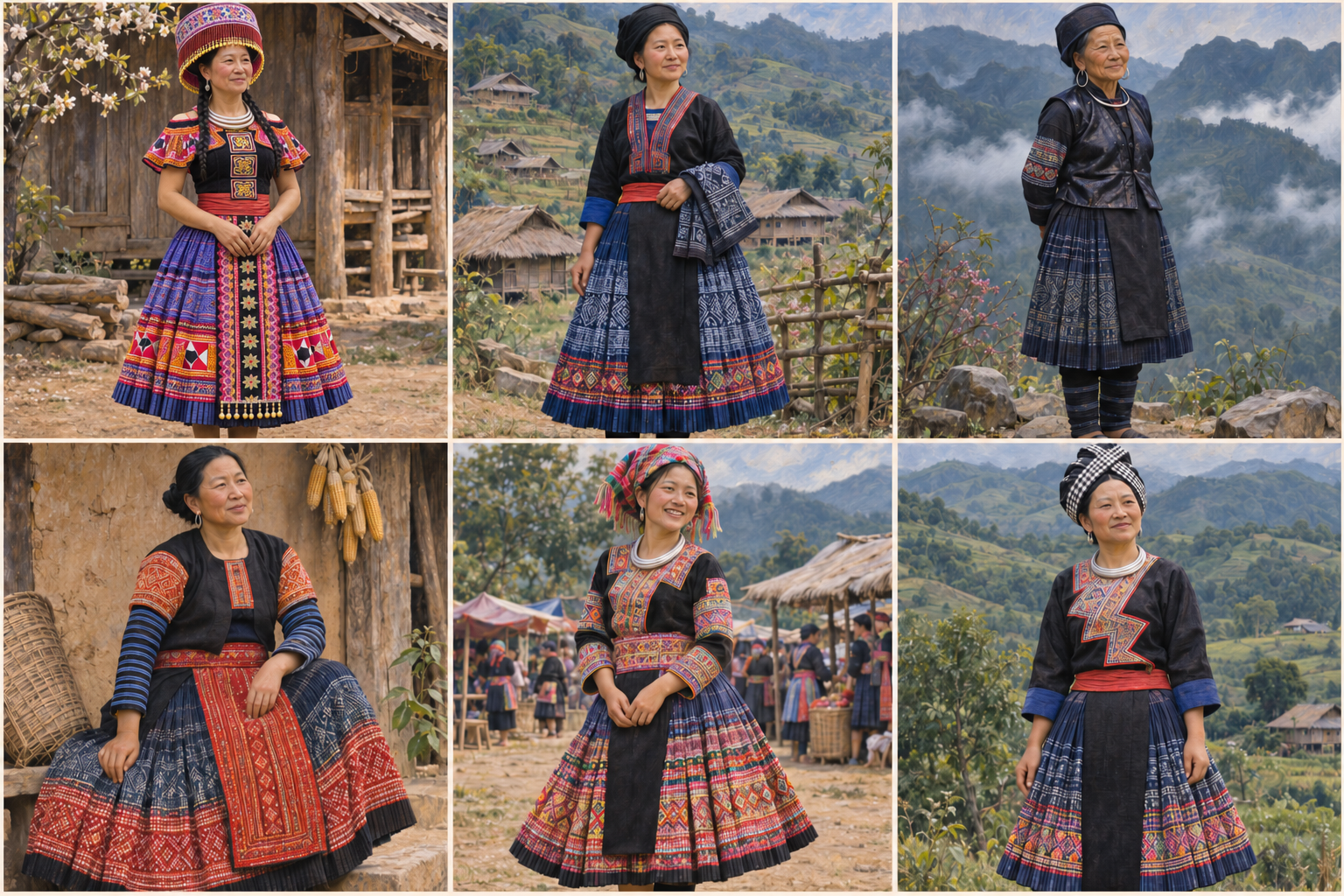
Imagined women in the dress of several Hmong subgroups.
AI-generated illustration. The figures are imagined composites inspired by the dress of several Hmong subgroups. They are not photographs of real people or records of any single community. For documented dress, see the dated and credited photographs and museum objects throughout this chapter.
Why the colors mislead
White, Green, Blue, Black, Red, Flower, Striped: the names seem to promise an orderly classification. They suggest a people divided into recognizable branches, each with its own color, costume, and place on the map. But the apparent order dissolves as soon as we cross a border—or sometimes move from one valley to another.
These labels belong to overlapping histories. Some occur in Chinese descriptions of the southwestern frontier. Others appear in Vietnamese ethnology, Lao and Thai usage, museum catalogs, or the language of tourism. Some have become important self-designations. A color may identify a locally meaningful community, a style of dress, a broad linguistic grouping, or a population quite different from the one bearing a similar name elsewhere.
The distinctions can be locally important. Understanding them requires us to ask who uses a name, for whom, where, and when. A garment, a language, a clan, and an official ethnic category describe different kinds of belonging, whose boundaries may overlap or diverge. [1, 2, 3]
The clearest trap is “Black.” In descriptions of southeastern Guizhou, Black Miao commonly refers to the Hmu. The Black Hmong discussed in research on Sa Pa (or Sapa), Vietnam, speak a different Hmongic language variety. The resemblance between the English labels does not make them the same population. [4, 5, 6]
Throughout this chapter, “Hmong” is used as an inclusive English term for the communities under discussion, including people who prefer “Mong.” Where a particular community, speaker, or author uses another form, that preference is retained. “Hmongic” names a linguistic branch; “Miao” refers principally to the Chinese official nationality or to a historically situated Chinese label. Broader identifications linking Hmong and Miao are discussed in their own contexts. [4, 7, 8, 9]
Hmong and Miao are not interchangeable categories
In China, Hmong are generally classified within the Miao nationality, one of the country’s 55 recognized minority nationalities alongside the Han majority. The 2020 census recorded 11,067,929 people as Miao. That figure is an ethnic-category total, not a count of speakers of Hmong alone. [10]
A familiar overview distinguishes Hmong, Hmu, Xong or Qo Xiong, and A-Hmao. These are four prominent groupings within a more diverse population. Their associated languages are distinct, and the wider linguistic landscape contains further divisions. [4, 9]
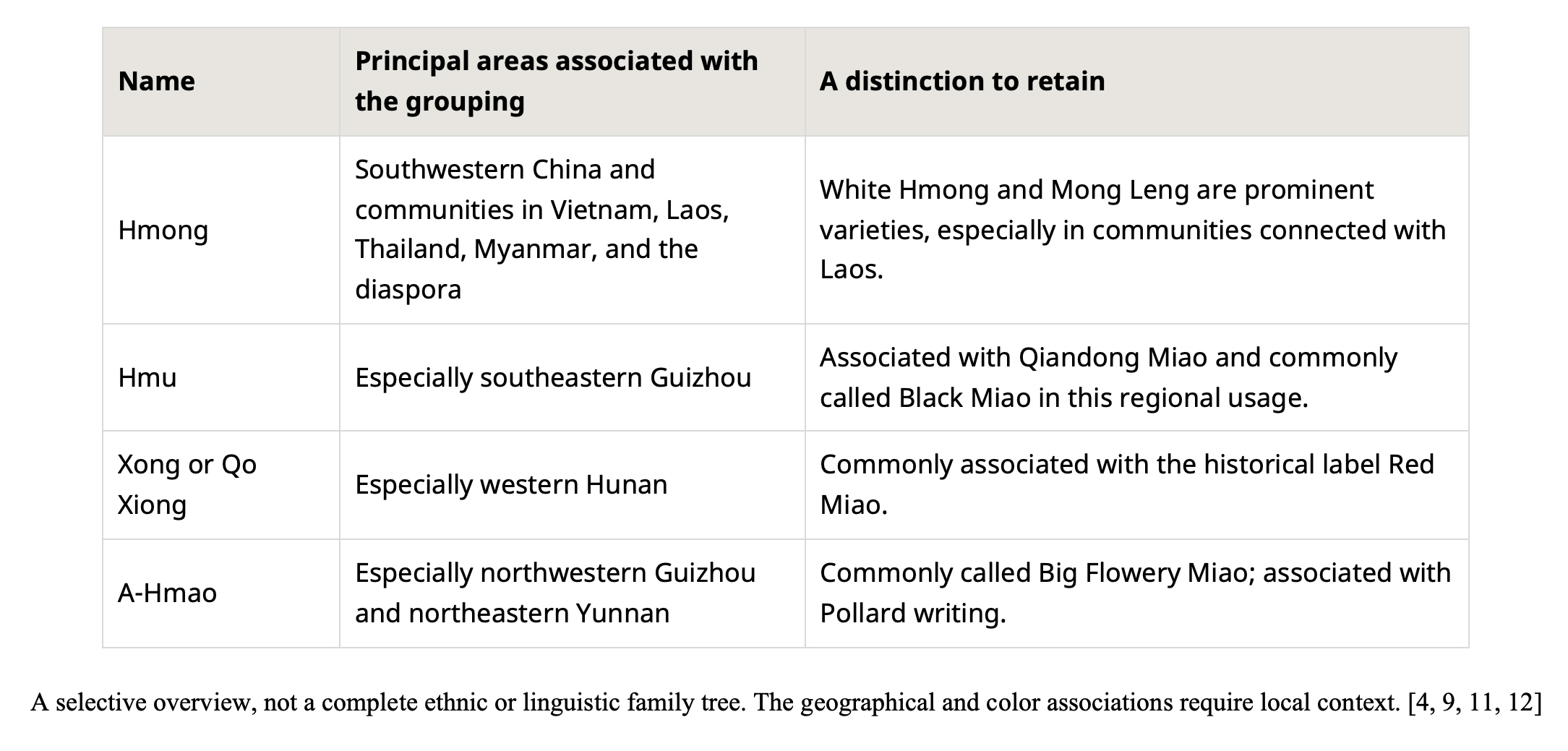
Several levels of classification must therefore be kept apart. Hmong–Mien is the language family. Hmongic is one of its two principal branches; Mienic is the other. Within Hmongic, West Hmongic is broader than the White Hmong–Mong Leng comparison that dominates much English-language writing. A-Hmao also belongs within West Hmongic in influential classifications. “Hmong,” “Hmongic,” and “West Hmongic” are not synonyms. [4]
The Chinese term Chuanqiandian—“Sichuan–Guizhou–Yunnan”—adds another difficulty because it occurs at different levels in different classificatory schemes. A reference to a Chuanqiandian branch, a subdialect, or a local variety needs to be read within the particular linguist’s system. It cannot safely be substituted for every other Western Hmongic label. [13, 14]
The written Western Miao standard associated with Dananshan in Guizhou belongs to this wider picture. Michael Johnson’s research shows that the standard incorporates features of neighboring varieties as well as Dananshan speech. It represents one particular process of standardization within the larger Miao linguistic field. [13]
The administrative name itself has a long history. “Miao” appears in Chinese texts with changing referents, while the modern nationality emerged through 20th-century processes of classification and identification that also involved minority participation. Broader affiliations continue to develop. Gary Yia Lee describes transnational encounters in which people identified as Hmong or Miao recognize one another as belonging to a larger community despite differences in language. [9]
Material culture makes these distinctions especially important. Some of the best-known large silver horn headdresses come from Hmu communities in southeastern Guizhou. Their makers and wearers should be identified as precisely as the evidence allows. “Miao silver” may be an appropriate regional or administrative description; it is not automatically a precise attribution to the Hmong communities of Laos or Vietnam. [6, 15, 16]
Dress in Guizhou alone shows how much the single word Miao contains. China Daily, reporting on Xijiang, a large Hmu village in Leishan County, cites the photographer Miao Xiaoliang’s count of nearly 170 documented costume systems in the province. [17] The festival dress of southeastern Guizhou is the most famous of them. At an exhibition of Guizhou Provincial Museum holdings in Hangzhou, three festive women’s costumes from Leishan, Huangping, and Taijiang were shown as distinct local styles, and the silver horn from Xijiang rose about 80 centimeters from the silver crown to which it was fixed. [18] Silver of this kind was reserved mostly for festivals and, most often, for unmarried women. It went with a bride as dowry and was eventually passed on to her children; the smiths themselves were men who learned the craft from their fathers. [19]
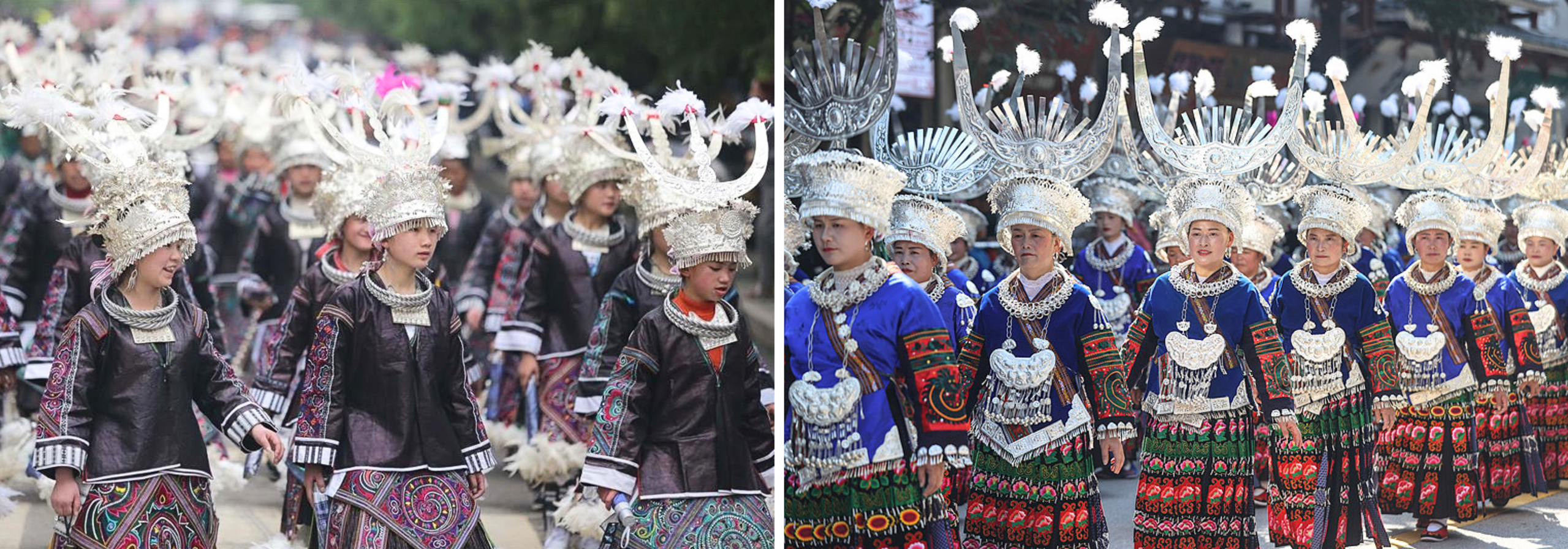
LEFT: Miao women in embroidered dress and elaborate silver headdresses take part in a traditional costume parade in Danzhai County, Guizhou, China, on May 1, 2016. More than 1,300 people from six local townships joined the parade. Photo: Zhang Hui/Xinhua.
RIGHT: Miao parade during the New Year Festival in Guizhou, China.
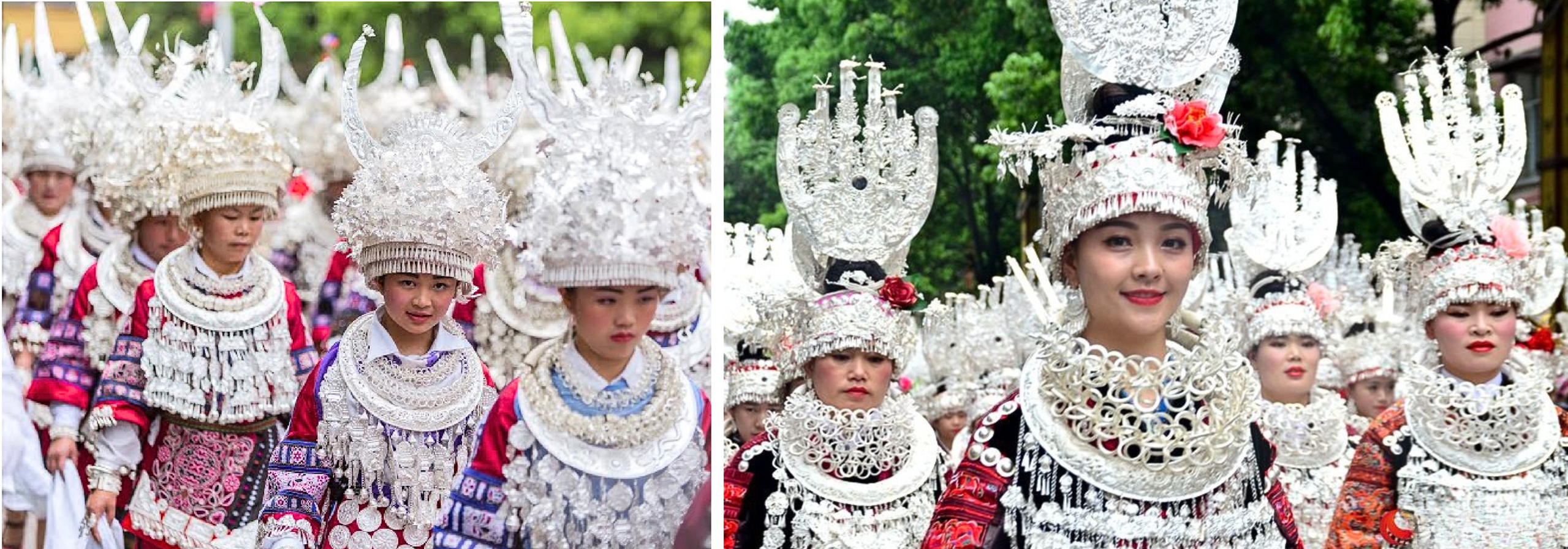
Miao girls wearing traditional festival attire during a parade in China.
Other branches dressed very differently. The museum of Academia Sinica’s Institute of Ethnology describes the traditional attire of the Miao of western Hunan, where the Xong are concentrated, as closely resembling that of their Tujia and Han neighbors. Its distinguishing feature is the embroidered geometric border, often bought ready-made at market and sewn onto clothing. [20] A Hmong Cultural Center doll dressed as Dahua, or Big Flowery Miao, the costume name most often linked with A-Hmao, wears a headdress of orange yarn and yellow ribbons and a silver neck ring; the center notes that a real jacket in this style would be white, and the skirt made of hemp with bluer coloring. [2] Change has reached China as well. The British Museum notes that Miao women have often replaced the tightly pleated skirt with trousers for everyday wear, and that synthetic yarns and plastic beads increasingly enter their costumes. [21]
Chinese color names and the imperial gaze
The Qing Miao albums show how naming could become an instrument of government. These illustrated manuscripts presented non-Han populations of China’s southwestern frontier through paintings and accompanying descriptions of dress, livelihood, and custom. Their contents were not limited to populations now classified as Miao. [22, 23, 24]
Leiden University Libraries’ collection research documents official sponsorship no later than the Yongzheng reign, 1723–1735. Some albums helped officials familiarize themselves with the peoples they governed; others circulated in different settings, including collecting and export. Their varied purposes and manuscript histories help explain the uneven classifications they preserve. [22, 23]
Dress was one of the features through which compilers made difference visible. The albums also expressed distinctions between “raw” and “cooked” populations: categories connected with incorporation into imperial order and judgments about civilization. Their descriptions reveal the observers’ political assumptions as well as the people observed. Zavidovskaia’s study of Guizhou albums further emphasizes the importance of manuscript genealogy and the written sources on which descriptions depended. [23, 24]
Chinese historical usage includes White, Black, Red, Green or Blue-Green, and Flowery Miao. Yet these names are not a translation key. Tapp’s examples show that people called Bai Miao, “White Miao,” in China cannot automatically be identified with Southeast Asian White Hmong. He explicitly cautions that Qing Miao does not equate with Green Hmong in Guizhou. [11, pp. 80–83 and note 10]
Collections call for the same caution. The museum of Academia Sinica’s Institute of Ethnology catalogs women’s festival dress of the Qing (Blue) Miao of Guizhou, worn for the Flower Dance Festival in the first or fifth lunar month, with geometric motifs and a sun-like design on the back of the jacket. [20] Nothing in that record connects its wearers with the Blue or Green Hmong of Laos and Thailand; the shared color word is a matter of translation, which is precisely Tapp’s warning.
The more specific Big Flowery Miao is commonly associated with A-Hmao. Work on the script known as Pollard writing began in 1904 and developed through Samuel Pollard’s collaboration with others. Its association with A-Hmao should not be confused with the Vietnamese label Flower Hmong. A similar floral adjective does not establish a common language. [4, 12, 25]
White Hmong and Mong Leng in Laos
White Hmong and Mong Leng are particularly prominent in accounts of Laos, Thailand, and communities descended from Lao refugees. Their languages are closely related, and their names often identify wider cultural affiliations. But this comparison does not exhaust Hmong diversity outside China: Johnson, for example, documents Hmong Sa in Myanmar and Thailand. [13, 26, 27]
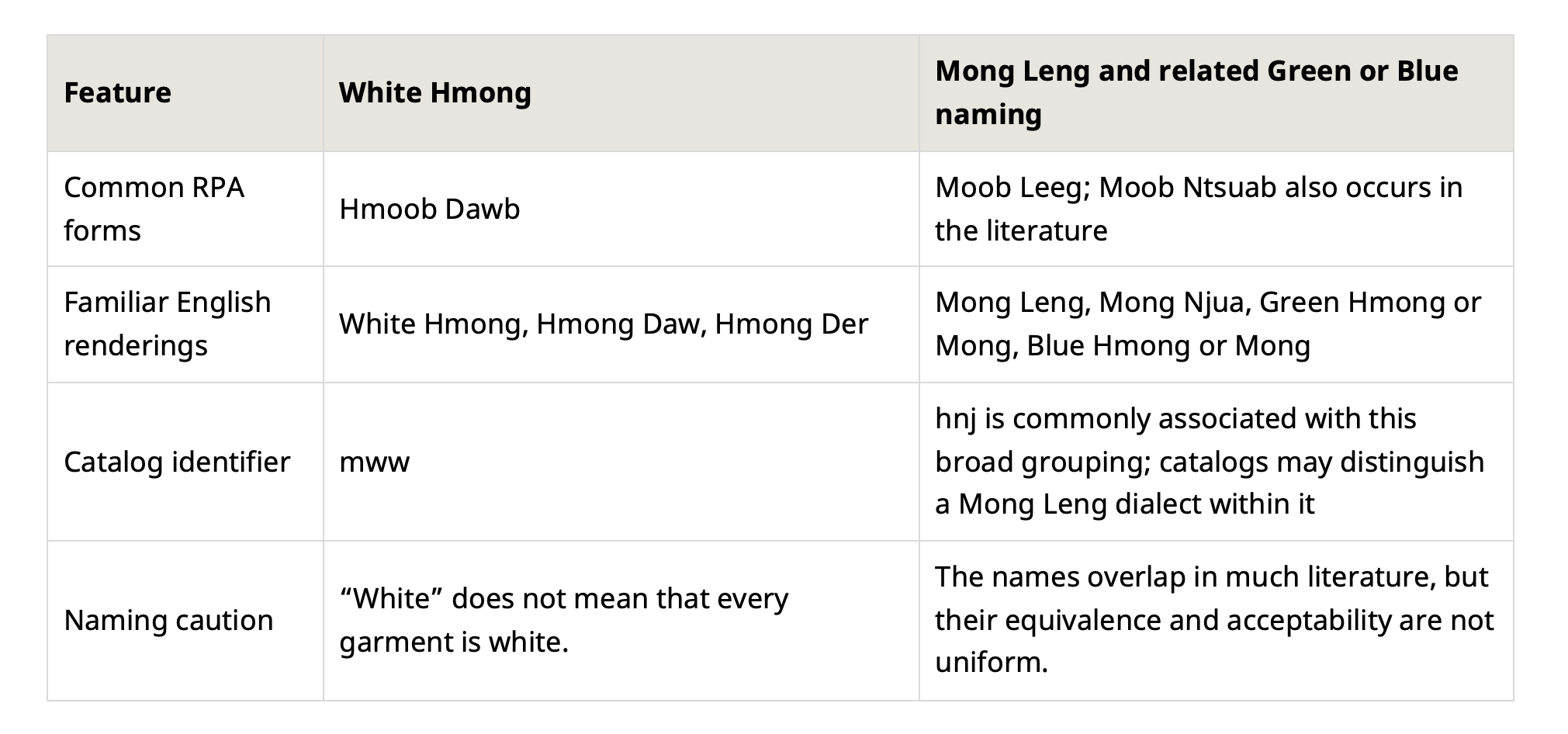
RPA is the Romanized Popular Alphabet. Catalog codes identify language records; they are not codes for costumes. [26, 28, 29] RPA was developed in Laos in the early 1950s. Its word-final letters generally mark tone and associated voice quality rather than pronounced final consonants; one tone is left unmarked. English spellings such as Hmong Daw and Hmong Der are conventional renderings, not exact guides to pronunciation. [26, 29]
The difference between Hmoob and Moob reflects a real sound contrast. White Hmong has a voiceless nasal represented by the two letters hm, where Mong Leng uses a voiced nasal. Other regular correspondences distinguish the varieties, including White Hmong siab and Mong Leng sab, “heart” or “liver.” [26, 30]
They are often described as mutually intelligible, though this should not be understood as effortless comprehension by every speaker. Exposure matters. Bruhn reports that White Hmong speakers may find Mong Leng more difficult than Mong Leng speakers find White Hmong. The familiar comparison with British and American English is an explanatory analogy, not a measurement. [26, 31]
Print and teaching have also affected the relationship. Older educational accounts describe White Hmong as better represented in dictionaries and written materials. That historical advantage concerns access and circulation. In comparative linguistic terms, Bruhn’s work treats White Hmong and Mong Leng as related descendants with regular correspondences between them. [30, 32]
“Blue” and “Green” often name the same broad grouping. Geddes’s 1976 ethnography uses Blue Miao in its title; Lyman’s publications use Green Miao. Both usages belong to the scholarly record. The color word ntsuab has been associated with a range extending toward blue, although Hmong also has xiav for blue. Translation helps explain the English variation, but community history and naming preferences matter as well. [27, 33, 34, 35]
Some speakers prefer Mong Leng and object to Green Hmong or Moob Ntsuab. Others have used the latter names without objection. Paoze Thao’s explanation of Mong Leng as the “veins” or lifeblood of the Mong is a stated interpretation, not an agreed historical etymology. [7, 8]
There is also disagreement about how the names divide linguistic varieties. Linguist William Johnston distinguishes Green Mong and Mong Leng as closely related varieties, while acknowledging that they are often treated as the same dialect. This is another reason to identify a speaker’s or researcher’s usage instead of deciding that the names must be interchangeable everywhere. [36]
White Hmong dress
Among the Hmong described by Robert Cooper and his coauthors, writing mainly about Thailand, dress once marked the line between White and Green Hmong with unusual clarity. They described Green Hmong women in batiked, embroidered, pleated “blue” skirts, and White Hmong women in blue trousers like their men, putting on a plain white skirt at New Year. In this setting, they added, batik was known only to Green Hmong women—a statement that would not hold in Vietnam, where Black and Flower Hmong also draw with wax. [27]
Men’s trousers differed as well. White Hmong men wore a high-crotched cut like that of lowland Lao and northern Thai; Green Hmong men wore a very baggy pair whose legs join just above the feet. [27]
The white skirt is itself a feat of hemp work. A White Hmong pleated skirt in the Hmong Cultural Center’s collection is made of hemp whose stems were stripped, soaked, pounded into yarn, woven, and bleached. It carries no embroidery or appliqué, and the center notes that until very recently White Hmong did not embroider or appliqué their skirts at all. [2] Above it, the festive ensemble of Xieng Khouang layers a white blouse beneath the jacket; front and back aprons, with a green sash over the front and a red one over the back; an embroidered and beaded belt; and the silver xauv neck ring. The turban was traditionally a long strip of indigo or purple cloth resembling cheesecloth, crossed with the black-and-white band called siv ceeb. Pre-sewn hats in many colors have largely replaced it. [2]

Alyx Becerra
OUR SERVICES
DO YOU NEED ANY HELP?
Did you inherit from your aunt a tribal mask, a stool, a vase, a rug, an ethnic item you don’t know what it is?
Did you find in a trunk an ethnic mysterious item you don’t even know how to describe?
Would you like to know if it’s worth something or is a worthless souvenir?
Would you like to know what it is exactly and if / how / where you might sell it?