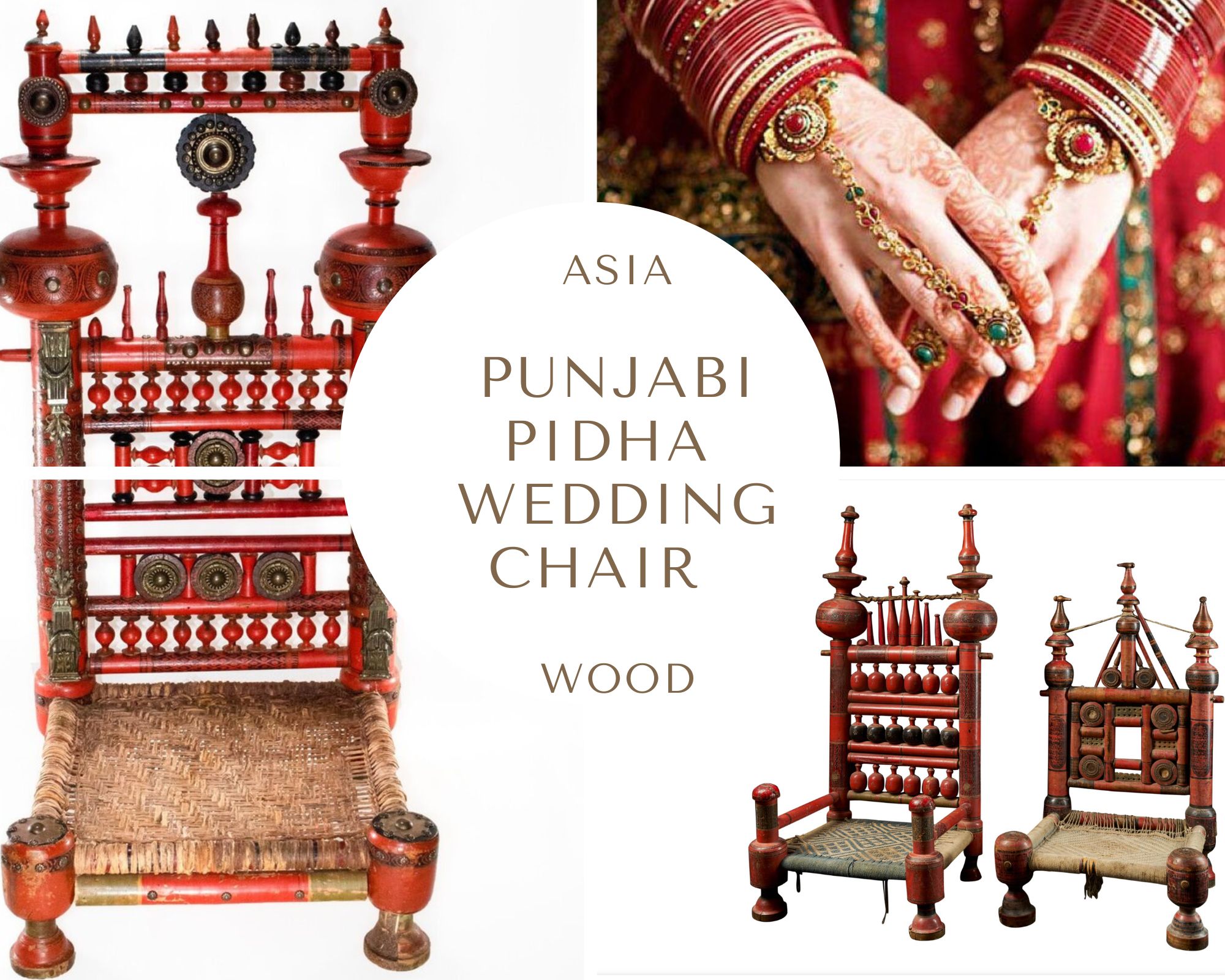
PUNJABI PIDHA WEDDING CHAIRS
A CHAIR IS NEVER JUST A CHAIR
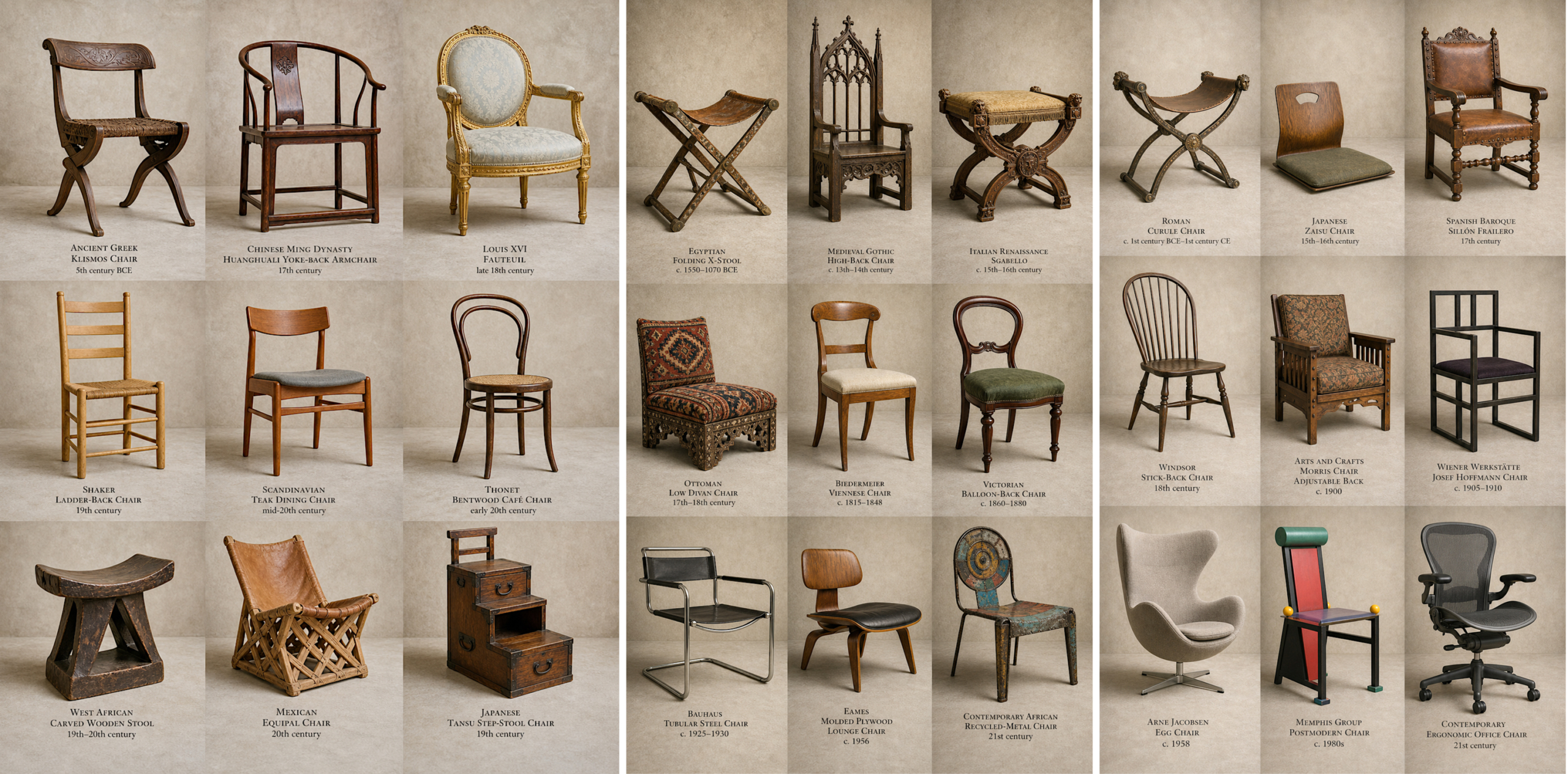
This triptych of chair “mosaics” offers a compact history of sitting, seen through real designs from different cultures and epochs. From ancient ceremonial stools to modern industrial icons, each piece condenses a specific way of living: materials, techniques, posture, and social hierarchy. Egypt and Greece already used the chair as a marker of rank, while in China and Europe it gradually became a more domestic, everyday presence. The 18th and 19th centuries multiplied types and styles, from refined courtly seats to mass‑produced café chairs, and the 20th century turned the chair into a laboratory of modern design. Today, contemporary artisans—from Scandinavia to West Africa or Mexico—continue to reinvent this basic object, transforming simple supports for the body into small sculptures and condensed stories of material culture.
The chair is both humble and sovereign. It is one of the most ordinary objects in human life, yet it condenses some of the deepest questions of civilization: the body, hierarchy, rest, authority, gender, labor, death, ritual, domesticity, and power. Formally, it has barely changed across millennia — a surface raised from the ground, a support for the back, sometimes arms, sometimes nothing more than a simple stool. And yet it is symbolically inexhaustible.
- The Body and the Seat
At its simplest, a chair is an answer to an anatomical fact: the body tires. The chair receives the body, lifts it from the ground, steadies it, frames it. It is a small architecture built around the seated human figure. Unlike the bed, which allows the body to dissolve into sleep, or the table, which organizes action, the chair holds the body in a state between rest and readiness. The seated person is not lying down, not working with the full body, not absent — but available: for speech, judgment, conversation, command, eating, writing, listening, teaching, waiting, remembering.
This is why the chair is never merely functional. It does not simply support the body; it gives the body a position in the world.
Merleau-Ponty observed that the body is not an object we have but a perspective we are — the point from which all other space is organized. The chair is one of the first objects that formalizes this. It gives the body a fixed orientation: a direction, a height, a relation to the surrounding room. To sit in a chair is to become legible — to others, to institutions, to oneself. The chair makes the body social.
In this sense, the chair is one of the first technologies of civilization. Not because sitting requires civilization — humans have always sat — but because the chair formalizes sitting. It separates the body from the earth. It marks a difference between ground and status, between floor and elevation, between the common surface of life and a designated place. To sit on a chair is to occupy a constructed position.
- Elevation and Authority
That elevation matters. A chair raises the body, even if only slightly. And this small vertical difference becomes symbolically immense.
The throne is only the most obvious example. A throne is not a different object in kind; it is a chair intensified into sovereignty — a chair that has become image, ideology, and theater. It makes authority visible. The king, judge, bishop, chief, or patriarch does not merely sit; they are seated. Their position is staged as legitimacy.
This is why “the chair” can mean office, rank, or institutional authority. We speak of the chair of a department, the chair of a committee, the chair of a board. The object becomes an abstraction. The seat becomes the role. The furniture becomes the institution. Whoever occupies the chair temporarily embodies a power that exceeds the individual body — a power that will outlast them when they rise.
The chair, then, is a sign of possession: one’s place, one’s rank, one’s function, one’s right to be there.
But the chair is also a sign of exclusion. Every chair silently asks: who is allowed to sit? Who must stand? Who serves? Who waits at the edge of the room? Who sits at the head of the table, who sits near the door, who has no chair at all? In domestic, religious, political, and colonial spaces, seating arrangements encode power with extraordinary precision. In many colonial contexts, the introduction of European furniture was itself an act of cultural imposure — the table and chair replacing the mat, the floor, the communal crouch, translating European bodily habits into architectural law. The chair distributes dignity. It also withholds it.
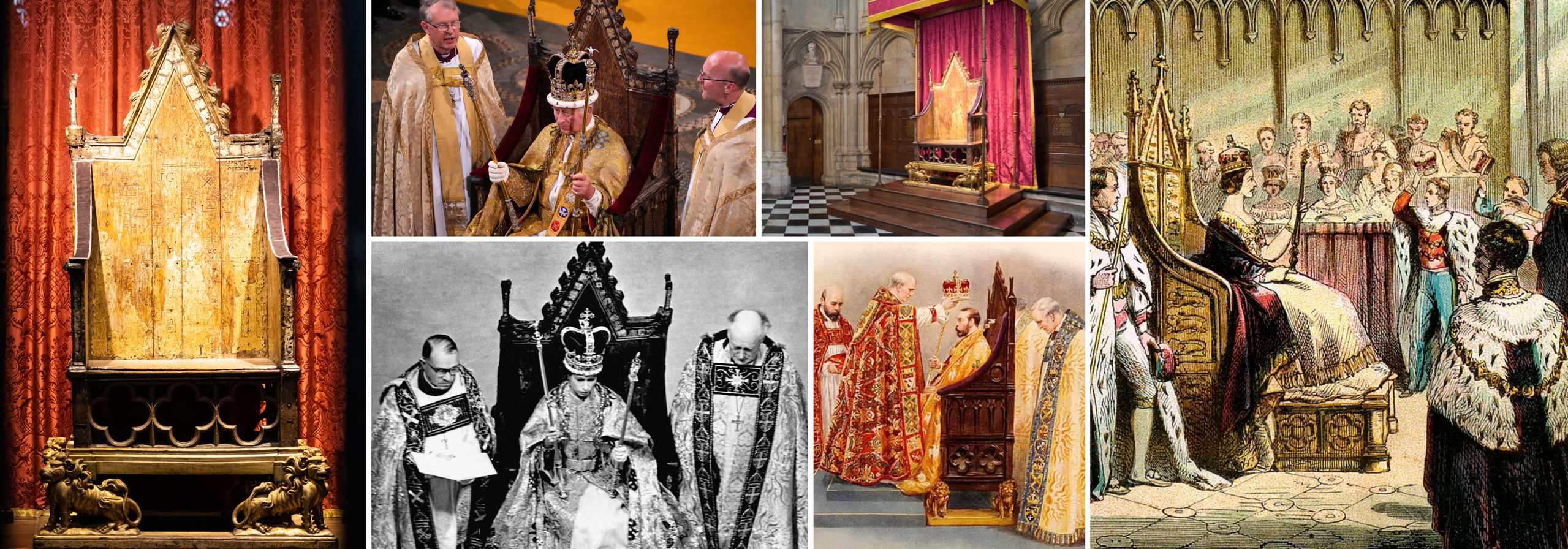
The Coronation Chair: The Most Political Seat in the World
The Coronation Chair is an oak chair of no great beauty. Compared with a Louis XV throne or a Baroque papal sedia gestatoria, it is almost austere: a medieval carpenter’s object, not a triumph of courtly display. Yet what it lacks in visual splendour it makes up for in symbolic density. Made in 1300–1301 by order of Edward I, it has stood at the centre of English and British coronations for more than seven centuries. It has been used in coronation ceremonies since 1308, and certainly for the act of crowning since 1399. Few objects in the Western political imagination can claim that kind of continuity.
And yet the chair is, in a precise sense, not the point. The point is what was placed beneath it.
In 1296, during the First Scottish War of Independence, Edward I seized the Stone of Scone, the ancient inauguration stone of Scottish kings, and brought it to Westminster Abbey. The chair was then made to contain it. This was not merely a throne to express English majesty. It was also a reliquary of conquest: a wooden structure built around a captured symbol of Scottish sovereignty. Every monarch who sat upon it was, literally and deliberately, enthroned above Scotland.
The Coronation Chair is therefore not only a sign of English authority. It is a sign made from the negation of another authority. Its power is relational, imperial, and colonial. It means what it means because it contains — or once contained — something taken.
The chair’s biography is also a history of damage, desecration, and political assault.
In the 18th and 19th centuries, Westminster schoolboys and visitors carved their names into it. This was not a revolution, but it matters: the sacred object was treated, at times, as a piece of old furniture. Its aura was cut into by penknives.
In 1914, suffragettes planted a bomb near the Coronation Chair. The explosion knocked off a corner of the chair and may have cracked the Stone. Women excluded from full political citizenship attacked one of the supreme objects of the political order that excluded them. It was an extraordinarily literal gesture: if the constitution would not make room for them, they would strike at the seat of constitutional power itself.
Then, on Christmas Day 1950, four Scottish nationalist students broke into Westminster Abbey and removed the Stone from beneath the chair. During the removal, the Stone broke in two. They took it back to Scotland, reversing Edward I’s gesture as directly as possible. What had been carried south as a trophy of conquest was carried north as an act of symbolic restitution.
These were not three identical attacks. One was vandalism, one was militant feminist protest, one was nationalist reclamation. But together they show the same thing: the chair attracted violence because it concentrated power. It encoded hierarchy, gender, monarchy, empire, and union. Different groups read different injuries in it — and answered the object in the language of injury.
Its symbolic force survived even the abolition of monarchy. In 1657, when Oliver Cromwell was installed as Lord Protector in Westminster Hall, the Coronation Chair was brought from Westminster Abbey for the ceremony. Cromwell had helped destroy the monarchy’s political order; Charles I had been executed, kingship abolished. Yet the revolutionary regime still reached for the monarchy’s chair. That may be the most extraordinary testament to the object’s force: even those who rejected the institution found themselves needing its furniture.
In 1996, the Stone of Scone was returned to Scotland. The Coronation Chair, once the oldest piece of English furniture still used for the purpose for which it was made, now usually stands empty. The Stone returns to Westminster only for coronations, as it did in 2023 for Charles III. So the chair now contains an absence. The throne of a kingdom that built part of its legitimacy on a captured object stands without that object. The absence is not neutral. It is structural: a wound partly acknowledged, but not fully healed.
The Coronation Chair is one of the most complete examples of what a chair can be and do: throne, reliquary, war trophy, constitutional instrument, political target, and now an empty frame around a contested absence. What it cannot do is resolve the contradiction it was built to stage. The British monarchy still crowns itself above a Scottish stone first brought to Westminster by military force. The symbol of constitutional continuity was made from an act of conquest.
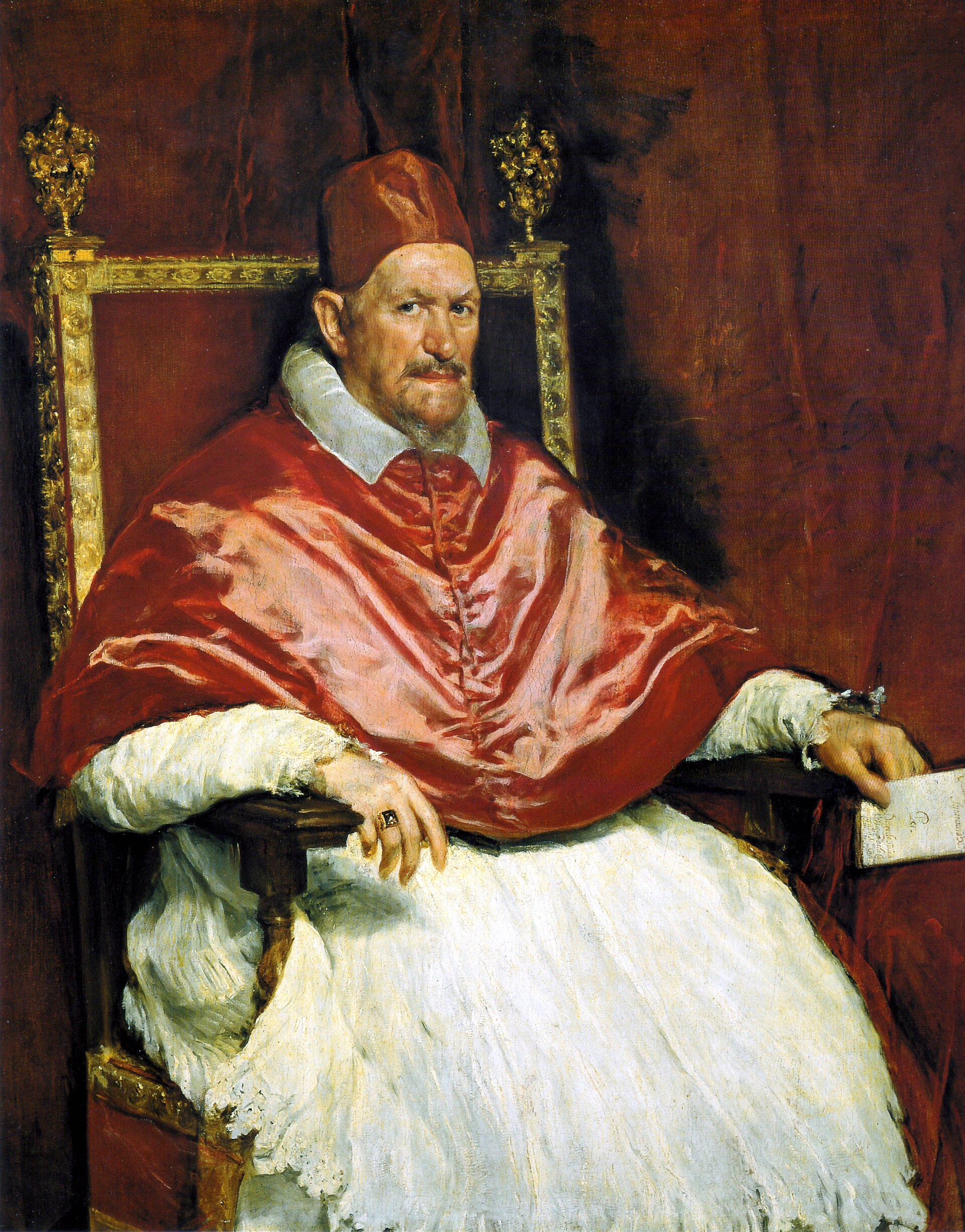
Diego Velázquez, Retrato del Papa Inocencio X (Portrait of Innocent X), 1649-1650. Oil on canvas. Dimensions: 141 × 119 cm (56 × 47 in). Galleria Doria Pamphilj, Rome, Italy.
Here the chair is not the subject, but it is essential. The papal chair frames the pope’s authority. Without the chair, the image becomes a portrait of a man; with it, it becomes an image of office. The seat converts a body into an institution.
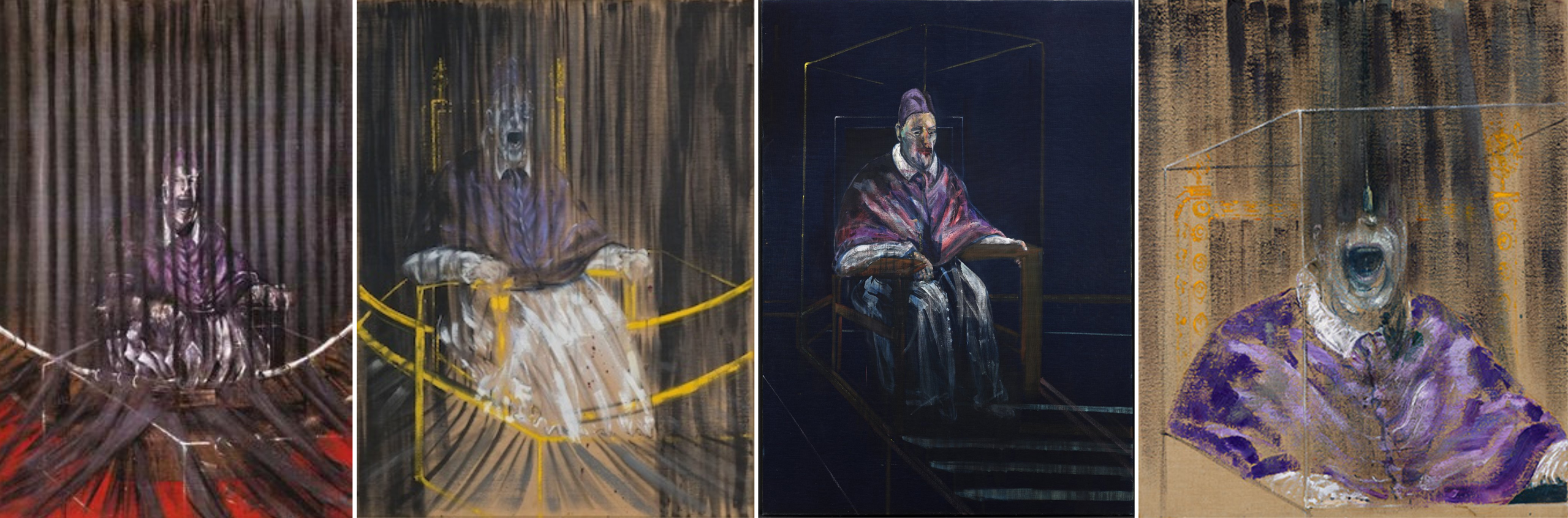
LEFT TO RIGHT: Study after Velázquez, 1950; Study after Velázquez’s Portrait of Pope Innocent X, 1953; Study for Portrait No.1, 1956; Head VI, 1949. All by Francis Bacon.
In his “screaming pope” paintings of the late 1940s and early 1950s, Francis Bacon takes Velázquez’s triumphant Portrait of Pope Innocent X and turns the papal throne into a kind of exposed device. The pope still sits in his sumptuous armchair—its uprights, armrests, and gilt frame clearly visible—but instead of radiating composure, the figure seems pinned to it, trapped inside a transparent cage of vertical lines and glass‑like planes. The chair becomes less a seat of authority than a static machine: a cross between a throne, a confessional, and an electric chair, bolted to the floor of an airless space. Bacon keeps the ceremonial elements—the purple or yellow upholstery, the heavy draperies, the suggestion of a dais—but lets them vibrate and dissolve around the body. The pope’s scream seems to tear through both flesh and fabric, as if the voice were short‑circuited by the very apparatus that should amplify it. Here the chair does not simply support power; it immobilises it, fixing the pontiff in place while the surrounding geometry closes in like a viewing box or execution chamber. If Velázquez painted Innocent X ex cathedra, enthroned and all‑powerful, Bacon shows a man who cannot stand up from his own throne—caged, electrified, and swallowed by the institution that once seemed to guarantee his authority.
- A Semiotics of Form and Material
The semiotics of the chair begins with form. A high back signals dignity, protection, or grandeur. Armrests suggest comfort but also command; they frame the sitter as someone entitled to space. Upholstery speaks of softness, wealth, and interiority. Hard wood suggests discipline, austerity, durability, craft. A folding chair suggests temporary assembly — democracy, emergency, congregation, or waiting. A stool can suggest humility, labor, informality, or ritual intensity. A throne declares symbolic excess.
The chair’s material also speaks. Wood carries warmth, ancestry, handwork, and continuity. Stone carries permanence and death. Metal suggests modernity, efficiency, industry, sometimes coldness. Plastic democratizes the chair, making it cheap, portable, anonymous, mass-produced — available to everyone and therefore belonging to no one. Cane, leather, velvet, bamboo, rattan, iron, bone, ivory, lacquer, gold leaf — each material gives the seated body a different cultural meaning.
From these variables emerges an extraordinary range: a chair can be austere and moral (Shaker design), aristocratic and theatrical (Louis XV furniture), intellectual and modernist (Bauhaus tubular steel), spiritual and political (African carved thrones and stools), bureaucratic, ergonomic, medical, punitive, ceremonial, domestic, erotic, maternal, scholastic, or sacred.
The chair is therefore not a simple object but a family of signs organized around the seated body.
- The Grammar of Gender
Among its most under-examined dimensions is gender. The chair has historically assigned female bodies to particular positions: the low nursing chair, the upright parlor chair demanding a corset’s posture, the chaise longue suggesting recline and passivity, the dressing-table seat before the mirror. The high-backed throne and the parliamentary chair were designed for male authority; the domestic chair was designed around female enclosure.
Even today, the boardroom chair and the nursing chair carry gendered histories in their frames. The ergonomic office chair was, for decades, calibrated to male body proportions — a minor design detail with significant physical consequences for the millions of women who used it. The politics of seating is also a politics of anatomy, and that anatomy has never been neutral.
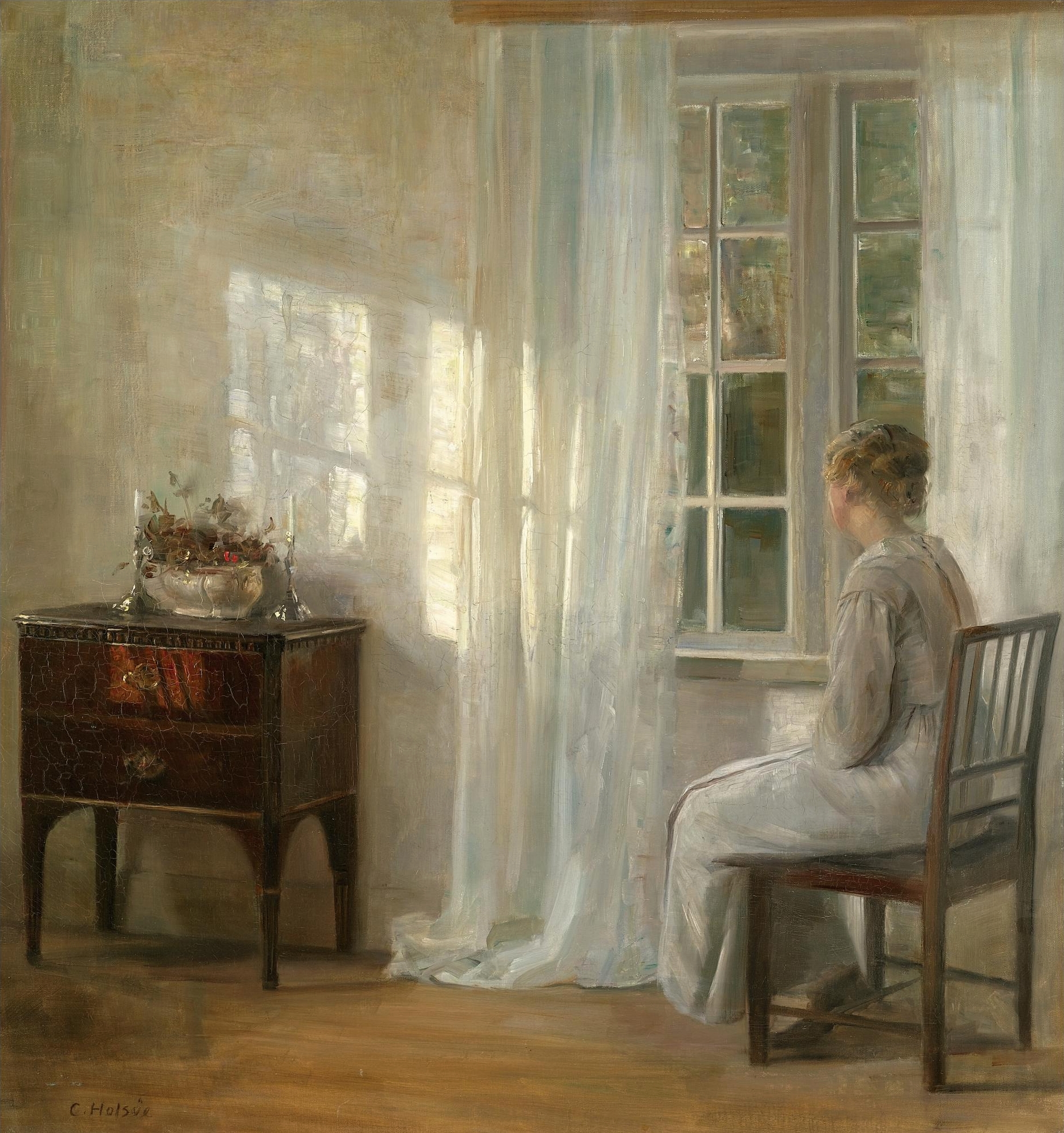
Carl Holsøe, Waiting by the Window: The Chair as a Grammar of Feminine Interior Life
Carl Holsøe’s Waiting by the Window is an intimate domestic scene built almost entirely from stillness. A woman sits in profile on a plain wooden chair, turned away from the viewer and toward the window. The room is quiet, pale, and diffused with light. A curtain falls between the figure and the window like a veil; sunlight strikes the wall in soft rectangular patches; a small chest of drawers and a bowl of flowers occupy the left side of the composition. Nothing dramatic occurs, yet the painting is charged with expectation. The woman is not simply seated. She is waiting. The chair is central to this grammar of waiting. It is not an armchair, not a throne, not a seat of comfort or authority. It is a modest, upright wooden chair, severe in line and almost disciplinary in posture. Its back is narrow and vertical; its rails form a strict geometry behind the woman’s body. The chair does not envelop her. It holds her. It supports a body that is outwardly composed, but psychologically suspended. In this sense, Holsøe’s chair belongs to a broader visual language in which furniture organizes gendered behavior. The seated woman is placed within the domestic interior, but she is oriented toward the outside world. The window opens onto elsewhere; the chair fixes her inside. Between them lies the central tension of the painting: desire and restraint, looking and remaining, inwardness and expectation. The woman’s body is turned toward the light, but her position is anchored by the chair. She may look outward, but she does not move outward. This is why the chair matters. It is not merely an accessory in the room. It is the instrument through which the painting gives form to feminine waiting. The chair makes visible a social condition: the woman’s relation to time is passive, interior, and suspended. She waits rather than acts; observes rather than enters; receives the world through light, window, and reflection rather than through direct participation. The chair thus becomes a quiet grammar of gender: it translates social expectation into posture. Holsøe intensifies this reading through contrast. On the left stands a chest of drawers, dark, polished, and material. It belongs to possession, storage, household order. On the right, the woman’s pale dress almost dissolves into the curtain and the light. She appears less solid than the furniture around her. The chair, however, gives her contour. Its dark wooden frame draws a boundary around her softness. It domesticates the body, placing it within an architecture of restraint. The woman’s back is especially important. Because she turns away from us, the viewer cannot read her face. Her emotional life is withheld. This refusal of facial expression shifts meaning onto posture, furniture, and light. The chair becomes a substitute language. Its uprightness suggests discipline; its simplicity suggests modesty; its placement near the window suggests anticipation. The figure’s silence is therefore not empty. It is spoken through the objects around her. The scene also recalls the nineteenth-century association between femininity and the interior. In many domestic paintings of the period, women are shown reading, sewing, waiting, looking through windows, or seated in reflective stillness. The chair often mediates these activities. It locates the female body within a socially acceptable space of repose, patience, and containment. In Holsøe’s painting, the chair does exactly this: it makes waiting decorous. It turns emotional suspension into a poised, almost elegant image. Yet the painting is not simply oppressive. Holsøe’s handling of light gives the scene tenderness and ambiguity. The window is not barred; the curtain is translucent; the woman’s attention is active, even if her body is still. She is not presented as inert. Her looking is meaningful. The chair may hold her in place, but it also gives her a position from which to contemplate, remember, desire, or hope. The painting’s power lies in this uncertainty. Is she confined, or is she choosing solitude? Is she waiting for someone, or thinking beyond the room? The chair does not answer; it stages the question. In a chapter on chairs and gender, Waiting by the Window can therefore be read as an exemplary image of the chair as a cultural sign. The chair is not neutral furniture. It regulates the body, establishes social posture, and helps define the kind of subject a woman is allowed to be within the painted interior. Here, the chair produces a figure of feminine patience: composed, inward, expectant, and bounded by domestic space. At the same time, because the woman faces the window, the image also suggests an inner life that exceeds the room. Holsøe’s painting is thus a study in the quiet politics of sitting. The chair does not dominate the composition, but it governs it. It is the hinge between body and room, between interior and exterior, between gendered decorum and private longing. Through this modest wooden chair, the painting makes visible a whole social grammar: how a woman sits, where she is placed, what she may look toward, and how waiting itself becomes a feminine form.
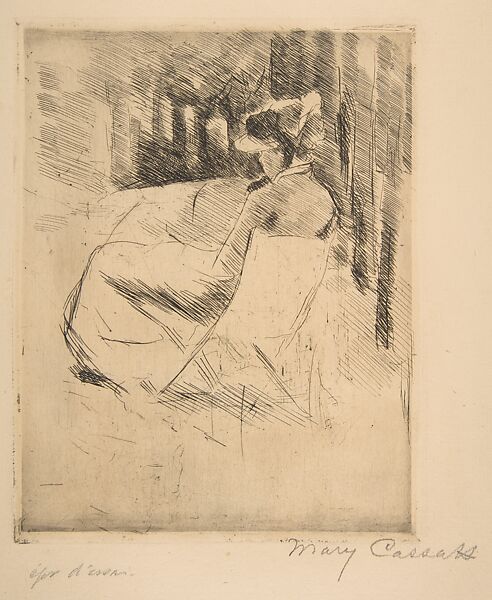
Mary Cassatt (Pittsburgh, Pennsylvania 1844–1926 Le Mesnil-Théribus, Oise), The Folding Chair, etching, ca. 1883. The MET, New York, USA.
A wonderful example for gender history and a small print that quietly rethinks how women’s bodies inhabit modern space. Cassatt makes a humble chair central enough to appear in the title. The scene is simple: a woman sits outdoors on a light, portable folding chair, her figure and seat forming the compositional core rather than the background detail. By naming the print after the chair, Cassatt signals that this modest object belongs to the architecture of women’s lives—something carried, opened, and occupied in moments of sociability, rest, or private thought. The folding chair stakes out a temporary territory for a female sitter: not the monumental throne of power, but a provisional support that allows her to claim a patch of ground, to pause, to look, to think. Cassatt’s etching makes the chair intimate, social, and psychologically charged rather than merely decorative, translating a humble object of portable comfort into a sign of women’s constrained mobility and quiet agency in the late nineteenth century.
Across European portrait traditions, gender is often organized through a visual opposition between activity and containment. Masculine figures are frequently associated with power, movement, command, public space, and social status; feminine figures, by contrast, are often associated with beauty, domesticity, passivity, and relational presence. This opposition is not only expressed through dress, gesture, and facial expression, but also through spatial arrangement. Men are often shown standing, mounted, outdoors, or placed in a position of visual dominance, while women are more often anchored to interiors, seated postures, and enclosed domestic settings. A Victorian illustration of Tennyson’s Lady of Shalott makes this logic almost diagrammatic: Lancelot does not sit beside her; he stands above her. His body commands space, while hers is fixed within it.
Yet the chair itself is not inherently feminine, passive, or subordinate. A chair can also be one of the most concentrated symbols of authority. A throne is a chair. A judge’s bench is a chair. A pope’s cathedra is a chair. A professor’s “chair,” even in academic language, preserves this older association between sitting and institutional power. For men in positions of recognized authority, sitting can signify command rather than weakness. It is the stillness of someone before whom others must stand, approach, bow, plead, or kneel. The opposition, then, is not simply “standing equals power” and “sitting equals subordination.” It is more precise than that: the meaning of the seated body depends on the room it occupies, the object on which it sits, the props surrounding it, and the social role assigned to the figure.
This is where the asymmetry actually lies. When men sit in images of authority, the surrounding signs often point beyond the private body toward public action: a throne, a sword, a scroll, a baton of command, a globe, a book, a document, a horse held under control. These objects extend the male body into the world of law, war, knowledge, property, government, or conquest. When women sit, especially in domestic and bourgeois portraiture, the props more often pull the body inward: needlework, a fan, a letter, a mirror, flowers, a lapdog, a musical instrument. These objects may indicate refinement, education, affection, or virtue, but they usually do so within the controlled space of the home. Even when they praise the woman, they confine the terms of that praise.
The double portrait tradition makes this visual grammar particularly clear. In Van Eyck’s Arnolfini Portrait, for instance, the man is positioned near the window, associated with the outside world of commerce and public exchange, while the woman stands deeper within the domestic interior, near the bed. Even though both figures are standing, the symbolic geography already divides them: window and world on one side, bed and household on the other. Later portrait conventions often literalized this same structure through posture itself: the man active, standing, or socially commanding; the woman seated, enclosed, or defined by her relation to him.
The pattern was not absolute. In one specific genre, Victorian engagement photography, the convention could be reversed: the man might sit while the woman stood beside him with her hand on his shoulder. But this reversal does not necessarily overturn the hierarchy. Her standing pose is not one of public command; it is a gesture of attachment, tenderness, or devotion. She is still organized around his body. The rule, therefore, is not that women always sit and men always stand. The deeper rule is that the active subject is allowed to command space, while the relational figure is fixed in relation to someone else.
The exceptions are revealing because they show how structural the code really was. When 17th- and 18th-century women were represented in equestrian portraits — one of the most masculine-coded genres in European art — it was usually because they possessed actual sovereign, dynastic, or martial authority. In these cases, the portrait had to borrow the established visual language of male power: the horse, the elevated body, the commanding pose, the controlled animal, the public field of action. A reigning queen such as Christina of Sweden could be granted the horse and the dynamic pose because the image needed to register real political authority. The convention bent when power itself made the exception unavoidable.
So the chair has no stable gender meaning of its own. For men, sitting could become the posture of sovereignty, judgment, teaching, or command. For women, sitting more often became the posture of containment, refinement, domestic virtue, or availability. The same object could therefore produce opposite meanings depending on who occupied it and under what conditions. A throne and a parlor chair may both be chairs, but they belong to different political grammars. The meaning was never simply in the furniture. It was in who was allowed to occupy space, who was allowed to command stillness, and who was allowed to stand up.
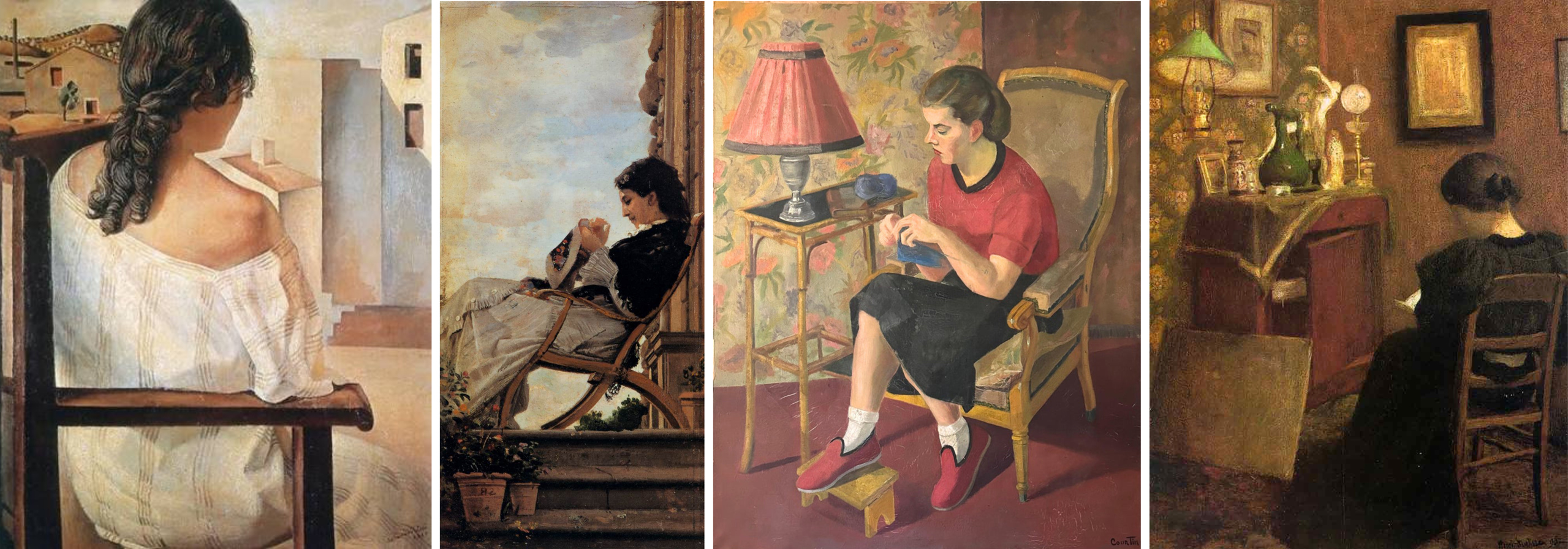
LEFT TO RIGHT
Salvador Dali, Seated Girl Seen from the Back, 1928, Museo Nacional Centro de Arte Reina Sofia, Madrid, Spain.
Cristiano Banti, Woman Sewing on the Terrace, 1882, Palazzo Pitti, Florence, Italy.
Emile Courtin, A young woman knitting in a room, 1950, private collection.
Henri Matisse, La Liseuse, 1895, Musée Matisse, Nice, France.
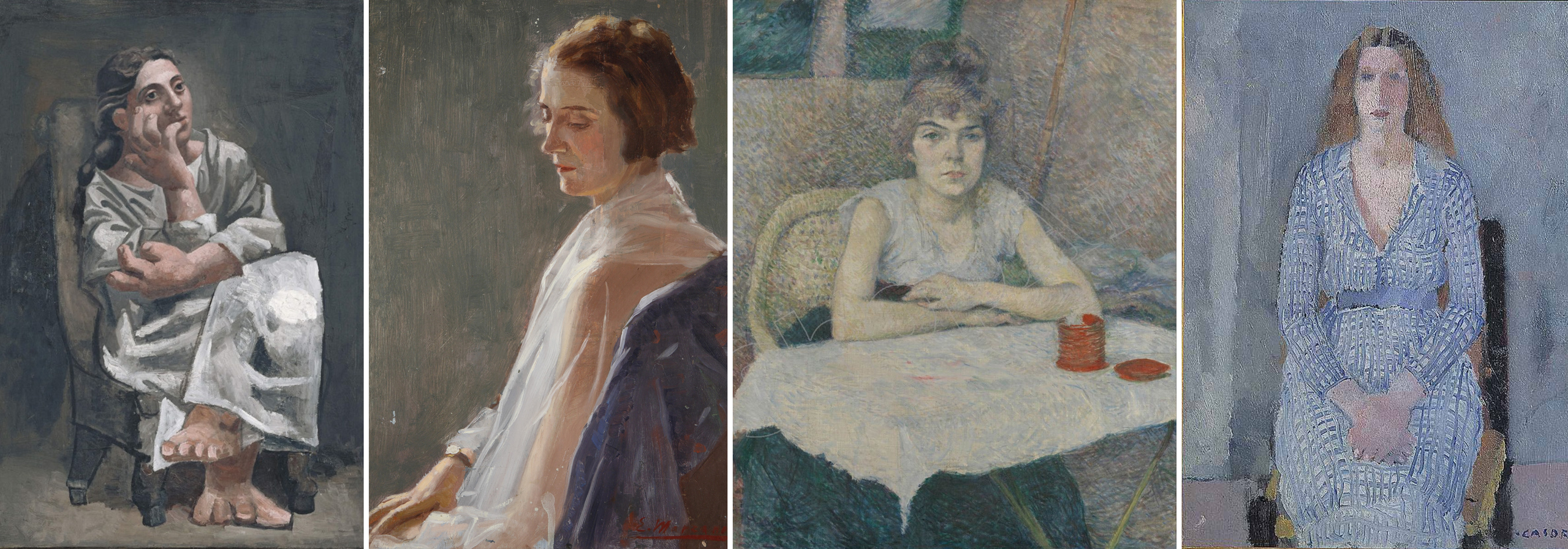
LEFT TO RIGHT
Pablo Picasso, Seated Woman, 1920, Musée Picasso, Paris, France.
Ennio Marzano, Portrait of a Seated Woman, mid-20th century, Galleria Nazionale della Puglia “Girolamo e Rosaria Devanna”, Bitonto (BA), Italy.
Henri de Toulouse-Lautrec, Young Woman at a table, 1887, Van Gogh Museum, Amsterdam, The Netherlands.
Felice Casorati, Ragazza in azzurro, 1933, Palazziona di Belvedere, Florence, Italy.
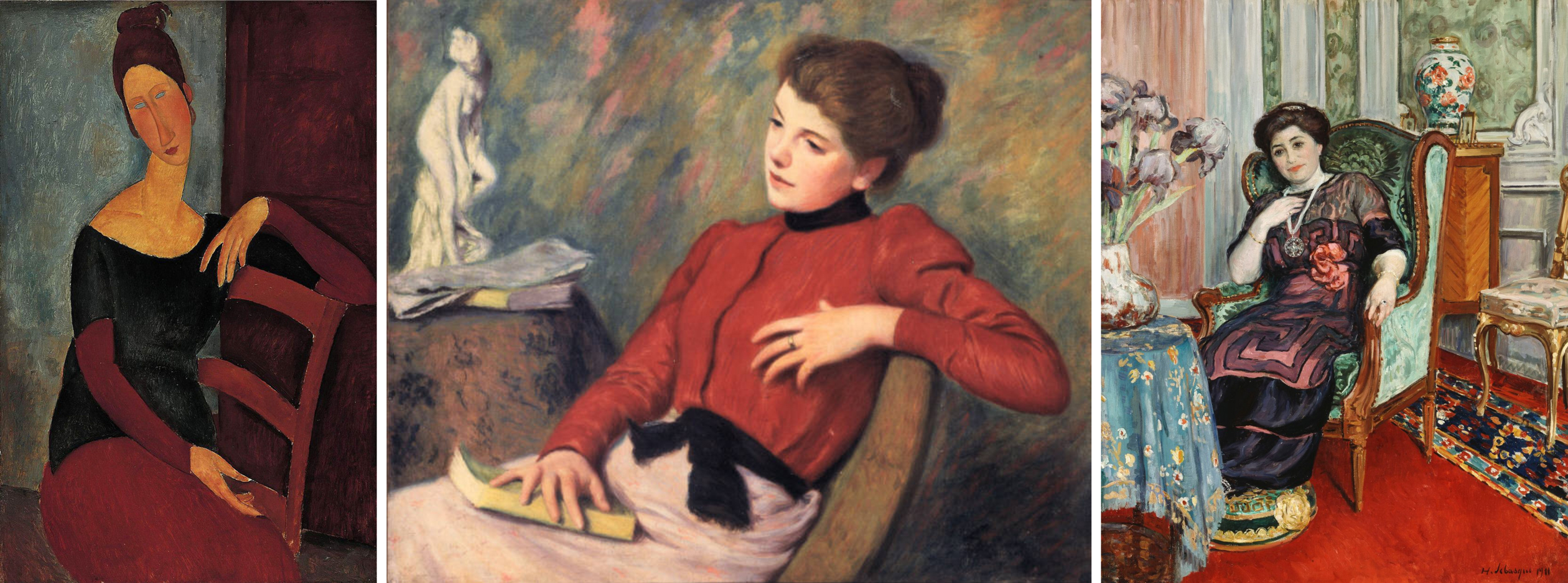
LEFT TO RIGHT
Amedeo Modigliani, Jeanne seated with the arm resting on the back of the chair, 1918 (?), Norton Simon Museum, Pasadena, California, USA.
Federico Zandomeneghi, Riflessione. Figura femminile seduta, ca. 1895, Castello Visconteo, Musei Civici di Pavia, Italy.
Henri Lebasque, A Woman Sitting In A Chair (Femme Assis Dans Un Fauteuil), 1911, private collection.
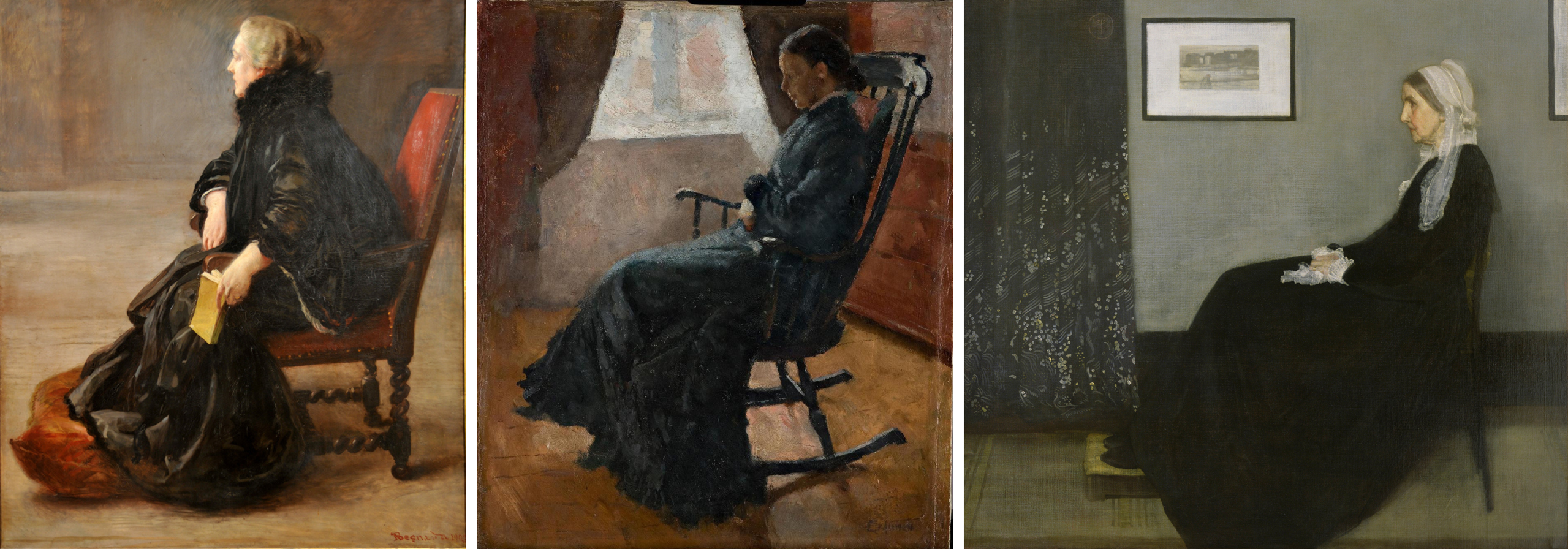
LEFT TO RIGHT
Besnard Paul Albert, Ritratto di Signora, 1903, Galleria Nazionale d’Arte Moderna, Rome, Italy.
Edvard Munch, Aunt Karen Bjølstad in the Rocking Chair, 1883, Munchmuseet, Oslo, Norway.
James McNeill Whistler, Arrangement in Grey and Black No. 1, aka Whistler’s Mother, 1871, Musée d’Orsay, Paris, France.
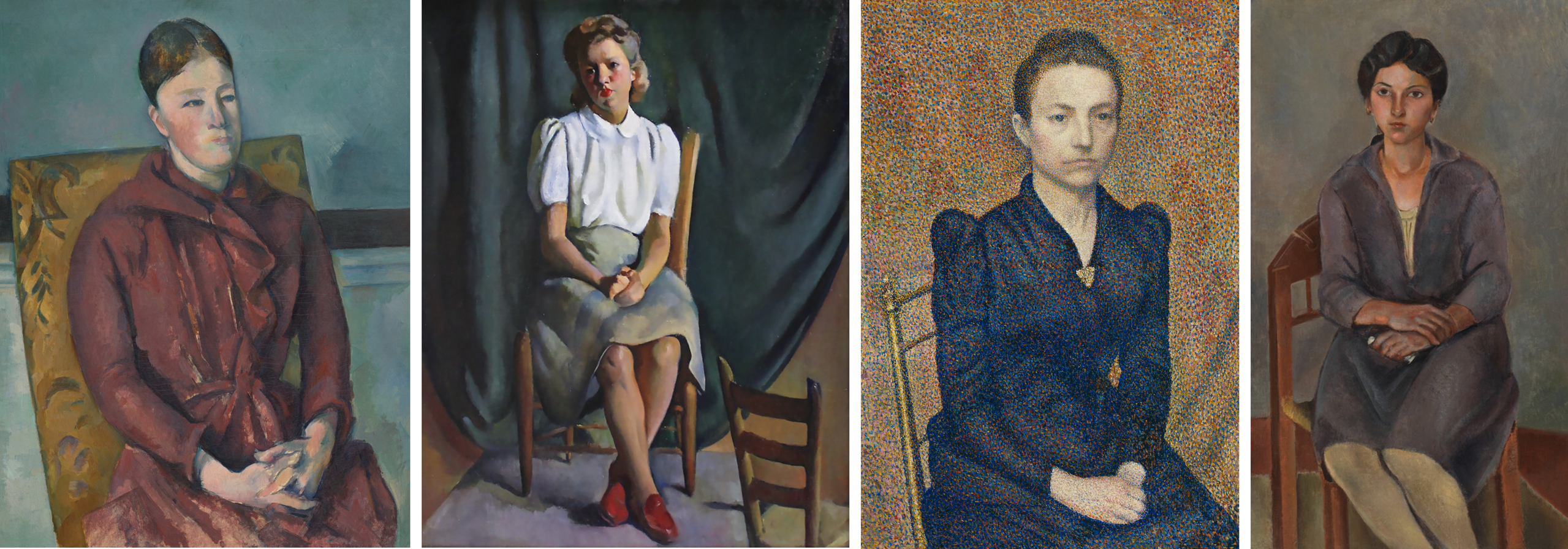
LEFT TO RIGHT
Paul Cézanne, Madame Cézanne in a Yellow Chair, 1888-90, The Art Institute of Chicago, IL, USA.
Irma Cook (18991984), Young Woman Seated in a Chair with a Green Backdrop, The Johnson Collection Gallery, Spartanburg, South Carolina, USA.
Georges Lemmen, Portrait of the Artist’s Sister, 1891, The Art Institute of Chicago, IL, USA.
Maurice Sterne, Portrait of Lucia, ca. 1928, Whitney Museum of American Art, New York, USA.
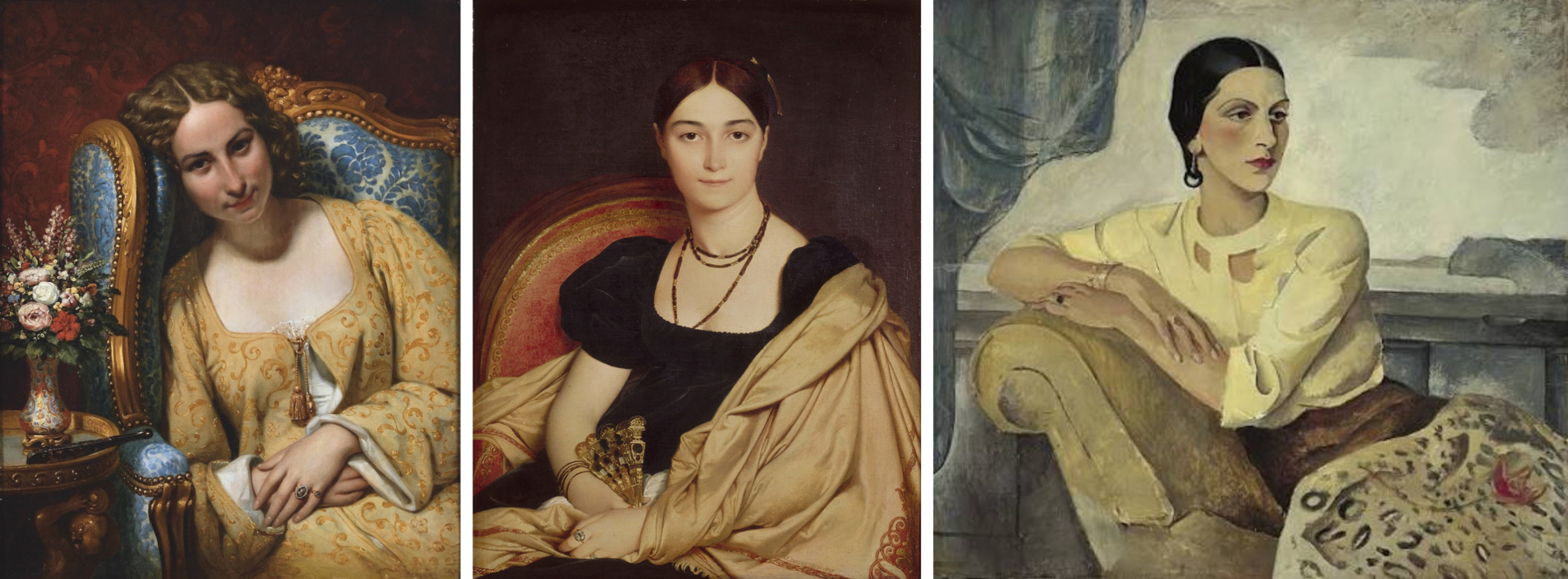
LEFT TO RIGHT
Joseph-Désiré Court, Woman nestled in an armchair, 1834, private collection.
Jean-Auguste-Dominique Ingres, Portrait de Madame Duvaucey, 1807, Musée Condé, Chantilly, France.
Boris Dmitrievich Grigoriev, Portrait of a Seated Woman, early 20th century, Norton Simon Museum, Pasadena, CA, USA.
- Discipline and the Modern Chair
The chair can also discipline the body violently. School chairs train children into the seated citizen — still, attentive, forward-facing, submissive to the pedagogical gaze. Factory and office chairs bind workers to stations of production. Interrogation chairs immobilize. Courtroom chairs arrange guilt, judgment, and testimony. The waiting-room chair suspends the body in bureaucratic time. The wheelchair both liberates and stigmatizes, marking the body as requiring mediation.
The office chair deserves particular attention. It is the throne of late capitalism — mobile, adjustable, padded, individualized — and yet profoundly subordinating. It grants the worker a private capsule of bodily support while binding them to the screen, the desk, the schedule, the task. It is comfort in the service of extraction.
The electric chair is the most violent inversion: a seat — normally an object of rest and dignity — transformed into an instrument of death. It does not merely kill; it kills while seated, making the condemned body perform the posture of civilization at the moment of its annihilation.
The chair is morally unstable. It can honor, comfort, support, and dignify. It can also rank, confine, punish, and exclude. Chairs are among the oldest instruments through which societies organize bodies in space and hierarchies.
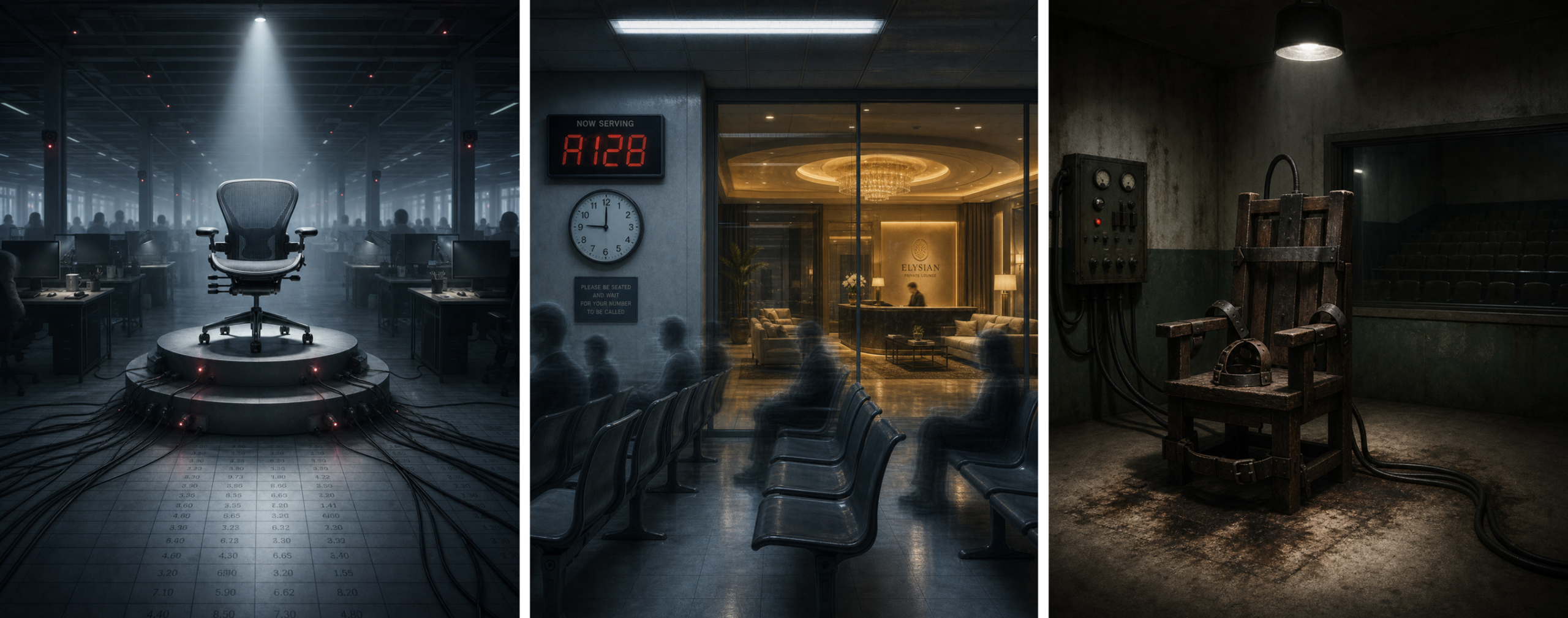
- Absence and the Empty Chair
The chair also has a powerful relation to absence. An empty chair is one of the most poignant images in human visual culture. It can signify waiting, loss, death, abandonment, invitation, memory, or expectation. A chair with no sitter becomes almost more human, not less. It carries the trace of the body that has left.
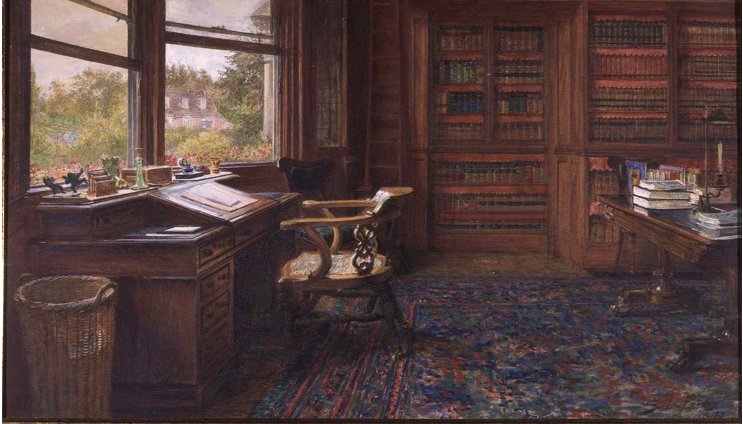
The Empty Chair by Sir Samuel Luke Fildes, R. A. (1844-1927). Watercolour on paper. 1870. Collection: The Free Library of Philadelphia.
Samuel Luke Fildes’s The Empty Chair, Gad’s Hill – Ninth of June 1870 was drawn in Dickens’s study just after the writer’s sudden death, using the actual arrangement of desk, chair, and books as Fildes found them. Instead of showing Dickens’s face, the artist presents his working space: shelves of volumes, manuscripts on the desk, the bay window, and, at the centre, a single vacant Windsor‑type chair pulled up to the writing table. That ordinary chair becomes a surrogate portrait and a secular relic. It marks the precise spot where Dickens once sat to write and, now empty, turns his absence into something almost physically tangible. For Victorian viewers, the image offered a way to mourn a national author through the things that sustained his labour, transforming a piece of everyday furniture into an icon of authorship, grief, and the abrupt silencing of a voice.
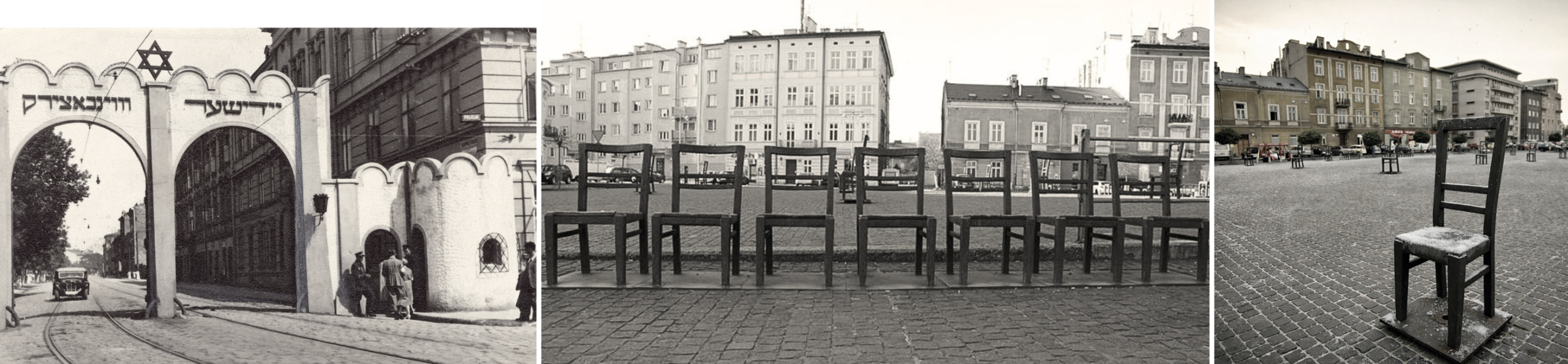
The Krakow Ghetto was established by the Nazi authorities during World War II, officially on March 3, 1941, in the Podgórze district of Krakow, rather than in the historic Jewish quarter of Kazimierz. Initially, some 15,000 to 17,000 Jews were forced to move to a 20-hectare area that previously had only about 3,000 inhabitants and only 320 buildings. This means that the entire ghetto area was overcrowded at the time, with 4 or 5 families often living in one small apartment. Many people had to live and sleep on the streets of the ghetto, which was surrounded by walls and barbed wire fences. The establishment of this ghetto, as well as all the other metropolitan ghettos created by the Nazis throughout German-occupied Eastern Europe, was designed to exploit, terrorize, and persecute all local Jews. It was a key step in the Nazi process of brutally segregating, persecuting, and ultimately destroying Europe’s Jewish population. In short, it was an integral part of the implementation of the Nazi Final Solution. The Krakow Ghetto was more than a prison, it was a hell. Plac Zgody, or Zgody Square, was its black hole: the place where Jewish furniture was piled up and discarded, a place of humiliation and suffering for all Jews. Systematic deportations began in May 1942, and many Jews were sent to extermination camps. The ghetto was finally liquidated in March 1943, resulting in the murder of thousands and the transfer of the remaining Jews to labor camps, concentration camps such as Auschwitz, and extermination camps such as Bełżec. Of the approximately 70,000 Jews in Krakow before the war, only about 1,000 survived the Holocaust. Zgody Square was the main site of deportations, and during the liquidation of the ghetto in March 1943, many old, sick, weak, and unemployed people were shot there, along with small children. Today, the remnants of the Krakow Ghetto can be found in the Podgórze district, especially around Plac Bohaterów Getta, the Ghetto Heroes Square, the new name of the old Zgody Square. In this place there is now an art installation of large iron chairs symbolizing the empty homes and lives lost during the Holocaust: the Empty Chairs Memorial, inaugurated in 2005. 33 oversized metal chairs and 37 smaller ones are scattered around the square, each representing the items left behind by deportees on their way to death.
This is because the chair is anthropomorphic without representing the human figure directly. It has legs, arms, a back. It stands. It receives. It waits. It is shaped by the absent body and, in turn, shapes the body that uses it. Even before anyone sits, the chair proposes a human presence.
That is why chairs are so charged in art. Van Gogh’s chairs — the plain yellow one, the more elaborate one with Gauguin’s candle — are not merely pieces of furniture. They are portraits without faces. The chair can portray character, poverty, dignity, solitude, humility, authority, domestic life, or spiritual fatigue without showing a human being at all. The chair becomes a proxy body. Absence with posture.
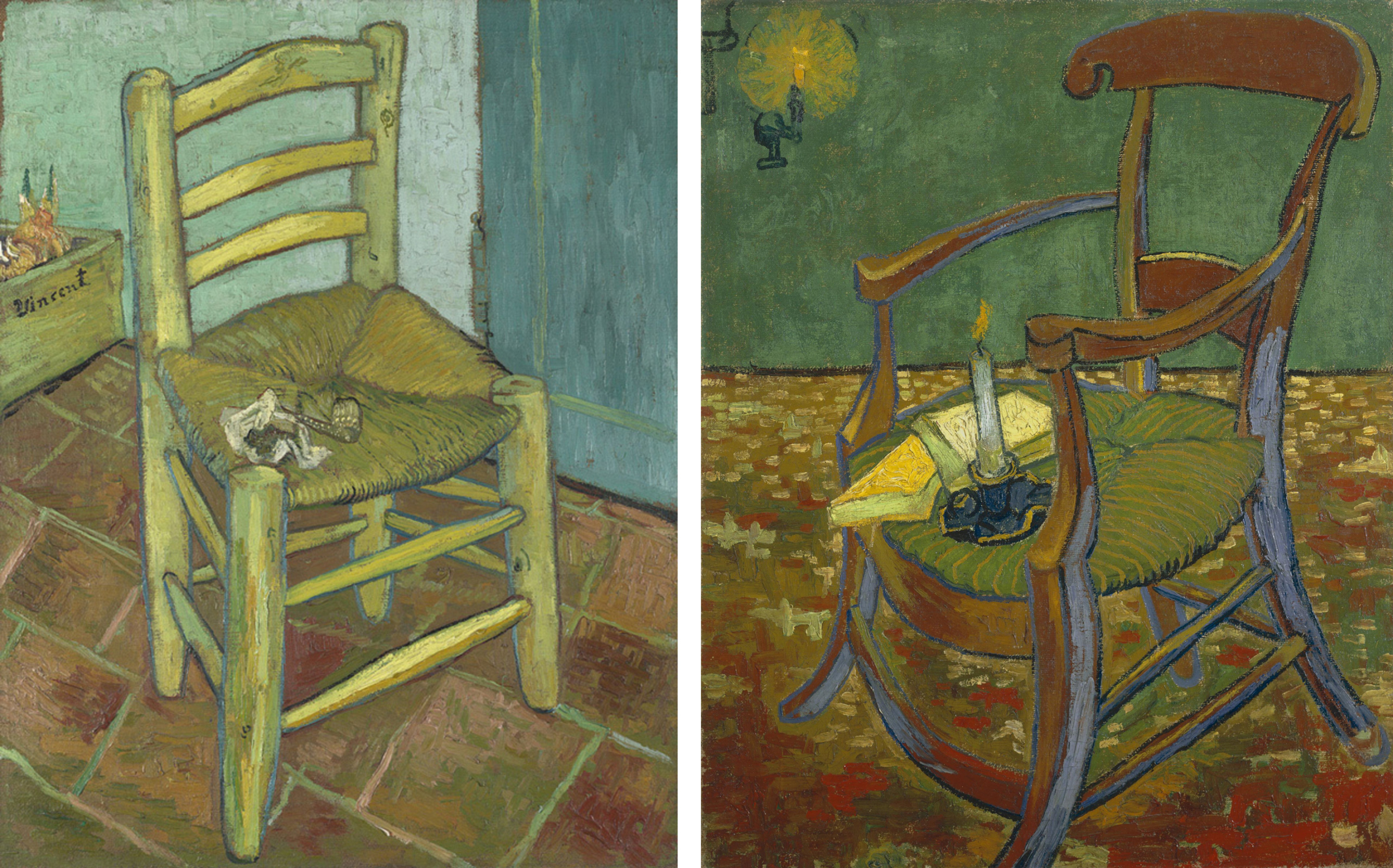
LEFT: Vincent van Gogh, Van Gogh’s Chair, 1888. Oil on canvas. Dimensions: 91.8 × 73 cm. The National Gallery, London, UK.
RIGHT: Vincent van Gogh, Gauguin’s chair, 1888. Oil on canvas. Dimensions: height: 90.3 x 72.5 cm. Van Gogh Museum, Amsterdam, The Netherlands.
These two paintings were made in Arles, December 1888, during the turbulent weeks of Van Gogh’s cohabitation with Gauguin — and they were conceived as a deliberate pair, portraits of two men through their seats alone. The image on the left is Vincent’s Chair. Plain, yellow, rush-seated. On it: a pipe and tobacco pouch — modest, working-class objects. Daylight. Tiled floor. A box of onions in the background signed “Vincent.” This is a chair of simplicity, honesty, and rootedness — a peasant chair that wants nothing to prove. Van Gogh saw himself as a laborer of painting, and his chair says exactly that. The image on the right is Gauguin’s Chair. Dark wood, armrests, cushioned seat — altogether grander, more theatrical. On it: two books and a lit candle. Nighttime. The gas lamp glows on the wall. This is a chair of intellect, restlessness, and drama — it speaks of someone passing through, not staying. Gauguin was always about to leave, and his chair knows it. Different chairs are different anthropologies. Van Gogh understood this intuitively — he painted two human beings without painting any faces, and said everything. When Gauguin left Arles days after these were completed, following the infamous ear incident, the empty chair became one of art history’s most haunting images of absence with posture.
- The Chair as Script and Anthropology
The chair is a sign, but it is also an instruction. It does not only mean; it tells the body what to do. Sit here. Wait here. Face this direction. Listen. Eat. Work. Confess. Rule. Be judged.
Place chairs in rows and you create an audience. Place them around a table and you create deliberation, family, negotiation, or communion. Place one chair above others and you create hierarchy. Place two chairs facing each other and you create dialogue, therapy, interrogation, seduction, or confrontation. Place a chair alone in a room and you create solitude. The chair does not merely furnish space; it scripts behavior.
And because every chair awaits a body, every chair contains an idea of the human. A low floor chair imagines the body close to the earth. A high-backed ceremonial chair imagines the body as vertical dignity. A modern ergonomic chair imagines the body as a problem of optimization. A rocking chair imagines the body as rhythm, age, care, and memory. A monastic chair imagines the body as discipline. A throne imagines the body as power made visible.
Different chairs are different anthropologies. They reveal what a culture thinks a human being is. Is the human body something to honor? To discipline? To comfort? To display? To rank? To punish? To make productive? To bring into conversation?
The chair answers silently.
Conclusion: Civilization in Miniature
A philosophy of chairs is ultimately a philosophy of the seated human: the human as tired, social, ranked, embodied, vulnerable, dignified, governed, remembered. A semiotics of chairs is a study of how the seated body becomes a sign — of authority, domesticity, absence, labor, care, punishment, gender, class, and memory.
The greatness of the chair lies in a paradox: it is formally simple, almost unchanged across time, yet symbolically inexhaustible. It is one of humanity’s most stable objects because the body has remained stable. But it is one of humanity’s richest objects because society never stops reassigning meaning to that body.
A chair is only a seat.
And yet: it is also a throne, a witness stand, a place at the table, a worker’s station, a child’s discipline, an elder’s rest, a mourner’s absence, a ruler’s legitimacy, a guest’s welcome, a prisoner’s containment, a lover’s trace, a scholar’s labor, a body’s pause.
The chair is civilization in miniature: the body raised from the ground, placed in order, made meaningful.
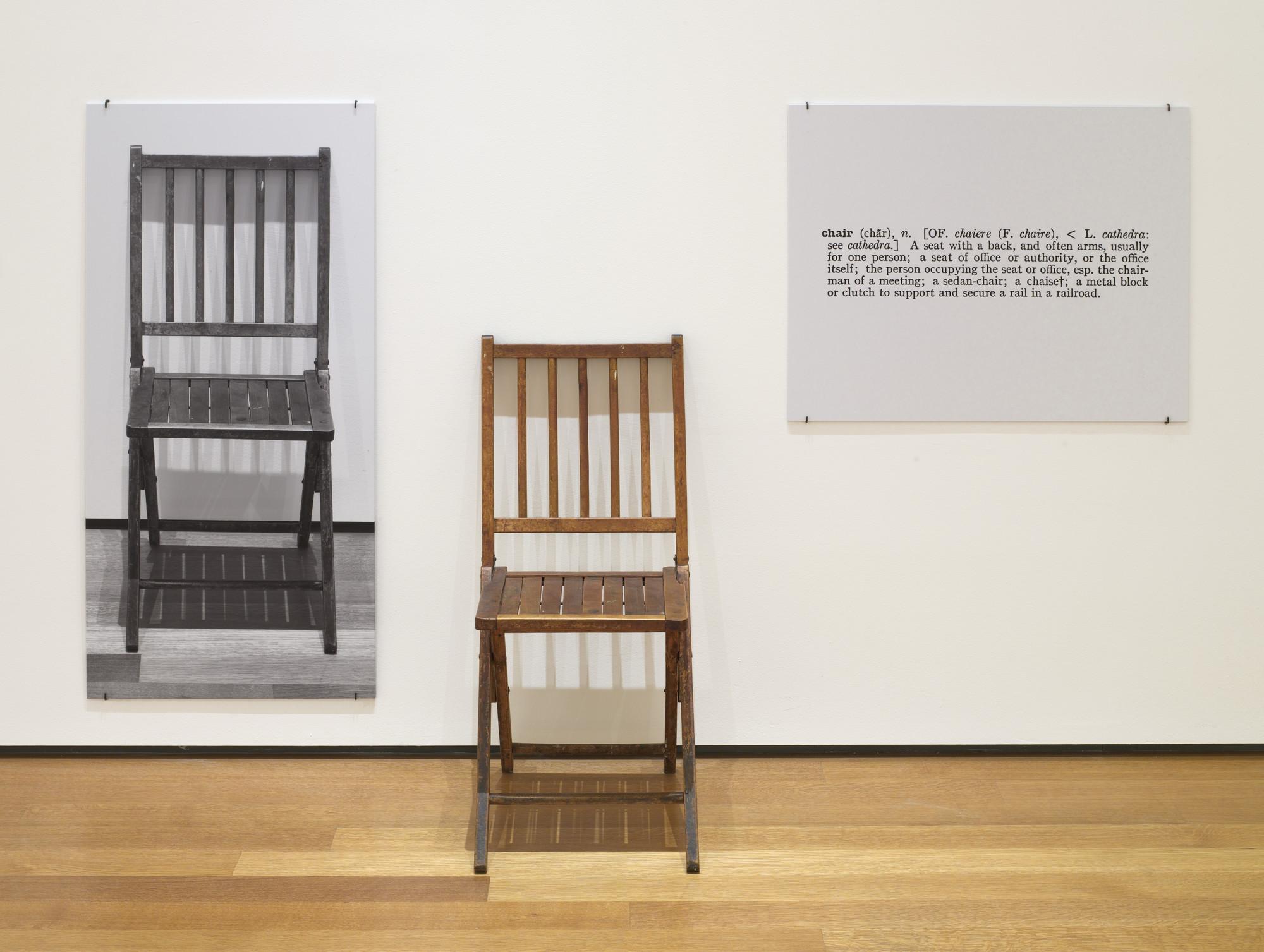
Joseph Kosuth One and Three Chairs, installation, 1965. MoMA, Manhattan, NY, USA.
Kosuth’s One and Three Chairs makes explicit what the Coronation Chair performs historically: a chair is never only an object. It is also an image, a definition, and a social agreement about what sitting means.
FROM THRONES TO THE GROUND
I have a complicated relationship with chairs. Some horrify me: thrones, interrogation chairs, electric chairs — seats that immobilize the body or turn it into an emblem of power. I dislike ergonomic desk chairs too, and I do not use them. Although I write constantly, for both work and pleasure, I write only in bed. Other chairs, however, make me fall in love at first sight. Among them are the pidha: low Punjabi wedding chairs whose wooden surfaces are astonishingly beautiful and visually striking. They sit incredibly close to the ground — and that closeness changes everything.
The Punjabi pidha brings the argument down from the monumental chair to the intimate ritual seat. After the Coronation Chair, papal thrones, empty memorial chairs, and modern design icons, the pidha may seem modest: low, woven, portable, domestic. Yet precisely for that reason it reveals another dimension of the chair’s symbolic life. Not every important seat raises the body above others; some place the body close to the ground, inside a circle of family, ritual, song, and touch. In Punjabi wedding culture, the pidha is not a throne of sovereignty but a seat of transition. It receives the bride or groom at moments when the body is being prepared, adorned, blessed, and socially transformed. If the throne makes authority visible, the pidha makes kinship visible. It turns sitting into ceremony, and ceremony into belonging. In this sense, it continues the larger claim of this essay: a chair is never merely a support for the body, but a cultural script that tells the body who it is, where it belongs, and what it is becoming.
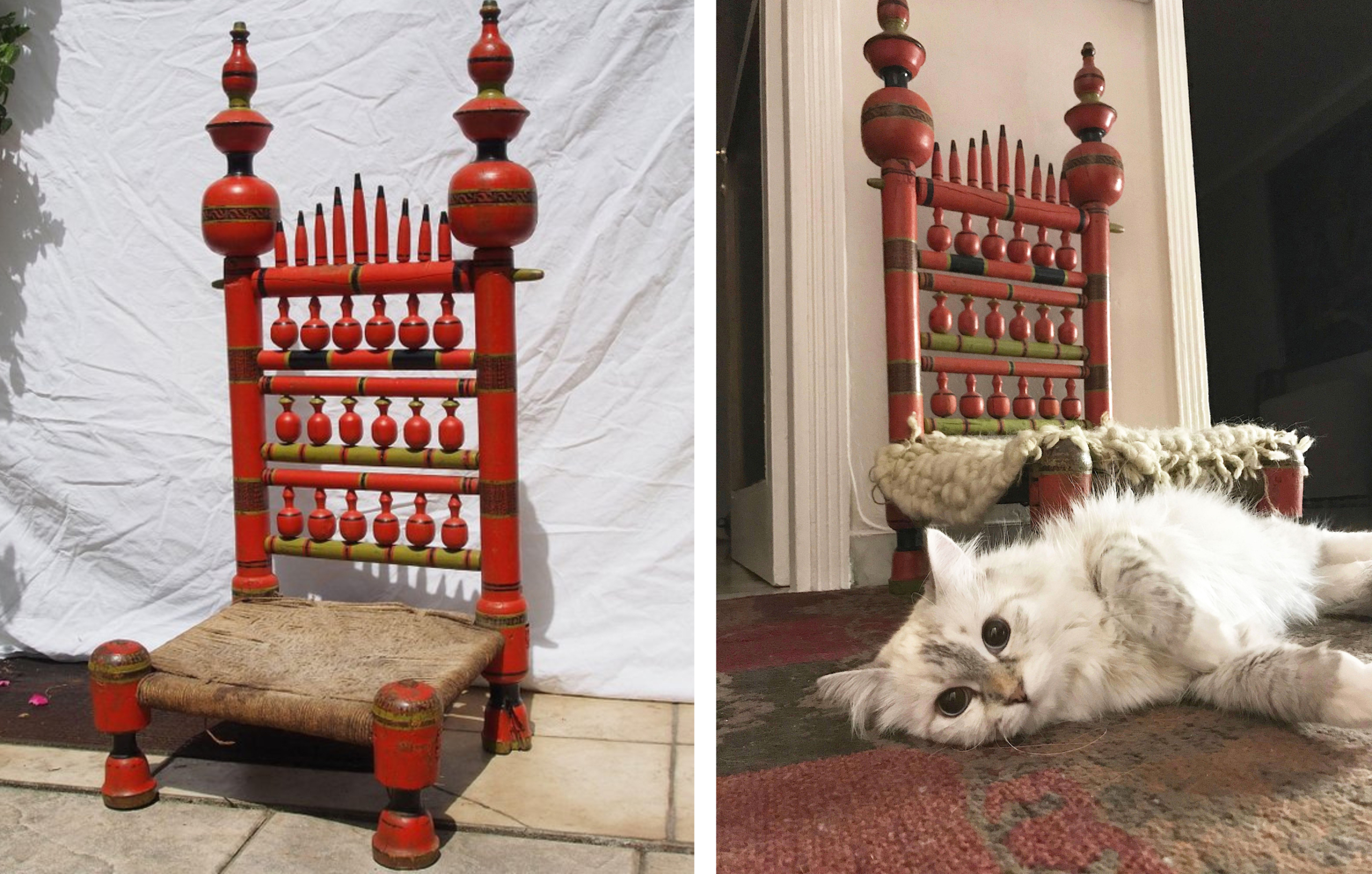
My first antique, handpainted Pidha: when I bought it (left) and after I cleaned it and set it up at home (right). The original seat is just 15 cm high, whereas the standard seat height for an adult dining chair is usually between 43 and 47 cm. Other dimensions: height 90 cm, width 47 cm, depth 41 cm.
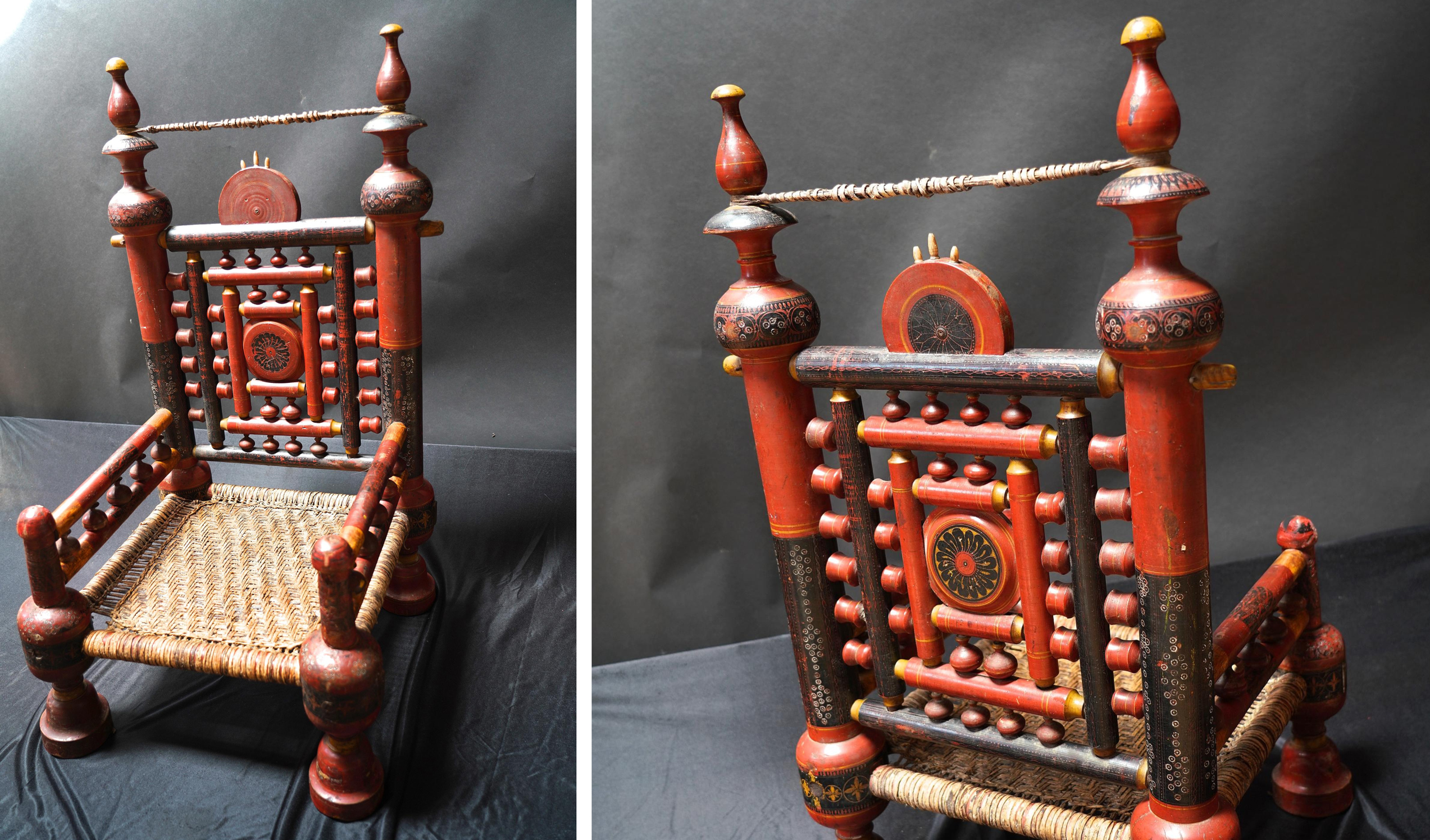
Another antique, handpainted pidha from my collection. Dimensions: width 54 cm, depth 58 cm, total height 98 cm; height of the seat 21 cm. The low seat is woven in sisal rope. I purchased it from Reto Zendher in Switzerland.
A FOREWORD
The Punjab Region: Geography, Partition, and Conflict
Punjab is a historic and cultural region of the northwestern Indian subcontinent whose very name encodes its essential character. Derived from the Persian panj (“five”) and āb (“water”), the word designates the land of five rivers — the Jhelum, Chenab, Ravi, Beas, and Sutlej — all tributaries of the greater Indus system. For millennia, this riverine landscape has sustained some of the subcontinent’s most productive agricultural plains, its most densely populated cities, and some of its most contested political frontiers.
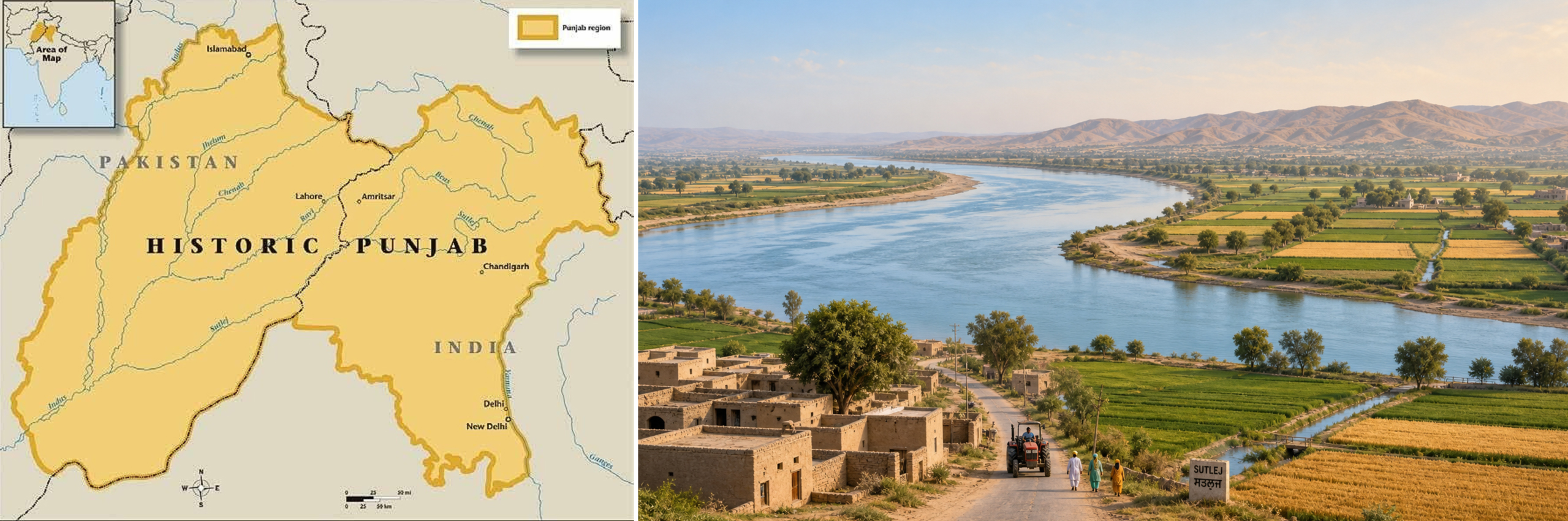
Left: a map of the historic Punjab. Right: AI-generated image.
Historically, Punjab was not a single sovereign state but a broad cultural region stretching across what is now eastern Pakistan and northwestern India. That unity was severed in August 1947, when the Partition of British India created two independent nations — India and Pakistan — and divided Punjab, as it divided Bengal, largely along religious-demographic lines. The Muslim-majority western districts were assigned to Pakistan; the Sikh- and Hindu-majority eastern districts to India. The boundary was drawn in haste by the Radcliffe Commission, whose award was announced only two days after independence, cutting through villages, families, trade routes, religious landscapes, and agricultural systems that had been bound together for centuries.
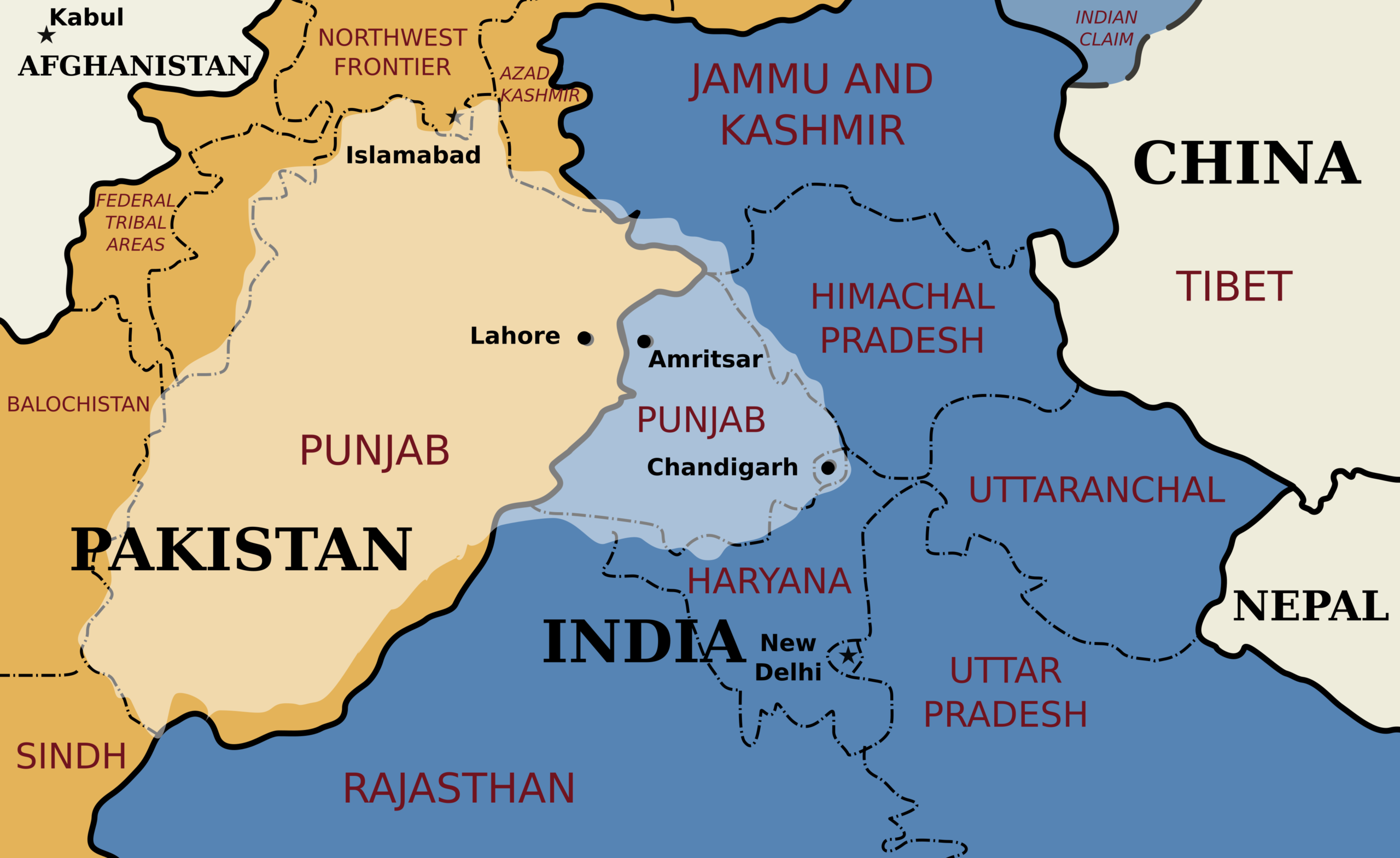
Punjab modern map, Wikimedia Commons.
The consequences were catastrophic. Partition triggered one of the largest forced migrations of the twentieth century: an estimated fifteen million Hindus, Muslims, and Sikhs crossed the new borders in both directions. The violence that accompanied this exodus was extraordinary in its scale and ferocity. Scholarly estimates of the death toll range from two hundred thousand to approximately one million, with Punjab bearing the heaviest burden of the carnage. Sacred sites, ancestral homes, markets, craft networks, and family histories were severed overnight, producing a wound in the collective memory of the region that has not fully healed.
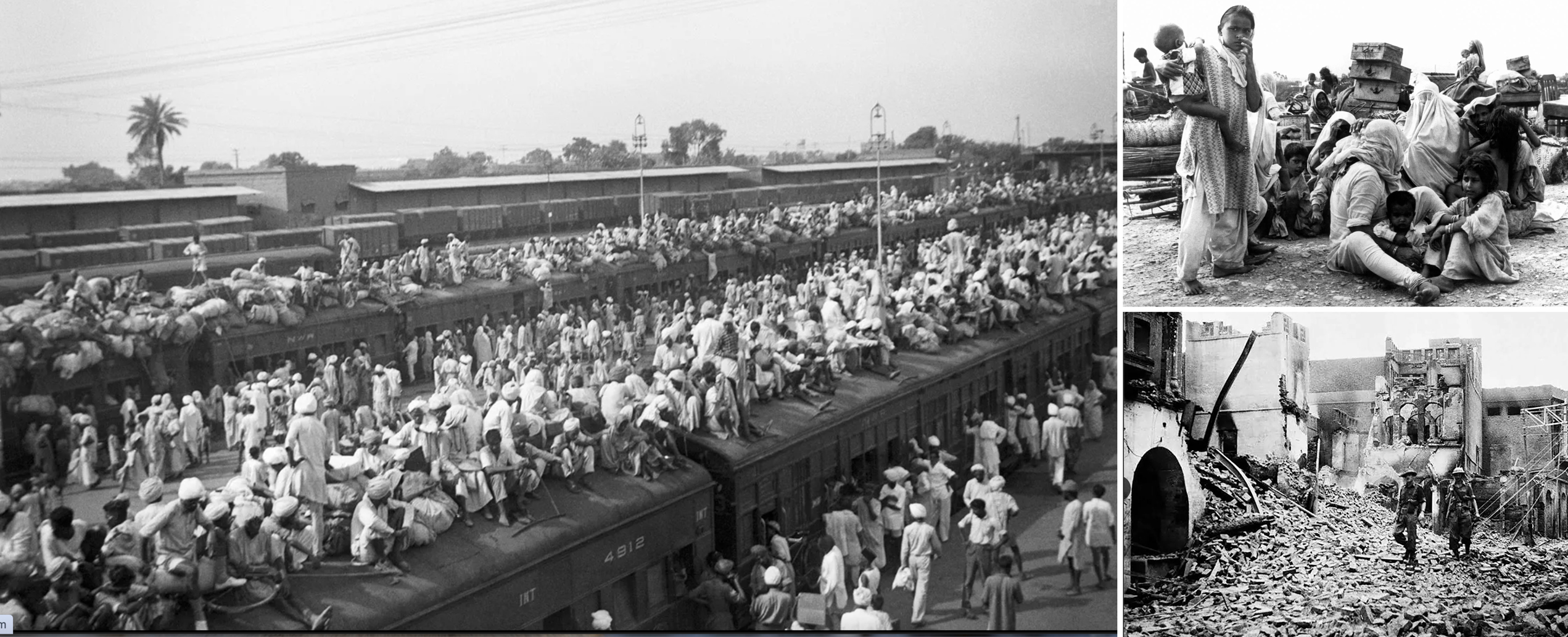
LEFT: Indians crowding onto trains during the partition of India into a predominantly Hindu state (India) and a predominantly Muslim state (Pakistan) in one of the largest population transfers in history, 1947.
TOP RIGHT: A family photographed in a refugee camp in Pakistan following the partition.
BOTTOM RIGHT: Indian soldiers walking through the debris of a building in the Chowk Bijli Wala area of Amristar, Punjab, during unrest following the partition, August 1947.
The division transformed the cultural map of the subcontinent in ways that are still felt today. Lahore — once a seat of Mughal splendor and, by the twentieth century, a cosmopolitan center for Sikhs, Hindus, Muslims, writers, artists, and reform movements — became part of Pakistan. Amritsar, the spiritual and institutional heart of Sikhism, remained in India, separated from Lahore by little more than twenty miles and an international border. The Wagah–Attari crossing between the two cities has since become one of the most theatrically charged frontiers in South Asia: formally militarized, yet the site of a nightly flag-lowering ceremony that draws crowds from both sides and has itself become a vernacular monument to the persistence of connection across division.
After 1947, the two Punjabs developed along sharply different trajectories. Pakistani Punjab, the larger of the two, became the country’s political, agricultural, military, and economic heartland. Its capital, Lahore, remains one of the great cultural cities of South Asia; its other major urban centers — Faisalabad, Rawalpindi, Gujranwala, Multan, and Sialkot — together anchor the country’s industrial and commercial life. The province covers approximately 205,344 square kilometers and, according to Pakistan’s 2023 census, has a population of some 127.7 million, making it by far the most populous of Pakistan’s four provinces.
Indian Punjab, considerably smaller in area, underwent its own reconfigurations. In 1966, the Punjab Reorganization Act divided it along linguistic lines: Punjabi-speaking districts remained in Punjab, while predominantly Hindi-speaking areas became the new state of Haryana and certain hill tracts were transferred to Himachal Pradesh. The resulting Indian Punjab covers approximately 50,362 square kilometers — roughly one-quarter the size of its Pakistani counterpart — and had a population of some 27.7 million at the 2011 census. Despite its reduced extent, it became one of India’s most agriculturally productive states, particularly after the Green Revolution of the late 1960s transformed its wheat and rice yields.
The region sits at the center of the broader conflict between India and Pakistan. The most internationally contested territory between the two countries is Kashmir, not Punjab itself; yet Punjab has been deeply implicated in India–Pakistan tensions by virtue of its position on the border, its military significance, and its role as the primary site of Partition memory. It is, in this sense, a region defined as much by what was taken apart as by what remains.
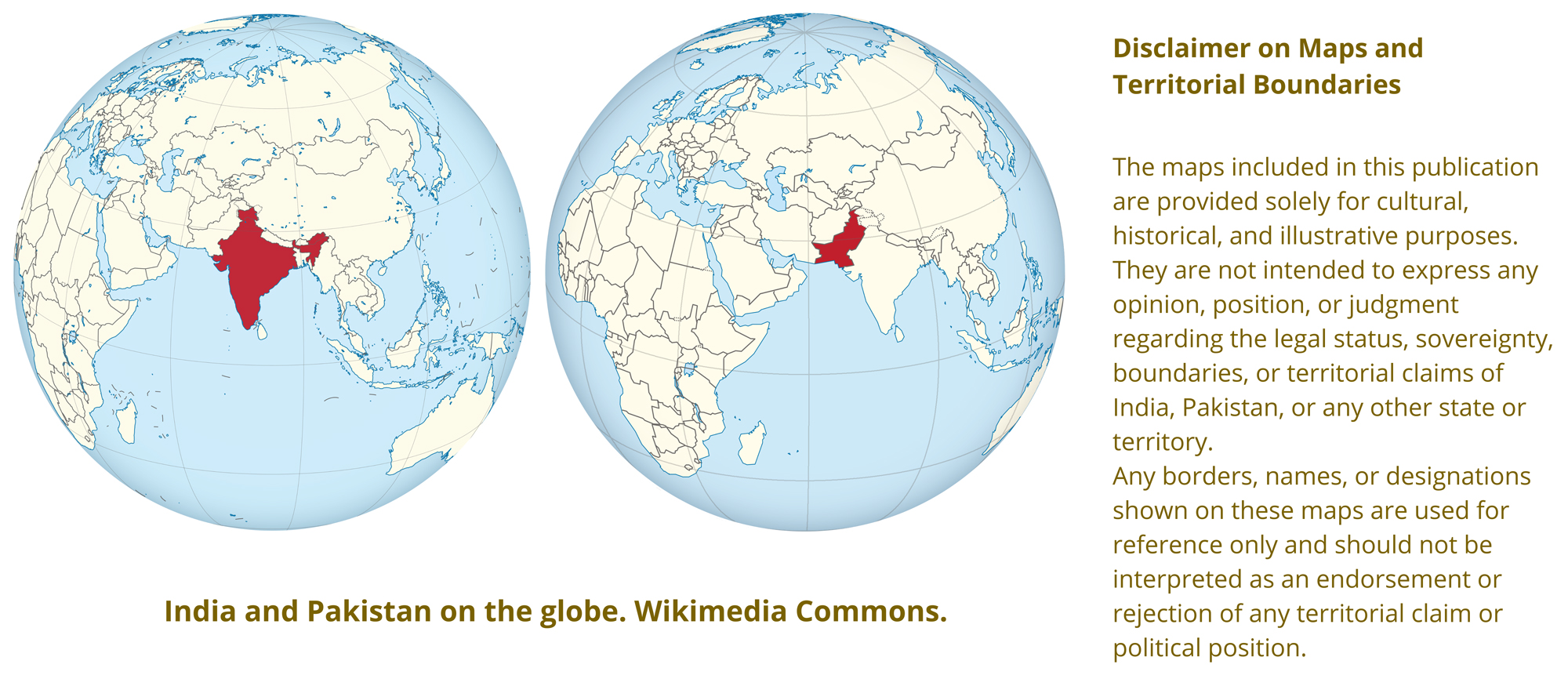
These pages treat Punjab as a transborder cultural region, divided in 1947 between two sovereign states but united by shared languages, foodways, music, oral traditions, agricultural landscapes, and craft practices that predate and outlast the line drawn through them. This framing makes no claim about contemporary borders, sovereignty, or territorial disputes. It is, rather, an attempt to hold together what history has separated: to read a landscape whole.
BELOW
An AI-generated image depicting a realistic rural landscape of the Punjab at sunset, featuring fields, a village, and a tractor.
THE PUNJABI PIDHA WEDDING CHAIR
History, Craft, and Cultural Significance
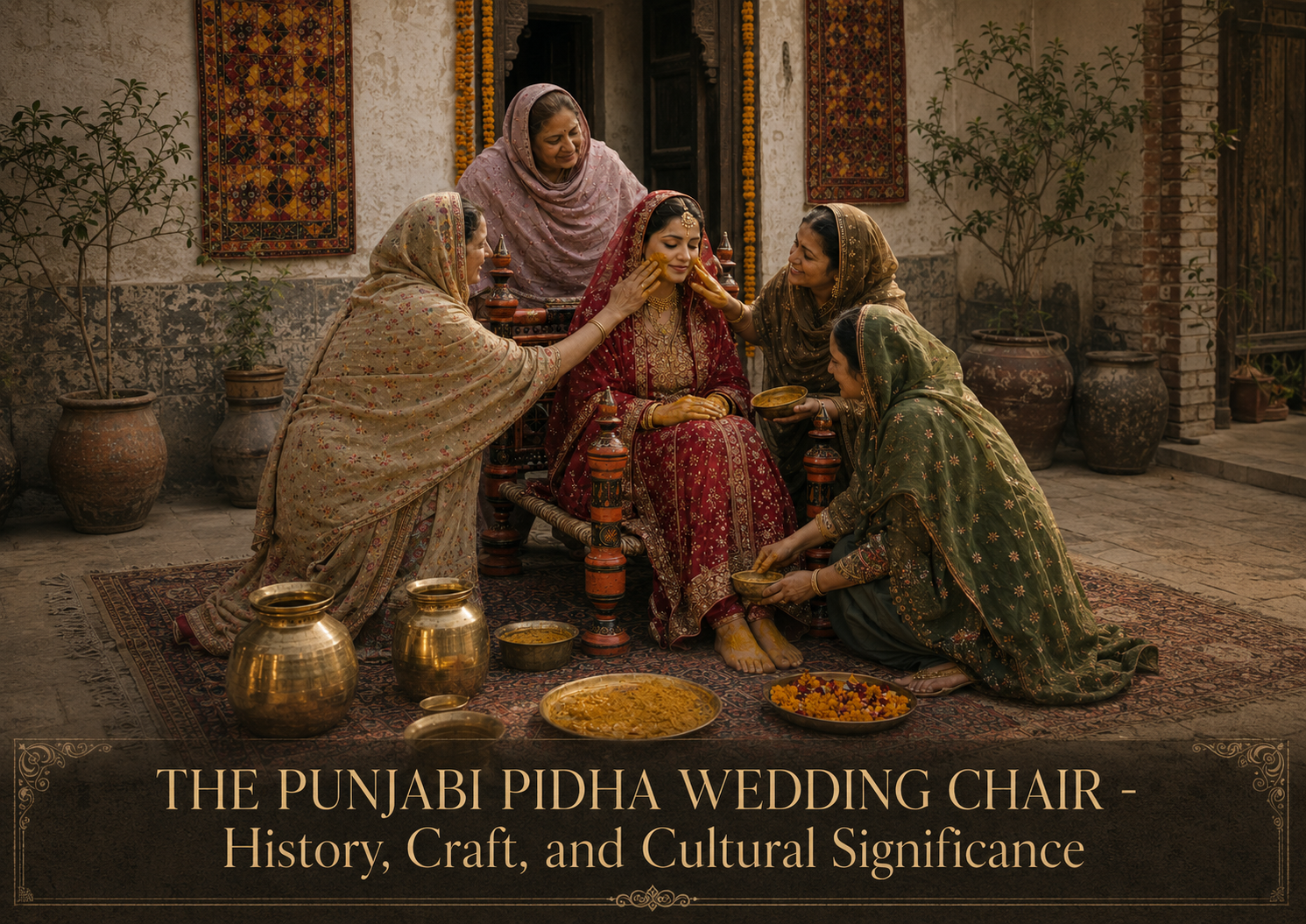
Overview
Among the most visually arresting artefacts of the Indian subcontinent’s material culture, the pidha — the low ceremonial chair of Punjab — occupies a singular position at the crossroads of woodcraft, ritual life, and domestic memory. Lacquered in deep vermilion, its turned members swelling into bulbous finials and its seat woven in the age-old charpoy tradition, the pidha holds together an entire world of social meaning: the bride about to leave her parents’ home, the artisan bent over the lathe in a village workshop, the grandmother’s careful hand preserving a cherished piece of furniture across generations. This study examines the pidha in its full historical, material, social, and aesthetic dimensions, drawing on fieldwork documentation, craft histories, and ethnographic sources to assemble a complete scholarly account of the object.
Terminology and Typology
The word pidha (rendered in regional variants as peedha, peerha, peera, peerhi, pidhā, pidi, or peedi, depending on dialect and context) belongs to a broader family of Punjabi low-seating terms rooted in the practice of floor-level living that has shaped domestic life across the subcontinent for millennia. In the typological framework established by the Vernacular Furniture of North-West India project — a six-year collaborative effort (2015–2021) between the Design Innovation and Craft Resource Centre (DICRC) at CEPT University, Ahmedabad, and the South Asian Decorative Arts and Crafts Collection Trust (SADACC) in Norwich, UK — the pidha is classified within the category of aasan (seating), a term derived from the Sanskrit āsana, which denotes both a bodily posture and a seat.
Within this schema, aasan spans a rich spectrum of vernacular seating — from the simple phatti (a flat wooden plank) and the parada (a low seat without backrest) to the pidhi (a small stool) and the mudha (a stool woven from coiled grass or reed). The pidha occupies a specific and distinguished niche within it: a low chair with a backrest, a feature that raises it both structurally and symbolically above its humbler relatives. The backrest, combined with the elaborate turned ornament of the finest Punjabi examples, lends the pidha the character of a small throne — a fitting form for the ceremonial roles it was called upon to play.
The Punjabi phatti, typical of the Majha region, is a low wooden seat used in kitchens for grinding spices in a kunda danda, or mortar and pestle. It is coloured red with oil-based paint and built from two planks nailed to side supports.
The pidhi is a stool typical of the Amritsar area, made of cotton rope and wood with tapered legs. According to the DICRC, its seat “was made by weaving dyed cotton ropes around the frame to create a dense wave-like pattern that is accentuated by the use of two different colours of rope.”
The mudha is a stool from the Mewat region, made of cotton rope and grass, and sometimes of bamboo. It was used mainly outdoors, in the front yard of the house, where the eldest men of the family would sit on it while smoking the hookah.
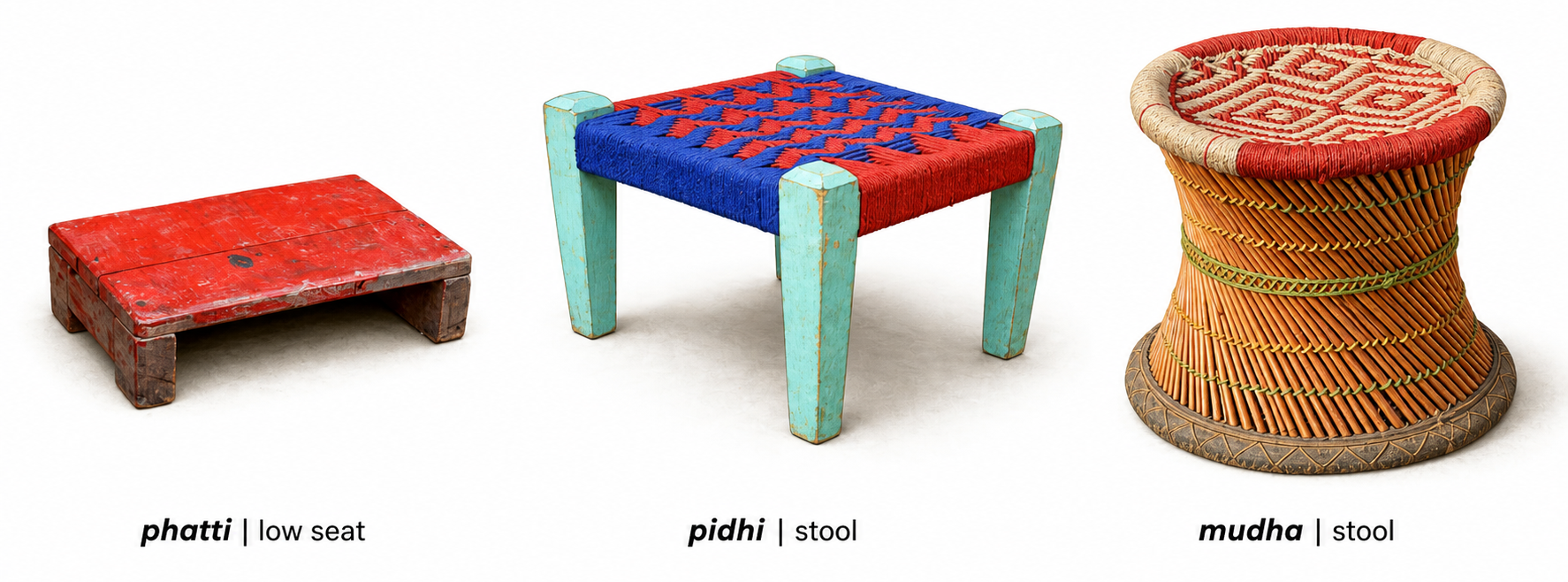
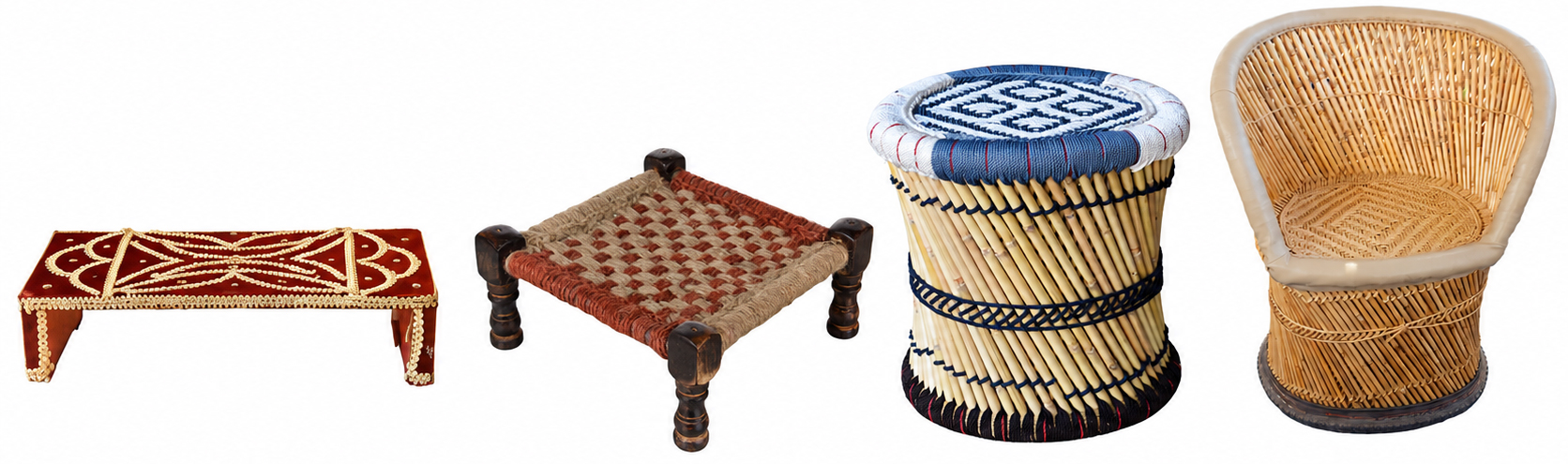
A critical distinction of nomenclature should be drawn here. The term pidhi (or peeree, peedi) typically refers to a backless stool — a flat seat on four turned legs — whereas pidha designates the low chair with a backrest. The chowki, which recurs in many related contexts, is a low platform or surface used for religious, domestic, and mercantile purposes. Though these terms overlap colloquially and are sometimes used interchangeably in popular writing, careful scholarly usage reserves pidha for the backed low chair that is the subject of this chapter.
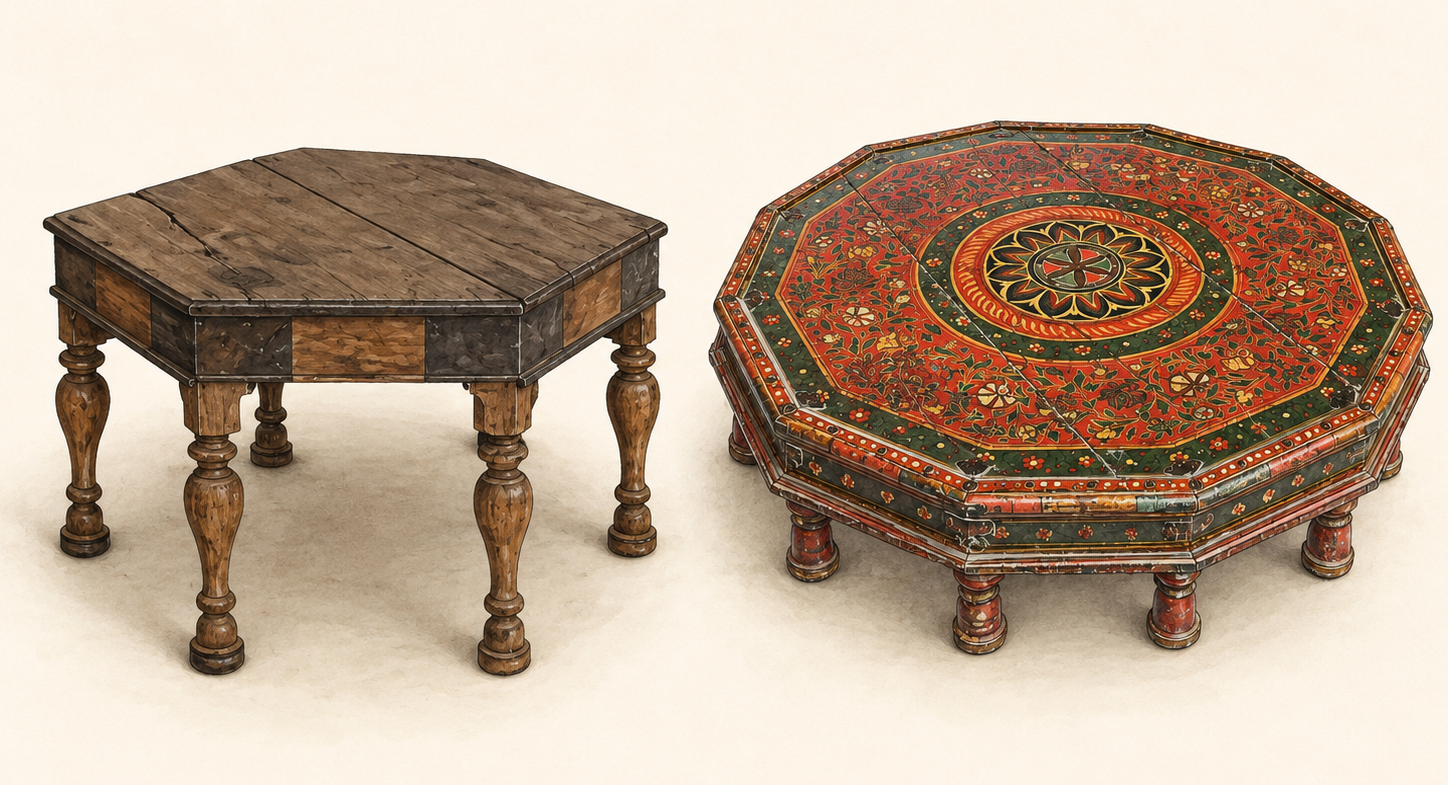
Two Punjabi chowkis. Both belong to the sapaat category, which comprises horizontal surfaces used to perform ceremonial activities, to set objects upon, or to write on.
Seats with Backrests
Kursi is an umbrella term: it can denote a traditional, dining, office, plastic, or metal chair — any one-person seat with a raised seat and, usually, a backrest. A pidha, by contrast, is a culturally specific vernacular form: low, wooden, frequently turned, joined, and painted, with a seat woven in cotton, newar, rope, or strap, and bound up with Punjabi domestic and ritual life. Both belong to the aasan category, and the relationship between them is straightforward: every pidha is a kind of kursi, but not every kursi is a pidha. Put differently, a traditional kursi is a general raised one-person chair, usually with legs and a backrest; a pidha is a distinctly Punjabi low kursi with short wooden legs and a woven, charpoy-like seat, often backed and sometimes carrying bridal or ceremonial associations.
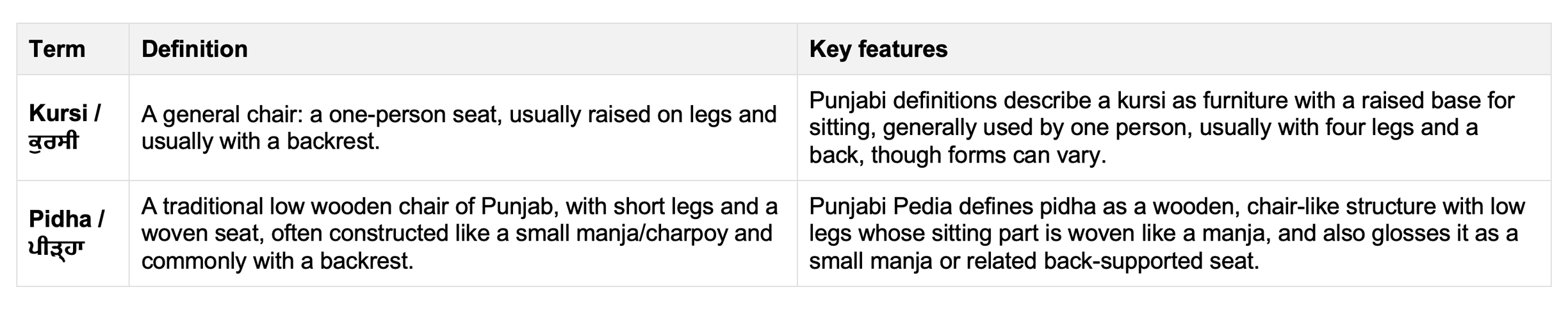
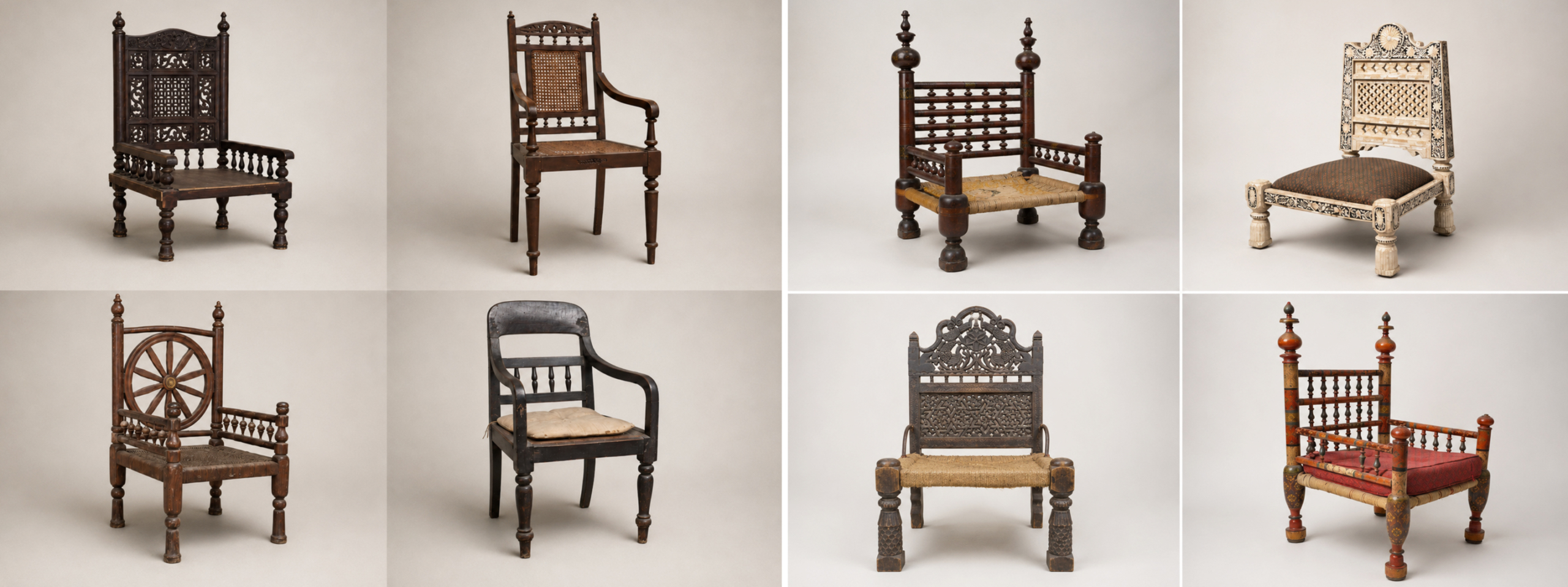
Four kursi (left) and four pidha (right). AI-generated composite based on real specimens.

From the Drawing Portfolio of Vernacular Furniture: Punjab, part of the Vernacular Furniture of North-West India Project, DICRC, India.
Indian Punjab: Geographic Distribution and Regional Variation
Historically, Punjab encompassed a vast territory stretching from the Indus valley in the west to the Himalayan foothills in the east — a region now divided between India and Pakistan. The pidha is documented throughout this entire cultural zone, with surviving examples and living craft traditions recorded across the present-day Indian state of Punjab as well as in Pakistan’s Punjab province. The form also appears, with variations, in the adjacent states of Haryana, Rajasthan, and Himachal Pradesh, evidence of a shared material culture that long preceded — and outlasted — modern political boundaries.
Within Punjab itself, the DICRC project identified pidha examples across all three major cultural sub-regions: Malwa (the southern and central plains, including Ludhiana, Sangrur, Patiala, and Bathinda), Doaba (the fertile land between the Beas and Sutlej rivers, including Jalandhar and Hoshiarpur), and Majha (the heartland around Amritsar and Gurdaspur). Regional variation in form is real but subtle: examples from Malwa documented at Punjab Agricultural University in Ludhiana have seats set higher than is usual, with backrests built from turned members fixed horizontally between the rear legs. The most elaborate ceremonial chairs — those with tall, finial-crowned corner posts rising well above the sitter’s head — appear to represent a festive, wedding-specific variant rather than an everyday domestic form.
The craft centres most closely associated with lacquered turned furniture, the pidha among them, are concentrated in the Doaba region. Three principal centres are documented: Hoshiarpur, Jalandhar (formerly anglicised as Jullundur), and Batala–Qadian in the Batala area. Of these, Hoshiarpur and Jalandhar each developed a distinct and identifiable style, separable by its choice of lac colours, ornamental vocabulary, and decorative technique.
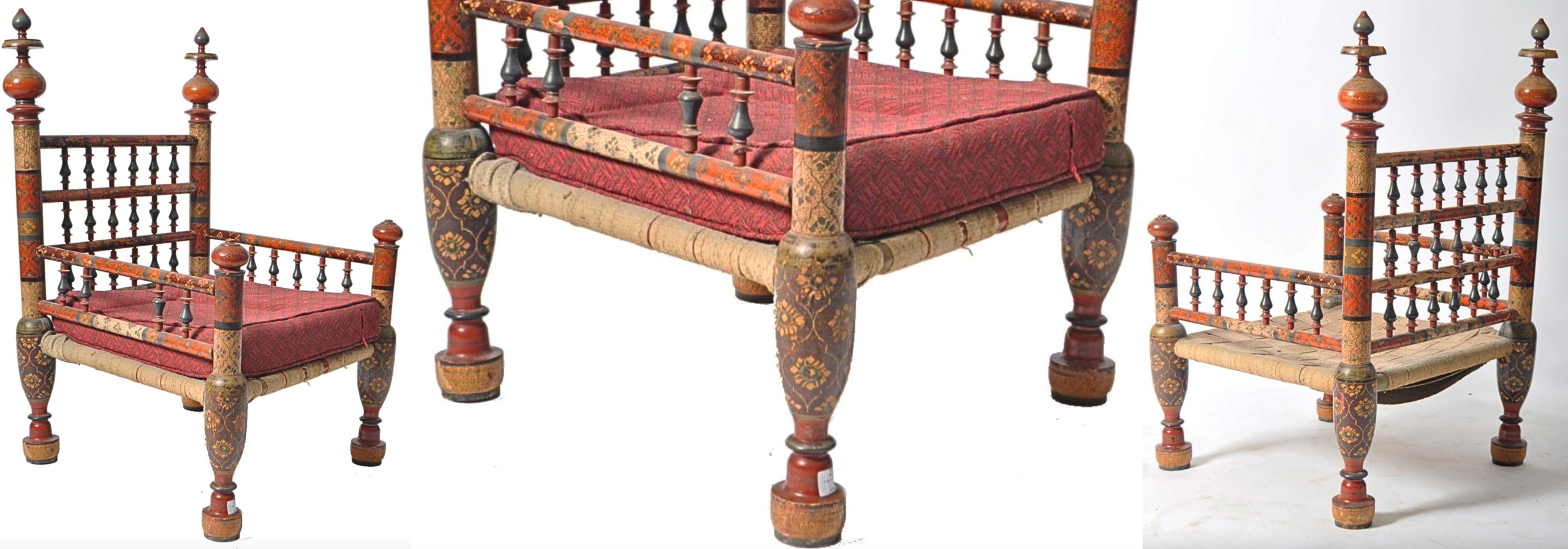
A nineteenth-century Indian Punjabi pidha marriage chair of high quality. The low form is built from turned wood sections and spindles set on bun feet, decorated with red, gilt, and black paint, inlay, panelled ornament, and a woven seat and cushion. Dimensions: 83 × 59 × 56 cm. Auctioned in 2023 by Auctioneum, Bristol, UK.
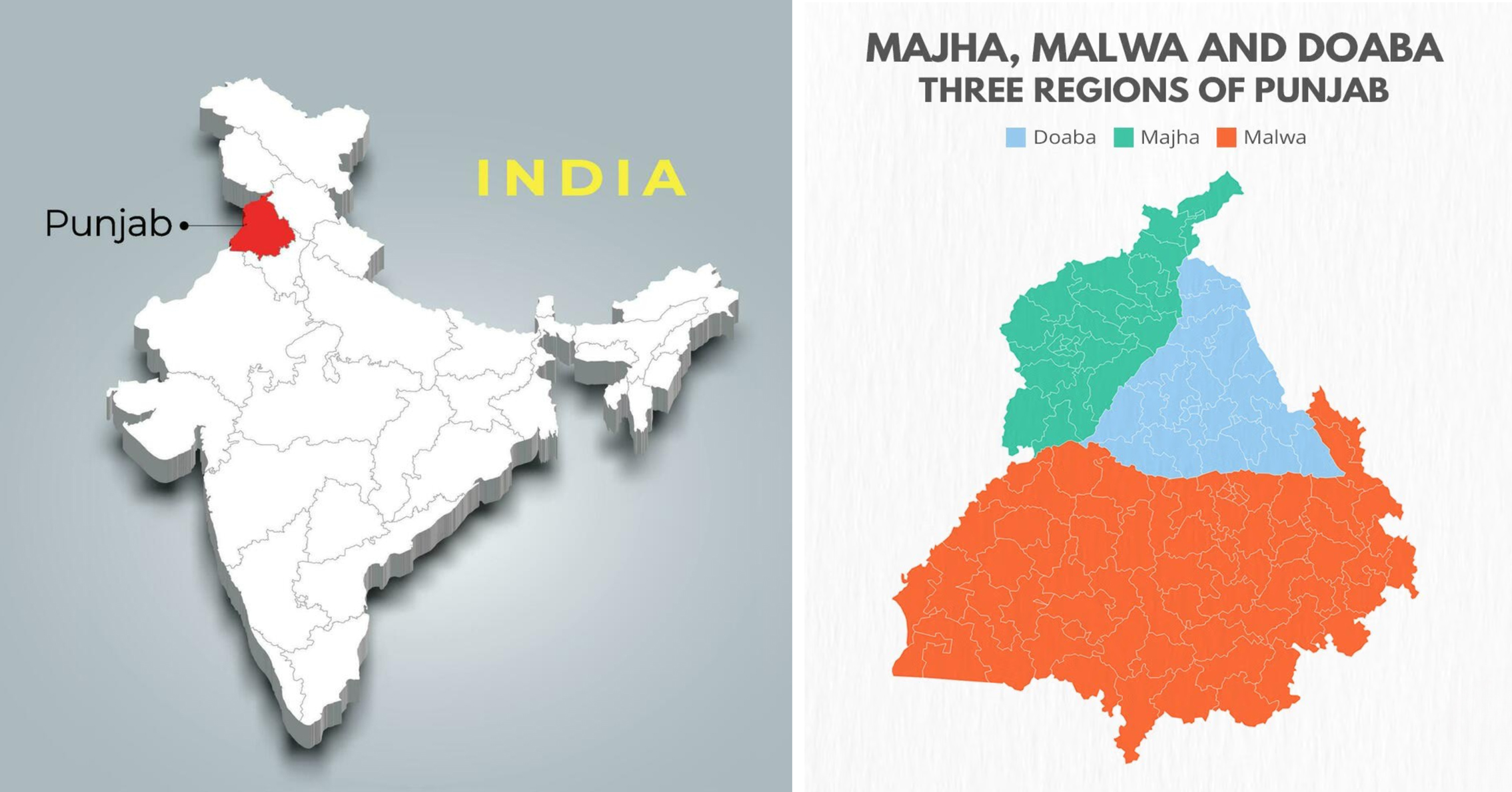
Indian Punjab is conventionally described through three cultural-geographic regions: Majha, Doaba, and Malwa.
Majha is the historic heartland of Punjab, lying between the Ravi and Beas rivers. On the Indian side it includes Amritsar, Gurdaspur, Pathankot, and Tarn Taran. Amritsar gives the region much of its religious and cultural weight, above all through the Golden Temple and its place in Sikh history.
Doaba means “land between two rivers,” here the tract between the Beas and the Sutlej. It includes Jalandhar, Hoshiarpur, Kapurthala, and Shaheed Bhagat Singh Nagar. The region is known for agriculture, dense migration networks, and craft traditions — and for towns such as Hoshiarpur and Jalandhar, long associated with lacquered and turned woodwork.
Malwa is the large southern and central region of Indian Punjab, extending across Ludhiana, Patiala, Sangrur, Bathinda, Moga, Barnala, and Ferozepur. The largest of the three regions, it is strongly associated with farming, rural domestic culture, princely-state history, and a robust everyday craft tradition.
Pakistani Punjab: Geographic Distribution and Regional Variation
The pidha/peerha belongs to the same wider Punjabi furniture family as the manji/charpai, but in Pakistan it is more often encountered in Urdu/Shahmukhi spellings such as پیڑھا (peerha, peera), and sometimes as a minor member of the charpai family rather than as a separately catalogued “pidha” type. A Pakistani Urdu essay on the charpai describes the furniture “family” as ranging from the larger dharanga through the charpai and panghuri to the peerha and peerhi, the last two reserved for other household activities; it also notes that charpai culture is especially strong in Punjab. Punjabi lexicographic sources define ਪੀੜ੍ਹਾ (pidha) as a low, chair-like wooden frame with short legs and a cot-woven seat, or simply as a small cot or stool — a definition that aligns closely with Pakistani usage of peerha.
The clearest documented Pakistan-specific style centre is Chiniot, in Pakistani Punjab. The South Asia Collection identifies a pidha with turned bulbous legs, an upright back, and finialled posts as a Chiniot type, noting its red, yellow, orange, and black lacquering and observing that the use of black lac is especially associated with the town. This matters because it gives Pakistani Punjab not merely a generic continuation of the pidha form, but a recognisable regional idiom: a turned wooden structure, a strong polychrome lac surface, and a darker ornamental palette than many Indian-side examples display.
Chiniot’s broader reputation for woodworking supports the attribution. The official district history describes the city as famous for wooden furniture, its trade encouraged by a location near the Chenab River and the timber routes that brought wood down from Kashmir; it also records that Chinioti designs were historically held superior to those of Hoshiarpur or Jalandhar. In short, where Indian documentation foregrounds Hoshiarpur, Jalandhar, and Batala–Qadian, the Pakistani-side account should foreground Chiniot as the major furniture and carving centre.
A second important Pakistani Punjab centre is Sillanwali, in Sargodha district. Pakistani lacquer work — known locally as laky ka kam, jandri ka kam, or, in Sillanwali, naqshi — is documented in Sillanwali and Chiniot within Punjab, and at Dera Ismail Khan and Kashmor beyond it. The technique combines woodturning, lacquer coating, and engraved or scratched decoration, producing multicoloured designs by cutting through the layers of lac. Sillanwali is therefore relevant as a living Pakistani Punjab centre for the very turned-and-lacquered wood technology used on pidha-like furniture.
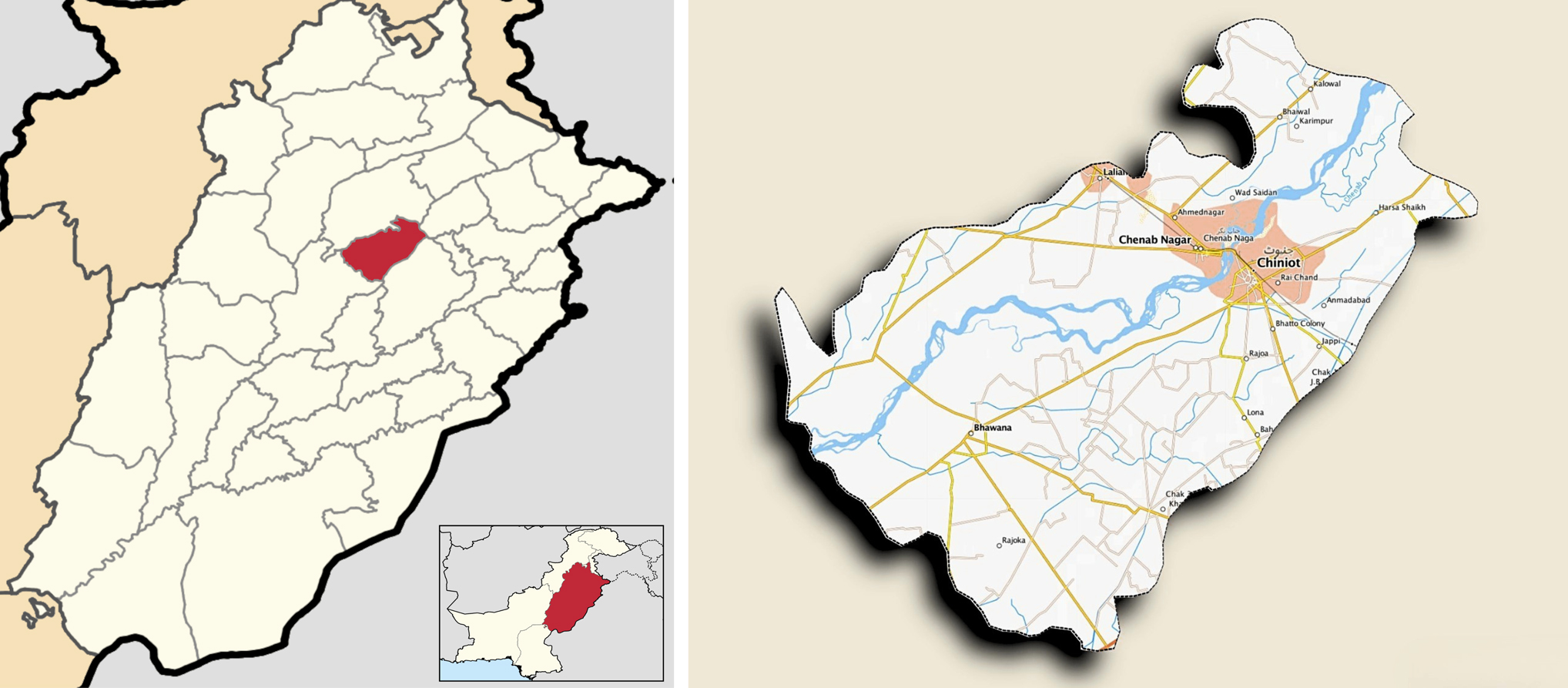
Chiniot district lies in Pakistan’s Punjab province on the banks of the Chenab. Its riverine position helped make it a major woodworking centre, since timber from Kashmir could be floated downstream to the city. Chiniot is now especially known for carved wooden furniture, architectural woodwork, and refined decorative traditions of Punjabi craftsmanship.
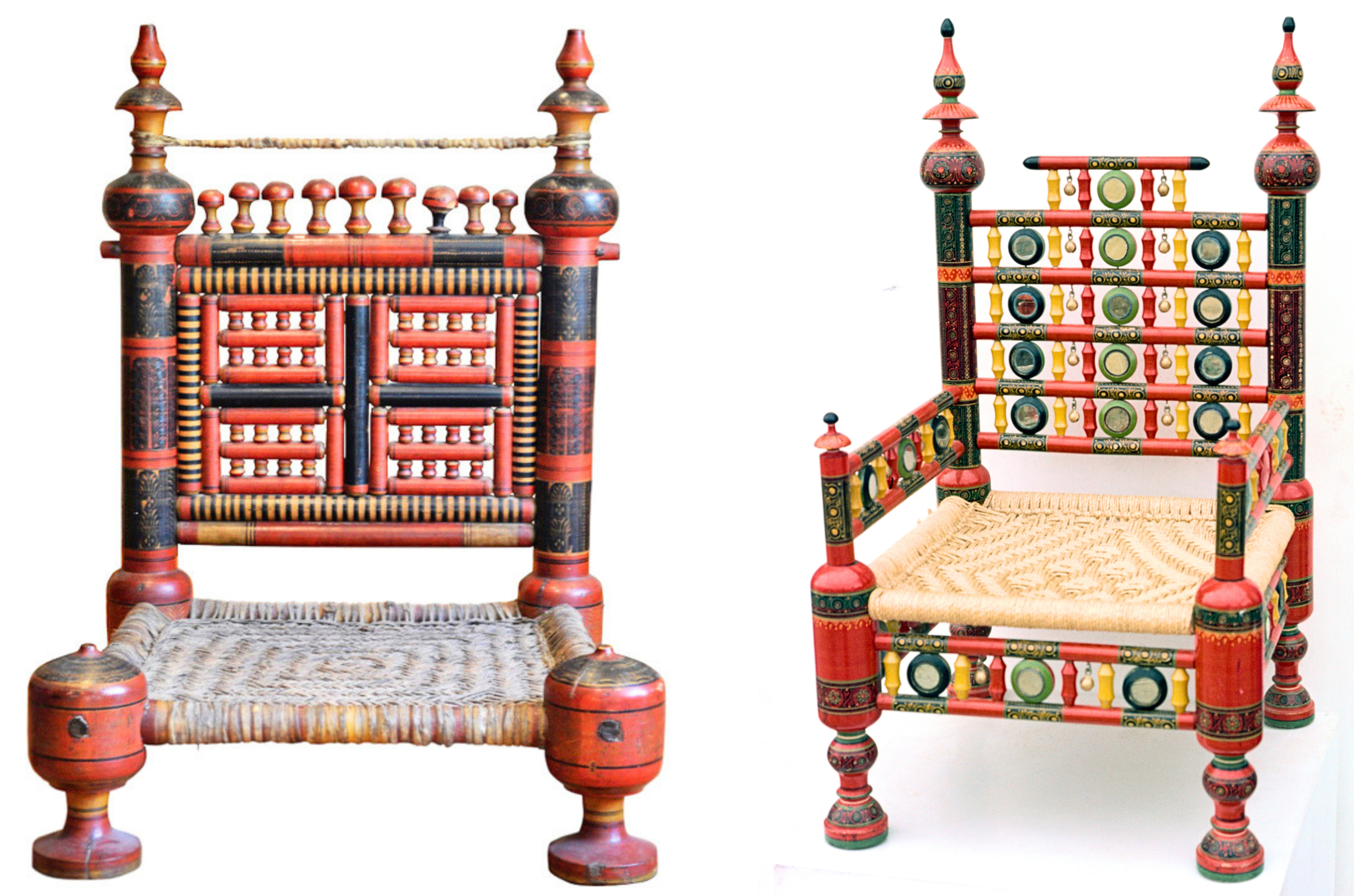
Left: antique pidha from Chiniot, Pakistan, at The South Asia Collection. © The SADACC Trust.
Right: vintage pidha made in Dera Ismail Khan, Pakistan. Photo: Robert Harding / Alamy.
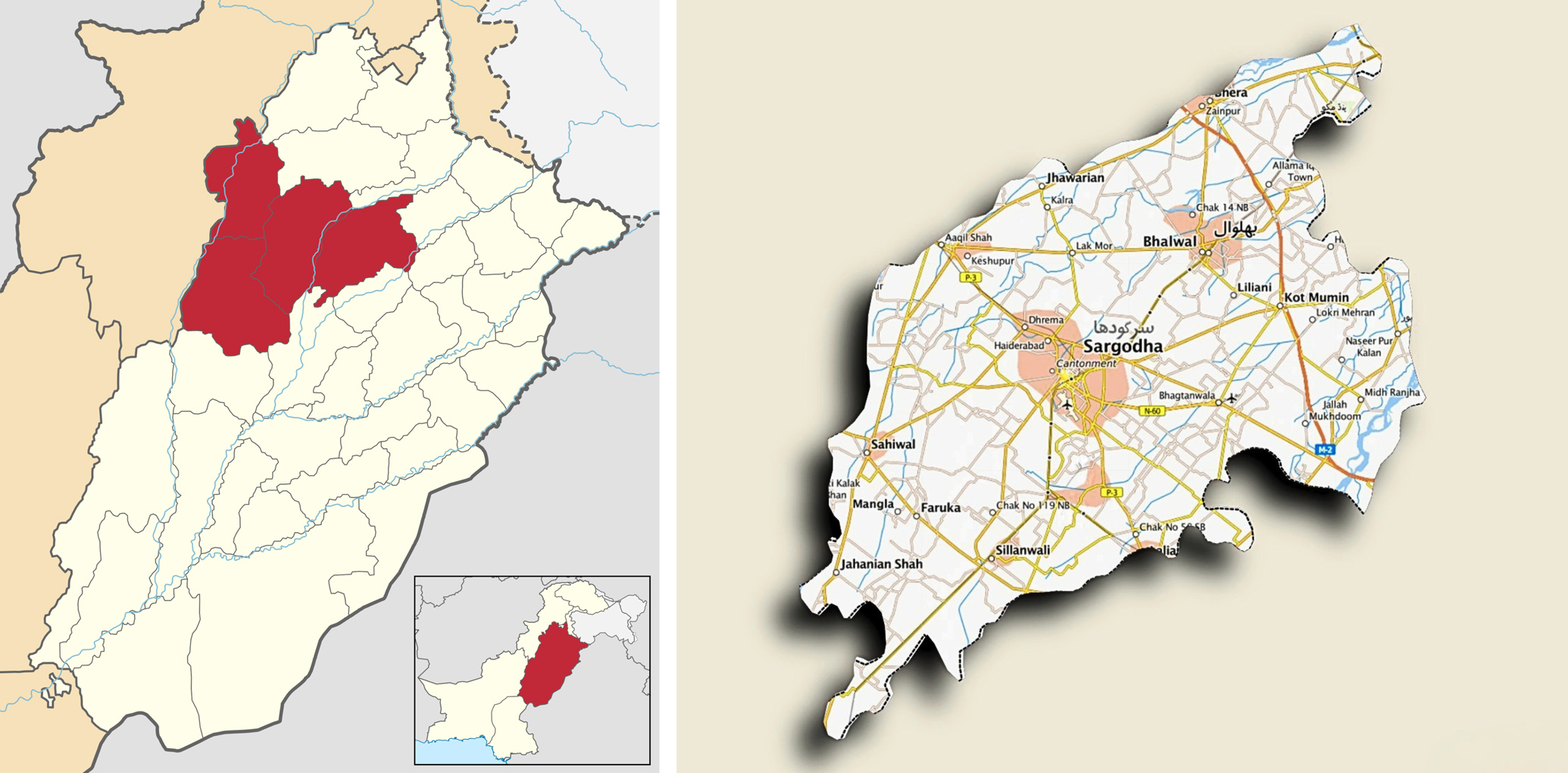
Sargodha Division is the wider administrative region of Pakistani Punjab in which Sillanwali lies. It comprises the districts of Sargodha, Bhakkar, Khushab, and Mianwali, with Sargodha city as its headquarters. The region is strongly agricultural — citrus above all — but also holds important craft localities such as Sillanwali, a centre for turned and lacquered woodwork.
WOOD, LAC, AND WOVEN BREATH
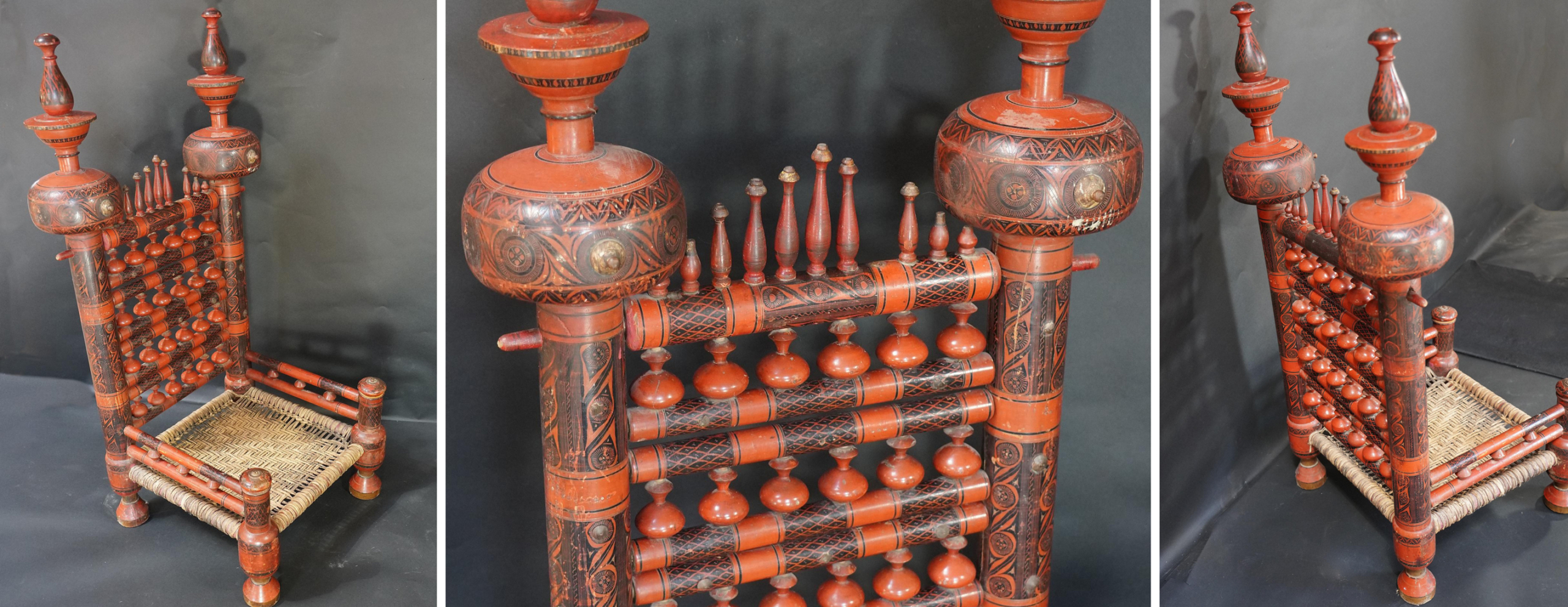
Old hand-crafted Punjabi-Pakistani wedding chair, hand-painted in vivid reds, with decorative painted spindles on the backrest and on the panels beneath the arms. Dimensions: height 116 cm, width 49 cm, depth 50 cm; weight 15 kg. Reto Zehnder Collection, Ethnic Design, Switzerland.
Wood
The structural frame of a Punjabi pidha is typically made of wood, shaped through joinery and turning and often finished with coloured lac. Documented examples combine wooden frames with woven seats, and museum records identify joinery, lacquering, and lathe-turning as the craft techniques central to the form.
For higher-quality furniture in Punjab and North India, one of the most valued timbers is sheesham or shisham (Dalbergia sissoo), known in English as Indian or North Indian rosewood. The tree is native to the sub-Himalayan and alluvial riverine zones of South Asia and is found across Punjab, Haryana, Uttar Pradesh, Rajasthan, Bihar, Assam, and other regions of India. Its heartwood is hard, heavy, strong, durable, and decay-resistant, which makes it especially suited to furniture, turning, carving, agricultural tools, and other demanding uses.
The appeal of sheesham lies not only in its strength but in its appearance: the heartwood ranges from golden to darker brown, often with attractive figuring. It seasons well, holds its shape reliably when properly dried, and takes a fine polish — qualities that help explain its long association with durable domestic furniture in northern India. The heartwood also resists termites and wood-rotting fungi naturally, though the sapwood is more vulnerable and should not be assumed equally durable.
Other woods were used according to cost, availability, and the status of the object. Everyday pidha could be made from accessible local timbers such as kikar (acacia), while more elaborate or ceremonial pieces might call for better-seasoned hardwoods. Teak appears in some later or higher-value examples, but it is best understood as a traded or premium timber rather than a default Punjabi village material. The coloured lac surface did more than decorate the frame: it gave the wood a protective skin that helped resist handling wear and minor moisture, though the longevity of any pidha still depended on the quality of the timber, the joinery, and the conditions of storage and use.
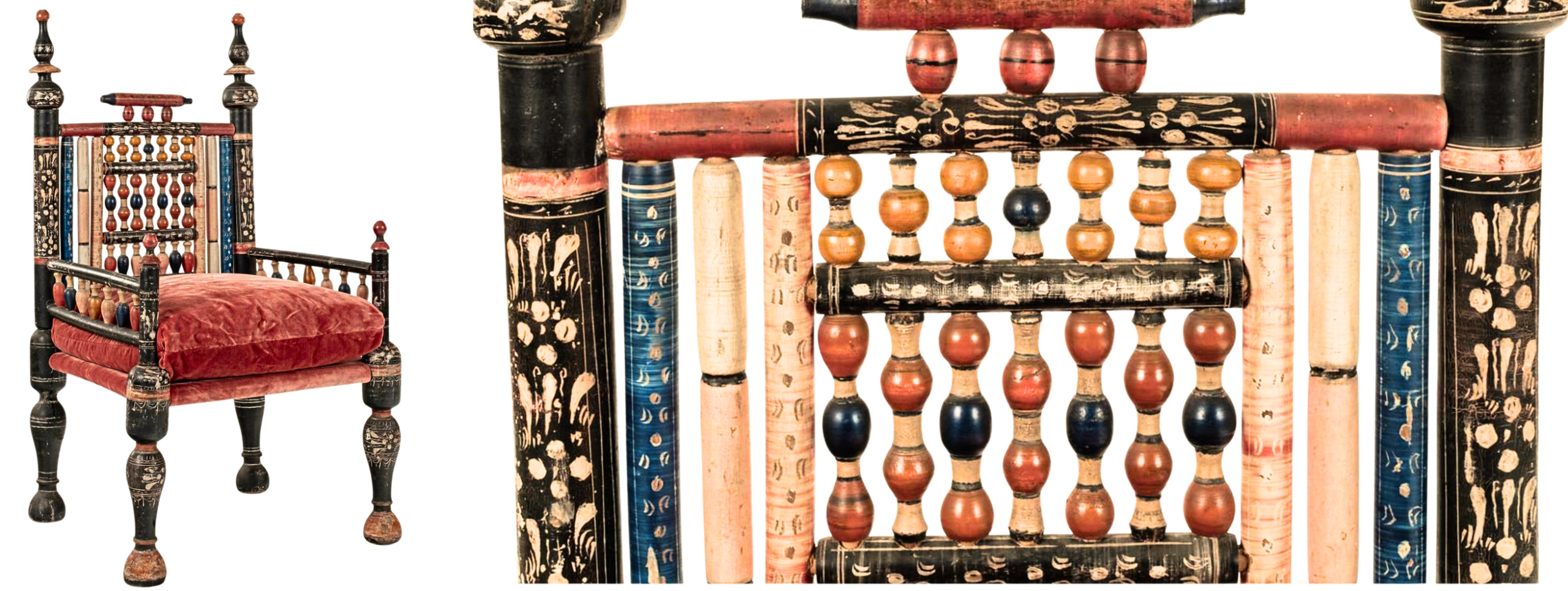
A Pakistani-Punjabi chair of the late nineteenth or early twentieth century: carved, turned, and hand-painted, with a seat cushion of khaki silk velvet and goose down. Dimensions: height 100.33 cm (39.5 in), width 55.88 cm (22 in), depth 52.71 cm (20.75 in). With a seat height of 43.18 cm (17 in), this is not a pidha but a remarkable kursi. Via 1stDibs.
Lac and the Lacquer Tradition
The finish that gives many Punjabi pidha and kursi their most recognisable character is lac lacquering, part of a long South Asian tradition of decorating wood, jewellery, toys, boxes, and furniture with coloured lac. Lac is a natural resin secreted by lac insects, identified today as Kerria lacca. Older scientific literature uses several synonyms, among them Tachardia lacca (Chamberlin, 1923) and Laccifer lacca (Cockerell, 1924). The word “lac” derives most probably from the Sanskrit lākshā, the term for the resin, connected to laksha, “one hundred thousand” — a reference to the vast colonies of insects required to yield commercially useful quantities of the substance. This numerical etymology is the most widely cited, though some scholars propose instead a derivation from an Indo-European root for colour or dye.
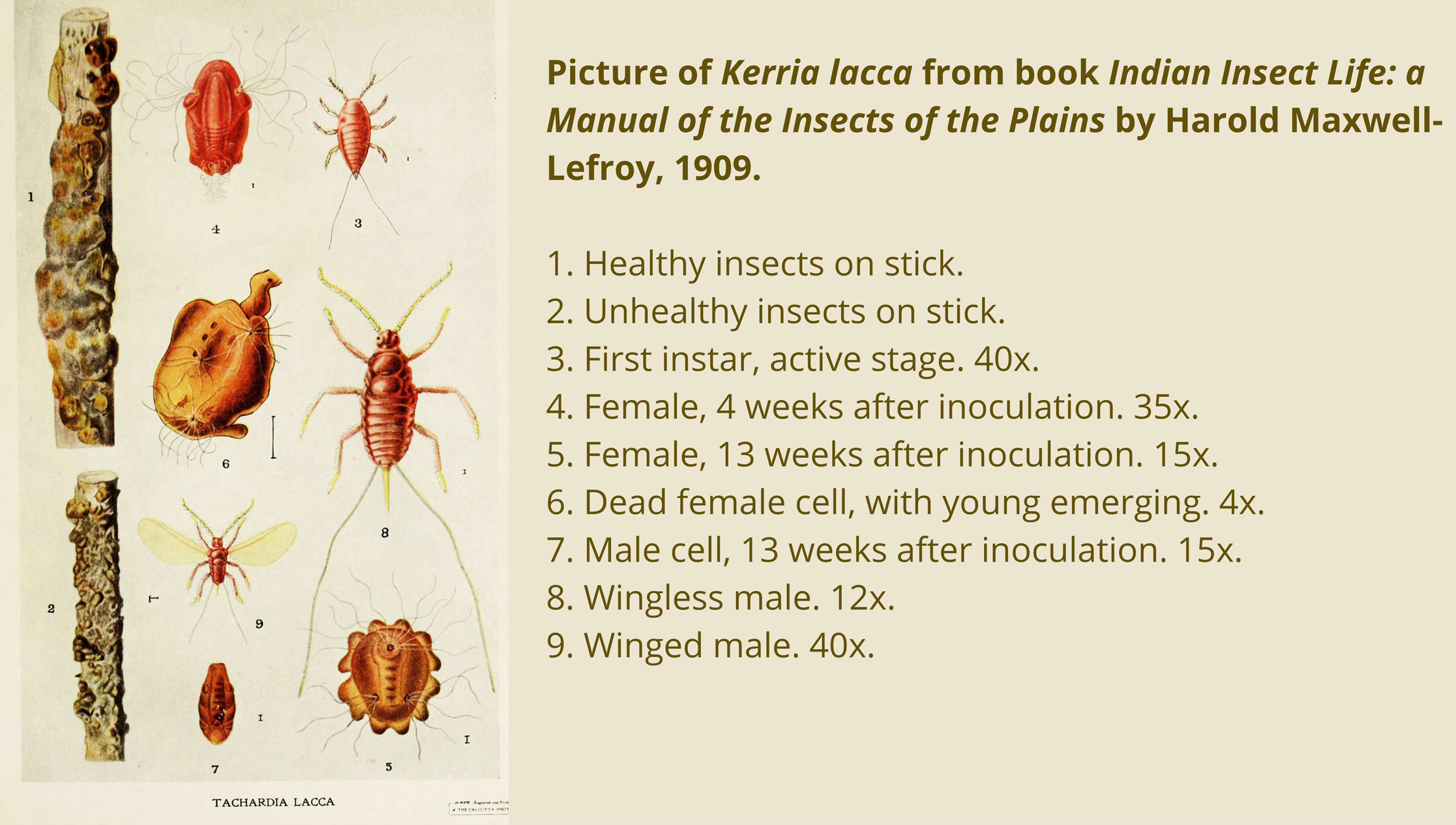
The cultural history of lac in South Asia is ancient. The Atharvaveda contains a hymn (Kāṇḍa 5, Sūkta 5) in which lākshā appears as a healing substance, invoked together with the plant arundhatī in a charm for the mending of wounds and broken bones. The Mahabharata preserves the notorious episode of the Lakshagriha — the House of Lac — a palace built by the Kaurava prince Duryodhana as a death-trap for his cousins the Pandavas: raised from lac, hemp, resin, and ghee-soaked timber so that it might be set ablaze while they slept. Forewarned by the minister Vidura, the Pandavas escaped through a tunnel, and Purochana, the architect of the plot, perished in his own construction. Refined lac goods later appear in Mughal-period documentation: Abu’l Fazl’s Ain-i-Akbari, composed between 1589 and 1596 and describing Akbar’s empire roughly as it stood around 1590, records lac-turned objects among taxable court commodities.
In Punjab, lacquered wooden furniture is especially bound up with turned forms and brilliant colour. The technique — jandri ka kam or laky ka kam, “lathe work” — proceeds in three stages: woodturning, the hot application of coloured lac sticks to the spinning surface, and surface engraving. Finer pieces from Chiniot also employ scratchwork, an intricate incised decoration distinctive to that tradition.
The documented Chiniot pidha at the South Asia Collection illustrates the form clearly: a low chair with bulbous lathe-turned legs, turned finials, and lacquering in red, yellow, orange, and black. The collection’s catalogue notes that black in this combination is a Chiniot speciality. Similar lac decoration appears on other Punjabi domestic objects in the collection, including mirrors, roti boxes, and architectural elements such as carved door frames. The pidha also carried ceremonial weight: fieldwork by the project recorded the practice of seating a new bride on a pidha as she first entered her husband’s home, making the object a threshold artefact as much as a seat.
The history of Punjabi lac furniture is also marked by rupture. With Punjab fieldwork conducted in 2018–2019, the Vernacular Furniture of North-West India project documented both the survival and the silences of this tradition across the Partition of 1947. Researchers found century-old lacquered doors still in family homes in Tarn Taran district, their decoration identical to objects in the museum collection; yet the living craft that produced them has become far less visible in everyday Indian Punjab. The disruption was not simply one of destroyed workshops but of severed knowledge: artisan communities, the cross-border trade in lac goods, and the transmission of technique all fractured along with the border itself. The project’s findings on the region are to appear in Smarya: Vernacular Furniture of Punjab and Haryana, co-authored by Mansi S. Rao, Ben Cartwright, Jay Thakkar, and Abhishek Ruikar.
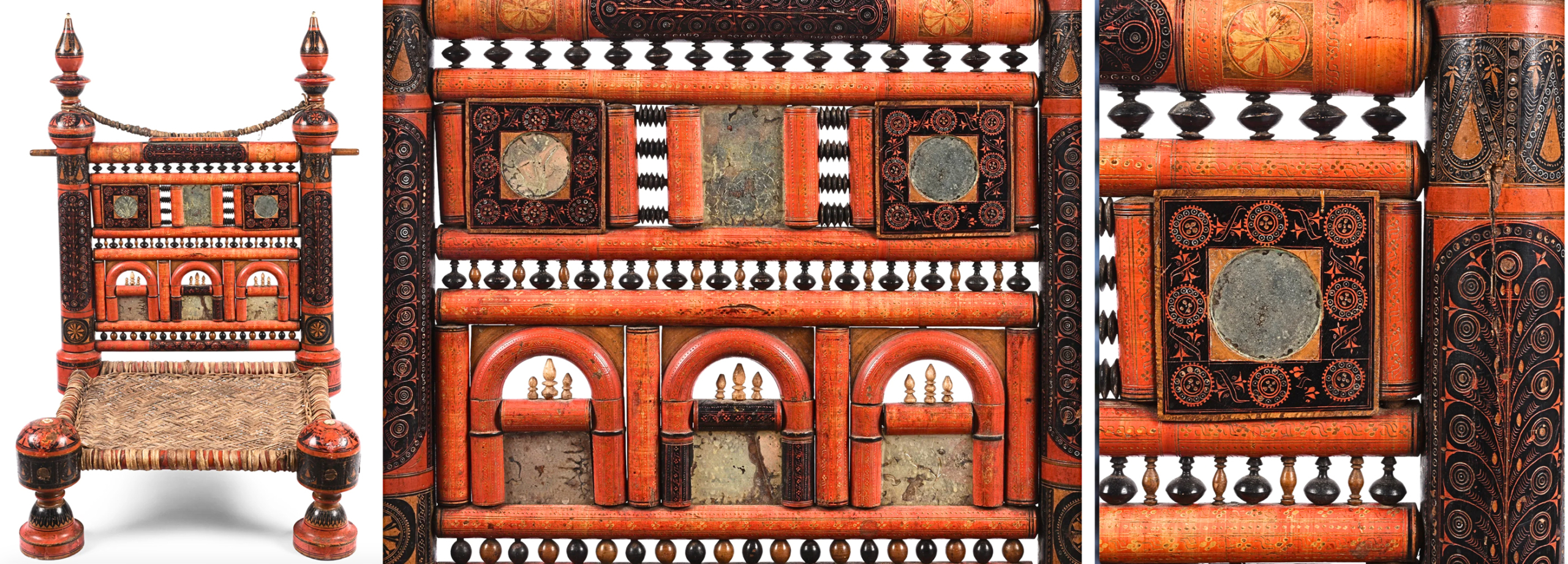
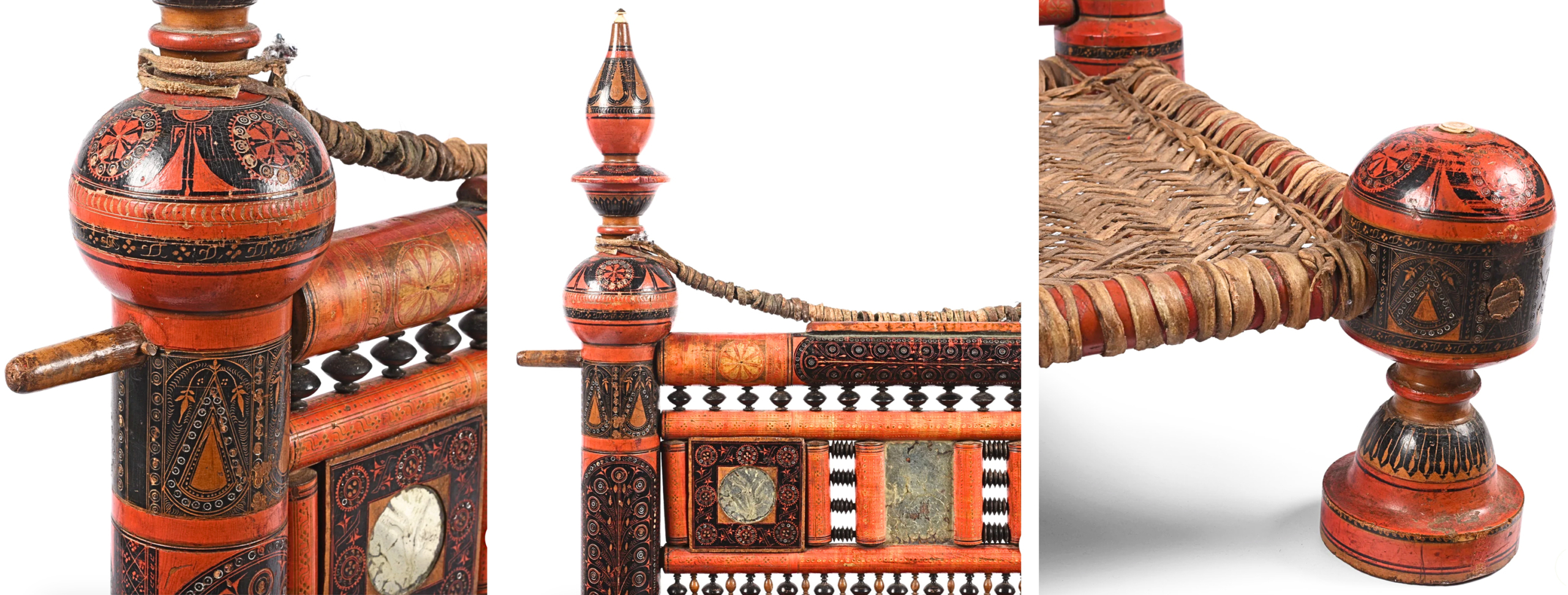
Scratchwork-and-lacquer Punjabi pidha chair, Pakistan, nineteenth century. Dimensions: width 70 cm, depth 55 cm, height 97 cm. Sold by Indigo Oriental Antiques, Manningford Bruce, Wiltshire, UK.
The Charpai-Woven Seat
The seat of the pidha is closely related to the woven technology of the charpai or manja — the South Asian rope bed, known regionally as charpoy, khat, khatla, manji, kaithu kattil, and other names. In documented Punjabi pidha, the wooden frame acts as a small loom: cotton strap, rope, or other fibre is stretched and interwoven across the seat rails to form a taut, resilient, breathable surface. A Ludhiana example recorded by the project lists its materials as wood and cotton strap, with weaving used for the seat and joinery, turning, and lacquering for the frame.
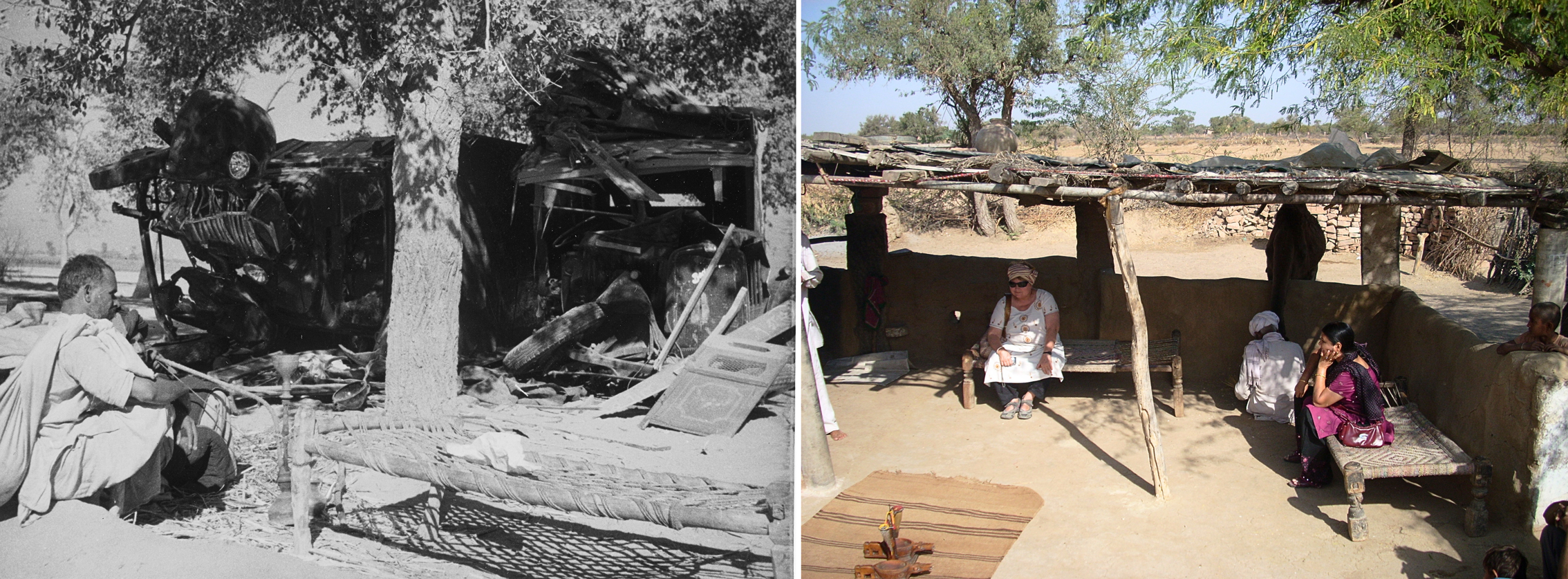
Left: two men with a hookah beside a charpai, with an overturned truck in the background; Amritsar, photographed by Annemarie Schwarzenbach, 1939–40. Swiss National Library, Literary Archives.
Right: charpais with a diamond-weave pattern, used as daybeds in Rajasthan. Wikimedia Commons.
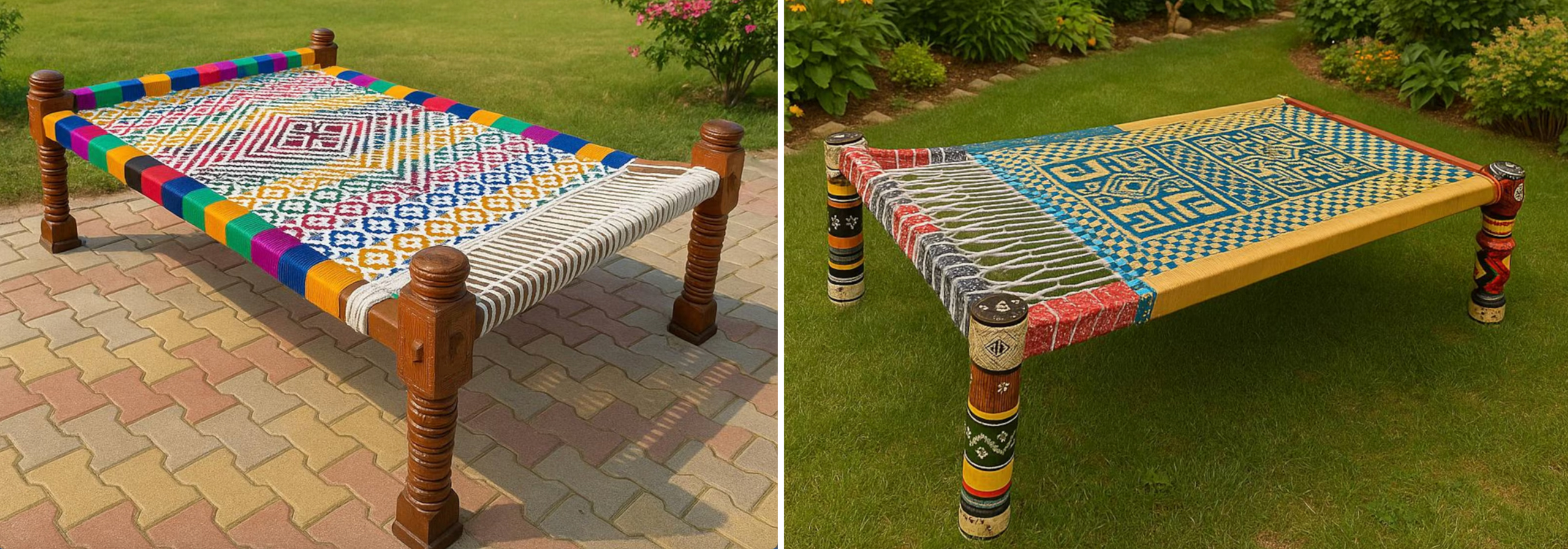
Two contemporary charpais.
Left: handwoven charpai from India, also called a khatiya, with bright multicoloured geometric patterns in durable cotton rope on hand-carved wooden legs; length 72 in, width 28 in, height 18 in. Vintage Studio 1999, Jodhpur, India.
Right: desi charpai bed from Pakistan, handwoven in 100% cotton rope on hand-carved wooden legs; length 68 in, width 41 in, height 24 in. ZamEsh, Hyderabad, Pakistan.
Traditional seat materials included cotton webbing or newar, jute or hemp cord (sutli), and grasses or reeds such as munj; later and contemporary examples may use synthetic cord, nylon, or plastic strapping. More decorative or ceremonial pieces sometimes used coloured fibres to echo or to contrast with the lacquered frame.
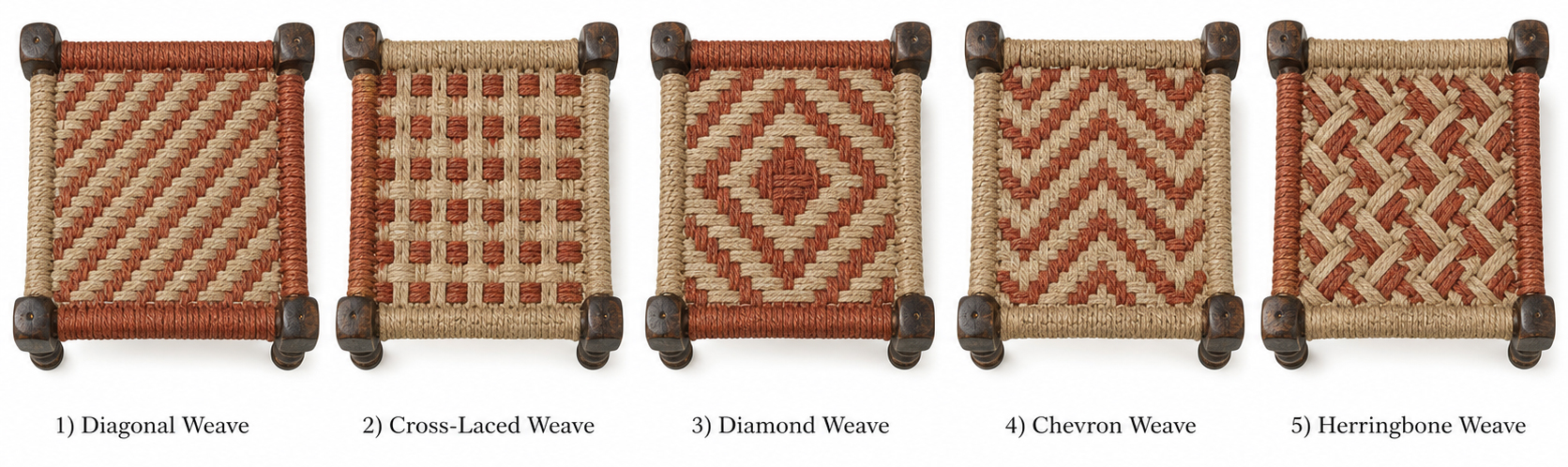
The weave is often worked diagonally, in cross-laced, diamond, chevron, or herringbone-like patterns, though the exact structure varies by region, maker, and period. The woven surface is practical as well as ornamental: it distributes weight, allows air to circulate in hot weather, and can be repaired or re-woven when worn. On ceremonial pidha, the contrast between the matte, fibrous seat and the glossy lacquered wood produces one of the object’s strongest visual effects — a meeting of everyday charpai technology with festive colour, polish, and wedding symbolism.
For wedding use, this combination of materials carries social meaning as well. The pidha is not merely a small seat; in Punjabi domestic memory it can mark transition, welcome, and ritual honour. Fieldwork recorded the practice of seating a new bride on a pidha when she first entered her husband’s home, after which the object might be reserved for special occasions.
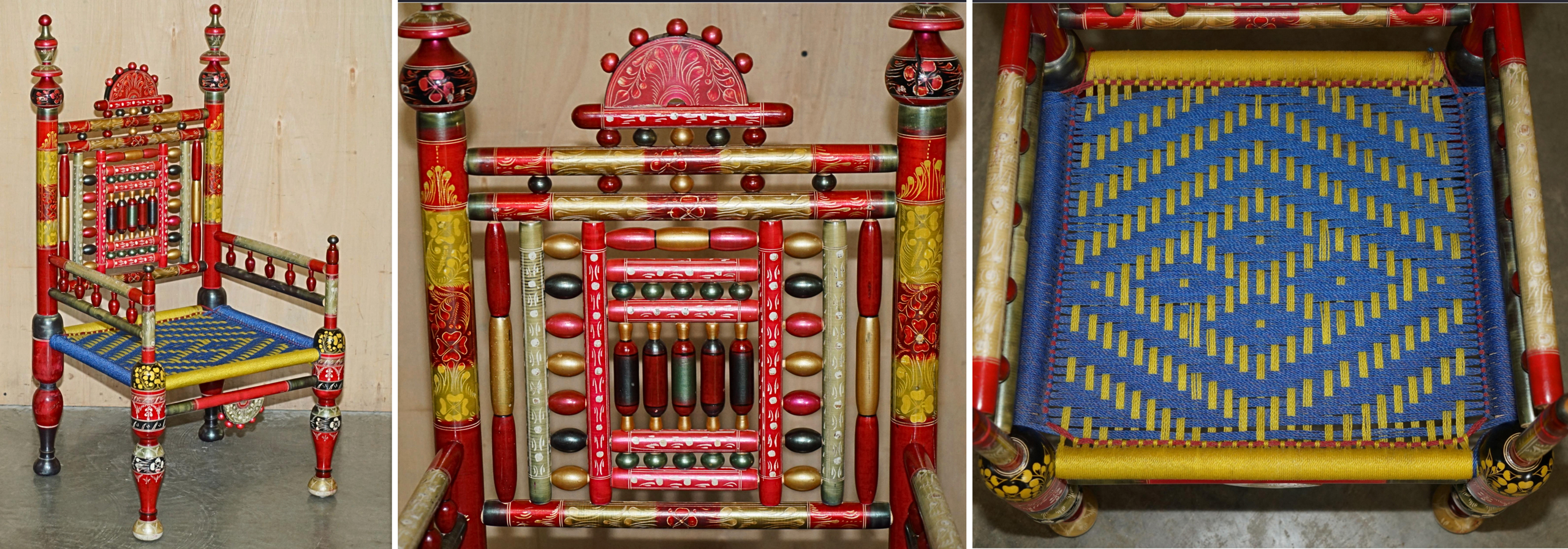
Traditional Punjabi wedding kursi in lacquered and painted cedar, Pakistan, twentieth century. Dimensions: height 112 cm (44.1 in), width 56 cm (22.05 in), depth 54 cm (21.26 in); seat height 37 cm (14.57 in). Royal House Antiques (GB), via 1stDibs.
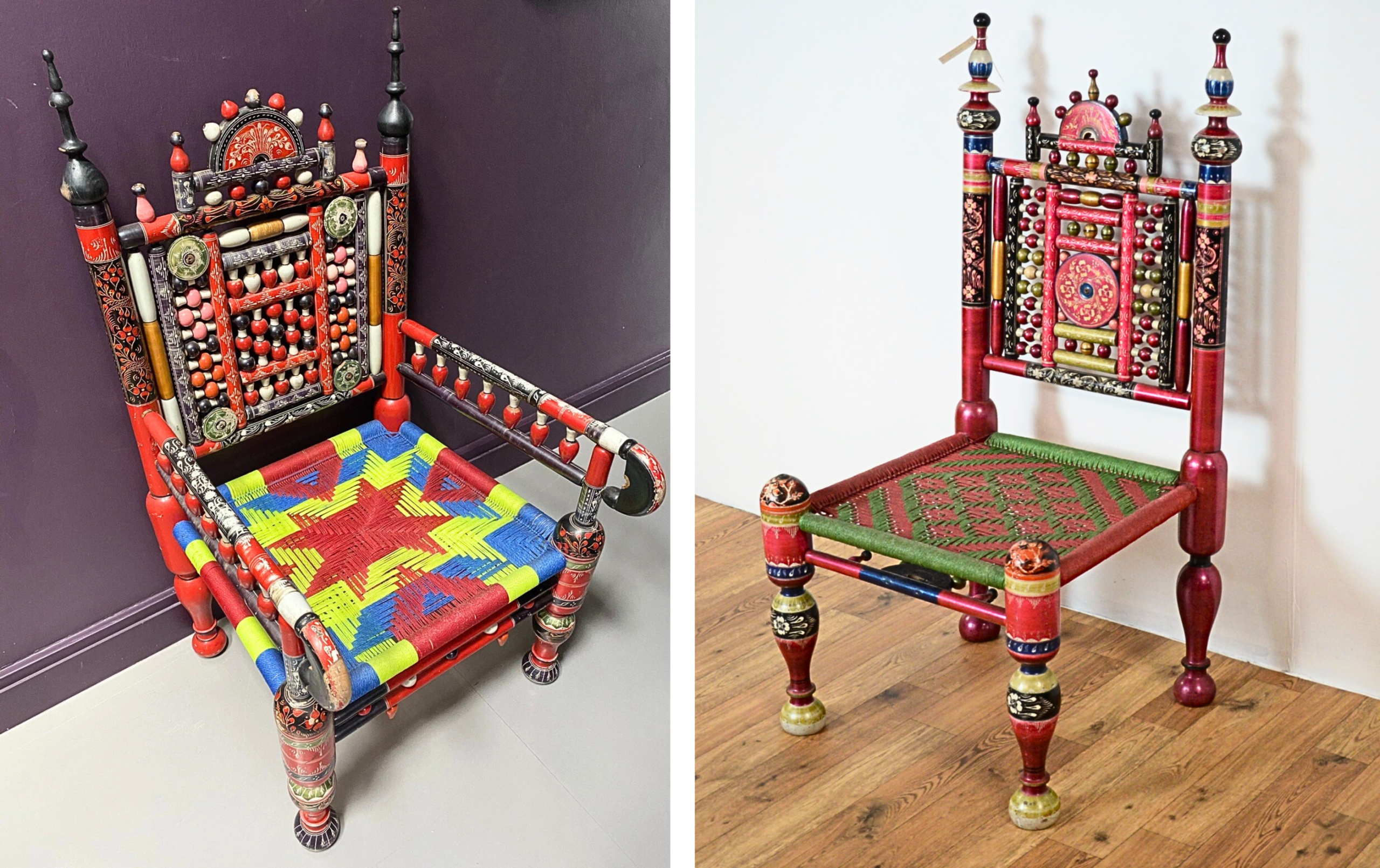
Two vintage Punjabi wedding chairs.
Left: an old wooden structure whose brightly woven seat may have been replaced over time; height 108 cm, depth 58 cm, width 54 cm. On sale in London, UK, via eBay.
Right: Indian Punjabi wedding chair; 55 × 50 cm, height 115 cm. Auctioned by Anderson & Garland (Newcastle upon Tyne, UK) in 2023.
The Craft of Making: Wood-Turning, Lathe, and Lac Etching
The Kharadi Artisan Community
The making of the turned wooden pidha is the domain of specialist craftspeople known as the Kharadi (also Khardila) — the lathe-turning community of Punjab, concentrated historically in Hoshiarpur and its surrounding villages. The Kharadi are a hereditary artisan caste whose identity rests on mastery of the lathe and on accumulated knowledge of how wood behaves, how lac is worked, and what ornamental vocabulary belongs to the tradition. Within the Hoshiarpur district their heartland includes not only the main town but villages such as Bassi Gulam Hussain, Bijwara Kalan, Nasrala, Basi Kiran, and Naro Nagal.
This community-based system of transmission — in which skills, tools, patterns, and trade relationships pass from one generation to the next — is typical of what the Indian tradition calls paramparā (hereditary lineage). It accounts at once for the remarkable consistency of the tradition’s formal vocabulary and for its acute vulnerability to disruption when economic or social conditions change.
The Turning Process
Production begins at the lathe. The structural members — legs, stretchers, backrest posts, and the turned ornamental elements that populate the chair’s surface — are formed individually on a power lathe (formerly a hand-driven bow lathe, now typically motorised). Turning demands the craftsperson’s deepest skill: the slow shaping of a spinning wood blank under the guided pressure of a metal chisel, which pares away material in continuous shavings to reveal the flowing curves of the finished form.
The turned vocabulary of the Punjabi pidha is distinctive and immediately recognisable: bulbous swellings at regular intervals along legs and posts, sequences of ring-and-bead profiles, vase-shaped balusters with their characteristic trumpet necks, and spherical knops — a repertoire that functions as a kind of regional visual dialect. DICRC documentation identifies the bulbous turning explicitly as “a distinctive feature of pidha in Punjab,” setting the regional type apart from the furniture of adjacent Rajasthan and Gujarat, which, though also lathe-turned, favours different proportions and profiles.
Lac Application and Etching
Once the turned components have been assembled into the chair’s structure with traditional mortise-and-tenon joinery, the lacquering begins. Lac is applied in successive layers to the wood as it rotates on the lathe, the heat of friction between lac stick and spinning surface softening the resin so that it adheres. The sequence documented for Hoshiarpur work is three layers, applied in the order white, black, and red, the final coat giving the piece its dominant surface colour; yellow is occasionally added as a fourth. The once-characteristic purple lac of Hoshiarpur — a signature of the region’s tradition — has fallen into disuse and is now seldom produced.
After the coating has been built up to the desired depth, a sharp metal stylus or needle is drawn across the surface to etch fine ornamental motifs, cutting through the uppermost layer or layers of lac to expose the contrasting colours beneath. This technique — effectively a form of sgraffito — produces the intricate geometric, floral, and foliate decoration that covers every surface of a well-made pidha: continuous bands of fine-line pattern encircling each turned member, rosettes on the broader spherical sections, and delicate meanders or scrollwork along the flat stretchers. In Jalandhar, the nakashi style (from naksh, “design”) uses needles to engrave the surface in a slightly different manner, yielding patterns in alternating colours distinct from the Hoshiarpur aesthetic.
The effect of a fully lacquered and etched pidha is one of extraordinary decorative density: every surface alive with pattern, the red ground glowing against incised lines of black and white, with occasional accents of gold or yellow at the prominent knops and finials. The finest surviving examples carry this richness to a remarkable degree, their deep vermilion lacquer enlivened by fine incised ornament across posts, stretchers, and turned members.
Joinery and Assembly
The assembly of the pidha draws on the joinery traditions common to northern Indian vernacular furniture: mortise-and-tenon joints for the principal connections (legs to seat frame, backrest members to rear posts), reinforced in some examples by metal bracing at the backrest attachments. The seat frame is built as a separate rectangular structure — four horizontal members joined at the corners — which receives the woven rope seat as a kind of loom and is then fixed to the four legs. The backrest, usually the most elaborate element, consists of two tall rear posts (with their prominent finials) linked by a series of horizontal turned spindles or spool-shaped members, often with a central decorative disc or medallion set at the visual focus.
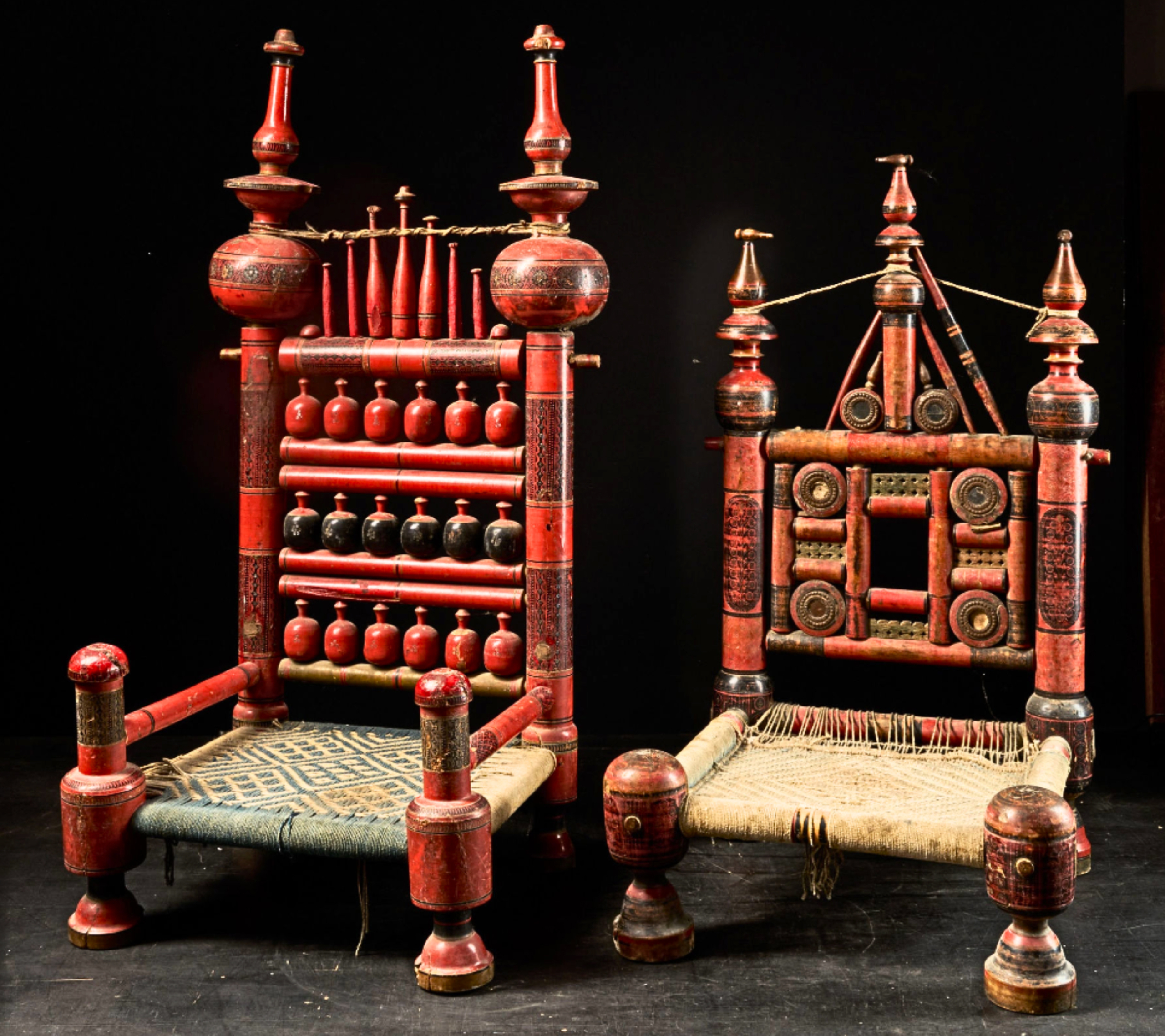
A pair of old Punjabi polychromed hand-crafted pidha (wedding chairs), c. 1874. Dimensions: 105 × 47 × 44 cm and 79 × 50 × 44 cm. Sold by Spectandum Gallery, Belgium.
A Morphological Analysis
Structural organisation. Pidha chairs share a single essential schema: four turned legs supporting a low woven seat (roughly 15–20 cm above the ground), with the two rear legs extended well upward to form the vertical supports of an elaborate backrest. This arrangement — in which the rear posts serve at once as legs and as backrest supports — is a structural hallmark of the type, and it distinguishes the pidha from the European chair tradition, in which the backrest is typically a separate superstructure added to an existing seat.
The finials. The most dramatic visual element of the finest ceremonial pidha is the pair of tall corner posts crowned with large turned finials of vase-and-dome profile, rising well above the head of any seated occupant. These finials — a flattened base disc, a swelling spherical belly, a narrowing neck, and a crowning dome or bud — bear an unmistakable formal kinship with the architectural finials of the subcontinent’s religious buildings: the kalasha (sacred pot) atop Hindu temples, the chattra (umbrella) finial of Buddhist stupas, and the dome profiles of Sikh gurdwaras and Mughal-derived architecture. Whether this parallel was consciously intended as a means of sacralisation, or arose from a shared vernacular vocabulary of form, is difficult to determine; but the effect is unmistakable: the posts make the chair architectonic, a miniature pavilion or mandapa beneath which the bride is sheltered and honoured.
The horizontal rail. A single thin rod or rail joins the two finial posts at their summit, passing between them at the level of the dome caps. Sometimes delicate and slightly irregular, this element adds a further architectural note, echoing the lintel of a gateway (torana) or the cross-bar of a ceremonial arch. It also serves the practical purpose of stabilising the tall posts against lateral movement.
The backrest. The backrest is built from a grid of horizontal turned spindles fitted between the two rear posts, with a prominent circular medallion — carved or turned in relief, bearing concentric rings or a radiating sun motif — set at the centre. Small knob-like projections, probably the tips of additional spindles or pegs, point inward from the posts at regular intervals, adding to the visual rhythm of the composition.
Colour and ornament. The dominant surface colour is a deep vermilion red, consistent with the Hoshiarpur–Jalandhar lac tradition, in which red is the final and dominant layer. The incised ornament — fine geometric banding, interlocking meanders, and floral medallions — covers every available surface, executed in the contrasting white and black of the underlying lac. Accents of yellow-gold appear at the prominent knops of the finials and at other nodal points. The red lacquer bears the traces of age and use, areas of wear revealing the wood beneath — a patina that testifies to a life of real domestic and ceremonial use rather than mere display.
The woven seat. The seat of old pidha is worked in a distinctive chevron or herringbone pattern in natural-coloured fibre (likely jute or sisal rope), the interlocking angular weave forming a dense, durable surface. The rope is lashed around the horizontal frame members and the ends wrapped and tied at the corners, following the charpoy convention. The contrast between the golden-tan of the woven surface and the glowing red of the lacquered frame is among the most compelling qualities of these objects — a chromatic balance of organic warmth and festive brilliance.
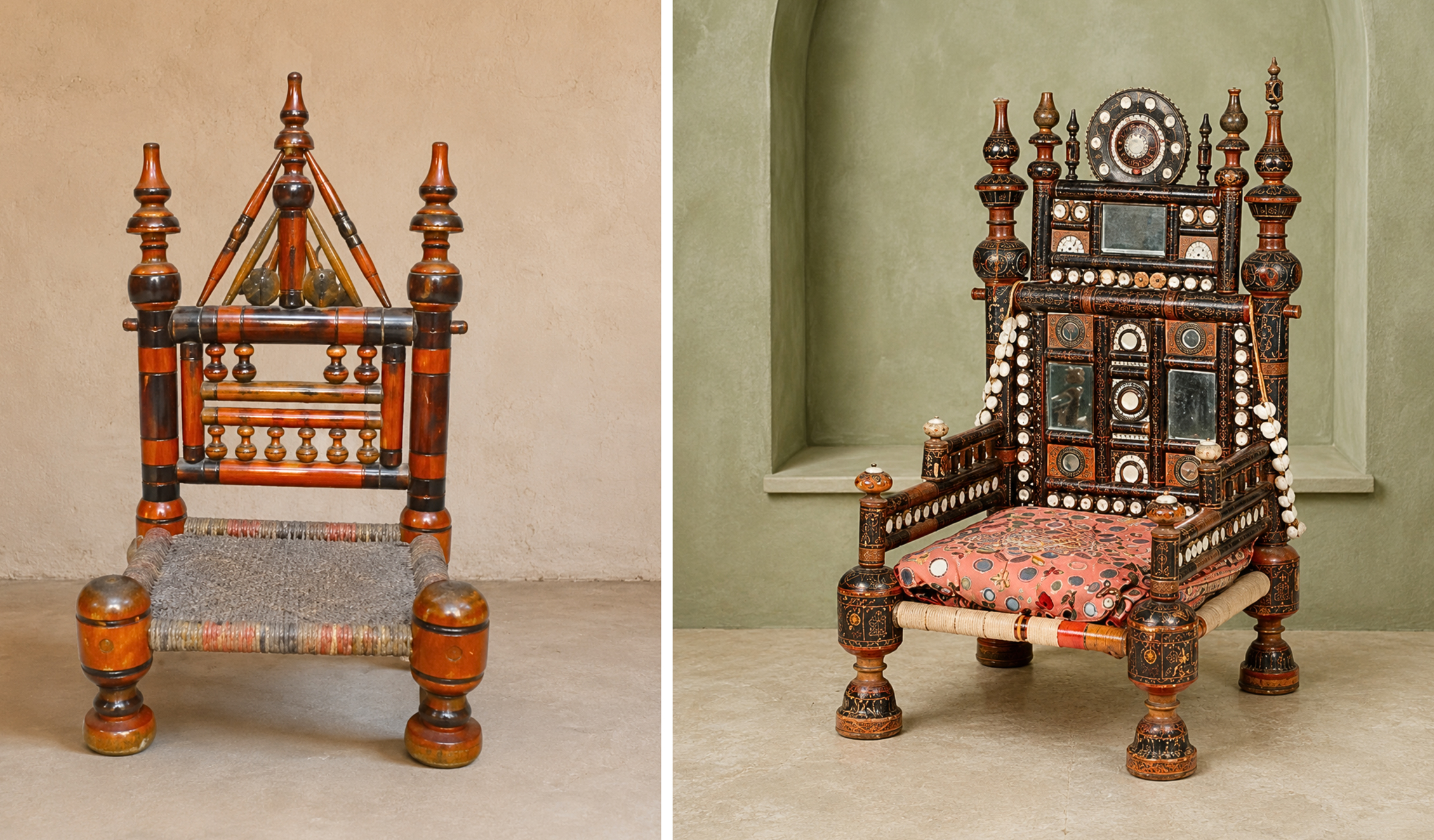
Two old wedding pidha. AI-generated composite based on real specimens.

Alyx Becerra
OUR SERVICES
DO YOU NEED ANY HELP?
Did you inherit from your aunt a tribal mask, a stool, a vase, a rug, an ethnic item you don’t know what it is?
Did you find in a trunk an ethnic mysterious item you don’t even know how to describe?
Would you like to know if it’s worth something or is a worthless souvenir?
Would you like to know what it is exactly and if / how / where you might sell it?